Author Archives: admineb5

Free EB-5 Project Evaluation

Why the EB-5 Program is Right for Canadians

Canada is an underrepresented nation when it comes to EB-5 investors, but Canadian investors may be missing out on a valuable opportunity. The EB-5 Immigrant Investor Program offers numerous benefits to Canadian investors interested in U.S. permanent resident status.

A Rich Business Landscape

The largest economy in the world, the United States offers Canadian entrepreneurs the optimal landscape for starting new businesses or expanding existing ones. Improving opportunities further, EB-5 investors are eligible to apply for U.S. citizenship after five years of permanent resident status, which is particularly enticing for Canadians, since both the United States and Canada allow dual citizenship.

Access to the World’s Top Educational Institutes

When it comes to post-secondary education, the United States dominates, with several U.S. universities among the highest-ranked in the world. Canadian investors (and their children) who immigrate to the United States on the EB-5 visa can more easily enroll in prestigious U.S. universities. Even better, if they invest through a regional center, they are not bound to the state of their EB-5 investment, so they may study at any institute in the United States without fear of forfeiting their EB-5 visa.

Warm Weather

Even in the Vancouver area, where Canadians can escape the snow volumes seen in the rest of the country, winter temperatures are nowhere near balmy. Canadian investors looking to permanently enjoy the beautiful weather of California, Florida, or Hawaii year-round can invest in the EB-5 program for their ticket to a nice, warm climate. The United States boasts extreme geographic diversity, so Canadian EB-5 investors can choose the right climate for them.

The Right to Live in the United States

There are a variety of reasons Canadian nationals may want to relocate to the United States. Many Canadians have U.S. relatives and may want to move closer to their family. Major U.S. cities such as New York City and Los Angeles also boast some of the world’s best lifestyle and entertainment options, which entices countless Canadian nationals.

The EB-5 visa program is a solid choice for Canadian investors, regardless of why they wish to relocate to the United States. The main program requirements are $1.8 million ($900,000 if the project is in a targeted employment area, defined as a high unemployment or rural location) and the creation of 10 new full-time permanent jobs. Successful EB-5 investors receive EB-5 visas for themselves as well as their spouse and unmarried children below the age of 21.

Free EB-5 Project Evaluation

Indian Priority Date to Become Current by Summer 2020

The recent diminished EB-5 demand from India is good news for Indian EB-5 applicants who have already invested in the EB-5 Immigrant Investor Program. New information from United States Citizenship and Immigration Services (USCIS) suggests the Indian EB-5 priority date will become current by summer 2020.

The Current Final Action Date for Indian EB-5 Investors

The recently released Visa Bulletin for April 2020 reveals a jump forward for the Indian EB-5 priority date. Now, any Indian EB-5 investors whose priority dates are earlier than January 1, 2019, are eligible to apply for their U.S. conditional permanent resident status. A recent decrease in demand has freed up more visas for Indian EB-5 applicants.

Indian Final Action Date to be Current by Summer 2020

On March 13, 2020, USCIS held a public engagement and announced the prediction that the Indian final action date would become current by summer 2020. Unless EB-5 demand in India picks back up, USCIS predicts the Indian final action date to then remain current for the foreseeable future. Applicants from countries with “current” final action dates are eligible to apply for a visa immediately upon approval of their I-526 petition.

A New Processing Approach at USCIS

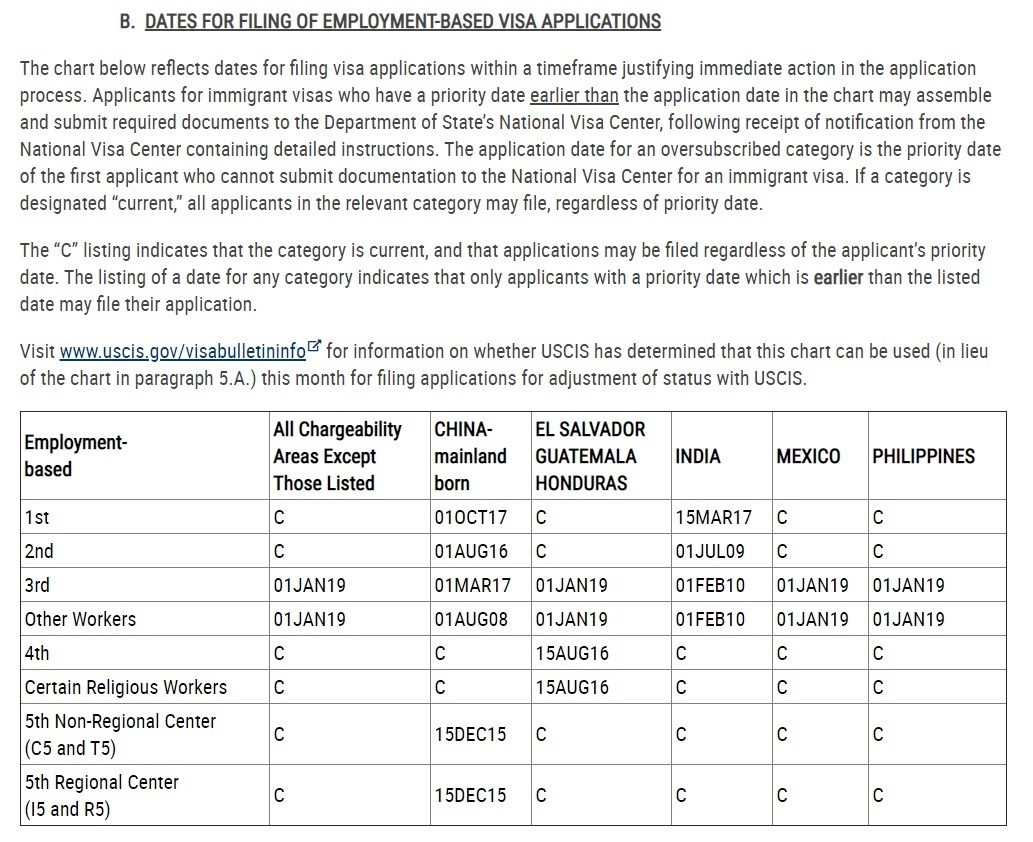
The visa availability processing approach, announced in January 2020 and taking effect March 31, 2020, is a new I-526 processing method meant to replace the traditional first-in-first-out method. Instead of assigning I-526 petitions for adjudication based on their date of receipt, USCIS assigns petitions for adjudication based on whether there are immediately available visas for the respective country. USCIS uses the dates listed in “Dates for Filing” (Chart B of the Visa Bulletin) to determine the availability of visas per country. As of March 2020, Mainland China is the only country whose “date for filing” is not current.

Current I-526 Processing Time Range

Currently, USCIS estimates the processing times for I-526 petitions to be between 33 and 50 months (2.8 to 4.2 years). However, processing data from the first quarter of FY2019 have revealed that many petitions fall outside the estimated processing time range, with many being adjudicated slightly faster than expected. It is also important to note that the current processing estimates are based on data from two months prior and are thus not a 100% accurate snapshot of the current situation.

New Tax on Indian Remittances

Starting April 1, 2020, the Indian government is levying a new tax on remittances out of India. Indian EB-5 investors will be required to pay 5% of their remittance amount in taxes, which amounts to $45,000 for EB-5 investments of $900,000 or $90,000 for investments of $1.8 million (the minimum investment amount depends on the targeted unemployment area designation of the project). The new tax could push EB-5 demand in India down even further.

Free EB-5 Project Evaluation

The EB-5 “At Risk” Requirement

One of the requirements of a successful EB-5 visa investment is that the investment capital be at risk for the duration of the investment.

This does not mean that EB-5 investors are required to invest in “risky” projects. Quite the contrary—EB-5 investors are strongly recommended to conduct thorough due diligence to minimize their exposure to financial and immigration risk. The “at risk” requirement is in place to ensure investors actually invest their capital in new commercial enterprises (NCEs) that can create jobs and boost the economy and not simply “buying” a U.S. green card. The EB-5 investment must incur a risk of loss as well as a chance of gain.

To be eligible for an EB-5 visa, investors must also demonstrate in their I-526 petition that their investment is at risk according to the requirements of the EB-5 program. Investors must make the investment prior to submitting their application, as intent to invest or prospective investment arrangements are not sufficient to prove an at-risk investment.

Matter of Izummi

Matter of Izummi and provisions in the USCIS Policy Manual 6(G)(2)(A) that cite Matter of Izummi lay out many of the details related to the EB-5 “at risk” requirement. Factors to consider include contractual obligations, the ownership and use of assets, and the transfer of investment amounts.

Any guarantees on the part of the project developer are prohibited—for an EB-5 investment to be at risk, there must be a chance of financial loss. The financial resolution of the investment cannot be artificially determined before the investment. Contractual rights to repayment are not allowed, and the investor must acknowledge the potential of significant financial loss. Profit distributions are permitted, but only if they are not guaranteed and not a portion of the investor’s minimum investment amount.

If an EB-5 investor is guaranteed eventual ownership or use of an asset, the expected value of the asset will be subtracted from the minimum qualifying EB-5 investment. Thus, such guarantees are permitted, but only if the investor transfers more capital than necessary and the value of the asset does not cut into the minimum required EB-5 investment amount.

Investors must also transfer the EB-5 investment amount to the NCE in full. Partial investments or installments are not permitted.

Matter of Ho

Matter of Ho lays out an additional rule for the “at risk” requirement.

For an EB-5 investment to be considered at risk, the investor must provide evidence of the project actually undertaking business activity. Without proof of actual business activity on the part of the project, United States Citizenship and Immigration Services (USCIS) cannot know whether the entity is bona fide and whether the investment will be used to stimulate the economy as intended.

The “At Risk” Requirement in Practice

The following are real-life examples of USCIS enforcing the “at risk” requirement.

Funds Not Made Available to the Job-Creating Entity

It’s not enough to prove the transfer of EB-5 capital in full—the invested funds must also be demonstrated to be fully available to the job-creating entity (JCE). One EB-5 investor found her I-526 application denied after transferring her investment capital to an escrow account for the NCE to loan to the JCE. The problem was that the program description memorandum and loan agreement did not mandate the NCE to loan the amount to the JCE. In this particular case, construction on the JCE was also completed while the applicant’s funds were still in escrow, pending her I-526 approval. Based on the JCE’s lack of reasonable need for the investment capital and the lack of obligation for the NCE to loan the amount to the JCE, the investor’s I-526 petition was denied.

Lack of Demonstrable Business Activities

If a project cannot prove the commencement of business activities, its EB-5 capital is not considered at risk. One JCE landed itself a denial for an application for exemplar status because USCIS could not determine that the entity was conducting business activities. When USCIS visited the project site and found no construction activities, they doubted the legitimacy of the project and issued a denial. The applicant then filed a repeal, providing construction contracts, building permits, inspection records, and other evidence of business activities. The new evidence was sufficient, and USCIS then approved the project’s request for exemplar status.

No Chance for Profits

EB-5 investments must, by EB-5 rules, offer the investor a chance at profits. One EB-5 investor’s petition was denied because the contract she signed with the NCE did not grant her rights to the entity’s profits. Interest payments upon maturity of the loan were optional, at the discretion of general partner, and would come from unspecified sources. The contract did not satisfy USCIS’s requirements for an at-risk investment, resulting in the denial of the applicant’s I-526 petition.

As long as an EB-5 investment offers a chance of profit, there are no rules for how good the investment must be. USCIS once tried to deny an I-526 petition because the investment terms would make it extremely difficult for the EB-5 investor to break even on the investment. However, the Administrative Appeals Office (AAO) disagreed, finding that the investment still incurred the chance for profit and the risk of loss, even though it was a poor investment in terms of financial risk.

Conducting Due Diligence for the “At Risk” Requirement

In addition to evaluating a potential EB-5 project’s financial and immigration risk, EB-5 investors should consider provisions or circumstances that could violate the “at risk” requirements of the EB-5 program. Below are some questions to ask to determine whether the “at risk” requirement will be met.

  • Are there any terms in the investment agreement that are similar to an equity interest?
  • Are the chances to both profit from and lose money on the EB-5 investment evident in the business plan and offering?
  • Are there any guarantees from the NCE for a rate of return or the ownership of an asset that could be subtracted from the qualifying EB-5 investment amount?
  • Is the NCE obligated to make the EB-5 capital available in full to the JCE, and are there any fees in place that could impact the amount of funds that the JCE receives?
  • Does the business plan stipulate the time and manner in which the JCE will deploy the invested EB-5 capital in full?
  • Does the business plan indicate ongoing business activities?
These questions are applicable to due diligence for I-526 petitions. EB-5 investors are also required to meet “at risk” requirements for their I-829 petition, but the rules are somewhat different. Investors must demonstrate that their EB-5 investment funds have remained at risk for the entire period of their conditional permanent residence in the United States.

Free EB-5 Project Evaluation

False Rumors About EB-5 Changes Due to COVID-19

COVID-19 has made its way to nearly every country in the world, with confirmed cases building quickly in New York, California, and other states across the United States. Schools are closing and businesses are shutting down—some permanently—resulting in major layoffs. Politico has falsely reported that to stimulate the economy in these chaotic times, President Trump is considering raising the number of available EB-5 visas to 75,000 and reducing the required investment amount to $450,000.

The EB-5 Immigrant Investor Program was born in 1990 as a way to entice foreign nationals to invest in the U.S. economy and job market in exchange for permanent residence—the right to live and work permanently in the United States.

Roughly 10,000 visas are available each fiscal year for EB-5 investors and their spouses and unmarried children below the age of 21. Some EB-5 projects are classified as being located within a targeted unemployment area (TEA), which is defined as an urban area with high unemployment or a rural area. Until 2019, EB-5 investors were required to invest $500,000 in a TEA project or $1 million in a non-TEA project. When the EB-5 Modernization Rule came into effect in November 2019, the amounts were increased to $900,000 and $1.8 million, respectively.

Politico reported that, in a movement headed by Senator Lindsey Graham (R-SC), a new reduction to an unprecedented low may be introduced to combat the economic turmoil caused by COVID-19. Graham has spoken out about the matter, declaring that the report is false and that he is not using the coronavirus recovery bills to promote the EB-5 program.

The EB-5 program has previously helped stimulate the U.S. economy after periods of chaos, such as after the 2008 recession. Project developers turned to the EB-5 program when loans from banks became difficult to obtain, and the program grew to new heights—since 2008, EB-5 investors have contributed an estimated $37.2 billion to fostering the U.S. economy. Between FY2010 and FY2015, the EB-5 program drove down unemployment by creating around 276,000 new full-time jobs and boosted national infrastructure by generating approximately $5 billion in tax revenues.

Most EB-5 investors invest in TEA projects, which are located in areas in greater need of economic stimulation. To be eligible for the EB-5 visa, investors need to prove that their capital has funded the creation of at least 10 new full-time jobs for U.S. citizens and residents, and their capital must remain at risk until they receive their unconditional permanent resident status after at least two years. Though changes to the EB-5 program in light of COVID-19 are not being considered at present, the program remains a powerful way to create new jobs, which may be desperately needed after the resolution of the coronavirus pandemic.

Free EB-5 Project Evaluation

All About the EB-5 Modernization Rule

In 2019, the EB-5 Modernization Rule brought some major changes to the EB-5 visa investment program. The changes have left EB-5 investors, project developers, and regional center managers alike confused and full of questions. Some of these questions were finally cleared up during the United States Citizenship and Immigration Services (USCIS) public engagement held on March 13, 2020. Here are the answers to some of the most common questions about the EB-5 Modernization Rule.

Priority Date Retention

Who is eligible to retain their priority date?

Depending on an EB-5 investor’s circumstances, he or she may be eligible to retain the priority date of a previously approved I-526 petition when filing a new I-526 petition on or after November 21, 2019. This benefit is only valid for EB-5 investors applying from abroad and does not apply if the investor’s previous I-526 petition was revoked for fraud or willful misrepresentation.

How can EB-5 investors request to retain an earlier priority date?

To make sure their new I-526 petition is filed with their existing priority date, when EB-5 investors file their new I-526 petitions, they should include a letter in which they formally request priority date retention. In addition, investors should fill out and include Form I-824 in their applications.

Increased Minimum Investment Amount

What have the minimum EB-5 investment amounts increased to?

Targeted employment areas: $900,000

Non-targeted employment areas: $1.8 million

When did the new minimum investment amounts come into effect?

The new minimum investment amounts apply to any EB-5 investors who filed their I-526 petition on or after November 21, 2019. For EB-5 investors who filed before November 21, even if their petition was pending on November 21, and even if they have not yet transferred the full investment amount, the old minimum investment amounts remain valid.

If an EB-5 investor files a new I-526 petition but retains his or her previous priority date, which minimum investment amount is he or she subject to?

The new rules apply to any EB-5 investor filing on or after November 21, 2019, without exception. Investors filing new I-526 petitions must adhere to the new rules and requirements, including the new minimum investment amounts, regardless of whether they retain their priority date.

Targeted Employment Area (TEA)

Do the TEA changes affect EB-5 investors who filed before November 21, 2019?

No.

How can EB-5 investors determine whether an EB-5 project is in a high-unemployment TEA?

The American Community Survey (ACS) and the Department of Labor–Bureau of Labor Statistics (BLS) are accepted by USCIS as credible data sources. EB-5 investors must simply be consistent with whichever source they use.

How can EB-5 investors prove under the new rules that their EB-5 project is located in a TEA?

According to USCIS, EB-5 investors can submit the following evidence to prove the TEA designation of their chosen EB-5 project:

  • The location where the new commercial entity (NCE) conducts the majority of its business activities
  • A map that shows the census tract(s) in which the NCE conducts the majority of its business as well as directly adjacent tracts, if applicable
  • The calculation used to determine the weighted average employment rate for the given location
  • Credible unemployment statistics data for the given area
  • Evidence backing up the credibility of other data provided

Can TEA designation from approved I-526 petitions filed before November 21, 2019, be carried over to new petitions from the same investor filed on or after November 21?

No. Any I-526 petitions filed on or after November 21, 2019, are subject to the new TEA rules, without exception.

Removal of Conditions on Permanent Resident Status

Are spouses and children required to submit their own separate I-829 petitions?

Yes, every person associated with an EB-5 investment must file a separate I-829 petition. The only exception is if the EB-5 investor has passed away, in which case the spouse and children submit a single petition together. EB-5 investor children who married or turned 21 during their two years of conditional permanent residency, as well as EB-5 investor spouses who got a divorce during this period, are still eligible for a U.S. green card on the investor’s principal I-829 petition.
Free EB-5 Project Evaluation

What Counts as “Lawful Funds” for the EB-5 Program?

One of the requirements of the EB-5 program is that an investor’s capital has been obtained through “legal sources.” What exactly does United States Citizenship and Immigration Services (USCIS) mean by “legal sources”? It’s important to know because EB-5 investors must document the lawful source of their funds on their I-526 petition.

What Documents Should EB-5 Investors Submit to Prove Source of Funds?

According to the USCIS website, a variety of documents are suitable as evidence of the lawful source of EB-5 funds. I-526 petitioners must submit the following documentation, where applicable:

  • Tax returns filed within the last five years for a corporation, partnership, or other entity
  • Personal tax returns filed within the last five years for income, a property, a franchise, or anything else
  • Registration records for a foreign business
  • Other documentation indicating the source of funds, such as documentation certifying the sale of an asset, inheritance papers, or documentation certifying the donation or gifting of the capital to the investor.
  • Certified copies of judgments of evidence of pending actions involving monetary judgments against the petitioner within the past 15 years, whether in the United States or abroad

In addition to proving the lawful source of funds, EB-5 investors are required to show the path of their capital to the new commercial enterprise (NCE). Examples of suitable documentation include wire transfer records and bank statements.

Documenting the lawful source of their EB-5 capital can be a time-consuming process for investors, depending on the sources of capital they choose. They may need to gather large amounts of documentation spanning several years.

Every EB-5 investor’s situation is different, and USCIS may require investors to submit more evidence than listed above, depending on their circumstances. Investors must discuss the matter with immigration counsel to ensure they don’t miss any essential documentation.

Examples of Suitable Source of Funds Documentation

Common examples of documents EB-5 investors may submit to prove the source of their EB-5 investments include the following:

  • To prove salary earnings, income tax returns, W-2s, contracts of employment, bank statements, and more
  • To prove the sale of a business, a business registration certificate; documentation of the sale of the business; documentation proving their ownership, directorship, or officership of the entity; an appraisal of the business from a certified accountant, and more
  • To prove investment earnings, documentation of investment accounts over the past three or more years, stock certificates, bank statements, and more
  • To prove the sale of property, the purchase and sale agreements, a certificate of ownership, a deed tax certificate, bank statements, a loan contract, and more
  • To prove a loan, bank statements, documentation showing the loan, asset appraisals, documentation showing the sources of the lender’s capital, and more

While these are the most common sources of EB-5 capital, EB-5 funds may also be sourced from inheritance, gifts, divorce income, lawsuit judgments, and more. If an investor receives EB-5 funds as a gift from parents, relatives, or friends, the donor must prove the lawful source of their funds for the gift.

Tips for Documenting the Source of Funds

Although collecting the required source of funds documentation can be time-consuming and cumbersome, EB-5 investors can take several steps to facilitate the process:

  • Consult an immigration attorney to determine which sources of funds are most appropriate to use and figure out what documentation to gather.
  • Store potential investment funds in a separate account to make tracking easier.
  • Start well in advance so they have time to have all their documents translated, if necessary.
Free EB-5 Project Evaluation

COVID-19’s Impact on Industries That Use EB-5 Investment

As the world continues its fight against the novel coronavirus, infections are rising, unemployment is increasing, and more and more industries and businesses are suffering. Other than those that operate solely online, most industries are not immune, and those that most heavily rely on the EB-5 Immigrant Investor Program are among the hardest hit. Here are several resources you can use to keep yourself up to date on the impact of the pandemic on key EB-5 industries.

COVID-19’s Impact on the Commercial and Multifamily Real Estate Industries

Yardi Matrix conducted webinars on COVID-19’s impact on multifamily real estate and commercial real estate on April 1 and April 2, respectively. The webinars provide focused, practical information, and the recordings are available for download to paid members.

CBRE has also held flash calls to discuss the virus’s impact on the real estate industry, with recordings and notes available for free download on its website. On March 18, the entity held a flash call on COVID-19’s impact on commercial real estate, and on March 27, it held two flash calls: one on the impacts on multifamily real estate and one on what occupiers should be focused on during the crisis. Listening to both the Yardi Matrix and CBRE webinars can offer EB-5 investors opinions from a multitude of industry experts.

COVID-19’s Impact on the Hotel Industry

STR is publishing webinars about COVID-19’s impact on the hotel industry. The webinars cover hotel industries worldwide, with weekly updates examining the impact on the United States and Canada published every Thursday. The site thus allows EB-5 investors to keep abreast of the changes in both the United States and their home region.

Marcus & Millichap has released a report titled Coronavirus Hospitality Special Report: 2020 Outlook. The report looks at how COVID-19 is impacting the hospitality sector and the relief bills being passed to save struggling hotels.

On March 20, 2020, HVS posted an article called The Importance of Financial Relief for the Hotel Industry. The article examines the sources of revenues for different types of hotels and makes clear the dire situation the hospitality sector finds itself in.

Specific Resources for Your EB-5 Project

If you’re a project developer or EB-5 investor concerned about the pandemic’s impact on a particular EB-5 project, it’s recommended to consult not only industry analyses but also analyses from the state, county, and municipality of the project. State-level responses have differed across the country, and some states, such as Utah, have offered their own financial relief where the federal aid does not suffice. Besides, the health of an industry and the predicted success of a project depends partially on its region, so it’s always a good idea to have a solid grasp on both the industry and local-area outlook when conducting due diligence and getting involved with an EB-5 project.

Free EB-5 Project Evaluation

Why Were EB-5 Processing Volumes Down in FY2019?

The EB-5 processing statistics of the past several years make one observation painfully clear: I-526 petition processing volumes were remarkably low in FY2019. The Immigrant Investor Program Office (IPO) is a complicated entity, and there is a lot going on behind the scenes that may not be clear on the surface. FY2019’s low processing rates were not without reason.

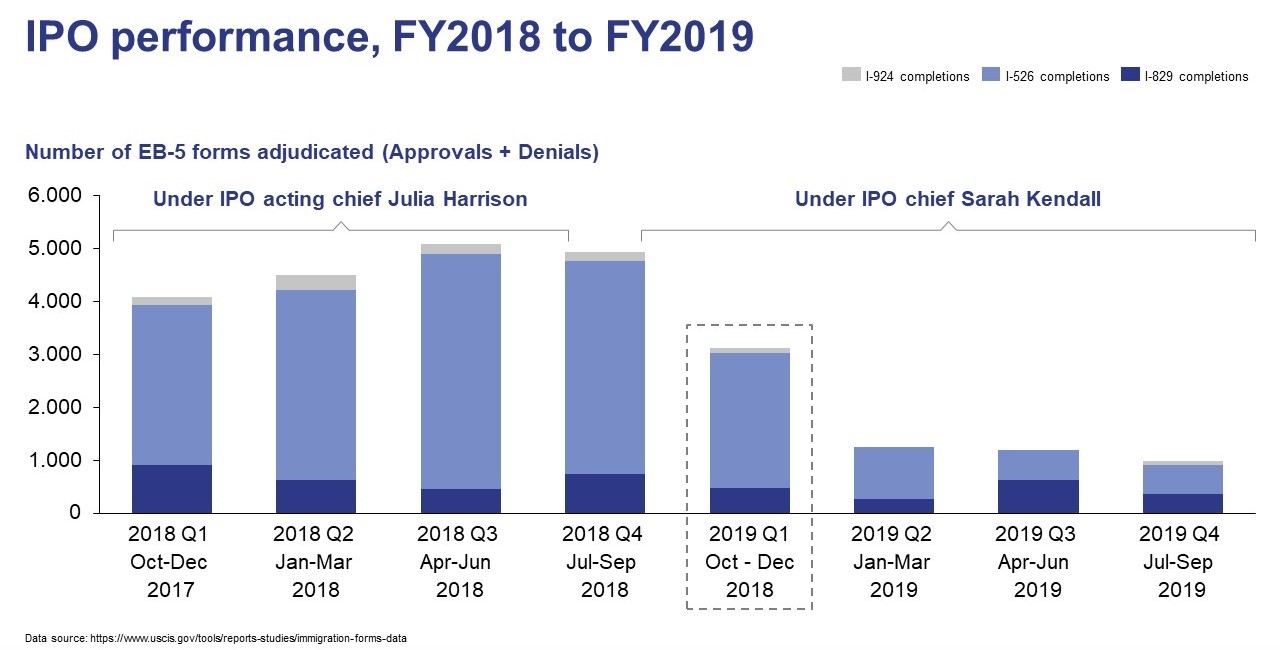
Contrary to FY2019, FY2018 recorded abnormally high I-526 petition processing volumes. The sharp drop may seem sudden and unexpected, but one important factor differentiates the two fiscal years: the IPO chief. In FY2018, Julia Harrison was the acting chief, and in FY2019, Sarah Kendall took over.

FY2018’s High Processing Volume

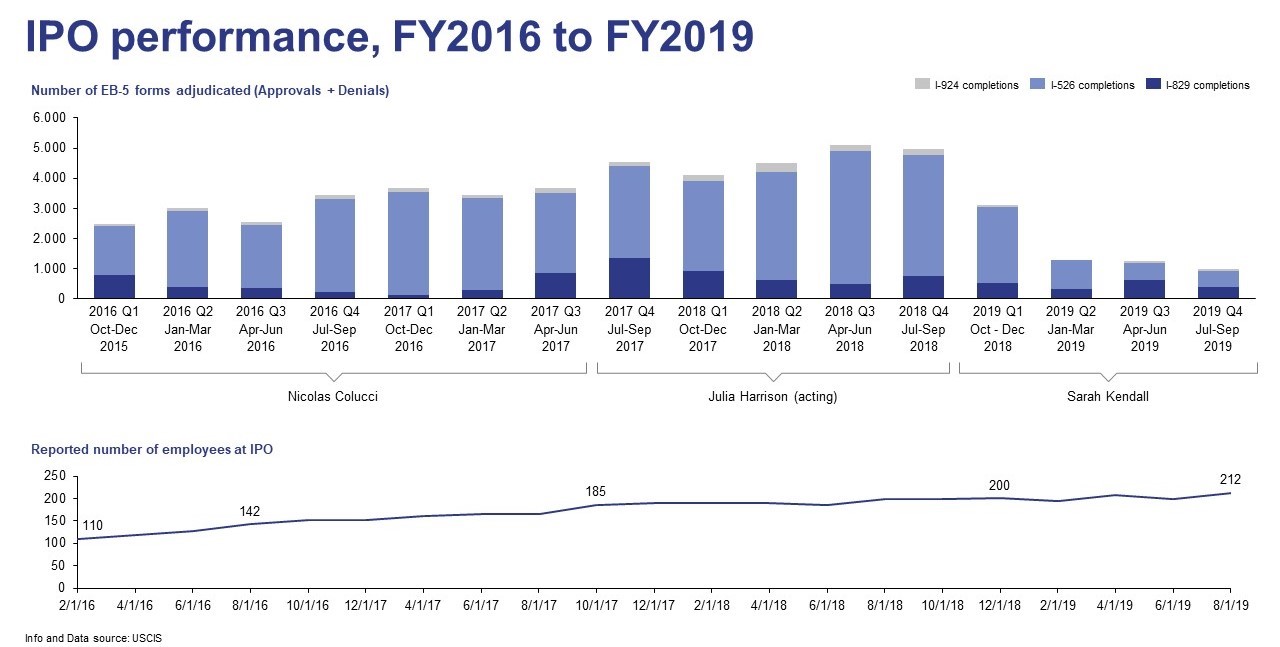
The high volume of I-526 petitions processed under Harrison’s oversight in FY2018 is attributable to numerous factors. At the end of 2017, the IPO recruited cross-trained economists and adjudicators to form multidisciplinary teams to process I-526 petitions. Harrison focused on standardizing operations at the IPO to better manage the assignment of EB-5 applications, streamlining and expediting the adjudication process. A steady increase of employees at the IPO was a further factor that likely contributed to the growth in productivity in FY2018.

FY2019’s Low Processing Volume

Conversely, in FY2019, it’s clear that Kendall has taken a different approach to managing the IPO than her predecessor. Under Kendall’s leadership, the IPO has made structural adjustments to devote more attention to integrity, quality assurance, and control. The IPO stepped up its rigor and fraud investigation, working with law enforcement and the U.S. Securities and Exchange Commission (SEC) in some cases, which cost significant amounts of time. Additionally, in FY2019, the IPO worked extensively with USCIS and Department of State officials abroad to conduct overseas checks, including issues related to EB-5 investors’ source of funds.

In addition to matters related to security, the IPO also shifted its focus from I-526 petitions to other priorities. According to Kendall, training conducted in May 2019 resulted in reduced time for adjudication, and throughout the year, some staff were temporarily assigned to other priorities, leaving fewer agents available to make adjudications. The sunset of the regional center program was an additional contributing factor, even though the program was extended. Finally, Kendall allocated additional resources to I-829 processing in FY2019, inevitably taking resources away from I-526 processing. All in all, IPO staff were estimated to have spent an additional 8.65 hours on each I-526 petition compared to FY2016, an increase of 33%.

What Will Happen in FY2020?

No one can say how EB-5 processing volumes will fare in FY2020. Though the fiscal year is already half over, calendar year 2020 has presented both foreseen and unforeseen challenges that are likely to affect processing volumes at the IPO. The Trump administration’s hiring freeze for non-asylum officers at USCIS is one factor that could affect processing volumes and that the IPO has little control over. USCIS’s switch from a first-in-first-out processing method to a visa availability approach is also likely to impact processing times for EB-5 investors, depending on their country of origin. Chinese EB-5 investors may be subjected to longer waiting times, while investors from underrepresented countries may enjoy expedited processing times. The new processing approach took effect March 31, 2020.

The impact of the rampant and unpredictable spread of COVID-19 on USCIS’s processing of EB-5 petitions is also unknown. With the closure of the U.S. consulate in China, leftover visas are currently poised to be issued to Vietnamese EB-5 investors, and the situation could result in EB-5 visa retrogression for Chinese nationals. The closure of further consulates is unpredictable and not out of the question. Lockdowns in countries around the world could also impact EB-5 investors’ ability to assess potential EB-5 projects, gather necessary documentation, and consult with immigration attorneys, which could potentially result in diminished EB-5 demand for the duration of the pandemic.

Free EB-5 Project Evaluation

The EB-5 Visa Bulletin for April 2020

The Department of State — Bureau of Consular Affairs has released the EB-5 Visa Bulletin for April 2020. April’s release has been highly anticipated, as April is the first month in which United States Citizenship and Immigration Services (USCIS) will implement its new visa availability processing approach for I-526 petitions.

The release of the Visa Bulletin comes on the heels of the March 13 stakeholder engagement, during which USCIS divulged important information about the new changes and how they will affect the EB-5 program and its investors.

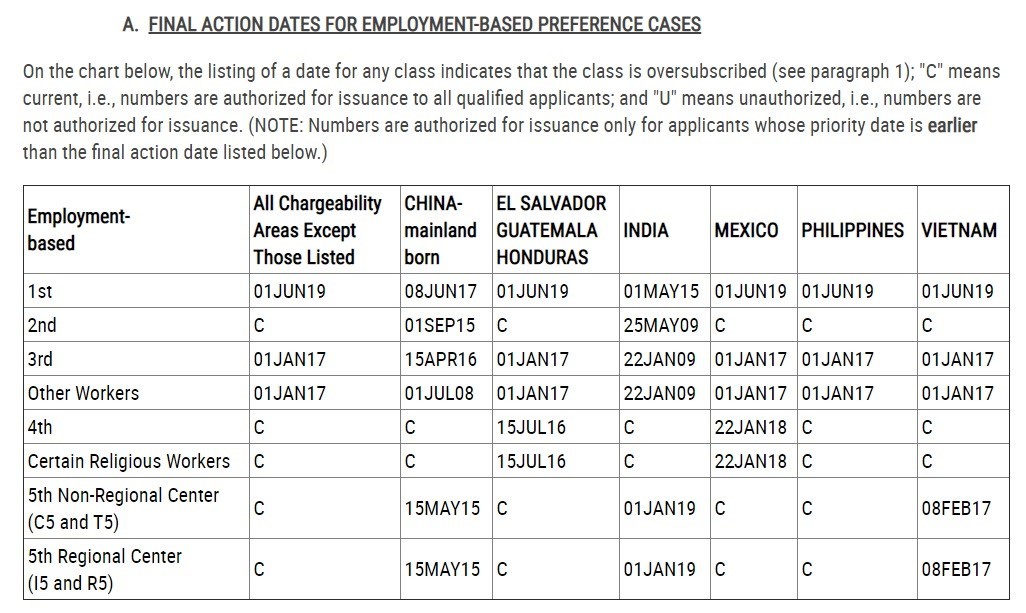
Most notable is the fast advancement of the final action date for Indian EB-5 investors. The new final action date for Indian EB-5 investors is January 1, 2019, an advancement of more than two months. This is a continuation of the rapidly advancing final action date for Indian EB-5 investors, with demand decreasing so much that the Indian backlog is expected to disappear by summer 2020.

Vietnam is also progressing forward, though at a slower pace than India. The new final action date for Vietnamese EB-5 investors is February 8, 2017, up three weeks from the March bulletin. Since the Chinese consulate is currently closed, unused visas are expected to be allocated to Vietnamese investors.

The new final action date for China has remained the same as in the March Visa Bulletin: May 15, 2015. Two major factors have contributed to these circumstances. First, the visa availability processing approach for I-526 petitions, which goes into effect March 31, 2020, will primarily impact EB-5 investors from Mainland China. Second, the U.S. consulate in China is currently shut down due to COVID-19 concerns, meaning Chinese EB-5 investors residing in China currently cannot apply for their green cards.

Final Action Dates For Employment-Based Preference Cases Chart. Notable is the fast movement of date for Indian investors.

All EB-5 investors from countries other than Mainland China, India, and Vietnam have current final action dates, which means they may apply for their EB-5 visas as soon as their I-526 petition is approved.

Only Mainland Chinese investors have filing dates that are not current. Like the final action date, the filing date for Chinese EB-5 investors has not changed since the March 2020 Visa Bulletin.

Dates For Filing of Employment-Based Visa Applications Chart broken down by employment-based class and country.
Free EB-5 Project Evaluation

I-526 and I-829 Processing Data by Country in FY2019 Q1

Likely due to the Freedom of Information Act, United States Citizenship and Immigration Services (USCIS) has released quarterly processing information for I-526 and I-829 petitions in FY2019 Q1. The data contained in the I-526 and I-829 processing data for FY2019 Q1 provide answers to certain EB-5 questions for which there is generally no concrete information, including whether approval rates vary by country, whether petition processing times vary by country, and which countries are filing the most I-526 petitions.

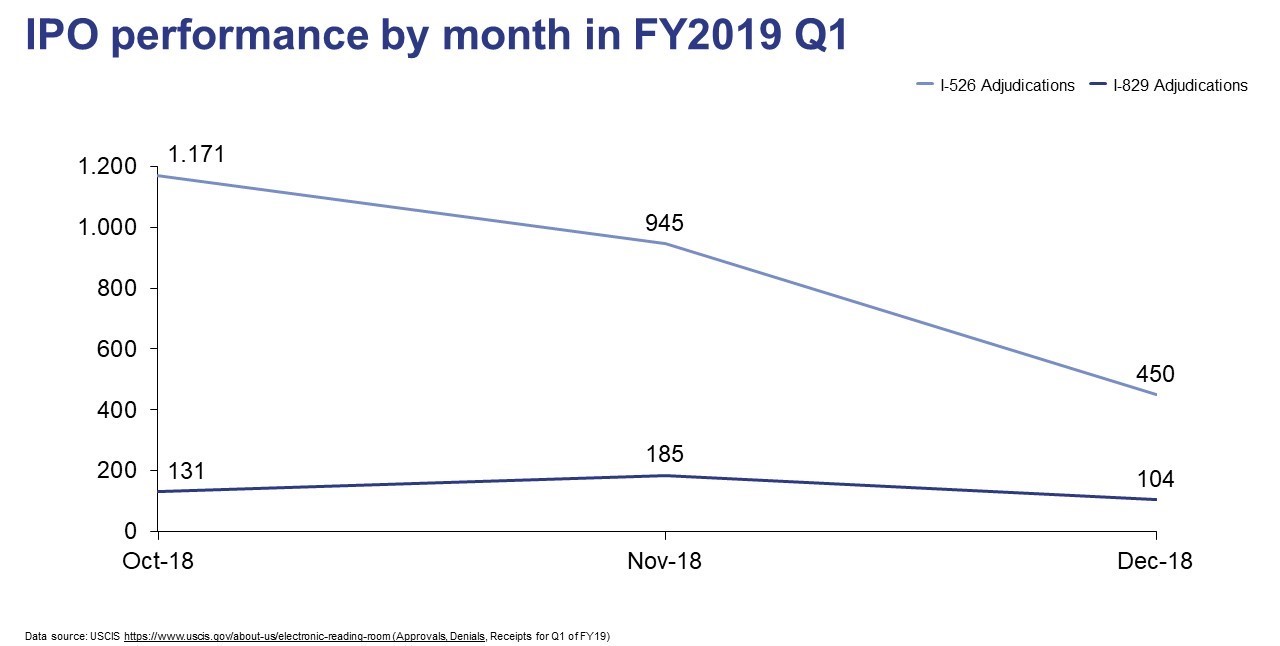
USCIS underwent an important change in FY2019 Q1: the introduction of a new IPO chief, Sarah Kendall. Kendall took over for Julia Harrison, after which processing volumes fell dramatically. Kendall’s leadership has led to a stricter EB-5 process, with denial volumes remaining steady but approval volumes sinking.

Graph showing number of EB-5 forms adjudicated from Fiscal Year 2018 to Fiscal Year 2019 under two different IPO chiefs.
Graphs showing number of EB-5 forms adjudicated as well as reported number of employees at IPO from FY2016 to FY2019.

FY2019 Q1 finds itself right in between FY2018’s high processing volumes and the remainder of FY2019’s low processing volumes, so it may not entirely represent the EB-5 circumstances before and after. Nonetheless, the data provide interesting insights.

Processing Times

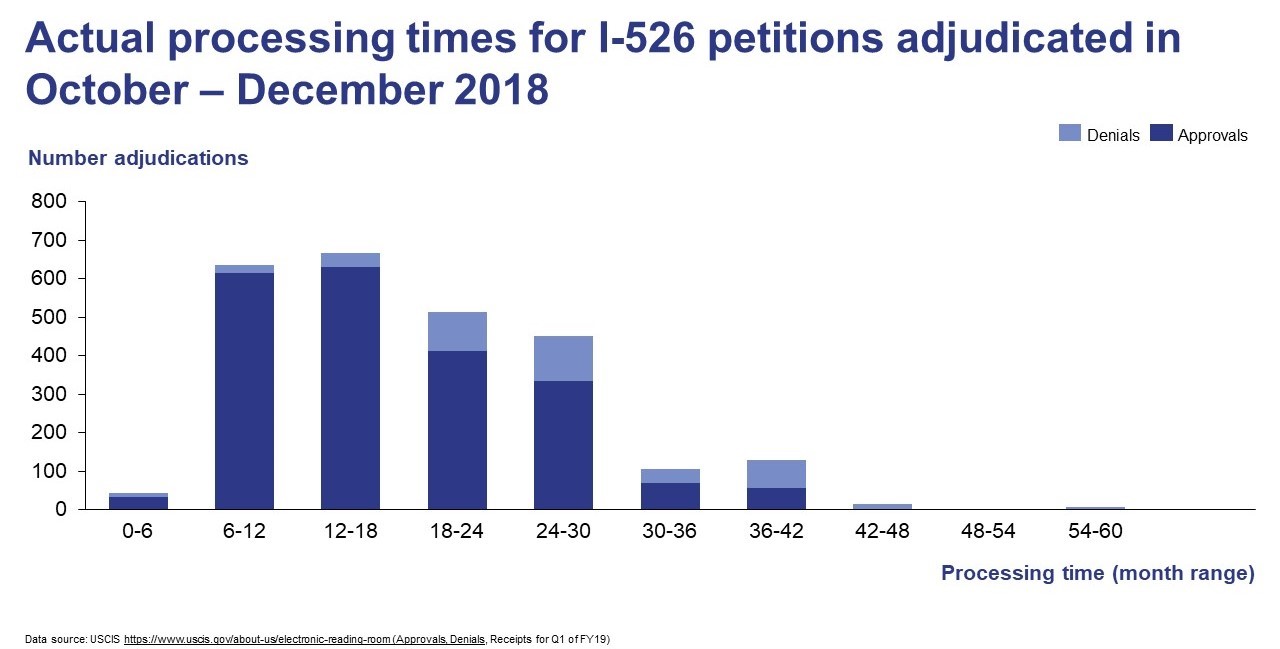
Graph showing actual processing times in months for I-526 petitions adjudicated in October through December 2018.
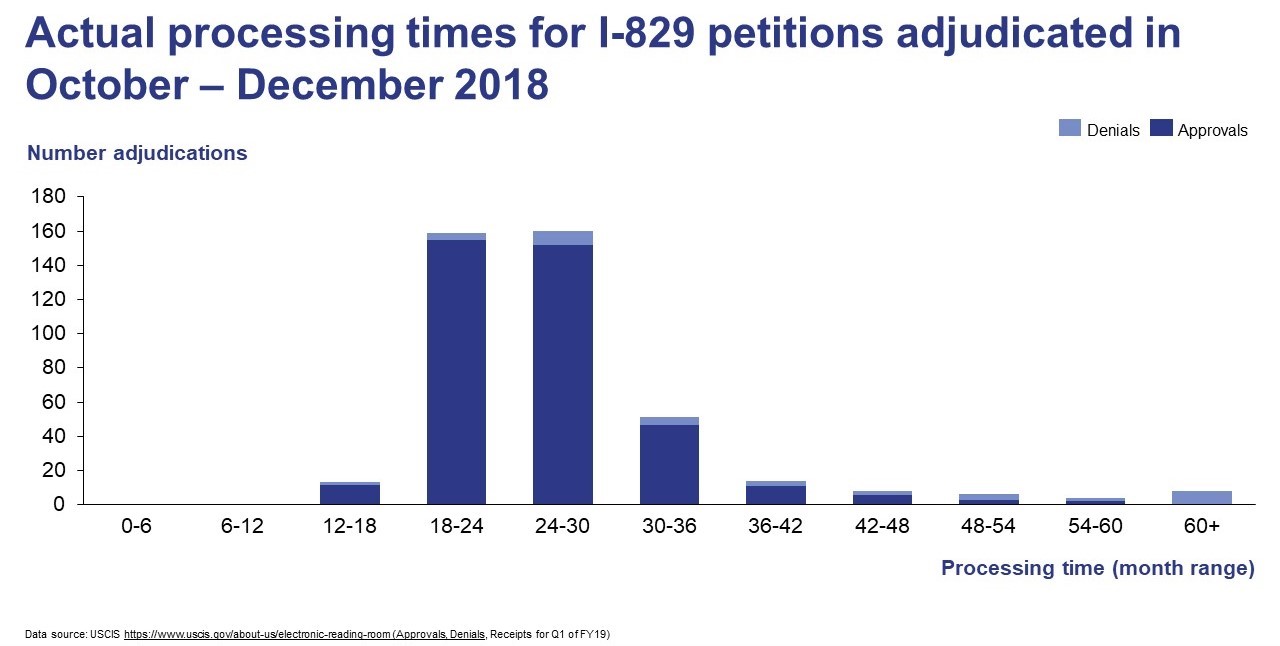
Graph of processing times for I-829 petitions adjudicated in October to December 2018 with most taking 18 to 30 months.
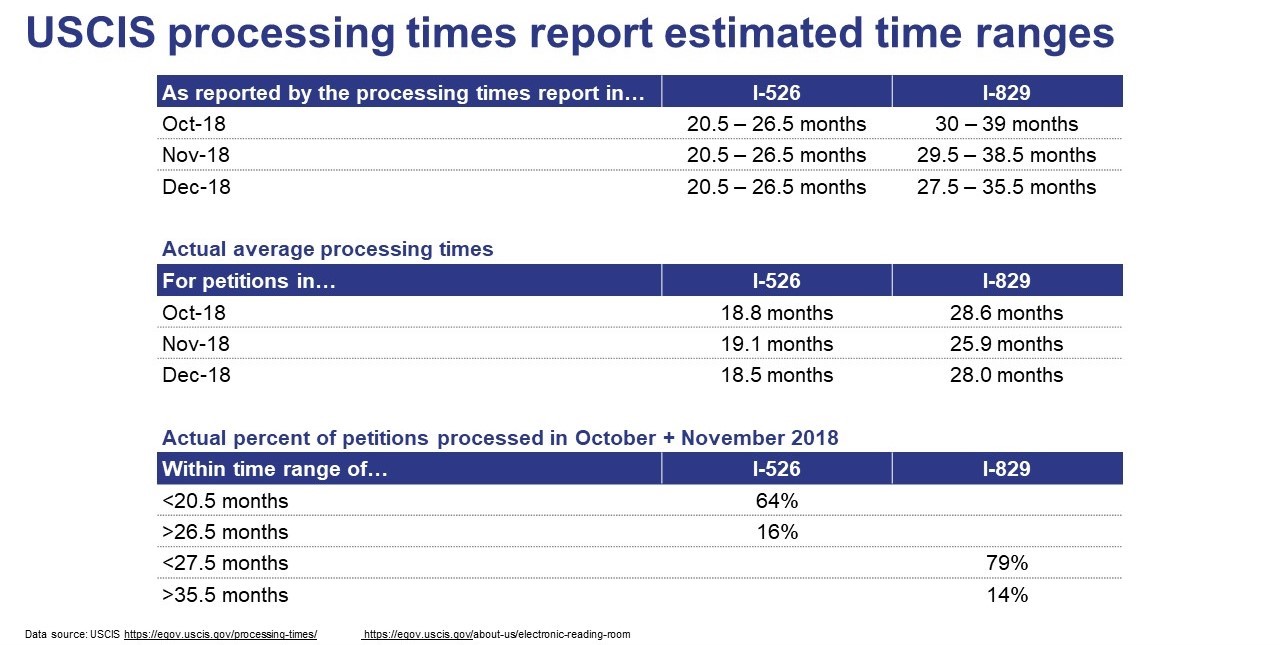
Table with the USCIS estimated processing time ranges for I-526 and I-829 petitions from October through December 2018.
Line graph showing the number of I-526 and I-829 Petitions adjudicated by month from October 2018 to December 2018.

Throughout the quarter, USCIS estimated that I-526 petitions would take 20–26 months to process and I-829 petitions 27–39 months. According to USCIS, the first number in the range is the median time it takes to adjudicate the respective petitions, while the second number is the period in which 93% of petitions have been adjudicated.

The range given did not entirely reflect the actual processing times during FY2019 Q1. In terms of I-526 petitions, 64% were adjudicated before the lower number in the range, while 16% took longer than the higher number. In total, that means 80% of I-526 adjudications fell outside of the estimated processing range.

The estimated processing period was even less accurate for I-829 petitions. A whopping 79% were adjudicated in only 27.5 months or less, and 14% extended beyond the outer range of the estimated period. That means that at most 7% of I-829 petitions were adjudicated within the estimated processing period, as opposed to the 43% that would be expected.

In general, petitions were processed a bit faster than estimated. Approvals were processed faster than denials, with the average I-526 approval taking 17.5 months and the average I-829 approval taking 26 months.

Country Differences

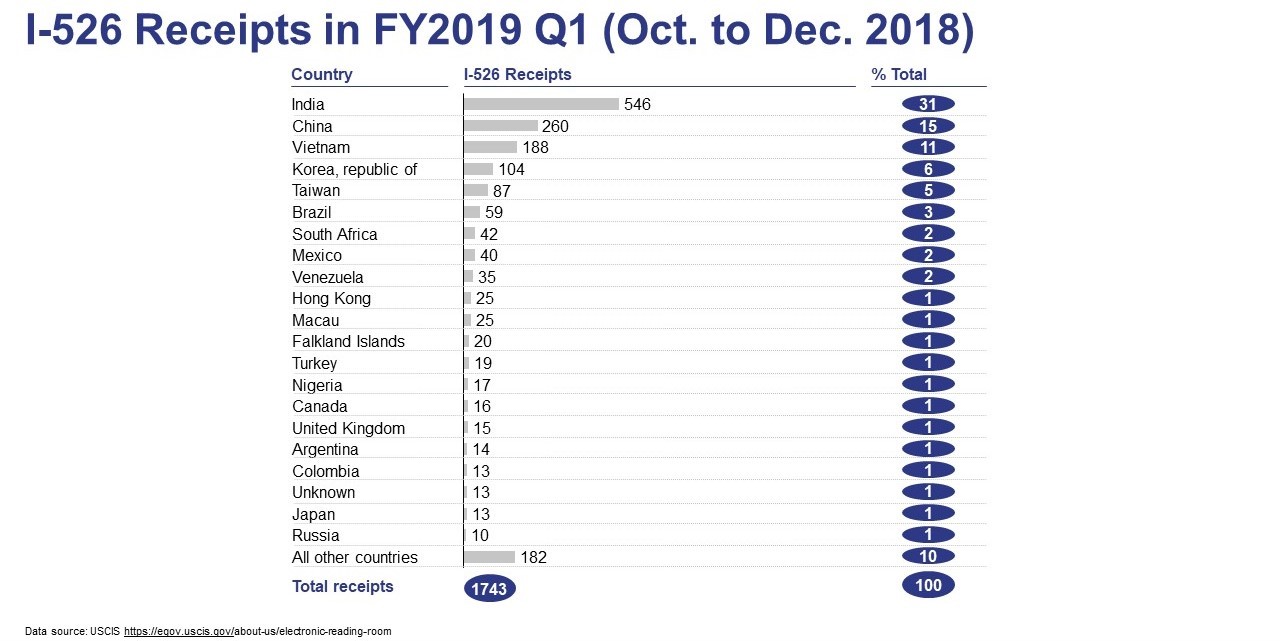
Table showing number of I-526 Petitions received in FY2019 Q1 with India at the top with 546 and China second with 260.

The data on I-526 adjudications for FY2019 Q1 reveal some differences in processing time by country, but it does not suggest that USCIS was already using a visa availability approach during this quarter. I-526 petitions from Chinese EB-5 investors took, on average, two months longer to be adjudicated than petitions from investors of other nationalities.

On the opposite end of the scale, Indian EB-5 investors had their I-526 petitions processed particularly quickly, with an average processing time five months shorter than the global average. This was to be expected, however, as Indian EB-5 investors have filed a large number of expedite requests. Indians accounted for 83% of the I-526 petitions adjudicated within six months during FY2019 Q1.

Of the I-526 petitions filed in FY2019 Q1, the largest country demographic group was Indians, at 31%. Long-time champion China followed at 15%, with Vietnam in third place at 11% and South Korea in fourth with 6%. In FY2019 Q1, Indian EB-5 investors filed enough I-526 petitions to account for more than a year and a half’s worth of Indian EB-5 visas.

In terms of I-829 petitions filed, Chinese EB-5 investors dominated, accounting for 81% of all receipts and adjudications. Since I-829 figures generally reflect the I-526 numbers of previous years, these data are unsurprising.

Additional Facts about I-526 and I-829 Processing

  • I-526 denials are categorized into two types: “fraud” and “others.” In FY2019 Q1, only a single I-526 petition was denied based on fraud.
  • The “country” column for I-526 petitions begs numerous questions. An astounding 20 I-526 petitions are recorded as having come from the Falkland Islands, which the Department of State recognizes as belonging to the United Kingdom. Furthermore, with a population of just around 2,000, it is extremely unlikely that 20 Falkland Islanders have filed I-526 petitions at any time during the EB-5 program’s history, let alone in a single quarter. An additional 13 petitions are classified as having come from an “unknown” country, 8 from the USSR, and, bafflingly, one from the United States.
  • There is a discrepancy between the 1,808 I-526 petitions processed in the official quarterly report and the 1,743 processed in this detailed quarterly report.
  • The data make clear that USCIS has not been operating under a strict first-in-first-out (FIFO) basis. Under a true FIFO system, the estimated processing range would not be so wide, and the data indeed reveal that Chinese investors are subjected to slightly longer waits than EB-5 investors from other countries. It is also clear that denial decisions take longer to make than approval decisions.