Author Archives: admineb5

Free EB-5 Project Evaluation

How Much Does an EB-5 Investor Need to Invest?

How Much Does an EB-5 Investor Need to Invest

Since its enactment in 1990, the EB-5 Immigrant Investor Program has been a popular way for foreign nationals to obtain U.S. green cards for themselves and their immediate family members. At a glance, the program is quite straightforward—a foreign national invests in a qualifying EB-5 project, and if their investment fuels the creation of at least 10 full-time jobs for U.S. workers, they obtain permanent resident status in the United States.

Investors must pour a certain amount of capital into their chosen EB-5 project to qualify for an EB-5 visa. The minimum required amount varies depending on whether the EB-5 project is in a targeted employment area (TEA), which can be defined as either a high-unemployment area, with an unemployment rate 50% higher than the national average, or a rural area, with a population of fewer than 20,000. For projects located outside of TEAs, EB-5 investors must invest at least $1.8 million, but for projects inside TEAs, the minimum required investment amount is $900,000.

After carefully conducting due diligence and selecting the most suitable EB-5 project, an investor initiates the process by filing Form I-526. In this petition, the investor must provide personal information and documentation proving the lawful sources of their investment capital, as well as documents proving the legitimacy and business potential of the new commercial enterprise (NCE) they are investing in.

While EB-5 investors must document the source of their investment funds, any legal source is permitted as long as it can be sufficiently traced. Investors often combine funds from numerous sources to meet the minimum investment amount requirement. Common sources include the following:

  • wage earnings
  • investments
  • business income
  • sale of assets
  • retirement funds
  • loans

The investment funds can even be a gift—it’s common for parents to donate EB-5 investment capital to allow their children to pursue permanent residency in the United States. In such a case, the recipient should provide a document certifying the transfer of the gift money, including a statement from the donor freeing the recipient from obligations to pay the money back, and the onus of tracing the lawful sources of the funds is then placed on the donor.

EB-5 investors are advised to work with an experienced EB-5 immigration attorney to determine the best sources of funds to document in their I-526 petition. Since documenting the lawful sources of EB-5 capital can be tiresome and time-consuming, knowing the easiest sources to trace can significantly expedite an EB-5 investor’s I-526 journey. Simpler source-of-funds documentation also facilitate the petition adjudicator’s job, potentially resulting in shorter wait times.

Free EB-5 Project Evaluation

U.S. Consulates and Embassies Beginning Phased Reopening

Reopening

Good news for the many EB-5 investors abroad who have been waiting eagerly to resume their journey to an EB-5 green card: the U.S. Department of State – Bureau of Consular Affairs has announced the phased resumption of routine visa services at U.S. consulates and embassies. Consulates have been closed since March 2020 following the outbreak of the COVID-19 pandemic, which has wreaked havoc on public life in most countries, including the United States.

The effects on the EB-5 Immigrant Investor Program have also been profound, with United States Citizenship and Immigration (USCIS) offices in the United States being closed to the public for several months and EB-5 investors abroad stalled in their EB-5 process due to the closure of embassies. While investors already residing in the United States under different visas have still been able to file I-485 petitions and receive EB-5 visas, investors living abroad have been unable to attend visa interviews and thereby unable to move forward.

While the announcement is good news for some, it doesn’t help all EB-5 investors. According to the Department of State, each embassy or consulate will determine its own opening based on the local situation. Investors are encouraged to check the website of the individual embassy or consulate for details. The Department of State will also post on its official website updates of when various consulates resume specific visa services.

Advancing in the EB-5 Program as Consulates Reopen

As a result of the presidential proclamation signed into law on June 22, 2020, that suspends many forms of employment-based immigration until the end of 2020, U.S. consulates and embassies should have lighter workloads than normal. Since EB-5 investors are exempt from the immigration ban, this may significantly speed up their wait times for visa appointments and interviews.

The EB-5 program can also be beneficial to the United States as it navigates the aftermath of this unforeseen crisis. As U.S. businesses begin to reopen, a damaged economy stares back at them, and millions of freshly unemployed Americans no longer have the necessary disposable income to buy nonessential goods. EB-5 investors and the millions in foreign capital they bring to the United States can help revitalize the U.S. economy and help it flourish once again.

It’s also an opportune time for new investors to consider the lucrative opportunities the EB-5 program offers. Due to the hardships the program has faced throughout 2020, fewer I-526 petitions have been filed, resulting in shorter wait times for the investors who do decide to pursue the program. Furthermore, since the COVID-19 pandemic has particularly ravaged major cities such as New York City and Los Angeles, more areas in these cities may now qualify as targeted employment areas (TEAs).

If you’re an Indian national, it’s an especially good time to invest in the EB-5 program. In July 2020, the Indian EB-5 final action date finally became current, and it’s projected to maintain this status for the foreseeable future. That means EB-5 visas are expected to be readily available for Indian investors, and they may begin their lives in the United States sooner than their counterparts in backlogged countries.

Free EB-5 Project Evaluation

The Implications of the EB-5 Capital Redeployment Policy Update Announced by USCIS

On July 24, 2020, United States Citizenship and Immigration Services (USCIS) published a Policy Alert announcing long-awaited clarification of the guidelines surrounding the redeployment of capital under the EB-5 program. The new guidance, which comes into effect immediately, focuses on Volume 6, Part G, Chapter 2 of the USCIS Policy Manual (A(2)). The update substantially influences the redeployment of EB-5 capital, not only for EB-5 investors but also for regional centers and developers working with project sponsors.

Why Do EB-5 Investors Need to Redeploy Capital?

To qualify for a permanent green card, an investor must show that their EB-5 investment remained at risk throughout the conditional residence period. Conditional permanent residence usually last two years, and in the last 90 days, investors must file their I-829 petitions to apply for removal of conditions and prove that they have met the requirements of the EB-5 program. An EB-5 investor’s funds cannot be released until the end of the investor’s two-year conditional permanent residence period, which begins only when the conditional green card is issued and not upon the approval of the I-526 petition.

Usually, EB-5 regional center investments are structured as loans or equity investments with five-year terms, where the new commercial enterprise (NCE) invests in a job-creating enterprise (JCE). This period initially related to the amount of time it took for most investors to complete the immigration process. However, because of the delays investors have experienced in recent years due to visa backlogs and retrogression and increased USCIS processing times, some investors can wait from three to 15 years to become eligible for permanent residence. During this time, their EB-5 capital must remain at risk for them to keep meeting the requirements of the EB-5 program. According to USCIS policy, an investment in the NCE, with the money simply sitting in an account, is not enough—the money must be deployed again. Thus, EB-5 investors who face significant delays in the immigration process must redeploy their capital to ensure that it remains at risk.

Redeployments must also meet several criteria to avoid USCIS viewing them as a material change. Capital can be redeployed only after the initial investment has met the requirements of the EB-5 program and the capital is available to the NCE or has been returned to the NCE. In other words, this implies that redeployment can occur only once the entire investment has been deployed to the JCE, the JCE has created all the required jobs, and most of the goals set out in the original business plan have been met.

Until now, USCIS has not provided clarity about redeploying funds in such a way that investors remain in compliance with the requirements of the EB-5 program. The July 2020 clarifications address in which types of activities and enterprises, where, and when capital should be redeployed.

5 Key Points Contained in the EB-5 Capital Redeployment Policy Update

The clarification of the guidelines covers five key points.

1. The EB-5 capital must be redeployed into a commercial activity. If an investor redeploys the capital into a purely financial activity by investing in securities or financial instruments on the secondary market, the investment does not meet the at-risk requirement of the EB-5 program. Thus, investors should not redeploy their capital by, for example, placing it in a brokerage account or buying stock on the stock exchange.

2. The capital must be redeployed through the NCE in which the investor made the original investment.

3. Investors can redeploy capital into any commercial activity that aligns with the purpose of the NCE to engage in the conduct of lawful business. The most important consideration is that the NCE must engage in commerce that falls within its stated scope. The good news is that USCIS seems to be flexible regarding the kinds of activities that would qualify and that it is willing to allow amendments to NCE operating and partnership agreements to adjust the scope of the business.

4. The NCE must operate within the approved geographic area of the same regional center. However, this includes areas that fall under any amendments to expand the geographic scope of the regional center that are approved before redeployment.

5. Redeployment should occur within 12 months, but USCIS may consider longer periods if the delay was out of the control of the investor, NCE, and regional center. In other words, USCIS will consider evidence that the delay was reasonable.

The Main Implications of the EB-5 Capital Redeployment Policy Update

While EB-5 investors should be aware of the criteria for redeployment to ensure that their capital remains at risk and that they continue to meet the requirements of the EB-5 program, the clarifications have the greatest implications for regional center operators and developers who work with regional center sponsors. Because of the restrictions relating to the geographic scope of regional centers, the latter two groups must consider the future redeployment of capital by expanding the scope of existing regional centers or working with regional centers that offer extensive geographic coverage.

1. Expanding the Approved Geographic Scope of a Regional Center

To expand the existing scope of a regional center, a regional center operator must file a Form I-924 amendment. Doing so is especially important for regional centers with limited coverage. For example, if a regional center covers only three counties, redeployment will have to occur in only those three counties. If the regional center can expand its coverage area by adding another 20 counties, redeployment can occur anywhere within the 23-county area.

2. Working with a Regional Center that Offers Extensive Geographic Coverage

EB-5 project developers who are considering regional center sponsorship must select a regional center with a large geographic coverage area, as this will ensure flexibility for future redeployment. Project developers should factor in this criterion when conducting their due diligence during their search for the ideal regional center sponsor.

How Can EB5AN Help You to Facilitate EB-5 Capital Redeployment?

EB5AN owns and operates 14 regional centers that cover 20 states. Many of our regional centers cover entire states, and some even extend across multiple states. Thus, if you choose one of our regional centers to sponsor your EB-5 project, you can maximize redeployment flexibility—in addition to benefiting from our best-in-class transparency and fund management practices.

If you’re the owner of a regional center, you can benefit from our experience: USCIS has approved more than 150 Form I-924 regional center formation and expansion amendments we’ve worked on. We specialize in expansion applications for larger geographic areas.

To ensure that your EB-5 investors remain in compliance with the EB-5 program by effectively redeploying their capital if the need arises, file a Form I-924 amendment as soon as possible. This will ensure that you can offer them the best investment options and flexibility available when the time comes.

Contact EB5AN today to learn more about the services we offer and to discuss your unique needs with a member of our team.

Free EB-5 Project Evaluation

How to Calculate the EB-5 Visa Queue

Understanding Employee Qualifications for Direct EB-5 Investments

It’s no secret that EB-5 applicants are subject to long waiting times, especially if they come from a country like China or Vietnam with extensive backlogs due to heightened demand. However, it can be difficult to interpret the backlog and understand the figures involved, especially since I-526 processing is complicated, messy, and nonlinear, which can lead to frustration for EB-5 investors. The key factors are the number of investors in the queue and the pace at which the queue moves forward, but both are complicated and can be difficult to predict.

Each year, roughly 10,000 visas are earmarked for the EB-5 program, which receives approximately 7.1% of all annual EB visas. Of the 10,000 EB-5 visas, each country can receive roughly 700 visas. The numbers are not set in stone and change every year, and it is expected that FY2021 will see increased numbers of visas allocated to the EB-5 program due to unused family visas rolling over. In FY2021, there could be as many as 14,000 visas allocated to the EB-5 program.

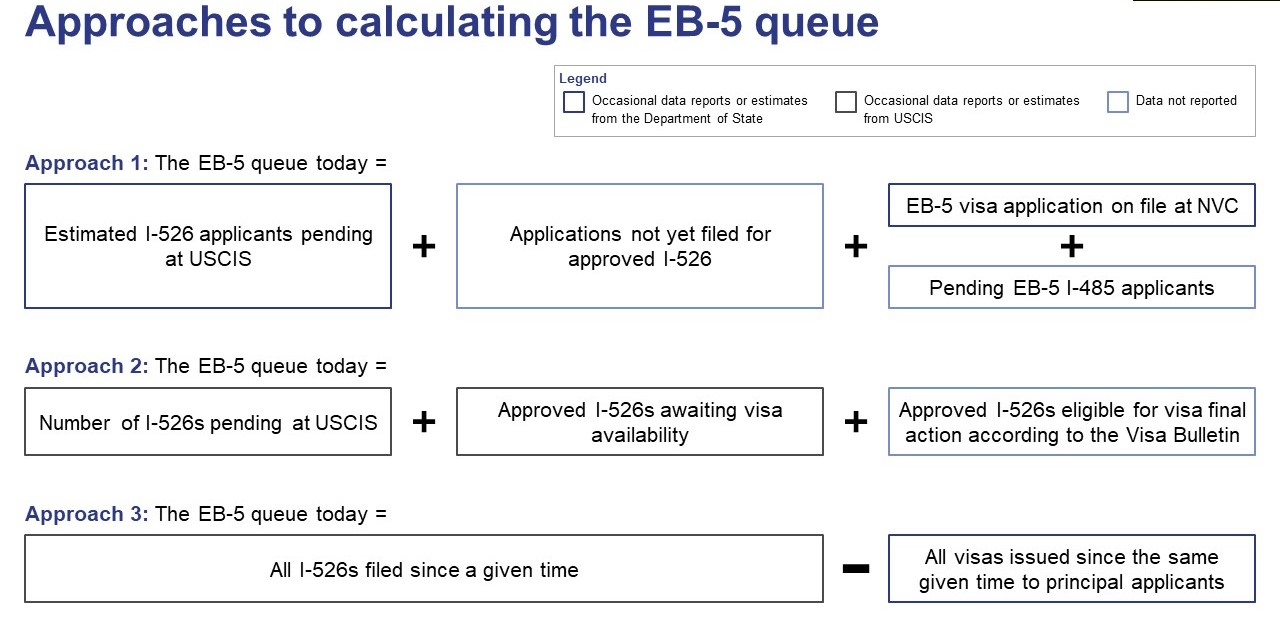
One can conceptualize the EB-5 visa queue in numerous ways. It is difficult to calculate because of the many different stages EB-5 investors must go through and the lack of data United States Citizenship and Immigration Services (UCSIS) provides on some of the stages.

Diagram of the three approaches to calculating the EB-5 queue with data from USCIS and the Department of State.

The first way to look at the EB-5 visa queue is to break it down in terms of USCIS and the Department of State. This is the approach adopted by Visa Control Office Chief Charles Oppenheim, who uses it to calculate the estimated wait times for EB-5 visas, but his is less nuanced: He only counts EB-5 investors with pending I-526 petitions and pending applicants at the National Visa Center (NVC). Since USCIS does not have data on EB-5 investors with I-526 approval who have not yet submitted a visa application nor pending I-485 applications, he omits these populations in his estimates, which may result in inaccurate figures. While the number of I-485 petitions has historically been low, the number of EB-5 investors with I-526 approval who have not yet filed their visa application could be significant, particularly in China.

The second approach to looking at the EB-5 visa queue is to divide it by I-526 approval and visa availability. The number of I-526 petitions pending at USCIS is a readily available statistic, but the addition of a newly added figure—the number of approved EB-5 investors with I-526 approval waiting for visa availability—has made this approach possible. The only factor left is EB-5 investors with I-526 approval waiting for their priority date to become current on the Visa Bulletin, but presently, no such data is available. However, it partially addresses a gap in the first approach: EB-5 investors with I-526 approval who have not yet filed their visa application are a subgroup of those with I-526 approval still waiting for visa availability.

The third method for calculating the EB-5 visa queue is the easiest: It simply subtracts the number of visas issued since a certain date from the number of I-526 petitions filed since the same date. The approach easily avoids the pitfalls of the others, although it provides no information on where investors are in the process.

Breaking Down Data from October 2019 and April 2020

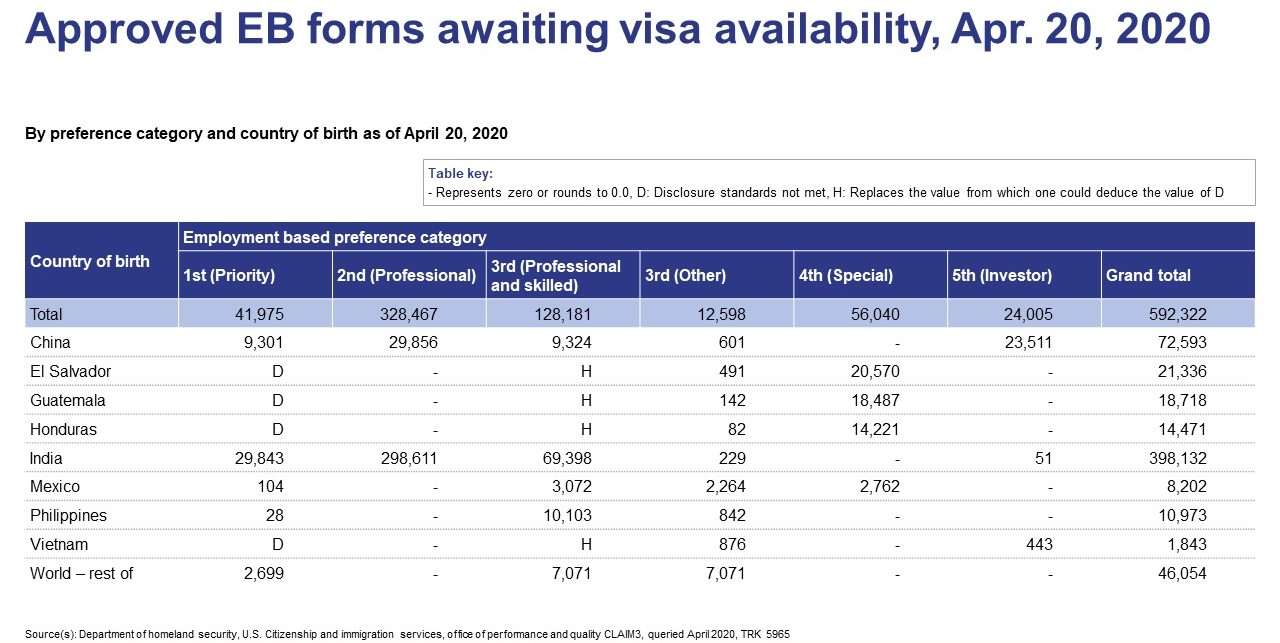
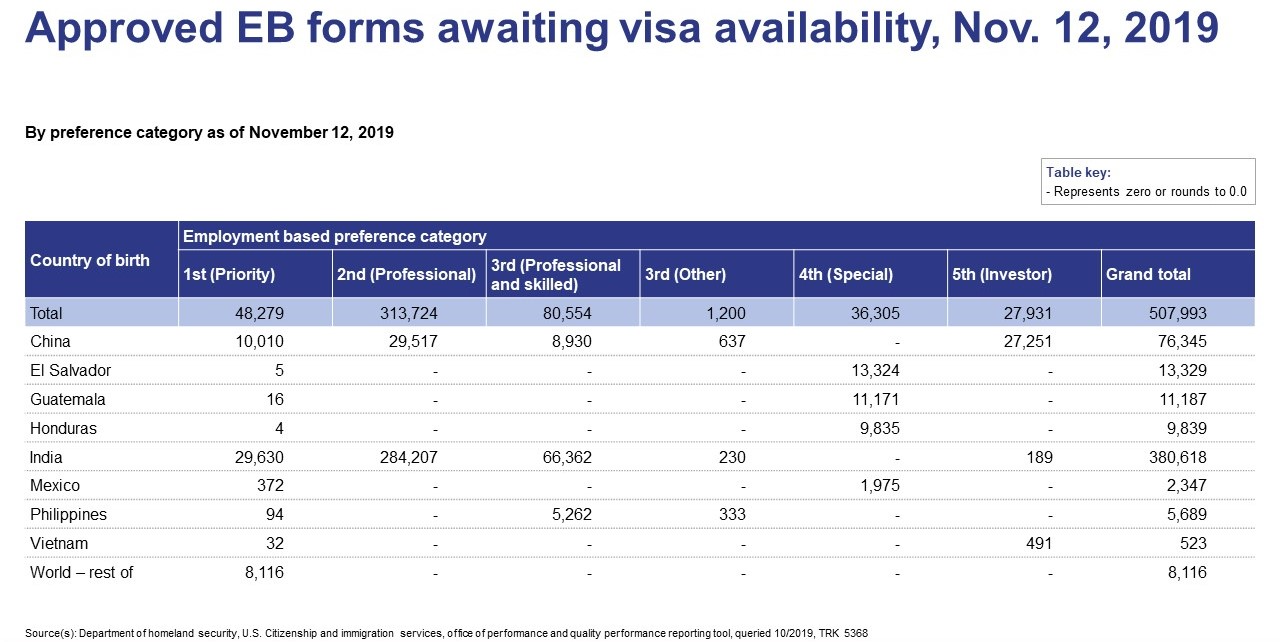
In the below tables, the number of EB-5 applicants from China, India, and Vietnam who have I-526 approval and are waiting for visa availability is displayed. The first is from October 2019, and the second pulls data from April 2020.

Table showing number of approved EB forms awaiting visa availability by country and preference category on April 20, 2020.

Table showing number of approved EB forms awaiting visa availability by country and preference category on November 12, 2019.

EB-5 Visa Figures for China

The data shows a clear decline between October 2019 and April 2020 in the number of Chinese EB-5 investors with I-526 approval awaiting visa availability. In October 2019, a total of 27,251 Chinese investors had approved I-526 petitions and priority dates more recent than November 1, 2014, which was the final action date for Chinese investors in the November 2019 Visa Bulletin. By April 2020, this figure had fallen to 23,511, with the final action date moving forward to May 15, 2015.

Even in April 2020, the number of Chinese investors waiting for visa availability was humongous, and the majority of these investors have been in the backlog for a while: The movement of the final action date from November 2014 to May 2015 only accounted for an extra 3,740 investors. A decrease in this number does not mean thousands of Chinese EB-5 investors received visas—it simply means there are more Chinese investors with visas available.

One also mustn’t forget that many EB-5 applicants apply for visas for their spouse and dependent children as well. Historically, each Chinese EB-5 investor has been granted 2.7 visas, which means 63,889 EB-5 visas need to be available to Chinese investors as of April 2020 to account for all those waiting for their priority dates to become current.

EB-5 Visa Figures for India

The figures for India are significantly lower because China has long maintained the dominant position in the EB-5 program. In October 2019, 189 Indian EB-5 investors had I-526 approval and a priority date more recent than December 8, 2017, and in April 2020, that number had decreased to 51, despite the final action date advancing all the way to January 1, 2019, in a shockingly rapid advancement that eventually led to a “current” final action date in the July 2020 Visa Bulletin.

When immediate family members are considered, India’s 51 EB-5 investors waiting for visa availability grows to an estimated 124 Indian nationals waiting for a U.S. green card. Since the Department of State still has approximately 200 visas to allocate to Indian investors and their families in FY2020, there may be enough visas to completely clear the Indian backlog in FY2020.

EB-5 Visa Figures for Vietnam

While the difference between the October 2019 and April 2020 figures for Vietnamese EB-5 investors is smaller than that for Chinese and Indian investors, there were still fewer Vietnamese EB-5 investors with I-526 approval waiting for their final action date to become current in April 2020 than in October 2019. In October 2019, with a final action date of November 15, 2016, there were 491 Vietnamese investors with I-526 approval waiting for visa availability. By April 2020, this number was down to 443, with the final action date having moved ahead to February 8, 2017.

The small difference between these two figures suggests either a large number of I-526 approvals and a large number of investors reaching the final action date, or a small number of I-526 approvals and a small number of investors reaching the final action date. The figures alone cannot reveal which situation Vietnamese EB-5 investors are in.

Vietnam’s final action date has not moved forward as quickly as India’s likely because there are not enough visas available to account for all Vietnamese EB-5 investors with I-526 approval. When spouses and dependent children are considered, the figure exceeds 800, which is more than the approximately 700 EB-5 visas available for Vietnamese nationals in FY2020.

Free EB-5 Project Evaluation

EB-5 Visa Petition Processing Data from FY2020 Q2

United States Citizenship and Immigration Services (USCIS) has released statistics about its processing data from the second quarter of 2020 financial year (January 1 to March 31, 2020). Processing rates have increased considerably compared to Q1 FY2020; however, the processing rate remains far lower than it was in previous years.

USCIS also received far fewer petitions than it did in previous years. The marked difference can be ascribed to the implementation of the EB-5 Modernization Rule on November 21, 2019, which doubled investment amounts and led to an application rush in Q1 of FY2020. Additionally, I-924 filings have probably declined because of the processing delays and USCIS’s estimated processing time of 53 to 99 months.

Download USCIS I-526 and I-829 Visa Processing Statistics for Q2 FY2020

I-526 Petition Statistics for Q2 FY2020

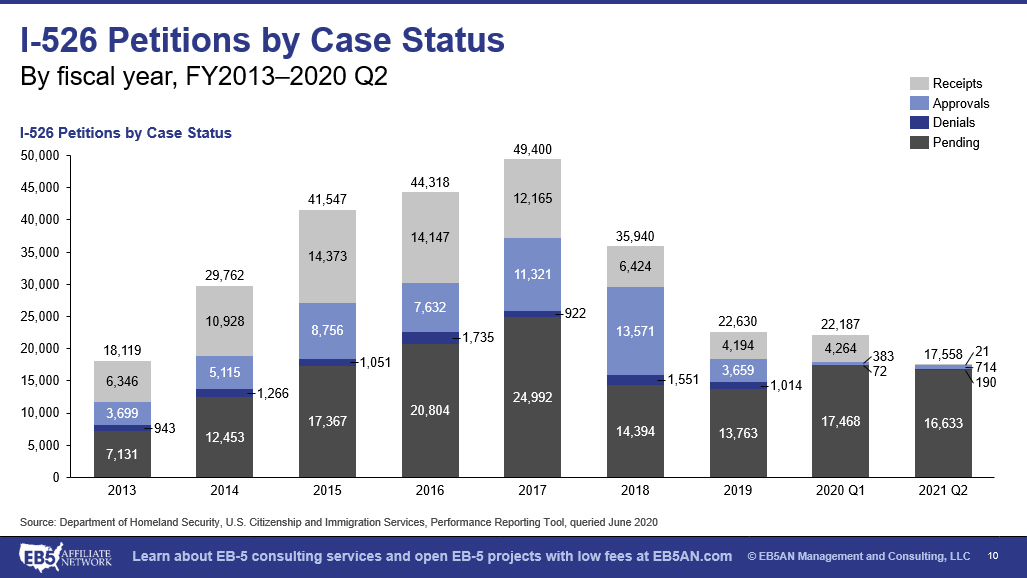
In Q1 of FY2020, USCIS received 4,264 I-526 petitions. This dropped to only 21 in Q2. In Q2, USCIS approved 714 petitions and denied 190, leaving 16,633 pending. While these numbers are an improvement on the first quarter of the year, when 383 petitions were approved, 72 were denied, and 17,468 remained pending, only 904 petitions were processed. This is on par with Q2 FY2019.


Chart shows I-526 Petitions by Case Status from FY2013 to 2020 Q2 broken down by Receipts, Approvals, Denials and Pending.
 

I-829 Petition Statistics for Q2 FY2020

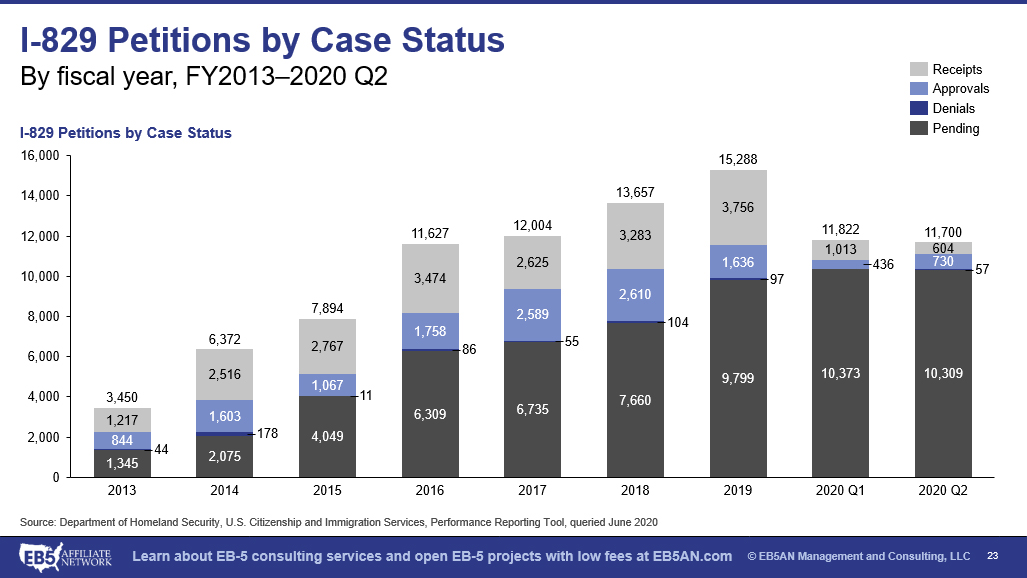
While the number of I-829 petitions has also decreased from Q1 to Q2 of FY2020, the decrease as not been as significant, falling from 1,013 to 604. The processing backlog has remained largely steady, decreasing from 10,373 in Q1 to 10,309 in Q2. However, the number of petitions approved increased from 436 to 730, which is the largest number of I-829 petitions approved since Q1 FY2018. USCIS did not include the number of petitions denied in Q1 2020, citing protection of privacy, but in Q2, it denied 57 petitions. Thus, the Q2 denial rate is 7%.


Chart shows I-829 Petitions by Case Status from FY2013 to 2020 Q2 broken down by Receipts, Approvals, Denials and Pending.
 

Are the Improved Processing Times a Reason for Optimism?

During the March 2020 EB-5 stakeholder engagement, Sarah Kendall, chief of the Immigrant Investor Program Office (IPO), mentioned infrastructure development as one of the reasons for the decrease in the processing of EB-5 petitions in FY2019. She noted that preliminary statistics for February 2020 showed a marked improvement in processing rates, and the Q2 FY2020 EB-5 data seems to support that claim. Nevertheless, the IPO’s productivity remains shockingly low compared to FY2018, despite no significant changes having been made to the staffing levels.

On June 16, 2020, Charles Oppenheim, the chief of the Visa Control and Reporting Division of the U.S. Department of State, participated in an EB-5 webinar hosted by IIUSA. During the webinar, he discussed not only the FY2020 processing statistics but also the way forward, focusing on investors from countries with high application volumes, the possibility of offering additional EB-5 visas in FY2021, and the improved processing output at the IPO. Based on his comments, there might be some reason for optimism, but only the Q3 and Q4 processing will provide a clear view of the situation at the IPO and USCIS.

Additional Factors Influencing EB-5 Petition Processing in FY2020

On March 31, 2020, USCIS changed from a first-in, first-out approach to a visa availability approach for adjudicating I-526 petitions. This change comes at the end of Q2, so it is not reflected in the latest statistics. While it will not affect overall processing output, it will affect processing on a per-country basis.

Additionally, the COVID-19 pandemic that is wreaking havoc worldwide brings its own uncertainties to the EB-5 program. Although the reopening of some U.S. consulates and embassies might mean that USCIS can issue all available EB-5 visas before the end of the financial year on September 30, 2020, only time will tell whether this will be the case.

Free EB-5 Project Evaluation

Trump Extends Immigration Ban Until the End of 2020

Understanding Employee Qualifications for Direct EB-5 Investments

On April 22, 2020, President Trump signed into law a temporary immigration ban, intended to last for 60 days. The purpose of the legislation was to ensure U.S. workers were prioritized as the economy reopens after being ravaged by the COVID-19 pandemic. However, the decree included a number of exceptions, including the immediate family members of U.S. citizens and residents and investors in the EB-5 Immigrant Investor Program.

On June 22, 2020, Trump extended the immigration ban, effective June 24. Citing the belief that economic recovery in the United States will take several months, Trump has prolonged the ban dramatically, with the United States now disallowing immigrants until the end of 2020. The proclamation was also extended to include holders of nonimmigrant visas H-1B, H-2B, L, and J. Any would-be immigrants who do not have a valid visa or travel document other than a visa by June 24, 2020, will be ineligible to enter the United States until the end of 2020, unless they also fall into one of the exception categories. Any foreign nationals already living in the United States under a work visa remain unaffected by the decree.

Exemptions to the Immigration Ban

Foreign nationals with permanent resident status are always permitted to enter the United States, as are the spouses of U.S. citizens or residents. Similarly, the unmarried children younger than 21 of any U.S. citizen or resident are always welcome in the country. In the fight against COVID-19, physicians, nurses, and other health care professionals are also exempt from the extended immigration ban. Additionally, EB-5 investors can breathe a sigh of relief, because they are once again exempt from the immigration ban, despite an open letter to President Trump from May 7 pressuring Trump to extend the ban to EB-5 investors.

Of course, EB-5 investors may face additional obstacles in the chaotic year of 2020. Any travel restrictions in place for an investor override the immigration ban exemption, so some EB-5 investors will still be unable to enter the United States. Investors must also obtain their U.S. green card before relocating to the United States, but the temporary suspension of routine visa services at U.S. embassies and consulates has halted the EB-5 process for investors overseas. Thus, while immigration to the United States is technically allowed for EB-5 investors, it is infeasible in practical terms for many investors.

Why the EB-5 Program Is the Best Choice for U.S. Immigration

Beyond the obvious advantage of the EB-5 program in the face of the pandemic, the EB-5 program offers numerous advantages over popular nonimmigrant visas such as the H-1B or L visa. To obtain such a visa, an applicant must locate an employer willing to sponsor them, which is easier said than done, and even then, acceptance is not guaranteed—applicants must compete in the annual H-1B lottery, since demand is too high. Those lucky enough to be accepted then face tough restrictions once in the United States, able to perform work activities only for the employer who sponsored them, and are generally only allowed to stay in the United States for a temporary period.

Conversely, EB-5 investors enjoy the freedoms the United States is known for. As green card holders, they have permanent resident status, which allows them to live, work, study, and travel freely anywhere in the United States. Permanent residents can also freely travel abroad and will always be welcomed back in the country simply by presenting their U.S. green card. An EB-5 visa allows an investor and their spouse and unmarried children younger than 21 to live in the United States indefinitely, enjoying almost all of the same rights and freedoms as U.S. citizens.

The EB-5 program is also generally easier for applicants, as long as they have the necessary investment capital. The key requirements of the EB-5 program are an investment of the appropriate amount—either $1.8 million or $900,000, depending on whether the chosen project is in a targeted employment area (TEA)—and proof of the lawful sources of the EB-5 investment funds. Once an investor’s I-526 petition is approved, they may apply for an EB-5 visa and are granted conditional permanent resident status for two years. During this two-year period, they must keep their investment capital at risk, and before their conditional permanent resident status expires, they must file an I-829 petition to prove their investment created at least 10 new full-time jobs for U.S. workers. Upon approval of the I-829, they and their immediate family members can enjoy U.S. permanent resident status—it’s as simple as that.

Free EB-5 Project Evaluation

Insights into FY2020 EB-5 Processing with Charles Oppenheim

Understanding Employee Qualifications for Direct EB-5 Investments

On June 16, 2020, IIUSA held a webinar with Charles Oppenheim, the chief of the Visa Control and Reporting Division of the U.S. Department of State. Oppenheim offered a wealth of valuable EB-5 information, primarily about EB-5 processing in FY2020 and how processing may look going forward. In total, the call lasted about one and a half hours, including a Q&A session with IIUSA panelists. This post explores the most important information Oppenheim shared in the webinar.

Consulate Closures

The most significant way in which the COVID-19 pandemic has affected the EB-5 Immigrant Investor Program has been the worldwide U.S. embassy and consulate closures, which has prevented overseas EB-5 immigrants from scheduling visa appointments and thus prevents them from claiming their U.S. green cards. Oppenheim revealed the U.S. Department of State is in talks to reopen consulates but could not offer any concrete dates or information. He emphasized that each consulate would take a different approach, so they will resume visa services at different times.

However, while consulates worldwide remain closed, the National Visa Center (NVC) is still offering services. Overseas EB-5 applicants can maximally expedite their visa process in the chaotic year of 2020 by becoming documentarily qualified through the NVC before the consulates reopen. That way, they’ll be ready for a visa interview immediately and will be able to claim their EB-5 visa soon after the consulates resume routine visa services. Oppenheim revealed that more than half of EB-5 applicants in a position to become documentarily qualified and pay the necessary fees have yet to do so, which could limit the number of EB-5 visas United States Citizenship and Immigration Services (USCIS) can issue in FY2020. He encouraged all investors presently able to become documentarily qualified to do so.

Issuance of EB-5 Visas in FY2020

In FY2020, more than 11,000 visas have been allocated to the EB-5 program. In a typical year, the allocated visas are distributed evenly throughout each quarter, but the COVID-19 pandemic has rendered even distribution impossible in FY2020. Oppenheim estimated that only around 4,500 EB-5 visas have been issued in FY2020 so far, as we near the end of the third quarter. This leaves more than 6,000 EB-5 visas to issue in a single quarter before September 30, 2020.

Oppenheim suggested USCIS could indeed issue most of the remaining EB-5 visas in FY2020 if the consulates reopen soon. Currently, the Immigrant Investor Program Office (IPO) is issuing EB-5 visas to domestic investors who have filed I-485 petitions to change their immigration status in the United States, but if statistics from previous years are anything to go by, domestic applicants account for only a minority of EB-5 investors. While Oppenheim is not authorized to reveal how many I-485 petitions are pending at the IPO, he did state they “don’t have a lot” and doubts the IPO can issue all allocated EB-5 visas through domestic processing alone.

FY2020 Visas Issued to Chinese EB-5 Investors

In October 2019, the beginning of FY2020, USCIS estimated Chinese investors would receive more than 5,000 EB-5 visas in FY2020. Those estimates did, of course, assume a pandemic would not sweep the globe and shut down public life in all parts of the planet. In reality, only 1,000 Chinese EB-5 investors received visas before the U.S. consulate in China stopped offering visa interviews in February 2020. According to Oppenheim, the one-week advancement of the Chinese final action date in the July 2020 Visa Bulletin frees up around 400 Chinese domestic investors and 3,000 Chinese overseas investors to claim an EB-5 visa, but with the consulate closed, only the 400 domestic investors will actually be able to proceed. Oppenheim added that the Chinese consulate likely couldn’t handle that many visa interviews even if it reopened immediately.

Oppenheim also had good news for Chinese investors: Despite uncertainty around Hong Kong’s status as an independent political actor, the EB-5 program will continue to treat Hong Kong applicants as separate from Mainland Chinese applicants. This way, the IPO can issue visas to Hong Kong investors without increasing the backlog for Chinese investors. The IPO will only alter its treatment of Hong Kong if U.S. immigration law changes.

FY2020 Visas Issued to Indian EB-5 Investors

Of the 11,000 or so EB-5 visas allocated for FY2020, 778 were earmarked for Indian investors. According to Oppenheim, a significant portion of these visas—possibly as many as 550—have already been granted to Indian investors. This has in part been possible due to the rapid advancement of the Indian EB-5 final action date, which, in the July 2020 Visa Bulletin, has finally become current, in line with predictions USCIS made in March 2020. Oppenheim further revealed that he believes the Indian final action date will remain current for the rest of FY2020.

FY2020 Visas Issued to Vietnamese EB-5 Investors

Oppenheim also touched on the prospects for the third major EB-5 country, Vietnam, but only vaguely. He provided no figures on the number of EB-5 visas issued to Vietnamese nationals thus far in FY2020 but did mention Vietnam’s final action date would likely continue to progress at the rate it has been during the pandemic (i.e., a few weeks at a time).

EB-5 Visa Availability in FY2021

Although the EB-5 program may lose large numbers of allocated visas in FY2020, FY2021 is expected to be a much brighter year. Assuming the world will have largely begun its “new normal” by the beginning of FY2021, EB-5 processing will be back to normal, and the number of visas allocated to the EB-5 program may be significantly higher than average. Each year, the EB-5 program is allocated 7.1% of all EB visas designated for that year. The number of EB visas is expected to be up in FY2021 because any unused family-based visas at the end of the fiscal year roll over to the EB programs the next year. Family-based immigration is also significantly down in FY2020—so much so that Oppenheim estimates EB visas in FY2021 will, at a “bare minimum,” be up 60,000, totaling more than 200,000.

India’s Rapid Final Action Date Advancement and the Possibility of Retrogression

Oppenheim’s webinar provides positive news for Indian EB-5 immigrants: He does not believe Indian investors will experience visa retrogression moving forward. The announcement came as a surprise to many EB-5 industry participants, who assumed the recent rapid advancement in the Indian final action date was primarily driven by the U.S. consulate closures and that the resumption of consular visa services would trigger a major retrogression. Oppenheim was firm in his stance, however, emphasizing the final action date movements as “measured” and “trying to avoid retrogression.” He stated clearly that he anticipates wait times for Indian EB-5 investors filing their I-526 today to be lower than the estimate in October 2019, which suggests a large number of Indian investors may be documentarily qualified and ready to receive their EB-5 visas in FY2020 or FY2021.

Oppenheim even suggested that the final action date for all countries could become current in FY2021 for a brief period, but the chances are extremely slim. This could possibly happen at the beginning of FY2021 if the consulates remain closed past September 30, 2020, and if there are enough domestic investors to justify moving the final action date forward.

IPO Processing Productivity

Processing productivity at the IPO has fluctuated dramatically in recent years, from record highs in FY2018 to a sharp decrease in FY2019. While the IPO has not released processing data for FY2020, the change between FY2018 and FY2019 was marked by a change in leadership, with Sarah Kendall, the chief in FY2019, continuing to head operations in FY2020. Oppenheim claimed the IPO was processing I-526 petitions rapidly and forwarding many investors to the next stage of the EB-5 process. He named Chinese investors specifically, implying a large number of petitions from Chinese investors may have been assigned for adjudication before the new visa availability approach debuted in April 2020.

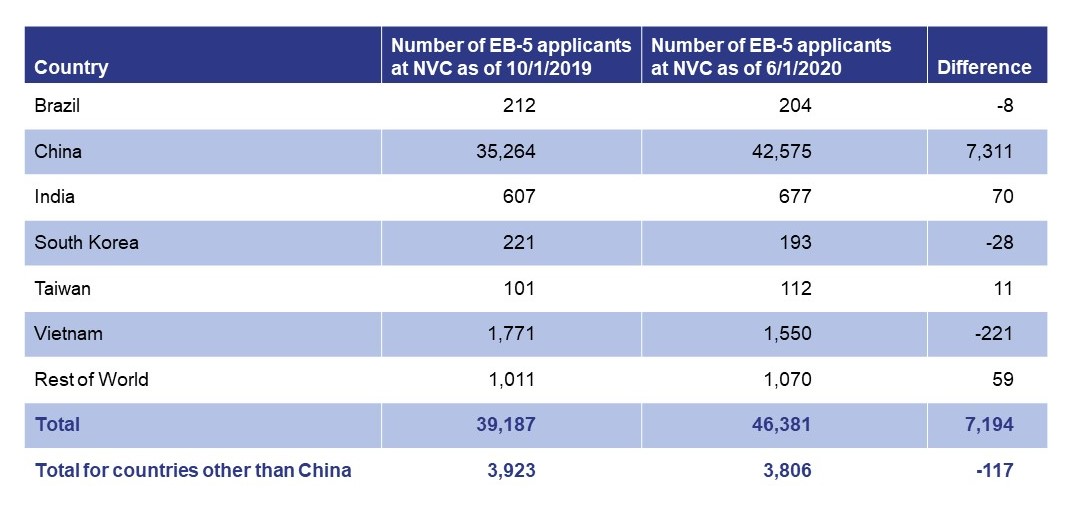
Table showing number of EB-5 applicants at NVC by country as of 10/1/19 and 6/1/20 and the difference between the two.

The large number of new Chinese investors at the NVC seems to support Oppenheim’s claims of increased productivity. Other countries have increased only marginally or even decreased, which could imply a concentration on Chinese investors before the new visa availability approach kicked in. However, the increase in Chinese investors at the NVC could also simply be due to the Visa Bulletin date for filing moving forward and enabling many more investors to file their visa applications, and since rest-of-world applicants are favored in the visa availability approach, their low numbers suggest the IPO’s processing in FY2020 may be more in line with FY2019 figures. Of course, some investors take time to become documentarily qualified after receiving I-526 approval, and some file an I-485 petition instead of going through the NVC, so the truth will remain unclear until USCIS provides more information on the matter.


Free EB-5 Project Evaluation

What Kind of Funds Can Investors Use in the EB-5 Program?

Understanding Employee Qualifications for Direct EB-5 Investments

One of the most troublesome requirements of the EB-5 Immigrant Investor Program for investors is the source of funds requirement. EB-5 investors must demonstrate in their I-526 petition that they have obtained all their EB-5 capital from lawful sources. Depending on the sources an investor uses, the process of collecting the necessary documentation can be time-consuming and difficult.

EB-5 applicants must invest, at a minimum, $1.8 million or $900,000, depending on whether their project is in a targeted employment area (TEA). While these are large sums, prospective investors should bear in mind that they don’t need to have the entire amount available in liquid funds right from the beginning. Many EB-5 investors sell properties or other assets to liquidize capital for their investment.

Below are a few common sources investors use for EB-5 capital:

  • Wage and salary earnings
  • Revenue from a business
  • Inheritance money
  • Donations from family
  • Investments in stocks, retirement funds, and other assets
  • Sale of property and other assets
  • Loans, whether from friends or relatives, a financial institution, a business, or another source

Many EB-5 investors use a combination of the above sources to liquidize enough funds for their investment. The difficult part is proving that they came from lawful sources, a process that can significantly delay an investor’s EB-5 journey. Investors should speak with an immigration lawyer highly familiar with the EB-5 program to determine the best funds to use to ensure a relatively easy and minimally stressful process of proving the legality of the capital.

For young investors, gifts are a common source of funds. Parents often donate the necessary investment funds to their child to allow them to pursue U.S. permanent residency through the EB-5 program. This is an especially attractive option to anyone hoping to study at one of the world-renowned universities in the United States. EB-5 visa holders may even be eligible for in-state tuition savings, depending on the college they enroll in.

Free EB-5 Project Evaluation

Indian EB-5 Final Action Date Current in July 2020 Visa Bulletin

It’s the news all Indian EB-5 investors have been waiting for: the Indian final action date for EB-5 visa green cards is finally current. The Indian final action date has been jumping forward rapidly in recent months, likely a result of the worldwide U.S. embassy and consulate closures due to the COVID-19 pandemic. United States Citizenship and Immigration Services (USCIS) predicted as early as March 2020 that the Indian EB-5 final action date would be current by summer 2020, and indeed, reality followed through. With that, the Indian backlog is finally cleared up—at least in theory.

The good news comes with a caveat, because the situation may not be as rosy as it seems. While Charles Oppenheim, chief of the Visa Control and Reporting Division of the U.S. Department of State, has announced that he expects the Indian final action date to remain current for the rest of FY2020, Indian EB-5 investors may experience a major visa retrogression when processing picks back up post-pandemic. EB-5 processing is hardly linear—it’s a messy and complicated process, with an investor’s priority date only playing a role if they are otherwise eligible to claim an EB-5 visa. With U.S. consulates closed around the world, Indian EB-5 investors living in India are ineligible to claim their visas during the pandemic, leaving this option solely to the Indian investors who already reside in the United States on a different visa. Statistics from previous years have shown that domestic EB-5 investors are scarce, and the rapid advancement of the Indian EB-5 date over the past several months may indeed indicate a low number of domestic EB-5 investors from India.

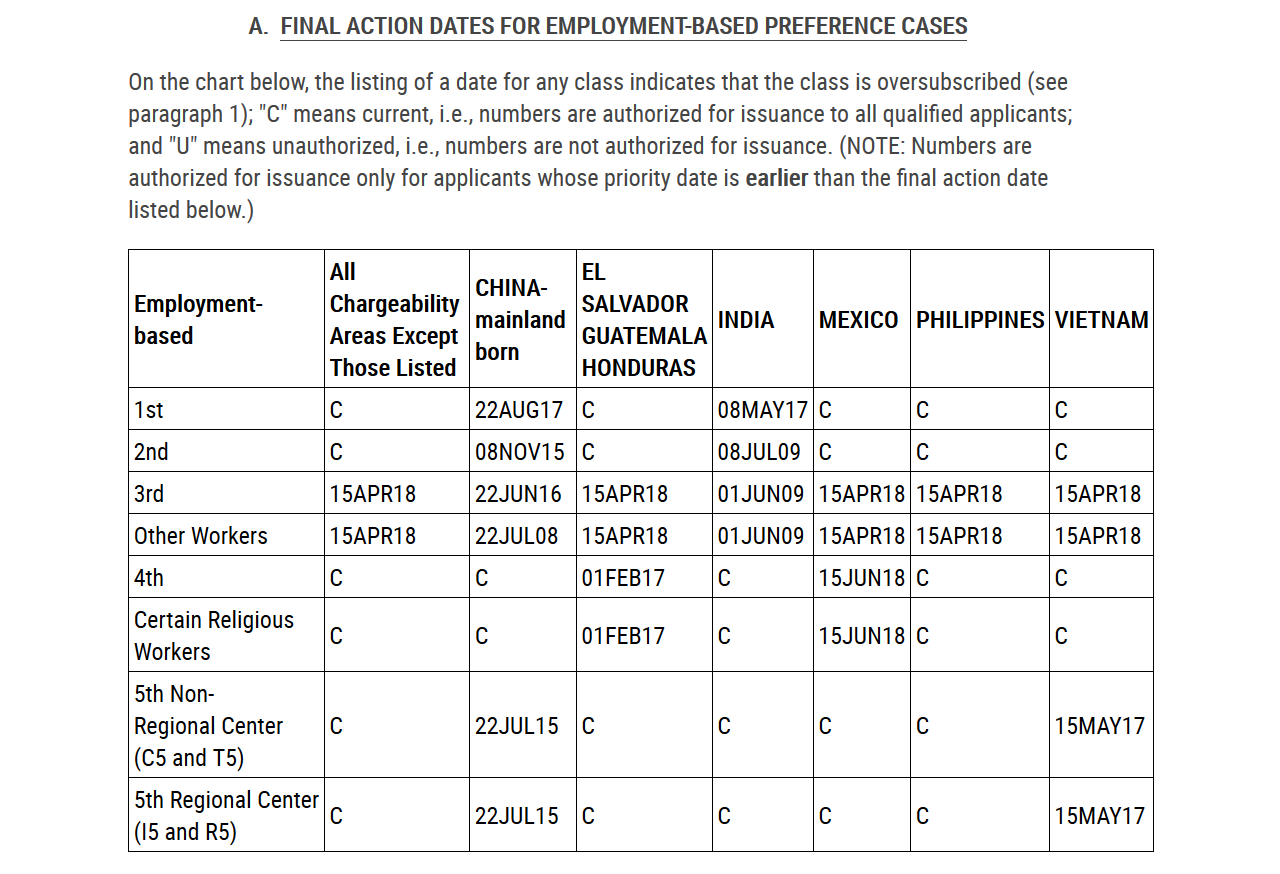
Chart A: Final Action Date

Chart of Final Action Dates For Employment-Based Preference Cases broken down by employment-based class and country.

All three backlogged countries—China, India, and Vietnam—have moved forward in the July 2020 Visa Bulletin, but India’s astounding advancement outweighs everything else. The Chinese final action date has advanced by one week to July 22, 2015, and the Vietnamese date by three weeks to May 15, 2017, but the Indian final action date has moved forward by a staggering seven months from January 1, 2020. With that, the Indian final action date is finally current, although it’s unclear how long-lived this status will be.

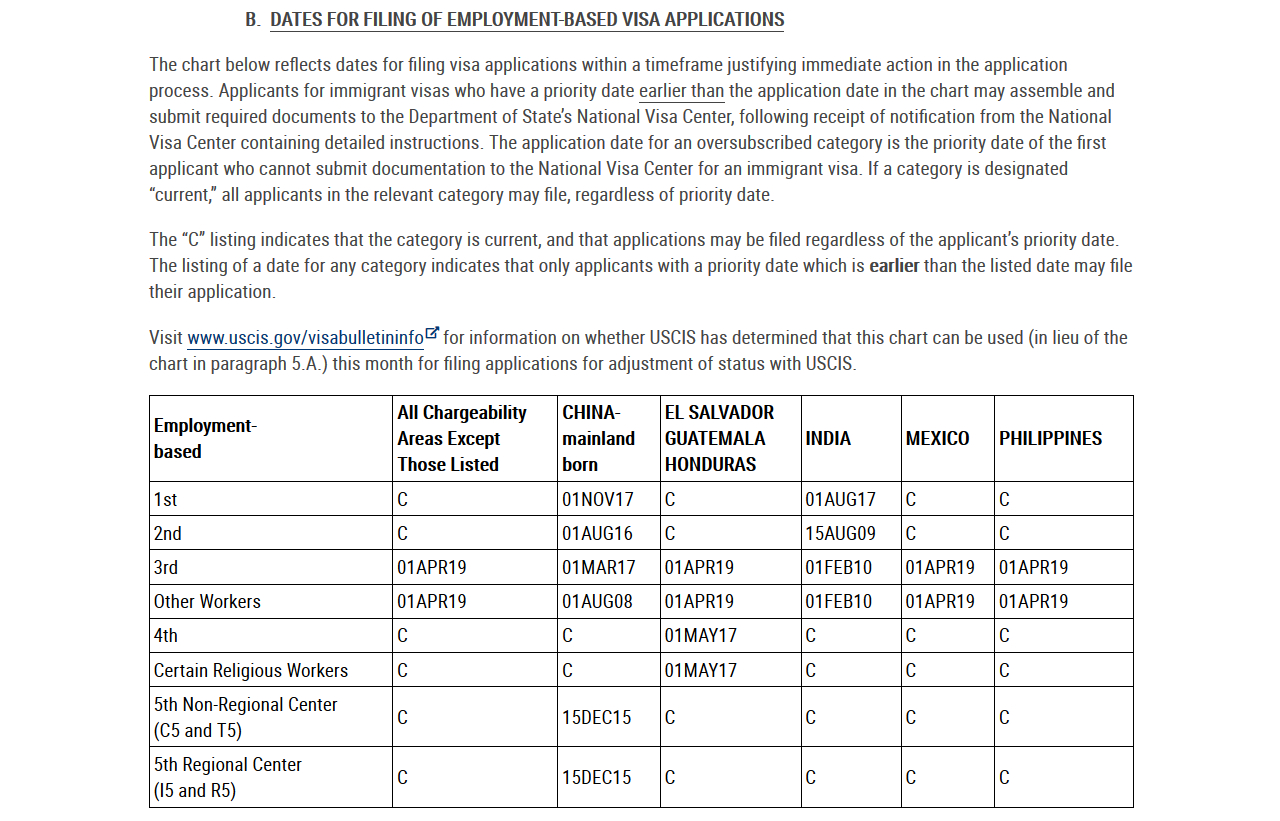
Chart B: Date for Filing

Graph shows the number of I-526 Petitions that were filed versus adjudicated from Fiscal Year 2013 to Fiscal Year 2018.

The Indian EB-5 date for filing is also current, but that isn’t news because it’s always been current, as has the Vietnamese date for filing. The only EB-5 investors who must wait to file their visa application are those from China, who are currently unable to submit visa applications due to the suspension of U.S. consular visa processes. The Chinese date for filing sits at December 15, 2015, where it has remained for the last several months.

Free EB-5 Project Evaluation

Investing in a Troubled Business in the EB-5 Program

The EB-5 Immigrant Investor Program, one of the quickest and easiest paths to a U.S. green card for foreign investors, offers EB-5 visas in exchange for an investment in a qualifying project. To receive a visa, an investor must demonstrate that their investment in a new commercial enterprise (NCE) has fulfilled certain requirements, such as the creation of at least 10 new full-time jobs for U.S. workers.

In certain circumstances, however, an EB-5 investor may invest in a troubled business and work toward saving existing jobs rather than creating new ones. This less traveled EB-5 path is equally viable and leads to the same outcome: EB-5 green cards for the investor and their immediate family members.

What businesses qualify as “troubled businesses” under the EB-5 program?

According to United States Citizenship and Immigration Services (USCIS), to qualify as a “troubled business” under the EB-5 program, a business must have been established at least two years prior to the investment. Over the 12- or 24-month period before the investor’s I-526 petition priority date, the business must have suffered a net loss. The net loss must follow a decline of at least 20% in its value or net worth.

How do EB-5 investors satisfy the “job creation” requirement when investing in a troubled business?

While any job creation spurred by an EB-5 investment in a troubled business is, of course, helpful, EB-5 investors are not required to create new jobs when investing in troubled businesses. Rather, they must demonstrate that their investment has saved jobs. To fulfill this EB-5 requirement, EB-5 investors must ensure the number of employees at the troubled business at the end of their two-year investment period is not lower than what it was prior to their investment.

What is the minimum required investment amount for troubled businesses?

In terms of the investment amount required, troubled businesses are no different from NCEs. If the zone where the troubled business is located qualifies as a targeted employment area (TEA), EB-5 investors are eligible to invest the lower required amount of $900,000. Otherwise, they must invest at least $1.8 million in the troubled business.

TEAs are determined by their population or unemployment rate. A rural TEA is defined as an area with a population under 20,000 that is outside a metropolitan statistical area. High unemployment TEAs are areas with an unemployment rate at least 150% higher than the national average.