Free EB-5 Project Evaluation

Can Investors Use Unsecured Loans for the EB-5 Visa Program?

A figurine looking at his own shadow, carrying a bag of loaned funds over his shoulder, and the word debt above.

In the past, there was much confusion and controversy about whether unsecured loans can be used to fund investments for the EB-5 Immigrant Investor Program. Unlike a secured loan, an unsecured loan is one that is not backed by any specific collateral. Instead, lenders approve these loans based on the principal borrower’s creditworthiness, income, debt-to-income ratio, and other factors.

In the context of the EB-5 visa program, a foreign national’s EB-5 investment can have a wide variety of source of funds (SOF). For example, funds from an investor’s paycheck wages or personal savings, proceeds from stock or property sales, an inheritance, or a gift are all legal sources of funds. If using a loan, best practices generally advise that investors use a secured loan, often with property or some other personal assets owned by the investor to be used as collateral. But historically, the United States Citizenship and Immigration Services (USCIS) did not have clear instructions for how to structure a loan for the EB-5 program. As a result, some investors attempted to use unsecured loans, taking money from a third party to make their EB-5 investment.

However, in 2015, USCIS decided that funds derived from unsecured loans were considered “indebtedness,” not cash. As a result, USCIS began denying the I-526/I-526E petitions of many EB-5 investors. This led to the landmark ruling in Zhang v. USCIS that helped clarify the uncertainty surrounding the question of unsecured loans, eventually leading to the conclusion that unsecured loans are permissible for EB-5 investments, but only if certain criteria are met.

This article will explain how financing for EB-5 visa projects typically works, the history of using secured loans and unsecured loans for EB-5 investments, and the outlook for investors who may be considering using a loan to finance an EB-5 investment.

How Funding for EB-5 Visa Projects Works

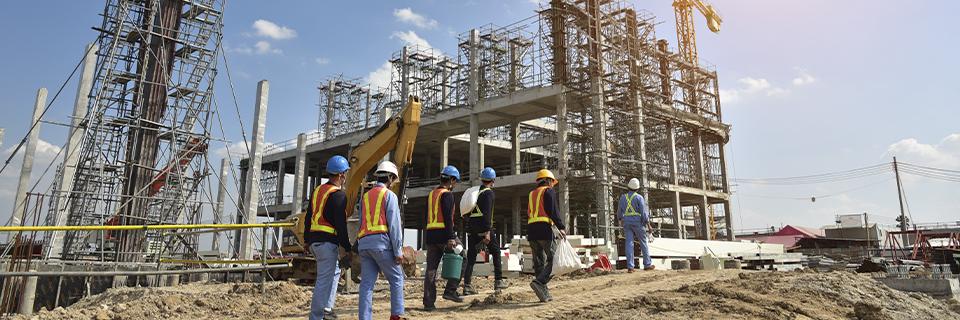
A group of workers in hard hats working on an EB-5 investor visa project site.

The EB-5 visa program stimulates economic growth and creates jobs in the United States by luring foreign investment in exchange for U.S. Green Cards for investors and their family members. Investors, along with their spouse and unmarried children, are able to live and work in the United States throughout the application process. During that time, they first obtain conditional permanent resident status—also known as a conditional Green Card—and are eligible to apply for permanent resident status—also known as a U.S. Green Card—after two years.

EB-5 program applicants must invest at least $800,000 in a new commercial enterprise (NCE) or in a troubled business that they will restructure or expand. Since the EB-5 Reform and Integrity Act (RIA) was passed in 2022, the minimum investment threshold for projects located in targeted employment areas (TEAs) has been $800,000, while the threshold for other projects is $1,050,000. A TEA is roughly defined as:

  • An area with a population of fewer than 20,000 people; or
  • An unemployment rate of at least 150% of the national average.

EB-5 investors can choose to make their EB-5 investment either directly or, like the vast majority of EB-5 program applicants, through a regional center. Unlike with a direct investment where the individual invests capital directly into an NCE, regional centers are organizations set up to combine funds from several EB-5 investors and manage the allocation of that capital on their behalf.

One of the first steps in the EB-5 visa process is submitting Form I-526 or I-526E (regional center investors submit Form I-526E). Form I-526E demonstrates investors’ eligibility for the EB-5 program, and includes supporting documentation about the individual’s identity, their selected EB-5 project, and their source of funds (SOF).

In order to demonstrate that an EB-5 investor’s source of funds were lawfully obtained, they may need to submit a considerable amount of documentation to USCIS, including bank statements, invoices, sales receipts, securities agreements, purchase contracts, property documents, mortgage agreements, promissory notes, and more. Compiling all of the necessary documentation to prove legal source of funds for the EB-5 program can be complex, so it is highly recommended that EB-5 investors hire an experienced immigration attorney and EB-5 program experts to ensure accuracy and completeness.

Using Unsecured Loans to Fund EB-5 Projects Before and After Zhang v. USCIS

A gavel on money, symbolizing district court regulations regarding lender's funds.

Historically, EB-5 investors have had to clearly demonstrate that their investment funds were secured through lawful means. Whether or not USCIS accepted unsecured loans from EB-5 investors was generally a case-by-case matter, as some of these loans were accepted if the investor could show a credible plan for how they would repay the loan.

The Zhang v. USCIS case involved EB-5 investors Huashan Zhang and Masayuki Hagiwara, who borrowed money from their own businesses to invest in an NCE. At a 2015 USCIS stakeholder meeting, it was determined that cash resulting from a third-party loan—like a loan from one’s business—was in fact “indebtedness,” which would require collateral. As a result, the investors’ EB-5 applications were denied.

After a District Court ruling, the U.S. Court of Appeals for the District of Columbia determined that USCIS’s demands for collateral on such loans should not have been imposed, ruling that cash derived from such a loan was to be considered a viable source of EB-5 investment capital.

As a result, the Zhang court case finally helped clarify the USCIS policy on unsecured loans. This clearly shifted the burden of proof to the EB-5 investor, but also provided clearer criteria for evaluating whether unsecured loans would be accepted as a lawful source of funds for an EB-5 capital investment. Some practical considerations investors should address include:

Providing Clear Documentation

A principal borrower and a lender signing eb5 unsecured loan documents.

The EB-5 investor must provide clear and comprehensive documentation to demonstrate the lawful source of the loan and the terms of the loan agreement.

Demonstrating the Ability to Repay

The investor must provide a clear plan for repaying the loan, considering several factors like the investor’s income, personal assets, and creditworthiness.

Demonstrating Lawful Source of Funds

A person holding money in their hands with a calculator and a notebook on a desk.

The investor also must prove that the funds for the loan were obtained through lawful means and were not derived from any illegal activities.

Proving That the Investment Is “At Risk”

The investor must prove that the loan cannot be guaranteed by the assets of the NCE or the EB-5 investment project. Rather, the investor must bear the risk of repayment.

Proving That the Loan Was Obtained From an Independent Third Party

The EB-5 investor must prove that the loan was obtained from an independent third party, rather than from the NCE or any other affiliated party.

The Outlook for EB-5 Investors

A close-up of hands writing on a document or loan agreement for an investor visa.

Ultimately, the Zhang v. USCIS decision established stricter requirements for the acceptance of unsecured loans for the EB-5 program, but also clearer guidelines. By emphasizing the importance of providing thorough documentation, demonstrating the investor’s repayment ability, and proving the lawful source of investment funds, the decision actually provided much-needed clarity for both investors and adjudicators. By standardizing the process of evaluating loans across all EB-5 visa applications, the Zhang decision made it easier for investors to navigate the process.

Still, it is important for prospective EB-5 investors to remain cautious when considering this type of loan for their source of funds. Investors should always consult with experienced EB-5 program experts and immigration attorneys before submitting their Form I-526E with an unsecured loan.

Start the Process of Obtaining a U.S. Green Card with EB5AN

A handshake between two people above some documents and a model house on a desk.

Whether you’re considering using an unsecured loan to finance your EB-5 investment or not, EB5AN has the experience and expertise to help navigate every step of the EB-5 visa application process.

EB5AN has helped more than 2,300 families from 60 countries obtain U.S. Green Cards. Our expert team has more than a decade of experience, and offers clients first-rate, low-risk EB-5 regional center projects with 100% USCIS project approval rate to date.

To begin your family’s journey toward becoming U.S. Green Card holders, schedule a free meeting with EB5AN today.

Free EB-5 Project Evaluation

What Could Happen If the EB-5 Regional Center Program Expires

What Could Happen If the EB-5 Regional Center Program Expires

In 2021, EB-5 investors and other stakeholders in the EB-5 Immigrant Investor Program industry have faced an uncertain future, with the EB-5 Regional Center Program scheduled to expire on June 30, 2021. The regional center program, which oversees a large network of EB-5 regional centers across the country through which foreign nationals can make more secure and regulated EB-5 investments, is an important aspect of the EB-5’s popularity and success. Because the program has not been made permanent, it has been subject to constant reauthorization over its three decades of existence, but historically, it has been coupled with an omnibus funding bill guaranteed to pass. With Congress divorcing the program from this bill when it reauthorized both in December 2020, the EB-5 Regional Center Program must now vie for reauthorization on its own, putting it in imminent danger of termination.

With only a month to go until June 30, 2021, EB-5 investment stakeholders from all corners of the industry are growing increasingly concerned about what may happen if the vital program fails to be extended. While expiration should by all means be avoided, it may not be as catastrophic as some believe. It’s impossible to say what could happen if the EB-5 Regional Center Program expires on June 30, 2021, but we can draw from historical examples to estimate the damage. Little known is the fact that the regional center program already expired—temporarily—at the end of 2018.

The EB-5 Regional Center Program’s Expiration in 2018

The expiration of the regional center program in 2018 wasn’t related to the regional center program itself—Congress simply failed to pass the omnibus funding bill it was tied to, resulting in a U.S. government shutdown and terminating the EB-5 Regional Center Program by association. Upon expiration, United States Citizenship and Immigration Services (USCIS) issued a statement clarifying the situation to panicking EB5 investment participants and stakeholders.

In the statement, USCIS warned that it would not accept new I-924 petitions to set up new regional centers as of December 21, 2018—the date on which the program officially expired—and that any pending I-924 petitions would be put on hold indefinitely. Regional centers were instructed to submit their I-924A form for FY2018 as normal, despite the official expiration of the program.

The letter went on to state that USCIS would continue to accept I-526 petitions—the first petition filed by a foreign national making an EB-5 investment—but as of December 22, I-526 petitions affiliated with regional centers would be put on hold indefinitely, even those received before the expiration date. Investors at the I-829 petition stage—the petition to remove the conditions from an investor’s conditional permanent resident status—were the only ones unaffected, even if they filed after the expiration date.

On January 25, 2019—roughly a month following the initial expiration—the U.S. government finally reached an agreement on the funding bill, and with that, the EB-5 Regional Center Program was also extended. Upon official resumption of the program, USCIS lifted its restrictions and began processing I-526 and I-924 petitions as normal. Thus, while the shutdown resulted in processing delays—indeed annoying—it was by no means a catastrophe.

Could This Time Be Similar?

The divorcing of the EB-5 Regional Center Program from the government spending bill is a point of concern for many in the EB5 investment industry. If the regional center program does expire on June 30, 2021, and pending I-526 petitions are put on hold, the U.S. government may not prioritize its reauthorization, considering it’s now a standalone program. This is a valid concern, but there’s also reason to be optimistic—the EB-5 program has contributed more than $41 billion in foreign capital to the U.S. economy, creating more than 820,000 new jobs for U.S. citizens and permanent residents at no cost to U.S. taxpayers. The EB-5 program also enjoys strong bipartisan backing, evident in the political support for the EB-5 Reform and Integrity Act that has been introduced to the House and Senate and embraced by EB5 investment stakeholders as a pathway to reauthorization, so the program shouldn’t fall victim to partisan bickering.

The threat of expiration is real, and the EB-5 industry should do everything possible to avoid this outcome—but don’t panic. Though many politicians are reluctant to loudly voice support for the EB-5 program, many still recognize the myriad of benefits it provides to the United States at no cost. Even if the program expires temporarily, in all likelihood, processing delays will be the worst outcome—the U.S. government is unlikely to definitively terminate a program as valuable as the EB-5 program.

Free EB-5 Project Evaluation

Biden’s USCIS Senate Nominee: What She Can Bring to USCIS?

Biden’s USCIS Senate Nominee: What She Can Bring to USCIS?

On May 26, 2021, a congressional hearing was held for Ur Jaddou, President Biden’s nominee to lead United States Citizenship and Immigration Services (USCIS). Speaking before the Senate Judiciary Committee, Jaddou emphasized her commitment to reducing ever-increasing visa backlogs at USCIS. Jaddou’s nomination is one more move in a string of initiatives the Biden administration has taken to address inefficiencies in the U.S. immigration system since assuming office in January 2021. Previously, Biden introduced the U.S. Citizenship Act of 2021, a large-scale reform of USCIS that proposes a number of substantial changes, including the abolishment of the country-based limit for annual visa allocations and recycling unused visas back to the same program in the following fiscal year. Still unpassed as of May 2021, the bill could revolutionize how USCIS is run and quash the lengthy backlogs of the EB-5 Immigrant Investor Program once and for all.

Who Is Ur Jaddou?

Jaddou is by all counts a qualified candidate to head USCIS, boasting a rich resume of credentials. Her career has been dedicated to improving the U.S. immigration system, formerly serving as majority chief counsel for the U.S. House Judiciary Subcomittee on Immigration and Citizenship. Previous posts also include acting as general counsel for USCIS and the director of DHS Watch, a registered 501(c)(3) that advocates for a “competently administered” immigration system.

Clearly, an efficient and properly organized immigration system is Jaddou’s passion, and previous USCIS leadership agrees with her nomination. Leon Rodriguez, who served as USCIS director when Jaddou was working as USCIS general counsel, called her “the most substantively prepared nominee in the history of the agency” and pointed to her previous role in the organization as evidence of her readiness.

Jaddou also has the backing of the USCIS employee union, with president Daniel Spooner suggesting that her knowledge and experience in immigration law will do wonders to address the current inefficiencies at the agency. Spooner is confident in Jaddou’s ability to introduce sensible policies that ensure appropriate security while supporting and facilitating immigration in a way that benefits all parties involved.

Jaddou’s Plans for USCIS

The May 26 nomination hearing explored Jaddou’s intended method for running USCIS. If nominated, she will have her hands full, inheriting an agency brimming with processing inefficiencies and insufficient funding—problems that those involved in EB-5 investments are no strangers to. When asked what her first priorities would be as head of USCIS, Jaddou declared she would work to bring the organization back to solvency, quash the backlogs, and modernize the U.S. immigration system with 21st-century tools.

Jaddou also highlighted her past experience at USCIS, which she noted would aid her in addressing the agency’s myriad inefficiencies. This past experience, she stated, gives her strong insight into which policies and guidelines need to be modified to create a better USCIS, allowing her to address the issues more effectively than a newcomer to the organization.

Jaddou’s Influence on the EB-5 Program

USCIS faced particular uncertainty and instability throughout the chaotic year of 2020, lacking a Senate-confirmed director since 2019. Thus, theoretically, the confirmation of any director could improve the situation for EB5 investment participants, but Jaddou is an especially valuable asset for EB-5 investors.

Jaddou’s dedication to ending the ever-increasing processing times and clearing up the backlogs should be good news for all EB-5 investors. Chinese and Vietnamese investors stand to benefit the most, as they have been stuck in lengthy backlogs for years, prohibiting them from starting their new lives in the United States despite having already made a successful EB-5 investment. Jaddou has the experience necessary to make this a reality, and her confirmation would likely bode well for EB-5 investors.

Of course, with the EB-5 Regional Center Program’s sunset date of June 30, 2021, looming ever closer, securing long-term reauthorization for the popular program should be the foremost priority for EB5 investment stakeholders. However, thinking ahead is also a good idea, and Jaddou’s nomination is a good omen for the future of USCIS as a whole, including the EB-5 program and the thousands of foreign nationals who have invested in the program to secure a brighter future for themselves and their children.

Free EB-5 Project Evaluation

Unpacking The New EB-5 Immigrant Investor Program: The Reform And Integrity Act

The EB-5 Regional Center Program, an integral part of the popular residency-by-investment program, was slated for termination on June 30th, 2021, following its separation from the omnibus funding bill it had traditionally been paired with.

Fortunately, the EB-5 Reform and Integrity Act was launched on May 14, 2022. This new act has brought about changes that impact the direct and regional center EB-5, including an increased minimum investment, amended targeted employment area (TEA) processes and definitions, new structure limitations, and new visa availability restrictions.

In this article, we will take a look at the EB-5 Regional Center Program, the Immigrant Investor Program, and the new EB-5 Reform and Integrity Act, as well as provide some background and updates that you need to be aware of.

What Are the Benefits of the EB-5 Immigrant Investor Program?

The EB-5 Immigrant Investor Program offers a pathway to permanent residency in the United States through investment into a new commercial enterprise that can be proven to create at least 10 full-time jobs for U.S. workers.

The EB-5 Immigrant Investor Program offers several benefits to foreign investors who participate in the program.

In addition to gaining permanent residency in the United States, as well as access to all the benefits that U.S. citizens enjoy, investors can look forward to becoming eligible to apply for U.S. citizenship through a naturalization process.

This option typically becomes available after the investor and his or her immediate family have maintained permanent residency for at least five years.

Some of the benefits that investors and their immediate families can enjoy, include:

No sponsorship needed

Unlike many other employment-based visa categories, the EB-5 program does not require sponsorship from an employer or a family member.

Investors have the freedom to pursue their own business or investment opportunities in the United States without the need for a specific job offer or family relationship.

Flexibility in employment and education

As permanent residents, EB-5 investors and their family members have the flexibility to work or attend educational institutions of their choice in the United States.

No language or education requirements

The EB-5 program does not have specific language or educational requirements for eligibility.

Investors are not required to demonstrate a certain level of English proficiency or hold a specific educational degree, which can make the program more accessible to a wider range of investors.

Access to excellent health care and social benefits

EB-5 investors and their families have access to the health care and social benefits available to all U.S. permanent residents.

This includes access to quality health care services, Social Security benefits, and other government programs.

Business and investment opportunities

Through the EB-5 program, investors have the opportunity to pursue their entrepreneurial objectives and invest in new commercial enterprises.

They can start their own business, invest in an existing business, or participate in approved regional center projects, all of which can potentially lead to financial growth and success.

What Is the EB-5 Reform and Integrity Act?

The EB-5 Reform and Integrity Act refers to a piece of legislation that is aimed at reforming and making changes to the EB-5 Immigrant Investor Program in the United States.

This act works by implementing stricter regulations, oversight, and compliance measures to prevent fraud and abuse. It also clarifies the job creation requirements for EB-5 projects and defines TEAs.

In addition, the EB-5 Reform and Integrity Act addresses the visa availability and backlog issues with the EB-5 program by allocating visas in a more efficient manner.

The EB-5 Reform and Integrity Act – An Overview and Updates

Republican Senator Chuck Grassley of Iowa and Democratic Senator Patrick Leahy of Vermont co-sponsored the bill, which was introduced to the Senate in late 2019.

Another version was introduced to the House by Greg Stanton (D-AZ) and Brian Fitzpatrick (R-PA).

Both duos showcased the bipartisan nature of the EB-5 program, which offers benefits to politicians all over the political spectrum.

After a number of high-profile problems with fraud and the misappropriation of investor funds, this act was created to reform the rules and regulations relating to the approval of green cards to foreign investors.

In line with this, the bill proposed a number of integrity measures for the EB-5 program, designed to tighten regulations and crack down on fraud, while implementing stronger protections for good-faith investors and developers.

Among the proposals was long-term reauthorization for the regional center program—if the bill was to be passed, it would see the EB-5 Regional Center Program reauthorized through 2026.

A new immigrant investor regional center program is signed into law

On March 15, 2022, President Biden signed a law that included the authority for an EB-5 Immigrant Investor Regional Center Program. This program will now remain in effect until September 30, 2027—a full year further than the original stipulated extension date.

As of April 2023, there are now 640 approved regional centers under the program.

Important changes to the EB-5 Reform and Integrity Act

Over 90% of EB-5 visa applications are managed by Regional Centers. The new EB-5 Reform and Integrity Act includes tougher, industry-wide transparency mandates that ensure EB-5 investors are able to feel more secure about their investments.

One of the most important changes in the new law is the ability to enable concurrent visa filing.

This means that immigrant investors can adjust their status while in the U.S. and no longer need to return to their home countries to do so.

Concurrent filing also allows foreign nationals to apply for adjustment of U.S. resident status (Form I-485) when filing their petitions to participate in the EB-5 program (Form I-526E).

Increased EB-5 investment amount for 2023

According to USCIS, the minimum capital investment amount that a foreign investor must contribute to an EB-5 project depends on the petition filing date and the investment location.

Under the RIA, the minimum investment amount for an EB-5 project in a targeted employment area (TEA) is $800,000. Non-TEA projects require a minimum investment of $1,050,000.

Increased EB-5 visa filing fees for 2024

The EB-5 visa filing fees will increase in April 2024 to allow for faster processing times and cover operational costs.

The table below shows the increase in fees for the various forms required under the EB-5 program, including petitions for regional center operators:

Relevant EB-5 Form Current Filing Fee USCIS Proposed Adjusted Filing Fee Filing Fee Difference Rate of Increase
Form I-526 (Immigrant Petition by Standalone Investor) $3, 675 $11, 160 $7, 485 204%
Form I-526E (Immigrant Petition by Regional Center Investor) $3, 675 $11, 160 $7, 485 204%
Form I-829 (Petition by Investor to Remove Conditions on Permanent Resident Status) $3, 835 (with Biometrics Fee) $9, 525 $5, 690 148%
Form I-956 (Application for Regional Center Designation) $17, 795 $47, 695 $29, 900 168%
Form I-956G (Application for Regional Center Annual Statement) $3, 035 $4, 470 $1, 435 47%
Form I-956F (Application for Approval of an Investment in a Commercial Enterprise) $17, 795 $47, 695 $29, 900 168%

What Is the EB-5 Regional Center Program?

The EB-5 Regional Center Program is an immigration program in the United States that was created to stimulate economic growth and job creation through foreign investment.

Under this program, citizenship and immigration services enable foreign investors and their immediate family members can obtain permanent residency, or green cards, by investing in approved regional center projects.

To participate in the EB-5 Regional Center Program, foreign investors must make a capital investment in a new commercial enterprise that is located in an approved regional center.

The minimum investment is generally $1,050,000; however, if the project is located in a targeted employment area, or TEA, the minimum investment is reduced to $800,000.

💡What is a target employment area (TEA)?

A TEA is an area that either has unemployment levels that are 150% of the national average or is rural. A certain number of green cards are reserved for TEA investors, which means you’re less likely to be put on a waiting list. TEA investors also benefit from lower thresholds and prioritization of their EB-5 application.

One of the key goals of the EB-5 Regional Center Program is to create jobs in the United States. Existing and future investors must demonstrate that their investment will lead to the creation of at least 10 full-time jobs for U.S. workers.

One of the advantages of investing through approved regional centers is that the investor is able to count indirect job creation toward the overall job creation requirement.

In other words, the jobs that this program creates can be direct jobs—where the investment creates employment directly—or indirect jobs which are created as a result of the economic impact generated by the investment.

The Final Word

Due to the changes brought about by the EB-5 Reform and Integrity Act of 2022, foreign nationals can now make EB-5 investments with far greater confidence.

Under the Act, the EB-5 industry has become more transparent and accountable.

These reforms help protect investors against many of the risks associated with EB-5 foreign investments.

As with all investments, however, the EB-5 investment process will always entail some level of risk.

Investors must always carefully weigh the risks of the EB-5 project that they are interested in. Working with a qualified, knowledgeable, and experienced EB-5 attorney can be extremely helpful.

If you would like to explore a future in the United States through the EB-5 Immigrant Investor Program, reach out to us to arrange a consultation today.


Free EB-5 Project Evaluation

What Documents Are Required for an I-526 Petition?

What Documents Are Required for an I-526 Petition?

Any foreign national interested in the EB-5 Immigrant Investor Program as a relatively quick and simple way to gain U.S. permanent residency rights for themselves and their qualifying family members should familiarize themselves with the I-526 petition. This important petition is an immigrant investor’s first contact with United States Citizenship and Immigration Services (USCIS), and it’s essential an investor understands the many nuances of the application to avoid jeopardizing the success of their EB-5 investment. Careful preparation can help an investor avoid requests for evidence (RFEs) and delays, accelerating their permanent move to the United States.

What’s Involved in an I-526 Petition?

Of course, an investor needs to fill out USCIS’s Form I-526, specifying various information about themselves, their accompanying family members, and the project they have chosen for their EB5 investment. But the form is only the beginning—investors must also submit a mountain of supplementary documents with their I-526 petition.

Anyone making an EB-5 investment must append documentation on the EB-5 project they are investing in—this can include a business plan, hiring schedule, market analysis, any required licenses or certification, and more. In essence, USCIS must be satisfied that the project is viable and will indeed create the 10 full-time jobs necessary for an EB5 investment. It’s important to note that even if a project has I-924 exemplar status, meaning the regional center has already submitted and received approval for the project documents, investors must still submit the project documentation in their personal I-526 petitions. Those investing through an EB-5 regional center will generally be provided with the required papers.

Anyone making an EB-5 investment in a targeted employment area (TEA) project also needs to include accompanying documents that justify the project’s TEA status. TEA projects are eligible for a lower minimum investment amount ($900,000 as opposed to $1.8 million), rendering them highly sought-after EB-5 projects. The documents needed to prove TEA eligibility depend on the type of TEA one is making an EB-5 investment in—high-unemployment TEAs and rural TEAs are both possible. High-unemployment TEA projects are more common but more difficult to document. Regional centers can often help their investors with the TEA paperwork.

Finally—and this is the trickiest part—all investors must provide comprehensive proof of the lawful sources of their EB5 investment capital. USCIS accepts funds from any number of sources, from employment income, business income, and capital gains to loans, gifts, and inheritance, but in all cases, investors must demonstrate that the capital came into their possession legally.

The source-of-funds requirement is far more in depth than investors often initially assume. For example, in the case of gifted or inherited EB-5 investment capital, not only must investors prove that they lawfully received the gift or inheritance, but they must also demonstrate that the donor or decedent legally obtained the funds. In the case of capital gains—such as through the sale of real estate—investors must show how they obtained the funds used to originally purchase the asset. For business income, evidence documenting the legal obtainment of the initial seed capital is required.

The complicated nature of the I-526 petition, particularly the source-of-funds documentation, means investors would be wise to hire an immigration lawyer to help guide them. Immigration attorneys who specialize in EB-5 can expertly guide an investor through the I-526 process.

What Supporting Documents Are Necessary for an I-526 Petition?

Once you’ve selected your EB-5 project and committed your capital to the project’s escrow account, it’s time to dive into the I-526 petition. Here’s a quick overview of the information and documents you’ll need for this EB5 investment application.

Personal Information

Form I-526 asks investors to provide personal information—both basic information such as age, citizenship, and place of birth, as well as more detailed information, such as personal history. For example, USCIS uses Form I-526 to learn an investor’s employment and address history throughout the past five years. If any dependents are accompanying the investor—their spouse or unmarried children under the age of 21—they must also provide information on these family members.

Project Documentation

Investors must provide information on the project they have chosen to make an EB-5 investment in. The required documents include the above-mentioned project paperwork, such as the business plan and hiring schedule, as well as its business address. If the project is in a TEA, the investor must also include the relevant population or unemployment data to justify this designation. Finally, if the investor is working with an EB-5 regional center—and most EB-5 investors do—they must provide information on the regional center as well.

Source-of-Funds Documentation

The source-of-funds requirement is generally considered the most difficult part of the I-526 process. Precisely what documents an investor might require to prove the lawful sources of their EB5 investment capital varies depending on the investor’s personal situation, including how they sourced the funds and in what country, and the process is more difficult for some investors than others.

Investors should work with an experienced EB-5 immigration lawyer to determine the best fund sources to use. A competent immigration attorney can streamline the process as much as possible and minimize the chances of receiving an RFE, causing delays in the EB-5 investment process. Documents could include bank statements, tax returns, employment records, investment records, property deeds, loan documentation, gift records, accounting records, and more.

Managerial Involvement Documentation

USCIS requires investors to be actively involved in the project in which they make an EB5 investment, but what exactly this entails depends on the particular project. While direct EB-5 investors typically have to engage in day-to-day management work, regional center investors usually just sign on as limited partners, vote on pertinent matters, and call it a day. Such a setup allows investors to live anywhere in the United States—even far away from their project—but documentation to prove their policy-making role is always required.

Translations

Unless an investor’s documents are in English, they will need to obtain certified translations for them. Alongside the translator’s signature certifying the translation, investors must include the name and contact information of their translator.

Free EB-5 Project Evaluation

The Steps to an EB-5 Green Card

The Steps to an EB-5 Green Card

Interested in forging a new life in the land of the free? The EB-5 Immigrant Investor Program makes it possible. Tens of thousands of immigrant investors and their families have already set up house in the United States after completing a successful EB-5 investment. Investors need only make a largely passive investment of $900,000 (if the project is in a targeted employment area, or TEA; otherwise the minimum investment amount is $1.8 million) and satisfy certain program requirements, such as the creation of at least 10 jobs for U.S. workers. Upon successful completion of an EB5 investment, the investor and their immediate family members are eligible for U.S. green cards.

Step 1: Read Up on the Program

The first step to an EB-5 investment is ensuring the EB-5 program is the right choice for you and your family. Understand the key EB-5 requirements: an investment of $1.8 million or $900,000 (depending on the TEA status of the project), the creation of at least 10 full-time jobs for U.S. workers, comprehensive documentation proving the lawful sources of the investment capital, and the maintenance of the capital at risk for the duration of the EB5 investment. Investing through a USCIS-approved regional center can facilitate some of the requirements, such as the creation of 10 full-time jobs, and make it easier to obtain an EB-5 visa.

Step 2: Conduct Due Diligence to Select a Project

Once you decide to undertake an EB-5 investment, you’ll have to carefully select the right EB-5 project for you, which requires meticulous due diligence. Unlike a typical investment, when you make an EB5 investment, you have to consider not just financial risk but also immigration risk. How likely is it that a prospective project will create enough jobs to account for all participating EB-5 investors?

To protect your finances, it’s also important to consider the conditions of the investment, the exit strategy, and other financial considerations. However, investors must ensure their EB-5 investment capital remains at risk throughout the entire investment period, which may even involve redeploying the capital, depending on United States Citizenship and Immigration Services (USCIS) processing speeds. Failure to maintain the capital at risk can jeopardize an investor’s immigration eligibility.

Step 3: Make the Investment and File Your I-526 Petition

After choosing a suitable EB-5 project, it’s time to commit your capital to the designated escrow account and start compiling your I-526 petition, which is the first form an EB-5 investor formally files with USCIS. Putting together an I-526 petition can be difficult and time-consuming, and EB-5 investors are advised to seek immigration legal counsel as they navigate this process.

For those making an EB5 investment through a regional center, the regional center will generally provide the project-side documentation. However, investors are also responsible for demonstrating the legal sources of their EB-5 investment capital, and depending on the sources and country, this process can be tricky. Working with an EB-5 immigration lawyer can dramatically facilitate the process and reduce the likelihood of receiving a request for evidence (RFE) from USCIS.

Investors making an EB-5 in a TEA project must also provide documentation justifying the project’s TEA designation. The necessary documents will depend on the type of TEA at hand: a rural TEA or a high-unemployment TEA. USCIS outlines strict rules for the TEA designation documentation procedure, but again, regional centers will generally provide their investors with the necessary papers.

Once an investor submits their I-526 petition, they receive a priority date. For investors from high-demand countries, who may face backlogs, the priority date determines eligibility to receive (or even just apply) for an EB-5 visa.

Step 4: Apply for an EB-5 Visa

Once an investor receives I-526 approval on their EB5 investment, they’re finally eligible to apply for a U.S. green card. Investors residing overseas must file a DS-260 with their local U.S. embassy or consulate and undergo an in-person visa interview. Investors who already live in the United States on a different visa have an easier process, as they may simply file an I-485 petition to adjust their U.S. immigration status.

Investors from backlogged countries—as of April 2021, China and Vietnam—will have to keep an eye on the final action dates and dates for filing in the monthly Visa Bulletins. Given the excessive demand for EB-5 investments among Chinese and Vietnamese nationals, supply is insufficient, and investors must wait until an EB-5 visa becomes available for them. When the date for filing moves ahead of their priority date, they may submit their EB-5 visa application, and when the final action date moves beyond their priority date, they are finally eligible to receive their EB-5 green card.

Step 5: Live in the United States for Two Years and File an I-829 Petition

As soon as an investor and their qualifying family members receive their green cards, they may relocate to the United States and reap all the benefits of U.S. permanent resident status. However, initially, they are residing on two-year conditional permanent resident status. Throughout these two years, the investor must keep their EB-5 investment capital at risk, and within the final 90 days of their conditional permanent residency period, they must submit an I-829 petition to remove the conditions. On the I-829 petition, they must demonstrate that they kept their EB5 investment funds at risk for the entire two years and created the necessary 10 new jobs for U.S. workers. Investors are encouraged to work with an EB-5 immigration lawyer at this stage as well.

Step 6: Obtain U.S. Permanent Resident Status

Upon approval of the I-829 petition, an investor’s EB5 investment journey is finally over, and they may live indefinitely in the United States with their spouse and qualifying children. As a permanent resident, a green card holder may live, work, study, and travel freely anywhere in the United States, and they may enjoy many of the same privileges that U.S. citizens do, such as in-state tuition savings for universities, access to state-of-the-art health care facilities, and free public education for their children. An optional additional step is to apply for U.S. citizenship, which is possible after five years of permanent residency (including the two years of conditional permanent residency).

Free EB-5 Project Evaluation

Chinese Final Action Date Finally Moves Ahead in June 2021 Visa Bulletin

Chinese Final Action Date Finally Moves Ahead in June 2021 Visa Bulletin

Every month, the U.S. Department of State – Bureau of Consular Affairs releases a new Visa Bulletin for employment-based and family-based immigration to the United States. With demand for immigration to the United States far outpacing the supply of visas, country-based annual visa caps result in lengthy backlogs for nationals of certain countries, and the EB-5 Immigrant Investor Program is no exception. Since 2014, Chinese investors, who have, throughout the residency-by-investment program’s history, accounted for the majority of EB-5 investments, have faced a backlog. Vietnamese EB-5 investors have similarly been stuck in a backlog since 2015, and an Indian backlog also formed in 2019 before clearing up in July 2020.

After the tumultuous year of 2020, with the effects of the COVID-19 pandemic still lingering throughout the world in 2021, EB5 investment stakeholders have faced mounting hardship and uncertainty. Although, for FY2021, the EB-5 program was granted almost double the typical number of visas, United States Citizenship and Immigration Services (USCIS) has failed to issue a large number of EB-5 visas, with EB-5 final action dates in the Visa Bulletin barely budging. Movement in the Chinese final action date in particular was slow, with Charles Oppenheim, chief of the Immigrant Visa Control and Reporting Division of the Department of State, even stating the high probability of the Chinese final action date failing to move throughout the entire fiscal year of 2021.

That’s what the June 2021 Visa Bulletin is so surprising. Much to the EB5 investment world’s surprise, the Chinese final action date jumped ahead one month, landing at September 15, 2015. Finally, after months and months of inaction, Chinese EB-5 investment participants are seeing forward momentum. Perhaps, finally, USCIS is issuing the large numbers of EB-5 visas at their disposal for FY2021.

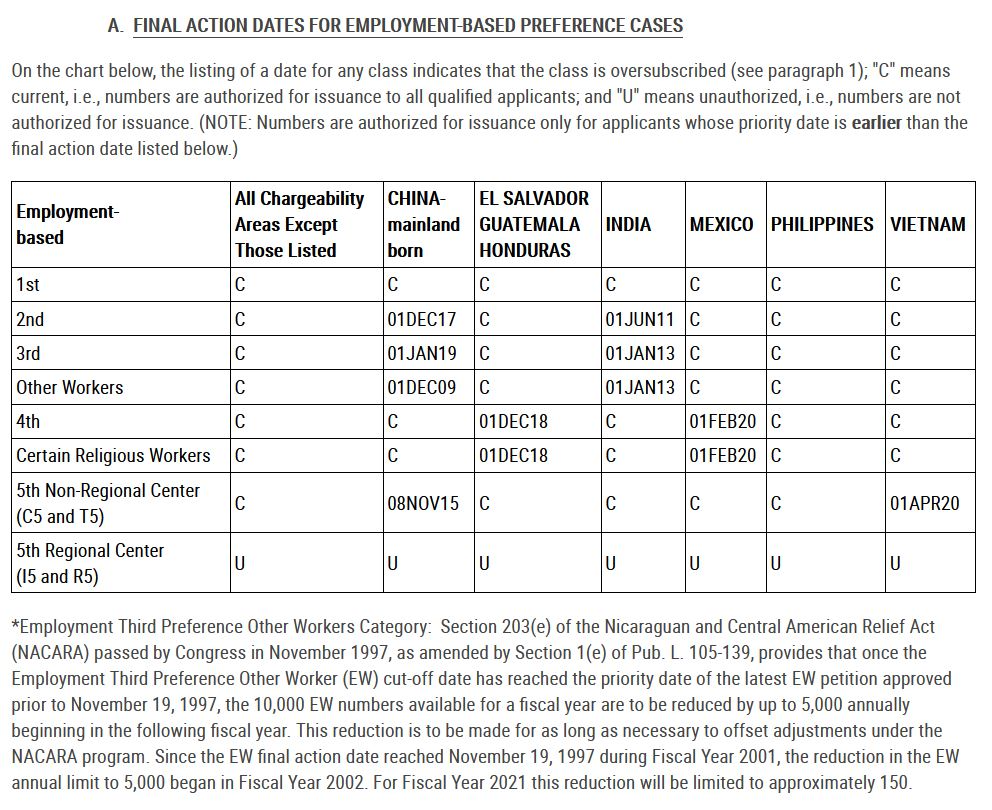
In Chart A, which displays the final action dates for June 2021, both China and Vietnam have advanced—hopefully a sign of good things to come for backlogged EB-5 investors. China’s final action date has advanced one month from August 15, 2015, to September 15, 2015. Vietnam’s, conversely, has moved ahead by two months, taking the date from February 15, 2018, to April 15, 2018. All other countries are current, including India, which has maintained its much-coveted “current” status for 11 months now. If this condition remains true in the July 2021 Visa Bulletin, it will mark one year since the south Asian country cleared up its backlog.

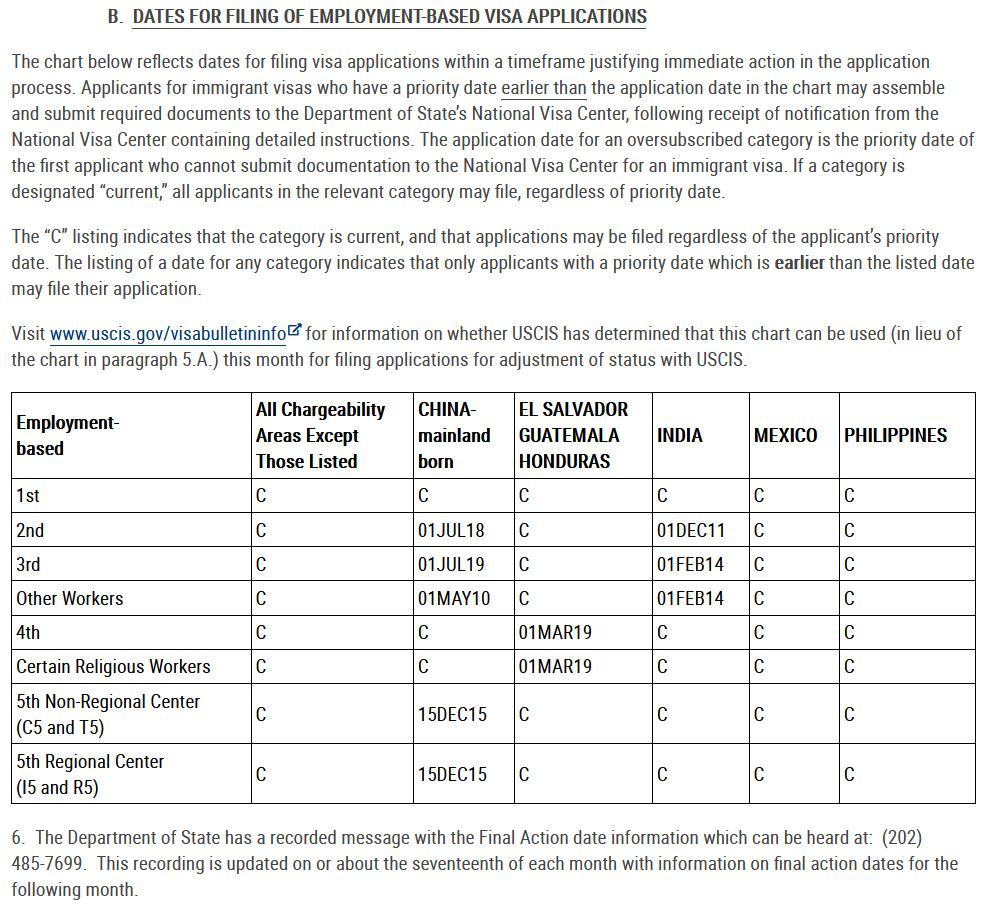
In Chart B, the news isn’t as good. While the Chinese final action date has finally advanced, there nonetheless remain countless Chinese nationals with active EB5 investments and approved I-526 petitions who are unable to file their application for an EB-5 visa. The Chinese date for filing has remained in place for more than a year, but with the advancement of the Chinese final action date comes hope for these EB-5 investment participants. If advancement in the Chinese final action date continues in future Visa Bulletins, advancement in the Chinese date for filing will be sure to follow—at least eventually.

Free EB-5 Project Evaluation

What Is a TEA, and Why Should You Make an EB-5 Investment in One?

What Is a TEA, and Why Should You Make an EB-5 Investment in One?

If a foreign national makes an EB-5 investment in a qualifying project and fulfills the various requirements laid out by United States Citizenship and Immigration Services (USCIS), they—and their immediate family members—will receive permanent resident status in the United States. In terms of qualifying for a green card, all EB-5 projects are equal—all successful EB5 investments lead to the same outcome. But depending on the type of project one invests in, their EB-5 investment journey may be simpler, easier, or more attainable. For many investors, this means making their EB5 investment in a targeted employment area (TEA).

A TEA is an area—usually a census tract or a conglomeration of census tracts—that Congress has determined to be particularly in need of economic stimulation and job creation. TEAs come in two flavors: high-unemployment TEAs and rural TEAs. Directing EB-5 investment capital into TEAs is, of course, in the government’s best interest, as it can drive economic growth in America’s most in-need communities. But thanks to a special incentive introduced by Congress, it’s also in the best interest of EB-5 investors, as it cuts the minimum required investment amount in half.

How Are TEAs Defined?

Rural TEAs are the easier of the two types to define and calculate. To be classified as a rural TEA, an area must simply house fewer than 20,000 inhabitants, not be within a metropolitan statistical area (MSA) as defined by the Office of Management and Budget, and not directly border a city or town with a population of 20,000 or more. The population statistics must be derived from the most recent ten-year U.S. census.

High-unemployment TEAs, however, are the more common of the two. To be considered a high-unemployment TEA, an area must be urban (i.e., not rural) and exhibit an unemployment rate of at least 150% of the national average. Historically, individual states designated TEAs, but regulation changes in July 2019 ushered in a new era, in which the Department of Homeland Security (DHS) oversees TEA designation. Under this system, individual investors are required to submit evidence to justify halving their EB5 investment amount.

High-unemployment TEAs are far more challenging to achieve designation for than rural TEAs. Investors must provide the most recent unemployment statistics for the area in question as well as for the United States as a whole. The measured period must be identical, and the data-collecting body must be the same. Generally, USCIS accepts American Community Survey (ACS) and Bureau of Labor Statistics (BLS) data, but both are imperfect—ACS data is available at the census tract level, but it spans five years. BLS data covers annual time periods, but it is only published at the national, MSA, and county levels. This typically leaves EB-5 investors with a choice: use the five-year ACS data solely, or combine the ACS and BLS data to derive a one-year unemployment rate estimate. While investors usually use BLS’s annual unemployment report, released each year in April, creating a rolling average using monthly BLS data over a one-year period may also be plausible.

Why Should EB-5 Participants Invest in a TEA?

EB5 investments aren’t cheap—a foreign national needs to inject at least $1.8 million into a non-TEA project to be eligible for a U.S. green card. When fees for immigration lawyers and, if applicable, EB-5 regional center operators are factored in, the amount is even higher. Depending on their country of origin, a foreign national may also need to spend some money obtaining the documentation to prove the lawful sources of their funds, a key requirement for any EB-5 investment. A minimum required investment amount of $1.8 million is simply too much for some investors.

When the minimum required investment amount is halved to $900,000, an EB-5 investment suddenly becomes much more affordable. Whether they can afford a $1.8 million EB5 investment or not, most investors feel more comfortable with the lower amount—but this incentive is only available to those who invest in a TEA project.

How Do Investors Prove TEA Designation?

When an applicant making an EB5 investment in a TEA project compiles their I-526 petition—the first petition filed by any EB-5 investor—they must enclose evidence justifying the TEA designation of the project. Regardless of the type of TEA they are working with, they must provide documentation showing where the project principally conducts business and maps that make clear the census tract(s) included in the proposed TEA.

If the TEA is a rural TEA, the investor must then show, based on the most recent ten-year U.S. census, that the area contains fewer than 20,000 inhabitants. If it is a high-unemployment TEA, the investor must provide the above-mentioned five-year ACS data, paired with BLS one-year data if desired, to show that the TEA has an unemployment rate at least 50% higher than the national average during the same period.

USCIS is aware that statistics and demographics can change, so even if the population or unemployment data of a given TEA changes after the submission of the I-526 petition, the investor is safe. However, any changes before the submission of the petition could jeopardize the TEA approval, so an investor must be careful to include the most recent data available.

Those who make an EB-5 investment through a USCIS-approved EB-5 regional center—and most EB-5 investors do—have an easier time with the TEA designation process, as the regional center will usually provide the necessary evidence to prove TEA designation. Investors can lean on the regional center’s expertise to craft a detailed TEA designation application with a maximized chance of success.

Free EB-5 Project Evaluation

Why Make an EB-5 Investment? Three Major U.S. Green Card Benefits

Why Make an EB-5 Investment? Three Major U.S. Green Card Benefits

Permanent resident status in the United States is something most people in the world can only dream of. Boasting the world’s largest economy, unparalleled freedom, and state-of-the-art health and education facilities, the United States is the number one destination of immigrants worldwide. The problem is that immigration is difficult, especially when it’s to such a sought-after nation. Most education- or employment-based visas come with stifling restrictions and only allow a temporary stay, with the visa holder obliged to return to their home country upon visa expiration. With permanent resident status, such obstacles can be avoided.

Some foreign nationals—especially those from visa-free or visa-waiver countries—may question the utility of an EB-5 visa when they can attend school in the United States (or send their children to school in the United States), purchase property in the United States, and vacation in the United States without permanent resident status. Indeed, permanent resident status isn’t required to take advantage of these opportunities. However, making an EB5 investment is worth it for a number of reasons—and savvy investors may even earn a handsome return on investment in the process.

Studying as a Green Card Holder: In-State Tuition Savings, Higher Admission Rates, Employment Freedom

It’s absolutely possible to earn a degree from a prestigious U.S. university as an international student—in fact, every year, hundreds of thousands of international students do. An F-1 student visa allows foreign nationals to enter the United States for the purpose of studying at their college of enrollment, but upon graduation, they must return to their home country or quickly find a company willing to sponsor them for an employment-based visa. F-1 visa holders are also severely restricted in the types of employment they may undertake in the United States, usually only able to take jobs offered by their university or required as part of their study program.

With an EB-5 visa, students are free to take any job during their studies, just as a U.S. citizen can. They can freely apply for internships and other positions to bolster their resume for their post-graduation job search, making them more employable than their peers on F-1 visas. Permanent residents also enjoy a less stressful job search after earning their degree, as they can stay indefinitely in the United States regardless of their success in securing employment.

Holding a green card also offers advantages before a student enrolls in a U.S. post-secondary education institute. Permanent residents applying to schools in their state of residence may be eligible for in-state tuition savings, which can save them tens of thousands of dollars a year. U.S. universities also favor U.S. citizens and permanent residents in the application process, making the admissions process easier and less competitive than for international students. Considering this, making an EB-5 investment could indeed be the difference between admission and rejection for a prospective student.

Investing as a Green Card Holder: Safer Investments, More Legal Protections, Easier Access

The United States allows individuals to purchase real estate, make investments, and deposit capital into bank accounts regardless of nationality or residency, but permanent resident status makes the process far easier and more secure. For one thing, having a green card would significantly facilitate travel between the United States and the foreign national’s home country, giving them more access to their own investments. These travel privileges extend beyond the United States to the various countries that hold travel treaties with the United States, so a foreign national may find that after making a successful EB-5 investment, they may travel visa-free to numerous countries they previously required a visa for. And not just that—an EB5 investment participant’s spouse and unmarried children below the age of 21 also gain these travel privileges.

Another advantage that permanent resident status offers to foreign nationals making investments in the United States is easy access to their U.S. bank accounts in the event of U.S. sanctions against their country. EB5 investments are particularly popular among nationals from politically unstable countries, and U.S. sanctions can be a major threat for temporary visa holders, but green card holders avoid such obstacles. Holding permanent resident status also offers a foreign national more legal rights in any legal procedures that may arise with their financial transactions.

Traveling as a Green Card Holder: Unlimited Stay, Freedom to Go Anywhere, Hassle-Free Entry to the United States

Every year, millions of foreign nationals flock to the United States for a visit—but visitor visas are the most restrictive of all. Visa waiver travelers can stay in the country for up to 90 days, and a B2 visa permits a maximum stay of six months (though an extension is possible). However, in both cases, travelers are extremely limited in what they can do while in the United States—study, employment, and paid performances are all forbidden.

Those who make an EB-5 investment and earn a U.S. green card, however, face no such restrictions. They may stay in the United States indefinitely and have the freedom to engage in any educational or employment activity they wish. They may also enjoy facilitated travel to countries with which the United States holds travel treaties, and they can always enter the United States easily by showing the border officer their green card.

Permanent residents do face one restriction that citizens do not: they must be careful spending too much time outside of the United States. To maintain permanent resident status, a green card holder must demonstrate an intention to permanently live in the United States, and this intention may be questioned if a permanent resident spends more than six months of a year outside of the United States. However, with strategic planning, after making a successful EB5 investment, a green card holder may split their time between the United States and their homeland, enjoying a life divided between the two countries.

Free EB-5 Project Evaluation

What Makes the EB-5 Program Better Than Most U.S. Immigration Programs?

important-decision-ahead-sign

All around the world, foreign nationals have their sights set on immigrating to the United States. There are indeed many immigration programs in the United States that allow talented foreign nationals to set up house in the land of the free, whether permanently or just for a temporary period. But not all U.S. immigration programs are made equal. Some offer clear benefits over others—and it just so happens that the EB-5 Immigrant Investor Program presents considerable advantages compared to many other U.S. employment-based immigration programs.

What Is the EB-5 Program?

The first thing one must understand about the EB-5 program is that it is not a conventional immigration program. The basic premise of the EB-5 program is that a foreign national makes an EB-5 investment in a qualifying project and, contingent on the fulfillment of program requirements, earns a U.S. green card, allowing them to live in the United States permanently. To avoid fraud and ensure the EB5 investment capital is used to the benefit of the U.S. economy, Congress has introduced a number of requirements for investors to satisfy.

One requirement involves the EB-5 investment amount. To be eligible for the EB-5 program, a foreign national must commit a minimum of $1.8 million to their chosen new commercial enterprise (NCE)—but this amount is halved to $900,000 if the NCE is located in a targeted employment area (TEA). Most EB-5 regional centers work exclusively or almost exclusively with TEA projects, so finding a suitable TEA project is relatively simple.

Further requirements include proving one’s EB5 investment capital is derived from lawful origins, which can be challenging and time-consuming, depending on the sources used. The best practice for proving the lawful sources of EB-5 investment funds is to hire an experienced EB-5 attorney. An attorney can also help a prospective investor select the best EB-5 project for their needs and assist them with conducting the necessary due diligence to maximize the chances of investing in an NCE that will meet the job creation requirements. Indeed, one of the most important requirements to United States Citizenship and Immigration Services (USCIS) is the creation of at least 10 new full-time jobs for U.S. workers, meaning EB-5 investments are a boon to the everyday American public.

The EB-5 program also offers a number of benefits that other U.S. immigration programs may not. Three are outlined below.

EB-5 Investors Can Come from Anywhere

Some employment-based U.S. programs restrict applicants by nationality. This is the case with, for example, the E-2 program, which issues two-year visas for substantial investments in U.S. companies by foreign nationals from treaty companies. Conversely, the EB-5 program offers any foreign national the opportunity to make an EB5 investment and gain permanent residency rights. It should be noted that certain nationalities are indeed disadvantaged, as backlogs for certain countries have resulted in longer waits for EB-5 investors from those countries. However, anyone is free to make an EB-5 investment.

An Investor’s Family Is Also Eligible for Green Cards

One of the most important benefits of the EB-5 program is that an investor’s immediate family members—defined as their spouse and unmarried children younger than 21—are also eligible for EB-5 visas. While some other U.S. immigration programs do allow minor dependent children to enter the United States with their parents, they must apply for permanent resident status on their own when they turn 18. EB-5 investor children gain permanent resident status simply as a result of their parent’s EB5 investment.

The advantages of permanent resident status for minors in the United States are many. EB-5 investors can send their children to public schools for free, immersing them in English and U.S. culture. When the children become college-aged, they will have an easier time gaining admission to U.S. universities, and they may be eligible for in-state tuition savings, depending on the school they are applying to. They will also be able to work freely during their studies, giving them a pronounced edge over F-1 visa students.

EB-5 Investors Can Earn Passive Income

The EB-5 Immigrant Investor Program is the only U.S. immigration program that offers foreign nationals immigrant status while earning them passive income. Most employment-based immigration programs offer status in the United States in exchange for an employed position at a U.S. company, but only the EB-5 program offers the same (or better) immigration benefits for a passive investment.

Not all EB5 investments are passive—if an investor elects to invest directly in an EB-5 project, they will be required to engage in the day-to-day management of the NCE. However, most program participants instead make their EB-5 investment through an EB-5 regional center, which allows them to sign on as a limited partner. Under such an arrangement, the investor needs only vote on important matters and are not even required to live near their project.

How much an investor can earn on their EB5 investment capital depends on the project, of course. However, an investor concerned about the return on investment should comb through the NCE documentation carefully and discern the interest rate. Traditionally, EB-5 investors have earned limited returns on their investments due to low interest rates, but the 80% increase in the minimum investment amount, as directed by the Modernization Rule enacted in November 2019, could result in higher investment amounts until EB-5 demand returns to pre-enactment levels. Thus, acting soon could allow an investor to earn higher-than-normal returns on their passive EB-5 investment.