


Free EB-5 Project Evaluation

Promoting the Positive Impacts of the EB-5 Program

The EB-5 Immigrant Investor Program has long been marred with stories of fraud and fakery, but the picture the media paints is far from the reality of the program. While there have indeed been cases of fraud in the EB-5 program—there will always be a minority of bad actors in the world—the vast majority of EB-5 projects involve honest businesspeople and entrepreneurs looking to establish a successful business that creates jobs in their community.

The negative press toward the EB-5 program has increased during the COVID-19 pandemic due to unfounded rumors that President Trump was considering relaxing EB-5 requirements as part of a coronavirus relief bill. Senator Lindsey Graham, who was purported to have headed the initiative, has vehemently denied the allegations, but the damage to EB-5’s reputation had already been done.

Combined with the extremely low adjudication volumes at the Immigrant Investor Program Office (IPO) in FY2019, the situation has fueled animosity toward the program domestically and doubt among prospective EB-5 investors abroad. If the EB-5 industry fails to take action, the future of the program could be in jeopardy.

Sharing Positive EB-5 Stories

EB5 Investors Magazine has decided to combat the negative press and launch an initiative to promote all the good impacts the EB-5 program has had on the United States and everyday U.S. citizens. Given the media stories of EB-5 fraud engraved in the public’s minds, the only way to fight back is with positive press showcasing the economic prosperity and jobs the EB-5 program has brought to the United States.

The magazine is inviting EB-5 regional centers and project companies to submit their stories of successful EB-5 projects that have brought benefits to the American people. The idea of the campaign is to show policy makers, industry professionals, prospective participants, and everyday U.S. citizens how the EB-5 program helps the United States and creates wealth and prosperity in the nation.

Holding USCIS Accountable

The negative press only accounts for a portion of the EB-5 program’s woes in 2020. The low adjudication rates at the IPO since the takeover by Sarah Kendall in FY2019 have been eroding trust and confidence in the program among investors and professionals alike, with some investors opting to pursue immigration programs in other countries instead. However, if United States Citizenship and Immigration Services (USCIS) is held accountable for its failure to do its job, the prospects for the EB-5 program may improve and investors may turn back to the program.

The IIUSA Public Policy Committee is preparing to confront USCIS about its slow and unreasonable adjudication practices in FY2019 and FY2020. Requests for evidence (RFEs) and notices of intent to deny (NOIDs) have been issued with increasing frequency under Kendall’s leadership, and a trend of unreasonable requests in these documents has emerged. If you have received an unreasonable request in an RFE or NOID, please black out the personal information and send the document to education@iiusa.org.

Calling on Congress to Recognize the Merits of the EB-5 Program

IIUSA has a second initiative: a public letter of support for the EB-5 program addressed to Congress. The letter details the many benefits the EB-5 program has brought to the United States, including generating $20.6 billion in investments and 731,792 jobs between 2008 and 2015. EB-5 stakeholders, project developers, and businesses all around the country are invited to voice their support for the EB-5 program and all the good it brings to the United States.

Free EB-5 Project Evaluation

What Happens to an EB-5 Petition If the Investor Dies?

The EB-5 Immigrant Investor Program offers a unique opportunity to foreign investors and their immediate family members to obtain U.S. permanent resident status in exchange for a successful qualifying investment in an EB-5 project. An investor can include their spouse and unmarried children younger than 21 on their EB-5 visa application.

At the end of the EB-5 process, the entire family can receive permanent resident status in the United States by each filing an I-829 petition. Investors and their families file the I-829 petition after two years of conditional permanent residency and may remove the conditions if the investment met all the EB-5 criteria, such as the creation of at least 10 new, full-time jobs for U.S. workers.

Unfortunately, however, sometimes an investor may pass away during the EB-5 process. This leaves their dependents not only riddled with grief but also unsure about the future in the United States they had been looking forward to.

Special Legislation for Deceased EB-5 Investors

New legislation to address the concerns of EB-5 families in the event of the primary applicant’s death was enacted in 2009 as part of the Immigration and Nationality Act (INA). The statutory provision, INA 204(l), permits a deceased investor’s dependents to apply “adjustment of immigration benefit” under certain conditions. The main condition is that the investor meets the definition of the term “qualifying relative,” which INA 204(I) does not define. Thus, United States Citizenship and Immigration Services (USCIS) decides who meets the criteria of a “qualifying relative.”

What Are the Requirements to Be a Qualifying Relative for the EB-5 Program?

The term “qualifying relative” refers to the main applicant, not to their relatives who are included in the application. USCIS defines a “qualifying relative” as someone who had applied to the EB-5 program shortly before their death, regardless of whether their petition is pending or approved at the time of death. Spouses and unmarried children younger than 21 of such investors may be eligible to receive EB-5 visas based on their relationship to the qualifying relative.

Eligible family members of qualifying relatives may proceed with their application for a U.S. green card if they satisfy the necessary residency requirements. Fundamentally, qualifying family members will be permitted to proceed with their immigration to the United States as if the principal applicant had not died. It’s not necessary for all family members to meet the residency requirements as long as one does.

What Does the Residency Requirement Entail?

The residency requirement consists of two conditions:

  • The family member must have been living in the United States when the qualifying relative passed away.
  • The family member must continue to live in the United States following the death of the qualifying relative.

The family member is allowed to have been temporarily abroad at the time of the qualifying relative’s death. The key requirement is that their principal dwelling place was in the United States.

Removing Conditions from Conditional Permanent Residency

Matters are trickier in the case of a recent marriage, given the existence of fraudulent marriages to dishonestly obtain U.S. permanent resident status. If the spouse of an EB-5 investor receives conditional permanent resident status as the result of a recent marriage to the investor and the investor then dies, USCIS will investigate the legitimacy of the marriage before granting unconditional permanent resident status to the bereaved spouse.

USCIS’s Discretion to Deny

Whether the dependent family members of a deceased EB-5 investor are granted U.S. permanent resident status is ultimately determined at the discretion of USCIS officers. Even if a family member seems to satisfy all the relevant requirements, USCIS may still decide to deny their application.

EB-5 is a complicated program to begin with, and the death of an investor only complicates matters further. Any family members bereaved of an EB-5 investor who was a qualifying relative should contact an immigration attorney to help them determine what options are available to them.

Free EB-5 Project Evaluation

What Can You Do If Your EB-5 Petition Is Denied?

For the countless foreign investors around the world who wish to relocate to the United States, the EB-5 Immigrant Investor Program is one of the best options. Established in 1990, the program offers foreign investors permanent resident status in the United States for themselves and their immediate family members in exchange for an investment in a qualifying EB-5 project. The program has surged in popularity as a relatively quick and easy means to U.S. immigration.

One of the reasons the program is popular is that it does not require a sponsor. Many employment-based immigration programs require petitioners to find an employer to sponsor them, which is a difficult task, but for the EB-5 program, applicants simply need to possess the required $1.8 million or $900,000, depending on the targeted employment area (TEA) status of the EB-5 project. Avoiding the need to find a sponsor also renders the EB-5 program a quicker immigration program than most others.

Why Your EB-5 Petition Might Be Denied

While the EB-5 program is generally easier than other immigration programs, approval is not guaranteed. As an EB-5 investor, you can face rejection for a variety of reasons, including the following:

  • Failing to provide necessary information on the I-526 or I-829 petition
  • Failing to provide required documentation, such as a copy of your birth certificate or passport
  • Failing to pay the required fees
  • Providing inaccurate or inconsistent information
  • Failing to invest the required $1.8 million or $900,000 in an EB-5 project
  • Investing in a project that doesn’t qualify for the EB-5 program
  • Failing to document that your EB-5 capital was obtained lawfully
  • Failing to show that your EB-5 capital is at risk for the duration of the investment
  • Failing to meet or failing to provide a business plan that shows how you plan to meet the EB-5 job creation requirement

You can minimize your chances of rejection by paying close attention to the above criteria and working closely with your immigration attorney to ensure strict adherence to EB-5 requirements.

How to Handle an EB-5 Rejection

If you do receive a denial, your EB-5 journey is not necessarily over. While the experience is disheartening and discouraging, there may still be actions you can take to salvage your relocation to the United States.

If you receive a denial notice from United States Citizenship and Immigration Services (USCIS), read it carefully. USCIS explains why your petition was denied and provides resources you may consult going forward. Work closely with your immigration attorney and legal advisor to determine the best course of action for your circumstances. Appropriate courses of action may include filing a legal motion, submitting an appeal, reapplying to the EB-5 program, or looking for alternative routes to immigration.

Filing a Legal Motion

If you have substantial new evidence that could persuade an adjudicator to approve your EB-5 petition, you may be eligible to file a legal motion. A legal motion requests the officer who adjudicated your petition to reevaluate it. You may also file a legal motion if you believe the adjudicator made an erroneous judgment in denying your petition, but you must back up your belief with an in-depth explanation. In this case, you should work with an immigration attorney who has experience working with EB-5 investors and is deeply familiar with EB-5 immigration laws.

Filing an Appeal

If you are unable to file a legal motion, or if you do but it is unsuccessful, you may be able to file an appeal against the denial of your EB-5 petition. Appeals against EB-5 denials are generally presented to the Administrative Appeals Officer.

Filing a New EB-5 Application

If your I-526 petition was denied for certain reasons, you may have success with a new application. For example, if your petition is denied because you invested in an ineligible project, you can simply submit a new petition with an investment in a qualifying EB-5 project.

No matter why your petition was rejected or what your options are going forward, working with an immigration attorney is vital. The EB-5 program is incredibly complicated, and if you aren’t familiar with all the intricate rules, success in the face of denial is wholly unlikely.

Free EB-5 Project Evaluation

Will EB-5 Investors Still Want to Immigrate After COVID-19?

The COVID-19 pandemic, an unprecedented crisis in the modern world, has changed the world as we know it. The health crisis has already deeply affected the EB-5 Immigrant Investor Program, forcing the temporary closure to the public of United States Citizenship and Immigration Services (USCIS) offices across the nation and the suspension of routine visa services at U.S. embassies and consulates around the world. As the world begins to lift restrictions and emerge from the pandemic, how will international travel and immigration be affected?

While we have never experienced a pandemic of this magnitude in modern times, we have experienced other crises that have affected travel and immigration demand. The September 11 terrorist attacks initially spurred a major decrease in travel demand, but the dip lasted only a few years before people’s wanderlust returned. Travel and immigration were hit again in 2008, when the global recession saw countless trips canceled and reduced travel budgets at corporations, but again, a few years later, consumers and companies alike took to the roads—and sky—once more to travel around the world.

Neither of these crises caused the same level of global disruption as COVID-19 has, so it may take longer for the travel and immigration industries to recover this time—but nothing is certain. The pandemic has remained unpredictable since its debut, and the aftermath may be equally as unpredictable. Airlines, hotels, restaurants, and other travel-related industries have been hit particularly hard by the shutdowns, but at the same time, people have expressed a desire to travel after being confined to their homes for so long. As the crisis begins to subside and people feel safer and safer, more and more of them will regain their desire to travel and immigrate.

Coming out of the pandemic, some foreign investors may be dissatisfied with the way their country handled the crisis or feel insecure about the poor-quality medical infrastructure in their homeland. They may feel safer in the United States, which boasts the world’s most advanced medical facilities. Coupled with the nation’s world-renowned educational institutions and world-class business opportunities, immigrants will continue to set their sights on the United States for a new and better life.

The EB-5 Program Will Facilitate Immigration After COVID-19

Immigration even outside of a pandemic is a difficult and complicated process. For foreign investors who wish to relocate to the United States, the EB-5 program is one of the fastest and easiest ways to achieve this dream. While countless EB-5 investors have had their new lives put on hold because they couldn’t apply for visas due to the consulate closures, the world is beginning to open back up. On June 4, USCIS began reopening its U.S. offices to the public, allowing appointments and other in-person services that had been suspended during the shutdowns.

Prospective EB-5 investors interested in the program should consult with an immigration attorney to discuss the best options for them. For an investment of $1.8 million or $900,000—depending on the targeted employment area (TEA) status of the EB-5 project—they can gain U.S. permanent resident status for themselves and their immediate family members. Indeed, a post-pandemic life in the United States would spell a brighter future for countless families around the world.

Free EB-5 Project Evaluation

What USCIS’s Case Processing Times Mean

On the United States Citizenship and Immigration Services (USCIS) website, EB-5 investors and regional centers can check the estimated processing time range for their I-526, I-829, and I-924 petitions on the Check Case Processing Times page. The page is constantly updated, and as of June 4, 2020, USCIS gives the following estimates for processing times:

I-526: 29.5 to 44.5 months (2.5 to 3.7 years)

I-829: 21.5 to 47 months (1.8 to 3.9 years)

I-924: 58.5 to 119 months (4.9 to 9.9 years)

Investors can also check the estimated processing times for their I-485 petitions, but the times vary by regional office.

One might assume an estimated processing time range of 29.5 to 44.5 months means USCIS is currently processing petitions that have been pending for 29.5 to 44.5 months, but that isn’t the case. “Estimated processing time range” is a bit of a misnomer because the majority of petitions are processed outside of the estimated range.

What the Range Really Means

The estimated processing time range is more an indicator of delays rather than an estimation of average processing times. The lower number in the range is the time by which 50% of petitions have been processed, and the higher number is the time by which 93% of petitions have been processed. Assuming perfect accuracy, this means only 43% of petitions are processed within the estimated time range.

However, naturally, the time ranges are not perfectly accurate. The EB-5 Immigrant Investor Program is far too complicated to predict such metrics with high precision, and the estimates are based on data from two months prior. The most an EB-5 investor can take away from the estimates is a very general idea of when their petition might be processed.

Understanding the Receipt Date for Case Inquiry

It’s no secret that some EB-5 investors are left waiting a considerable period of time for their petition to be adjudicated. The process is particularly complicated for I-526 petitions, since the adjudication process is anything but linear and USCIS introduced a visa availability approach to I-526 processing at the end of March that sees petitions adjudicated based on the immediate availability of visas for the applicant’s country rather than the date of receipt.

To address unreasonably long delays, USCIS offers a “receipt date for case inquiry”—the date before which USCIS must have received a petition before the petitioner is permitted to send a case inquiry. USCIS uses the higher number of the estimated time range (i.e., the time by which 93% of petitions have been adjudicated) to define the case inquiry date. Why USCIS designates only the 7% of petitioners with extremely long processing delays for case inquiries is unclear when those whose petition has been pending for longer than the lower number are also experiencing a longer than average processing period.

Why the Receipt Date for Case Inquiry Can Move Erratically

EB-5 investors who watch the case inquiry date for the chance to inquire about their unusually delayed petition are often confused by the erratic nature of the date, which can sometimes move ahead suddenly or move backward. It seems strange because generally, the date moves steadily, increasing by one day at a time.

The answer is simple: The receipt date for case inquiry is updated automatically each day, but the estimated case processing times are not. The case processing times are updated at irregular intervals, and since the receipt date for case inquiry is based on the upper limit of the range, it can seem like the case inquiry date suddenly jumps significantly at random times.

Historical Average Processing Time vs. Estimated Processing Time Range

Many EB-5 investors have also pointed out the clear discrepancies between the historical average processing time and the estimated processing time range. While it may initially seem confusing, the first thing that’s important to note is that the estimated processing time range is measuring petitions processed two months earlier and the historical average processing time is measuring the average age of petitions currently pending. Since the metrics measure different things, a bit of discrepancy is only natural.

The second thing that’s important to understand is that, as discussed above, the estimated time range does not indicate the mean average processing time but rather the median. Petitions processed unusually quickly or slowly can skew the overall numbers for the mean average but not for the median, which can sometimes result in large discrepancies.

Detailed Data for FY2019 Q1

USCIS doesn’t release detailed data for most quarters, but it did release a comprehensive report on the figures for October to December 2018 (FY2019 Q1). The period reveals a stark difference between the estimated processing range and the actual processing times. Although USCIS gave an estimated processing range of 20.6 to 26.5 months for I-526 petitions, the majority of petitions were adjudicated within 10 to 15 months. The figures make clear the truth of USCIS’s nonlinear processing tendencies.

Graph showing number of pending I-526 Petitions that were or were not processed from October 2018 to December 2018.

Free EB-5 Project Evaluation

A Guide to Understanding the Monthly Visa Bulletin

A group of figurines in front of a United States flag.

The U.S. Department of State’s Monthly Bulletin, also called the Visa Bulletin, is a key source of visa availability information for foreign nationals who want to move to the United States. Every month, the U.S. Department of State – Bureau of Consular Affairs releases an update with charts that show which foreign nationals are eligible to apply for and receive visas.

Applicants who invest under the EB-5 Immigrant Investor Program can track their visa applications and find out when they can apply for adjustment of status to become lawful permanent residents.

However, the EB-5 process is complicated. The information in this monthly Visa Bulletin is easy to misunderstand.

This article will provide information regarding the Visa Bulletin in the context of the EB-5 program.

Why Do We Need a Visa Bulletin?

A person in a suit holding a computer.

A Visa Bulletin is important because many people want visas, but not everyone can get one when they want one due to backlogs. These delays happen when there is greater demand for immigrant visas than supply in a certain category or from a certain country.

The U.S. government generally limits the number of visas available to EB-5 applicants from each country. When there are too many applicants for the available supply, the visas are oversubscribed. Qualified applicants must wait until more visas are available before their applications can be adjudicated.

If visas are oversubscribed, something called visa retrogression can happen. Retrogression means the priority dates for a visa category move backward. The State Department “retrogresses” priority dates to make sure annual limits are not exceeded. This means applicants have to wait until their priority dates become current again before their applications can continue to move through the process.

By reading the Visa Bulletin, an investor can sometimes receive warning of retrogression before it happens and gain a better understanding of the process for determining visa availability.

How to Read the Visa Bulletin

To improve your chances of having your petition accepted, study the structure of the Visa Bulletin carefully.

Here are some key terms you should be familiar with.

Visa Categories

The Visa Bulletin groups visas by their particular category, such as family-sponsored or employment-based preference categories. The family preference category is for those who are related to U.S. citizens or lawful permanent residents. Employment-based preference applicants have special skills or qualifications.

Some individuals also fall under other categories, such as the Diversity Visa Lottery Program, Special Immigrant Visas, or adjustment of status applicants.

Priority Date

A hand circling some important dates on a digital calendar.

A priority date—also called a priority number—is the date when the immigrant petition is submitted to the United States Citizenship and Immigration Services (USCIS) or the Department of State. Like a place in line, it determines when an applicant can move forward with their application.

Different visa categories and countries have different priority dates. The application can advance in the process when the priority date is earlier than the listed final action date and becomes “current.”

Current

This means there are enough visas under a visa category and country for all applicants. There is no backlog. Applicants who have received approvals of their petitions can move forward in the process without delay.

Chargeability Area

This is the country or region used for processing an individual’s visa application. This is usually the applicant’s country of birth. This information helps to determine visa availability and priority dates.

Immediate Relative

Generally applies to a spouse, unmarried child under the age of 21, or parent of a U.S. citizen or lawful permanent resident. Immediate relatives are prioritized in the immigration process and are not subject to quotas, so these categories are usually displayed as “current” in the Visa Bulletin.

Cut-Off Date

If an individual’s priority date is earlier than the listed cut-off date, they can continue with the visa application process. Cut-off dates are displayed under the “Final Action Date” section of the Visa Bulletin.

Final Action Date

The Visa Bulletin contains information for each immigrant visa category and country related to the “Final Action Date.” This is the cutoff date for when an individual who has an approved immigrant petition (Form I-526 or Form I-526E) can adjust status, provided they are physically located in the United States.

Dates for Filing

A person holding a stack of documents on a desk.

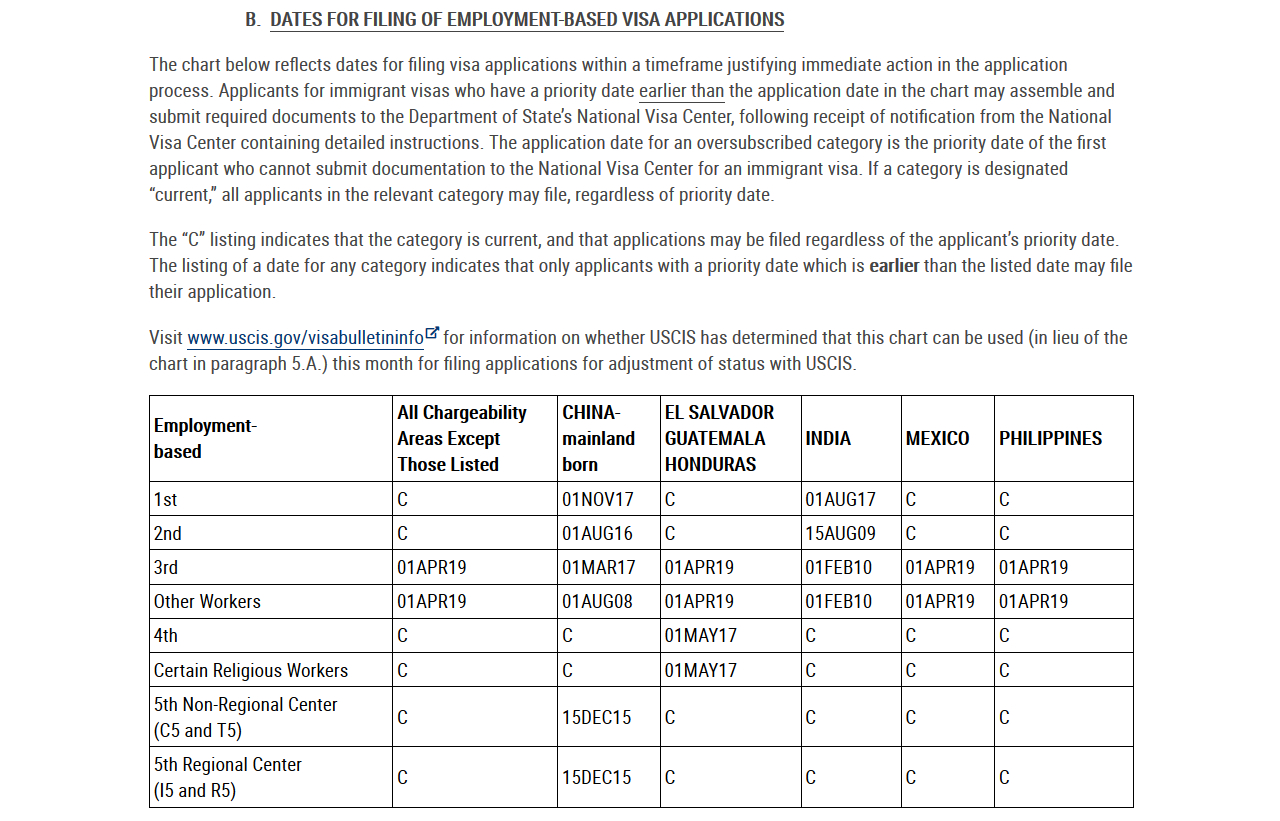
This shows when individuals can start the visa or adjustment of status application process before visas are available. This information is mainly for those who are applying from outside the United States, and shows when required documents can be mailed to the State Department’s National Visa Center.

Country-Specific Columns

Each of these columns reflects a country where demand for visas is high, so waiting times are likely to be longer for applicants from these countries. The column has information about visa processing such as final action dates and dates for filing for that country or region. An applicant can look up their country in this column and better track their own application or find out when they can continue the application process.

What Does the Visa Bulletin Say About the EB-5 Program?

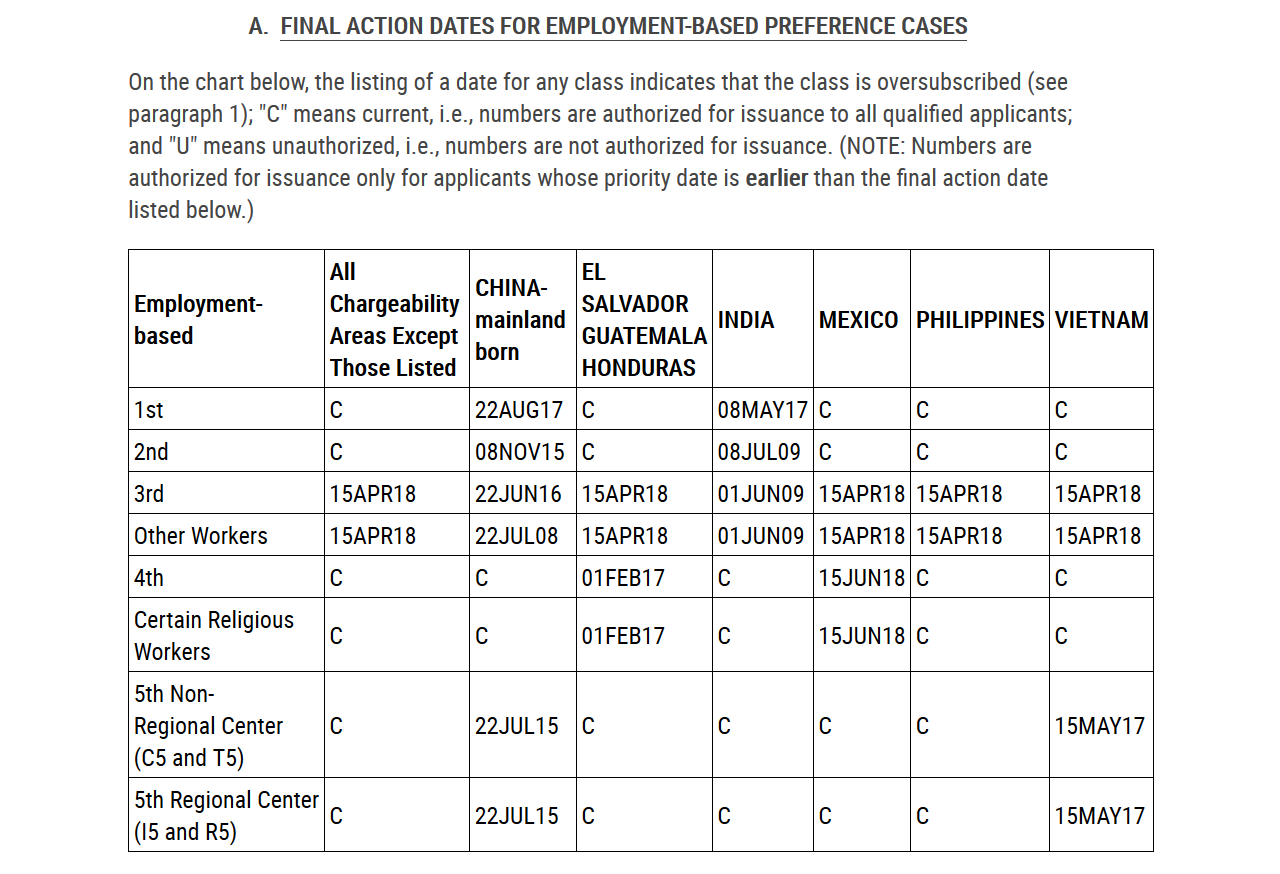
Below are the final action dates for employment-based visas from the April 2024 Visa Bulletin.

A table showing the April 2024 Visa Bulletin, also known as USCIS monthly bulletin.

The chart deals with the final action dates for all employment-based visa programs, but only the bottom four rows are relevant for EB-5 investors.

EB-5 investors should understand the differences between unreserved and set-aside visas.

Unreserved

Ordinarily, the Immigration and Nationality Act restricts the number of available EB-5 visas to no more than 7% of the total for each participating nationality outside the United States. That number applies to “unreserved” visas.

To qualify for an unreserved visa, an individual must invest at least $1,050,000 in a new commercial enterprise that creates at least 10 full-time jobs for American workers.

Investors under the unreserved category are more likely to face visa retrogression.

As mentioned earlier, sections marked with “C” indicate applicants from the specified country have a current final action date. All investors who have been accepted to the EB-5 program from that country are currently eligible to receive an EB-5 visa. In the April 2024 visa bulletin, only investors from China and India are subject to wait times—all other countries are current.

All investors who filed their I-526E or I-526 petition before the indicated final action date are eligible to proceed with their EB-5 visa process. For example, a Chinese investor who filed for an unreserved visa before December 15, 2015, is now eligible to receive their conditional permanent resident status, but one who filed for an unreserved visa on or after December 15, 2015 must continue to wait.

Reserved

There is a way for EB-5 investors to avoid the 7% cap. They can do this by pursuing a reserved visa instead. This is especially important for investors from populous, high-demand countries like China and India.

To qualify, an individual can invest a lower amount of at least $800,000 in a new commercial enterprise located in a targeted employment area (TEA).

Every fiscal year, 32% of EB-5 visas are reserved for those who invest in TEA projects. Most TEAs are for projects located in rural or high-unemployment areas. The allocations are as follows:

  • 20% for rural projects.
  • 10% for high-unemployment projects.
  • 2% for public infrastructure projects.

As per the latest Visa Bulletin at the time of writing, all reserved categories are current.

Current Status Doesn’t Automatically Mean Your Application Will Proceed

A stack of files on a table, symbolizing an EB5 visa backlog.

Not all investors who filed their I-526 or I-526E petition before the final action date can move forward with their EB-5 process. Here are some examples of such situations.

Problems With the Immigration System

A good example is the worldwide U.S. consulate closures that happened during the first year of the COVID-19 pandemic. This prevented overseas EB-5 investors from getting visa interviews, effectively putting their applications on hold.

In practice, the only investors who could receive EB-5 visas in June 2020 were those already living in the United States who had filed an I-485 petition to adjust their immigration status. These investors did not need a consulate interview to proceed with their application.

Form Processing Delays

A “qualified” investor is one who has received I-526E approval and gone through the necessary processes to apply for an EB-5 visa. However, even if an investor’s final action date is current, they must still fulfill the requirements to qualify for an EB-5 visa.

Failing to meet these requirements or submitting incorrect or incomplete documentation can cause processing delays.

Large Volume of Applicants

A large number of applications at an overloaded and understaffed USCIS field office can also contribute to delays.

How People Think the EB-5 Process Works

Contrary to popular belief, the EB-5 process is not exactly sequential. It’s easy to assume that those with earlier priority dates will receive their EB-5 visas earlier.

However, the EB-5 program is too complicated for such a simple process, and as explained above, some investors fall behind in the system for numerous reasons.

The diagram below shows the way most people assume EB-5 processing works.

12 investors wait in line according to priority number after filing petition to get visa with final action number of 4.

In this scenario, each EB-5 investor receives a priority number when they file their I-526E petition. The investors wait in line according to their priority number. The posted final action number in this scenario is 4, which means the first three applicants can receive their visas.

If the final action number continues to increase by three per month, all 12 investors will receive their visas within four months. In this hypothetical scenario, investors can easily predict when they will receive their visa based on their priority number, since it is a sequential process.

Unfortunately, as mentioned earlier, this scenario doesn’t reflect reality.

How the EB-5 Process Actually Works

The scenario below shows that an investor’s priority number does not necessarily predict when they will receive their EB-5 visa. The priority number plays a role only within different stages of the process.

12 investors with nonsequential priority numbers wait in 3 groups after filing visa petition with final number of 10.

In the second scenario, all investors receive a priority number when they file their I-526E petition, just like in the first scenario. However, instead of waiting in a single line, the applicants are divided into groups.

Some investors’ petitions are delayed. This can happen for a number of reasons, including complicated sources of funds documentation or requests for evidence (RFEs). Since these delays do not adhere to the priority numbers, some applicants with earlier priority numbers fall behind, while others with later numbers move forward.

Even once an investor’s I-526E petition is approved, they still may not be eligible to receive a visa. As previously noted, it may take them a long time to compile and submit their visa application, or they may be unable to schedule a visa appointment—such was the case for overseas EB-5 investors faced with U.S. embassy and consulate closures during the first year of the COVID-19 pandemic.

Thus, the only investors in a position to claim a visa are those in the final group. This is the only group the Visa Bulletin refers to. Applicant 10 is the first investor in this group who is unable to claim a visa, so the final action number is set at 10. In this way, even though the final action number in this scenario is 10, investors 2, 4, 5, 7, 8, and 9 are ineligible to claim their visas. If those investors had also been eligible to claim, the final action number would have been 4 instead.

If these investors become eligible to claim a visa in the next month, the final action number will fall back to a lower number, such as 7, to account for the new applicants. Investor 10 should not have necessarily expected their priority number to become current because retrogressions like this can happen anytime.

While messy, this scenario is more reflective of the real EB-5 process. Unfortunately, prediction is extremely difficult, and there’s no surefire way for investors to know when they’ll receive their EB-5 visa.

Get Your Green Card With EB5AN

A hand holding a green card with the EB5AN logo on it.

Tracking the Monthly Visa Bulletin is a good idea for prospective Green Card applicants who plan to obtain lawful permanent resident status in the United States through the EB-5 program.

Working with EB-5 professionals who have a long track record of success is a great idea.

EB5AN has helped more than 2,300 families from 60 countries relocate to the United States as lawful permanent residents. Our expert team has more than a decade of experience, and offers clients first-rate, low-risk EB-5 regional center projects with 100% USCIS project approval rate to date.

Book a free call with us today to find out more.

Free EB-5 Project Evaluation

USCIS Offices Slated to Reopen: June 2020 EB-5 News

On March 18, 2020, United States Citizenship and Immigration Services (USCIS) closed all its offices to the public to help curb the spread of COVID-19. Nonetheless, USCIS continued to adjudicate I-526, I-829, and I-485 petitions for EB-5 investors because they do not require face-to-face contact. With the pandemic beginning to subside and the country starting to reopen, USCIS is planning to reopen its offices on or after June 4 and resume in-person services in accordance with health guidelines.

Individual offices may remain closed, so USCIS urges EB-5 investors to check its office closures page to check the status of the office in their area. Limited emergency in-person services are, however, available at all locations. Those who require emergency services should contact the USCIS Contact Center.

All visitors are expected to follow the new health and safety guidelines to avoid new COVID-19 infections. USCIS plans to reduce the number of appointments and interviews to adhere to the new guidelines, which is likely to lead to slower service than before the pandemic.

Finally, USCIS urges anyone who feels sick, even if they haven’t tested positive for COVID-19, to reschedule their appointment. Individuals who reschedule their appointment due to sickness will not incur a penalty.

Final Action Dates Move Forward in June 2020 Visa Bulletin

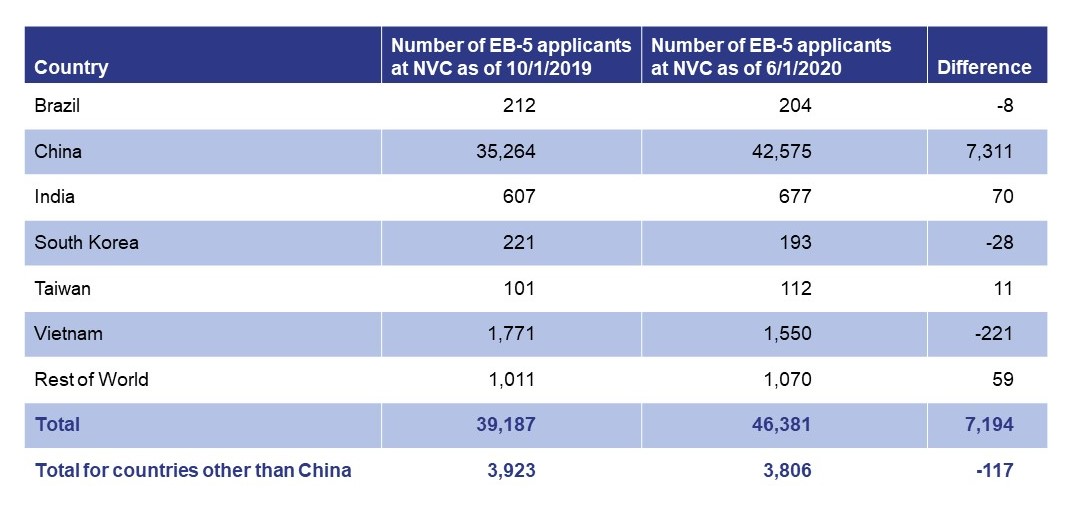
The final action dates for Chinese, Indian, and Vietnamese EB-5 investors have all moved forward in the June 2020 Visa Bulletin. India, which has experienced major leaps forward in recent months, continues to move ahead quickly. With a final action date of January 1, 2020, India is likely to become current by summer 2020, in line with USCIS predictions. However, retrogression is possible in the future, since USCIS has announced they are using the final action dates for I-485 petitions.

Webinar with Charles Oppenheim

On June 16, Charles Oppenheim, the chief of the Visa Control and Reporting Division at the U.S. Department of State, intends to hold a webinar with IIUSA to discuss the allocation of EB-5 visas during the COVID-19 pandemic. The webinar is expected to address the recent leaps forward in the final action dates, particularly for Indian EB-5 investors, as well as discuss what will happen if not all the visas allocated for EB-5 investors are issued in FY2020.

Free EB-5 Project Evaluation

How is COVID-19 Affecting EB-5 Processing and Visa Availability?

Though the COVID-19 pandemic has brought the world to a standstill, with economic shutdowns across the United States and other countries, the EB-5 Immigrant Investor Program continues on. The pandemic has caused United States Citizenship and Immigration Services (UCSIS) to temporarily close its offices to the public all across the nation, but since application processing doesn’t require face-to-face interaction with the public, it has continued to adjudicate I-526, I-829, and I-485 petitions throughout the crisis.

As of June 1, 2020, USCIS is preparing to reopen its offices to the public on or after June 4. However, even after the reopening, USCIS still plans to offer deadline extensions for requests for evidence (RFEs) and notices of intent to deny (NOIDs) issued between March 1 and July 1. USCIS has announced on its “Response to COVID-19” page that responses to such notices received within 60 days of the deadline stipulated on the notice will be accepted and considered.

What will happen with the EB-5 program going forward in 2020 is anyone’s guess. The modern world has never experienced a pandemic of this magnitude before, so the consequences are impossible to know. Nonetheless, it’s possible to make some predictions about what could happen.

More Lawyer Involvement in EB-5

The Immigrant Investor Program Office (IPO) recorded famously low I-526 adjudication rates in FY2019, with productivity dropping as much as four times compared to FY2018. The stark difference in processing volumes can largely be attributed to the management of Sarah Kendall, who took over the IPO in FY2019. The unprecedently low processing volumes have caused headaches for EB-5 investors and eroded trust in the program, and this situation may be a factor in the sudden drop in EB-5 demand in India.

In 2019, the IPO got away with essentially failing to do its job, but that may change in 2020. With almost the entire world on lockdown, lawyers have little to do in 2020, so they may set their sights on the EB-5 program, turning investor lawsuits against USCIS into one of their few viable sources of income during the crisis. Indeed, the delays are unreasonably long and are jeopardizing the EB-5 program’s ability to foster economic growth and revitalization, and EB-5 investors forgotten by the system have a right to recourse. The best strategy for the IPO would be to take the opportunity the pandemic has afforded it to start clearing up the backlog and avoid the lawsuits that might pour in otherwise.

EB-5 Visa Availability for Consular Processing

With all U.S. embassies and consulates suspending routine visa processes, consular EB-5 processing has come to a halt. Visa appointments have ceased, so overseas EB-5 investors can do nothing but wait for the pandemic to pass and the consulates to resume services. As of June 1, 2020, the U.S. consulates in China, India, and Vietnam have all yet to announce plans to resume visa appointments, meaning the wait for EB-5 investors will continue for the foreseeable future. Thus, even though EB-5 visas can still legally be issued, the consulate closures prevent this from happening.

In October 2019, the beginning of FY2020, the Department of State announced that 11,112 EB-5 visas were available for FY2020. It further explained that India and Vietnam could both receive 778 visas and Chinese EB-5 investors could receive an estimated 5,270 leftover visas. Under normal circumstances, the yearly available visas are distributed roughly equally throughout the year—one quarter per quarter—but the worldwide consulate closures make this even distribution impossible in 2020, with the actual numbers vastly lower than the expectations in October 2019.

Chart showing a lower-than-expected number of EB-5 visas issued to China, India, and Vietnam as of April 30, 2020.

Possible Routes of FY2020 EB-5 Visa Processing

Given the COVID-19 pandemic and the U.S. consulate closures, FY2020 is anything but a normal year for the IPO. Only time will tell how EB-5 visas are ultimately issued, but a few scenarios are possible:

Visas Could Go to Domestic EB-5 Investors

Not all EB-5 investors invest from overseas—some already live in the United States on different visas and claim their EB-5 permanent resident status by filing Form I-485 to adjust their immigration status. Since USCIS doesn’t release information on pending I-485 petitions, it’s not clear how many domestic EB-5 investors are available to claim visas, but previous years have shown that domestic applicants account for only a small minority of all EB-5 investors. Furthermore, the rapidly advancing final action dates in the months of the pandemic suggest that the I-485 backlog may be fairly small. Thus, even if the I-485 backlog is entirely cleared up, there are likely to still be many leftover visas.

Visa Processing Might Catch Up by the End of the Fiscal Year

If the U.S. embassies and consulates reopen soon enough and catch up on all the visa appointments they missed during the pandemic, USCIS may be able to pick up the pace and issue all the available visas before the fiscal year ends on September 30, 2020. Different embassies and consulates may reopen at different times, but the most important are the ones in China, as Chinese investors account for the largest EB-5 backlog.

Visas Might Roll Over to EB-1 FY2021

If, conversely, the consulates remain closed for a while yet, it’s unlikely that they can catch up to demand before the end of FY2020. If USCIS can’t issue all the allocated EB-5 visas before September 30, 2020, the leftover visas will roll over to EB-1 in FY2021, and the EB-5 program will suffer a loss of visas in FY2020, further aggravating the backlogs.

Free EB-5 Project Evaluation

Why Aren’t All I-526 Petitions Adjudicated in the Same Time Frame?

It can be frustrating for EB-5 investors to wait a long time for their I-526 petition to be adjudicated, especially when they see other investors around them receiving adjudication. Since the EB-5 Immigrant Investor Program is complicated, every petition is different and therefore requires a different process and timeline for adjudication. This can result in some EB-5 investors waiting far longer than others, even if they have invested in the same EB-5 project.

There are several reasons why one EB-5 investor’s I-526 petition may take longer to adjudicate than another’s. Some are within the investor’s control, although some are not.

Adjudicator Differences

Just as all EB-5 investors are different, so too are all EB-5 adjudicators different. Different adjudicators may use different processes and have different timelines for adjudicating I-526 petitions.

Complicated Sources of Funds

All EB-5 investors are required to document the lawful sources of their $1.8 million or $900,000 in EB-5 capital. The capital can come from many different sources, from investments, to business income, to donations from family, but in all cases, the EB-5 investor must document that the funds are legal. Some sources are more complicated than others, which can increase the processing time for an I-526 petition.

Country Backlogs

At the end of March 2020, United States Citizenship and Immigration Services (USCIS) implemented a new processing approach for I-526 petitions. Unlike the previous first-in-first-out method, the new approach prioritizes petitions for adjudication based on the immediate availability of visas for the applicant’s country. Chinese EB-5 investors, who, as of May 2020, are the only investors affected by the switch, may experience longer wait times due to the new regulation.

Petition Errors

If an I-526 petition contains errors or insufficient information, it will naturally take longer to adjudicate. Investors who fall into this category may receive a request for evidence (RFE) or notice of intent to deny (NOID), and in the worst-case scenario, their I-526 petition may just be denied.

How to Reduce the Likelihood of Processing Delays

Any EB-5 investor could face processing delays, but there are steps investors can take to reduce the likelihood. Here are three simple tips to help EB-5 investors accelerate their I-526 adjudication process.

  • Work with an EB-5 immigration attorney to figure out the best funds to use as EB-5 capital.
  • If you are from a country subject to backlogs but your spouse is not, list your spouse as the principal investor. This way, your entire family can be processed under your spouse’s country, potentially speeding up your journey to an EB-5 green card.
  • Carefully review your I-526 petition for mistakes and omissions before you submit it. Have your immigration attorney look it over as well. It’s worth it to take the time to sort out minor issues that could result in major delays.

There’s no surefire way to avoid I-526 processing delays, but these tips can help many investors. The EB-5 program remains one of the fastest and easiest ways to immigrate permanently to the United States.

Free EB-5 Project Evaluation

How to Make an EB-5 Investment During COVID-19

Though much of the world has come to a standstill in the COVID-19 pandemic, the EB-5 Immigrant Investor Program carries on. United States Citizenship and Immigration Services (USCIS) continues to work on EB-5 petition adjudications, and foreign investors are still free to prepare and make EB-5 investments during the crisis.

The pandemic has certainly changed certain aspects of the EB-5 process, and some investors already in the pipeline may have to wait until restrictions are lifted to overcome certain obstacles. Specifically, the closure of USCIS offices to the public and suspension of routine visa procedures at U.S. embassies and consulates represents an insurmountable hurdle for EB-5 investors already halfway through their EB-5 journey. However, nothing is preventing prospective EB-5 investors from launching their own EB-5 journey during the pandemic.

Figure Out What Kind of EB-5 Investment Works Best for You

The first step any prospective EB-5 investor should take is discussing the matter with an experienced EB-5 immigration attorney. An immigration attorney can help investors determine whether direct or regional center EB-5 investment better suits their needs and whether investing in a project within a targeted employment area (TEA) would be preferable. Prospective investors can connect with immigration lawyers via video call applications during the pandemic.

Assess Your Eligibility for the EB-5 Program

EB-5 investors must meet certain requirements to be eligible for the program. A minimum investment amount of $900,000 if the project is in a TEA and $1.8 million if not is the most pressing requirement. It may be necessary to sell assets to liquidize the funds, which may be difficult during the pandemic, depending on the asset.

If an investor possesses the necessary funds, they must then determine whether they can prove the lawful sources of that capital. Prospective EB-5 investors are encouraged to consult an immigration attorney to determine the best types of funds to facilitate the process of proving the lawful sources of investment capital.

Determine Your EB-5 Investment Goals

Many EB-5 investors are primarily concerned with obtaining a U.S. green card and do not particularly care if they don’t earn high returns on their investment. In such cases, regional center investment is generally more appropriate, as it facilitates the job creation requirement of the EB-5 program, which is vital to obtaining an EB-5 visa.

Some investors, however, do wish to make a lucrative financial investment as well. Such EB-5 investors may wish to exercise more control over their capital to help ensure the success of the new commercial enterprise (NCE). In such cases, direct EB-5 investment is a good idea, as it allows investors with strong managerial skills to help drive the NCE to success and earn a higher profit on their investment.

Conduct Meticulous Due Diligence

All the pandemic-related shutdowns make for a good opportunity to conduct careful due diligence at home. Any prospective EB-5 investors who wish to fly out to the project site for an up-close view will have to wait until travel restrictions are lifted, but investors can certainly comb through a project’s documentation and investigate the track records of the associated developer and regional center. Investors should ensure that the majority of the regional center’s I-526 and I-829 petitions were approved in the past and that they have returned investors’ funds.

One great way to conduct due diligence is to use EB5AN’s EB-5 Project Risk Assessment Questionnaire. This carefully developed tool allows investors to meticulously assess a potential project’s immigration and financial risk and makes it easy to determine whether it’s a good idea to invest in a given EB-5 project.