Free EB-5 Project Evaluation

Predictions of Clearing Up the Vietnamese EB-5 Backlog

Predictions of Clearing Up the Vietnamese EB-5 Backlog

One of the key issues that has plagued the EB-5 Immigrant Investor Program in the late 2010s has been the emergence—and continued deepening—of EB-5 backlogs. Backlogs are not unique to the EB-5 program—rather, they’re due to a United States Citizenship and Immigration Services (USCIS) policy that restricts annual visa allocation based on country of citizenship. All countries have equal limits, regardless of size or demand, and when the quota is reached for nationals of a given country, pending applicants must wait until the next fiscal year. Regarding EB-5 investments, the biggest countries are China and Vietnam, which, as of June 2021, both face backlogs.

The Chinese backlog surfaced in 2014, when the EB-5 was gaining increasing traction in China and the rest of the world. China has long dominated the program, many years accounting for around 80% of all investors. Unfortunately for applicants of Chinese nationality, this has resulted in exceedingly long wait times, with new EB-5 investment participants from China told to expect wait times of seven or more years as of June 2021.

In 2018, after months of speculation, Vietnam joined their northern neighbors in USCIS’s monthly Visa Bulletin. However, while EB-5 demand in Vietnam is evidently strong, it doesn’t compare to the spiraling wait times faced by Chinese EB5 investment participants. Vietnamese investors have certainly been disadvantaged compared to those from most other countries, but the Vietnamese backlog has never reached the depths of the Chinese one. And now, according to Charles Oppenheim, the chief of the Visa Control and Reporting Division of the U.S. Department of State, those who have made EB-5 investments from Vietnam may finally see the backlog clear up by September 2021.

The Jump in the Vietnamese Final Action Date

Considering the dismal movement in final action dates throughout 2020 and now 2021, the shock announcement has come as a surprise to many Vietnamese investors. For much of this period, the Vietnamese final action date, which stood at April 15, 2018, in the June 2021 Visa Bulletin, has only been moving forward slowly, with two months constituting a large advancement. Compared to the Chinese final action date, which had failed to advance for almost a year, the situation was rosy, but Vietnamese investors still expected a long road ahead of them to complete their EB5 investment journey.

And then, the July 2021 Visa Bulletin was released.

The Chinese final action date advanced by three weeks, but that small step forward was so overshadowed by the massive leap of the Vietnamese date that it was hardly news. In contrast, the Vietnamese final action date jumped almost two entire years to April 1, 2020. In a landscape of processing inefficiencies, worldwide public shutdowns, and remarkably slow Visa Bulletin action, this jump has come as a pleasant shock. And officials are hinting at even better news for Vietnamese investors going forward.

The Factors Behind the Vietnamese Final Action Date Prediction

Considering the shocking leap of Vietnamese final action date in the July 2021 Visa Bulletin, the idea of Vietnam achieving “current” status by September suddenly doesn’t seem so unrealistic. And it wouldn’t be the first time a country had escaped an EB-5 visa backlog—India did so in July 2020.

Vietnam’s leap forward may be attributable to two key factors. The first is USCIS’s slow processing of I-526 petitions—indeed, slowing the addition of new Vietnamese applicants waiting for visa availability helps shrink the backlog. While it may sound counter-intuitive, this is not necessarily a bad thing for the Vietnamese investors with pending I-526 petitions, either. With Vietnam stuck in a backlog, these investors will have to wait for their EB-5 visas either way, but at least if they have a pending I-526 petition, their children will be protected from aging out. If they’re simply awaiting visa availability, their children aren’t protected.

The other factor influencing Vietnam’s move is the processing abilities of the U.S. embassy in Ho Chi Minh City. In 2020, as COVID-19 ravaged the world, consular processing was shut down broadly. In 2021, as the world cautiously reopens, different countries are at different stages, and not all U.S. consulates are at equal processing capacity. Ho Chi Minh City has been pumping out the EB-5 visas to Vietnamese nationals, issuing more than 540 by April 2021 and a staggering 320 just in March 2021 alone.

In China and India, the situation is different. The consulates in Guangzhou and Mumbai, respectively, have hardly processed any EB-5 visas for people from their countries who have made an EB-5 investment. In fact, between October 2020 and April 2021, only 14 Chinese nationals and 29 Indian nationals have been recorded as being issued consular EB-5 visas.

In light of this situation, it’s likely that Vietnam will be the only country to hit the FY2021 per-country visa cap of 1,302 visas—nearly double the limit in previous years. That will likely allow the country to clear up its backlog, as predicted by Charles Oppenheim, and hopefully Vietnam will stay out of the Visa Bulletin in the future. However, even if EB5 investment participants from Vietnam face another backlog in 2022, it may not last long. The rollover of visas from the family-based visa categories in FY2022 is predicted to result in more than 20,000 visas for the EB-5 program, enabling each country to claim up to 1,441 visas. This spike could also help drive down the Chinese backlog, as long as Guangzhou starts upping its processing capacity.

Free EB-5 Project Evaluation

The Lawsuit Against the EB-5 Modernization Rule

The Lawsuit Against the EB-5 Modernization Rule

Those in the EB-5 investment community have faced their fair share of challenges throughout the late 2010s and into the 2020s, including a global pandemic, but as the world begins to open up after COVID-19, the EB-5 world is being confronted with more hardships. Most pressingly, the looming sunset date of June 30, 2021, on which the EB-5 Regional Center Program has been slated to expire, is hurtling toward us, and many see EB-5 reform as the only path to salvation. Another problem in the EB-5 investment program—one that has been around since November 2019—is the new regulations enacted with the Modernization Rule, which restricted the definition of targeted employment areas (TEAs) and increased the minimum required investment amounts by 80%.

Indeed, these new rules have not been popular among EB5 investment stakeholders such as investors, developers, and regional center operators. But while most adjusted—by either making a larger EB-5 investment, tweaking the location of their project, or shifting their business model to accommodate the legislative changes—the Behring Regional Center in California and Florida EB5 Investments LLC in Florida chose to file lawsuits.

Lawsuits Against the EB-5 Modernization Rule

Filing suit simply because new regulations invalidate your business model will hardly get a regional center anywhere, especially when so many of their peers have adjusted to the changes and continue to run successful businesses. But the lawsuits do have a legitimate legal grounding. They target what the plaintiffs see as illegal finalization of the regulations, requesting the courts to vacate the rules and allow the EB-5 program to revert back to the former legislation.

When Florida EB5 Investments LLC took their case to court, they lost their motion for injunctive relief, which would halt the regulations, at least until a decision was reached on the case. As of June 2021, the courts are still adjudicating the regional center’s claim of “illegal finalization,” but until a decision is reached, the rules will stay in place.

So the Behring Regional Center jumped in, filing the same lawsuit in a different court. This time, the court was more open to the plaintiff’s arguments. The court did not grant injunctive relief during the adjudication period, but the judge did, with the plaintiff’s permission, switched the motion to a summary judgment. Under these circumstances, whatever the judge rules determines the future of the Modernization Rule regulations: if the government wins, they stay, but if the plaintiff wins, they go. And with the court requesting the government to provide suggestions for possible remedies, many in the EB-5 investment world jumped to conclusions about how the judge would rule. Rumors abounded that the Modernization Rule regulations would be overturned and the $500,000 and $1,000,000 EB5 investment amounts would be back.

Mayorkas’s Interjection

Unfortunately, the case is not that simple. For one thing, there has yet to be an official ruling, and legal cases tend not to be quick. For another, the government is clearly in favor of the updated regulations.

The plaintiff’s argument rests on the idea that the Department of Homeland Security (DHS) did not have a Senate-confirmed secretary at the time the legislation was ratified. The rationale is that the person who ratified the regulations was an “acting secretary,” not a Senate-confirmed one, and the law states that actions taken by an acting secretary may not be ratified. The argument further claims that at the time of ratification, the “acting secretary” position was not filled by the person who was next in line to fill it, invalidating the position entirely.

So, what did the newly Senate-confirmed head of DHS, Alejandro Mayorkas, do in response to the lawsuit? He simply ratified the regulations, throwing an unexpected wrench into the case. And in response to this sudden plot twist, the Behring Regional Center’s lawyers, in turn, filed a pleading in which they claimed the government cannot protect the regulations retroactively to shut down the lawsuit. As of June 16, 2021, the court has yet to issue a ruling on this pleading.

The EB-5 Regional Center Program Reauthorization Conundrum

While many EB-5 investment stakeholders would be thrilled to see the Modernization Rule regulations overturned, most are focusing their attention on the looming sunset date of the EB-5 Regional Center Program. As the window to act gets ever smaller, the EB-5 community is increasingly embracing the EB-5 Reform and Integrity Act—as imperfect as it may be—as a key tool to procure reauthorization for the regional center program, the lifeblood of the EB-5 program. And that’s why the Behring Regional Center’s controversial lawsuit seems so strange—under circumstances where the very regional center program itself is under existential threat, this particular regional center continues to push forward with a lawsuit to overturn previously enacted rules. The lawsuit would have no impact on the standing of EB-5 Regional Center Program reauthorization—the efforts seem misplaced during this period of EB-5 crisis.

Free EB-5 Project Evaluation

EB-5 Final Rule ($500K to $900K) Invalidated by Federal Court Without Injunction Preventing Rule Reinstatement by Mayorkas

EB-5 Final Rule

On June 22, 2021, Judge Jacqueline Scott Corley of the U.S. District Court of the Northern District of California (the “Court”) issued an order granting summary judgment in Plaintiff’s favor in the matter of Behring Regional Center LLC V. Chad Wolf, et al.

In summary, Plaintiff sought both (1) a declaratory judgment that the Final EB-5 Rule (changing the minimum investment amount from $500K to $900K among other changes) which went into effect on November 21, 2019, is without force and effect, as well as (2) an injunction barring Secretary Mayorkas from reinstating the Final EB-5 Rule absent compliance with the APA’s rule-making process.

The Court granted relief on the first item and issued remand with vacatur – essentially invalidating the Final EB-5 Rule. However, the Court declined to grant Plaintiff an injunction barring Secretary Mayorkas from reinstating the Final EB-5 Rule absent compliance with the Administrative Procedure Act’s (APA) rulemaking process. Therefore, the Court has set aside the Final EB-5 Rule and has remanded the matter back to the agency (Department of Homeland Security).

Although the Court did invalidate the Final EB-5 Rule, it is highly likely that Secretary Mayorkas will take action to reinstate the Final EB-5 Rule as the Court declined to grant Plaintiff an injunction barring Secretary Mayorkas from reinstating the Final EB-5 Rule absent compliance with the APA’s rule-making process.

To view the full order granting summary judgment, please click here.

“We are very pleased by the Judge’s ruling,” said Sam Silverman, managing partner of EB5AN. “Many qualified and deserving foreign investors were excluded from the EB-5 program when DHS improperly increased the minimum investment amount. Our team is excited about this news and proud to offer Saltaire St. Petersburg Phase II (Loan) for immediate subscription at a reduced investment of $500,000. However, serious EB-5 investors need to act quickly because the window of opportunity is likely to be short, potentially closing on June 30, 2021, the current sunset date of the EB-5 regional center program.”

An administrative action by DHS Secretary Alejandro Mayorkas to reinstate the rule, or legislative action by the U.S. Congress, could return the minimum investment amount to $900,000 within days. Therefore, an unprecedented short period of time exists for foreign nationals seeking U.S. residency to invest at the reduced $500,000 investment threshold.

Saltaire St. Petersburg Phase II (Loan) is a low-risk EB-5 visa investment in a high-rise luxury condominium in downtown St. Petersburg, Florida. The project is being developed by KOLTER, one of the largest private real estate developers in the United States. Construction is underway and all project financing is in place, and over 75% of the condominium units are already sold with non-refundable cash deposits. An EB-5 visa investment in Saltaire St. Petersburg Phase II (Loan) is secured by a parent-entity repayment guaranty and all investors receive an I-526 early release guaranty.

Investors seeking additional information or needing to speak with an experienced EB-5 immigration attorney about immediately submitting an I-526 petition should send a message to info@eb5an.com.

Free EB-5 Project Evaluation

July 2021 Visa Bulletin: Vietnam’s Huge Leap Forward

July 2021 Visa Bulletin: Vietnam’s Huge Leap Forward

It’s been a while since a monthly Visa Bulletin from United States Citizenship and Immigration Services (USCIS) has offered the EB-5 investment community good news of any magnitude. The three-week jump in the Chinese final action date in the June 2021 Visa Bulletin was good news, but only because the Chinese final action date hadn’t budged in close to a year before that. Under normal circumstances, a three-week move would hardly warrant celebration. The fact that predictions had assumed the Chinese final action date would not move until at least October 2021 did, however, make the advance more impressive.

The Chinese final action date moved ahead two months in the July 2021 Visa Bulletin, suggesting continued movement forward may once again become the norm for EB5 investment participants from China. However, this time, Vietnam has stolen China’s spotlight. Indeed, a two-month advancement pales in comparison to a two-year leap forward.

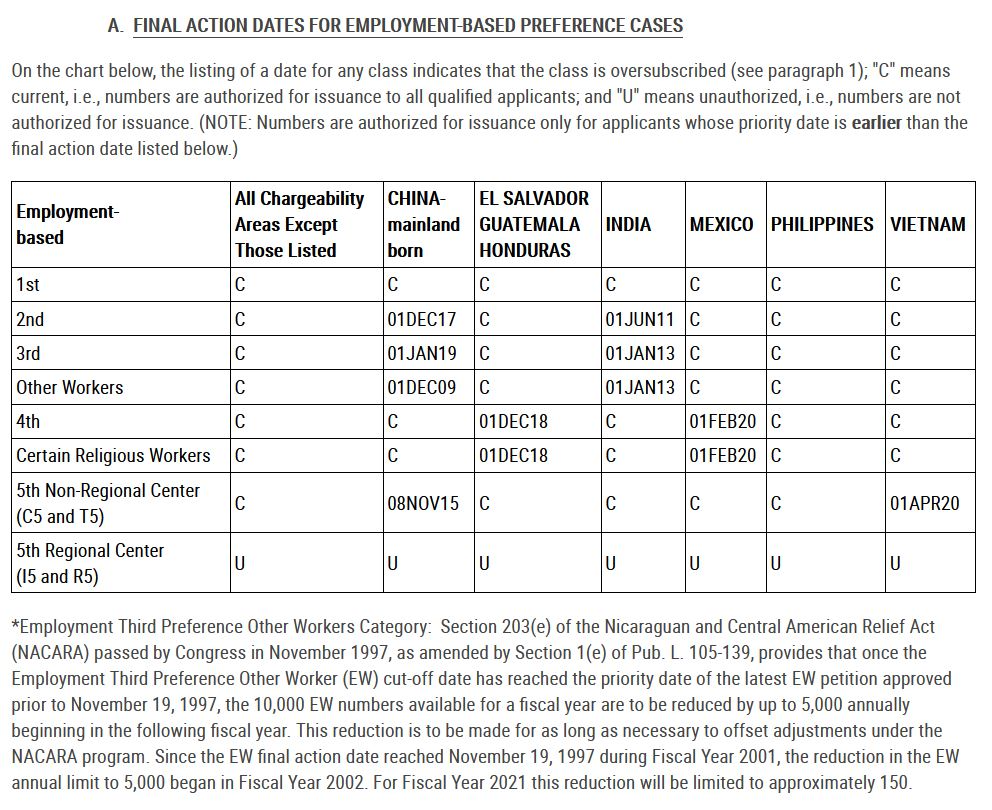
That’s right—two entire years. Unless the figure in the July 2021 Visa Bulletin is a typo, the final action date for EB-5 investment participants from Vietnam has sped ahead by an astonishing two years, taking the final action date from April 15, 2018, in the June 2021 Visa Bulletin to April 1, 2020, in the July 2021 bulletin. And if that weren’t enough of a shock, the chief of the Visa Control and Reporting Division of the U.S. Department of State has more good news for Vietnamese investors: he expects Vietnam to achieve “current” status by September 2021.

July 2021 Visa Bulletin, Chart A

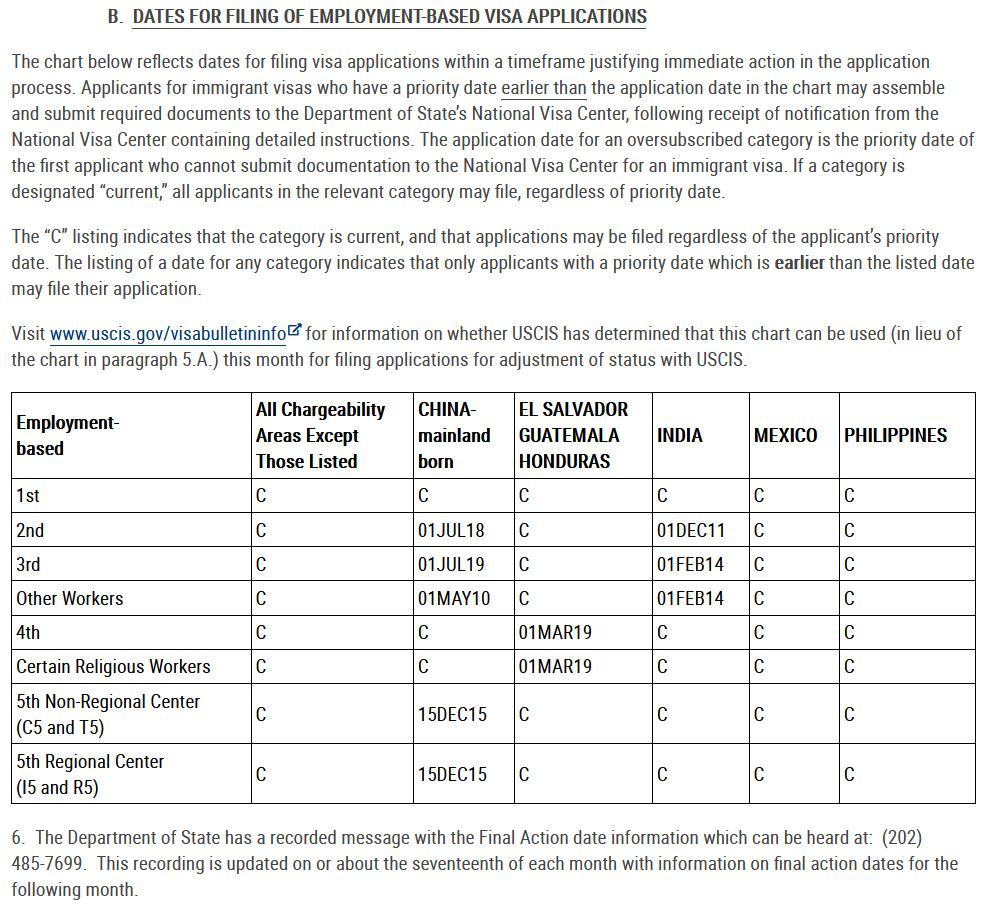
In Chart A of the July 2021 Visa Bulletin, “01APR20” is printed clearly in the EB-5 row of the Vietnam column. Broken down, this means April 1, 2020. To Vietnamese EB-5 investors, who have been suffering from delays and long processing waits for three years, this may seem unbelievable, but there it is, clear as day. Effectively, any Vietnamese national who made an EB-5 investment between April 2018 and April 2020 is now eligible to receive their conditional U.S. green card and begin their life in the United States—with predictions of the door soon opening for the remainder of Vietnamese investors.

The Chinese final action date has also moved ahead, this time by two months. This is a higher pace than in the June 2021 bulletin, which saw the first movement in the Chinese date for close to a year. The EB5 investment community celebrated alongside Chinese investors when the final action date finally moved, and the July 2021 bulletin indicates that forward momentum may become the new normal for Chinese investors.

The final action dates for those who have made an EB5 investment through an EB-5 regional center stand out in the July 2021 bulletin—all values are “U.” “U” stands for “unauthorized,” with USCIS taking into account the uncertain status of the program going into July. The EB-5 Regional Center Program is set to expire on June 30, 2021, unless it secures reauthorization from Congress, and many EB-5 investment stakeholders fear reauthorization will be contingent on program reform. With less than two weeks to go, reform has still failed to be enacted, and the EB-5 community is growing increasingly anxious as the sunset date nears. Industry experts note that the U.S. government is unlikely to let such a valuable program expire permanently, but a temporary suspension could be in the cards, presenting investors with unwelcome delays in their EB-5 investment journey.

July 2021 Visa Bulletin, Chart B

Unfortunately, the movement in the EB-5 final action dates has not been reflected in the dates for filing. Chinese EB-5 investment participants have built up such a massive EB-5 backlog that many have to wait just to file their application for an EB-5 visa following I-526 petition approval. The Chinese date for filing has remained at December 15, 2015, for more than a year, and though changes in the date for filing will inevitably follow final action date progress, the momentum has clearly not been sufficient yet. Chinese investors waiting to file their EB-5 visa applications must continue to sit tight.

Interestingly, the regional center values in Chart B are not “U” for unauthorized but the same as those for direct EB-5 investors. While this is probably just an administrative oversight, hopefully it indicates a continued future for the EB-5 Regional Center Program.

Free EB-5 Project Evaluation

The EB-5 Regional Center Program Needs Permanent Authorization

The EB-5 Regional Center Program Needs Permanent Authorization

Throughout the beginning of 2021, EB-5 investment participants have faced an uncertain battle for the continued authorization of the EB-5 Regional Center Program, through which more than 95% of EB5 investments are made. The EB-5 Immigrant Investor Program itself is a permanent government program, but the regional center program, which allows United States Citizenship and Immigration Services (USCIS) to designate commercial entities to sponsor EB-5 projects and pool together the EB-5 investment funds of multiple investors, remains a temporary program almost 30 years after its initial introduction. For EB-5 investors, who can take years to obtain their conditional permanent resident status, that’s a problem.

For most of the EB-5 Regional Center Program’s history, it has been bundled together with an omnibus government funding bill, which has guaranteed renewal. Thus, even though the regional center program was constantly facing expiration, the EB5 investment community generally had little to worry about. But in December 2020, Congress separated the popular regional center program from the funding bill that had always carried it along, leaving the program to fend for itself. With the sunset date of June 30, 2021, fast approaching, the EB5 investment community is pushing for EB-5 reform viewed as necessary to secure reauthorization for the ever-important regional center program. But the EB-5 Reform and Integrity Act, which many EB-5 stakeholders have rallied behind, is only a temporary solution.

The EB-5 Reform and Integrity Act

The EB-5 Reform and Integrity Act, introduced by Republican Senator Chuck Grassley and Democratic Senator Patrick Leahy, focuses, as the name suggests, on strengthening integrity measures in the EB-5 program to better weed out fraud and protect honest EB-5 investors, developers, and regional centers. It also includes provisions aimed at improving the overall usability of the program, such as shorter processing times for EB-5 investment petitions. Among the provisions is longer-term reauthorization for the EB-5 Regional Center Program, to the tune of five years. If passed, the EB-5 Reform and Integrity Act would reauthorize the program through 2026.

However, in the context of the EB-5 program, five years is short. If the regional center program is renewed for five years, Congress will soon be faced once again with an anxious EB5 investment community pushing for further reauthorization. It can take two to three years for USCIS to adjudicate an I-526 petition, and then, depending on an investor’s country of origin, it could take as many as 10 years to actually obtain conditional permanent residency. An investor—provided they are investing through a regional center, as most do—must be continuously wary of the EB-5 Regional Center Program’s authorization status until they receive their conditional green card, because expiration of the program could potentially destroy their dreams of a life in the United States.

What Would Happen If the Regional Center Program Expired?

What would happen if the regional center program expired? This is the question at the forefront of every EB-5 stakeholder’s mind as June 30, 2021, careens ever closer. At best, it would cause a temporary delay—although more delays are the last thing EB-5 investors need. At worst, it would nullify as many as 100,000 EB-5 investments, slashing the dreams of that many investors and their immediate family members.

The expiration of the EB-5 Regional Center Program would impact every regional center investor who has not yet obtained conditional permanent resident status in the United States. Thus, every investor with a pending I-526 petition would be affected, as well as the thousands of Chinese and Vietnamese applicants stuck in backlogs waiting for visa availability. At first, USCIS would likely suspend processing of these I-526 petitions and visas, holding out for retroactive legislation to reactivate the popular EB-5 investment route. But if that retroactive legislation did not ultimately come, USCIS would deny all pending I-526 petitions and revoke I-526 approval for the EB-5 investment participants who were waiting on EB-5 visa availability.

The result would be chaos—tens of thousands of investors, who had already deposited their $900,000 (if the project was in a targeted employment area, or TEA) or $1.8 million (if it was in a non-TEA) and fulfilled all the criteria that makes up a successful EB5 investment, would suddenly have their bright future taken away, through no fault of their own. Lawsuits would likely abound, but it’s uncertain what outcome they would come away with. Only investors who had already obtained conditional permanent resident status would be safe, and USCIS would continue to adjudicate I-829 petitions even for investors in regional centers.

The good news is that Congress is unlikely to let a program as lucrative as the EB-5 Regional Center Program permanently expire. After all, doing so would mean cutting off an important source of funding for thousands of U.S.-based projects. But until Congress makes the regional center program permanent, this uncertainty will plague the program, and Congress will always be faced with EB-5 stakeholders demanding permanent authorization. The program has already been around for nearly 30 years, and it’s helped funnel billions of dollars into the U.S. economy. It’s about time it was authorized permanently.

Free EB-5 Project Evaluation

The Most Common Reason for I-526 Petition Denial

The Most Common Reason for I-526 Petition Denial

In the EB-5 Immigrant Investor Program, as in life, there are no guarantees. There are no steps an EB-5 investor can take in preparing their I-526 petition to guarantee that United States Citizenship and Immigration Services (USCIS) will approve. The majority of I-526 petitions are approved, so anyone who makes an EB-5 investment has a relatively high chance of gaining approval. However, an investment in one’s future in the United States is not something to leave to chance—by carefully preparing their I-526 petition, EB-5 investors can elevate their likelihood of I-526 petition approval.

What Does an I-526 Petition Entail?

Form I-526 is the first petition an EB-5 applicant files with USCIS after committing their EB5 investment funds to their chosen new commercial enterprise (NCE). Part of the petition asks for personal information about the investor and any accompanying family members and requires documents such as passports and driver’s licenses as supporting documentation.

Another portion of the I-526 petition focuses on the project in which the applicant has made their EB-5 investment. For this, the investor must obtain the relevant project documentation from the NCE or the EB-5 regional center through which they are investing. If the project has obtained exemplar status, the investor likely has nothing to worry about, unless there have been substantial material changes to the project.

If the EB-5 project is located in a targeted employment area (TEA), EB-5 investors must append an additional section to their I-526 petition package—data and documentation justifying the TEA designation of the project. If USCIS approves the TEA designation, the investor may make an EB-5 investment of $900,000, as opposed to the minimum $1.8 million required for non-TEA projects. If an investor is working with an EB-5 regional center, the regional center will generally help with the provision of TEA justification documents.

The final aspect of the I-526 petition is the most challenging and time-consuming—the source-of-funds documentation section. Investors must provide documentary evidence that their full EB5 investment amount derives from lawful sources and has been committed to their EB-5 project, as well as that any applicable taxes have been paid. The complexity of this task varies based on the source of funds and the country in which the capital was obtained, but in general, it’s more complicated than EB-5 investors realize—and it’s the most common reason for I-526 denial.

What Makes the Source-of-Funds Process So Complicated?

The source-of-funds requirement makes sense—the U.S. government wants to ensure that it’s funding its economy and the creation of new jobs for U.S. workers with legally obtained capital. But USCIS’s source-of-funds scrutiny goes fairly deep. For example, if a foreign national brought property and later sold it and used the resulting capital gains as EB-5 investment capital, simply presenting the deed of sale would be insufficient. They would also have to prove that they legally purchased the property in the first place, lawfully earned the seed capital to make that purchase, and paid all applicable property taxes on the asset.

Gifts and inheritance, which are by all means valid sources of EB5 investment capital, are similarly complicated. For a gift, the investor must provide a gift agreement that states the recipient is under no obligation to repay the sum to the donor, and the donor must provide source-of-funds documentation to prove that they obtained the capital lawfully. In the case of inheritance, the investor must show that they rightfully inherited the capital (or any relevant asset) and that the decedent earned the amount lawfully. The requirement to prove the lawful source of third-party funds even extends to loans from third-party entities other than well-established banks.

And it gets even more complicated. Using a currency swap entity? Investors from countries like Vietnam, China, India, and South Africa, which place limits on the amount of capital than can be transferred abroad, face obstacles simply in transferring their EB5 investment capital to the applicable escrow account in the United States, even if they can easily prove the legal sources of their funds. USCIS is aware of remittance limits in these and other countries and will require evidence from investors of how they legally bypassed the restrictions. Several options exist to circumnavigate remittance limits, but investors must always opt for a legal route.

How to Approach the Source-of-Funds Process

The first step any EB-5 investor should take toward the source-of-funds process is consulting with an experienced EB-5 immigration attorney, particularly one with extensive experience with investors from the same country. Experienced EB-5 immigration counsel is aware of both USCIS requirements and the challenges posed by particular countries, and they can go over an investor’s options and advise them regarding the easiest sources to use for their EB5 investment.

Depending on an investor’s source of funds, they may have to submit the following documents. Bear in mind that EB-5 capital may derive from any number of sources, as long as they are all appropriately documented.

  • Bank statements
  • Employment records
  • Business accounting records
  • Investment records
  • Loan documents
  • Tax returns
  • Property deeds
  • Sale-of-asset records
  • Gift contracts

In some cases, USCIS will demand documentation of the full path of the funds from the source to the EB-5 project escrow account. For example, if an investor is using the capital gains earned from the sale of real estate for their EB-5 investment, they may have to provide the following documentation:

  1. Evidence of the lawful sources of the seed capital to purchase the real estate asset (e.g., employment records, business accounting records, inheritance records)
  2. The deed for the purchase of the real estate asset
  3. The deed for the sale of the real estate asset
  4. An appraisal evaluating the market value of the real estate asset
  5. A bank statement showing the sale proceeds deposited into the investor’s foreign bank account

It’s important to note that some countries may not have stringent recordkeeping practices, which can complicate the source-of-funds documentation process, especially if the records date back decades. In such cases, it may be possible to have a local legal or tax expert produce a signed statement attesting to the impossibility of obtaining such records. USCIS evaluates source of funds on the basis that they are “more likely than not” lawful, so approval is possible even without irrefutable evidence of the EB5 investment capital’s lawful sources.

Another point to bear in mind is that insufficient source-of-funds documentation may result in a request for evidence (RFE) rather than a denial. If an investor receives an RFE, they have a limited window of time to collect and send any documentation that USCIS requests, and if USCIS is satisfied with the provided evidence, they will likely go on to approve the I-526 petition. If an investor is in a rush to file their I-526 petition—such as to prevent their child from aging out of EB-5 visa eligibility—they may submit insufficient source-of-funds documentation and prepare more rigorous documents for the later RFE.

Free EB-5 Project Evaluation

Favorable Policy Updates at USCIS

Favorable Policy Updates at USCIS

Throughout the late 2010s, EB-5 investors and other stakeholders have grown wary of policy updates from United States Citizenship and Immigration Services (USCIS), which have often been negative—and applied retroactively. A case in point is the redeployment policy update that came in July 2020, which the immigration agency applied retroactively by officially terming it a “clarification,” not an update. Additionally, with about two years under the leadership of Sarah Kendall, productivity at the Immigrant Investor Program Office (IPO) has fallen significantly, with processing times skyrocketing and EB-5 investment participants growing increasingly disgruntled.

But changes in leadership may be turning the tides. Kendall left her post at the IPO in November 2020, and though the results of her successor, Nick Colucci, have yet to be seen, the EB5 investment community remains hopeful that the dark days of the Kendall reign are over. USCIS leadership is changing as well, with Biden’s nomination for the head of USCIS, Ur Maddou, promising to modernize the U.S. immigration system.

On June 9, 2021, USCIS came out with new policy updates, proving the pro-immigration rhetoric wasn’t mere talk. The modified policies are favorable to EB5 investment participants and are hopefully indicative of more changes to come down the road.

Clarifications for Expedited Processing Eligibility

In the late 2010s, speed has hardly come to mind when discussing EB-5 petition processing times. The idea of expedited processing surely excites many individuals pursuing EB-5 investments, no matter how difficult it may be to obtain. The latest USCIS policy update clarifies the criteria and conditions for expedited processing, painting a clearer picture of who is eligible for this fast-track path to U.S. permanent residency rights. The policy update also restores the ability of registered nonprofit organizations providing a service for the cultural or societal benefit of the United States to request expedited processing for immigration benefits.

More Reliance on RFEs and NOIDs

No EB5 investment participant wants to receive a request for evidence (RFE) or notice of intent to deny (NOID), but it’s certainly preferable to a denial. Though NOIDs are highly concerning, RFEs don’t necessarily mean USCIS will deny an I-526 petition or an I-829 petition—rather, it means certain information necessary for the adjudicator to make a decision is missing or unclear. As long as the applicant responds with the appropriate documentation within the allotted timeframe, in most cases, USCIS approves the petition, and the individual goes on to have a successful EB5 investment.

In 2013, USCIS ruled that adjudicators must issue an RFE or a NOID unless they determined that the applicant could not possibly supply sufficient evidence for an approval. In 2018, this was overturned, with USCIS declaring that adjudicators may deny petitions simply for lack of evidence without first issuing an RFE. EB-5 investment participants and others denied in this way simply had their cases reopened or filed new petitions with the missing evidence, resulting in headaches for immigrant hopefuls and an inefficient use of time and resources for USCIS. The June 9, 2021, policy update reverts back to the 2013 rules, where adjudicators generally must issue an RFE or NOID, unless the existing evidence is already sufficient to determine ineligibility. This update is a huge positive for those with EB-5 investments, who are essentially guaranteed a second chance if the documentation they have submitted is insufficient or unclear.

Longer Validity for Employment Authorization Documents

Long wait times characterize much of the EB-5 investment process, including for investors who apply domestically. Foreign nationals residing in the United States on a nonimmigrant visa are eligible to participate in the EB-5 program, and their journeys are mostly identical to those of overseas applicants, except that they file Form I-485 to adjust their immigration status rather than apply for their green card through consular processing.

Since USCIS processing times are long across the board, those who have made an EB-5 investment from within the United States do not necessary experience faster processing times. In fact, USCIS can take a year or more to process I-485 petitions. Without a work permit, this wait time could put an applicant in a precarious personal situation—and providing welfare services would be a burden on the U.S. taxpayer. That’s why USCIS offers employment authorization documents (EADs), which allow applicants to work while their I-485 petition is pending.

Previously, EADs and their renewals were valid for a one-year period, but with the ever-increasing processing times at USCIS, the immigration agency has opted to switch to a two-year validity period. This is a win–win: immigration applicants, including EB-5 investors, can work while they wait for their adjustment of status decision, and USCIS can reduce the number of EAD applications it receives, freeing up more time to adjudicate the pending petitions themselves.

Free EB-5 Project Evaluation

Comparing the EB-5 Reform and Integrity Act to the Alternative

Comparing the EB-5 Reform and Integrity Act to the Alternative
In 2021, the EB-5 Immigrant Investor Program community has been abuzz with the very real possibility of EB-5 Regional Center Program suspension after June 30, 2021. Traditionally, the regional center program has been reauthorized in conjunction with a broader government spending bill that was guaranteed to be passed. But when Congress reauthorized the program in December 2020, it separated the regional center program from this spending bill, forcing the program to fight on its own for reauthorization. And with all the problems that have been plaguing the EB-5 program in the late 2010s, reauthorization without significant reform is unlikely.

EB-5 investment stakeholders have largely rallied behind the EB-5 Reform and Integrity Act, proposed by bipartisan senatorial duo Chuck Grassley and Patrick Leahy, but some have held out for a more favorable alternative. However, as we careen ever closer to the sunset date of June 30, 2021, there is little room to air complaints about the specifics of the bill. Even though temporary suspension is much more likely than definitive termination should the regional center fail to gain reauthorization, suspension would cause major disruptions to EB-5 investments, the individuals relying on them for a brighter future, and the developers across the United States depending on EB-5 capital to build projects and create jobs. Suspension should be avoided at all costs, even if that means embracing less-than-ideal legislation.

On November 5, 2019, a previous EB-5 reform bill, entitled Immigrant Investor Program Reform Act, was introduced to the Senate by Lindsey Graham, John Cornyn, and Chuck Schumer. A quick comparison of the two proposed acts can offer some insight into what potential future EB-5 reform bills may look like.

Judicial Reviews

In the 2010s, United States Citizenship and Immigration Services (USCIS) has come under fire for various mismanagement practices, including retroactive policy changes and I-526 petition denials based on unreasonable interpretations. Those who make EB-5 investments are not the type to be walked over and have exercised their right to litigation—and quite often, the courts side with the investors. In late 2020, for example, the U.S. Court of Appeals reiterated a ruling from district court that unsecured loans should be an acceptable source of EB5 investment funds, contrary to USCIS’s newly adopted policy of rejecting unsecured loans.

Likely due to USCIS’s appeals to the government, both EB-5 reform bills mandate that EB-5 investors exhaust a list of bureaucratic pathways before suing USCIS over a petition denial or regional center termination. The only winner here is USCIS—certainly not EB-5 investment stakeholders.

Reauthorization

Given the precarious situation of the EB-5 Regional Center Program in the first half of 2021, reauthorization is a key issue on everyone’s mind. Again, both bills are identical in their proposal for a five-year extension to the regional center program’s validity. While a five-year reauthorization is certainly a good thing, most EB5 investments take longer than five years, particularly in light of USCIS’s recent processing times. If the regional center program is extended for five years, it won’t be long until the community needs to push for further renewal.

Fees

Administrative fees are a necessary evil, and considering that USCIS just barely skirted a massive furlough of 70% of its workforce in the middle of 2020, the agency is clearly hurting for cash. Higher fees are likely one of USCIS’s top demands from Congress, and indeed, both bills delivered, promising higher fees for investors and regional centers alike. Under both bills, investors must include a $1000 “Petition Fee” or “Integrity Fund Fee” with their I-526 petition, and regional centers must pay an annual fee of $20,000, reduced to $10,000 if they are registered as a nonprofit or managed fewer than 21 investors in the applicable year. Any regional center found to not be compliant with EB-5 regulations could additionally expect fines to the tune of 10% of the total EB-5 investment capital under the center’s control.

But the Immigrant Investor Program Reform Act doesn’t stop there. In addition to the above fees, this bill further requires EB-5 investors to pay a whopping $50,000 fee, called the “Program Improvement Fee,” when they file their I-526 petition. Regional center hopefuls filing an I-924 petition would additionally have the option to pay $50,000 for “premium processing,” effectively selling quick processing times.

Visa Backlogs

Out of all the problems that the EB-5 program has experienced in the late 2010s, visa backlogs are among the worst for EB5 investment participants. Country caps on visa allocation have resulted in petitioners from high-demand countries—notably China and Vietnam—being subject to long waits, as their EB-5 demand has exceeded their country limit. Both bills deal lightly with the issue of visa backlogs, although the solutions are likely insufficient to address the woes of the EB-5 investment program.

The EB-5 Reform and Integrity Act has laid out “reasonable processing times” for different EB-5 petitions and proposes to give USCIS one year to conduct a feasibility study to determine the fees necessary to process EB-5 petitions within these timelines. This strategy would see I-526 petitions processed within eight months at the latest, but it fails to address country limits on visas. Another upside of this bill is the protections it offers to good-faith investors who find themselves wrapped up in fraud, significant material changes, regional center termination, and other major complications. Such investors would be given six months to strike an agreement with another regional center and invest whatever additional capital is necessary to create their obligatory 10 jobs.

The Immigrant Investor Program Reform Act takes a different approach, setting aside 30% of visas for applicants making EB-5 investments in newly defined targeted employment areas (TEAs). This is clearly favorable for new investors, offering them a faster path to a permanent life in the United States and developers faster access to their EB5 investment capital. The victims are existing EB-5 investors—the ones who have already been waiting years for their future in the United States. Even the developers of the projects in which they have invested would benefit, given the additional time they could deploy their EB-5 investment capital. The bill’s provision for these investors is “parole,” which can allow foreign nationals entry and residency in the United States before they are officially admittable. However, parole is remarkably difficult to obtain and may thus be a nonsolution.

One positive of the Immigrant Investor Program Reform Act, however, is strong protections for aging children. Under current EB-5 policy, children’s ages are frozen only while the I-526 petition is pending, putting families with approved I-526 petitions awaiting visa availability at risk of their children aging out of eligibility for an EB-5 green card. The Immigrant Investor Program Reform Act would guarantee green card eligibility for any dependent considered a child at the time the I-526 petition is filed, effectively eliminating the risk of aging out.

Investment Amounts and TEA Designations

The EB-5 investment community is still reeling from the enactment of the Modernization Rule in November 2019, which increased the minimum required EB5 investment amount by 80% and restricted TEA designations. Following this massive hike, EB-5 demand dropped significantly, and further increases would only serve to further restrict access to the EB-5 program.

The EB-5 Reform and Integrity Act offers no amendments to the Modernization Rule’s changes. The Immigrant Investor Program Reform Act does—and quite substantially. First, it would significantly decrease the difference between the TEA and non-TEA investment amounts, placing the TEA investment amount at $1 million and the non-TEA amount at $1.1 million. The bill also proposes redefining TEAs as Opportunity Zones rather than high-unemployment areas. Whether this change would be beneficial to a particular area would depend, and given that unemployment rates can change, an area that benefits one year may not the next. A case in point is New York City, which in 2019 would have benefited from the proposed change but now, in 2021, after the devastation of the COVID-19 pandemic, benefits more from the current high-unemployment TEA definition.

Overall

Which EB-5 investment program reform bill is superior is up to each individual to decide. What’s important to note is that the alternative Immigrant Investor Program Reform Act is generally not substantially different from the EB-5 Reform and Integrity Act, and both have myriad flaws. Embracing the EB-5 Reform and Integrity Act as an important pathway to EB-5 reauthorization doesn’t mean the EB5 investment community has to stop pushing for reform and change later—but for now, the best solution would be to focus on the pertinent and looming issue of EB-5 Regional Center Program expiration, and the EB-5 Reform and Integrity Act is the only realistic solution.

Free EB-5 Project Evaluation

Why Is the EB-5 Program So Popular?

Why Is the EB-5 Program So Popular?

When the EB-5 Immigrant Investor Program was first created in 1990, it didn’t garner a lot of attention, and for years, the program failed to dole out the majority of the visas allocated to it each year. The 2008 crisis was a turning point, and what started as a slow increase blossomed into skyrocketing demand, with EB-5 investment applications reaching a peak in 2018. Though the program has since seen a decrease—due in part to the COVID-19 pandemic—it remains a widely popular option for foreign nationals seeking U.S. permanent resident status. But what exactly is it that makes the EB-5 program so popular?

Few Restrictions

Immigration to the United States is difficult, and most immigration programs come with tight restrictions and time limits. For example, students on F-1 visas are generally prohibited from undertaking employment, and after they graduate, their valid U.S. status expires. Many holders of work visas, including the popular H-1B visa, have to find a company willing to sponsor them for employment, are restricted from taking additional jobs (including most freelance work), and are only permitted to stay for a finite period of time. Even other investment immigration programs pose strict limitations. For example, to enter the United States on an E-2 visa, an investor must hold citizenship from a treaty country.

The EB-5 program is different because, essentially, the only requirement is to make an EB-5 investment in a qualifying project with lawfully obtained capital. As long as the EB5 investment capital is at least $1.8 million (or $900,000 for targeted employment area [TEA] projects), the funds remain at risk throughout the entire investment period, and the investor can demonstrate the creation of at least 10 new, full-time jobs for U.S. workers, nationals from any country, of any age and occupation, are free to participate. This opens up a route to U.S. immigration for those who are unable to procure employment sponsorship or who are not from a treaty country.

Relatively Quick Immigration

The EB-5 investment program is notorious for its long processing times, so a prospective investor may initially shy away from the program due to the wait times. However, compared to other EB programs, such as the EB-2 program, EB-5 processing times are relatively speedy—even for investors from backlogged countries.

The contrast is particularly stark for Indian nationals: in the April 2021 Visa Bulletin, the final action dates for Indian nationals in the EB-2 and EB-3 programs are stuck at 2010, while for the EB-5 program, Indian nationals have a current final action date. What that means is that Indian nationals who filed for EB-2 and EB-3 visas in 2010 and after are still waiting to receive their visas, 11 years later. Indian nationals who have made an EB5 investment, on the other hand, face no such restrictions in the April 2021 Visa Bulletin. There was previously an EB-5 backlog for Indians, but it cleared up in the July 2020 Visa Bulletin and has never returned.

Green Cards for Family at No Additional Expense

Naturally, anyone with a family who makes an EB5 investment wants to immigrate to the United States with their family. In fact, for many investors, obtaining U.S. green cards for their children is one of the key motivations for making an EB-5 investment in the first place. After all, with U.S. green cards for the whole family, an investor can send their children through the U.S. public school system for free, and when their children become college-aged, they can enroll in U.S. colleges and universities more easily.

In the EB-5 program, a single EB-5 investment qualifies not only the principal investor but also their spouse and unmarried children younger than 21 for U.S. permanent resident status. Investors need not invest extra capital to sponsor their family for EB-5 visas, and there is no limitation on the number of children they can sponsor, as long as they are all unmarried and younger than 21 when the I-526 petition is submitted.

Ultimate Freedom and Minimal Risk with EB-5 Regional Center Investments

Part of the United States Citizenship and Immigration Services (USCIS) requirements for EB-5 investments is the obligation to participate in the management of the new commercial enterprise (NCE). In a direct EB5 investment, where the investor invests their capital directly in the NCE, this usually entails day-to-day managerial labor, requiring the investor to move close to the NCE location. However, if an investor chooses to invest through an EB-5 regional center, they have much more freedom regarding the participation requirement.

Regional center investors still need to demonstrate managerial involvement to USCIS, but they can usually satisfy this requirement simply by signing on as a limited partner and voting on important matters. They can do this remotely from anywhere in the United States, so an investor can, for example, invest in an EB-5 project in Georgia, yet set up house on the sunny shores of Hawaii.

But freedom isn’t the only advantage of regional center EB5 investment. Reputable regional centers, which have been examined and approved by USCIS, are run by EB-5 industry experts who carefully vet the projects they offer to ensure low immigration and financial risk for their investors. Regional center operators can provide their investors with carefully produced project documentation and TEA designation paperwork to include in their I-526 petition, streamlining the application process and reducing the risk of denials or delays.

The World’s Best Investment Immigration Program

Though the United States is a favorite immigration destination for foreign nationals around the world, it isn’t the only option. Other wealthy, highly developed nations, such as Canada, the UK, and Australia, also offer a high standard of living and welcome countless immigrants every year. However, none of these countries have an immigration program as enticing as the EB-5 program.

In the past, Canada and Australia offered their own residency-by-investment programs, but both have been discontinued. The UK immigrant investor program is still running, but the minimum required investment amount is a whopping $2.75 million, making it unattainable for many investors. Therefore, the EB-5 program is easily the best choice for foreign nationals around the world. An EB-5 investment is not just an investment in the United States—it’s also an investment in your future.

Free EB-5 Project Evaluation

Can Investors Use Unsecured Loans for the EB-5 Visa Program?

A figurine looking at his own shadow, carrying a bag of loaned funds over his shoulder, and the word debt above.

In the past, there was much confusion and controversy about whether unsecured loans can be used to fund investments for the EB-5 Immigrant Investor Program. Unlike a secured loan, an unsecured loan is one that is not backed by any specific collateral. Instead, lenders approve these loans based on the principal borrower’s creditworthiness, income, debt-to-income ratio, and other factors.

In the context of the EB-5 visa program, a foreign national’s EB-5 investment can have a wide variety of source of funds (SOF). For example, funds from an investor’s paycheck wages or personal savings, proceeds from stock or property sales, an inheritance, or a gift are all legal sources of funds. If using a loan, best practices generally advise that investors use a secured loan, often with property or some other personal assets owned by the investor to be used as collateral. But historically, the United States Citizenship and Immigration Services (USCIS) did not have clear instructions for how to structure a loan for the EB-5 program. As a result, some investors attempted to use unsecured loans, taking money from a third party to make their EB-5 investment.

However, in 2015, USCIS decided that funds derived from unsecured loans were considered “indebtedness,” not cash. As a result, USCIS began denying the I-526/I-526E petitions of many EB-5 investors. This led to the landmark ruling in Zhang v. USCIS that helped clarify the uncertainty surrounding the question of unsecured loans, eventually leading to the conclusion that unsecured loans are permissible for EB-5 investments, but only if certain criteria are met.

This article will explain how financing for EB-5 visa projects typically works, the history of using secured loans and unsecured loans for EB-5 investments, and the outlook for investors who may be considering using a loan to finance an EB-5 investment.

How Funding for EB-5 Visa Projects Works

A group of workers in hard hats working on an EB-5 investor visa project site.

The EB-5 visa program stimulates economic growth and creates jobs in the United States by luring foreign investment in exchange for U.S. Green Cards for investors and their family members. Investors, along with their spouse and unmarried children, are able to live and work in the United States throughout the application process. During that time, they first obtain conditional permanent resident status—also known as a conditional Green Card—and are eligible to apply for permanent resident status—also known as a U.S. Green Card—after two years.

EB-5 program applicants must invest at least $800,000 in a new commercial enterprise (NCE) or in a troubled business that they will restructure or expand. Since the EB-5 Reform and Integrity Act (RIA) was passed in 2022, the minimum investment threshold for projects located in targeted employment areas (TEAs) has been $800,000, while the threshold for other projects is $1,050,000. A TEA is roughly defined as:

  • An area with a population of fewer than 20,000 people; or
  • An unemployment rate of at least 150% of the national average.

EB-5 investors can choose to make their EB-5 investment either directly or, like the vast majority of EB-5 program applicants, through a regional center. Unlike with a direct investment where the individual invests capital directly into an NCE, regional centers are organizations set up to combine funds from several EB-5 investors and manage the allocation of that capital on their behalf.

One of the first steps in the EB-5 visa process is submitting Form I-526 or I-526E (regional center investors submit Form I-526E). Form I-526E demonstrates investors’ eligibility for the EB-5 program, and includes supporting documentation about the individual’s identity, their selected EB-5 project, and their source of funds (SOF).

In order to demonstrate that an EB-5 investor’s source of funds were lawfully obtained, they may need to submit a considerable amount of documentation to USCIS, including bank statements, invoices, sales receipts, securities agreements, purchase contracts, property documents, mortgage agreements, promissory notes, and more. Compiling all of the necessary documentation to prove legal source of funds for the EB-5 program can be complex, so it is highly recommended that EB-5 investors hire an experienced immigration attorney and EB-5 program experts to ensure accuracy and completeness.

Using Unsecured Loans to Fund EB-5 Projects Before and After Zhang v. USCIS

A gavel on money, symbolizing district court regulations regarding lender's funds.

Historically, EB-5 investors have had to clearly demonstrate that their investment funds were secured through lawful means. Whether or not USCIS accepted unsecured loans from EB-5 investors was generally a case-by-case matter, as some of these loans were accepted if the investor could show a credible plan for how they would repay the loan.

The Zhang v. USCIS case involved EB-5 investors Huashan Zhang and Masayuki Hagiwara, who borrowed money from their own businesses to invest in an NCE. At a 2015 USCIS stakeholder meeting, it was determined that cash resulting from a third-party loan—like a loan from one’s business—was in fact “indebtedness,” which would require collateral. As a result, the investors’ EB-5 applications were denied.

After a District Court ruling, the U.S. Court of Appeals for the District of Columbia determined that USCIS’s demands for collateral on such loans should not have been imposed, ruling that cash derived from such a loan was to be considered a viable source of EB-5 investment capital.

As a result, the Zhang court case finally helped clarify the USCIS policy on unsecured loans. This clearly shifted the burden of proof to the EB-5 investor, but also provided clearer criteria for evaluating whether unsecured loans would be accepted as a lawful source of funds for an EB-5 capital investment. Some practical considerations investors should address include:

Providing Clear Documentation

A principal borrower and a lender signing eb5 unsecured loan documents.

The EB-5 investor must provide clear and comprehensive documentation to demonstrate the lawful source of the loan and the terms of the loan agreement.

Demonstrating the Ability to Repay

The investor must provide a clear plan for repaying the loan, considering several factors like the investor’s income, personal assets, and creditworthiness.

Demonstrating Lawful Source of Funds

A person holding money in their hands with a calculator and a notebook on a desk.

The investor also must prove that the funds for the loan were obtained through lawful means and were not derived from any illegal activities.

Proving That the Investment Is “At Risk”

The investor must prove that the loan cannot be guaranteed by the assets of the NCE or the EB-5 investment project. Rather, the investor must bear the risk of repayment.

Proving That the Loan Was Obtained From an Independent Third Party

The EB-5 investor must prove that the loan was obtained from an independent third party, rather than from the NCE or any other affiliated party.

The Outlook for EB-5 Investors

A close-up of hands writing on a document or loan agreement for an investor visa.

Ultimately, the Zhang v. USCIS decision established stricter requirements for the acceptance of unsecured loans for the EB-5 program, but also clearer guidelines. By emphasizing the importance of providing thorough documentation, demonstrating the investor’s repayment ability, and proving the lawful source of investment funds, the decision actually provided much-needed clarity for both investors and adjudicators. By standardizing the process of evaluating loans across all EB-5 visa applications, the Zhang decision made it easier for investors to navigate the process.

Still, it is important for prospective EB-5 investors to remain cautious when considering this type of loan for their source of funds. Investors should always consult with experienced EB-5 program experts and immigration attorneys before submitting their Form I-526E with an unsecured loan.

Start the Process of Obtaining a U.S. Green Card with EB5AN

A handshake between two people above some documents and a model house on a desk.

Whether you’re considering using an unsecured loan to finance your EB-5 investment or not, EB5AN has the experience and expertise to help navigate every step of the EB-5 visa application process.

EB5AN has helped more than 2,300 families from 60 countries obtain U.S. Green Cards. Our expert team has more than a decade of experience, and offers clients first-rate, low-risk EB-5 regional center projects with 100% USCIS project approval rate to date.

To begin your family’s journey toward becoming U.S. Green Card holders, schedule a free meeting with EB5AN today.