Author Archives: admineb5

Free EB-5 Project Evaluation

December 2020 Visa Bulletin Shows EB-5 in a Holding Pattern

December-2020-Visa-Bulletin-Shows-EB5-in-a-Holding-Pattern.jpg

While the industry saw significant delays in the publishing of the November 2020 Visa Bulletin, a closer-to-timely release of December’s bulletin indicates the State Department’s efforts to play catch-up. That said, apart from most countries in the EB-5 program maintaining current final action cut off dates, the news still isn’t as promising as the EB-5 industry had hoped.

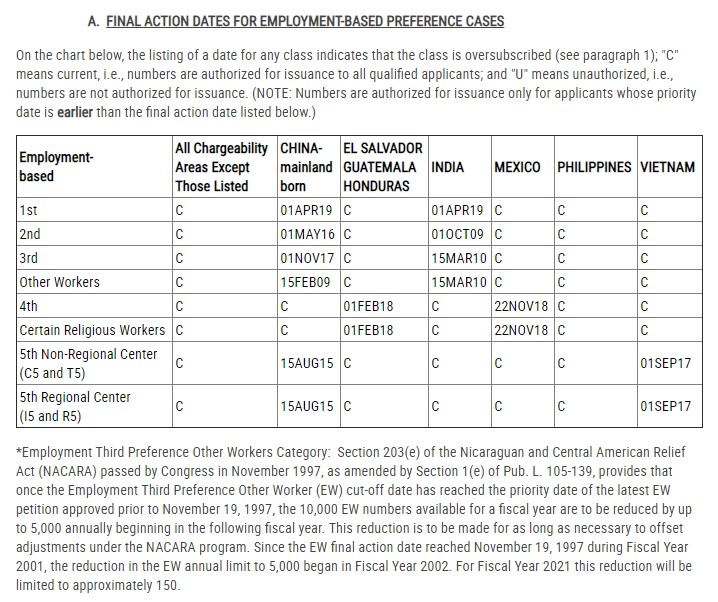
Chart A: Final Action Dates Remain Relatively Unchanged

The December 2020 Visa Bulletin is the third bulletin issued in FY2021, and the industry has yet to see the advances anticipated following the influx of visas in the wake of a challenging 2020. Instead, Chinese EB-5 investment participants are still caught in a holding pattern as final action dates for the country remain static at August 15, 2015. EB-5 investors from Vietnam inch forward as that final action date has advanced by a mere two weeks to September 1, 2017.

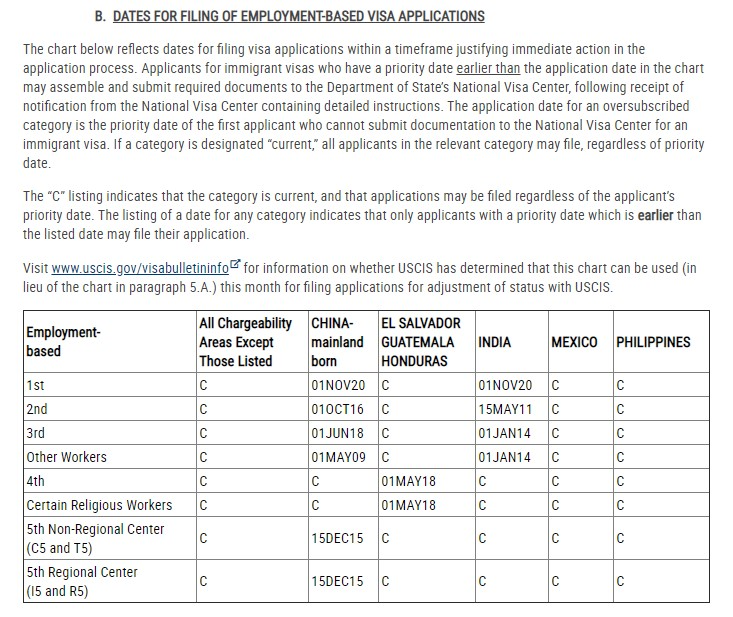
Chart B: Dates for Filing EB-5 Applications Stand Static

Again this month, Chinese participants are the only EB-5 investors who haven’t seen any forward shift in application filing dates. China’s date for filing applications stands static according to Chart B in the Visa Bulletin. For affected investors, this chart reflects which foreign EB5 investment participants seeking their green cards are allowed to submit applications with the National Visa Center (NVC). It generally addresses those EB-5 investors who will apply from outside of the U.S. And for the last few months, China’s date hasn’t budged from mid-December of 2015.

EB-5 Regional Center Program Set to Expire December 11

Furthermore, the EB-5 Regional Center Program carries an expiration date of December 11, 2020. If Congress is unable to successfully reauthorize the program (or pass a temporary expenditure measure at least), immigration visas will become unavailable through the program as of 12 a.m. on that date. EB-5 investment participants who applied through regional centers and hope to continue down that path must be admitted into the U.S. before the clock strikes midnight. Note that EB5 investments outside the Regional Center Program will remain unchanged. If the program is saved, direct investment cut-off dates are expected to mirror current bulletin data.

Overall, there’s been no outpouring of extra visas issued and no influx of applications being processed…yet. This month’s Visa Bulletin brings another report on the lack of movement for the EB-5 investment category. Perhaps a wind-down period for a very different year is what United States Citizenship and Immigration Services (USCIS) needs to launch refreshed and in full force into a new calendar year in 2021? Only time will tell.

Free EB-5 Project Evaluation

How Will the 2020 U.S. Election Results Affect the EB-5 Program?

How-Will-the-2020-US-Election-Results-Affect-the-EB5-Program

The 2020 U.S. presidential election has been one of the most contentious in recent history, with growing polarization fueling animosity on both sides of the political spectrum. After four tense days of Americans’ eyes glued to the results as they rolled out, Joe Biden was finally declared the projected winner of the election. It’s clear that the Biden administration will bring significant changes to the United States, but how will the EB-5 Immigrant Investor Program look in Biden’s America?

Changes to the program are inevitable, regardless of the election outcome, declared Aaron Grau, executive director of Invest in the USA (IIUSA), prior to the election. With the EB-5 regional center program set to expire on December 11, 2020, he expects the government to take a closer look at the program for its reauthorization. President Trump will still be in office during this review and could introduce changes, but subsequent reviews by president-to-be Biden may usher in even more changes in the future.

Trump vs. Biden: Who’s Better for EB-5?

In 1990, when the EB-5 program was enacted, it was approved in the House of Representatives by a whopping 423 to 3, clearly marking it as a nonpartisan program. Despite the broad approval from all both political parties, however, both Trump and Biden tread lightly when it comes to the controversial investment immigration program. Although the EB-5 program was passed to foster economy stimulation, the immigration aspect renders it a controversial program that can be politically dangerous to get too involved with.

Trump is known for being harsh on immigration, but he’s clearly not an enemy of the EB-5 program: EB-5 investors were spared from his April 22, 2020, executive order temporarily suspending immigration in light of the COVID-19 pandemic. When the executive order was extended to the end of 2020, it was expanded to include even more classes of immigrants, but once again, EB-5 investors were given the go-ahead to immigrate. Trump clearly recognizes the economic benefits of the EB-5 investment program.

Biden, conversely, is more supportive of immigration in aggregate, but a Biden presidency isn’t necessarily good news for EB-5 investors. Given the contentious nature of the program, he may prefer to sidestep it and focus on other areas of immigration. A Biden government may also improve the United States’ global image as a country that welcomes immigrants, as many foreign nationals have felt that the United States under Trump is not friendly to immigrants. However, with Biden yet to assume political office in the White House, it’s too early to know exactly what treatment the EB-5 program will receive from his administration.

Senate Control Matters

While most of the attention in U.S. politics is focused on the president, one mustn’t forget that the president isn’t the be-all and end-all. As of November 9, 2020, the Senate and House results have not yet been called, and even though the Democrats have won the federal election, the Senate and the House could still be dominated by Republicans, which would limit the changes the Biden administration could make to the EB-5 program.

The Senate oversees Homeland Security, which manages United States Citizenship and Immigration Services (USCIS), meaning the party that controls the Senate can exercise a lot of power over the EB-5 program. However, support for the EB-5 program isn’t that simple to calculate—as a nonpartisan program, it has support and opposition from both parties. Generally, support for the program is determined more by urban versus rural interests rather than Democratic versus Republican affiliations. The program is often preferred by those in rural areas or somewhat impoverished urban areas due to the targeted employment area (TEA) rules, which changed in November 2019 when the Modernization Rule came into force to more heavily favor EB5 investment in more in-need areas.

The Push for Reform

A further element in the political atmosphere surrounding the EB-5 program is the push for reform, particularly regarding integrity issues. Republican Senator Chuck Grassley of Iowa and Democratic Senator Patrick Leahy of Vermont have collaborated for years to bring about EB-5 reform and tighten its integrity measures. These two senators not only serve as a shining example of the EB-5 program’s ability to cross party lines but also as a real possibility for considerable change to the EB-5 program requirements.

An EB-5 program reform to improve integrity would broadly be welcomed by the EB-5 community, per Grau. Both the staff at USCIS and the Judiciary Committee staff in the House agree that any EB-5 program reform must involve integrity measures. However, when this reform will come, and what precisely it will entail, is still up in the air.

Free EB-5 Project Evaluation

FY2020 Q3 EB-5 Processing Data Shows Low Adjudication Figures

FY2020-Q3-EB5-Processing-Data-Shows-Low-Adjudication-Figures

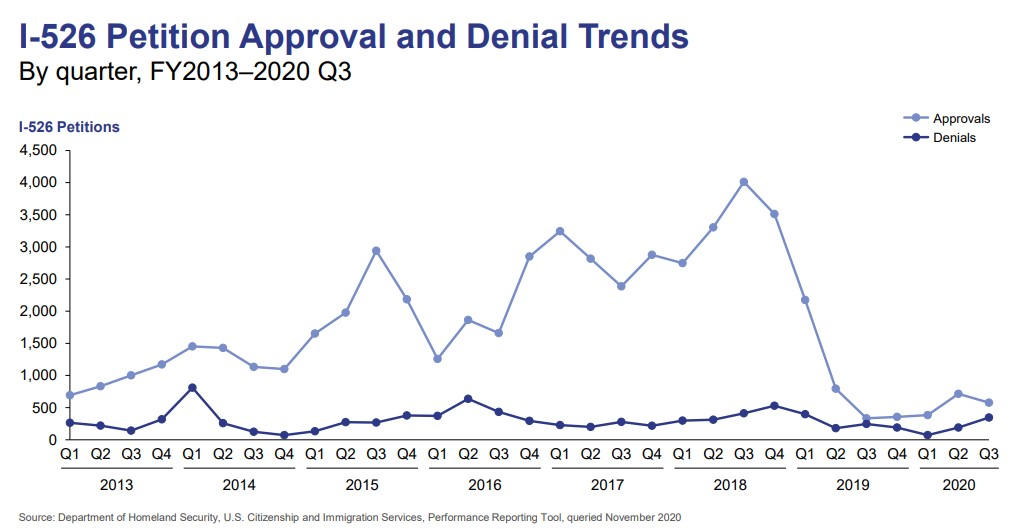
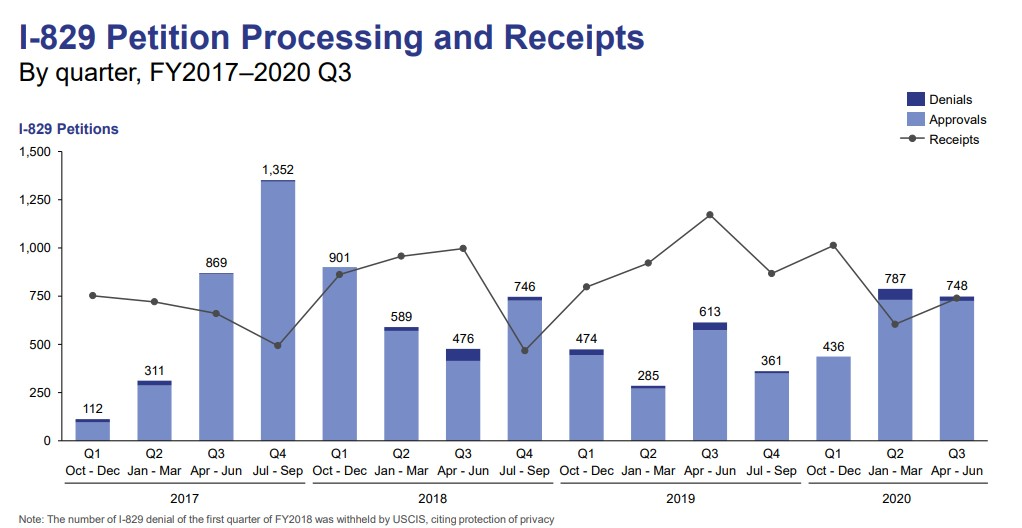
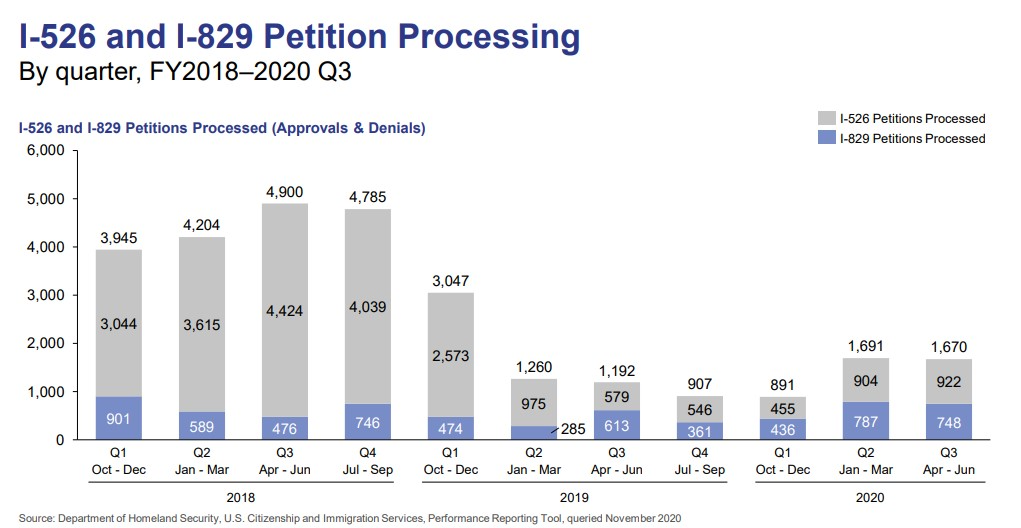
United States Citizenship and Immigration Services (USCIS) regularly releases comprehensive processing data on the different types of petitions it works with on its Immigration and Citizenship Data page, albeit with a several-month-long delay. In November 2020, the immigration body finally published the processing data for FY2020 Q3 (April to June 2020), and it doesn’t paint an overly welcoming picture for those involved in EB-5 investments. Low adjudication rates, high denial rates, and a shift from I-526 petitions to I-829 petitions characterize USCIS’s processing activity throughout spring 2020.

EB-5 Petition Processing Data for FY2020 Q3 in Numbers

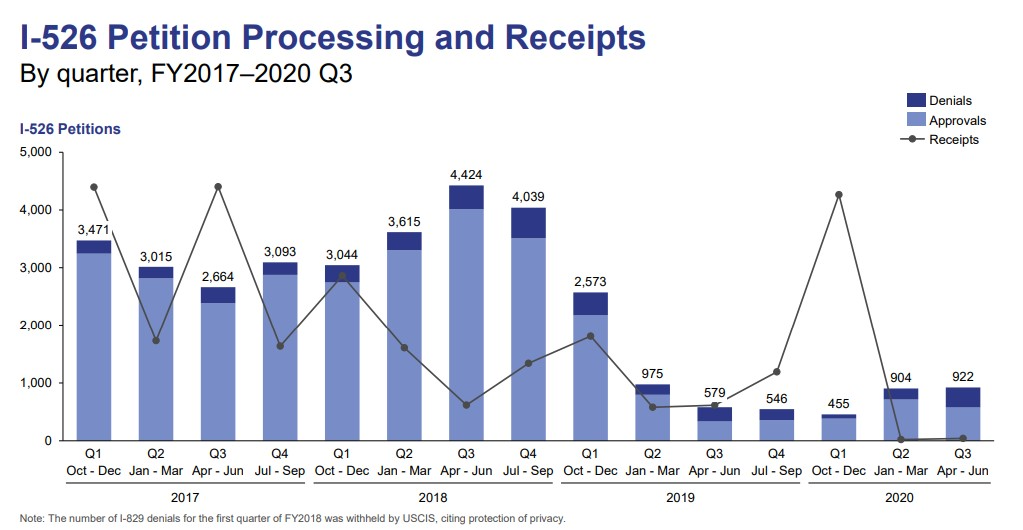
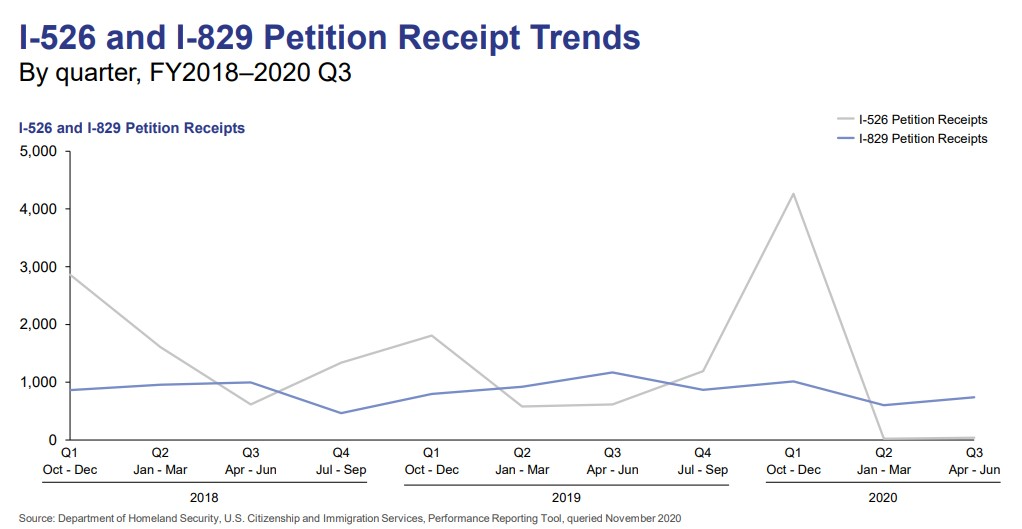
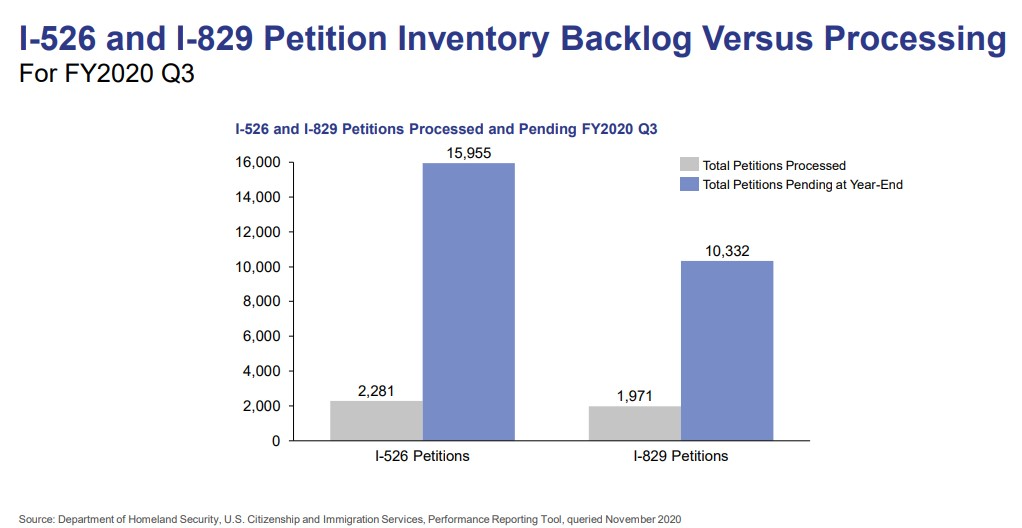
The figures for EB-5 petition processing from April to June 2020 show an astonishingly low number of adjudications carried out over the three months. Particularly noteworthy is the high rate of I-526 denials, with denials accounting for a whopping 37% of all I-526 adjudications during the period. The focus on I-829 petitions over I-526 petitions is also clear, with the number of I-526 adjudications only moderately higher despite the far higher supply of pending I-526 petitions.

I-526 Petition Processing Data
Receipts: 40
Approvals: 576
Denials: 346
Pending: 15,955

I-829 Petition Processing Data
Receipts: 739
Approvals: 725
Denials: 23
Pending: 10,332

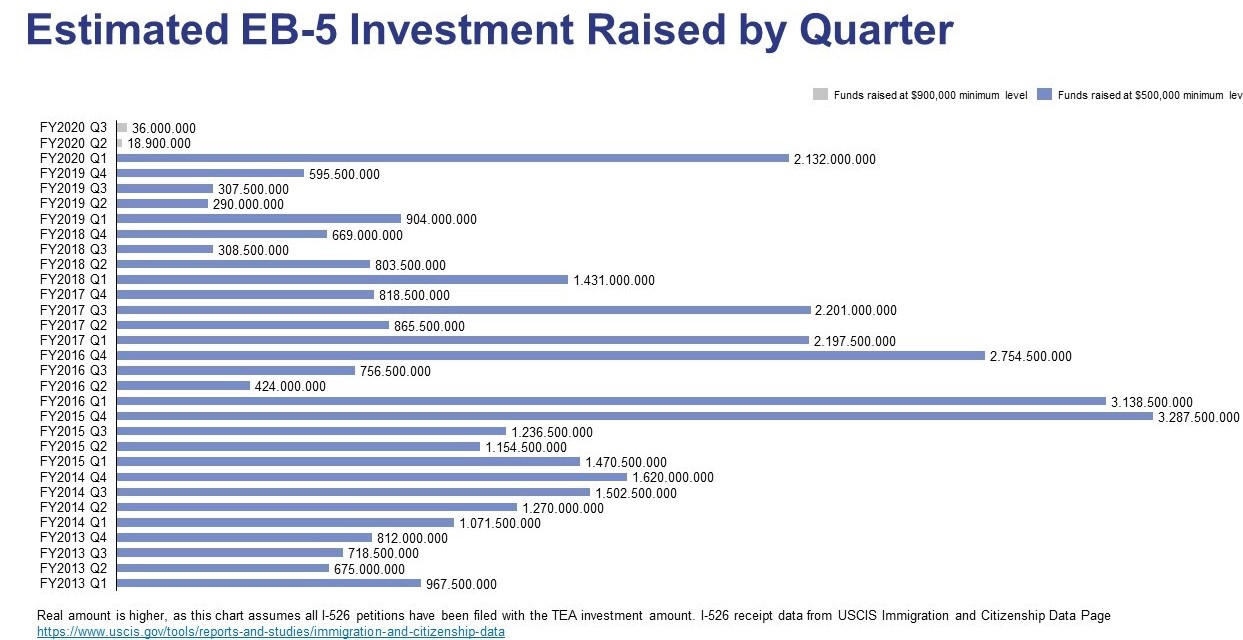
estimated eb-5 investment raised by quarter


What do these figures mean for foreign nationals pursuing an EB5 investment? Read on for an in-depth analysis.

High Rate of Denials under Sarah Kendall

Since FY2019, when Sarah Kendall was appointed chief of the Immigrant Investor Program Office (IPO), processing volumes have taken a nosedive. But denial rates haven’t—the IPO has been issuing denials steadily under Kendall’s watch, with the dramatic decrease affecting only I-526 approvals. Kendall claims she’s strengthening program integrity, which is resulting in both lower processing volumes and lower approval rates. It may be that EB-5 investment petition processing volumes won’t improve until the IPO has a new leader.

Increased EB-5 Investment Amounts Result in Lower I-526 Receipts

With only 40 I-526 receipts from April to June 2020, USCIS is reeling from the consequences of its own policies. In November 2019, the Modernization Rule went into effect, nearly doubling the minimum required EB5 investment amounts from $1 million (or $500,000 for projects in targeted employment areas, or TEAs) to $1.8 million (or $900,000 for TEA projects).

USCIS proposed the increases as a method to raise more funds to sustain the agency, but without the foresight to consider the law of demand, the immigration body has failed to draw in the EB5 investment capital it was hoping for. In fact, the poorly executed policy changes resulted in 45 times less EB-5 investment funds per quarter in FY2020 than in the previous six years and likely contributed to USCIS’s budget crisis in August 2020 that almost resulted in a massive furlough. The COVID-19 pandemic ravaging the globe and the excessive EB-5 demand in countries such as China and Vietnam are also likely factors contributing to the low rate of I-526 receipts.

A Preference for I-829 Petitions

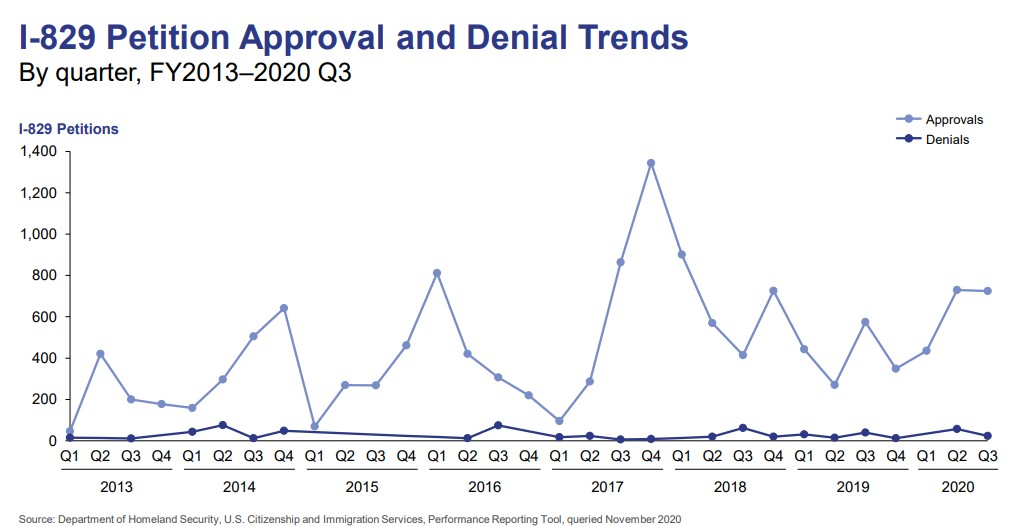
Even though I-526 petitions account for a larger portion of backlogged petitions, the FY2020 Q3 processing data make clear that USCIS has been prioritizing I-829 petitions. I-829 adjudication has remained steady, with no obvious trends either upward or downward, and the rate of approval is as high as ever. The number of adjudicated I-829 petitions during the quarter indicate that the IPO is prioritizing I-829 adjudication over I-526 adjudication.

Current Processing Volumes Are Unreasonably Low

If productivity at the IPO doesn’t improve, it will be 4.3 years before all I-526 petitions that were pending at the end of June 2020 are adjudicated. Similarly, it will take 3.5 years to clear up the I-829 backlog up to June 2020 at this processing rate. If indeed processing volumes continue at this rate, the EB-5 investment process will take about seven times longer than Congress had intended. While such a scenario would truly highlight USCIS’s ineptitude, productivity will likely improve.

Low processing volumes don’t only affect processing times, either—they also impact the number of EB-5 visas claimed. Every fiscal year, the EB-5 program is allotted approximately 10,000 visas to grant to EB-5 investors and their families, but at the FY2020 Q3 rate, barely 20% of available EB5 investment visas will be claimed. The unused visas would then be recycled through the EB-1 program in the following fiscal year, spelling a slow death for the EB-5 program.

Free EB-5 Project Evaluation

Historical National Average Processing Times for I-526 Petitions Reaches Five-Year Low

Historical-National-Average-Processing-Times-f-or-I-526-Petitions-Reaches-Five-Year-Low

When foreign nationals commit to making an EB-5 investment in the EB-5 Immigrant Investor Program, it isn’t clear when exactly they will receive their conditional permanent resident status in the United States. An investor and their immediate family members are eligible for conditional U.S. green cards following approval of the investor’s I-526 petition, but processing times can be impacted by a myriad of factors, from a global pandemic temporarily shutting down most of public life to waning finances at United States Citizenship and Immigration Services (USCIS).

2020 has been a difficult year for everyone, and USCIS and EB-5 investors are no exception. The temporary suspension of routine visa services at U.S. consulates and embassies the world over has left thousands of EB5 investment participants in limbo, unable to complete their visa interview and obtain their U.S. conditional permanent resident status. At the same time, the COVID-19 pandemic has benefited the program in certain ways, including by freeing up time for staff at the Immigrant Investor Program Office (IPO) to adjudicate I-526 and I-829 petitions through the forced cessation of other activities.

The beneficial effects of the pandemic on I-526 petition processing is evident with the release of USCIS’s historical national average processing times data up to August 31, 2020. At just 14.1 months, the average I-526 processing time for the first three quarters of FY2020 is the lowest it’s been in five years and certainly lower than FY2019’s figure of 19.8 months.

The EB-5 community has long lamented the IPO’s sluggishness since the appointment of Sarah Kendall as chief. While the number of adjudicated petitions has fallen dramatically (accompanied by, notably, a much lower approvals-to-denials ratio) under Kendall’s watch, this drop is not reflected in the historical average processing times. This could indicate that the IPO is primarily adjudicating newer petitions, casting older applications into seemingly perpetual limbo.

The updated historical national average processing time is also incongruent with USCIS’s posted estimated processing time range, which, as of November 19, 2020, lists the estimated processing time range for I-526 petitions at 30–49.5 months (47–76.5 months for EB-5 investment participants from China). Discrepancies between these two figures is normal, considering that the historical national average processing times reflect processing averages from two months prior. Furthermore, interpreting the estimated processing time range is not as straightforward as one may assume—the lower number in the range represents the number of months by which 50% of applications are estimated to have been processed. Regardless, with a historical national average processing time figure of less than half of the lower figure in the estimated processing time range, the utility of the estimated processing time range may be questioned.

Time will tell whether the processing times remain low, but the trend is certainly a positive movement for those involved with EB5 investments. The lower processing times, combined with various other factors, may make the COVID-19 pandemic the ideal time to initiate the process of obtaining permanent residency in the United States through the EB-5 program.

Free EB-5 Project Evaluation

10 Frequently Asked Questions About EB-5

10 Frequently Asked Questions About EB5

1. What is an EB-5 visa?

An EB-5 visa is an immigration visa for U.S. permanent residency, also known as a green card. An EB-5 visa is an employment-based green card that is based on U.S. job creation and investment. Most other immigration visas are derived from either family-based relationships or employment-based sponsorships.

2. What are the requirements for an EB-5 visa?

EB-5 visas are initially issued on a conditional basis. Each petitioner must invest at least $1.8 million (or $900,000 if you are investing in a targeted employment area, or TEA) to receive conditional permanent resident status, and to remove the conditions and receive permanent resident status, an investor must prove that their funds have created 10 U.S. jobs for qualifying U.S. workers by the end of the two-year conditional period.

3. How long is the process to receive an EB-5 visa?

It depends. There are many variables that impact how long it takes to receive an EB-5 visa. An investor’s filing preparation, USCIS processing times for filing or removing conditions, visa wait times once approved, and the time it takes an investor and their family members to actually enter the United States can all change the amount of time it takes to move through the EB-5 process.

4. Can an EB-5 investor get a return on their investment?

Yes. An EB-5 investment is like any other capital investment insomuch as the goal is to grow the principal. However, as an EB5 investment is required to be “at risk”, there can be no promises attached to an EB-5 investment that an investor will definitively see a return or gain on it.

5. Does the whole family apply for an EB-5 visa?

The EB-5 application is for an individual investor, and their spouse and children under 21 years of age are included in this single application. To qualify, any children must still be under 21 when the visa becomes available, although their age is “frozen” during the I-526 processing time, giving families more leeway.

6. What is the visa backlog?

In the EB-5 program, only about 10,000 visas are made available each year. U.S. immigration is a quota-based system, so the number of visas allotted each year is limited. Visa backlogs happen when demand for a particular visa exceeds supply. As of November 2020, EB-5 visas are backlogged for applicants from China and Vietnam. Visa backlogs have long been common for other immigration visas but have only impacted the EB-5 program since 2015. A 2019 visa backlog for nationals from India recently ended in July 2020, when India’s status became “current.” It is expected to remain current.

7. What happens if my country is in an EB-5 visa backlog?

If an investor’s nation has a visa backlog, they still cannot obtain their EB-5 visas even after their I-526 petition is approved. Wait times are impacted by the number of visa applicants in the queue ahead of each particular investor. Investors with children under 21 should discuss the visa backlog with immigration advisors before investing, as their children may age out of eligibility for the EB-5 program by the time their parent moves to the front of the queue.

8. What is the EB-5 regional center program?

EB-5 regional centers allow EB-5 investors to merge their capital for greater economic impact in a particular region. Created in 1993, the regional center program must frequently be renewed, as it is not a permanent fixture of U.S. immigration law.

9. What is the difference between the regional center and non-regional center programs?

With a normal EB5 investment, the 10 U.S. jobs required must be directly created by the same business as your investment. With the EB-5 regional center program, those 10 U.S. jobs do not have to be directly created—they can be created indirectly by businesses simply using or receiving EB-5 capital. Indirect job creation is measured with conventional job creation techniques.

10. How is job creation measured in the regional center program?

USCIS typically measures indirect job creation through input–output models, which estimate the economic impact and job creation of a particular capital investment or other stimulus in the economy. These input–output models are accepted and used by entities around the world, including the U.S. government.

Free EB-5 Project Evaluation

Expedited EB-5 Projects: An Overview

Expedited EB5 Projects, An Overview

Despite the EB-5 Immigrant Investor Program being among the quickest ways to obtain U.S. residency, the wait time can be long—often two years and sometimes longer. For EB-5 investors from countries not listed as “current” in the monthly Visa Bulletins, the wait is longer: five to 15 years. The benefits of living in the United States, including a high-quality public education system, state-of-the-art medical facilities, and political and economic stability, are worth the wait, but the years spent in limbo at the mercy of U.S. Citizenship and Immigration Services (USCIS) can cause undue stress and increase the likelihood of challenges arising.

For EB-5 investors with an urgent need for a green card, there exists another option: expedited EB-5 projects. Expedited status can reduce an investor’s wait time for I-526 processing from approximately two years to between four and ten months. Most EB-5 projects do not qualify for expedited status, so any investors considering this path must carefully conduct their research to find a qualifying expedited project. Expedited status exists simply as a way for a project to gain quick access to the funds of its EB-5 investors and begin construction and is available only to projects that USCIS has deemed to represent urgent humanitarian needs or be of compelling interest to the U.S. government.

The Process of Obtaining Expedited Status

To have an EB-5 project designated as an expedited project, the project’s owner must obtain a substantive letter from a high-ranking government official, such as a cabinet officer or agency head, outlining the benefits the project promises to the United States. This letter alone does not suffice, however. The letter must be accompanied by detailed information about the project and evidence of why the project is of compelling interest to the U.S. government, and elucidating the urgent need for the swift release of EB-5 capital into the project’s pool of funds. Included with the submission should be a convincing cover letter arguing the case, credible evidence supporting the arguments, and a completed sample I-526 petition to secure exemplar status. The request should be submitted as an I-924 petition. USCIS will have 90 days to respond.

Considerations for EB-5 Investors

With the potential for considerably quicker I-526 approval that expedited EB-5 projects offer, one might question why EB-5 investors do not clamor after the very few expedited projects that exist. One important caveat to bear in mind is that expedited status does not free up additional EB-5 visas, meaning investors from backlogged countries may still be subject to long wait times to apply for and obtain their U.S. green card, effectively rendering the benefits of expedited projects pointless for such investors. Furthermore, while the advantage of faster adjudication is certainly beneficial, expedited projects often have significant downsides, including higher financial risk and higher immigration risk to EB-5 investors.

USCIS applies the same scrutiny to the I-526 petitions of investors in expedited projects as it does to those of investors in non-expedited projects. Having expedited status does not make it easier for I-526 petitions to be approved and, importantly, does not lessen the risk to EB-5 investors. In fact, the opposite may be true. This means careful EB-5 due diligence is more important than ever for applicants investing in expedited projects.

Evaluating Financial Risk

When evaluating an EB-5 project for financial risk, a prospective investor should look at the additional sources of financing in the project. The lower the percentage of overall funding that EB-5 investment capital occupies, the safer the project. The safest EB-5 projects are those that use EB-5 capital to replace expensive debt or equity, not fund essential construction and operational activities.

Expedited EB-5 projects are granted expedited status precisely due to the essential role EB-5 capital plays in the successful construction and operation of the project, meaning the risk is generally elevated in these projects. In these cases, investors should also consider whether their EB-5 investment is secured by tangible assets, such as real estate, which would offer an extra layer of protection.

Another important aspect in financial risk calculation is the exit strategy. Investors should make themselves acutely aware of when and how they can expect their EB5 investment capital to be repaid. Investigating the project’s cash flow can shed light on the riskiness of the project. Guaranties should be a further consideration: Is there a completion guaranty? If so, who is offering it? Perhaps most importantly, investors should also confirm that their EB-5 investment capital will be returned if their I-526 petition is denied—any project that does not offer such a guaranty in writing is inherently risky.

Evaluating Immigration Risk

Generally, EB-5 investors are more concerned with immigration risk than financial risk, so conducting thorough due diligence to ascertain the immigration risk of an EB-5 project is vital. Whether an EB-5 project is expedited or not, the requirement for each participating EB-5 investor to prove the creation of at least 10 new full-time jobs for U.S. workers remains, so it’s crucial for an investor to evaluate the nature and timetable of the projected job creation of the new commercial enterprise (NCE).

When evaluating the job-creation potential of an EB-5 project, investors should look at where the jobs are coming from—construction work versus operational activities—as well as the number of projected jobs per EB-5 investor. If the estimated figure is close to 10, it’s risky. The lowest-risk projects plan for higher job creation than is necessary to cover each EB-5 investor.

Determining the project’s viability is also a critical part of EB-5 due diligence: Has the project obtained the required licenses and approvals? Does the developer have access to sufficient funding to construct the project? Does the project company own the land? The wrong answer to these questions could automatically negate all of the project’s advantages.

Finally, an investor should find out more about the project’s developer and sponsor, and if an investor is working with an EB-5 regional center, they must not overlook the regional center in the due diligence process. EB-5 investors are advised to determine the experience and expertise of each key person involved in the project and their success records with previous projects. In the case of regional centers, an investor should investigate the percentage of previously approved I-526 and I-829 petitions for projects sponsored by the regional center.

When conducting due diligence, an investor should carefully read as much project documentation as possible and ask as many questions as they can. Working with an experienced EB-5 immigration attorney can be invaluable in helping the investor determine what to look for and what to ask. A consultation with an EB-5 attorney can also help the investor decide whether investing in an expedited EB-5 project is the right choice for them in the first place. Ultimately, expedited EB-5 projects can be an ideal option for EB-5 investors on short timelines, such as those already residing in the United States on a different visa that is set to expire, but the disadvantages can outweigh the quick adjudication process.

Close-up of Form I-485, Application to Register Permanent Residence or Adjust Status. Free EB-5 Project Evaluation

Form I-485: Adjust Your Immigration Status and Obtain a U.S. Green Card

Form I-485 allows foreign nationals living in the United States to apply to adjust their immigration status to lawful permanent resident. This allows them to receive a Green Card. Applicants can remain in the United States while they await adjudication of their petitions.

In this article, we will explain everything you need to know about Form I-485. We will also introduce you to the EB-5 visa program, which is one of the best ways to get a U.S. Green Card.

What Is Form I-485?

Close up of a U.S. permanent resident card, also known as a green card.

Foreign nationals can file Form I-485, Application to Register Permanent Residence or Adjust Status, to change their non-immigrant status to lawful permanent resident status. This means they will become a U.S. Green Card holder.

To do so, they must meet a series of U.S. Citizenship and Immigration Services (USCIS) requirements.

Let’s take a closer look at who can and cannot file this important form, and what a successful application looks like.

Who Can Apply?

A successful I-485 applicant must meet a series of eligibility requirements.

Most importantly, an I-485 petitioner should be lawfully and physically present inside the United States. They must have entered the country lawfully; in other words, they were admitted or paroled by a U.S. immigration officer, entered with a valid visa, and were carrying proper documentation. An immigrant visa must also be available for such an applicant, per the USCIS Visa Bulletin.

Beyond these requirements, foreign nationals who fall into one of several USCIS eligibility categories may apply for a Green Card. The main ones are:

  • Family-based.
  • Employment-based.
  • Humanitarian.

A successful applicant must also avoid certain conditions or activities that may get their petition rejected.

Who Cannot Apply

Some foreign nationals are not eligible to receive Form I-485 approval. Individuals who demonstrate one or more of the following “inadmissibility grounds,” as described in the Immigration and Nationality Act, are likely to be disqualified from getting this form approved.

  • Major health problems, including carrying certain infectious diseases.
  • Criminal record that includes being convicted of a serious crime.
  • Security concerns that suggest a threat to U.S. national security.
  • U.S. immigration law violations.
  • Other miscellaneous concerns at USCIS’ discretion.

Furthermore, USCIS will generally not approve Form I-485 from an applicant who has done one or more of the following:

  • Entered the United States as a crewman.
  • Entered the United States as an informant or witness.
  • Entered the United States while traveling through it to visit a different country.
  • Been subjected to removal proceedings because of terrorist activities.

However, not all of the aforementioned issues will automatically cause an applicant’s Form I-485 to be denied. In some cases, you may be eligible to receive a waiver.

Consult an experienced immigration attorney to determine whether a waiver may apply to your particular circumstances.

Step-by-Step Instructions: How to Compile and File Form I-485

An EB-5 investor typing on a keyboard with visa application icons above it.

Be prepared to complete each of the following steps and provide the following types of evidence to file Form I-485.

Use the Latest Version

Look up and fill out the latest version of Form I-485, using the USCIS website. Also be sure to study the filing instructions closely.

Should You File Online or by Mail?

At the time of writing, it was not possible to file an I-485 electronically. However, it is possible to file other related forms online, such as the N-400, Application for Naturalization and I-130, Petition for Alien Relative. To do so, create an account on the USCIS webpage and sign up to receive updates using your alien registration number.

The I-485 must be printed and filled out as a hard copy. Send it to the appropriate filing location. To do so, look up the lockbox address that corresponds to your physical address and mail it in to a USCIS service center or USCIS field office when ready.

Gather Documentation

You must provide a great deal of evidence and many supporting documents to get approval from USCIS of your Form I-485. The time needed to complete this step will vary between individuals. Evidence required includes:

  1. Proof of eligibility: If you file Form I-485 concurrently with your I-526/I-526E immigrant petition, include a copy of the I-526/I-526E. If you do not engage in concurrent filing, include a copy of Form I-797, Approval or Receipt Notice. This is an acknowledgment from USCIS that it received the immigrant petition. Either document shows the individual may apply to adjust status.
  2. Personal records: Copies of your birth certificate, marriage certificate (if you are married), and divorce certificate (if you are divorced).
  3. Photos: Two of the same passport-style photos (glossy and on a white background) taken during the 30-day period before you filed your I-485.
  4. Passport and immigration documents: Copies of every page of your passport (or a different government-issued identity document) and documentation proving you were inspected by an immigration officer and admitted or paroled into the United States.
  5. Criminal history documentation: Records of your criminal history, if you have one.
  6. Medical documentation: Records of your vaccinations and medical exams.
  7. Biographic information: Each eligible immediate relative should complete and file Form I-130, Petition for Alien Relative. The day that USCIS receives Form I-130 is called the priority date.

Include the Correct Filing Fee

You must also include the correct filing fee. The amount is $1,440 (including biometric services), effective April 1, 2024.

Use the Correct Mailing Address

Applicants must mail hard copies of their I-485 petitions to the appropriate USCIS lockbox.

A lockbox facility collects documentation and filing fees. It also makes a preliminary decision on whether to accept or reject of the application based on the fee paid. If you are rejected at this point, you probably sent the wrong fee amount.

Petitioners should file their I-485s by mail or courier service to one of the lockboxes below, depending on the delivery service they select. Addresses change from time to time, so check the list of USCIS direct addresses for the latest guidance before submitting your form.

USCIS Dallas Lockbox

U.S. Postal Service (USPS)

USCIS
Attn: I-526/E
P.O. Box 660168
Dallas, TX 75266-0168

FedEx, UPS, and DHL Deliveries

USCIS
Attn: I-526/E (Box 660168)
2501 S. State Highway 121 Business
Suite 400
Lewisville, TX 75067-8003

Attend a Biometrics Appointment and Green Card Interview

USCIS may contact you to set up a biometrics appointment. If so, they will need you to provide photographs, fingerprints, and/or your signature.

Several months later, USCIS may also reach out to set up an interview. You can expect them to confirm your identity and ask you additional questions related to your I-485 during the meeting.
If applicable, USCIS will inform you of the time, date, and location of your appointments.

Receive Employment Authorization Document (EAD)

If you need to get a work permit, file Form I-765, Application for Employment Authorization. Submitting this means you can request an EAD.

Once your I-485 is approved, an EAD is not required if you wish to work in the United States. Lawful permanent residents of the United States do not need one. The Green Card itself is evidence of employment authorization.

Form I-485 Estimated Processing Times

A calendar with the applicant's priority date circled, and I-485 supporting documents on a desk with a stamp and an hourglass symbolizing processing times for adjustment of status.

An adjustment to your U.S. resident status is a huge and often lengthy step. It’s not uncommon for EB-5 participants to wait years to secure their Green Cards.

Factors such as different caseloads between local USCIS offices, the basis for the application, and whether the paperwork is correct and complete can cause Form I-485 processing times to vary widely among applicants.

For example, USCIS adjudicates 80% of employment-based I-485 filings submitted to the California Service Center within 20.5 months. However, it decides on 80% of employment-based I-485 applications filed with the Orlando, Florida USCIS field office within 38 months—almost twice as long.

USCIS calculates these estimated processing times based on how long it took them to adjudicate 80% of their cases during the preceding six months and updates the figures on the USCIS website regularly.

Within two years of getting Form I-485 approved and receiving conditional permanent residency, you must file an I-829 petition to have those conditions removed and become a U.S. permanent resident.

Save Time with Concurrent Filing of Form I-485 and Form I-526

An adjustment of status petitioner pointing at a red alarm clock.

Thanks to the passage of the EB-5 Reform and Integrity Act of 2022, qualified investors living in the United States on non-immigrant visas may concurrently apply for adjustment of status while filing their I-526E petitions.

Concurrent filing allows EB-5 investors to enjoy the benefits of being lawful permanent residents.

While they wait for their I-485s to be adjudicated, foreign investors and their families can apply for work authorization and travel permits. The latter, also known as an advance parole document, permits a noncitizen to return to the United States after completing temporary travel outside of the country.

The EB-5 Immigrant Investor Program: One of the Best Ways to Get a Green Card

A U.S. green card holder holding a passport in hand with dollars in it, symbolizing the path to U.S. citizenship through investment.

If you are an immigrant already living in the United States, you may be able to obtain your Green Card by making an EB-5 investment.

Each year, numerous foreign nationals invest in the EB-5 program domestically, receiving U.S. permanent resident status for themselves and their qualified immediate family members upon successful completion.

Let’s explore in greater detail what this program is, who may qualify to participate, and how to complete the EB-5 process successfully.

What Is the EB-5 Immigrant Investor Program?

Foreign nationals with the means to invest foreign capital proven to be lawfully obtained in an approved EB-5 project have an opportunity to secure Green Cards for themselves and their eligible family members through the EB-5 Immigrant Investor Program.

This immigrant visa program is a pathway toward U.S. permanent resident status that has been available to foreign investors since the 1990s. It was proposed as a solution to a downturned U.S. economy and functions as a pathway to Green Cards (and citizenship, if desired) in return for an infusion of foreign capital into program-approved projects across the country.

Minimum EB-5 Investment Requirements

EB-5 investors calculating minimum investment requirements for a Green Card, using project documents and a calculator.

In most cases, the minimum requirements to gain U.S. permanent resident status through the EB-5 program are as follows:

  • A $1,050,000* investment in a program-approved new commercial enterprise (NCE).
  • The creation of 10 new full-time jobs for U.S. workers.
  • Capital proven to have derived from lawful sources that remains “at risk” throughout the investment period.

*If an investment is made in a designated TEA (targeted employment area), then the minimum investment required is reduced to only $800,000.

Essentially, there are seven basic steps in the EB-5 investment process. The next section provides a brief overview of how the EB-5 investment process works through a firm like EB5AN.

Seven Steps of the EB-5 Investment Process with EB5AN

EB-5 investors are not required to consult an attorney or firm that specializes in EB-5 investment processing. That said, many foreign investors understand the value in having access to experienced professionals for questions and concerns. Additionally, working with a specialized EB-5 investment team is a way to ensure a program participant’s EB-5 investment is handled appropriately throughout the process.

Here is how the investment process works through EB5AN:

  • Initiate the EB-5 investment process.
  • Prepare the supporting documentation for your capital investment.
  • Finalize your EB-5 investment partnership.
  • Make the appropriate capital funds transfer.
  • Petition for your conditional Green Card status.
  • Conduct the necessary government interviews and/or request an adjustment of status.
  • Complete your program terms, petition for the removal of conditions, and recuperate your EB-5 investment (plus any gains your investment may have realized).

Most investors can have their immigration status adjusted within just a few years. However, navigating the complexities of the program is not always easy.

When the EB-5 Program Can Become Complex

While the EB-5 program provides one of the quickest routes to a U.S. Green Card, every step of the journey has its own set of rules, which can be tricky.

For example, processing delays are common. However, most investment terms are not so flexible. When an investment period extends beyond the funding terms, an option to redeploy EB-5 capital to maintain the required at-risk status may seem like the best choice.

For these reasons, it is always advisable to partner with an experienced EB-5 attorney to ensure your immigrant visa journey toward a Green Card is as smooth as possible.

Partway through their EB-5 journey, investors who meet all of the EB-5 investment requirements may seek to update their immigration status through Form I-485, which we addressed earlier.

Save Time and Effort with EB5AN

An EB-5 expert holding a green card with the EB5AN logo on it.

Adjusting your immigration status via Form I-485 is just one step in a broader EB-5 process. Receiving lawful permanent residence in the United States will open many doors for you and your family.

However, the EB-5 process can be quite difficult and risky for those who are inexperienced and go it alone. Mistakes can lead to denials. To give your application the best odds of approval, be sure to work with a professional team.

An industry leader, EB5AN has helped more than 2,300 families from 60 countries relocate to the United States as lawful permanent residents. Our expert team has more than a decade of experience, and offers clients first-rate, low-risk EB-5 regional center projects with 100% USCIS project approval rate to date.

If you have questions about anything from how to select a project and seek legal counsel to the implications of becoming a Green Card holder, book a call with us today to receive in-depth support from our EB-5 team.


eb5 visa, eb5 program, I-829, i829, processing times, i829 processing, US permanent residency Free EB-5 Project Evaluation

I-829 Waiting Time: How Long Before You Get Your Permanent EB-5 Visa?

eb5 visa, eb5 program, I-829, i829, processing times, i829 processing, US permanent residency

Form I-829, Petition by Investor to Remove Conditions on Permanent Residency, is the form filed by EB-5 investors to apply to have their conditional resident status lifted. Submitting it is an exciting moment—it’s the final step before obtaining your permanent Green Card!
However, it can take United States Citizenship and Immigration Services (USCIS) a long time to process your petition, and it’s difficult to predict how long you will have to wait. This creates uncertainty for EB-5 investors and their families. It’s therefore important to fully understand what the I-829 process involves and how the processing times work.

This article analyzes recent and historic data of processing time for Form I-829 to help you understand how long you may have to wait. We’ll also explain what you can do to give your Form I-829 the best chance of being approved quickly.

💡 I-829 processing times in short

Currently, USCIS takes around 49 months to process the median Form I-829. However, this figure varies wildly—we’ll discuss this further down in this article.

You can speed up the process by submitting your form at the right time and providing good documentary evidence that you have met EB-5 visa requirements.


What is Form I-829?

eb5 visa, eb5 program, I-829, i829, processing times, i829 processing, US permanent residency, I-526E, I526E, NCE,

The EB-5 Immigrant Investor Program allows foreign investors to gain permanent residency in the United States by investing in the country’s economy. The initial steps are:

  1. Invest in a new commercial enterprise (NCE) in the U.S.
  2. Submit Form I-526E
  3. Leave your investment at risk for at least two years
  4. Ensure your investment generates at least 10 full-time jobs for U.S. citizens

When an EB-5 investor’s Form I-526E is approved, they are given a conditional Green Card. This gives them the right to live and work in the U.S. It also gives them the right to travel internationally and return to the U.S.

An investor’s conditional Green Card lasts for the two-year period during which their investment is at risk. Form I-829 is filed by immigrant investors 90 days before the expiration of this two-year period, assuming they’ve generated the required number of jobs.

Form I-829 is 11 pages long. It requires EB-5 investors to submit documentary proof that they have fulfilled the conditions of their visa. This includes:

✔️ Bank statements or similar documents proving that the investor invested the required amount of capital into the right company
✔️ Proof that this investment remained with the company throughout the two-year period
✔️ Proof that the investment generated 10 full-time jobs
✔️ Copies of the EB-5 investor’s conditional Green Card, and those belonging to family members
✔️ Details of any U.S. criminal convictions accrued by the investor during the two-year period
✔️ A filing fee of $3,750 and biometric services fee of $85. (The filing fee will be raised to $9,525 as of April 1, 2024.)

The EB-5 investor then sends the form to USCIS for processing. This involves USCIS confirming that the investor has met the program’s requirements. They will also check if there are any legal issues surrounding the investor’s application.

The EB-5 investor’s conditional permanent resident status gets an automatic two-year extension when they submit Form I-829. It can be extended year-by-year, until the investor’s Form I-829 is adjudicated.

Once USCIS approves the form, the investor’s visa conditions are lifted and they gain permanent resident status in the U.S.

What Is the I-829 Waiting Time?

I-829 waiting time, i829 waiting time, i829 processing, eb5 processing times, eb5 waiting times

USCIS reports that, as of November 14, 2023, 80% of I-829 petitions were processed within 67 months—that’s approximately 5.5 years. The median processing time was 49.4 months, or 4.1 years.

At first glance, the 67-month figure may seem worrying. However, this represents the longest time taken within the fastest 80% of cases. Many cases were completed far quicker, as evidenced by the 49.4-month median. Because of this, we know that, during 2023:

  • 50% of I-829 forms were processed faster than 49.4 months.
  • 50% of I-829 forms were processed slower than 49.4 months.

In our experience, the I-829 processing time is around three years for many EB-5 investors. However, this shorter timeframe may be because the investors we work with submit comprehensive forms with strong evidence.

How many I-829 petitions get denied?

According to data from Q3, 2023, 444 I-829 petitions were approved, and 30 were denied. In our experience, the most common reasons for denial are because the investor does not—or can’t—prove that they created the required number of jobs or that they supported the business throughout the two-year period.

When can I send an inquiry?

USCIS won’t accept an inquiry about the progress of your I-829 petition until it’s significantly surpassed normal processing times. For example, if you submitted your petition on November 14, 2023, you can’t send an inquiry until September 25, 2030. Unfortunately, when the time at which inquiries are allowed is nearly 7 years away, they’re effectively discouraged.

This happened to I-526 petition processing times in 2020. The estimated processing time range for I-526 petitions nearly doubled, leaving new investors with case inquiry dates that were up to five or six years away. The entire situation was mysterious, given that statistics showed hardly any pending I-526 petitions from so long ago. Some speculated that it had been intended to quell case inquiries entirely.

What are the longest and shortest processing times?

The estimated Form I-829 processing time figure from the USCIS website isn’t very helpful. The median processing time only gives a slightly better indication of how long it’ll take. However, in the past, USCIS published more detailed data on processing times. These insights can help us understand the discrepancies between the estimated and actual processing times.

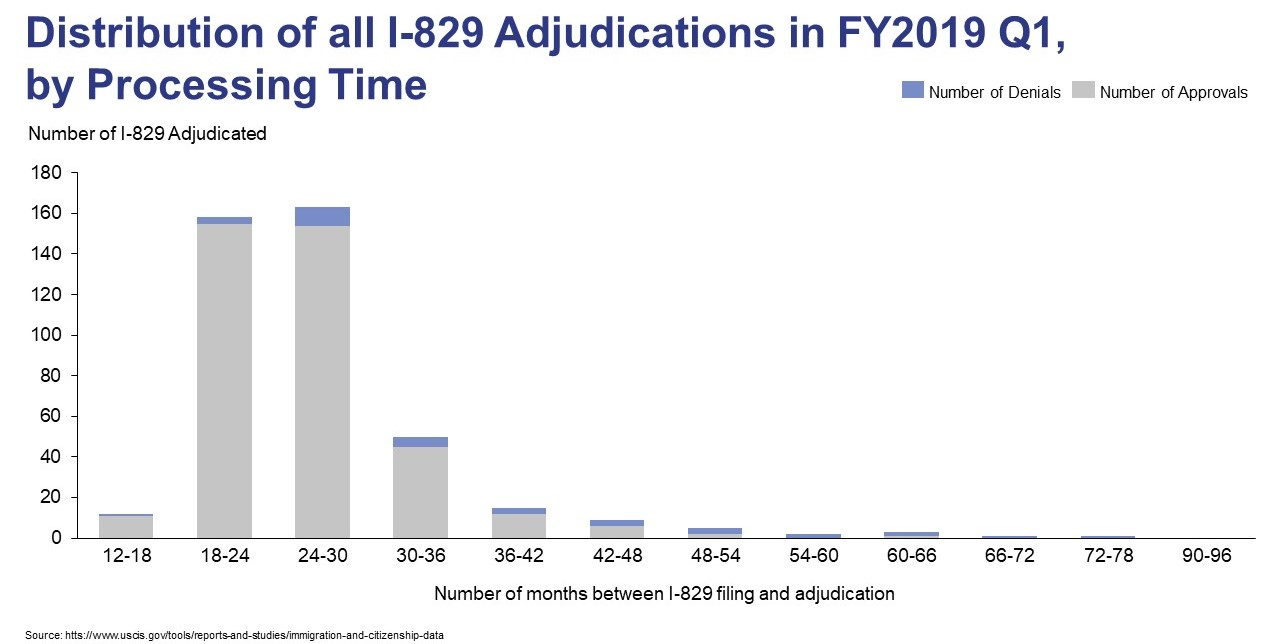
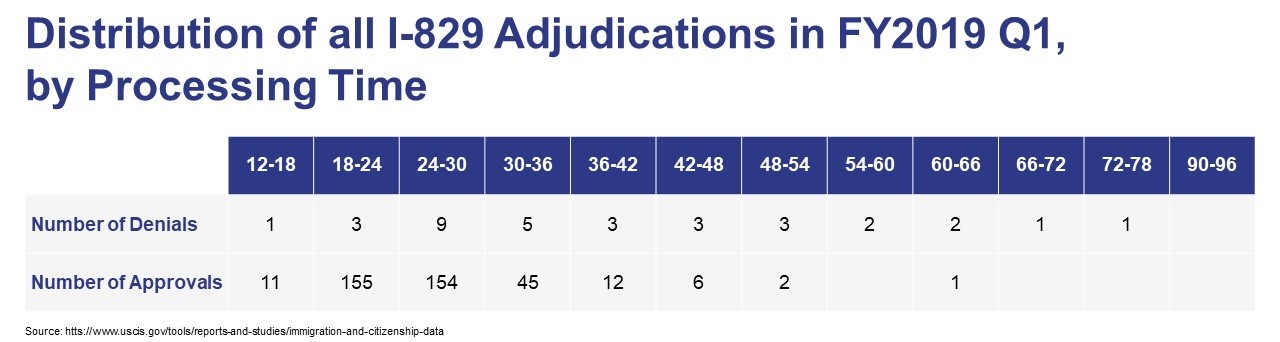
For example, below is data from Q1, 2019. It gives a breakdown of how many forms were processed within different timeframes. As you can see, the vast majority of cases were completed within 36 months. The timeframe in which the most applications were approved was 18–24 months, and some were even approved within 12–18 months. The longest processing time was 6.5 years.

Factors affecting I-829 processing times in 2023

Of course, statistics from late 2019 don’t reflect the reality in late 2023. The pandemic created backlogs in processing times. But there have also been many changes to the EB-5 Program, including the introduction of the Reform and Integrity Act of 2022. These changes have led to USCIS adopting more efficient processing practices.

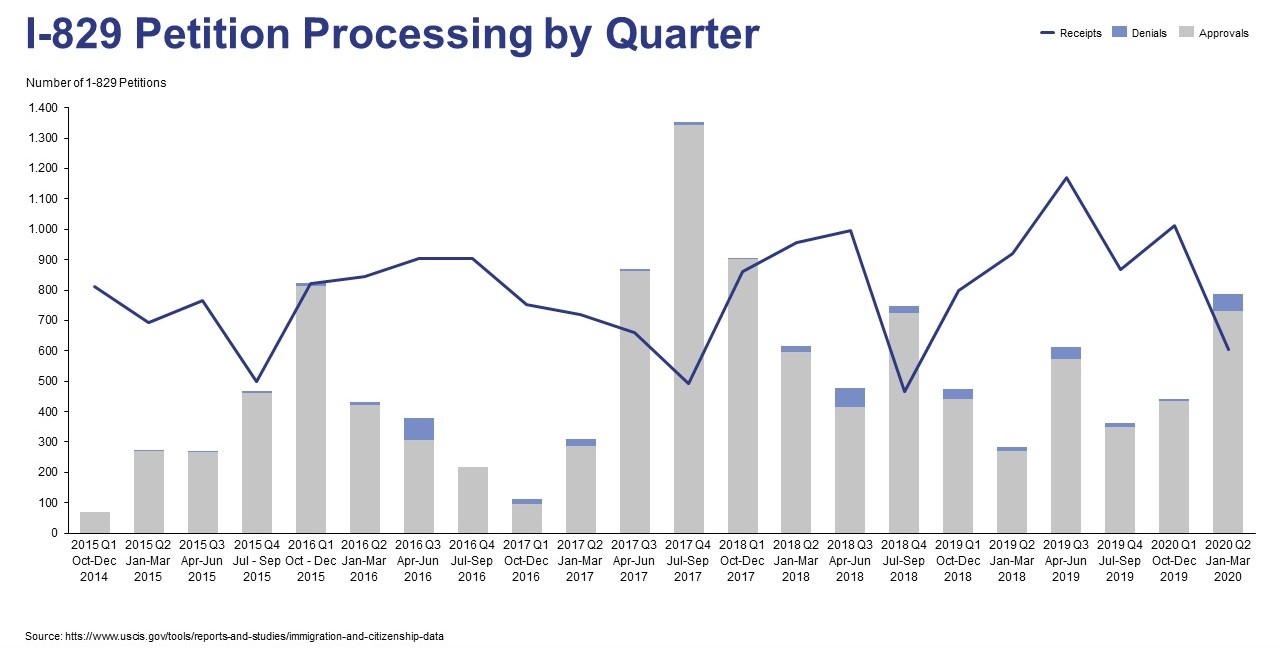
I-829 processing times depend on USCIS’s productivity, and, while real-time processing data is not available, I-829 adjudication data for each quarter is available on USCIS’s Citizenship and Immigration Data page. The chart below shows trends in USCIS productivity by quarter since FY2015 Q1, revealing clear fluctuations in USCIS’s I-829 adjudication productivity over the years.

How to Speed Up Your Form I-829 Processing Time

EB-5 investors have very little control over Form I-829’s lengthy processing times. There are, however, a few things you can do to speed up the process:

File at the right time

Form I-829 should be filed within a 90-day period prior to the expiration date of your two-year conditional resident status. If you leave it until your conditional Green Card expires, your ability to gain a permanent residency card will be jeopardized. However, if you file it too early, it will be rejected.

Fill all documentation and evidence correctly

To get your I-829 form approved, you need to provide concrete evidence that your investment has created 10 full-time jobs. Any gaps in documentation or weak evidence may slow your form’s processing time or even lead to it being rejected.

Work with a regional center

Regional centers document job creation data on behalf of their investors. They can also help their investors compile the necessary evidence and documentation. Many regional centers work closely with USCIS and will know what a good I-829 petition looks like.

Make an expedited request

If your I-829 petition was submitted more than two years ago, you can request for it to be expedited. However, you need to have a specific, compelling reason. These include:

  • Severe financial loss
  • Humanitarian reasons or emergencies
  • Situations where it will benefit the United States’ cultural or social interests (this needs to be requested via a non-profit organization)
  • Cases where it’s in the interest of the United States government
  • Errors made by USCIS

I-829 Processing Times: Conclusions

i829 processing times, eb5 visa, eb5 program, eb5 processing times, eb5 investment, form i829, i-829

The EB-5 Immigrant Investor Program is a great way for foreign nationals to become lawful permanent residents in the U.S. However, I-829 processing times can be frightening. A long waiting period can mean uncertainty for investors and their families. However, it’s important to remember that many Green Cards are granted within a reasonable timeframe. Some are even approved quickly.

Our advice is to make a contingency plan, just in case your I-829 petition is delayed. This avoids disappointment and ensures you have a plan in place, should there be delays.

For more information on the EB-5 process or to find help filing your I-829 petition, get in touch with EB5AN. We’ve helped hundreds of EB-5 investors to gain permanent residency status in the United States. Book a free consultation and discover how we can do the same for you.

Free EB-5 Project Evaluation

What Factors Influence EB-5 Visa Wait Times?

What-Factors-Influence-EB5-Visa-Wait-Times

The EB-5 Immigrant Investor Program may be one of the quickest and simplest pathways to U.S. permanent residency, but that doesn’t mean the process is necessarily quick or simple. Lengthy wait times have long plagued the EB-5 program, particularly for investors from backlogged countries. Excessive EB-5 demand is clearly one contributing factor to long wait times for an EB-5 visa, but it’s far from the only one, and those making an EB-5 investment should bear in mind the multitude of factors at play.

Obtaining conditional permanent resident status through the EB-5 program is a two-stage process: first, investors must file Form I-526, and then, upon I-526 approval, they must apply for the U.S. green card itself. As EB-5 investors from backlogged countries know all too well, simply receiving I-526 approval does not necessarily mark the end of the wait. To balance the excessive demand with the lower supply of EB-5 visas, United States Citizenship and Immigration Services (USCIS) releases monthly Visa Bulletins that limit the number of investors who can claim an EB-5 visa based on their priority date, or the date USCIS received their I-526 petition.

Most foreign nationals with an active EB-5 investment may file for their EB-5 visa immediately upon receiving I-526 approval, but for particularly backlogged countries—as of November 2020, only China—investors must wait even to file their green card application. Investors from countries not marked as “current” in Chart B of the monthly Visa Bulletin must hold off even on submitting their application for U.S. permanent resident status, elongating their wait indefinitely.

However, simply being from a “current” country does not free an EB-5 investor from hurdles and delays in their EB-5 journey. Anyone considering making an EB5 investment must also take into account that factors such as USCIS productivity and manpower or U.S. embassy and consulate closures could delay their journey to an EB-5 visa. Some such obstacles, such as the COVID-19 pandemic, whose subsequent global shutdown has thrown countless EB-5 investors into processing limbo, are unforeseeable. Those subject to a final action date in Chart A of the Visa Bulletin must also understand that this means that their priority date becoming current is not a guarantee of EB-5 visa issuance.

Effects of COVID-19

The COVID-19 pandemic, not USCIS itself, was the primary reason for the astoundingly low number of EB-5 visas issued in FY2020. Catching the whole world by surprise, the virus quickly spread around the globe and temporarily shut down nearly everything in its path, including U.S. consulates and embassies. Unable to proceed with their visa interviews, EB-5 investors from around the world have been left unable to claim their U.S. green cards—but those already living in the United States have escaped this obstacle.

With the ability to bypass the National Visa Center (NVC) and simply submit Form I-485 to adjust their immigration status, domestic investors have been one of the primary beneficiary groups of the COVID-19 pandemic in the EB-5 sphere. Given the consular shutdowns around the world, when final action dates in the Visa Bulletin move forward, they generally benefit only those applying for a U.S. green card by adjusting their status. In normal times, domestic and overseas applications are affected roughly equally, but in the COVID-19 era, the Visa Bulletin suddenly takes on a different significance for these two groups.

Wait Times for Indian Investors

The EB-5 world collectively rejoiced when the Indian final action date finally became “current” in July 2020. True to predictions from the chief of the Visa Control and Reporting Division at the U.S. Department of State, it has also remained current as of November 2020. However, this monumental status change doesn’t necessarily mean the wait times for all Indian EB-5 investors have been reduced. It’s important to consider where in the process the investors are. Whereas many investors from Vietnam, a backlogged country, have received I-526 approval and are awaiting their EB-5 visa, numerous Indian investors are still waiting for their I-526 petitions to be adjudicated. Since the Visa Bulletin does not account for these investors, it was able to leap forward, leaving thousands of Indian EB-5 investors behind. When these individuals from India with EB5 investments are finally approved, the final action date could fall back, and India could once again become a backlogged country.

Free EB-5 Project Evaluation

Why COVID-19 Is a Great Time to Invest in the EB-5 Program

Why-COVID19-Is-a-Great-Time-to-Invest-in-the-EB5-Program

The devastation that the COVID-19 pandemic has caused, including in the United States, is not news to anyone. As the world moves into a second wave and Europe sees the re-emergence of lockdown measures, immigration may be the last thing on most people’s minds. But in fact, the COVID-19 pandemic may present the perfect opportunity to invest in the EB-5 Immigrant Investor Program for a permanent life in the United States.

Life returning to normal is a question of when, not if. Even in the absence of a vaccine, viruses naturally weaken over time, and populations naturally build up herd immunity, meaning a return to normalcy is inevitable. Though it is still, as of November 2020, unknown when the world can return to normal life, those investing in their future through an EB-5 investment have plenty of time to wait. The program’s long processing times for I-526 petitions are no secret, with investors often waiting up to two years. EB-5 investors from backlogged countries—as of November 2020, China and Vietnam—must generally wait even longer.

The long processing times are not a good thing—there is even legal precedent of judges deeming unreasonable the wait times United States Citizenship and Immigration Services (USCIS) subjects EB-5 petitioners to. However, as they remain part and parcel of the EB-5 journey, advance planning is paramount, and prospective EB-5 investors can take advantage of the “lost time” of the pandemic to wait for USCIS to adjudicate their I-526 petition.

Another advantage the pandemic has bestowed upon those making EB5 investments is the flood of unused family-based visas reallocated to the employment-based visa programs. Each fiscal year, unused family-based visas from the previous year are rolled over to the employment-based programs, and the EB-5 program is entitled to 7.1% of these visas. The pandemic effectively halted all streams of immigration, including family-based immigration, which has resulted in the number of available EB-5 visas in FY2021 nearly doubling from the annual average. That means roughly twice as many investors as normal can receive their EB-5 visas in FY2021.

Some prospective investors may have doubts about the viability of initiating an EB-5 investment during the pandemic due to the suspended operations at U.S. consulates and embassies and travel restrictions that prohibit travelers from certain regions. These indeed constitute hinderances to an EB5 investment. However, anyone considering making an EB-5 investment should conduct careful due diligence on any potential project and EB-5 regional center, which can be time-consuming. Additionally, EB-5 investors must collect and submit complicated documentation proving the lawful sources of their EB-5 capital when filing their I-526 petition, which can account for another large chunk of time. By the time an investor is ready to submit their I-526 petition, life may already be well on its way to normalcy.

Potential Progress in the COVID-19 Fight

Since the onset of the pandemic in the United States, the Centers for Disease Control and Prevention (CDC) has been toiling away to keep Americans safe. According to the CDC, the government-initiated Operation Warp Speed, a public–private partnership intended to accelerate the development and distribution of a COVID-19 vaccine to the American people, has been operating since the beginning of the crisis, and while there remain no approved vaccines as of November 2, 2020, a CDC report dated October 14, 2020, indicates the possibility of a vaccine becoming available before 2020 ends.

A COVID-19 vaccine has been hailed by many as the key driver in the eventual return to normalcy. A vaccine could allow businesses to reopen with larger capacity, schools and universities to return to in-person classes, and the entertainment, travel, and hospitality industries—the most heavily affected industries—to resume their services. Given that the lucrative business opportunities and world-class education options the United States offers are among the top reasons foreign nationals opt to immigrate to the nation, the advent of a COVID-19 vaccine promises a return of the United States immigrants know and love—just in time for those who start the EB5 investment process now.