



Author Archives: admineb5

Free EB-5 Project Evaluation

Considerations in EB-5 TEA Eligibility Calculation: Timing and Rolling Calculations

Considerations in EB - 5 TEA Eligibility Calculation- Timing and Rolling Calculations (1)
The EB-5 Immigrant Investor Program is a successful U.S. green-card-by-investment program that, since its inception in 1990, has contributed billions in foreign capital to the U.S. economy and funded the creation of hundreds of thousands of new jobs. The foreign nationals who provide the EB-5 investment capital are issued green cards, assuming their investment satisfies the various requirements of the EB-5 program. Requirements include the creation of at least 10 full-time jobs for U.S. workers, proof of the legal sources of one’s EB5 investment funds, the maintenance of the capital in an at-risk status for the duration of the EB-5 investment, and, of course, funds that meet the minimum required investment amount.

All of the above-mentioned requirements can pose problems to EB-5 investors, with the minimum required investment amount constituting the most absolute obstacle. Clocking in at $1.8 million, the minimum required investment amount can nullify an EB5 investment journey before it even begins, since many foreign nationals don’t have $1.8 million handy to infuse into a U.S. new commercial enterprise (NCE). That’s where targeted employment area (TEA) projects come in. With a minimum required investment amount of $900,000, TEA investment allows an EB-5 investor to obtain the same U.S. permanent residency benefits as with non-TEA projects at half the cost.

Complexities of TEA Eligibility Calculation

While the definition of a TEA is clear cut, in practice, calculating whether a project qualifies for TEA designation can be tricky. TEAs come in two different flavors—high-unemployment TEAs and rural TEAs, with high-unemployment TEAs accounting for the majority. Rural TEAs are relatively easy to calculate—using the latest 10-year U.S. census data, an investor must show the area has fewer than 20,000 inhabitants and is not located in a metropolitan statistical area (MSA) or on the outskirts of an area with more than 20,000 inhabitants.

The calculation of TEA eligibility for high-unemployment TEAs is more complicated. To qualify, an area must have an unemployment rate 50% higher than the national average, using reliable and current census-tract-level unemployment data. Those pursuing an EB-5 investment essentially only have two datasets to cull figures from: American Community Survey (ACS) five-year census-tract data and Bureau of Labor Statistics (BLS) annual county-level data. In most cases, EB-5 investors target a census-tract-level TEA, leaving them with two calculation options: using the imprecise five-year estimates from ACS or combining the five-year ACS data with the annual county-level data from BLS to extract a more precise estimate. The latter is known as the census-share method.

Poor Timing Can Lead to Projects Losing TEA Eligibility

United States Citizenship and Immigration Services (USCIS) requires investors to use the most recent available unemployment data when demonstrating TEA eligibility in their I-526 petition. If the unemployment rate decreases and the area no longer encompasses a rate 50% higher than the national average after the investor has submitted their I-526 petition, they can proceed with their lower investment amount, as long as the area qualified as a TEA at the time of submission. However, fluctuating unemployment data throughout the project planning stage can put investors in danger of needing to make a $1.8 million EB5 investment.

Rolling Monthly Calculations of Census Tract Unemployment Data

While ACS figures are only released yearly, consolidated in a five-year chunk of data, BLS releases unemployment data monthly with a two- to three-month lag. Typically, investors use BLS’s annual releases, published in April of the following year, to obtain a more precise estimate of unemployment levels. However, if an investor compiled BLS’s monthly data releases over the most recent 12 months, the calculation would yield the most accurate possible estimate of current unemployment data.

This calculation method is known as the “rolling average” because it provides insight into a 12-month period covering periods in two different calendar years. In the era of COVID-19, such a calculation could be particularly valuable, as it would highlight the debilitating economic effects of the pandemic more quickly than the annual BLS data, expected to be published in April 2021. As of January 2021, the most recent yearly BLS data available covers 2019, thus missing any effects from the COVID-19 pandemic.

If an EB-5 investor opts for the rolling average calculation method—which, it should be noted, is an atypical calculation method that could throw a USCIS adjudicator for a loop—it’s imperative to compare the data to the national unemployment data for the same period. Presenting data from different time periods, even if they overlap, would constitute an invalid TEA calculation. The investor should also ensure they are filing their I-526 petition with the most recent BLS monthly data available. If the next month’s data is released during the I-526 preparation period, the rolling average calculation should be revised to encompass it.

Can You Calculate a TEA with Data Covering Less Than a Year?

An EB-5 investment participant may wonder whether they can calculate TEA eligibility with data covering nine months, six months, three months, or even one month. USCIS has not provided any specific guidance against such a calculation method, but prospective investors should be aware that this constitutes unexplored territory in the EB-5 realm. In a data release in March 2020, the immigration body did indirectly consider a one-month TEA eligibility calculation, with the example calculation in the question only spanning a one-month period and USCIS ignoring the calculation period in its answer to the main point of inquiry. However, this should not be automatically construed as acceptance of such a method.

Since month-to-month unemployment data can fluctuate greatly, a USCIS adjudicator may be reluctant to accept a rolling average calculation of less than one year, as it could be deemed to inaccurately represent the region’s unemployment situation. This danger is magnified during the COVID-19 crisis, since a rolling average calculation over a short period of time could dramatically accentuate unemployment that may not continue long into the post-COVID recovery. Considering that most I-526 petitions are not adjudicated until about two years following submission, it’s unlikely that such a calculation would be effective. The government may wish to exercise more leniency in light of the damage the pandemic has bestowed on the U.S. economy, but foreign nationals hoping to immigrate to the United States are strongly advised to avoid such gambles on their EB-5 investment.


Free EB-5 Project Evaluation

Addressing the EB-5 “Lawful Sources of Funds” Requirement

Addressing the EB-5 “Lawful Sources of Funds” Requirement

Since 1990, foreign nationals from various countries have taken advantage of the EB-5 Immigrant Investor Program to start a new life in the United States with their spouse and unmarried children younger than 21. Investors must part with $1.8 million—$900,000 for targeted employment area (TEA) projects—but an EB-5 investment in a bright, promising future in the United States is more than worth it, and if they select their EB-5 project carefully, investors may also earn a handsome return on their initial EB5 investment amount.

While the EB-5 program is known as one of the quickest and simplest methods to long-term U.S. immigration, an EB-5 investment still has to fulfill several requirements to qualify its investor for a U.S. green card. One such requirement is to provide documentation that proves the EB-5 investment capital originated from lawful sources. Although it makes sense for United States Citizenship and Immigration Services (USCIS) to require proof that its green-card-by-investment program is not promoting crime, either in the United States or abroad, the source-of-funds requirement can be time-consuming and challenging for investors to complete, depending on the type of funds comprising their EB5 investment.

To quote USCIS verbatim, an investor must “demonstrate by a preponderance of the evidence that the capital invested, or actively in the process of being invested, in the new commercial enterprise was obtained through lawful means.” Put more simply, an investor must provide evidence that shows their EB-5 investment capital is more likely than not lawful.

Different Investors Require Different Documentation

The difficulty behind offering general advice regarding the source-of-funds requirement is that each EB5 investment is different and thus requires different documentation. Procedures can also vary by country, with some documents more accessible in certain countries than others. Then, there’s the translation requirement—if an investor’s source-of-funds documents are not in English, they will also have to supply certified translations in English.

As USCIS allows EB-5 investment capital to come from any number of sources so long as it can be proven to derive from lawful sources, a wide array of documents could constitute source-of-funds documents for an EB5 investment. Below is a non-exhaustive list of potential source documents:

  • Tax returns
  • Bank statements
  • Loan documentation
  • Investment records
  • Employment records
  • Sale of asset records
  • Accounting records from the investor’s own business
  • Records of private transactions, such as gifts

How Long Does It Take to Gather Lawful Documentation?

The length of time any given EB-5 investor will require to gather the documents necessary to prove the lawful sources of their EB5 investment capital varies based on their country and the sources of their funds. Investors should speak with their EB-5 immigration lawyer to determine the most suitable sources of funds to use. EB-5 investment participants should also start considering the lawful sources of their capital in the investment planning stages, as their attorney will likely request the documents long before I-526 petition submission.

Additionally, the sooner an investor gathers source-of-funds documents, the sooner they can begin their new life in the United States. Delays in the document-gathering process will inevitably lead to delays in filing the I-526 petition, which will push the date of immigration to the United States further back.

Maximize Data Collection for Maximum Chances of I-526 Success

If you’re not sure whether to include a particular document—then you should probably provide it! Investors aren’t penalized for providing too many documents to prove the lawful sources of their EB-5 investment funds, and any document that can sway the adjudicator’s opinion in favor of the investor is a good thing.

In some cases, certain documents or records may not be available to the investor. If, for example, an EB-5 investor’s bank deletes bank account statements from its archives after a certain period of time, the investor may not be able to access necessary records to prove the sources of their funds. Fortunately, there are workarounds in such situations—an investor may ask their accountant to provide a sworn affidavit that details the same information that the bank statement would have, alongside a justification of why the original document is unavailable. Using such solutions to source-of-funds obstacles, most investors can secure their bright future in the United States.

Free EB-5 Project Evaluation

What Data Can EB-5 Investors Use to Justify TEA Designation of Their Project?

What Data Can EB - 5 Investors Use to Justify TEA Designation of Their Project-min

Since 1990, foreign investors interested in obtaining U.S. permanent resident status for themselves and their immediate family members have had a lucrative option available to do so: the EB-5 Immigrant Investor Program. For years, the program has granted U.S. green cards to foreign nationals who make successful EB-5 investments, meeting the various program requirements and creating 10 full-time jobs filled by U.S. workers. The program funnels foreign capital into in-need regions by promoting targeted employment area (TEA) investment with the incentive of a lower required investment amount.

Though the EB-5 program has been continuing its mission to stimulate the U.S. economy for decades, in November 2019, making a viable EB5 investment suddenly became more difficult for countless prospective investors. When the Modernization Rule came into effect, it increased the minimum required investment amount for non-TEA projects from $1 million to $1.8 million and the amount for TEA projects from $500,000 to $900,000. Suddenly, countless prospective investors were no longer eligible to participate, and countless others found themselves restricted to TEA EB-5 investment.

The complicated aspect of TEA investment is that United States Citizenship and Immigration Services (USCIS) does not itself demarcate TEAs, meaning the investor must present evidence in their I-526 petition demonstrating why their project qualifies for TEA designation. While this certainly complicates matters, it packs both advantages and disadvantages: it demands additional effort from the investor and adds an extra element of uncertainty into the EB-5 investment journey, but at the same time, it allows for flexibility in demarcating TEAs.

TEAs come in two varieties: high-unemployment TEAs and rural TEAs. High-unemployment TEAs are classified as areas with an unemployment rate 150% of the national average, while rural TEAs are defined as having fewer than 20,000 inhabitants. The methods for calculating TEA eligibility differs for the two types, and this article focuses on calculation methods for high-unemployment TEAs.

Two Main Data Sources for TEA Justification

While USCIS does not outline one specific calculation method for determining TEA eligibility, the immigration body does provide particular data sources that EB-5 investors must base their calculation on. The first is American Community Survey (ACS) data, which is calculated at the census-tract level and released every five years. As of January 2021, the most recent release of ACS census-tract employment data is ACS 15–19, covering the five-year period between 2015 and 2019.

The second data source for determining high-unemployment TEA designation is Bureau of Labor Statistics (BLS) Local Area Unemployment Statistics (LAUS). BLS data is calculated at the county level and may be used independently to procure TEA status for qualifying counties or metropolitan statistical areas (MSAs). However, most TEA designation is granted at the census tract level, where BLS must be used in conjunction with ACS data to obtain a more precise estimate of current unemployment levels. While BLS data is released monthly, the yearly estimates are typically used in TEA status calculation because the calculations must be based on the most recent data available at the time of adjudication. In other words, using annual data is more practical, as the data remains valid for longer. Annual BLS data is usually published in April of the following year, so the annual BLS data for 2020 can be expected in April 2021.

Time Lags Mean Long Delays Before COVID-19 Impacts Are Visible

The COVID-19 pandemic has wreaked havoc on the entire world, including the United States and its economy. While the EB-5 program represents a lucrative means to help stimulate the U.S. economy in its time of need, the time lag in ACS and BLS unemployment data minimize the potential benefits the EB-5 program could offer as the United States rebuilds its economy. Those participating in an active EB-5 investment, as well as those considering making an EB5 investment, may predict future unemployment levels by considering which areas of the United States have suffered greater economic consequences as a result of the pandemic, but the nature of EB-5 TEA calculation may prevent the effects from permeating the data for several years. BLS data for 2020 will be available in April 2021, but in most cases, TEA calculation with just BLS data is unviable, and even when the ACS five-year data for 2016 to 2020 is released in December 2021, the impacts of COVID-19 will be drowned out by the data of the previous five years.

TEA Calculation Methods: ACS-Only vs. Census-Share

One of the key advantages of having to individually prove TEA eligibility for each EB-5 investment is that the two census-tract unemployment rate calculation methods can garner different results, and even if the EB5 investment does not qualify for the lowered investment amount in one calculation method, it may in the other. Ineligibility in one method does not disqualify an EB5 investment for TEA status as long as the other one indicates TEA eligibility, giving investors some control over their TEA designation.

Since the five-year ACS unemployment dataset focuses on census tracts, EB-5 investors can opt to use only ACS data in their TEA calculation. If they choose this route, they must similarly use ACS data to determine the national unemployment average to which they are comparing the census-tract unemployment rate.

If, however, the ACS-only method does not yield TEA eligibility, an investor can instead apply the census-share method, which combines the five-year ACS data with BLS data for a more precise estimate of current unemployment levels. The method compares the percentage of unemployment in the census tract as measured by the ACS data to the more recent county-based rate of the BLS data and, under the assumption that the percentage will remain stable, estimates a more current unemployment rate for the census tract.

Given the wide-ranging changes that are expected to permeate the unemployment rate data due to the COVID-19 pandemic’s debilitating impacts, differentiating between these two calculation methods could become more important than ever. EB-5 investment participants concerned their current TEA will lose its eligibility should opt for the more stable ACS-only method, while investors hoping their project region will become eligible for TEA designation should use the more volatile census-tract method, which will reflect the impacts of the pandemic sooner. By carefully choosing their TEA calculation method, EB-5 investors can better procure a bright future in the United States for themselves and their immediate family members.

Free EB-5 Project Evaluation

USCIS’s EB-5 Redeployment “Clarification” Spells Unknown Consequences for Investors

USCIS’s EB-5 Redeployment “Clarification” Spells Unknown Conse…vestors

Try as United States Citizenship and Immigration Services (USCIS) might to infuse the EB-5 Immigrant Investor Program with obstacles and hardships, the residency-by-investment program remains one of the fastest and simplest pathways to permanent U.S. immigration. Since 1990, the program has been issuing U.S. green cards to foreign nationals who make a qualifying EB-5 investment in a U.S. new commercial enterprise (NCE) and create at least 10 new jobs for citizens or permanent residents of the United States. Thanks to the EB-5 program, hundreds of thousands of U.S. workers have found new, gainful employment, and countless foreign investors have escaped political and economic turmoil in their home countries, forging a new, peaceful, stable life in the United States.

Of course, just because the EB-5 program is relatively quick and easy doesn’t mean it is quick or easy. The program ran smoothly until about 2014, when explosive demand, particularly from China, resulted in massive backlogs for Chinese EB-5 investors. Six years later, the backlogs remain, having seemingly become a permanent aspect of the EB-5 program. Long backlogs mean long processing times, with investors and their EB5 investments left in limbo for years. These delays don’t just postpone the invaluable opportunities that investors and their family members can benefit from in the United States—in some cases, they also conflict with EB-5 program requirements, such as the need to maintain EB-5 investment capital at risk until the end of the investor’s two-year conditional permanent residency period.

EB-5 Investment Capital Redeployment

Increasingly lengthy processing times in the EB-5 program led to the necessity to redeploy EB-5 investment capital to satisfy the EB-5 “at risk” requirement. If an investor who had not yet met all the EB-5 requirements withdrew their capital following a successful EB5 investment that created the required 10 jobs, they would disqualify themselves for a U.S. green card by failing to meet the requirement to keep their capital until their two-year conditional residency period is up. Thus, investors were forced to reinvest their capital with little guidance from USCIS, as such a situation had not been foreseen upon the creation of the program.

USCIS eventually published guidance on the redeployment of EB5 investment capital in June 2017, which EB-5 stakeholders welcomed with open arms. Much to the relief of investors, USCIS confirmed in its revision that the “at risk” requirement applies only until an investor files their I-829 petition, not until their I-829 petition is adjudicated. But the agency also provided an unclear provision that served as the source of confusion for countless EB-5 investors: the capital must be reinvested in commercial activity “consistent with the scope of the new commercial enterprise’s ongoing business.” It was unclear whether the redeployment needed to be through the same EB-5 regional center or in a targeted employment area (TEA) and whether the commercial activity needed to be similar to the activity of the initial JCE.

USCIS’s Clarification Constitutes Retroactive Policy Changes

In July 2020, three years after the publication of its unclear guidelines, USCIS finally released a clarification of EB-5 redeployment regulations—and to the dismay of the entire EB-5 world, it introduced policy changes that USCIS has stated will be applied retroactively. According to USCIS, retroactive application is justified because the clarification does not introduce any substantive changes and potential impacts on EB-5 investors will be minimal. If precedent is any indication, however, courts are likely to side with petitioners who made viable EB-5 investment redeployments based on the published guidelines at the time if they file suit against USCIS for wrongful denial of their EB-5 petition.

The July 2020 EB-5 redeployment policy clarification comprised six key updates, some of which could serve as substantial obstacles to applicants who have already redeployed their EB5 investment funds. The six key updates are as follows:

  • Capital must be redeployed through the same NCE.
  • If enough jobs have already been created, the redeployment does not need to be in a TEA.
  • Capital must be redeployed within 12 months (if more than 12 months is needed, USCIS will consider evidence justifying the necessity of the delay).
  • Capital can be deployed in any commercial activity consistent with the NCE’s goal to engage in the “ongoing conduct of lawful business.”
  • The redeployment activity must not involve the purchase of financial instruments on the secondary market, as USCIS considers this a “financial” activity rather than a “commercial” activity.
  • Capital must be redeployed in the approved jurisdiction of the regional center as of the date of redeployment.

It is clear that these policy updates will land some EB-5 petitions in the rejection pile through no fault of the investor or their immigration counsel. Undeserved denials are most likely with the requirement that redeployment not be in what USCIS considers “financial” activity, especially since the 2017 guidelines seemingly approved redeployment in “new issue municipal bonds” as long as they fell under the scope of the NCE’s ongoing business activities.

Another clear problem in the updated policies is the requirement for the EB5 investment capital to be redeployed in the EB-5 regional center’s approved jurisdiction. This seemingly random restriction could see honest EB-5 investors’ petitions needlessly rejected and NCEs’ business freedom unnecessarily stifled, and USCIS can cite no basis in law or regulation for such a requirement.

The clarification didn’t just pack sweeping policy updates—it also begs even more questions. The requirement to redeploy EB-5 capital through the same NCE, for example, automatically disqualifies EB-5 investors unfortunate enough to work with NCEs that have closed, whether due to fraud or bankruptcy, bringing their dream of a life in the United States to a screeching halt.

USCIS’s disingenuous policy updates may be challenged in court, however. Already in 2018, a court ruled USCIS’s policy updates disguised as a clarification were unlawful and could not be applied to EB-5 petitions retroactively. Thus, EB-5 investors unfairly rejected on the grounds of the redeployment policy updates may similarly follow suit and overturn the unreasonable aspects of the update.

Free EB-5 Project Evaluation

What Does the EB-5 Reform and Integrity Act Entail?

What Does the EB-5 Reform and Integrity Act Entail

As the EB-5 Regional Center Program sunset date of June 30, 2021, hurtles closer and closer, the EB-5 investment world finds itself in a bind. Without the omnibus government funding bill the program’s reauthorization has traditionally been tied to, the possibility of regional center program termination has become a very real possibility. With three months left to save the ever-popular regional center program—which accounts for the majority of EB5 investments—the EB-5 industry has rallied behind the EB-5 Reform and Integrity Act, a bill proposed by bipartisan senatorial duo Chuck Grassley and Patrick Leahy. But what exactly would the bill do for EB-5 investment stakeholders?

The bill is primarily concerned with tightening security and integrity measures to more effectively root out fraud and ensure EB5 investment capital is used as Congress intended. The changes are generally beneficial for investors, as the bill includes special protections for those with EB-5 investments. It also introduces more stringent integrity measures for regional centers, which would make it easier for a prospective EB-5 investor to locate a trustworthy EB-5 regional center to invest through.

The key changes of the proposed bill for EB-5 investors are as follows:

Long-term EB-5 Regional Center Program Reauthorization

The most pressing issue for the EB5 investment industry is the looming termination of the regional center program, whose termination would be disastrous for the EB-5 industry. If the EB-5 Reform and Integrity Act comes to pass, it will automatically reauthorize the regional center program through 2026, giving applicants who make an EB-5 investment through a regional center peace of mind for the next five years.

More Accountability from Regional Centers to Investors

Regional center EB5 investment offers a myriad of advantages over the less popular direct investment route. For example, regional center investors do not have to engage in the day-to-day management of the new commercial enterprise (NCE), giving them more time and the freedom to live far away from their EB-5 project. Regional center investors are also able to include indirect and induced jobs in their job creation calculation, making the requirement of 10 newly created full-time jobs for U.S. workers easier to achieve. Finally, if a foreign national makes an EB5 investment through a USCIS-approved regional center, they can leverage the knowledge and experience of the EB-5 experts on staff.

Nonetheless, the risk of fraud in a regional center remains, however slim. Some EB-5 investors also have concerns about not directly supervising their EB-5 investment project. The proposed reform bill could help to alleviate investors’ concerns regarding such issues, as it would compel regional centers to provide, on an annual basis, statements to the Department of Homeland Security and to all participating EB-5 investors that account for all EB-5 investment capital and demonstrate EB-5 program requirement compliance. Regional centers would additionally need to hire a fund administrator or commission an independent annual audit to ensure EB5 investment capital is being used as intended.

Stronger Protections for EB-5 Investors

If an investor does, despite good faith on their part, find themselves mired in a fraudulent regional center, the EB-5 Reform and Integrity Act can also salvage their immigration eligibility. Fraud is rare, but it can destroy the hopes and dreams of unsuspecting, honest EB-5 investors, which is why the proposed act is written to offer such victims a second chance at a brighter future in the United States. As long as the investor was not involved with the fraud themselves, they “associate with EB-5 entities in good standing,” and they meet the rest of the EB-5 program requirements, they may continue with their participation in the residency-by-investment program. The investor would be given 180 days to find a new regional center and make whatever additional investment is necessary to create the remaining jobs needed to fulfill the EB-5 requirements.

Another protection the bill would offer applies to EB-5 investors with older children. Under U.S. immigration law, a child must be unmarried and younger than 21 to be considered a child for immigration purposes. Given the long wait times associated with an EB-5 investment, particularly for Chinese nationals, children aging out of EB-5 visa eligibility is a serious concern for many investors, but the proposed bill would protect the children of certain EB-5 investors from aging out if their petition were terminated or their application to remove the conditions on their conditional permanent residency were denied.

Mandate for USCIS to Work Toward Faster Processing Times

The issue of long processing times has been detrimental not only to the EB-5 program but to U.S. immigration as a whole. As of March 2021, some EB-5 investors—mostly Chinese nationals—have been waiting more than six years for their EB-5 visa, and the backlogs for some other immigration programs are even longer. The EB-5 Reform and Integrity Act would address the slow processing times in the EB-5 program by laying out reasonable processing times and forcing USCIS to conduct a fee study within a year of enactment. Then, USCIS would be required to adjust program fees as necessary to process EB-5 petitions at the stipulated efficiency.

What’s in Store for the EB-5 Program?

If the EB-5 Reform and Integrity Act passes, the landscape of the EB-5 program will change significantly, with the modifications adding new protections for EB-5 investors, accelerating processing times, and improving the program’s public image by cracking down on the few fraudulent cases that exist. If complemented by the passage of the Biden administration’s proposed U.S. Citizenship Act of 2021, which would enact significant reform to cut down on backlogs, the EB-5 program could soon be in a much better position than it has been in years. The reform would inspire more trust among both investors and the U.S. public, allowing the program to continue stimulating the U.S. economy and offering a chance at a better life for countless foreign investors.

Free EB-5 Project Evaluation

USCIS in History: Upending EB-5 Investors’ Lives with Retroactive Policy Changes

USCIS in History- Upending EB - 5 Investors’ Lives with Retroactive Policy Changes

The EB-5 Immigrant Investor Program, established in 1990, has long been a top choice among foreign investors looking to migrate permanently to the United States. The program was forged by Congress to introduce foreign capital to in-need regions in the United States, fostering economic growth and spurring new job creation. Foreign investors are more than willing to inject their hard-earned capital into qualifying EB-5 projects due to the promise of U.S. green cards for themselves and their immediate family members as long as their EB-5 investment satisfies the program requirements. With the United States gaining billions in foreign capital and hundreds of thousands of new jobs and foreign investors attaining a better, brighter future for their families, the EB-5 program represents a lucrative win-win situation.

But all is not rosy in the EB-5 world—in fact, EB5 investment participants must contend with the inefficiency and, seemingly, the incompetence and ill will of the very agency that oversees the EB-5 program. Over the years, United States Citizenship and Immigration Services (USCIS) has thrown obstacle after obstacle at EB-5 investors, from drawing out the adjudication process to introducing retroactive policy changes. In 2020, wait times for I-526 processing have been unthinkably long, particularly for those who have made their EB-5 investment from China, in light of the massive backlogs for Chinese investors. But while inefficient processing could just be a result of incompetence, it’s hard to paint retroactively applied rule changes as anything but malicious.

Surprise Denial Throws EB-5 Investor for a Loop

Back in 2014, a simpler time, when the well-oiled wheels of the EB-5 program turned smoothly and the explosive growth of the Chinese backlog was only in its beginning stages, Laura (name changed for privacy purposes) had made the major decision to relocate her life and family to the United States under the EB-5 program. She loved her home country, South Africa, but she knew the United States offered significantly better education and career opportunities for her children, and her family ties to the United States only sweetened the deal. She dove into an EB5 investment thanks to an unsecured loan gifted by her father and filed her I-526 in May 2014, excited about the prospects of her future in the United States.

She received her adjudication in November 2015, and it wasn’t the answer she was hoping for. She was devastated to find her I-526 petition had been denied because USCIS had ruled her EB5 investment using capital loaned by her father constituted “indebtedness” instead of cash. As Laura watched her family’s bright future in the United States crumble before her eyes, she felt as if she’d been blindsided, with her immigration counsel never tipping her off to such a possibility. However, her immigration lawyers were just as stumped: the policy that formed the grounds for her denial hadn’t existed when she filed her I-526 petition.

Retroactive Policy Changes Disguised as “Clarifications”

Laura fell victim to a USCIS “clarification” that, in reality, constituted far more than a simple clarification. In April 2015, USCIS released a memo stating that third-party loans were unviable as EB-5 investment capital unless the investor proved their personal liability for the indebtedness by securing the full amount of the loan with their personal assets. As the EB-5 community had long believed unsecured loans to fulfill EB-5 requirements, countless investors had made their EB5 investment through such means, dooming scores of I-526 petitions filed in good faith to undeserved rejection.

USCIS’s disingenuous classification of the rule change as a “clarification” rather than a proper rule change allowed the immigration body to apply the new interpretations to previously filed I-526 petitions, whose unwitting applicants had followed the rules as laid out at the time of submission. The release of the information as a “clarification” furthermore allowed USCIS to bypass the notice and comment requirements of the Administrative Procedures Act (APA), rendering unnecessary a general notice of the new interpretations and offering the opportunity for stakeholders to submit feedback, opinions, and suggestions for policy change.

Court Rules USCIS’s “Clarification” Not Suitable Grounds for Denial

Fortunately, while those who make EB5 investments may have to battle against USCIS, the courts usually serve as allies. Laura was not the only EB-5 investor whose dreams were retroactively crushed by the policy shift, and two such other investors filed suit against USCIS a few months after the release of the memo. The long-awaited ruling finally came on November 30, 2018, with the courts annulling all I-526 denials issued due to the policy change and ordering USCIS to readjudicate the petitions.

The ruling was a blow to USCIS and its dishonest practices, with the court further declaring that third-party cash loans clearly constitute capital and not indebtedness and that USCIS was acting capriciously in rejecting some I-526 petitions on that basis. More devastating for USCIS was the determination that the “clarification” constituted unlawful rule-making that violated the regulations of the APA. According to the court, the clarification was clearly a policy shift, introducing sweeping changes to EB-5 program requirements without the due notices and stakeholder input. The U.S. Court of Appeals for the District of Columbia echoed this determination in October 2020, ruling that USCIS’s interpretation “violated the regulation.”

Court Decision Too Slow for Many Investors

Laura was delighted when the courts ruled in favor of her and the numerous other EB-5 investors whose perfectly viable EB5 investment capital had been unfairly deemed unacceptable by USCIS. However, the decision came too late: the original decision was declared in 2018, but an appeal elongated the waiting period to late 2020. With the political and economic outlook for South Africa deteriorating faster and faster, Laura opted to make a new EB-5 investment rather than wait for the court decision. It paid off and afforded her family a cozy life in an idyllic Southern U.S. town, but Laura has been forced to face the financial consequences that come with effectively doubling her EB5 investment. Not all EB-5 investors in her situation have been as fortunate, with some lacking the means to dive into a new EB5 investment and others having their children age out of eligibility due to the prolonged wait times.

The EB-5 program remains one of the simplest and fastest ways to permanently immigrate to the United States, but investors must be wary of USCIS and the curveballs it can throw. While the courts will always be there to back investors up should USCIS introduce unlawful policy changes or denial decisions, court proceedings are notoriously lengthy, and investors could nonetheless lose their chance for a better, more stable life in the United States.

Free EB-5 Project Evaluation

Progress Toward EB-5 Reform

Progress Toward EB-5 Reform

The need for reform has long been noted in the EB-5 Immigrant Investor Program community, but action has been slow. Ever-lengthening processing times have plagued the program since roughly 2014, when the infamous Chinese backlog was born. The EB-5 Regional Center Program, which allows foreign nationals to make an EB-5 investment through an approved regional center instead of directly in the new commercial enterprise (NCE), remains a temporary program subject to continual reauthorization. The public image of the economy-boosting residency-by-investment program is abysmal, with laypeople associating the program with the few stories of fraud that have preoccupied the media. All these issues can be solved with EB-5 reform, and that’s precisely what the EB-5 Reform and Integrity Act aims to do.

The EB-5 Reform and Integrity Act, drafted by bipartisan senatorial duo Chuck Grassley (R-IA) and Patrick Leahy (D-VT), has been on the table for several months, particularly entering the limelight following the divorcing of the EB-5 Regional Center Program from the omnibus funding bill it has traditionally been renewed alongside. With the regional center vying alone for reauthorization before its sunset date of June 30, 2021, industry leaders fear reform is the only way to secure the program’s future. Termination of the popular program could be disastrous for EB5 investment participants, and it would significantly impact the EB-5 program’s ability to foster the U.S. economy, spelling bad news all around.

On March 18, 2021, Grassley and Leahy finally officially introduced their reform bill to Congress. With this, the gears have been set in motion to finally reform the EB-5 investment landscape. Following the introduction, EB-5 industry trade association Invest in the USA (IIUSA), which has been rallying for the bill on the belief that it is the only way to achieve reauthorization, voiced its support for the bill.

Industry Leaders Optimistic

Grassley and Leahy have worked alongside IIUSA to draft the bill, which addresses various problem areas in the EB-5 program. If all had gone according to plan, the bill would have been introduced in December 2020 as part of the federal omnibus budget, but since the bill was unfinished at the time, its inclusion was ultimately impossible. With the EB-5 program given a sunset date of June 30, 2021, the clock is ticking, and the time to enact reform is growing smaller—which is why the EB5 investment world has been relieved to hear of the bill’s formal introduction in Congress.

The primary concerns of the bill revolve around integrity, security, and transparency, tightening anti-fraud regulations and better protecting the interests of honest, good-faith EB-5 investment participants, project developers, and regional centers. More stringent security measures would also improve the program’s public image and help the program combat its demonization in the press. The legislation the bill has laid out would provide these necessary protections while simultaneously allowing the program to prosper and continue to pour billions of foreign capital into the U.S. economy—a win-win.

Another key issue the bill addresses is long-term reauthorization for the regional center program. If the EB-5 Reform and Integrity Act passes, it will reauthorize the EB-5 Regional Center Program through 2026. While not permanent reauthorization, a five-year reauthorization would do wonders for the short-term future of the EB-5 program, with foreign nationals able to comfortably make EB5 investments without fear of sudden regional center program termination.

Free EB-5 Project Evaluation

Visa Bulletin for April 2021: Vietnam Moves Ahead, China Stays Put

Visa Bulletin for April 2021 Vietnam Moves Ahead, China Stays Put

The coming of a new month once again brings a new Visa Bulletin from the U.S. Department of State—Bureau of Consular Affairs. With fiscal year 2021 more than halfway over, United States Citizenship and Immigration Services (USCIS) has still done little to use up the more than 18,000 visas allocated to the EB-5 Immigrant Investor Program for FY2021, with the Chinese final action date not budging for the entire duration of the fiscal year thus far. Whether USCIS will use the once-in-a-lifetime surge of visas available for EB-5 investment participants remains to be seen, but the current situation looks bleak. If, however, the Biden administration’s proposed U.S. Citizenship Act of 2021 comes to pass, USCIS programs will retain the allocated visas they failed to issue in a given fiscal year, safeguarding this uptick of EB-5 visas.

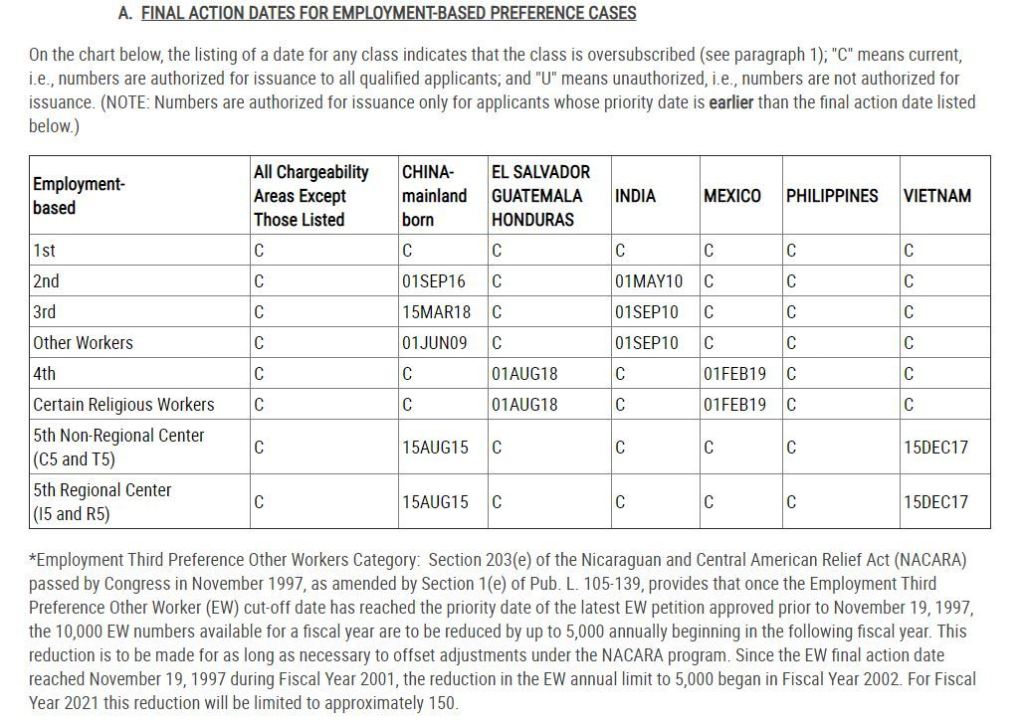
Indeed, the extra visas are unlikely to benefit Chinese EB5 investment participants. The Chinese final action date has failed to budge since September 2020, and according to a statement from Charles Oppenheim, the chief of the Visa Control and Reporting Division at the U.S. Department of State, Chinese EB-5 investors shouldn’t expect movement for the rest of FY2021. Calculations from November 2020 indicated a queue of about 6,000 Chinese nationals—primary EB-5 investment participants and their eligible family members—with I-526 approval and a current final action date awaiting an EB-5 visa. Oppenheim stated around the same time that he expected only around 3,000 EB-5 visas to be issued to Chinese nationals in FY2021, meaning final action date movement for the world’s most populous country is unlikely in FY2021.

As expected, the April 2021 Visa Bulletin places the Chinese final action date at August 15, 2015, for the eighth month in a row—and hitting the unfortunate one-year milestone is predicted. Chinese EB5 investors trapped in this processing limbo should keep an eye on the progress of the U.S. Citizenship Act of 2021, which proposes a comprehensive overhaul of the U.S. immigration system, including the removal of country-based visa limits, the retention of allocated yet unissued visas, and the exemption of eligible family members from the primary visa pool of employment-based immigration programs. This bill could redefine the EB-5 landscape and the position of Chinese EB-5 investors within it—but without the bill, Chinese EB-5 investment participants are in for a long wait.

Fortunately, Vietnamese investors are in a better position. While still subject to a backlog, unlike Indian investors, who escaped this burden in July 2020, Vietnamese investors can rejoice in the almost two-month jump of their final action date from October 22, 2017, to December 15, 2017. This leap represents the most sizeable EB-5 final action date advancement in several months and indicates a much brighter situation for Vietnamese EB-5 investment participants yet to achieve a current final action date than for their Chinese counterparts.

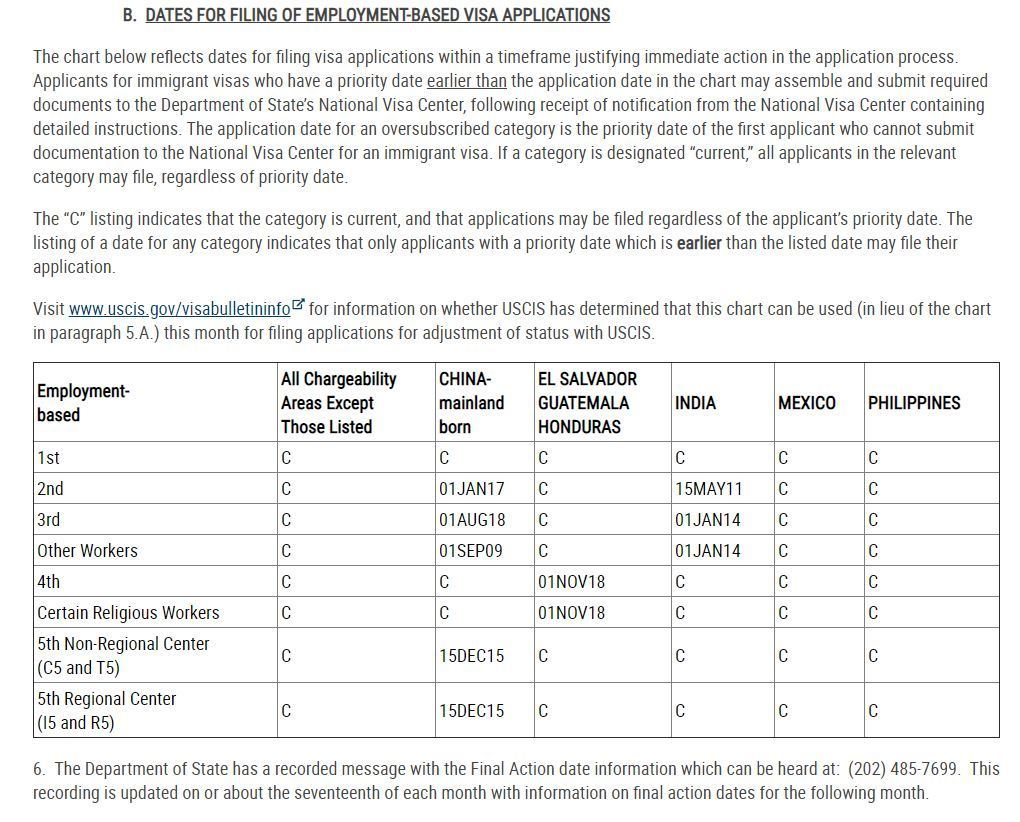
In terms of dates for filing for EB-5 applicants, only Chinese nationals are affected—in fact, China is the only country that has been impacted by a date for filing backlog in the EB-5 program’s more than 30-year history. While those waiting for final action date advancement have already submitted their visa application and are simply awaiting approval, Chinese EB-5 investors with a priority date later than December 15, 2015, are not even permitted to submit their EB-5 visa applications.

The Chinese date for filing has remained in place since March 2020, when the rapid international spread of the COVID-19 virus initially shut down the world. It’s already been more than a year since the date advanced, but as long as the Chinese final action date stays put, so too will the Chinese date for filing. With the final action date expected to remain at August 15, 2015, for at least the rest of FY2021, the date for filing is similarly expected to stay at December 15, 2015, at least until October 2021.

Free EB-5 Project Evaluation

EB-5 Country Trends in FY2020: Who Was Lucky Enough to Get an EB-5 Visa?

EB-5 Country Trends in FY2020 Who Was Lucky Enough to Get an EB-5 Visa

2020 was not a good year for participants of the EB-5 Immigrant Investor Program. It was not a good year for most inhabitants of the planet, as public life began to shut down and people were confined to their homes indefinitely. With shutdowns, lockdowns, and border closures, those who had made an EB-5 investment and were in queue to finally receive U.S. permanent resident status suddenly found their new life in the United States unattainable, with U.S. embassies and consulates temporarily ceasing routine visa services. Domestically, United States Citizenship and Immigration Services (USCIS) closed its offices to in-person traffic in the early stages of the pandemic, and the Trump administration enacted a year-long ban on most forms of employment-based immigration. It was a bad year for hopeful foreign nationals looking to forge a better life in the United States.

Most years, the country-based statistics of EB-5 visa issuances offers insight into what countries represent the highest levels of EB-5 demand, what share of investors from a particular country opt for EB-5 regional center investment, and how many EB5 investment participants from a specific nation obtained their EB-5 visa through domestic adjustment of immigration status rather than overseas consular processing. In 2020, the statistics are more representative of who was lucky enough to obtain a U.S. green card despite the mass shutdowns and processing bottlenecks due to the COVID-19 pandemic.

Adjustment of Status EB-5 Visas Issued

Adjustment of Status EB-5 Visas Issued

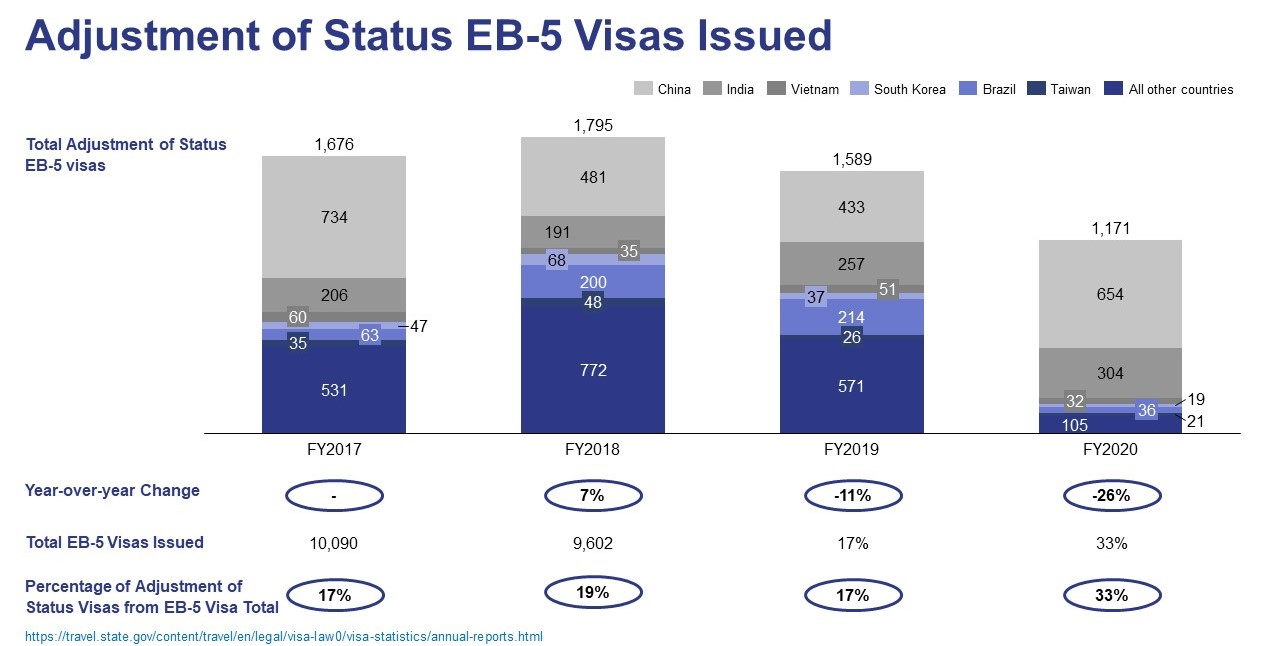
With consular processing effectively shut down for much of 2020, the door was left wide open to process I-485 petitions from domestic EB-5 investment participants to change their U.S. immigration status. With Charles Oppenheim, chief of the Visa Control and Reporting Division at the U.S. Department of State, declaring in November 2020 the existence of around 2,500 pending I-485 petitions just for Chinese applicants, theoretically, USCIS could have processed a maximum number of pending I-485 petitions to salvage as many allocated EB-5 visas as possible. But in practice, the immigration body failed to even meet FY2019 figures of adjustment of status EB-5 visa issuance.

I-485 processing for Chinese and Indian nationals was up, but only slightly. Across the board, other countries saw drops—such as Brazil, which fell from 214 in FY2019 to a measly 36 in FY2020. Overall, the number of adjustment of status EB-5 visas issued in FY2020 was lower than in the three preceding fiscal years, down 26% from FY2019. The percentage of adjustment of status visas among all EB-5 visas issued in FY2020 was indeed higher than previous years, but that was due to the overall lack of visas issued for EB-5 investments in FY2020.

So, what prevented the mass issuance of adjustment of status EB-5 visas in FY2020, when consular visas were all but impossible to grant? Given Oppenheim’s previous remarks, a depression in demand seems implausible. Rather, USCIS’s snail-paced processing speed is likely to blame, with slow Visa Bulletin movement the likely culprit behind the low number of Chinese EB5 investment participants receiving visas. EB-5 visa issuance has been on a downtrend trend since a high in FY2018, so the abysmal figures cannot be solely attributed to COVID-19.

Steep Drop in Overall EB-5 Visa Issuance

Steep Drop in Overall EB-5 Visa Issuance

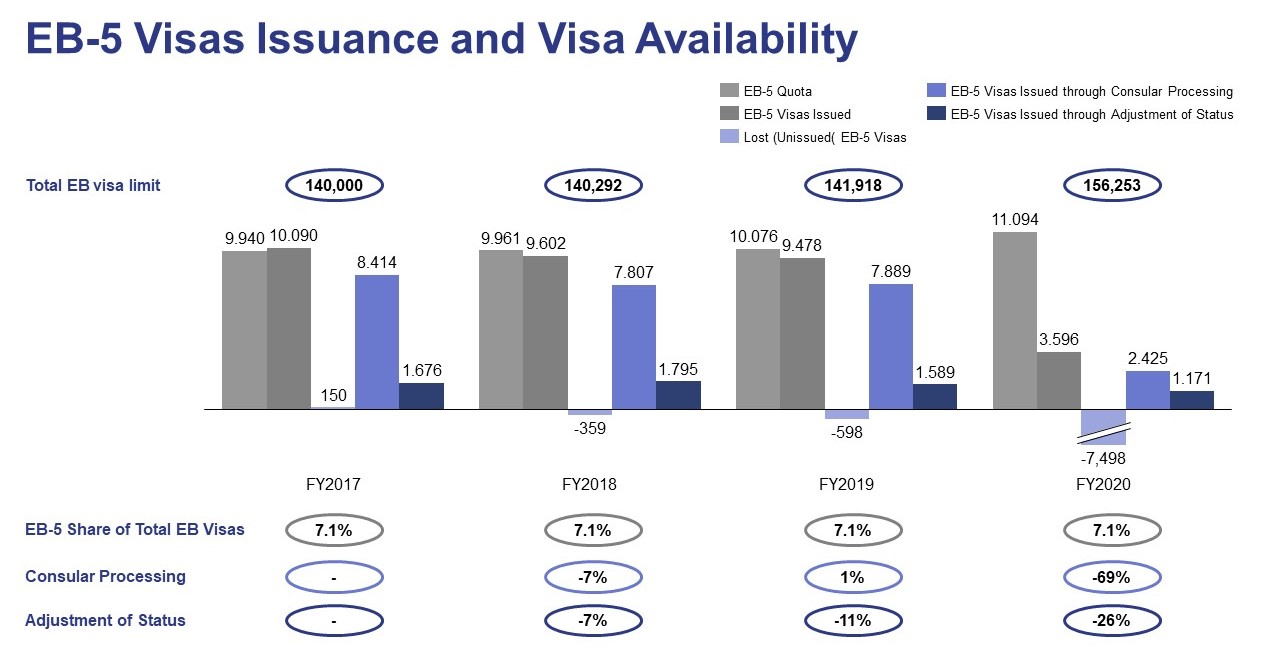
The pandemic’s dramatic effect on the EB-5 program can be seen in the overall number of EB-5 visas issued. Although the EB-5 program had more than 11,000 visas earmarked for it in FY2020—more than the previous three fiscal years—it issued little more than 3,500, letting almost 7,500 visas go to waste. EB-5 investment visas issued through consular processing dropped by 69% to around 2,400, while I-485-based visa issuance fell by 26% to around 1,100. The loss of 7,500 visas was offset by the massive gain at the beginning of FY2021, when unused family-based visas were recycled through the EB programs, granting the EB-5 program upwards of 18,000 visas—but with the pandemic still raging on in March 2021, whether those EB-5 visas will actually be granted in FY2021 remains to be seen.

EB-5 Visa Issuance in FY2020 by Country

EB-5 Visa Issuance in FY2020 by Country
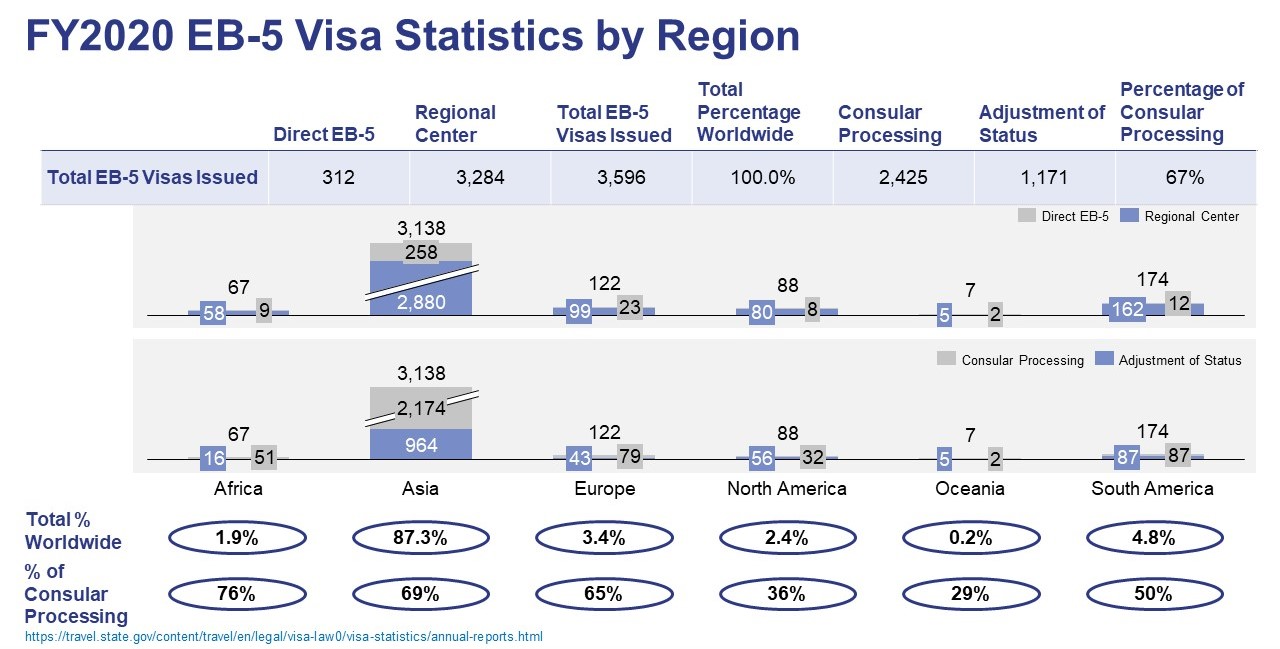
EB-5 Visa Issuance in FY2020 by region

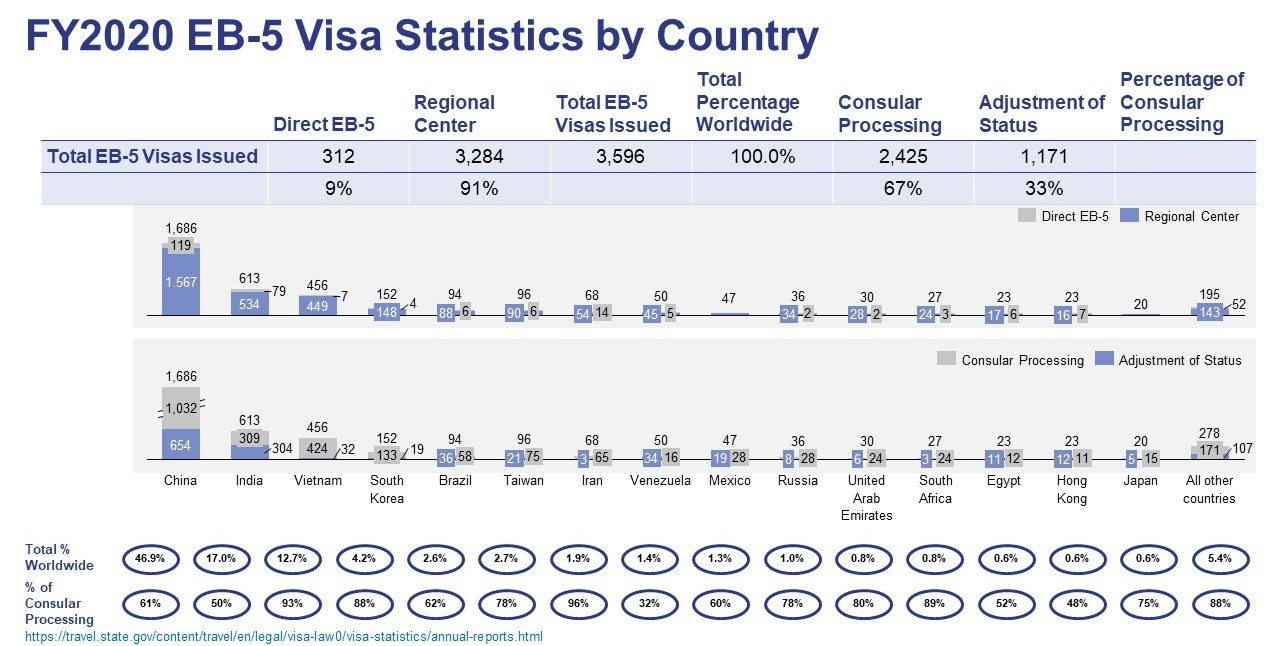
As usual, Chinese EB5 investment participants topped the country list in FY2020, accounting for more than 46% of all EB-5 visas issued in the fiscal year. India and Vietnam also accounted for sizeable portions, at 17% and 13%, respectively, and South Korea was next in line at just 4%.

EB-5 investment through a regional center remained the overwhelming favorite of EB-5 investors, with 91% of those lucky enough to receive an EB-5 visa in FY2020 having affiliated with a regional center. Of the 15 countries that saw more than 20 EB-5 visas in FY2020, two—Mexico and Japan—had no direct investors at all. Others, like Russia or the UAE, had only two. Direct investment seemed more popular among Iranian investors, however, with 14 out of 54 Iranian investors having made a direct EB5 investment.

Most interesting is the breakdown of visas issuance through consular processing versus adjustment of status petitions. Despite the total shutdown of consular processing throughout half of FY2020, it nonetheless accounted for more than half of all EB-5 visa issuances in the 15 major EB-5 countries, with the exception of Venezuela. In Iran, consular processing represented a whopping 96% of EB-5 visa issuances, which suggests that almost no Iranian nationals received an EB-5 visa in the latter half of FY2020. Even though USCIS was effectively unable to issue consular processing EB-5 visas for several months, the agency apparently could not muster the capacity to dole out adjustment of status EB-5 visas in their stead.

The 2,400-odd EB-5 visas issued in FY2020 through consular processing are likely to have been distributed between October 2019 and February 2020, before the world shut down due to the COVID-19 pandemic. If the pandemic hadn’t struck and USCIS had continued processing at the same pace, the yearly total still would have only come to around 5,000, plus another maybe 1,500 resulting from approved I-485 petitions. At roughly 6,500, this still would have been the lowest number of issued EB-5 visas among the three years preceding FY2020, meaning EB-5 investment stakeholders would be wrong to direct all their ire toward the pandemic and its containment measures. Clearly, there also lies a problem with USCIS’s processing practices, independent of the pandemic.

Free EB-5 Project Evaluation

EB-5 Backlogs May Not Be Around for Much Longer

EB-5 Backlogs May Not Be Around for Much Longer

As advantageous as the EB-5 Immigrant Investor Program is for foreign nationals looking for a permanent life in the United States, the slow, inefficient processing practices at United States Citizenship and Immigration Services (USCIS) can cause major headaches for EB-5 investment participants, particularly those from backlogged countries. The program has been plagued with problems since FY2019, with the COVID-19 pandemic only compounding existing issues. While Indian EB-5 investors experienced a monumental clearing of their backlog in July 2020, the backlogs have remained for Chinese and Vietnamese investors. In fact, with the addition of Hong Kong EB5 investment participants following Beijing’s implementation of the controversial Hong Kong national security law, China’s EB-5 backlog has grown even larger.

USCIS’s lackluster efforts in I-526 petition adjudication are understandably off-putting to foreign nationals considering making an EB-5 investment, particularly if they hail from China or Vietnam. However, investors hoping to gain permanent residency rights in the United States would be wise to not write off this popular residency-by-investment program just yet—pending legislation could be a game-changer for the EB5 investment world.

How the U.S. Citizenship Act of 2021 Can Benefit the EB-5 Program

Immigration-friendly President Biden may not have the EB-5 program specifically in mind with his proposed overhaul of the U.S. immigration system, but the sweeping changes his administration is looking to enact could change the landscape of the program and revitalize lost interest among prospective EB5 investment participants. The bill contains a myriad of provisions that would tighten up the U.S. immigration system as a whole, and among them are three important proposals that could finally eliminate EB-5 backlogs.

Eliminating Country-Based Caps on Visa Issuance

As of March 2021, the EB-5 program is subject to a country-cap restriction that limits the number of visas that can be issued annually to recipients of a given nationality to a mere 7%. Putting aside the fact that this system ignores differences in population and demand, with the same figures reserved for China and Andorra, the restrictive rules discriminate based on nationality and force honest EB5 investment participants into processing limbo through no fault of their own. If the country caps were done away with, the backlogs may largely disappear.

Fortunately for Chinese and Vietnamese EB-5 investors, Biden seems to agree that the system is unfair. One of his proposals is the elimination of the country-cap system, which would free up thousands of investors to finally receive the EB-5 visa they earned long ago. With no more country caps, the need for investors to redeploy their EB-5 investment capital may also be reduced, lessening financial risk and allowing investors to have their capital repaid more quickly.

Exempting Families from the Visa Pools

One of the key motivations of EB-5 investors is to forge a better life for their children in the United States, including by sending them through the U.S. public school system or securing higher chances of college admission for them. Even if this isn’t one of the driving factors to make an EB5 investment, investors would hardly move to the United States if it meant leaving their spouse and dependent children behind. So don’t worry—this proposal isn’t suggesting families be disallowed from claiming green cards in relation to an EB5 investment.

But the addition of family members on most EB-5 petitions eats away at the available EB-5 visas for a year, which typically clocks in at around 10,000. Estimates have put the number of visas going to primary investors at a little over 3,000, with the rest being taken by family members. If family members were exempted from the pool, as the U.S. Citizenship Act of 2021 proposes, they would still receive permanent residency rights, but their visas would not be taken out of the pool of EB-5 visas, meaning the program could grant visas to roughly 10,000 primary investors per year. This would roughly triple the program’s output capacity, driving down backlogs and wait times.

Reclaiming Historically Unused Visas

The EB-5 program’s underutilization in its early years could also constitute a boon to those with active EB5 investments in 2021. Though the residency-by-investment program was born in 1990, it failed to gain significant traction until the 2010s, regularly issuing fewer than 500 EB-5 visas annually. With the capacity to issue about 10,000 visas each year, tens of thousands of EB-5 visas have been lost throughout the years.

If the U.S. Citizenship Act of 2021 comes to pass, the EB-5 program can reclaim the tens of thousands of visas it failed to distribute in its first two decades. This move alone could clear up the EB-5 program’s lengthy backlogs, and combined with the above two initiatives, backlogs could remain a relic of the past for the foreseeable future of the EB5 investment program. Though not specifically focused on the EB-5 program, the U.S. Citizenship Act of 2021 is just what is needed to reinvigorate the program and attract new EB-5 investment capital from foreign nationals seeking a better life in the United States.