Free EB-5 Project Evaluation

Anticipating the Impact of the Coronavirus on U.S. Unemployment Rates and EB-5 TEA Determination

The closing of businesses due to the pandemic caused by the rapid spread of the 2019 novel coronavirus, which causes COVID-19, has had a significant effect on employment levels in the United States. At this stage, it is impossible to know exactly what the long-term outcomes for employment will be, but it is reasonable to expect an increase in the national unemployment rate and fluctuations in regional unemployment rates. This, in turn, will affect targeted employment area (TEA) designation based on a high unemployment rate, but not rural TEA designation. Additionally, the effects will be delayed due to data lag, with the data for the current calendar year becoming relevant only in April 2021.

COVID-19 and EB-5 TEA Designation: The Basic Assumptions

Although numerous factors will influence the outcomes of the coronavirus pandemic for EB-5 investors, we can make several key assumptions. Infection rates and the effectiveness of response strategies will fluctuate across regions. Severely affected regions may experience unemployment rates that are on par with or higher than the national unemployment rate. Likewise, in less affected areas, the unemployment rate may be significantly lower than the national unemployment rate. The implications of this is that new regions may qualify as TEAs, and regions that currently qualify as TEAs may no longer qualify.

Moreover, the changes to unemployment rates and their implications for TEA designation will not become clear immediately. The two main types of data used to determine whether a project location qualifies as a TEA are American Community Survey (ACS) data and the data published under the Bureau of Labor Statistics (BLS) Local Area Unemployment Statistics (LAUS) program. The earliest update to a relevant data set relating to the current calendar year is expected in April 2021.

Understanding Unemployment Data for TEA Designation: ACS vs. BLS Data

When calculating unemployment rates for TEA designation, we use either ACS five-year data only or the census-share method, which relies on a combination of ACS and BLS data. Data about 2020 unemployment statistics will not become available until April or December 2021, depending on the data set.

ACS data is based on a five-year period and updated each December, with the data set published in 2019 covering the 2014 to 2018 five-year period. The next set of five-year data, expected in December 2020, will cover 2015 to 2019. Thus, data related to current employment conditions will not appear until December 2021, when the 2016 to 2020 data will be published.

BLS data is published monthly, but using monthly data for TEA calculations would not make sense, as the designation would need to be updated each month when the data becomes outdated. Consequently, census-share calculations typically rely on annual BLS data, which is published in mid-April each year. Therefore, the 2020 data will be published in April 2021.

Because the ACS five-year calculation method relies on data covering a span of five years, it tends to be the more stable method, and the effects of the COVID-19 crisis may not be as pronounced. Additionally, the updated information will not be available until December 2021, so it will take longer for the current employment rate changes to affect the data.

In contrast, the census-share method relies on annual BLS data in addition to ACS data, and the relevant data will be released in April 2021. This means calculations based on BLS data will show the effects of the COVID-19 pandemic faster than ACS five-year calculations, and we will probably observe more significant fluctuations over time.

United States Citizenship and Immigration Services (USCIS) accepts either the ACS five-year method or the census-share method. That means a project area must qualify as a TEA based on either calculation method—the project area does not have to qualify under both. In other words, even if a project area does not qualify as a TEA when we use the ACS five-year method to calculate unemployment rates, it could qualify as a TEA when we use the census-share method.

Future TEA Status in the Face of Uncertainty

While it is difficult to predict future TEA status at the best of times, the current uncertainty complicates forecasts even further. Current TEAs with unemployment levels far above the threshold might continue to qualify for designation. Similarly, we can base assumptions on the effects of the COVID-19 outbreak as they become clear. For example, considering the extent of the outbreak in New York, it should be safe to assume current TEAs in New York will still qualify as such when the data for 2020 is released in 2021.

Calculations are usually made at the census-tract level for a small labor force. This makes it extremely difficult to predict how COVID-19 will affect specific TEAs, as it is impossible to know at this stage whether or not major changes will occur. Moreover, if unemployment rates rise steeply due to COVID-19, entire counties may qualify as TEAs, eliminating the need for census aggregation. Finally, the most significant impacts of the pandemic should be temporary, so unemployment rates that increase in the wake of COVID-19 might fall back below the threshold once the local economy recovers. Whatever happens, it is safe to assume that unemployment rates will fluctuate

While no one can predict the future, we can look at monthly county-level BLS data to develop an idea of a project site’s continued TEA status. Although using BLS data will be more accurate for the census-share method, it is useful for the ACS five-year data method. ACS data will not be available until December 2021, but analyzing the BLS data can show how conditions in the project area are changing over time. This could provide valuable clues about what we can expect from the updated ACS data.

If you would like us to monitor a specific project location for you, please e-mail the EB5AN team at info@eb5an.com or schedule a call. We have developed an excellent understanding of the factors affecting TEA determination through the development of our free national EB-5 TEA map and our EB-5 TEA qualification report service.

Free EB-5 Project Evaluation

EB-5 Investment from Saudi Arabia

Although the United States surpassed Saudi Arabia and Russia in 2018 to become the world’s largest producer of crude oil, Saudi Arabia has amassed great wealth over the last half century with its own plentiful oil reserves. This has enabled it to maintain a large presence on the world stage, and it is home to an abundance of moneyed residents. Nonetheless, the recent crackdowns by the Saudi government against dissenters and perceived corruption have led to increased interest in Saudi EB-5 investing.

Wealth and Economy

As a result of its large oil reserves, Saudi Arabia is known for containing some of the world’s richest people, especially among the royal family and its associates. It currently is home to more millionaires than any other Middle Eastern country, totaling 176,000 in 2017. Saudi Crown Prince Mohammed bin Salman (MBS) has also launched an ambitious plan called Vision 2030 to diversify the Saudi economy, reduce its dependence on oil, and expand public service sectors throughout the country.

Political Landscape

MBS has been seen by many as a reformer for the Saudi people, purging corruption within the government and royal family and ushering new changes into the kingdom. The most publicized reform has been the repeal of a long-held ban on female drivers. However, it is still common for Saudi activists to be detained and tortured for expressing dissent, and the Crown Prince has been heavily criticized for his country’s role in the humanitarian crisis in Yemen. MBS has also been embroiled in the scandal surrounding the 2018 murder of Washington Post columnist Jamal Kashoggi in the Saudi consulate in Turkey. Political instability in Saudi Arabia has prompted many potential EB-5 investors to seek safer ground in a more liberal environment.

While Saudi Arabia welcomes expatriates into its workforce, their presence in the country must be tied to a sponsor and a specific work contract. The government offers no visas for retirees or opportunities for naturalization, making it quite difficult for non-Saudis to stay in the country after retirement. This policy was enacted to prevent non-Saudi citizens from taking advantage of the country’s retirement and health benefits. As such, EB-5 visas might be an appealing option for wealthy non-Saudis after they retire.

Crime and Safety

Crime rates among the Saudi population are low, but this is likely due to the extreme punishments given to criminals or those who dare to speak out against the government. Penalties include lashings, torture, amputations, excessive prison sentences, and public beheadings. Another issue of concern in Saudi Arabia is the ballistic missiles being launched across the border by Houthi rebels in Yemen since 2015. This is in response to Saudi Arabia’s continued military presence in Yemen. There is also an increased risk of terrorist attacks in the country, though the Saudi government has strengthened its security forces in response. Still, many wealthy Saudis prefer to move their families to a more stable location.

Environmental Conditions

As the home of the largest desert on Earth, Saudi Arabia’s frequent sandstorms compound the air pollution already emitted by factories and vehicles in its cities. The Saudi capital of Riyadh is now one of the most polluted cities in the world, with current pollution levels shortening the average Saudi’s life by 1.5 years. Agricultural practices and city expansion risk threatening the country’s rich biodiversity as well. Other large risks are oil spills, desertification, and shrinking underground reservoirs of water. The Saudi government is making some effort to transform the country into a more environmentally friendly economy, but sustainability is not yet a popular concept among the Saudi public.

Educational Quality

Elementary through high school education is free for all Saudis, with a slightly lesser enrollment rate for girls than boys. Saudi Arabia is also creating more than 150 vocational training centers across the country so as to decrease its economic dependence on oil. Thousands of Saudi students are sent to American universities as well, with the total reaching almost 60,000 in 2018. The vast majority of these students are sponsored by the Saudi government, with the intention that they will use their newfound knowledge to benefit the kingdom upon their return.

EB-5 Project Selection Preferences

As in Vietnam, Saudi EB-5 investors prefer large, flashy projects boasting established brand names. EB5AN frequently works with Saudi project developers and sponsors to assemble the required project documentation for EB-5 Form I-526. EB5AN also provides sponsorship through its 14 USCIS-approved regional centers for projects seeking Saudi EB-5 investors.

Capital Flow and Other Challenges with the EB-5 Process

The Saudi government imposes no limits on how much money can be moved out of the country, assuming the money is earned legally. Saudi EB-5 investors and foreigners working in Saudi Arabia must ensure that the money they try to transfer matches their earnings on paper. Otherwise the government has the authority to open an investigation into the funds.

Marketing Channels for Investors

Like in India, the Saudi EB-5 market consists of only a few experienced agents. Most Saudi EB-5 investors are sourced through small entities such as travel agencies, chartered accountants, wealth managers, and real estate brokers. In addition, regional centers and project sponsors target many Saudis directly through in-person seminars in Saudi Arabia itself. Saudis already in the U.S. on visas such as the H-1B or F-1 are also targeted.

Free EB-5 Project Evaluation

What Are the EB-5 Eligibility Requirements?

The EB-5 visa program is open to foreign investors and their families all over the world with the means to invest in EB-5 projects, as long as they meet certain requirements. Those who are successful in their EB-5 investments receive U.S. green cards for themselves, their spouse, and their unmarried children under the age of 21.

EB-5 investors must fulfill several requirements to receive U.S. permanent resident status:

  1. Investors are required to invest the stipulated required investment amount ($900,000 or $1.8 million, depending on targeted unemployment area, or TEA, designation) into an EB-5 project in the United States.
  2. Investors’ EB-5 capital must create (or, alternatively, preserve) 10 full-time jobs for U.S. citizens or residents that last at least two years.
  3. Investors’ EB-5 funds must remain at risk for the entire duration of the EB-5 process.
  4. Investors must document the sources of their EB-5 funds (both the $900,000 or $1.8 million investment amount and the additional $50,000–$80,000 in administrative fees) to prove that they were obtained legally.
  5. Investors must take on a concrete role in the new commercial enterprise (NCE). EB-5 investors investing directly must be heavily involved in the management of the project, while those investing through regional centers can simply assume a role as a policymaker.

How Do EB-5 Investors Make Their Investments?

The first step is to find a suitable EB-5 project with low financial and immigration risk. EB-5 investors should take their time to carefully assess a project’s documents and conduct due diligence to evaluate a project’s risk levels. Upon selecting an appropriate EB-5 project, investors should work with their immigration attorney to review the applicable laws and regulations before moving the required funds into the account designated in the project documents. In many cases, this will be an escrow account.

How Can EB-5 Investors Qualify for the Lower Investment Amount?

Investors working with EB-5 projects that meet the requirements for TEA designation are eligible to invest only $900,000 as opposed to the regular amount of $1.8 million. There are two types of TEA projects: projects in a high-unemployment urban area and projects in a rural area, which is defined as having a population of less than 20,000.

What Qualifies as an EB-5 Project?

An EB-5 project must be an NCE, which is defined as a lawful business that conducts for-profit activity. Many different types of businesses qualify, including corporations, limited partnerships, sole proprietorships, business trusts, and joint ventures. Furthermore, the NCE must have been established after November 29, 1990, when the EB-5 program was enacted.

What Does the Job Creation Requirement Entail?

One of the key requirements of the EB-5 program is the need for each investor’s capital to create at least 10 new full-time jobs in the United States. This requirement differs depending on the investment path the investor chooses.

Investors who invest directly in an EB-5 project must fund the creation of at least 10 full-time direct jobs. Direct jobs are defined as construction jobs or jobs on the NCE’s payroll.

Investors who invest in an EB-5 project via a regional center must fund the creation of at least 10 full-time direct, indirect, or induced jobs. Indirect jobs are jobs at external businesses that produce supplies or provide services to the NCE. Induced jobs are jobs created in the local community through the money spent by the workers of the NCE. The job creation must be estimated by a professional third-party economist using accepted economic or statistical calculation approaches.

Free EB-5 Project Evaluation

The Answers to Your Questions About the EB-5 Program

The EB-5 Immigrant Investor Program is subject to constant change as United States Citizenship and Immigration Services (USCIS) modifies its regulations and processing standards. In recent months, the program has undergone several new changes, with additional changes to come in the near future. Here are the answers to a few of the top questions about the changes to the EB-5 program.

Will the EB-5 program continue?

Foreign nationals can directly invest in EB-5 projects indefinitely. However, more EB-5 investors choose to take the regional center route, as it requires less managerial input from the investor and relaxes restrictions around the EB-5 job creation requirement. The EB5 Regional Center Program is extended periodically, with the most recent extension valid until September 30, 2020, and updates posted on the USCIS website.

What is the minimum required investment for an EB-5 project?

For close to 30 years, the EB-5 minimum investment amount remained the same, but in November 2019, the new EB-5 Modernization Rule went into effect, increasing the minimum investment amounts significantly. Now, for EB-5 projects that are in a targeted unemployment area (TEA), the minimum required investment amount is $900,000. For EB-5 projects without TEA designation, the minimum investment amount is $1.8 million. These amounts are set to increase in line with inflation every five years, with the first increase expected in 2024.

What options do investors have for investing in EB-5 projects?

There are two pathways to EB-5 investment: direct investment and regional center investment. Both pathways are part of the same program and, upon successful completion, result in the same lawful permanent resident status for investors and their spouses and children.

The direct investment program is better suited to EB-5 investors who wish to be heavily involved in the management of the project. This is a good option for EB-5 investors who would like to run their own business and have more control over their investment. It offers the potential of greater financial returns, if the EB-5 investor is a skilled project manager.

The regional center program is better suited to EB-5 investors who prefer to have limited managerial involvement in the project and desire the added financial and immigration security regional center investment offers. This is a better option for EB-5 investors whose main objective is obtaining a green card, not earning high returns on investment. Regional center EB-5 projects can also count indirect and induced jobs toward the EB-5 job creation requirements, which makes it easier for regional center EB-5 investors to successfully complete their investment.

A commonly held belief is that only regional center EB-5 projects qualify for the lower $900,000 minimum investment amount, but the truth is that both types are eligible as long as the project is located in a TEA. The myth might have come about due to regional centers primarily choosing to work with EB-5 projects located in TEAs.

How long does it take to complete the EB-5 process?

There is no one answer to this question because it depends heavily on each investor’s individual situation. As of March 2020, USCIS takes approximately three to four years to process I-526 petitions.

Factors that may impact the length of an EB-5 investor’s EB-5 journey include the following:

  • Citizenship from a backlogged country (as of March 2020, Mainland China, India, and Vietnam)
  • The complexity of the investor’s I-526 petition, including the difficulty of tracing the source of the investor’s EB-5 capital
  • The previous track record of the EB-5 project

How are I-526 petitions processed?

The traditional processing method for I-526 petitions has been a first-in-first-out (FIFO) approach. At the time of writing, USCIS is still using the FIFO approach in its I-526 processing.

However, effective March 31, 2020, USCIS will switch to a visa-availability I-526 processing approach. Under the new regulations, USCIS will prioritize I-526 petitions from investors whose countries have visas immediately available. This will benefit applicants from underrepresented EB-5 countries by potentially speeding up their pathway to a U.S. green card, but it will hurt Chinese, Indian, and Vietnamese investors by potentially elongating the time it takes them to complete the EB-5 process.

Who is the EB-5 program for?

The EB5 program is for foreign national investors who wish to obtain a green card to live permanently in the United States. Qualifying investors may add their spouse and unmarried children younger than 21 to their application to obtain green cards for the whole family. An EB-5 green card offers grantees numerous benefits, including the freedom to work, live, study, travel, and do business anywhere in the United States as well as facilitated access to U.S. universities.

Who qualifies to be an EB-5 investor?

Foreign nationals with the appropriate capital ($900,000 for a project in a TEA or $1.8 million for a project outside a TEA) who can prove the lawful source of their funds qualify to participate in the EB-5 program. Foreign nationals can invest from abroad or while already living in the United States on a different visa, but those already residing in the United States must be accredited investors to qualify.

Can a loan be used as EB-5 capital?

EB-5 funds may take any number of forms. In addition to income, investments, and the sale of assets, EB-5 capital may also come from inheritance, loans, and gifts. This is a non-exhaustive list.

Can investors work or study as conditional permanent residents during the EB-5 process?

Conditional permanent resident status offers grantees the right to live, work, and study anywhere in the United States. EB-5 regional center investors are not required to live near their EB-5 project, so it is possible to invest in an EB-5 project in Florida and reside in Hawaii. Since regional center investors do not need to be heavily involved in the management of the EB-5 project, they have plenty of time to work, study, or live as they wish in the United States.

What is the first step to an EB-5 investment?

Foreign nationals interested in participating in the EB-5 program should first consult an EB-5 immigration attorney to ensure that the program aligns with their needs and goals. If you are interested in pursuing an EB-5 visa and would like more information about the program and its processes, don’t hesitate to contact the EB5AN team.

Free EB-5 Project Evaluation

Where Is the EB-5 Program Gaining Popularity?

Year by year, the EB-5 Immigrant Investor Program grows in popularity, attracting more and more foreign nationals who wish to invest in the U.S. economy to obtain a green card. The U.S. Department of State – Bureau of Consular Affairs recently released the EB-5 data for fiscal year 2019, and it reveals explosive EB-5 growth since FY17 in several countries.

It’s general EB-5 knowledge that investors from Mainland China dominate the program, and it’s also quite well known that India, Vietnam, South Korea, Taiwan, and Brazil have been steadily approaching China’s lead over the past several years. Since this isn’t news, we’ll concentrate on the EB-5 growth in the countries next in line.

EB-5 Growth from FY17 to FY19

Graph shows EB-5 Visa growth in 9 countries from FY2017 to FY2019 with the highest numbers from South Africa and the UK.

Wealthy individuals and families in growing EB-5 markets are increasingly choosing to invest in the EB-5 program for various reasons. As word spreads of the opportunities the EB-5 program provides, more and more investors wish to dive into the program before the backlogs grow too large. The following are some of the key advantages of the EB-5 program that investors list:

  • The EB-5 program grants visas to not only the investor but also his or her spouse and unmarried children younger than 21.
  • The EB-5 program provides investors with a path to U.S. citizenship, which investors may apply for after only five years of permanent residency.
  • The EB-5 program allows investors to enroll their children in the U.S. public education system and increases their children’s chances of admission to U.S. colleges.
  • The United States is a rich, safe, highly developed nation that offers citizens and residents a wealth of opportunities to succeed and live the life they desire.
  • In addition to permanent residency in the United States, EB-5 investors can potentially make handsome monetary gains from their EB-5 investment.

As the graphic shows, Libya and Iraq jumped to 22 and 36, respectively, from 0. The growth in Japan and South Africa is also significant, although there was already a fair number of EB-5 investors from these countries in FY17. Growth in the United Kingdom was slower, but there is still an upward trend.

EB-5 growth did not occur all across the board, however. In a handful of countries, while there was growth—in some cases significant growth—in the number of EB-5 visas from FY17 to FY18, figures dropped in FY19. In Russia, the number of EB-5 visas in FY19 even dropped below FY17 figures. Nevertheless, despite the decline, all six countries in the graph below remain relatively strong EB-5 markets.

Graph shows the decline in number of EB-5 investors who received visas in Fiscal Year 2019 from the previous two years.

The data can be misleading because the figures do not represent the number of I-526 petitions filed during the respective fiscal year. Instead, they represent the number of investors from each country who received their visas during the respective year. For most countries, it takes around two years for United States Citizenship and Immigration Services (USCIS) to process the I-526 petition, so in most cases, these numbers reflect EB-5 demand from two years prior.

Why does an investor’s country of origin matter?

USCIS can only issue around 10,000 EB-5 visas per year, regardless of the demand. To make distribution among different countries fair, the maximum number of visas available annually for each country is capped at around 700. For investors from countries like China, India, and Vietnam, where the demand is higher than the supply, visa backlogs can cause wait times of several years.

Until recently, country of origin only mattered in the visa application process, with I-526 petitions being processed on a first-in-first-out basis, but USCIS has announced, effective March 31, 2020, that new I-526 petitions will be processed based on visa availability. This will further push back the wait times for investors from China, India, and Vietnam, but it could foster further growth in underrepresented markets such as Japan, South Africa, and the UK, as it offers investors from these countries a faster path to a U.S. visa.

Free EB-5 Project Evaluation

How Long Should EB-5 Investors Expect to Wait Until I-526 Approval?

The EB-5 visa program is anything but fast. Given its growing popularity, backlogs for popular EB-5 countries like China, India, and Vietnam have steadily grown over the years, with countries like South Korea and Taiwan starting to catch up.

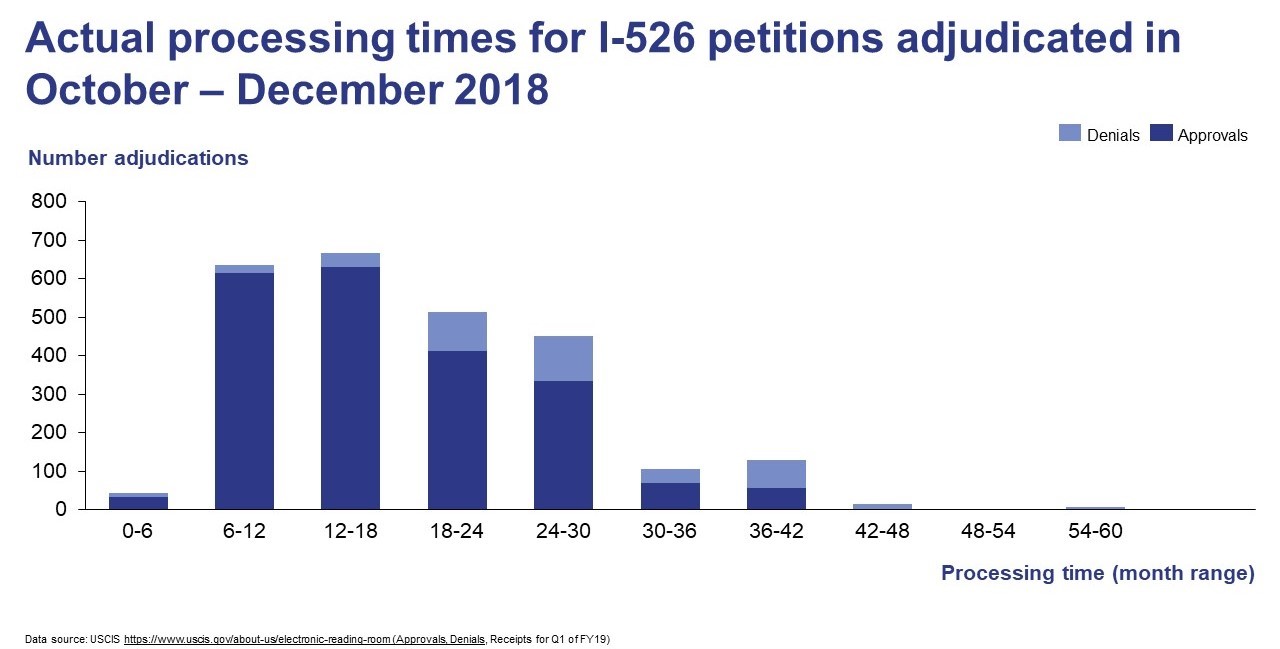
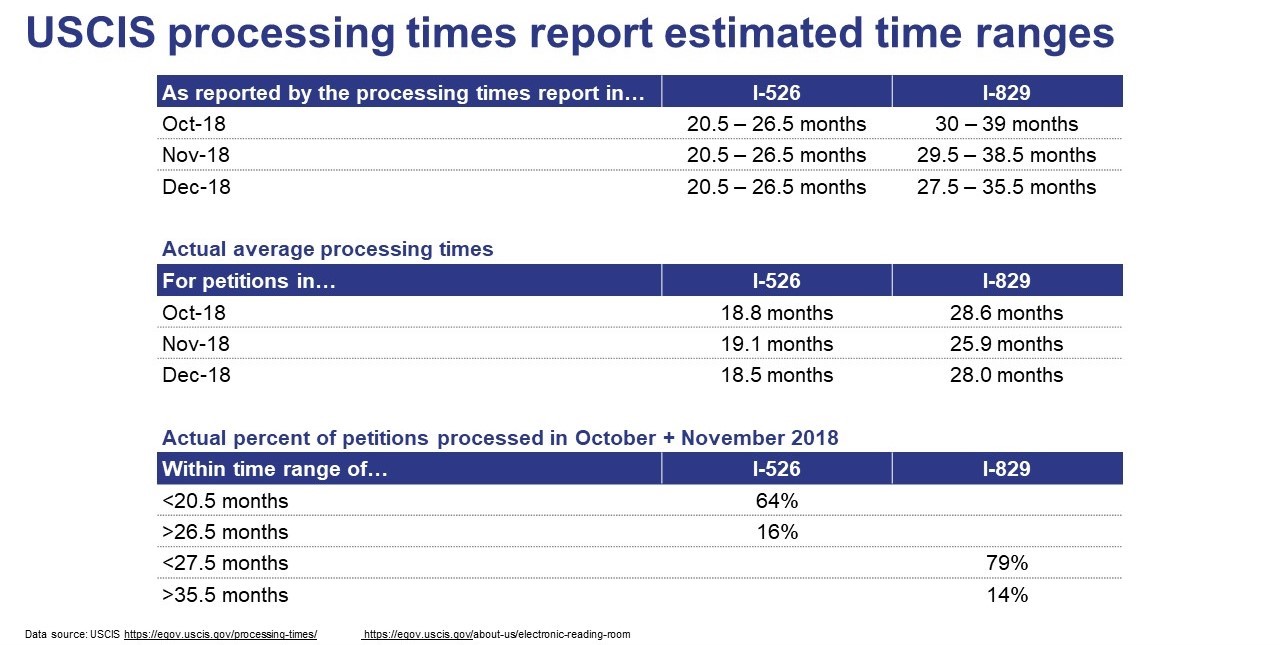
The waiting process begins even before I-526 approval, as it has typically taken around two years for USCIS to process an I-526 petition. These times have been growing recently, climbing to a range of 32 to 49 months (2.7 to 4 years) in February 2020. This growth trend has continued into March 2020, with USCIS updating the processing times to a range of 33 to 50 months (2.8 to 4.2 years).

In conjunction with the updated wait times, USCIS also provides the priority date for case inquiries. EB-5 investors with a priority date on or before the specified date are eligible to launch a case inquiry into their abnormally long I-526 processing times. As of March 3, 2020, it is January 13, 2016, but it is constantly subject to change.

Upcoming Changes to the I-526 Processing Approach

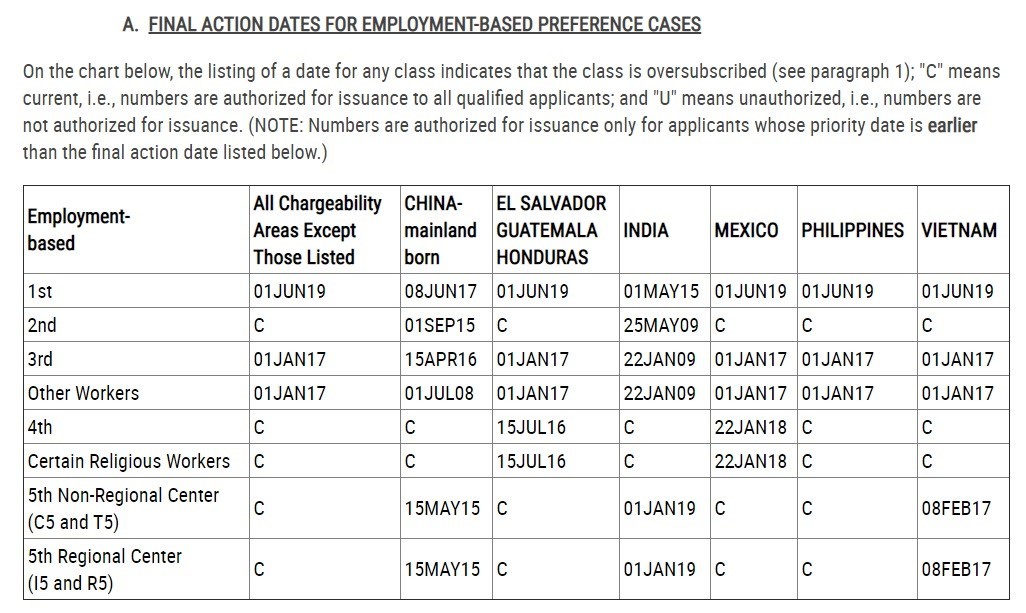
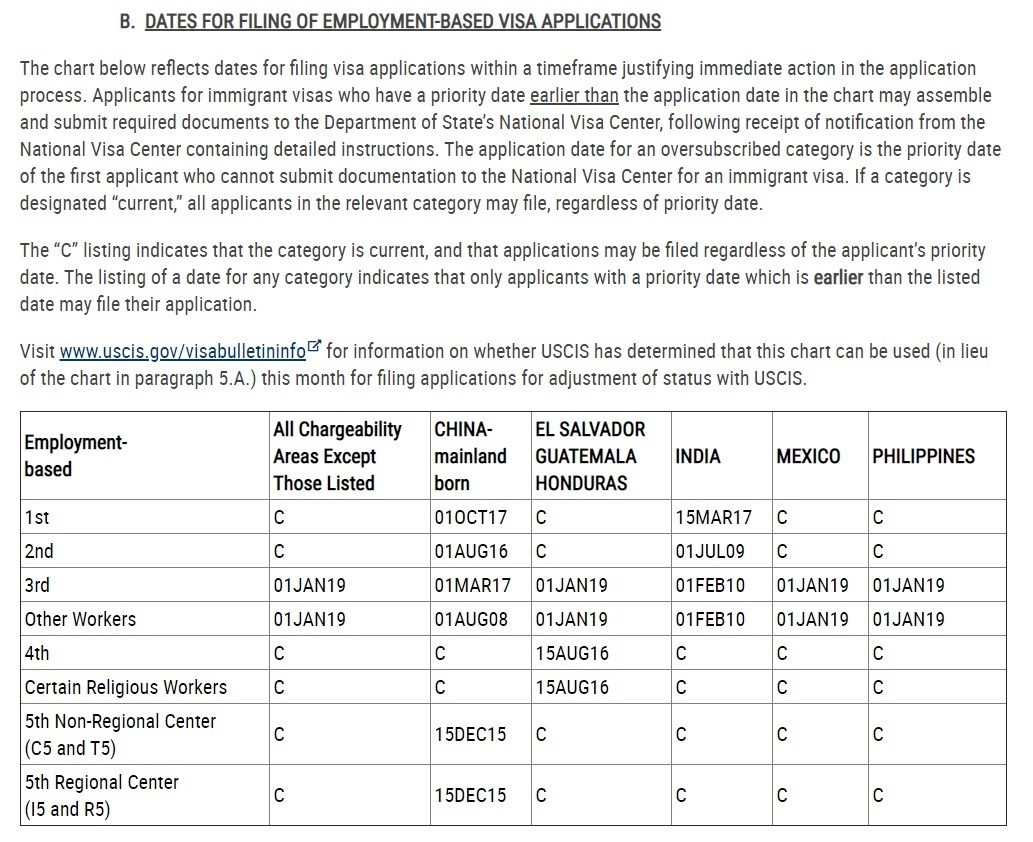
March 2020 is the final month of USCIS’s traditional first-in-first-out processing method for I-526 petitions. Starting March 31, 2020, USCIS will switch to a new visa availability approach, processing I-526 petitions based on the availability of visas for the applicant’s country. USCIS uses the dates in Chart B of the monthly Visa Bulletin to determine adjudication assignment decisions, which means that EB-5 applications from investors in underrepresented countries, such as Canada, the UK, and Japan, will be prioritized, while applications from Chinese investors will be delayed, subjecting these investors to even longer wait times. Keep an eye open for USCIS’s April 2020 I-526 processing times update, as the new system could spell major changes.
Free EB-5 Project Evaluation

Indian EB-5 Investors to Pay 5% More for EB-5 Visas Starting in April 2020

The Indian government has announced a new 5% tax on remittances out of India, effective April 1, 2020. It’s not an April Fool’s joke: This new regulation will increase the cost of an EB-5 visa for Indian investors by $45,000 for an investment in a project within a targeted employment area (TEA) or by $90,000 for an investment in a project without TEA designation.

The EB-5 program is a convenient pathway to U.S. permanent residency for wealthy individuals and families around the world, with particular popularity in Mainland China, India, and Vietnam. In India, the number of investors has been growing substantially in recent years, making it the second-biggest EB-5 country.

Indian EB-5 investors have to pay tax on their EB-5 transfers eventually anyway, but they can avoid paying the additional $45,000 or $90,000 now by transferring their capital to a U.S. escrow account before April 1.

EB-5 funds can remain in an escrow account until the investor is ready to proceed with his or her investment. That means Indian EB-5 investors can comfortably transfer their capital to a U.S. escrow account while still taking the time to conduct thorough due diligence on their preferred EB-5 project. Time is of the essence for any Indian EB-5 investors who wish to avoid the new 5% tax on remittances, however.

Free EB-5 Project Evaluation

Country-Based EB-5 Statistics in FY2019

Every year, the U.S. Department of State releases the Report of the Visa Office, which offers a peek into the statistics of the U.S. visas, including EB-5 visas, issued throughout the given year. In the report, EB-5 visa statistics are spread out across two different tables: Table V Part 3 (visa recipients who already resided in the US under a different visa) and Table VI Part IV (visa recipients who were granted their visa while abroad). The recently released Report of the Visa Office 2019 offers insights into which countries the EB-5 investors who were granted U.S. permanent residency in FY2019 are from.

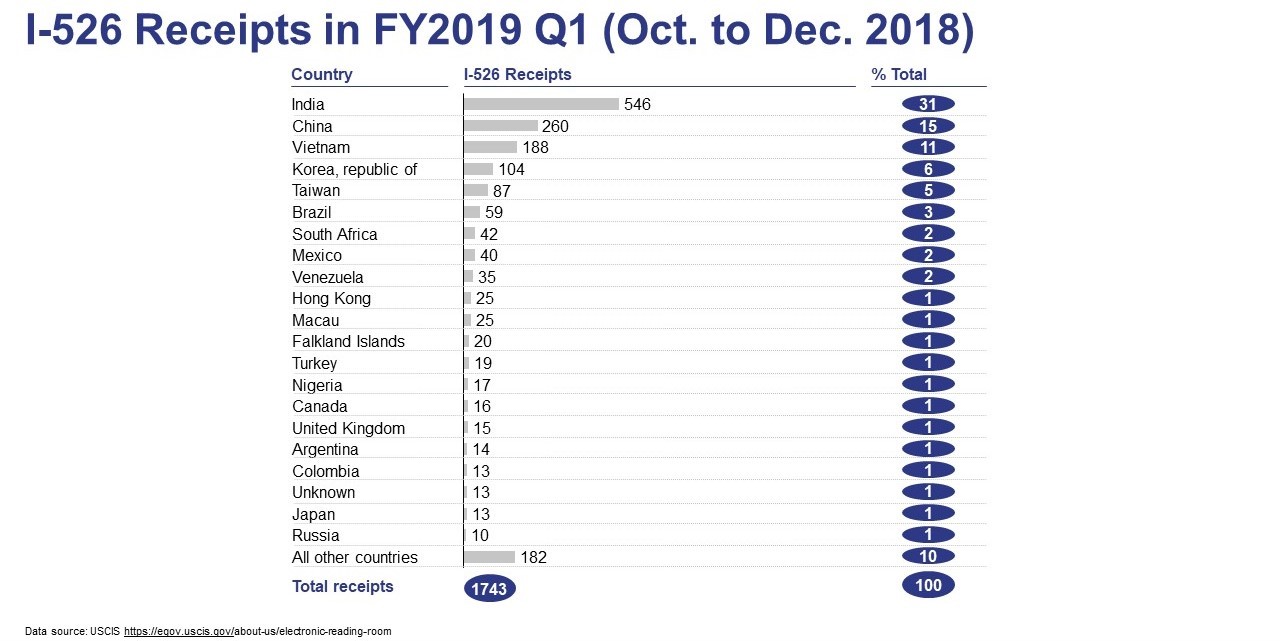
One important thing to note is that these statistics do not reveal the current EB-5 demand. Because of the long I-526 processing times, investors receive their green cards only after a few years—and often more for investors from China, India, and Vietnam, who must wait in large backlogs for their opportunity to apply—so the information in these charts is more reflective of the EB-5 demand from a few years ago. Unfortunately, United States Citizenship and Immigration Services (USCIS) does not release any information about the number of I-526 petitions it receives each year, so the most up-to-date information we can access on EB-5 demand is the EB-5 visa statistics. It is also possible to make predictions based on the EB-5 program processing statistics from the past 11 years, however.

The EB-5 Visa Cap

As suggested by the addition of the number in its name, the EB-5 program is not the only EB visa program. USCIS sets a limit on the number of EB visas that can be issued per year, and only 7.1% of those visas are allocated to the EB-5 program. Further dividing up the EB-5 visas—of which there were 10,076 in FY2019—no single country is permitted to account for more than 7% of the yearly EB-5 visa allocation (in this case, 705). Since this restriction does not account for a country’s population or EB-5 demand, it naturally affects some countries—such as China or India—more than others. If, at the end of the fiscal year, there are still EB-5 visas left, USCIS will issue them to countries with backlogs, slightly exceeding the country visa limit. This occurred in FY2019, with India and Vietnam both receiving slightly more visas than the country limit of 705.

EB-5 Visas Granted Domestically vs. Internationally

Table showing the number of EB-5 Visas issued in FY2019 by applicant origin and location in countries other than China.

As of 2017, the total migrant population of the United States was nearly 50,000,000—more than the population of many countries. Not all of these immigrants are permanent residents, however, so many EB-5 investors make their investments from within the United States. This way, they can switch their current visa to an EB-5 visa without having to leave the United States. The Report of the Visa Office 2019 reveals that close to one half of all South American EB-5 investors were already living in the United States when they received their green card. European and Indian EB-5 investors were more likely to apply from their home country, with one-third applying for adjustment of status within the United States. Regarding Chinese EB-5 investors, only 10% were already living in the United States when they received their EB-5 visa, but given the huge number of Chinese EB-5 investors, that still accounts for 433 people. Similarly, most Africans who received EB-5 visas in FY2019 did so in their home state, but the total number of African nationals who were granted EB-5 visas was lower than the 10% of Chinese applicants already living in the United States.

Investor Visas vs. Family Member Visas

Despite the EB-5 visa program’s original intentions, the majority of the yearly 10,000 or so available EB-5 visas are not granted to investors. A large portion of investors apply with their spouse and children, especially since the EB-5 program offers benefits such as facilitated access to U.S. colleges and universities, so family members regularly account for a larger share of the available visas. According to the DHS Yearbook of Immigration Statistics, investors only account for around one-third of the EB-5 visas granted—42% go to children and 23% to spouses. This means that in FY2018, instead of the 10,000 investments and at least 100,000 new jobs one might expect, there were 3,363 investments and at least 33,630 new jobs.

EB-5 Visas Broken Down by Country

Chart showing number of EB-5 visas issued in Fiscal Year 2019 broken down by country.
Table showing number of EB-5 Visas issued by multiple regions from Fiscal Year 2017 to Fiscal Year 2019.
Graph showing number of EB-5 Visas issued by region from Fiscal Years 2017 to 2019 with Asia second to Worldwide.
Graph showing statistics for EB-5 Visas issued in FY2019 by country including direct issues versus regional centers.

The EB-5 visa statistics for FY2019 show that China still maintains its lead by a large margin, but other countries are slowly beginning to catch up, and more and more countries are jumping into the program. India, Vietnam, South Korea, Brazil, and Taiwan are the next in line after Mainland China, with India and Vietnam exceeding the country limit and South Korea dangerously close. The future could see more countries reaching their country limits, not only as a result of the increasing popularity of the EB-5 program but also because of the new visa-availability processing approach that USCIS is adopting from April 2020 onward. Instead of the current first-in-first-out approach, USCIS will begin prioritizing I-526 petitions based on the visa availability of the applicant’s country, which is good news for Brazilian, Taiwanese, Venezuelan, and other EB-5 investors but bad news for Chinese, Indian, Vietnamese, and South Korean investors.

It is interesting to note some of the countries that appeared on the list, such as North Korea. Exactly how four wealthy North Koreans managed to contact EB-5 projects from within their isolated nation with a 30-website-strong intranet is the most fascinating mystery the FY2019 EB-5 country statistics provide.

When the country statistics are broken down further, they reveal that the majority of investors worldwide made EB-5 investments via regional centers instead of working directly with the EB-5 project developer. In several countries, including Nigeria, Japan, Argentina, Turkey, and Egypt, 100% of investors invested through a regional center, even though between 59 and 96 investors from each country received EB-5 visas in FY2019. There are numerous advantages of regional center investment, such as relaxed job creation requirements that allow project developers to include indirect and induced jobs in the calculation, which likely accounts for the clear preference for regional center investment.

Don’t Forget to Work with the NVC

EB-5 investors do not automatically receive conditional permanent resident status in the United States upon the approval of their I-526 petition. Instead, they gain the right to apply for a visa, and they must become documentarily qualified before they are eligible to do so. EB-5 investors living abroad should work with the National Visa Center (NVC) to complete the required forms and file the necessary documentation. The next step for EB-5 investors applying for a visa through a U.S. consulate is to undergo an immigration interview. Many Chinese investors experience additional delays in their EB-5 process because they are ineligible for immigration interviews once their priority date finally becomes current. To ensure a smooth EB-5 journey that is as fast as possible, all factors considered, it is necessary to work with the NVC in a timely manner.

Free EB-5 Project Evaluation

EB5AN’s New Automated EB-5 Program Subscription Agreement

Any government process is accompanied by a large amount of bureaucracy, and the EB-5 visa program is no exception. When an investor decides to commit to a particular EB-5 project, he or she is required to fill out a long, 20-page EB-5 subscription agreement. Filling out a 20-page legal document is a tiresome and error-prone process for anybody, but for investors from top EB-5 countries, such as China, Vietnam, and South Korea, where English is drastically different from the national language and thus extremely difficult to learn, the challenges are even more substantial. There are plenty of opportunities to make mistakes, and even a minor mistake can result in rejection from the escrow bank.

Save Time and Effort With EB5AN’s Automated Subscription Agreement

EB5AN has developed an automated EB-5 subscription agreement to save investors and regional centers time and money. In a manual setup, investors must print out the 20-page agreement and fill in all the fields by hand, with measures to ensure all necessary fields are completed. In contrast, with the automated subscription agreement, investors need only fill out two pages of information, which they can complete easily and comfortably on the computer, with blue-colored text to indicate mandatory fields. Additionally, all fields that require signatures are clearly indicated with red arrows, making them hard to miss.

Thanks to the miracle of computer programming, once the investor has filled in the two pages of information, the code-enhanced subscription agreement fills in all the remaining fields using the provided information, ensuring a consistent and correctly completed document.

To make the process even more convenient, the automated subscription agreement also integrates the NES Financial Subscription Worksheet, which the investor would otherwise have to fill out manually as a separate form.

The form is available for download for free on the EB5AN website.

Free EB-5 Project Evaluation

What the New USCIS I-526 Petition Processing Approach Means for Applicants

An announcement on January 29, 2020, revealed that USCIS will shift its I-526 petition processing approach from first-in-first-in (FIFO) to a “visa availability approach” starting March 31, 2020. The new approach aims to prioritize processing for applicants from countries that have visas immediately available, ensuring more countries fill their annual visa allocations. Otherwise, there are no major requirement changes.

It is already clear who this new change benefits and who it hurts.

Good for I-526 applicants from countries with immediately available visas: EB-5 applicants from countries without backlogs, such as Canada, the United Kingdom, and the Philippines, stand to benefit the most from this new change.

Good for I-526 applicants from backlogged countries with children at risk of aging out: Children may immigrate through the EB-5 program with their family only if they are under the age of 21. However, the Child Status Protection Act (CSPA) protects the children of EB-5 investors by allowing leeway for the amount of time the I-526 petition remained pending with USCIS. On the date a visa becomes available, the number of days it took to adjudicate the I-526 petition, from date of filing to date of approval, is subtracted from the child’s actual age.

In contrast, the clock begins ticking again after I-526 approval while applicants wait for visas to become available. Consequently, for children at risk of aging out of the program, a delay at the point of I-526 processing is beneficial if it potentially reduces the delay before visas becoming available.

Bad for I-526 applicants from backlogged countries: The new changes will further slow processing times for applicants from backlogged countries—Mainland China, India, and Vietnam. Children will be protected from aging out, but the whole family will have to wait even longer to immigrate. As investors are required to keep their investments at risk throughout the entire process, these investors will additionally be exposed to increased financial risk.

Bad for I-526 applicants in mismanaged projects with no priority date retention protection: Under the November 2019 EB-5 rule changes, in some cases an investor who has already received I-526 approval may file a new I-526 petition with the first application’s priority date. This hurts applicants who invested in mismanaged projects and lose their priority date due to fraud or a terminated regional center, increasing the wait time for them.

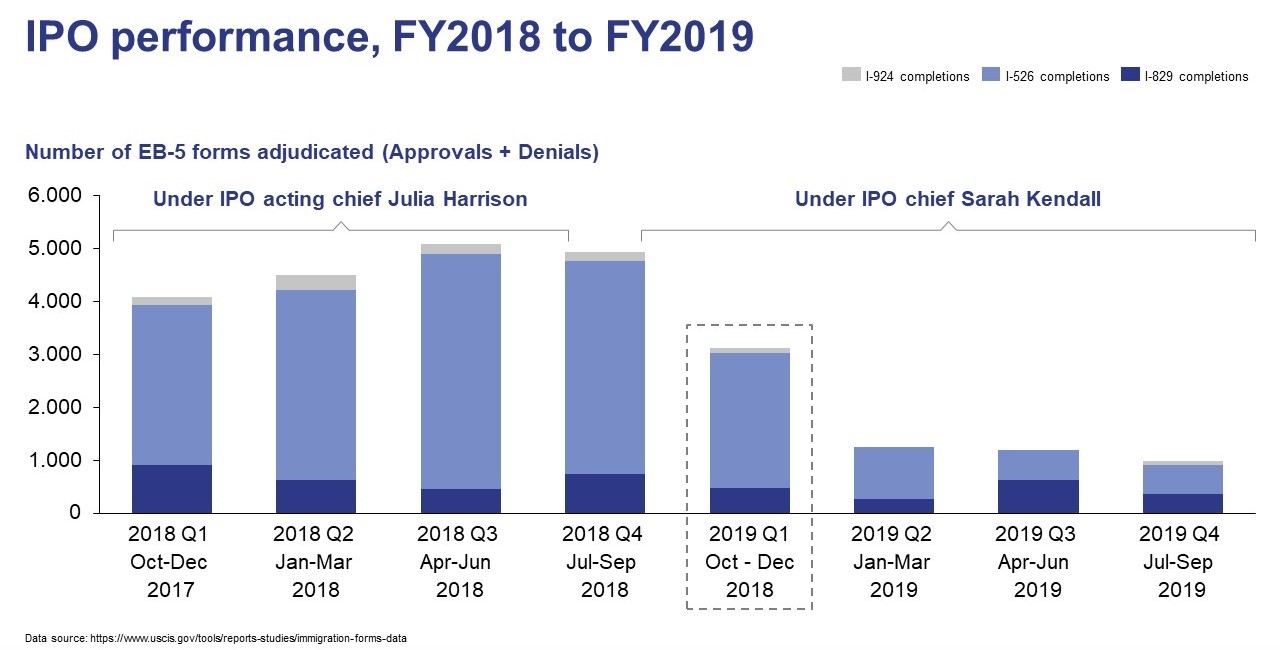
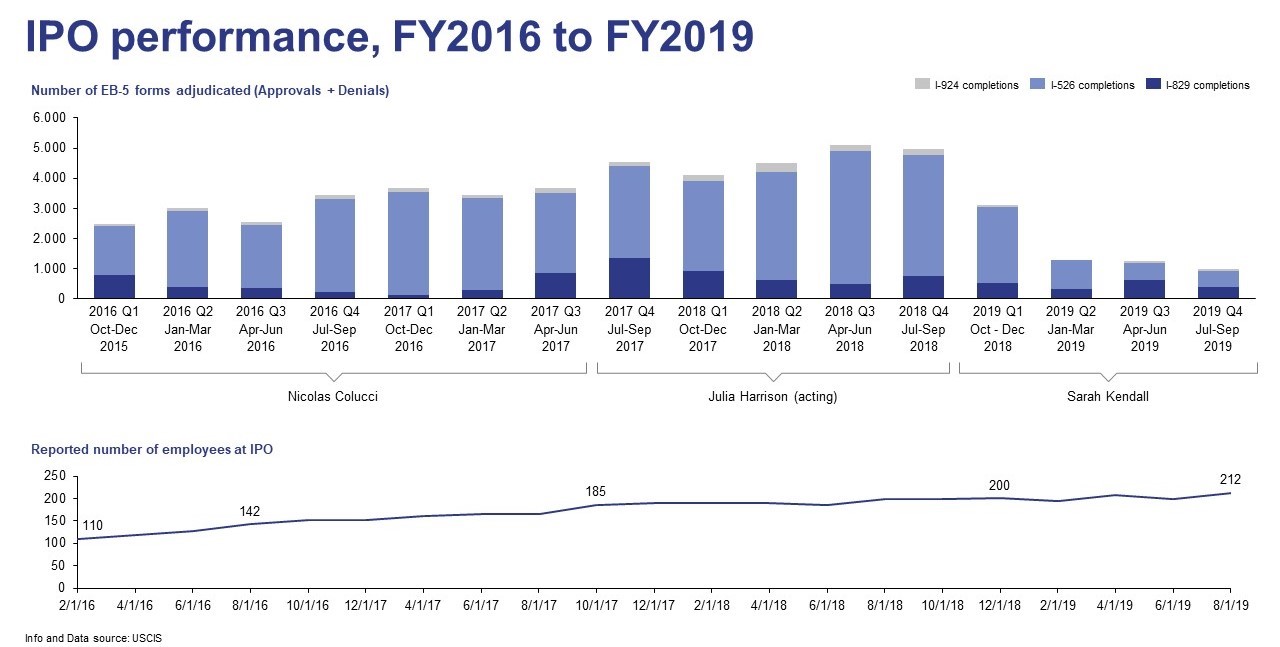
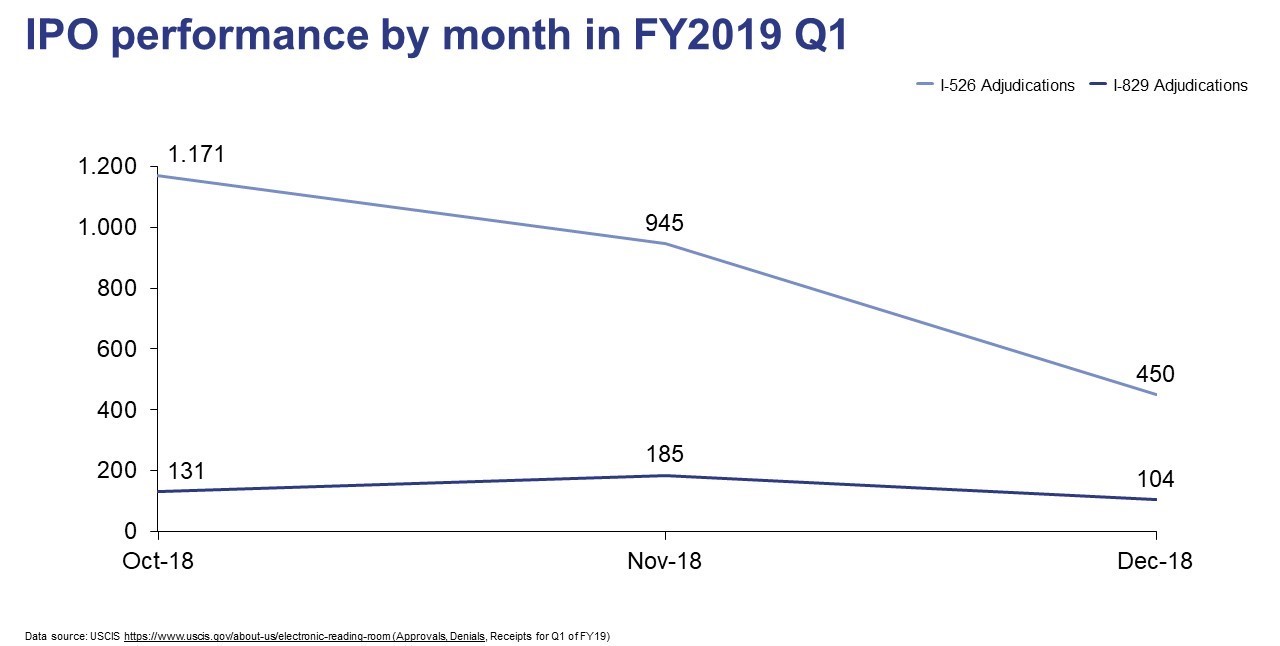
Bad for USCIS: Though USCIS claims to currently adjudicate I-526 petitions on a FIFO basis, in reality, petitions associated with EB-5 projects with exemplar approval are often given priority. Overall, the current processing statistics reveal that USCIS has hardly been adjudicating anything lately anyway. If USCIS does not pick up the pace, backlogs in additional countries may also form.

On March 13, 2020, USCIS will answer questions and field concerns from the public regarding the new changes in a public engagement. If you would like to attend the engagement in person, send an email to public.engagement@uscis.dhs.gov. There are limited seats, so we recommend registering as soon as possible. You can also send general questions to be addressed as agenda items to the above email address before 5 p.m. EST on February 11.

Alternatively, you can join the engagement via teleconference. You should call in 10 to 15 minutes before the conference begins.

Domestic toll-free number: (888) 946-7792

Toll number for international callers: (517) 308-9375

Participant passcode: 3996336