Free EB-5 Project Evaluation

Obtain a U.S. Green Card Through the EB-5 Program After COVID-19

As the number of new COVID-19 infections continues to decline in various countries, the world can start to evaluate each country’s response to the pandemic. The health crisis has exposed weaknesses in many countries’ systems, particularly in developing countries. In response, foreign investors around the world are contemplating whether they should move to a more secure country.

Many opt for the United States because it remains a wealthy powerhouse where foreign nationals can thrive in freedom and prosperity, and the EB-5 Immigrant Investor Program is a relatively quick and easy pathway to a U.S. green card. To make the most out of life in the United States, EB-5 investors can even apply for U.S. citizenship after five years of permanent residency.

Foreign nationals simply need to invest $900,000 or $1.8 million in a qualifying new commercial enterprise (NCE) to qualify as an EB-5 investor. The minimum required investment amount depends on the targeted employment area (TEA) status of the EB-5 project, and qualifying for the lower investment amount is quite easy because most regional centers primarily sponsor projects in TEAs.

The Benefits of a U.S. Green Card

Living in the United States as a permanent resident offers many advantages to EB-5 investors and their immediate family members, such as the following:

  • A facilitated admissions process at U.S. universities and potential in-state tuition savings
  • The freedom to live anywhere in the United States
  • The freedom to work for any U.S. company, engage in freelance work, or launch a business
  • The freedom to travel abroad freely
  • The ability to live permanently in the United States without going through the hassle of renewing a visa
  • No need to pass a language proficiency test
  • The ability to apply for U.S. citizenship after living in the United States as a permanent resident for five years

The benefits extend to an EB-5 investor’s spouse and unmarried children below the age of 21, with the whole family receiving U.S. green cards after a successful EB-5 investment. Therefore, the EB-5 program is a way for foreign nationals to invest in a better future following the COVID-19 pandemic.

Free EB-5 Project Evaluation

All About the Visa Bulletin

While the EB-5 Immigrant Investor Program is open to investors from all over the world, not everyone experiences the same EB-5 journey. United States Citizenship and Immigration Services (USCIS) only allocates approximately 10,000 visas to the EB-5 program per fiscal year, and no country is supposed to get more than 700, meaning investors from high-demand EB-5 countries face a backlog and a delayed EB-5 visa process.

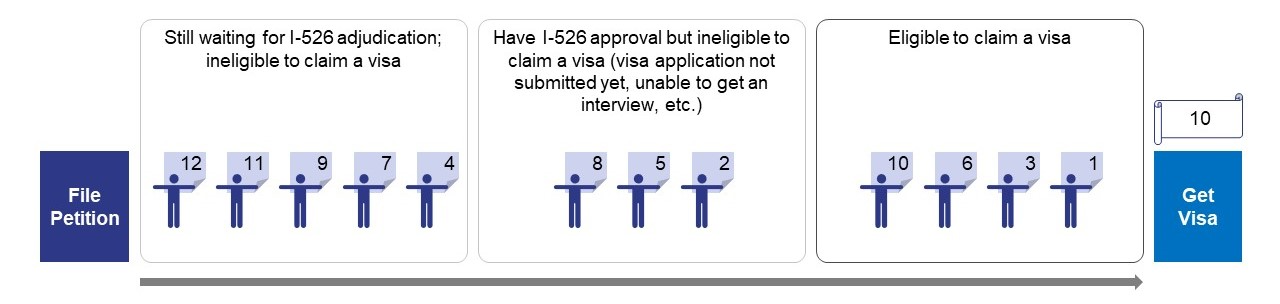
When an EB-5 investor submits an I-526 petition, USCIS sends them a priority date—the date USCIS received the petition. Until March 2020, USCIS used priority dates to assign petitions for adjudication, but now, the organization uses a visa availability approach to adjudicate I-526 petitions. Now, priority dates are only relevant to EB-5 investors whose countries are backlogged.

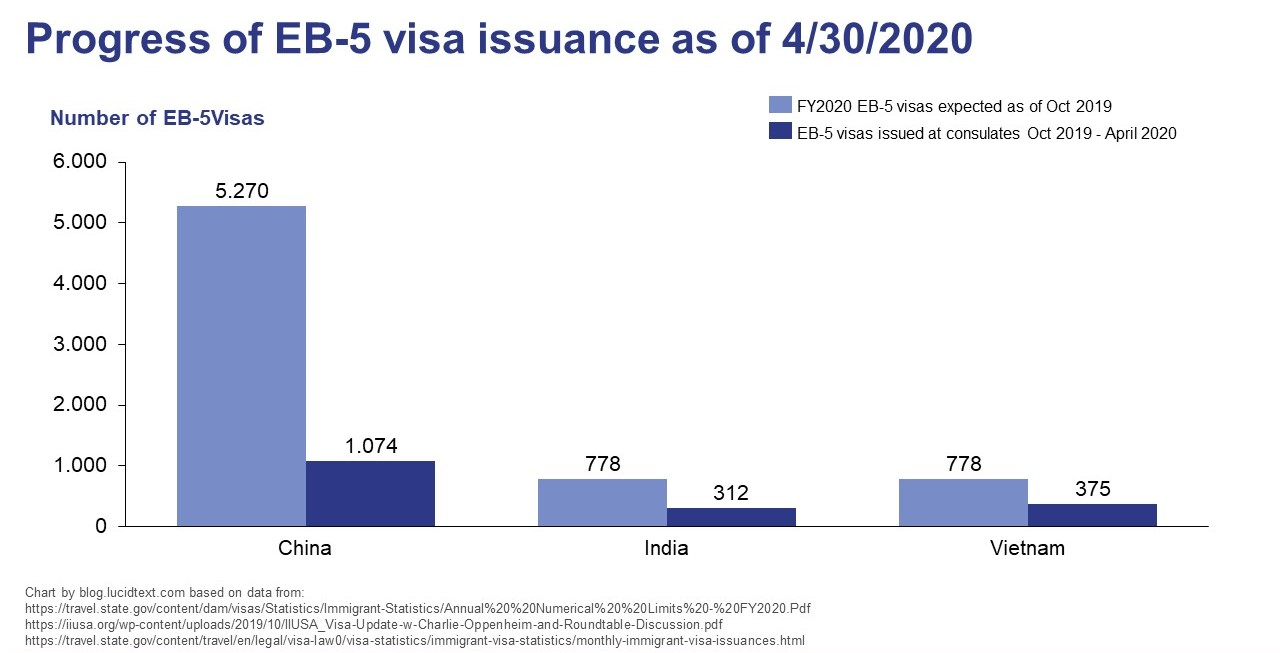
As of May 2020, only three countries are subject to a backlog: China, India, and Vietnam. While applicants from all other countries are free to immediately apply for and receive their EB-5 visa as soon as they receive approval on their I-526 petition, Chinese, Indian, and Vietnamese EB-5 investors must wait until their priority date is on or before the final action date for their country. The final action dates are presented in the monthly Visa Bulletins the U.S. Department of State releases on its website.

EB-5 investors from countries that are not backlogged do not need to pay attention to the Visa Bulletins, as their final action date is “current.” However, investors from countries such as South Korea and Brazil, which have been seeing more and more investors in recent years, should keep an eye on the situation, in case their country also builds up a backlog. Chinese and Vietnamese EB-5 investors will likely need to continuously consult the final action dates for the foreseeable future, although a recent drop in EB-5 demand in India means India’s final action date could become current by summer 2020.

Chart A vs Chart B

What makes the Visa Bulletin for EB-5 investors a little more complicated is that it is comprised of two different charts. Most EB-5 investors need only concern themselves with Chart A, which displays the final action dates. The final action date refers to the date by which an EB-5 visa is available for an investor, so if USCIS has received an EB-5 visa application from the investor and has all the necessary information it needs to make an adjudication, the investor may receive his or her conditional permanent resident status once his or her priority date is on or before the final action date. As of May 2020, Chinese, Indian, and Vietnamese EB-5 investors must monitor Chart A.

Chart B is only relevant to investors from China. It presents the dates for filing, which refer to the date from which an overseas EB-5 investor can submit a visa application to the National Visa Center (NVC), even though a visa is not yet available for the applicant. Whereas Indian and Vietnamese EB-5 investors may apply for their visa immediately, even though they are subject to considerable wait times before receiving a visa, Chinese investors may have to wait years just to submit their EB-5 visa application.

Free EB-5 Project Evaluation

FY2019 EB-5 Investor Country Statistics

The country statistics for EB-5 investors in FY2019 are in, and they reveal an increasingly diversifying pool of EB-5 investors. Since FY2014, several countries have seen spikes in investor numbers, and these countries may even join the ranks of backlogged countries in the future.

The top six countries are China, India, Vietnam, South Korea, Brazil, and Taiwan, with China leading by a significant margin. A whopping 45.7% of EB-5 investors in FY2019 hailed from China—but this is down considerably from 85.4% in FY2014. India has also experienced sizable growth during this five-year period, growing from 0.9% to 8.0%. Venezuela is another country with significant growth, from no investors in FY2014 to FY2016 to making the top 10 in FY2019 at 1.8%. Likewise, Brazil has made it into the top 10 from 0 investors in FY2015.

Even though China’s numbers are decreasing, it still represents by far the largest pool of EB-5 investors, and the Chinese EB-5 backlogs show no sign of letting up anytime soon. India, on the other hand, which accounted for the second-largest number of EB-5 investors in FY2019, is predicted to become current by summer 2020, which means Indian EB-5 investors will no longer be subject to a backlog.

At 15.3%, “rest of world” applicants—investors from countries other than those in the top 10—also hit one of their highest numbers in FY2019, indicating more diversification. The EB-5 program works best when a relatively small number of investors from each country participate, as that way, the country doesn’t exceed its roughly 700 EB-5 visa limit per fiscal year.

All in all, it’s clear that China remains the leader in the EB-5 program, but if current trends continue, the Chinese lead may be challenged. EB-5 investors from more and more countries are realizing the advantages of this relatively quick and easy path to U.S. permanent resident status, suggesting a more diverse EB-5 program in the future.

Free EB-5 Project Evaluation

Debunking Common Misconceptions about the EB-5 Program

The EB-5 program has found itself embroiled in bad press amidst the COVID-19 pandemic, largely due to false rumors that President Trump would bring sweeping changes to the EB-5 program as part of a coronavirus relief bill. Though Senator Lindsey Graham, purported to have pushed for the changes, has vehemently denied the rumors, it was too late to save the EB-5 program from the barrage of negative press that followed. Now, the EB-5 program has fallen victim to another scheme: a May 7 letter to President Trump from four U.S. senators urging the suspension of many employment-based immigration programs, including the EB-5 program.

While the majority of the letter focuses on the temporary abolition of the H-1B, H-2B, and OTP programs, with the senators arguing that bringing in unnecessary foreign workers will prevent U.S. citizens and residents from obtaining much-needed jobs following the COVID-19 crisis, they also specifically touch on the EB-5 program near the end of the letter. In reference to Trump’s April 27 presidential proclamation to temporarily suspend most forms of immigration, the senators request that the president remove EB-5 investors from those exempted.

The senators—Tom Cotton, Ted Cruz, Josh Hawley, and Chuck Grassley—back up their argument to suspend EB-5 immigration using common misconceptions about the program: that it’s “plagued by scandal and fraud” and works as a “pay-for-citizenship scheme.” Fortunately for EB-5 investors, they’re completely wrong.

The EB-5 Program Employs Strong Anti-Fraud Measures

While there has been fraud in the EB-5 program before, the vast majority of EB-5 project developers are honest entrepreneurs looking for a way to foster their business. Unfortunately, the negative stories are the only ones that make it into the media.

To address the rare cases of fraud, United States Citizenship and Immigration Services (USCIS) has ramped up its anti-fraud measures in recent months. With extra training and more cooperation with external agencies, the Immigrant Investor Program Office (IPO) is working hard to wipe out fraud.

The introduction of the EB-5 Modernization Rule in November 2019 also helps ensure the EB-5 program fulfills the objectives for which it was created. The rule helps funnel EB-5 capital into the areas that need it the most with the intention of creating much-needed jobs.

EB-5 Is an Investment, Not a Purchase

The idea that the EB-5 program is a “pay-for-citizenship scheme” is not just purported by the four senators who penned this letter but is a common misconception among EB-5 critics. However, it is far from the truth.

EB-5 investors are required to keep their EB-5 investment capital at risk for the duration of the investment period, which has led to some investors losing significant portions or even all of their investment. Simply making an at-risk investment is not enough, either: To receive a U.S. green card, an investor must demonstrate that their investment will create or has created 10 new full-time jobs for U.S. workers.

Far from being a pay-for-citizenship scheme, the EB-5 program pours billions of dollars into the U.S. economy, fostering new businesses and creating new jobs. EB-5 investors have poured more than $37 billion in foreign capital into the United States since 2008, funding countless projects after the 2008 recession.

Only Successful EB-5 Investors Receive Green Cards

USCIS doesn’t hesitate to deny the petitions of investors who don’t fulfill EB-5 program requirements. In addition to demonstrating the creation of 10 new full-time jobs, investors must also provide evidence that they have sourced their EB-5 capital lawfully. That means the EB-5 program accepts lawfully earned foreign capital and uses it to create new jobs in the United States, boosting the economy at no cost to U.S. taxpayers.

EB-5 Investors Are the Best and Brightest

The people who immigrate to the United States through the EB-5 program are wealthy and successful. They bring their money to the United States through not only their EB-5 investment but also business activities they undertake in the United States. They are a boon to the U.S. economy even outside of their EB-5 investment.

The Senators Should Prop Up EB-5, Not Tear It Down

If the senators who signed the letter want the best for the U.S. economy and U.S. citizens, they should be propping up EB-5 instead. Fixing the visa backlog could revitalize the program, attracting more investors interested in adding their capital to the U.S. economy. The program would create countless jobs for U.S. workers at a time when they are desperately needed. The EB-5 program could be exactly what the United States needs in the aftermath of the pandemic, if only more senators recognized its many merits.

Free EB-5 Project Evaluation

USCIS Updates the National Historical Average Processing Time for I-526 Petitions

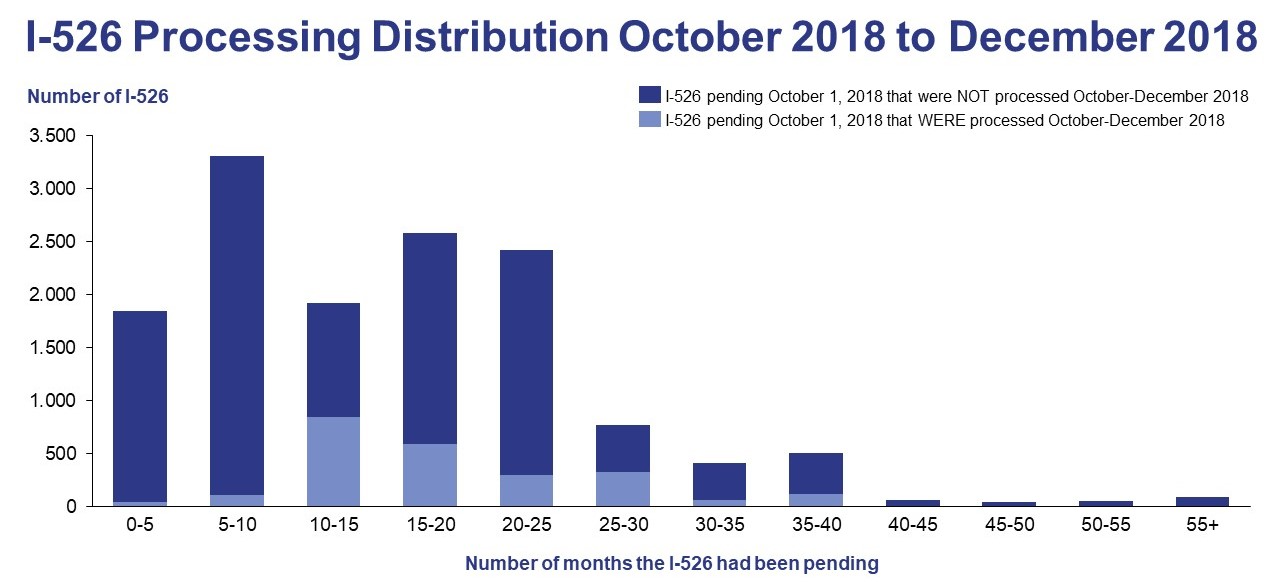
United States Citizenship and Immigration Services (USCIS) has updated the historical national average processing times for I-526 petitions to include February 2020, with processing times increasing to 12.9 months from 12.6. Despite the increase, the national historical processing time remains at a five-year record low, indicating a faster I-526 processing period for EB-5 investors.

The truly interesting update will come in June, when the data for March 2020 is added. March was the first month of the COVID-19 lockdown in the United States, with USCIS shutting its offices to the public and suspending routine visa services at embassies and consulates around the world. Anecdotal accounts suggest processing times have decreased, but only the data will provide the true picture.

It is also important to note the discrepancies between the national historical processing times page and the USCIS case processing page. USCIS’s estimated range of 31 to 50.5 months is at a minimum more than double the length indicated in the national historical average processing page. While the low average processing times are good news, EB-5 investors must bear in mind that their actual processing time could be far longer.

The I-526 petition is the first petition an EB-5 investor files. It is essentially an application for the EB-5 program, with EB-5 investors required to demonstrate evidence of the legal source of their funds, proof that they have invested it in a qualifying new commercial enterprise (NCE), and the business plan of the NCE, including its hiring schedule and economic projections.

In exchange for a qualifying investment that creates at least 10 new full-time jobs for U.S. citizens or residents, the EB-5 program grants investors and their immediate family members permanent resident status in the United States. The minimum required investment amount is $1.8 million unless the EB-5 project is in a targeted employment area (TEA), in which case it is lowered to $900,000.

Despite the current USCIS office closures to curb the spread of COVID-19, the organization continues to adjudicate I-526 petitions and other petitions related to the EB-5 program. The closure of embassies and consulates worldwide means EB-5 investors residing overseas are currently unable to apply for an EB-5 visa, but those residing in the United States on a different visa may receive their permanent resident status more quickly because the overseas investors are unable to claim theirs.

Free EB-5 Project Evaluation

The EB-5 Job-Creation Potential the U.S. Government Refuses to See

As COVID-19 sweeps through the United States and the rest of the world, it has left a path of shuttered businesses and unemployment behind it. As an employment-based immigration program that creates jobs for the everyday U.S. worker, the EB-5 Immigrant Investor Program could be ideal to help the U.S. economy get back up and running. Unfortunately, the U.S. government does not seem to recognize the powerful ways in which the EB-5 program could aid in the economic aftermath of COVID-19.

Immigration has been a hot topic in Washington in the midst of the pandemic. On April 22, President Trump signed an executive order suspending most forms of immigration for 60 days, although EB-5 investors were among the exemptions due to the many jobs they create for U.S. workers. However, much of the immigration activity has not been in the EB-5 program’s favor, from unfounded rumors of major changes to the EB-5 program in coronavirus relief bills to a letter from senators urging Trump to expand the immigration suspension to EB-5 investors and other employment-based immigration.

So far, no concrete actions have been taken against the EB-5 program, but the threat looms in the air. The unpredictable circumstances could bring hardships to the EB-5 program or, conversely, offer benefits to EB-5 investors, since the lack of other visas being issued could work in EB-5 investors’ favor. At the same time, given that Congress created the EB-5 program in 1990 specifically to stimulate the U.S. economy through job creation, it’s a mystery that it isn’t being promoted. The EB-5 program may be exactly what the United States needs in the aftermath of COVID-19.

Lack of Political Support for the EB-5 Program

While the EB-5 program could provide massive benefits to the U.S. economy and U.S. workers as the country prepares to exit the lockdowns and resume normal life, politicians largely aren’t on board. Rather than look at the objective facts of EB-5’s job-creation potential, many politicians prefer to stubbornly stick to their talking points. With Republicans fixated only on the negative aspects of immigration and Democrats edging ever closer to socialist policies and away from business interests, the EB-5 program doesn’t fit within either party’s narrow scope.

The EB-5 program could help struggling businesses survive and regain the jobs they had to terminate, and it could offer thousands of newly unemployed Americans fresh employment opportunities, all while bringing in successful upper-middle-class or upper-class foreign investors ready to spend their disposable income and tax dollars in the United States. It would be good for Republicans, saving businesses, and for Democrats, helping vulnerable people regain their jobs. Unfortunately, neither party seems to see these benefits.

The EB-5 Program’s Undeserved Poor Reputation

The EB-5 program generally does not have a positive public image, largely thanks to negative press coverage. A successful EB-5 investment would not be newsworthy, but a fraudulent scandal makes headlines across the nation, which ensures the general public associates EB-5 with fraud, even though EB-5 fraud is extremely rare. Then, government officials, who ought to know better, are forced to fall in line with the mob to maintain popularity.

The EB-5 industry must fight bad press with good press. If the U.S. public realized what the program actually does—that each investor’s approval is contingent on the creation of at least 10 new full-time jobs for U.S. workers—they would be far more likely to support it. If people knew that each investment had to be at least $1.8 million—or $900,000, if the project is in a targeted employment area (TEA)—they would be far more likely to rally behind it. The EB-5 program’s economic potential is obscured by the industry’s poor public relations.

The IPO’s Failings

Amidst all the difficulties the EB-5 program is currently facing, the Immigrant Investor Processing Office (IPO), which oversees the EB-5 program, is not helping EB-5’s cause, either. To work properly and provide the economic stimulation it was intended to, the program needs to be run efficiently, with I-924 petitions processed quickly to establish new regional centers and foster promising EB-5 projects and I-526 petitions traveling through the pipeline quickly to ensure EB-5 investors trust the program and don’t become discouraged and withdraw.

At present, this is mere fantasy. The IPO seems to be doing the exact opposite, taking four to six years to adjudicate I-924 petitions and as long as three years for I-526 petitions. Its recent string of EB-5 regional center terminations also hurt the program’s ability to help jumpstart the U.S. economy after COVID-19. The IPO has been shutting down regional centers that fail to maintain a robust investment pipeline and frequent activity, which naturally disproportionately affects regional centers in rural and high-unemployment areas. In this way, the IPO is actively disincentivizing investors from pouring capital into the areas that need EB-5 the most.

EB-5 Needs an Image Change

The EB-5 program is poised to significantly aid the United States in its economic recovery following the pandemic, but the media, Congress, and even the IPO are hampering its potential. With all the troubles the EB-5 program is facing, some potential investors are instead opting for immigrant investor visas from Canada, Australia, and other countries instead of investing their valuable capital into the United States. Congress and the IPO need to make some changes to the EB-5 program to increase its viability.

The path to a better EB-5 may be through alterations to its public image. EB-5 users can help the cause by signing IIUSA’s open letter to Congress.

Free EB-5 Project Evaluation

What to Consider When Selecting an EB-5 Project

The EB-5 Immigrant Investor Program is one of the fastest and easiest ways foreign nationals can immigrate to the United States, provided they have the necessary investment funds. An investment must satisfy several EB-5 criteria before the investor can receive a U.S. green card, so prospective investors are urged to conduct meticulous due diligence when selecting an EB-5 project for investment.

EB-5 investors must carefully assess any prospective EB-5 project to ensure low financial and immigration risk, which necessitates wide-ranging due diligence that examines various aspects of the project and its developer. Here are some of the top things EB-5 investors should consider when selecting a project.

Immigration Track Record of the Developer and Regional Center

EB-5 investors can fall victim to inexperienced, unprepared, and sloppy project developers or regional centers as well as outright malicious and fraudulent ones. To ensure the project developers and regional centers they work with are reputable, EB-5 investors should determine how much experience the entities have and what their track records are. Investors should identify whether they are well known in the EB-5 industry and check how many of their previous I-526 and I-829 petitions have been approved or denied.

Financial Track Record of the Developer and Regional Center

While most EB-5 project developers and regional centers are trustworthy, EB-5 investors should be aware of the ever-present threat of fraud. To avoid being duped out of their hard-earned capital and a chance at life in the United States, investors should look at whether the project developer and regional center have returned capital to investors in previous projects. It’s also important to note how many earlier projects the developer and regional center were successfully completed.

Projected Number of Jobs

To fulfill the EB-5 program requirements and receive permanent resident status, an EB-5 investor must demonstrate that their investment has funded the creation of at least 10 new full-time jobs in the United States. Therefore, investors are urged to investigate a project’s job creation methodology and hiring schedule, as well as how many jobs have already been created. An ideal EB-5 project has a job buffer—more jobs than necessary for all the EB-5 investors in the project.

Project Funding

An EB-5 investor’s investment will be for naught if the project cannot secure enough other funding and cannot move forward with its plans. EB-5 investors should carefully examine a prospective project’s additional funding sources, including bridge loans and other equity sources, to make sure the developer can complete the project even if they do not receive the desired amount of EB-5 capital from other investors.

Earnings Potential

A high return on investment is not necessary for every EB-5 investor—many investors are primarily concerned with immigration and wish simply not to lose money on the investment. Investors should first clearly identify their financial goals and then examine the potential of the investment accordingly. For many EB-5 investors, accepting a lower return on investment in exchange for lower immigration risk is worth it.

Transparency and Trustworthiness

EB-5 investors should avoid any project developer or regional center who is not transparent about its financials or anything else that concerns investors. Investors should look for developers and regional centers that communicate frequently with investors and charge honest administrative fees. EB-5 investors should work with their immigration attorneys to determine whether developers and regional centers are presenting the necessary information and documentation for the investors to be successful.

Free EB-5 Project Evaluation

The Implications of USCIS Office Closures for EB-5 Investors

On March 18, 2020, United States Citizenship and Immigration Services (USCIS) announced the nationwide closure of all its public offices due to the COVID-19 pandemic. The global crisis is affecting countries all over the world, upending life on all corners of the globe, and EB-5 investors are also encountering disruptions in their U.S. visa process.

The closures apply to not only domestic USCIS offices but also all U.S. embassies and consulates abroad. While they are still providing emergency services, they have suspended all routine visa services. Thus, EB-5 investors must put their EB-5 visa applications on hold until COVID-19 tapers off and the consulates reopen.

Originally, the closures were planned to continue until May 4, but with the pandemic continuing to rage on as the date neared, USCIS made a new announcement that it was extending the closures to June 4, 2020. Only time will tell whether USCIS really opens back up on June 4, but it’s worthwhile for EB-5 investors to prepare to set their visa journeys back in motion.

What’s important to note about the closures is that they only apply to procedures that involve face-to-face interaction with the public. Visa interviews and other in-person appointments must be rescheduled, but USCIS is still in operation, contactable by email or phone and providing remote services. Since the adjudication of petitions takes place behind closed doors, USCIS continues working hard to adjudicate I-526 petitions and I-829 petitions, among other EB-5-related petitions.

Also affecting EB-5 investors’ ability to immigrate to the United States during the COVID-19 pandemic are the numerous travel restrictions around the world. EB-5 investors must keep abreast of the latest developments to determine whether they are permitted to enter the United States. While the temporary immigration suspension signed into law on April 22 does not affect EB-5 investors, other travel restrictions may.

Free EB-5 Project Evaluation

The U.S. Immigration Ban Doesn’t Affect EB-5 Investors

The novel coronavirus pandemic has halted life around the world, confining ordinary people worldwide to their homes and forcing U.S. consulates globally to close. As the United States begins to look forward, the government is drafting plans to prioritize U.S. workers when the economy opens back up. One such measure President Trump has taken was signing a proclamation on April 22 that temporarily halts immigration to the United States.

In Trump’s own words, the proclamation is meant to ensure that “unemployed Americans of all backgrounds will be first in line for jobs as our economy reopens.” As the United States faces unprecedented economic turmoil while it slowly lays the foundation to return to normal life after COVID-19, the government plans to suspend certain types of immigration for 60 days.

While the proclamation generally prohibits immigration for a short period, it does not ban all immigration, and among the exceptions are EB-5 investors, along with their spouses and unmarried children younger than 21. EB-5 investors must, however, continue to monitor the numerous travel restrictions worldwide during the pandemic, as some may override an EB-5 investor’s exemption to Trump’s new immigration ban. EB-5 investors are advised to seek immigration counsel to determine their situation and options.

Since one of the requirements of the EB-5 program is the creation of 10 new full-time jobs for U.S. workers, the U.S. government likely sees it as a boon to the U.S. economic recovery efforts. The EB-5 program has the power to create new jobs, for which the U.S. will see overwhelming demand, and as EB-5 investors are required to invest a minimum of $1.8 million or $900,000, depending on whether their EB-5 project is in a targeted employment area, the program introduces substantial capital into the U.S. economy. This also means the program exclusively brings in wealthy individuals and families who will not require assistance from U.S. social welfare programs.

In 2008, suffering under the weight of a global recession, developers funded their projects through the EB-5 program because they couldn’t access traditional funding. The program proved a superb way to boost the U.S. economy and helped countless U.S. workers find new jobs. As the United States faces another economic downturn, with skyrocketing unemployment rates, the EB-5 program may be just what the United States needs to get back on track.

Free EB-5 Project Evaluation

What Is an EB-5 Targeted Employment Area?

U.S. Congress created the EB-5 Immigrant Investor Program in November 1990 to spur economic growth in the United States via the capital of foreign investors. In exchange for a large investment that funds the creation of at least 10 full-time jobs occupied by U.S. workers, EB-5 investors receive U.S. green cards for themselves and their immediate family members, giving them the right to live, work, and study in the United States of America.

Since most EB-5 investors participate in the EB-5 program primarily to obtain U.S. permanent residence and not for financial gain, they generally prefer to invest the minimum allowed amount. Until November 2019, the minimum required investment amount was $1,000,000, which was increased to $1,800,000 when the EB-5 Modernization Rule came into effect. However, EB-5 projects in special zones, called targeted employment areas (TEAs), only require a minimum investment of half of the default amount. That means EB-5 investors working with a project in a targeted employment area only need to invest $900,000.

What Qualifies as a TEA?

Targeted employment areas can be found all across the United States. Instead of specifically defining particular areas, United States Citizenship and Immigration Services (USCIS) defines a set of criteria used to determine the TEA status of an area, so it is up to the investor to determine whether a given EB-5 project qualifies for the lower investment amount. There are two types of targeted employment areas: high-unemployment TEAs and rural TEAs.

High-Unemployment TEAs

A high-unemployment TEA is an area that has an unemployment rate 150% higher than the national average. For example, in 2019, the average U.S. unemployment rate was 3.66%, so in 2020, an area must have an unemployment rate of at least 5.49% to qualify as a high-unemployment TEA. Additionally, high-unemployment TEAs must be located in towns or cities with more than 20,000 residents or in an area that the Office of Management and Budget defines as a metropolitan statistical area (MSA).

Rural TEAs

A rural targeted employment area is simply any area outside an MSA that has a population of fewer than 20,000 inhabitants. EB-5 investors must use the most recent 10-year U.S. Census data to determine the population of a given area.

Obtaining TEA Designation

Since USCIS does not make targeted employment area determinations in advance, it is up to EB-5 investors and project developers to obtain TEA designation themselves. In some cases, project developers apply for exemplar status for their EB-5 project, which represents USCIS approval that the project meets EB-5 requirements. If an EB-5 project with exemplar status has TEA designation, EB-5 investors can rest easy knowing USCIS will highly likely accept their documents demonstrating the project’s TEA qualifications.

In other cases, trying to demonstrate targeted employment area status is more uncertain, but with careful preparation, most EB-5 investors are successful. EB-5 investors can include the following forms of evidence in their I-526 petition to demonstrate to USCIS that the area of their EB-5 project qualifies as a TEA:

  • Statistics on population and geographic data compiled by the Office of Management and Budget that indicate the region qualifies as a rural TEA
  • Recent unemployment statistics sourced from the U.S. Bureau of Labor Statistics Local Area Unemployment Statistics (LAUS) office that indicate the region qualifies as a high-unemployment TEA
  • Other third-party data and statistics that indicate the region has an unemployment rate 150% higher than the national average or fewer than 20,000 inhabitants
  • No matter what data an EB-5 investor uses to apply for targeted employment area designation, it must be credible and verifiable. When using data originating from a source other than the U.S. government, the EB-5 investor should demonstrate the credibility of the party, and in all cases, EB-5 investors should explain the methodology used and why it supports their claim for TEA designation.

    TEA Projects at Regional Centers

    Both direct and regional center EB-5 projects can qualify for TEA status, as long as they are in a targeted employment area. However, EB-5 projects associated with regional centers are more likely to be located in a TEA because regional centers specifically seek out the most attractive EB-5 projects to investors. The vast majority of EB-5 investors choose regional center EB-5 projects in targeted employment areas because they offer a wealth of investor benefits, including access to a lower minimum investment amount, lower immigration and financial risk, and the ability to count indirect and induced jobs toward the 10-job job creation requirement.