Free EB-5 Project Evaluation

How Could the EB-5 Reform and Integrity Act Revolutionize the EB-5 Program?

How Could the EB - 5 Reform and Integrity Act Revolutionize the EB - 5 Program

Even as the world descends further into COVID-induced chaos in 2021, potential for large-scale positive reform swirls about the EB-5 industry. A month and a half into the year, EB-5 investment stakeholders have witnessed freshly inaugurated President Biden’s pledge to overhaul the U.S. immigration system by clearing up backlogs, shortening processing times, and removing country-based allocation limitations. The EB-5 Immigrant Investor Program could also see a dedicated reform with the EB-5 Reform and Integrity Act proposed by long-time EB-5 allies Chuck Grassley (R-IA) and Patrick Leahy (D-VT).

The looming sunset date of the EB-5 Regional Center Program, set at June 30, 2021, provides an urgent impetus to implement the act. Without it, industry leaders fear the EB-5 program’s overwhelmingly popular regional center program, which has contributed billions to the U.S. economy, could be terminated, with Congress judging it too problem-ridden. But even if the possible termination of the regional center program were not a concern, the EB-5 Reform and Integrity Act would still bring highly welcomed change that EB5 investment stakeholders have long sought after.

Long-Term Regional Center Program Reauthorization

One benefit of the act is that it would introduce some much-needed stability into the EB-5 program. As it stands in February 2021, the regional center program is only temporary, necessitating constant reauthorization by Congress. The program’s previous coupling with broader government funding bills effectively protected it from termination, but its divorce from the group bill in the reauthorization in December 2020 now leaves it to fend for reauthorization on its own. The proposed EB-5 reform would address the issue of regional center authorization, securing authorization for a five-year period.

Strengthened Protections for EB-5 Investors

Regional center EB-5 investment offers numerous benefits to investors, making it far more popular than direct investment. Those who make an EB5 investment through a regional center enjoy easier job creation requirements, far lighter managerial duties, and can leverage the EB-5 expertise of experienced regional center managers. Nonetheless, some investors are concerned with the possibility of fraud or poor management on the part of the regional center and are more comfortable with direct EB-5 investment because the structure places them closer to the new commercial enterprise (NCE).

The proposed reform bill addresses concerns of integrity in regional centers, mandating that regional centers draft annual statements certifying their compliance with all relevant regulations. They must explain all pending or recently resolved litigation or bankruptcy proceedings involving the regional center, NCE, or job-creating entity (JCE) and accounting for all foreign capital invested in those entities. A statement for each affiliated NCE must be drafted, detailing such information as the total amount of EB5 investment capital injected, how the capital is being spent, proof that all funds from EB-5 investors have been committed to the project, details about the progress toward the project’s goals, and a report of all jobs created or preserved. These annual statements must be made available to any EB-5 investment participant who requests them.

The EB-5 Reform and Integrity Act’s protection of investors doesn’t stop at compliance and transparency reports—it extends to preserving the immigration rights of EB-5 investors duped by fraudsters. Though the incidence rate of fraud in the EB-5 program is extremely low, some investors are still deceived and have their immigration eligibility revoked as a result. Under the proposed bill, EB5 investment participants in this situation would receive a notice from the Department of Homeland Security and be given 180 days to submit an amendment or notice to secure continued EB-5 eligibility. They would keep the priority date of their I-526 petition, and their children would be protected from aging out.

Extra Time for Job Creation

The current regulations of the EB-5 program allocate two years to an EB-5 investor to create at least 10 new full-time jobs for U.S. workers as they live in the United States as a conditional permanent resident. The proposed act would offer investors who failed to create the necessary number of jobs in the two years one more year to satisfy the job creation requirement, resulting in more U.S. jobs created and more successful EB5 investments.

The EB-5 Reform and Integrity Bill Could Change the EB-5 Program’s Future

If the EB-5 industry rallies together to have the proposed bill enacted, it would have long-lasting effects on the EB-5 program and, as a result, the U.S. economy. By extending the authorization of the EB-5 Regional Center Program by five years, it would ensure the program continues to pump EB-5 capital into the U.S. economy, which could prove invaluable as the country recovers from the debilitating effects of COVID-19.

But the EB-5 community should be excited about the act for more than just the regional center program extension. The proposed integrity measures would revolutionize certain aspects of the EB-5 program, protecting investors and honest EB-5 actors while addressing outsiders’ concerns of fraud and abuse. It could help transform the program’s reputation, opening the door to more support from within and outside of the United States. While it doesn’t address all the issues EB-5 investment stakeholders face, it would go a long way in improving the EB-5 landscape.

Free EB-5 Project Evaluation

EB-5 Attorneys Rethink the Fight Against Unreasonable Delays

EB-5 Attorneys Rethink the Fight Against Unreasonable Delays

The writ of mandamus: A seemingly singular option in the broken case inquiry system of United States Citizenship and Immigration Services (USCIS), it is an action designed to force the hand of USCIS adjudicators on pending I-526 and I-829 petitions. Unfortunately, this course of action also poses the inherent threat associated with immediate adjudication – rejection over a request for evidence (RFE) if insufficient or inconsistent information is found in the petition.

Because of this, filing a writ of mandamus has been designated a last-resort measure only in cases where wait times have become “excessive.” The process is simply too expensive and too risky an endeavor – and still offers no guarantee of EB-5 success. The EB-5 litigation bar has advised exactly this course of action for years, defining “excessive delays” as those which exceed published processing times.

Writ of Mandamus Action Isn’t Working

As it stands, mandamus case results vary little, settling only the longest pending petitions at the Immigrant Investor Program Office (IPO) and USCIS. In these rare settlement cases, the United States government has usually submitted a motion to dismiss following federal complaints officially filed by immigrant investors who have reached their wits’ ends. This has been deemed the norm, and with the published processing times standing at 30–50 months as of December 16, 2020, it is safe to assume that adjudication delays will only continue to increase. Why is that? Because right now, the IPO – not the investors – defines what a “reasonable” wait time is.

EB-5 Attorneys Contemplate Litigation

A glance through recent Visa Bulletins shows the IPO has published ever-increasing processing times, which implicitly extends “reasonable” adjudication delays. Form I-526 adjudication wait times are currently claimed to be two to four years, and in FY2020, only 1,359 I-526 petitions were resolved in the first six months. As a result, EB-5 attorneys are contemplating litigation as the only viable course for resetting the norm on what is considered a reasonable delay.

A Visible Path to Redefining Reasonable Wait Times

Some industry professionals believe that, as a practicality, the EB-5 litigation bar has to first separate actual processing times from what has been established as a reasonable amount of time for EB5 investment petition adjudication. This is because USCIS published processing times merely provide context for delays. As a matter of law, they do not prove in any way that the delays are reasonable. Alternative and more relevant guideposts must be used to define reasonable processing times.

Congressional Intent on Eliminating Backlogs

Congressional intent may serve as evidence for the need for a new definition. Congress’s express concern over excessive backlogs in benefit application processing for immigrants dates back two decades. At the time, the legislative body authorized an appropriation of funds for dissolving backlogs on pending petitions older than 180 days to confer status under the Immigration and Nationality Act. The language used was “the processing of an immigration benefit application should be completed not later than 180 days after the initial filing of the application.”

A few years later, when the Department of Homeland Security was created, Congress amended its verbiage on the matter to extend the mandate for eliminating backlogs from 180 days to one year. This doubled the definition of a reasonable wait time at a time when when Congress felt the added time was warranted. Is so much time still warranted? Actual IPO metrics would be crucial to determining that.

IPO Metrics on Workload Capacity

An evaluation of IPO metrics could pinpoint the workload capacity of its offices as a starting point. Let’s run through an exercise based on 2019 data. IPO data shows 212 adjudicators on staff in 2018, and USCIS claims it takes adjudicators an average of 8.65 hours to process an I-526 petition. This is known as the “touch time.” Then, assume that just half (106) of those IPO adjudicators are dedicated to working on I-526 applications 40 hours per week for 50 weeks per year. That equates to 212,000 work hours on I-526 petitions. Divide the dedicated hours by the touch time to find the workload capacity. We’ll save you the calculation and tell you – based on that formula, the IPO had the capacity to process 24,500 I-526 petitions a year in 2019.

While it is only fair to note that every EB-5 case is unique and that individual circumstances must be factored into processing times, as it stands, only a fraction of the petitions the IPO could theoretically be adjudicating are actually getting done. In all likelihood, therein lies a large part of the problem. Another area that should be further examined is the role of both USCIS deference and IPO prioritization in those delays.

USCIS Deference and IPO Prioritization

USCIS interprets statutory authorization for the EB-5 Regional Center Program as a license to prioritize individual EB5 investment participants’ petitions when they are filed through a regional center. Moreover, the agency grants deference to project fundamentals when there is an approved exemplar application on file. While this may seem like an efficient way to get through stacks of EB-5 petitions, the result of this interpretation has been to allow other well-qualified investors to be cast aside in the wait line for an indeterminate amount of time.

Furthermore, the IPO began prioritizing EB5 investment petitions by listing countries of origin that have visas available – also a tactic that may make sense in terms of tackling individual adjudicators’ caseloads. But where does it leave investors who have already been waiting?

A Strategy Emerges for Potential Group Action

Because every EB-5 investment is different, the individual explanations available to USCIS and the IPO for delays are virtually endless. This has made it difficult to shift the norm on what constitutes a reasonable wait time. USCIS holds up published wait times as a primary defense. Case-by-case litigation isn’t usually an option until a delay of a year and a half or two years has been established, and that’s only the beginning. The worst part is that these motions increase EB-5 investors’ hard costs, personal stress levels, and overall risks, making innovation in this type of litigation paramount.

As such, a new thought within the EB-5 legal community is emerging: it may be a wise strategy to pursue group actions in smaller jurisdictions. This would allow varying USCIS arguments to be addressed with small groups of individual investors experiencing the same kinds of delays. One suit may pursue discovery immediately. Another could move to compel the production of administrative records. The courts would become a testing ground for how to design a new precedent on what constitutes a reasonable delay.

One thing is certain – no action means no change. Following a year of unprecedented challenges, it seems there is no better time than the present to seek out new and creative ways to protect the EB-5 Immigrant Investor Program and its participants!

Free EB-5 Project Evaluation

Why South Africans Are Hedging Their Bets in EB-5 Investments

Why20South20Africans20Are20Hedging20Their20Bets20in20EB-5.jpg

Every year since the initiative’s inception, the EB-5 Immigrant Investor Program has grown in popularity. It was designed to attract foreign nationals to invest in the U.S. economy, and in exchange for a qualifying investment, they and each of their eligible family members may obtain a green card. The most recent fiscal data release reveals explosive growth since 2017 in several feeder countries. South Africa is one of them.

Within just a two-year span, the number of South African EB-5 investors grew by 226%, and 2020 market trends have pointed to a large uptick in applications as an indicator that South Africa is an emerging EB-5 market.

A stroke of luck for prospective South African investors, United States Citizenship and Immigration Services (USCIS) implemented new processing procedures for I-526 petitions that allow adjudicators to process applications on a first-in, first-out basis. While this is projected to extend wait times for EB5 investment participants in countries such as China, India, and Vietnam, industry experts say these procedural changes may foster even more growth in underrepresented markets. Again, South Africa is one of them.

Learn more about the kinds of South African investors who are participating in EB-5 investments, why they are choosing this program, and what key strategies they are employing to shore up their legacies in the United States.

The Savvy South African Investor

The worldwide financial meltdown in 2008 was a catalyst for a steady rise in foreign direct investment (FDI) in the southern hemisphere. Add to that the explosive economic growth in parts of Africa and a savvier, more sophisticated South African EB-5 investor seems to have emerged. A 92% petition approval rate reflects that sophistication.

Generally, EB5 investment participants from South Africa either accumulated their family wealth over two or three generations or their entrepreneurial endeavors have been highly successful in recent years. They are savvy business owners and investors, looking for solid returns. For obvious reasons, then, a primary question they initially ask when considering the program is why they would invest such a substantial amount of capital into an investment with such a comparatively low monetary return.

Reasons More South Africans Are Seeking EB-5 Visas

Right now, the minimum capital requirement to participate in an EB-5 investment is $1.8 million (or $900,000 when a project is located in a designated targeted employment area, or TEA). That is a lot of money to tie up for potentially years for returns that are generally 5% or less, especially considering the rand-to-dollar exchange rate. Yet savvy South African investors continue to pursue the EB-5 path, and there are several reasons why.

Diversification and Security of Wealth

Diversification of a portfolio is always important, and the security of one’s investment is especially fragile at present. Despite its challenges in the last few years, the U.S. economic climate is still relatively strong, and certainly more stable than South Africa’s in the post-pandemic environment.

Education and Employment Opportunities

Additionally, the vast majority of South African EB-5 investors are seeking a life in the United States for the educational opportunities. Enrolling their children in quality schools creates an opportunity for education—and ultimately employment—opportunities they wouldn’t otherwise have such easy access to.

While it is possible for South Africans to send their children to the United States to study at the cost of international tuition, it is far more cost effective to seek permanent residency for the entire family first. Residence also increases the likelihood of acceptance into an Ivy League school.

Relative Efficiency in Processing

The rule of law seems to be crumbling in South Africa, which is signaling to many South Africans that it’s time to take their business and families elsewhere, and the EB-5 visa program is one of the most direct paths to U.S. permanent residency. Alternative employment-based visa programs often require far more time before gaining a green card.

For instance, some programs require an employer sponsorship prior to coming into the U.S. Other programs have a limited number of allocated visas, so even approval doesn’t mean a visa will be granted. Furthermore, the temporary consulate closures in 2020 drastically increased the visa rollover totals, which means more visas allocated in FY2021 for EB5 investment participants.

These are only three of the most common challenges in securing a visa through other U.S. immigration programs.

Ultimately, the EB-5 program appeals to South African investors because they can count on the security of their investment, they can access better education and employment opportunities for themselves and their families, and they can do it relatively quickly.

However, participation in the EB-5 investment program takes a bit more planning when your country of origin is South Africa.

Strategies for Meeting EB-5 Requirements Under Reserve Bank and SARS Regulations

One of the greatest challenges South African EB-5 investors face is ensuring they can meet EB-5 investment program requirements while also adhering to South African Revenue Services (SARS) and South African Reserve Bank (SARB) regulations. The SARB, which governs exchange controls, sets a limit on the amount of money citizens may take out of the country. Each passport holder retains a 1-million-rand discretionary allowance, no questions asked. At the current exchange rate in December 2020, even the minimum EB-5 investment in a designated TEA ($900,000) equates to R 15 million.

Investors use three common strategies used when funds are being sourced from within South Africa.

Prepare for Scrutiny

Keep in mind, it is not unlawful to move more than R 1 million offshore; there will simply be greater scrutiny and greater tax implications for an investor when they do. The first strategy, then, is to properly prepare for an invasive review. The review process has significantly slowed for EB-5 investment participants since the minimum investment requirement increased, and it involves both the SARS and the SARB.

Move EB5 Investment Capital Offshore Early

Many prudent investors have long-since diversified their portfolios and externalized their money. This creates a situation in which the amount of money they seek to clear with SARB isn’t the full $900,000. This strategy is usually implemented by more experienced investors, as they often attempt to time it against the strength of the rand. However, because of the volatility of the rand, this can be risky, especially when there are looming EB-5 deadlines.

Make a Spousal Donation

The regulations allow 1 million rand per citizen. When an investor needs to move more than what’s allowed, it is perfectly acceptable to do so through a spousal donation. To remain eligible for the EB-5 investment program, participants simply need to provide the proper documentation for lawfully sourced funds.

None of these strategies are new, which means the South African government is familiar with them and unlikely to send up any red flags if investors’ affairs are in proper order.

The EB-5 Journey from South Africa to the United States

While the EB-5 market certainly isn’t as large as it is in other parts of the world, there are large pockets of South Africans who are seriously considering a move to the United States. Unfortunately, the recent near doubling of the investment requirement has put the program out of reach for many of them. For some, that means they will not be able to participate, but for an increasing number of others, it has simply meant being a little more creative. This is not only a testament to the sophistication of South African investors but also an indicator of the caliber of experienced EB-5 professionals they choose to work with on their EB-5 investment.

The general rule of thumb when advising a South Africa–based client is to plan on three years of preparation before they leave for the U.S. It is also important to understand there isn’t much an EB-5 investment participant can do to speed up the process, at least in the earliest of the following three phases.

Phase 1: Addressing EB-5 Investment Capital

From the time a South African investor decides to participate in the program to the time they make an actual investment in an EB-5 project, it usually takes around three months. It may take far less time if an investor is using capital that is already located offshore because they won’t need approval from SARS. But it may take significantly more when they need to secure funding to begin with and/or have to work through SARS because the amount needed to move out of the country is greater than the threshold set by the government.

Phase 2: Awaiting EB-5 Consular Processing

During the processing phase, EB-5 investors must file several petition packets, schedule visits with the consulate, and take care of follow up. At each substage of this process, there are various strategies to help move things along (or that can slow them down).

This is the longest phase in the process, and it currently takes about three years to complete. That is an average time frame, though, and every EB5 investment is unique. Working with an experienced U.S. immigration attorney who also understands South African law is imperative to managing one’s own expectations and to garnering the most efficient processing possible.

Phase 3: Beginning the Move

Once an EB-5 investment participant receives approval on their I-526 petition, it is time to make more definite travel plans. USCIS adjudication is currently running between eight and 24 months to completion. (Non-exemplar approved projects may take a bit longer.) That is essentially enough time to tie up loose ends such as finishing out a school year or selling the house, and arranging the move.


Free EB-5 Project Evaluation

Calculations Indicate Chinese EB-5 Final Action Date Unlikely to Advance in FY2021

Calculations Indicate Chinese EB-5 Final Action Date Unlikely to Advance in FY2021

The most controversial aspect of the EB-5 Immigrant Investor Program is easily the few cases of fraud that have cropped up in the program’s history of 30+ years, harped on by the media despite the immense economic stimulation and job creation the program contributes to the U.S. economy. Within the EB-5 world, however, perhaps the most controversial aspect is the ever-growing backlogs, leaving thousands of investors and their qualifying family members in processing limbo for years despite their ongoing contribution to the U.S. economy.

The foremost victims of processing inefficiencies at United States Citizenship and Immigration Services (USCIS) are Chinese investors, pursuing an EB-5 investment from the most populous country in the world. For the tens of thousands of Chinese investors—and tens of thousands more if dependents are considered—stuck waiting indefinitely, the only hope is to keep checking USCIS’s monthly Visa Bulletin, as applicants whose priority date is earlier than the listed final action date are in line to receive a U.S. green card. But the tumultuous year of 2020 has thrown backlogged EB-5 investors a curve ball, elongating their wait times by an unknown amount.

As of January 28, 2021, the most recent Visa Bulletin is the one for February 2021, which lists the Chinese final action date at August 15, 2015. The problem, other than the fact that this final action date is around four and a half years in the past, is that it hasn’t budged since August 2020’s Visa Bulletin. Although USCIS does not release statistics on the number of EB-5 investment participants with I-526 approval eligible to receive their EB-5 visa, it’s possible to derive this figure through calculations using official USCIS data. Unfortunately for Chinese EB5 investment participants with later priority dates, this calculation doesn’t offer good news.

How Many Chinese Investors with I-526 Approval Are Waiting for Visas?

USCIS periodically provides the number of EB-5 investment participants by nationality who have approved I-526 petitions but whose priority date is not yet current. This information may be useful in its own right but cannot enable prediction of when, and by how much, the final action date may advance again. However, simple logic tells us the number of Chinese investors with approved I-526 petitions and clearance from the Visa Bulletin waiting on EB-5 visas increases with each advancement of the Visa Bulletin and decreases with each EB-5 green card issued to a Chinese investor. Due to the COVID-19 pandemic, the U.S. consulate in Guangzhou has canceled EB-5 visas, issuing precisely 0 since March 2020. Thus, we must focus on the number of additions to the queue.

Based on these figures, the difference between the number of EB-5 investment participants with I-526 approval waiting for their priority date to become current in April 2020 and November 2020, as provided by USCIS, should roughly equal the number of investors with I-526 approval who have been cleared by the Visa Bulletin. Since the figure provided by USCIS for April 2020 is 23,511 and that for November 2020 is 21,253, the difference is 2,258. The calculation gets more complicated than that, however, because spouses and children also take green cards from the yearly EB-5 visa pool. Data from FY2018 shows that dependents accounted for 63.2% of EB-5 visas claimed by Chinese nationals, so we can infer that as of November 2020, roughly 6,136 Chinese nationals were in line to receive an EB-5 visa under the final action date of August 15, 2015.

visa availability

Given the combined obstacles of suspended visa interviews in China (with no timeline for resumption) and USCIS’s notoriously slow processing speeds, large-scale visa issuances are unlikely. In November 2020, Charles Oppenheim (chief of the Visa Control & Reporting Division at the U.S. Department of State) predicted around 3,000 visas might be granted to Chinese EB5 investment participants in FY2021—enough to supply only half of those eligible with visas. Given these projections, barring a miracle, the Chinese EB-5 final action date is unlikely to budge throughout FY2021. This also suggests USCIS may fail to distribute most of the 18,000+ visas the EB-5 program has been allocated in FY2021, nearly double the typical annual allocation.

Free EB-5 Project Evaluation

Biden Administration Promises Immigration Reform Favorable for EB-5

Biden Administration Promises Immigration Reform Favorable for EB-5-min

It’s hardly a secret that the Biden administration is far friendlier toward immigration than the Trump administration was. While President Trump introduced various hurdles for newcomers to the United States, including an outright ban on most forms of immigration throughout 2020, President Biden has announced that comprehensive legislative reform to United States Citizenship and Immigration Services (USCIS) can be expected. Indeed, immigration reform was among Biden’s top talking points throughout his presidential campaign, and if his proposed plan is anything to go by, he will certainly make good on his promises. The full text of the bill has not yet been officially released, but the White House has published a fact sheet that provides a detailed outline of the changes to be proposed.

If the U.S. Citizenship Act of 2021 is passed, it will constitute one of the biggest legislative overhauls the U.S. immigration system has seen in decades. It would revolutionize the way the United States deals with immigration, with the White House citing “keeping families together, growing our economy, responsibly managing the border with smart investments, addressing the root causes of migration from Central America, and ensuring that the United States remains a refuge for those fleeing persecution” as the primary goals of the reform.

How Would the EB-5 Program Benefit from the Act?

The EB-5 Immigrant Investor Program is not explicitly named in the overview of the bill, and as a controversial residency-by-investment program, it is unlikely to garner significant focus from the president. Nonetheless, EB-5 investment participants stand to benefit greatly from the measures in the proposed bill favoring economic immigration. Here are five key measures that could dramatically improve the EB5 investment landscape.

Clearing Employment-based Visa Backlogs

Since 2014, the EB-5 program has been plagued with lengthy backlogs for EB-5 investment participants from particularly high-demand countries. China has led the pack in backlogs since the onset, but their southern neighbors in Vietnam joined the ranks a few years later. With thousands of EB5 investment participants with approved I-526 petitions awaiting visa availability per the monthly USCIS Visa Bulletin, backlogs dramatically delay an investor’s start to a new life in the United States while presenting the risks of necessary redeployment of EB-5 investment capital and dependent children aging out and becoming ineligible for a U.S. green card. Focusing on clearing the backlogs would change the lives of thousands of Chinese and Vietnamese EB-5 investors.

Recapturing Unused Visas

At the beginning of every fiscal year, USCIS designates a certain number of visas to each immigration program. If unclaimed visas remain at the end of the fiscal year, they are generally recycled into other programs more heavily favored by the U.S. government. Sometimes this can be good for the EB-5 program—for example, the unprecedented events of 2020 resulted in tens of thousands of unused family visas being rolled over to employment-based immigration in FY2021, with the EB-5 program receiving almost 10,000 more visas than usual.

Of course, most years won’t be like 2020, and recapturing unused visas will generally ensure that the EB-5 program doesn’t lose visas it was previously allocated. With USCIS having issued only a fraction of EB-5 visas five months into FY2021 despite the huge uptick in supply, the enactment of the proposed bill could save thousands of unused visas from rolling over into other programs.

Shortening Long Wait Times

As of February 2021, the typical wait time for I-526 petition approval—the first step on the EB5 investment journey toward U.S. permanent resident status—hovers around two to four years. For backlogged investors, this wait time is only elongated. USCIS’s inefficiency since FY2019 has resulted in ever-growing wait times for investors, markedly decreasing the attractiveness of the United States’ residency-by-investment program. Shortening wait times could boost the appeal of making an EB-5 investment, resulting in more investors embarking on the journey and funneling more capital into the U.S. economy.

Eliminating Country-based Visa Caps

U.S. immigration programs are subject to country-based visa caps, originally intended to spread immigration out across many countries. However, these caps are applied uniformly with no regard for the demand or population of a country, leaving China with the same number of permitted visas per fiscal year as Andorra. These caps are the reason behind the EB-5 backlogs, as the demand in large countries like China and Vietnam significantly outpaces the uniform country caps. Eliminating country limits for EB-5 visas could see the backlogs disappear rapidly, with thousands of Chinese and Vietnamese EB-5 investors finally receiving their long-awaited permanent resident status.

Exempting Spouses and Dependent Children from Employment-based Visa Quotas

Also contributing to the lengthy backlogs are EB-5 visas for spouses and dependent children cutting into the number of visas available for EB5 investment participants themselves. With roughly 10,000 EB-5 visas available per year, only around 3,000 go to investors. If spouses and dependent children are exempted from this pool, thousands more EB-5 investors will become eligible for visas, allowing USCIS to easily clear the long-standing backlogs and granting more families a brighter future in the United States.

Promoting Economic Growth with the EB-5 Program

EB-5 investors should monitor the U.S. Citizenship Act of 2021 eagerly, as its enactment could bring radical changes that significantly improve the outlook of an EB5 investment. The EB-5 program offers the Biden administration an excellent opportunity to fulfill its stated goal of immigration-driven economic growth, considering that the program has contributed billions in EB-5 investment capital to the U.S. economy over its three-decade history. The proposed bill would allow the EB-5 program to more efficiently stimulate the U.S. economy, attracting more investors and their EB5 investment capital.

Free EB-5 Project Evaluation

Alejandro Mayorkas Confirmed as Secretary of DHS

Alejandro Mayorkas Confirmed as Secretary of DHS-min

Good news for the EB-5 community: Alejandro Mayorkas, Biden’s pick to head the Department of Homeland Security (DHS), has officially been confirmed by the Senate. Mayorkas, whose family fled Cuba for Los Angeles when he was just an infant, built an impressive legal career for himself before diving into politics, serving in positions in the Clinton and Obama administrations. He previously headed United States Citizenship and Immigration Services (USCIS), promoting and fostering the EB-5 program from the severely underused state he inherited it in. With a streak of successes behind him, Mayorkas was among the first cabinet nominees announced by Biden, and his appointment as secretary of DHS is welcome news to EB-5 investment stakeholders everywhere.

Mayorkas’s confirmation was supposed to come sooner, but some Republican senators, notably Josh Hawley (R-MO), objected to the fast-tracked confirmation, triggering a more rigorous background check into the nominee. However, when a vote was held the next week, a number of Republican senators, including Mitt Romney, voted in line with the Democrats to speed up the confirmation. Another week later, the vote for Mayorkas’s confirmation was held, and the Senate voted to confirm him as the secretary of DHS.

As head of DHS, Mayorkas will oversee UCSIS and its various programs, including the EB-5 program. Unless his priorities have shifted from his time in the Obama administration, he is likely to usher in favorable changes to the EB-5 program, restoring the residency-by-investment program to its former glory. The White House has already announced President Biden’s proposed U.S. Citizenship Act of 2021, which promises a major overhaul to the U.S. immigration system, packed with policy changes that could dramatically improve the situation for EB5 investment participants. As secretary of DHS, Mayorkas will occupy an important role for the rollout of these wide-ranging changes, and his partiality to the EB-5 program could bode well for those involved in EB-5 investments.

Mayorkas’s takeover of DHS comes at an opportune time for the EB-5 Regional Center Program as well. With a sunset date of June 30, 2021, the ever-popular regional center program is hurtling toward the most likely termination in years, having been divorced from the year-end government funding bill it is normally associated with. EB-5 industry leaders believe the only way to save the EB-5 Regional Center Program may be to enact large-scale reform, but it’s a race against time to unite the EB-5 world and work toward the needed policy changes. Having already proven himself a valuable ally of the EB-5 program, Mayorkas could further the fight for reform and permanent authorization, which would constitute a major boon for EB-5 investment participants.

Free EB-5 Project Evaluation

Analyzing EB-5 Form Data from FY2020 Q4

Analyzing EB-5 Form Data from FY2020 Q4

To say FY2020 was a volatile year is an understatement. 2020 will forever be known as the year the COVID-19 pandemic struck the world, a crisis that has also had devastating effects on the EB-5 Immigrant Investor Program and the thousands of investors in the throngs of EB-5 uncertainty. Those with EB-5 investments active throughout FY2020 faced more than just the pandemic, however. The switch to a visa availability processing approach for I-526 petitions and a narrowly averted large-scale furlough at United States Citizenship and Immigration Services (USCIS) also presented challenges to EB-5 investors in 2020.

To top off the woes of EB5 investment participants in FY2020, USCIS was fairly unproductive in I-526 processing, despite all the time freed up by the pandemic. What could have been an unprecedented opportunity to cut down the backlogs was squandered, lost to Immigrant Investor Program Office (IPO) inefficiency. This is what the release of FY2020 Q4 data on the three key EB-5 forms—I-526, I-829, and I-924—indicates, wrapping up the tumultuous year of FY2020.

Download USCIS EB-5 Visa Petition Statistics through FY2020

FY2020 covers the period from July to September 2020, as USCIS’s fiscal year ends three months before the respective calendar year. According to USCIS data, EB-5 form data for this period can be summarized as follows:

Form I-526

  • Received: 53
  • Approved: 904
  • Denied: 236
  • Pending: 15,063

Form I-829

  • Received: 740
  • Approved: 732
  • Denied: 62
  • Pending: 10,304

Form I-924

  • Received: Unreported but estimated to be 129
  • Approved: 45
  • Denied: 45
  • Pending: 163

I-526 Data

The figures for I-526 processing show a slight improvement in productivity compared to FY2020 Q3, with adjudication rates in FY2020 beating out the figures in the final three quarters of FY2019. The low productivity is generally attributed to Sarah Kendall’s reign of the IPO, which contrasts starkly against the performance achieved by her predecessor, Julia Harrison, in FY2018. Notably, USCIS has maintained denial figures at roughly the same level as throughout EB-5 history, with only approval rates dropping, meaning adjudicators exercised harsher decision-making under Kendall. Graphs make clear that the gap between approvals and denials has narrowed dramatically under Kendall, with USCIS issuing only slightly more I-526 approvals than rejections.

I-829 Data

Kendall’s focus on I-829 petitions, to the detriment of I-526 petitions, was no secret. I-829 adjudication remained high throughout FY2020 Q4, beaten only by figures seen in 2017. One important distinction between the FY2020 I-829 adjudication data and that from 2017, however, is that FY2020 saw far more denials, generally outpacing historical I-829 denial figures.

Receipts

In FY2020 Q4, I-829 petitions poured in steadily, which is to be expected considering that I-829 petitions must necessarily follow I-526 trends from a few years prior. Since I-829 petitions need to be filed within the final 90 days of an investor’s two-year conditional permanent residency period, current events have little effect on the number of receipts.

I-526 petitions are different, and the chaotic circumstances of FY2020 resulted in some of the lowest receipt numbers the EB-5 program has ever seen. With I-526 petitions arriving in the mere double digits, the low receipt figures are offset by the spike in FY2020 Q1, when more than 4,000 arrived at USCIS’s door. Covering the period of October to December 2019, this was pre-pandemic and was triggered not by the economic turmoil that was to come but the EB-5 Modernization Rule, which, when enacted in November 2019, doubled the minimum required amounts for EB-5 investments. Having been given a deadline, EB-5 investors rushed to submit their applications under the lower investment amounts.

Throughout the rest of FY2020, few investors were inspired to jump into an EB5 investment. Though investing during the COVID-19 pandemic also offers advantages, a number of factors likely contributed to the diminished appetite for EB-5 investment in 2020, including the pandemic and the associated shutdowns, the newly increased required investment amounts, and the notoriously long processing times of the EB-5 program. The good news is that the low receipt figures present an opportunity for USCIS to significantly reduce the backlogs—the question is just whether the immigration agency will jump on this chance.

Free EB-5 Project Evaluation

Visa Bulletin for February 2021: Slow Movement for Vietnam, Nothing for China

February 2021 ’s Visa Bulletin Offers Little Movement to Backlogged Chinese and Vietnamese EB-5 Investors (1)

United States Citizenship and Immigration Services (USCIS) has released the February 2021 edition of its monthly Visa Bulletin to inform petitioners of the state of the visa backlogs in February 2021. As the world hurtles into strengthened COVID-19 travel bans and restrictions following the emergence of new, more contagious strains of the virus, USCIS provides no light at the end of the tunnel for those involved in EB-5 investments and hoping to earn U.S. permanent residency rights. Five months into FY2021, the U.S. immigration body has failed to take advantage of the thousands of extra EB-5 visas allocated for the fiscal year to reduce the lengthy EB-5 backlogs, risking countless EB-5 visas going unused by the end of FY2021.

With COVID-19 vaccines making their global debut, albeit at dramatically varying speeds depending on the country, there is hope for some sense of normalcy in 2021. However, from the current vantage point in late January 2021, the future of EB5 investment participants and the world at large is unpredictable, and EB-5 investors should prepare for the possibility of a second 2020. Adding to the EB-5 program’s challenges in FY2021 is the increased risk for EB-5 Regional Center Program termination on June 30, 2021, with industry leaders rallying stakeholders to work together toward EB-5 reform as the most effective weapon against a program sunset.

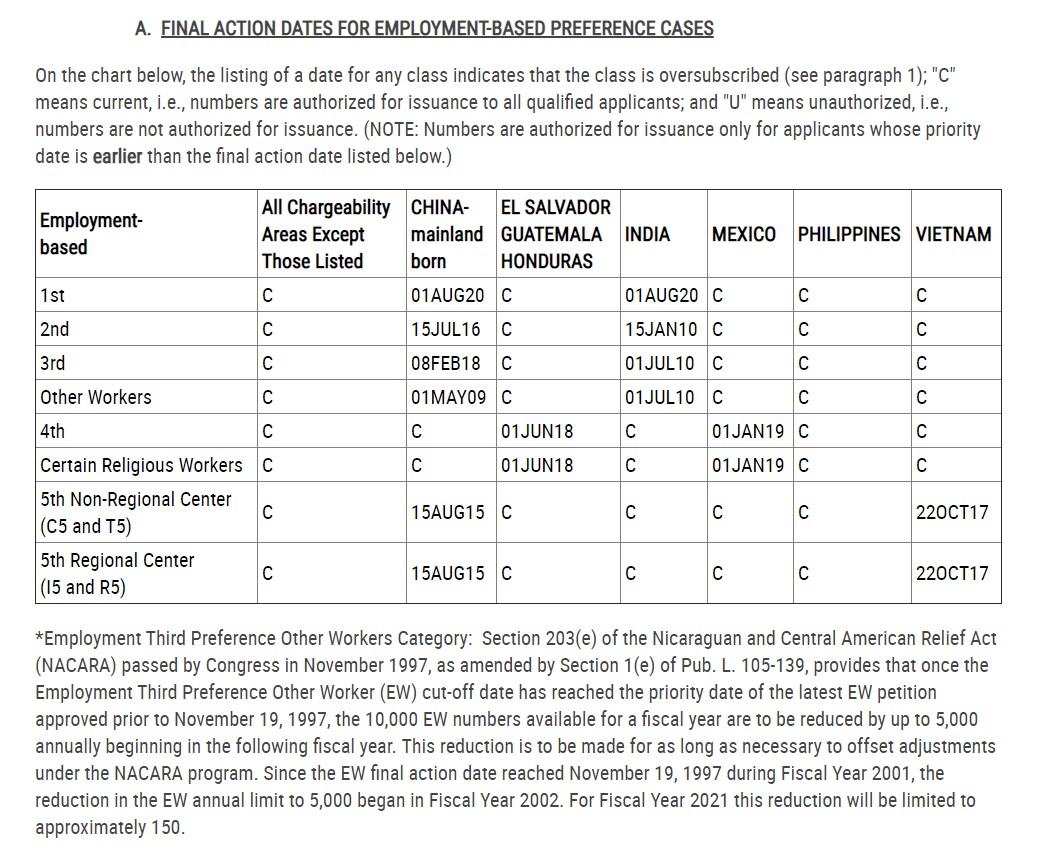
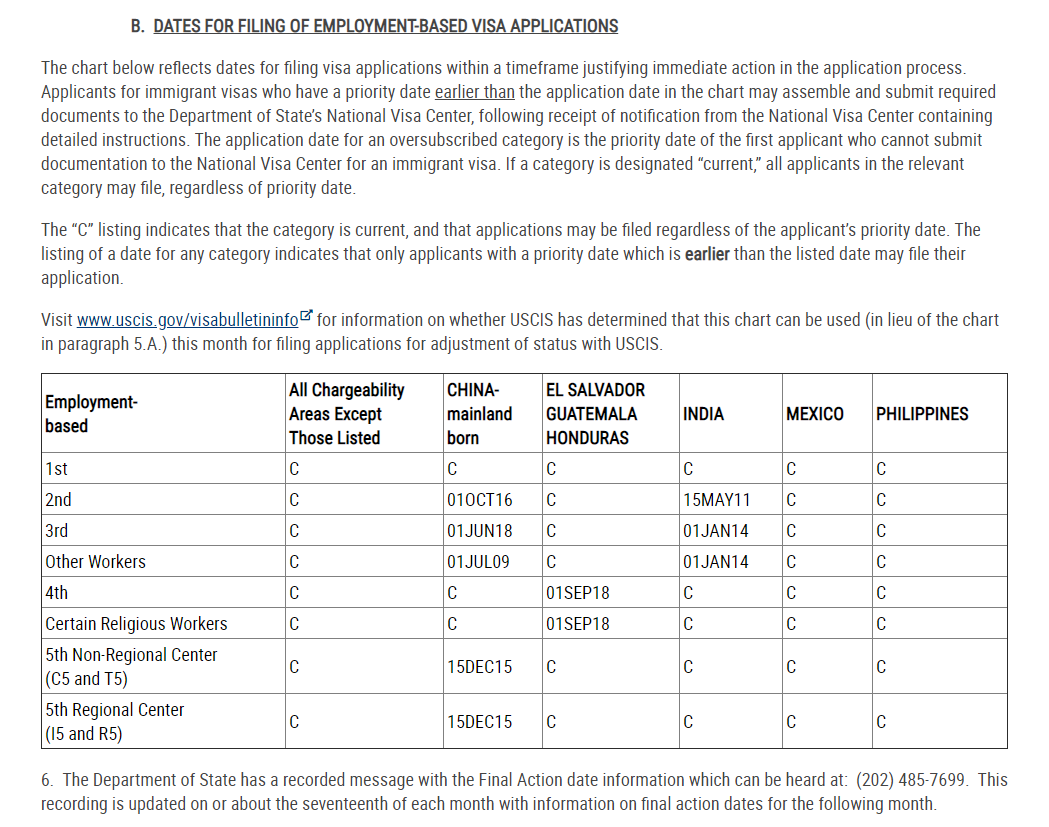
While the February 2021 Visa Bulletin is good news for Indian EB-5 investors—still no backlog since achieving “current” status in July 2020—the outlook is not so good for those in China and Vietnam pursuing EB-5 investments. The Vietnamese final action date has advanced two weeks from the January 2021 Visa Bulletin, landing at October 1, 2017. The Chinese final action date, meanwhile, remains at August 15, 2015, where it has stood since the August 2020 Visa Bulletin. The deluge of new EB-5 visas in FY2021 has thus far done nothing to improve the situation of EB5 investment participants, with wait times growing ever larger and Chinese investors entering their seventh month of final action date inaction.

Chinese EB-5 investors have to face not only a stalled final action date but also a disconcerting lack of movement in the date for filing, which has stood steady at December 15, 2015, for 11 months. Should the March 2021 Visa Bulletin not offer any improvements, Chinese EB-5 investment participants will have reached the unfortunate milestone of a year-long unchanged date for filing. Though a lot can happen in a month, the current global situation surrounding COVID-19 does not offer a lot of hope that the March 2021 Visa Bulletin will provide good news to Chinese EB-5 investors.

Free EB-5 Project Evaluation

Urgent Calls for EB-5 Reform as Regional Center Program Expiration Looms

Urgent Calls for EB - 5 Reform as Regional Center Program Expiration Looms

Reform has been a major theme in EB-5 Immigrant Investor Program world for years, with the unresolved problems in the program becoming more and more aggravated each year. In January 2021, EB-5 industry leaders, including Invest in the USA (IIUSA), have made official calls on Congress to finally implement EB-5 program reform as well as permanently reauthorize the ever-popular EB-5 Regional Center Program.

The EB-5 World Narrowly Missed an Opportunity for Reform

Throughout its history of 30+ years, the EB-5 program—especially through the EB-5 Regional Center Program—has pumped billions of dollars into the U.S. economy, particularly into in-need communities in targeted employment areas (TEAs), and created tens of thousands of new jobs for U.S. workers. Despite this impressive track record, critics fault the regional center program for insufficient integrity measures, accusing those who make EB-5 investments as abusing the guidelines. In response, IIUSA has released a statement stressing the necessity of EB-5 reforms and the legislation needed to enact them.

According to IIUSA, an integrity-based reform to the EB-5 Regional Center Program is “necessary to achieve any other significant legislative goal.” Until integrity measures within the program are tightened, EB5 investment stakeholders have no room to address the mountain of other problems the program faces. At the end of 2020, the long-awaited reform almost came, but ultimately, it was too little, too late.

The EB-5 Reform and Integrity Act was presented by Senators Chuck Grassley and Patrick Leahy, who for years have formed a bipartisan partnership for the betterment of the EB-5 program. The bill addressed only a fraction of the issues that EB5 investment stakeholders have been pushing for years, but nonetheless, it offered an opportunity for strong reform and long-awaited chances. Promising integrity reforms to the regional center program and long-term reauthorization, the bill could have transformed the EB-5 landscape—but since it wasn’t finalized in time to be passed in conjunction with 2020’s year-end federal spending bill, the EB5 investment community must continue the fight for reform and permanent reauthorization.

Reform Needed Desperately to Ensure the Future of the Regional Center Program

As of January 2021, the EB-5 Regional Center Program is set to expire on June 30, 2021, the decision coming after a bumpy few months at the end of 2020 characterized by constant, short-term reauthorization. The reauthorization came alongside a wider government spending bill that included various government programs, as has been the custom for years. This time, however, Congress opted to give the EB-5 Regional Center Program a sunset date of June 30, 2021, as opposed to the normal September 30 date allocated to the other programs in the bill, effectively divorcing the regional center program from the consolidated bill.

This situation represents a rich opportunity for the EB-5 investment world, but it simultaneously presents a major risk—having been separated from federal budget legislation, the regional center program now needs to achieve reauthorization based solely on its own merits. The program has until June 30, 2021, to prove its worth, and then, if no legislation is passed, the program will become a relic of the past. IIUSA’s statement acknowledges the very real risk of termination, calling on the EB-5 industry to support Grassley and Leahy’s reform bill as “perhaps the only path to reauthorization.”

Other industry leaders have released similar statements, some elaborating on the type of reforms they would like to see realized. While Grassley and Leahy’s bill revolves around integrity—which indeed has been the focus of critics—calls have also been made to remove dependents from the yearly allocation of EB-5 visas, which would significantly clear up the backlogs and sufficiently meet EB-5 investment demand.

Reform Is the Way Forward for the EB-5 Program

As a temporary government program, the EB-5 Regional Center Program has dealt with short-term reauthorizations since its debut in 1992, so EB-5 investment stakeholders are no strangers to program uncertainty. The difference this time is the independence of the EB-5 program, having been released from the consolidated federal spending bill, as it faces a looming expiration date.

The EB-5 industry should not panic but rather work together to prove before the June 30, 2021, deadline that the program is beneficial to the United States. Industry stakeholders in all areas agree on the need for reform, and in light of the potential termination of the regional center program, it’s imperative for EB-5 leaders to work together to ensure a bright future for the EB-5 program and all the foreign investors looking to start a new life in the United States.

Free EB-5 Project Evaluation

Analyzing the Trends of the EB-5 Visa Bulletin

Analyzing the Trends of the EB-5 Visa Bulletin

The EB-5 Immigrant Investor Program has long been a popular way for foreign investors to gain permanent residency in the United States for not only themselves but also their immediate family members. In fact, for some, the program has proven too popular—as of January 2021, EB-5 investment participants from China and Vietnam face lengthy backlogs that significantly delay the start of their new life in the United States.

Every fiscal year, a limited number of U.S. green cards are allocated for successful EB5 investment participants, and United States Citizenship and Immigration Services (USCIS) further restricts visa issuance by country of origin. All countries are capped at around 700 EB-5 visas per year, regardless of their population or EB-5 investment demand. Thus, in high-population, high-demand countries like China and Vietnam, backlogs can easily build up that significantly lengthen an EB-5 investment participant’s wait time.

To shed light on the state of USCIS backlogs, the immigration body releases monthly Visa Bulletins that list which countries are “current” (i.e., not backlogged) and the final action dates for those that are not current. If the posted final action date is later than an EB5 investment participant’s priority date (i.e., the date on which USCIS received their I-526 petition), the investor is finally in line to receive their conditional permanent resident status.

China’s Final Action Date

In May 2015, the Chinese EB-5 backlog first sprung up and has raged on for more than five years with no signs of decreasing. In the early days of the backlog, the number of days between the final action date and the current Visa Bulletin month was 730 days, meaning the initial final action dates clocked in at May 2013. Though more than five years have passed since the emergence of the backlog, the final action date has advanced by only two—as of the January 2021 Visa Bulletin, the Chinese final action date is August 15, 2015. Advancing a mere 31 days between June and November 2020, the day gap now stands at 1,935, the highest it’s ever been. The Chinese final date has remained at a standstill since August 2020.

Vietnam’s Final Action Date

It was May 2018, three years after the emergence of the Chinese backlog, that EB5 investment participants from Vietnam joined their northern neighbors in USCIS’s Visa Bulletins. With a final action date in July 2014, Vietnam began its Visa Bulletin journey with a four-year backlog—a day gap of 1,379 days. Unlike the Chinese day gap, which has risen steadily since emergence, the Vietnamese day gap has remained fairly consistent at between 1,000 to 1,100 days, save for a sudden spike to 1,775 in mid-2019 and a subsequent drop back down to normal levels a couple months later. As of January 2021, the Vietnamese final action date stands at September 1, 2017, with a day gap of 1,187, having advanced 51 days between June and November 2020. For the most part, the Vietnamese day gap has remained remarkably lower than the Chinese one, though the Vietnamese backlog similarly slows no signs of letting up.

Download EB-5 Visa Bulletin Trend Analysis