The EB-5 investment program has enabled thousands of foreign nationals to relocate to the United States and acquire permanent residency. While United States Citizenship and Immigration Services (USCIS) lays out clear regulations for the program, the EB-5 process is complex and time consuming. Moreover, if an EB-5 project fails to comply with USCIS regulations, its investors’ visa petitions may be denied.
Because of the complexity of the EB-5 process, prospective investors are advised to work closely with an experienced immigration attorney. It is also important for them to begin preparing as early as possible so that they can start gathering the documentation they will need later in the process.
In this article, we describe the early preparations that prospective EB-5 investors should make and how they can begin the EB-5 process.
Preparing for the EB-5 Process
First, interested foreign nationals need to determine whether the EB-5 visa is a viable immigration option and hire an immigration attorney. They should examine the source of funds that would be used to make an EB-5 investment as well as the minimum investment thresholds: $500,000 for targeted employment area (TEA) projects and $1,000,000 for non-TEA projects.
Having hired an immigration attorney and examined basic requirements for EB-5 investors, interested foreign nationals must then select a suitable EB-5 project. They should carefully examine the details of each option and determine whether the project fulfills EB-5 criteria, especially the requirement to create 10 qualifying U.S. jobs.
Making an EB-5 Investment
Having selected a qualifying EB-5 business, investors must then subscribe to the project and make their investment. Then, they must prepare to file Form I-526, Immigrant Petition by Alien Investor. In this petition, the investor must provide details such as how the funds will be used and prove compliance with the at-risk requirement. Proving that the funds were sourced lawfully can be particularly challenging.
Preparing the source-of-funds documentation to meet USCIS’s high evidentiary standard can take some time. Investors are advised to start preparing this material as soon as they decide to pursue the EB-5 investment visa. Their immigration attorney will be able to advise on exactly what documentation is required, depending on the specific source of capital used in the investment.
The path to obtaining permanent U.S. residency through the EB5 investment program can be complex. However, with the help of an experienced attorney, foreign nationals will be able to navigate this process with confidence.
Since its launch in the 1990s, the EB-5 investment program has brought investors from all over the world to the United States. Foreign investment in qualifying EB-5 businesses has helped the United States’ economy and reduced unemployment. This capital is usually offered at below-market rates, which is advantageous for U.S. business owners. In addition, businesses receiving EB-5 investment capital are required to generate at least 10 full-time jobs.
Recent changes to the regulations of the EB5 investment industry have increased interest in the program. The repeal of the Modernization Rule in June 2021 reduced the minimum investment threshold from $900,000 to $500,000 for business projects located in targeted employment areas (TEAs). This makes the EB-5 program more accessible to interested foreign nationals.
EB-5 investments can be an excellent source of funding. However, in order to qualify for the EB-5 program, business owners must plan their projects carefully to ensure compliance with United States Citizenship and Immigration Services (USCIS) regulations and make their offerings attractive.
How to Make an EB-5 Project Attractive to Investors
EB-5 investors tend to look for safe investment opportunities that provide them with the most benefits. Many foreign nationals value their eligibility for U.S. citizenship more than the return on their investments, so they look for projects with low immigration risk. The best projects, therefore, comply with all USCIS regulations and have viable business plans.
Another thing that foreign nationals look for when evaluating EB-5 investment opportunities is the business’s ability to generate jobs. As each EB-5 investment needs to create at least 10 jobs, projects that allow for the creation of large numbers of jobs are more likely to guarantee that each investor’s quota is met early on. Such projects have an especially low immigration risk.
Marketing Your Project
EB-5 projects require a carefully devised marketing strategy. EB-5 business owners must create marketing materials that appeal to their target audience. This may include brochures and other printed materials translated into the potential investors’ native language. As many potential investors do research on available projects from overseas, EB-5 projects must have a strong online presence to catch their attention. Informational videos, for instance, can help business owners engage investors. Seminars, conducted online or in person, can be a good way for business owners to interact directly with their potential investors and answer their questions.
EB-5 capital provides significant benefits to U.S. businesses. Of course, creating and marketing an EB-5 project that follows all USCIS regulations can be challenging. Business owners are advised to consult with an immigration attorney and EB-5 specialists.
The United States’ strong economy, political stability, reliable infrastructure, and many other strengths offer an enticing opportunity for foreign nationals—many around the world want to share in these benefits by becoming permanent residents of the United States. The EB-5 visa is one of the most efficient and low-risk ways to obtain U.S. permanent resident status. Since 1990, investors from around the world have made EB-5 investments and relocated to the United States successfully. We now summarize the EB-5 process and explain how foreign nationals and their families can qualify for EB-5 visas.
1. Making An EB-5 Investment
An immigration attorney’s services will be invaluable throughout the EB-5 process; foreign nationals should work with an immigration attorney with ample experience in the EB-5 program. Moreover, these professionals can help investors find reliable EB-5 projects with a low immigration risk—that is, projects that comply fully with United States Citizenship and Immigration Services (USCIS) regulations. It is particularly important to choose a project that has adequate job creation potential. Preferably, an EB-5 project should aim to create more than the minimum requirement of 10 jobs per EB-5 investor.
2. Filing Form I-526
Once an EB-5 investment has been made, the investor must submit Form I-526, Immigrant Petition by Alien Investor. USCIS will examine this petition carefully to determine whether the EB-5 investment complies with the at risk requirement, was made in a qualifying new commercial enterprise (NCE), and used lawfully sourced funds. It can be particularly challenging to gather the documentary evidence needed to trace the EB5 investment capital back to its source. An immigration attorney’s assistance is particularly crucial at this step of the process. In addition, the at risk requirement entails that there can be no guarantee the EB-5 funds will be repaid.
3. Conditional Permanent Resident Status
USCIS typically takes years to adjudicate Form I-526. Once this petition is approved, the EB-5 investor will be granted conditional permanent resident status. For two years, the investor will be entitled to live and work anywhere within the United States. During this period, it is crucial for the EB-5 project to create the needed number of jobs and to keep the EB-5 capital at risk.
4. Filing Form I-829
During the last 90 days of the two-year conditional residency period, EB-5 investors must submit Form I-829, Petition by Investor to Remove Conditions on Permanent Resident Status. This form must prove that the EB-5 project fulfilled USCIS’s criteria, particularly the employment creation requirement. Once this petition is approved, investors are granted U.S. permanent resident status without restrictions.
This general overview of the EB-5 process can help foreign nationals decide whether the EB-5 industry is right for them. Consulting firms such as EB5AN can answer any questions related to the EB-5 process and help foreign nationals find the most reliable, USCIS-compliant projects on the market.
Since 1990, when the EB-5 Immigrant Investor Program was launched, many foreign nationals have participated in EB-5 and obtained U.S. permanent resident status . Unlike other U.S. immigration opportunities, that can take a long time to process, the EB-5 Program is one of the quickest ways to secure a green card.
One key requirement of the EB-5 Program is for foreign nationals to comply with the United States Citizenship and Immigration Services (USCIS) regulations. These regulations are fairly complex and can be highly specific in terms of the information that USCIS needs.
For this reason, the EB-5 process can be difficult to navigate alone, without the help of an experienced EB-5 attorney.
In this article, we will take a look at the role of EB-5 attorneys and explore how you, the investor, can go about choosing one that will suit your specific needs. We will also shed some light on the fees that you can expect to pay as a foreign investor.
The EB-5 Immigrant Investor Program: A Quick Overview
The EB-5 Immigrant Investor Program is an initiative that allows foreign investors to secure visas and, eventually, green cards by investing a specific amount of capital in a U.S.-based business that generates jobs.
💡What Is a New Commercial Enterprise and Targeted Employment Area?
Investors will come across the terms “new commercial enterprise, or NCE,” and “targeted employment area, or TEA” a lot within the U.S. EB-5 Immigrant Investor Program context.
Here is what these terms mean:
New commercial enterprise (NCE):
An NCE refers to the business entity in which an EB-5 investor makes their capital investment. It can be a for-profit entity engaged in various types of commercial activities, such as manufacturing, real estate development, hospitality, or any other legal business.
Targeted employment area (TEA):
A TEA is a specific geographic area designated as such by the U.S. government based on specific criteria. TEAs are categorized as two main types:
High unemployment TEA: An area with an unemployment rate at least 150% of the national average.
Rural TEA: A rural area outside a metropolitan statistical area or a city with a population of fewer than 20,000.
EB-5 applicants need to invest either $1,050,000 in non-TEA projects or $800,000 in a targeted employment area (TEA).
What Does an EB-5 Attorney Do?
Guide investors through the investment process
An EB-5 attorney guides investors through the entire investment process, from explaining the requirements of the program to preparing and submitting all the necessary paperwork.
Conduct research on potential projects
These attorneys conduct thorough research on potential investment projects that the investor may have identified, to ensure they meet program criteria. In some cases, they may already have solid EB-5 investment opportunities on their books for a foreign investor to explore.
Help navigate complex immigration procedures
Immigration attorneys help investors by providing services such as filing visa petitions and preparing supporting documentation. They also make sure investors adhere to program rules, such as meeting job creation requirements and maintaining their investments.
Should any issues arise during the application process, EB-5 attorneys advocate on behalf of their clients. Essentially, they serve as trusted partners who help investors achieve their goal of obtaining permanent residency in the U.S. through the EB-5 Program.
What to Look Out For When Selecting an EB-5 Attorney
It’s crucial for EB-5 investors to work with an immigration attorney who has experience in the EB-5 industry. Immigration counsel can help an investor make sense of the EB-5 Program’s requirements throughout every step of the process.
EB-5 investors must choose their immigration counsel very carefully. Working with an immigration attorney who lacks EB-5 experience could seriously jeopardize an investor’s chances of success.
When evaluating potential attorneys, EB-5 investors should look for the following characteristics:
❗A solid track record
The most reliable immigration attorneys have a history of successfully preparing I-526 and I-829 petitions for their clients. All reputable immigration attorneys should be willing to disclose their past success rates.
Of course, investors must keep in mind that past success does not guarantee that their upcoming visa petitions will be approved. In addition, if an immigration attorney has a high success rate but has only worked with a few EB-5 investors, the success rate becomes less meaningful.
❗Effective communication
Ideally, immigration attorneys should be easily accessible and available to answer their clients’ questions quickly and clearly. Foreign investors should always remember that it is important to communicate with their attorney in a transparent way.
❗Positive client testimonials
If an immigration attorney can provide positive client testimonials, their reliability increases substantially. EB-5 investors should ask for references from the attorney’s other clients, and look for online reviews of the attorney’s services.
❗A source-of-funds strategy
Gathering the legal source-of-funds evidence for Form I-526 is a particularly challenging aspect of the EB-5 process. Immigration attorneys should have a solid strategy for helping their clients compile the necessary evidence and be willing to devote significant time and effort to completing Form I-526.
How Can EB5AN Help You, the Investor?
✅ EB5AN’s solid track record
EB5AN has an impressive track record in the field of EB-5 immigration and investment. With a strong history of successful projects and satisfied investors, we at EB5AN have consistently demonstrated our expertise in navigating the complex EB-5 Program requirements.
Our experience in project development, regional center operations, and compliance ensures that investors receive reliable guidance and support throughout their immigration journey.
Whether it’s job creation, capital deployment, or I-526 and I-829 petition approval, EB5AN’s proven track record speaks to our commitment to ensuring successful EB-5 investments for foreign investors across the United States.
✅ EB5AN’s communication strategy
Through our commitment to clarity, accessibility, transparency, and timeline adherence, EB5AN excels in effective communication. We simplify complex EB-5 Program details, which makes them easy to understand for clients.
Our team is readily available and responsive, which ensures that clients get the support they need, when they need it. We are transparent about program intricacies, which allows us to empower clients to make informed decisions.
✅ EB5AN’s testimonials
Clients consistently praise us at EB5AN for our transparent communication, accessibility, and ability to simplify complex matters. Read through our wide range of client testimonials to see why foreign investors choose us as their immigration attorney.
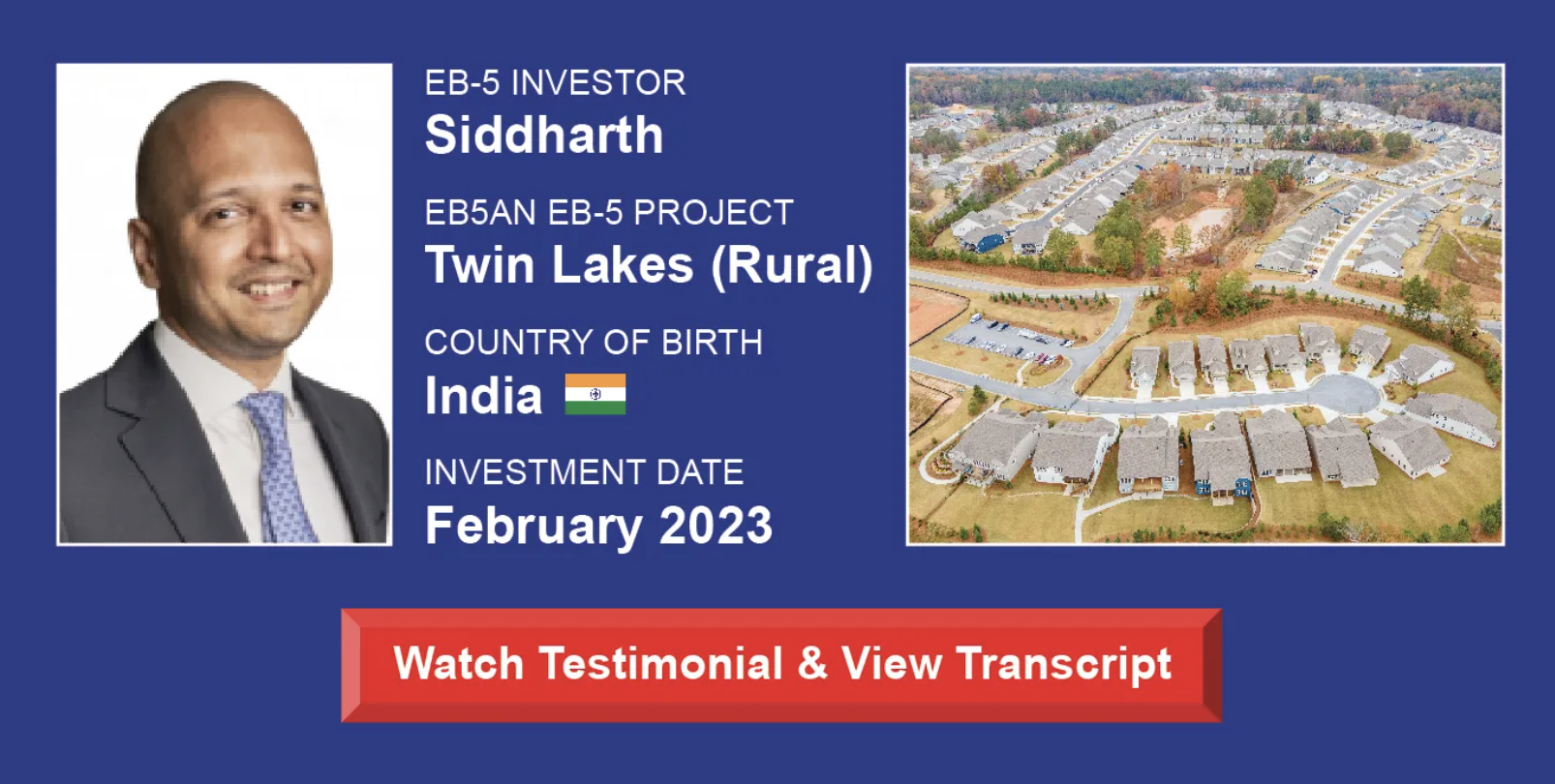
Here is one example from Siddharth, who says:
“After doing a lot of Google research to really be sure about the project I was going to invest in, I found EB5AN. A few good things stood out for me, including the pedigree of the founders. It gave me comfort to see that the team I was corresponding with were all highly qualified, intelligent individuals who had worked for global organizations.”
✅ EB5AN’s source-of-funds strategy
EB5AN’s due diligence process ensures that the source of funds is thoroughly reviewed and any potential issues are identified and addressed promptly. By working closely with EB5AN, investors can streamline the process of documenting the lawful source of funds.
In addition, our personalized approach means that strategies are tailored to the specific financial circumstances of each investor.
Of course, all of our investors are free to choose their own attorneys, and no immigration attorneys work for EB5AN.
The Steps to Hire an EB5 Attorney
Selecting an experienced attorney is essential for a successful immigration process, so foreign investors should take their time to make an informed decision.
Conduct some thorough research
Begin by researching and identifying immigration attorneys with expertise in the EB-5 Program. You can use online resources, referrals, or legal directories to create a list of potential attorneys.
Here are some pointers for you to consider:
Experience: Check the attorney’s experience in handling EB-5 cases, including their success rate and years in practice.
Specialization: Ensure the attorney specializes in immigration law and has a focus on EB-5 cases.
Track record: Investigate their track record of approved EB-5 petitions and successful investor cases.
Fees: Understand the attorney’s fee structure, including any hidden costs or additional fees.
Team: Inquire about the attorney’s support team and resources available to handle your case.
Ethical record: Check whether the attorney has any disciplinary actions or ethical violations on their record.
Immigration association memberships: Check whether the attorney is a member of reputable immigration law associations, which could indicate their expertise in the field and ensure current knowledge of policy or procedural changes.
Arrange a consultation
Schedule consultations with the attorneys on your list. During these consultations, discuss your specific EB-5 immigration needs and concerns.
Evaluate the attorney
Evaluate each attorney’s experience, track record, and communication style. Consider their past success with EB-5 cases and how well they address your questions and concerns.
Fees and service agreements
Inquire about the attorney’s fees, payment structure, and any additional costs. Review the terms of engagement, including the scope of their services and responsibilities.
Obtain references
Ask for references from previous clients or check online reviews to gauge client satisfaction and the attorney’s reputation.
Select your attorney
Based on your research, consultations, and evaluation, choose the EB-5 attorney who best aligns with your needs and goals.
Review and sign the engagement agreement
Once you’ve made your selection, formally retain the attorney by signing an engagement agreement. This document will outline the terms and conditions of your working relationship.
Some Insights on Rates and Fees
There is no doubt that the EB-5 Program is very much an investment in your future in the United States.
Let’s dive into some key insights about the rates and fees involved when considering the EB-5 Immigrant Investor Program. Understanding these financial aspects is essential for anyone looking to pursue U.S. permanent residency through the EB-5 pathway.
Attorney fees
There are three fees that you will need to be aware of when hiring an immigration attorney to help you navigate the EB-5 process. These include:
I-526 Petition (Immigrant Investor Petition) legal fees: These are fees charged to prepare and file the I-526 petition. Complex cases may result in higher fees. Of course, all fees will vary across each immigration attorney and each particular client.
I-829 Petition (Petition to Remove Conditions) legal fees: Fees for the I-829 petition, filed toward the end of the two-year conditional residency period, are also charged.
Consultation fees: Some attorneys charge a consultation fee for an initial assessment of your eligibility and options.
Additional services: Attorneys may offer services beyond the petition filings, such as due diligence on EB-5 projects, assistance with selecting a regional center, or other related services. The cost for these additional services can vary widely.
Petition filing fees
Petition filing fees are the official charges associated with submitting the necessary immigration forms to U.S. Citizenship and Immigration Services (USCIS) as part of the EB-5 Visa process. These fees cover the cost of processing and reviewing your petitions.
These fees currently include:
I-526 Petition: The filing fee for the I-526 petition, which is $3,675.
I-829 Petition: The filing fee for the I-829 petition, which is $3,750.
In the highly complex landscape of the EB-5 Immigrant Investor Program, securing the right immigration attorney can make all the difference. EB5AN offers all the expertise and guidance that you need to navigate this process easily and successfully.
With a track record of excellence, transparent communication, and a commitment to your immigration goals, EB5AN is your trusted partner. Take the next step toward your EB-5 journey by contacting us today. Your path to U.S. permanent residency awaits!
The EB-5 investment program underwent many changes in 2021, many of which were unexpected and had a significant effect on the industry. For instance, the EB-5 Modernization Rule, a far-reaching amendment to many EB-5 regulations, was repealed in June 2021. As a result, the EB-5 investment threshold was lowered, and the process for designating targeted employment areas (TEAs) once again became the responsibility of individual states.
The most significant change to the EB-5 program in 2021 was the expiration of the regional center program, which left the EB-5 industry without its most popular investment model. As a result of this legislative lapse, EB-5 investors in regional center projects who filed Form I-526 are now unable to proceed with the EB-5 process. United States Citizenship and Immigration Services (USCIS) is no longer processing I-526 petitions from regional center investors.
The lapse in regional center EB-5 investment has also shifted attention toward direct EB-5 projects. Even though direct EB-5 investors do not enjoy the more flexible job creation criteria of their regional center counterparts, the direct EB-5 investment model does not rely on government revalidation.
Of course, it is possible for more changes to take place in 2022, and EB-5 industry stakeholders should be prepared for such changes.
The EB-5 Investment Threshold
As of the June 2021 repeal of the Modernization Rule, the minimum investment amounts are $500,000 for projects in TEAs and $1,000,000 for projects outside TEAs. However, many analysts believe that the U.S. government will raise the amounts in the relatively near future. If Congress approves any legislation that introduces reforms to the EB-5 program, the minimum amounts will likely become higher than the Modernization Rule-era thresholds of $900,000 for TEA projects and $1,8000,000 for non-TEA projects.
In light of this possibility, interested foreign nationals should consider participating in the EB-5 program as soon as possible. Many foreign nationals successfully made direct EB-5 investments in 2021 and filed their I-526 petitions.
The Adjudication of Regional Center I-526 Petitions
As mentioned previously, USCIS is not adjudicating I-526 petitions from regional center investors. Foreign nationals who filed I-526 petitions may fear that the agency could take the next step and issue denials to regional center investors. However, it is unlikely for USCIS to do so; denying pending regional center petitions only because of the program’s suspension would undoubtedly result in numerous lawsuits.
There is a chance that the EB-5 industry will succeed in promoting legislation that would allow regional center investors to be “grandfathered in” and continue with the EB-5 process even if the regional center program remains suspended. Such a scenario would become likely if Congress continues to delay the reauthorization of the regional center program.
TEA Designation
Currently, the EB-5 industry must follow the pre-Modernization Rule criteria for designating TEAs. However, if USCIS or the Department of Homeland Security (DHS) takes action to restore Modernization Rule regulations governing TEAs, there will likely be stricter eligibility criteria for high-unemployment TEAs. Such a change may make it more difficult for EB-5 projects to receive TEA status.
The EB-5 Industry’s Continued Success
Despite its rapidly changing regulations, the EB5 investment industry continues to succeed, helping foreign nationals relocate to the United States and benefitting businesses across the country. Foreign nationals and business owners interested in the EB-5 program would do well to keep these potential changes in mind.
Most members of the EB-5 investment industry would certainly agree that 2021 has been a turbulent year, perhaps one of the most eventful periods in the EB-5 Immigrant Investor Program’s 31-year history. This year saw major changes to EB-5 policies and regulations.
To begin with, the EB-5 Modernization Rule, which had made many controversial changes to EB-5 investment regulations, was invalidated by a June 22, 2021 court ruling. This move reversed the minimum EB-5 investment thresholds back to their pre-November 2019 amounts of $500,000 for targeted employment area (TEA) projects and $1,000,000 for projects outside TEAs. The EB-5 industry as a whole welcomed this change enthusiastically, but the program would soon suffer a major blow. Just a few days later, on June 30, the regional center program expired. Congress failed to pass a bill that would have reauthorized the regional center investment model and made other reforms to the EB-5 program.
Despite this setback, many EB-5 investors and project developers were confident that the lapse in regional center EB-5 investment would be brief. Unfortunately, they were mistaken—as of December 2021, the regional center program remained unauthorized. Many had hoped that Congress would include EB-5 reform in an appropriations bill that was due in December 2021, but it now seems that regional center investment will not be revalidated until February 2022—at the earliest.
As 2022 begins, members of the EB-5 industry and foreign nationals interested in the EB-5 visa may wonder what the future holds for the EB-5 program.
Direct Investment Will Likely Remain Popular
Even though most EB-5 investors used to choose projects sponsored by regional centers due to their flexible job creation criteria, direct EB-5 investment is now the sole option for EB-5 investors. This investment model offers several distinct advantages, often granting investors increased managerial responsibilities and higher returns. Perhaps the greatest advantage to investing in a direct EB-5 project is knowing that direct investment will never suffer a legislative lapse—direct EB5 investment is an inextricable component of the EB-5 program. As such, it does not require periodic reauthorization. Many investors have found suitable direct EB-5 projects in 2021.
What Will Happen to Regional Center Investors?
Due to the expiration of regional center investment, tens of thousands of foreign nationals who had filed their I-526 petitions now find themselves unable to continue with the EB-5 process. United States Citizenship and Immigration Services (USCIS) is no longer processing I-526 petitions from regional center investors; the agency is unlikely to resume adjudication on such petitions unless Congress revalidates the regional center program.
Therefore, regional center operators and investors hope that EB-5 reform, including reauthorization for regional center investment, will be included in the appropriations bill that is due on February 18, 2022. The possibilities of a bill that exclusively addresses the EB-5 program to be passed in Congress are very low.
It may be that the EB-5 industry will find an alternative way to rescue regional center EB-5 investors from processing limbo, such as proposing legislation that would require USCIS to process regional center visa petitions even if the program is suspended. It is clear that the lapse in regional center investment has not only been detrimental to the EB-5 industry—it has also deprived the U.S. economy of much-needed investment capital.
Despite these potential issues, the EB-5 visa remains an ideal way to relocate to the United States, and it has injected billions of dollars of funding into U.S. businesses. 2022 will likely be another eventful and busy year for the EB-5 industry.
Many foreign nationals view the EB-5 investment program as the safest and most reliable way to move to the United States with their families. Indeed, the visa-by-investment approach taken by the EB-5 program has benefitted the country’s economy, created jobs, and helped thousands of foreign nationals to relocate to the United States.
However, the EB-5 industry can be difficult to navigate. The regulations on the EB-5 program set out by United States Citizenship and Immigration Services (USCIS) are numerous and complex. Therefore, it is essential for EB-5 investors to work with immigration counsel in every step of the process; if an EB-5 investment fails to comply with all USCIS regulations, the investor will become ineligible for permanent resident status.
Investors must also keep in mind that the minimum EB-5 investment amounts are substantial: targeted employment area (TEA) projects require a minimum investment of $500,000, and the investment threshold for non-TEA projects is $1,000,000. Moreover, one of the key requirements for EB-5 investment capital is that it must remain at risk; all EB-5 investors must be able to experience either loss or gain, and there can be no guarantees that their funding will be returned. Foreign nationals who would like to make an EB-5 investment must consider the following factors when evaluating potential projects.
Evaluate Projects Thoroughly to Avoid Fraud
Unfortunately, EB-5 business owners have occasionally committed fraud and misused EB-5 capital. Before subscribing to a project, potential EB-5 investors should do research on the experience and legal standing of the project’s owners and managers, especially those in charge of overseeing the EB-5 investment funds. Making an in-person or virtual site visit is highly recommended, and transparent EB-5 projects will gladly allow investors to tour the project site. Foreign nationals should also gather third-party information on the EB-5 project and the parties involved.
Reducing Immigration Risk
Many EB-5 investors are more concerned with obtaining U.S. permanent resident status than gaining significant profits from their investments. Therefore, it is crucial to evaluate an EB-5 project’s immigration risk—that is, its chances of being completed successfully and complying with all USCIS requirements, such as creating 10 jobs per investor.
One of the most relevant factors that determine a project’s immigration risk is whether it will be completed if the expected amount of EB-5 funding is not raised. The most trustworthy EB-5 projects will have an alternative source of funding available in the case of a shortfall of EB-5 capital. This way, it will be much more likely for the project to be completed successfully.
It is also indispensable to evaluate an EB-5 project’s potential for job creation. Projects that plan on generating far more than 10 jobs per investor and thus offer ample job cushions are the safest options. In fact, foreign nationals may even be able to invest in projects that have already created the necessary number of jobs. For instance, a real estate development project may create all the necessary jobs for its investors before construction is complete. Potential EB-5 investors should look for safe opportunities like these.
Interested foreign nationals must also look at the more minute details of a project’s offering. For instance, job creation must be timed carefully. If all 10 jobs have not been created by the time USCIS adjudicates Form I-829, an EB-5 investor will be unlikely to receive permanent resident status. In addition, projects with USCIS exemplar status or an approved I-526 petition have already shown compliance with all of the agency’s standards.
Making an EB5 investment requires diligent planning and professional consultation, but numerous foreign nationals have successfully relocated to the United States and even obtained citizenship through the program. Potential investors should contact EB5AN to receive personalized guidance on how to begin the EB-5 process and find trustworthy projects.
The December 2021 Visa Bulletin contained momentous news for the EB-5 investment industry: for the first time since 2015, all direct EB-5 investors would no longer be subject to final action dates or dates for filing. This positive development enables direct investors to apply for and receive their visas as soon as their I-526 petitions have been approved by United States Citizenship and Immigration Services (USCIS).
Fortunately, the January 2022 Visa Bulletin shows that all direct investors remain at “C” (current) status. Chinese EB-5 investors, who had been subject to cutoff dates since 2015, will undoubtedly benefit from possessing current status; many more foreign nationals will likely be able to move on with the EB-5 process and get closer to obtaining permanent resident status.
Despite the good news in the two most recent Visa Bulletins, the EB-5 Regional Center Program, which had been the most popular EB5 investment type, remains suspended as of December 2021. The U.S. government has failed to revalidate the regional center program since its expiration on June 30, 2021. This extended lapse has contributed to the popularity of direct EB-5 investment, which often grants investors many unique benefits such as increased managerial control and, possibly, higher returns.
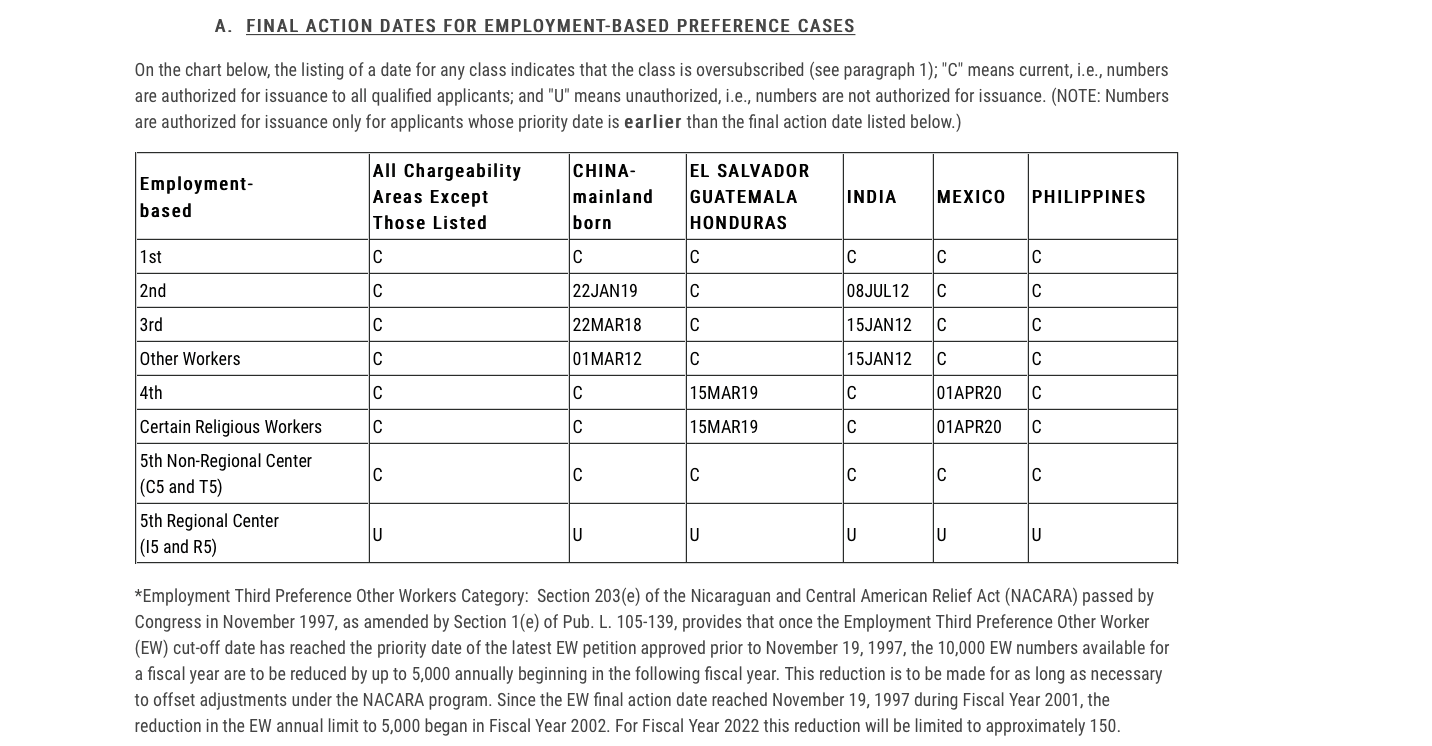
Chart A
Chart A of the January 2022 Visa Bulletin contains the final action dates for oversubscribed countries. As in the previous bulletin, all direct (“non-regional center”) investors enjoy “C” status and can receive their visas as soon as they are documentarily qualified.
The regional center values in Chart A are marked as “U” (unauthorized). In Section D of the Visa Bulletin, the Department of State (DOS) notes that, should the regional center program be reauthorized in January 2022, the final action date for regional center investors will be November 22, 2015. However, it is unlikely for regional center investment to be revalidated before February 2022.
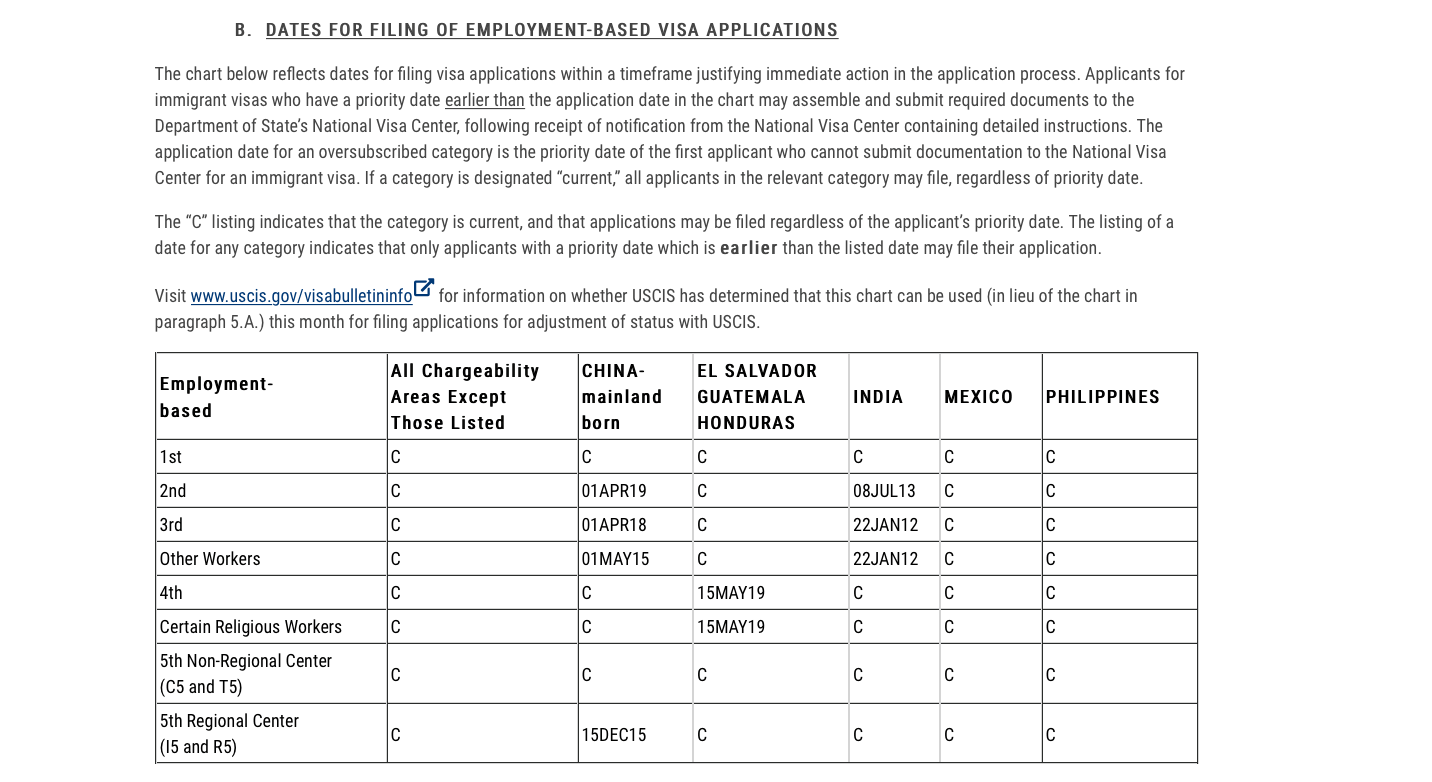
Chart B
The dates for filing are current for all direct investors, meaning that these EB-5 investment applicants no longer have to wait to request their visas. The date for filing for Chinese regional center investors remains at December 15, 2015.
It is unclear how long the regional center program will remain suspended, or how a possible reauthorization could affect the cutoff dates. Still, Chinese investors whose EB-5 visa petitions were put on hold due to the cutoff dates are surely relieved that they can now continue with the process.
The EB-5 visa’s popularity has noticeably increased in recent years, with thousands of foreign nationals participating in the EB-5 investment program and obtaining U.S. permanent resident status. Even though many investors have obtained U.S. green cards through the EB-5 program, foreign nationals interested in the EB-5 industry should note that simply making an EB-5 investment does not guarantee that the investor will receive permanent residency. United States Citizenship and Immigration Services (USCIS) examines every EB-5 investment to determine whether it complies with its guidelines. USCIS regulations govern the way EB-5 investments can be made, the kind of businesses that are eligible for the EB-5 program, and many other facets of the EB-5 industry.
To ensure compliance with USCIS guidelines, EB-5 investors must work closely with experienced immigration counsel and do thorough research on the EB-5 program before investing. During the EB-5 process, investors must submit Form I-526, Immigrant Petition by Alien Investor, and Form I-829, Petition by Investor to Remove Conditions on Permanent Resident Status. These visa petitions determine whether an EB-5 investor will receive a U.S. green card.
Occasionally, despite an investor’s best efforts, USCIS denies their visa petition. In this article, we explain how investors can respond to a USCIS denial.
Next Steps After a USCIS Denial
If an EB-5 investor receives a petition denial, this does not necessarily mean that they will never be able to immigrate to the United States. First, they should read the denial notice carefully to find out why USCIS found the visa petition deficient. The investor’s immigration counsel should also review the denial notice.
If an EB-5 investor and their immigration counsel possess evidence that could likely persuade USCIS to reconsider the visa petition, they might decide to file a legal motion requesting the agency to reevaluate its decision. Of course, a legal motion must be accompanied by an exhaustive, detailed explanation of why the visa petition is valid. If an investor’s legal motion is unsuccessful, they may instead file an appeal of the petition denial.
EB-5 investors should also keep in mind that they will likely be able to file a new EB-5 visa petition. If, for instance, an investor’s petition was denied because the EB-5 project was not USCIS-compliant, they can simply file a new petition with a more reliable project.
Common Reasons for USCIS Denials
Of course, the best course of action is to avoid a USCIS denial in the first place. In many cases, EB-5 petitions are rejected because the investor failed to reach the minimum investment threshold. As of June 22, 2021, the minimum investment amounts are $500,00 for targeted employment area (TEA) projects and $1,000,000 for non-TEA projects. USCIS is also strict about enforcing the at-risk requirement, which entails that EB-5 investors cannot have a contractual right to repayment; they must be open to either profits or losses.
Moreover, the information provided in EB-5 visa petitions must be as accurate and up-to-date as possible. For instance, Form I-526 must include detailed information on the EB-5 project’s business plan, including its financial projections and capacity for job creation. These figures must be presented consistently across the petition.
EB-5 investors must also take great care to provide the needed source-of-funds documentation in Form I-526, tracing the EB-5 investment capital back to its source. USCIS must be able to ascertain that the EB-5 investment funds were sourced legally, and preparing this evidence is one of the most important aspects of the EB-5 process.
The EB5 investment process may bring unexpected challenges or delays; still, as long as an EB-5 investor plans carefully and works with competent immigration counsel, they will likely be able to obtain U.S. permanent resident status.
In recent years, numerous U.S. business owners have expressed interest in the EB-5 investment industry. The EB-5 program has for many years allowed foreign nationals to receive U.S. green cards in exchange for investing in qualifying businesses. Since EB-5 investment capital is often available at below-market rates, it is especially convenient for the U.S. economy.
The EB-5 investment industry is overseen by United States Citizenship and Immigration Services (USCIS). Moreover, making an EB-5 investment does not guarantee that a foreign national will receive permanent resident status: USCIS will carefully examine the investment to ensure that it complies with the EB-5 program’s requirements. EB-5 investors receive permanent residency only after their I-526 and I-829 visa petitions have been approved. USCIS requires all EB-5 investments to create a minimum of 10 jobs, remain at risk, and fulfill many other criteria.
Therefore, EB-5 projects must be tailored to the needs of EB-5 investors and comply with all USCIS guidelines. Project developers should take care to offer ample job creation potential, avoid relying solely on EB-5 capital, and try to obtain TEA designation.
Potential for Employment Creation
One of the main purposes of the EB-5 program is to reduce unemployment, so USCIS is strict about its job creation requirement. Even though each investor needs to be allotted a minimum of 10 jobs, EB-5 project developers are recommended to create more than the minimum number of jobs. EB-5 projects with an ample job cushion are perceived as safer and are thus popular among investors.
In some cases, investors may wait until a project has already created several jobs and then subscribe. For instance, a construction project that is open to a maximum of 10 EB-5 investors may plan on creating approximately 300 jobs. Once construction is halfway through, about 150 jobs will have been created. An EB-5 investor who subscribes to the project at this point will already fulfill the employment creation requirement.
Avoiding Reliance on EB-5 Funding
The safest and most popular projects do not rely on EB-5 funding for completion; EB-5 investment capital should make up a relatively small portion of the overall capital stack. Therefore, the project should be successfully completed even if there is a shortfall of EB-5 funds. Having alternative sources of funding is perhaps the most important factor that determines a project’s reliability from an immigration perspective.
Alternative sources of funding can include an initial bridge loan or additional sources of debt or equity. Irrevocably committed developer funds, a construction completion guarantee (if applicable), and a senior loan with a major bank will also add to an EB-5 project’s reliability from an immigration perspective.
TEA Designation
The standard EB-5 investment threshold is $1,000,000, but EB-5 projects located in targeted employment areas (TEAs) can receive investments of only $500,000. Naturally, most investors look for projects located in TEAs.
The EB-5 industry offers valuable opportunities for U.S. business owners. As long as an EB-5 project has sufficient job creation potential, does not rely on EB5 investment funds for completion, and possesses TEA status, it will likely attract EB-5 investors. Interested project developers should consult with EB5AN, which has helped numerous U.S. businesses obtain EB-5 capital.