


Author Archives: admineb5

Free EB-5 Project Evaluation

Proving the Legality of Loaned EB-5 Investment Capital

Proving the Legality of Loaned EB-5 Investment Capital

Many foreign nationals have come to enjoy the benefits of relocating to the United States through the EB-5 investment program. United States Citizenship and Immigration Services (USCIS), the agency that regulates the EB-5 program, sets out that investors who invest in a new commercial enterprise (NCE) and create at least 10 jobs for U.S. workers are entitled to permanent resident status. Unlike many other visa-by-investment programs, the EB-5 program’s minimum investment amounts are reasonable: as of June 22, 2021, EB-5 investors must invest at least $500,000 for projects in targeted employment areas (TEAs) and $1,000,000 for projects outside TEAs.

Qualifying investors from any country are allowed to make an EB-5 investment, and USCIS allows EB5 investment capital to come from a wide variety of sources. After making their investments, foreign nationals need to submit Form I-526, Immigrant Petition By Alien Investor. This petition must prove that the EB-5 investment was made in compliance with all applicable regulations and that the capital was sourced legally. Proving the legality of EB-5 funds can be challenging; investors must typically gather numerous documents to satisfy USCIS’s high evidentiary standards. In this article, we explain how to prove the legality of loaned funds, which many investors use to finance their EB-5 investments.

Proving the Legality of Loaned Funds

When completing their I-526 petitions, EB-5 investors must trace the invested funds back to their source. Therefore, they must include a loan contract that explains the terms of the loan, including the interest rate and deadline for repayment. This contract must also show which personal assets were used to secure the loan. (Even though the Zhang v. USCIS ruling sets a precedent for using unsecured loans for EB-5 investments, it will always be safer to use a secured loan.) Since USCIS must be able to trace the loaned funds back to their origin, EB-5 investors also need to prove that the personal assets used to secure the loan were sourced legally. For instance, if the personal assets consist of a real estate property purchased using salary payments, Form I-526 must prove that the investor indeed owns the property and that the salary payments were lawful.

Additionally, EB-5 investors must provide a capital source statement showing that the EB-5 investment capital came from a loan. If the investor borrowed funds from an individual rather than from a lending institution, the lender must also provide documentation. USCIS must have proof that the lender sourced the loan lawfully. It may be necessary to include employment records, real estate documents, or other evidence from the lender.

Whenever possible, Form I-526 must include the investor’s personal income tax returns for the preceding five years. If tax returns are unavailable in the investor’s country, a tax professional can provide the needed information and explain why tax returns cannot be procured.

Of course, the documentation needed to prove the legality of loaned EB-5 investment funds will vary greatly in each case, especially if the loan was made by an individual. Investors should keep in mind that gathering the necessary evidence will likely require time and effort. Therefore, an immigration attorney’s guidance during this stage can be invaluable.


Free EB-5 Project Evaluation

How to Make an EB-5 Investment in a Troubled Business

How to Make an EB-5 Investment in a Troubled Business

Thousands of foreign nationals have received U.S. permanent resident status after participating in the EB-5 Immigrant Investor Program. Obtaining an EB-5 visa is undoubtedly the best way to relocate to the United States—successful EB-5 investors gain the opportunity to live and work anywhere in the country. Moreover, EB-5 investors who obtain green cards can eventually apply for U.S. citizenship. The EB-5 program offers investors the chance to enjoy the United States’ thriving economy, delightful culture, and political stability. Since every EB5 investment must create or preserve a minimum of 10 jobs, the program also strengthens the U.S. economy.

Most foreign nationals who participate in the EB-5 program invest in new commercial enterprises (NCEs)—that is, for-profit organizations that were created or restructured after November 29, 1990. Still, EB-5 investors can also choose to invest in troubled businesses. United States Citizenship and Immigration Services (USCIS) defines a troubled business as an enterprise that has existed for at least two years and experienced a net loss of at least 20% in the 12 or 24 months before the investor filed Form I-526.

Even though the vast majority of EB-5 investments are made in NCEs, investing in a troubled business is also acceptable and can result in gaining U.S. permanent resident status.

Benefits of Investing in a Troubled Business

As of August 2021, the COVID-19 pandemic has not ended, and the U.S. economy is still recovering from the devastating effects of the widespread lockdowns and travel restrictions enforced in 2020. Numerous businesses across the United States saw a sharp decrease in profits during the peak of the pandemic, and many of them have yet to regain solvency. This financial crisis means that there are likely many more U.S. businesses that can qualify as troubled and that sorely need EB-5 investment capital—EB-5 investors looking for troubled businesses now have many options at their disposal.

In addition, an important change in EB-5 regulations took place on June 22, 2021. The controversial EB-5 Modernization Rule was invalidated by a U.S. district court, and the minimum investment amounts were thus lowered to $500,000 for projects located in a targeted employment area (TEA) and $1,000,000 for non-TEA projects. Since USCIS or the Department of Homeland Security (DHS) might raise the required investment amounts once more, interested foreign nationals should act quickly and take advantage of the valuable opportunity to make an EB-5 investment at only $500,000.

Preserving Employment in a Troubled Business

EB-5 investments made in NCEs are typically expected to create at least 10 new jobs for qualifying U.S. workers. In contrast, EB-5 capital invested in a troubled business does not necessarily have to generate new employment. For instance, an EB5 investment made in a troubled business with 10 employees would not have to create new jobs—it would only have to preserve the 10 existing positions. If the troubled business had nine employees, then the EB-5 investment would have to preserve the nine positions and create at least one new job, thus fulfilling the requirement of creating or preserving at least 10 jobs.

Now is the ideal time to make an EB-5 investment at $500,000. Experienced EB-5 consultants can make the investment process smoother and more efficient—for example, EB5AN offers the most reliable and low-risk EB-5 projects in the industry.

Free EB-5 Project Evaluation

Reauthorization for the EB-5 Regional Center Program Is Urgent

Reauthorization for the EB-5 Regional Center Program Is Urgent

The second half of 2021 has been a turbulent and historic time for the EB-5 Immigrant Investor Program—many of the program’s long-standing regulations have been altered, with both positive and negative consequences for investors. The first major alteration to the EB-5 program’s rules was the June 22, 2021, repeal of the much-criticized Modernization Rule. As a result of this court ruling, the minimum investment amounts were lowered significantly, thus making the EB-5 program accessible to more foreign nationals. As a whole, the EB-5 investment industry celebrated this decision.

However, on June 30, 2021, the regional center program, an essential component of the EB-5 investment industry, expired. The Senate failed to pass the EB-5 Reform and Integrity Act, which would have reauthorized regional center investments and introduced new EB-5 integrity measures. Because Senator Lindsey Graham blocked the unanimous consent vote, the EB-5 industry was left without its most popular and convenient investment option. As of September 16, 2021, the regional center program has not been reauthorized.

It is urgent for the regional center program to be reauthorized—if this investment option remains suspended for a prolonged period, the consequences for the EB-5 industry could be dire.

The Plight of Regional Center Investors

Due to the expiration of the regional center program, United States Citizenship and Immigration Services (USCIS) has announced that it will no longer accept I-526 petitions from regional center investors. Form I-924, Application for Regional Center Designation Under the Immigrant Investor Program, will also be denied. More importantly, the agency will no longer process any preexisting petitions associated with regional centers. Due to this policy, regional center investors who complied with all of the program’s regulations, made a qualifying EB-5 investment, and submitted Form I-526 will be unable to receive conditional permanent resident status until USCIS begins to process regional center petitions once more.

If regional center I-526 petitions remain in limbo for a prolonged period, the EB-5 industry could potentially lose billions of dollars. Regional center investors could lose hope that the regional center program will be revalidated and try to get their invested capital back. Moreover, if USCIS decides to deny existing regional center I-526 petitions, thousands of EB-5 visas could go to waste. The longer this situation drags on, the more likely it is for these unfortunate scenarios to take place.

Fortunately, USCIS is still processing existing I-829 petitions, which are used by investors to obtain permanent resident status. All regional center investors whose I-526 petitions were approved and who successfully completed their two-year conditional permanent residency can file Form I-829.

Could Reauthorization Be Imminent?

Most likely, the regional center program will only be reauthorized as part of a larger legislative vehicle. For this to happen, the EB-5 industry would have to lower its expectations for significant reform. Conversely, Congress may have to agree to EB-5 stakeholders’ requests for reform. The various parties in the EB-5 investment industry seem unable to agree on what reform would be most beneficial.

The regional center program’s expiration is the most urgent issue facing the EB5 investment industry. Still, foreign nationals are currently allowed to invest directly at only $500,000. The minimum EB5 investment amounts may be raised once more, so interested foreign nationals should take advantage of this unique opportunity.

Free EB-5 Project Evaluation

Direct EB-5 Investments Are on the Rise

Direct EB-5 Investments Are on the Rise

Ever since the expiration of the EB-5 regional center program on June 30, 2021, the direct investment route has become much more popular—after all, direct investments do not depend on periodic government reauthorization. In fact, direct EB-5 investments have always been a viable option, even before the regional center program expired: they offer many unique benefits to investors.

Many industry leaders believe that long United States Citizenship and Immigration Services (USCIS) wait times for I-526 petition and visa adjudication have made regional centers less appealing to foreign nationals planning an EB-5 investment.

The direct EB-5 investment route requires foreign nationals to make an investment in a qualifying new commercial enterprise (NCE). An NCE is a for-profit organization that was created or restructured after November 29, 1990. Applicants to the EB-5 program are also required to create at least 10 jobs for qualifying U.S. workers, and these positions must last at least two years. Due to the June 22, 2021 repeal of the EB-5 Modernization Rule, the minimum EB-5 investment amounts were lowered to $500,000 for projects located in a targeted employment area (TEA) and $1,000,000 for projects outside a TEA. Direct investment may be preferable for some investors because it allows them to operate and manage their EB-5 investment capital themselves.

Why the Direct Investment Route is Appealing

Many industry stakeholders sustain that the EB-5 program in general has been in decline ever since the 2019 Modernization Rule raised the minimum investment amounts. However, the number of overall EB-5 investment petitions increased dramatically just after the minimum amounts were lowered. Currently, there is no political push to end EB-5 direct investments, so they are considered a relatively “safe” way for foreign nationals to relocate to the United States.

Future Trends in Direct EB-5 Investments

Many direct EB-5 investments have been made in technology, infrastructure, and construction projects. Other industries that have expansion opportunities are also in continual growth. In fact, direct EB-5 investments can be made in a wide variety of sectors.

EB-5 direct investments are experiencing renewed interest—with COVID-19 travel restrictions ending, many EB-5 investment opportunities are becoming more and more popular. There has never been a more favorable time to make a direct EB-5 investment.

Given the end of the EB-5 regional center program and the lowering of the minimum EB5 investment amounts, the popularity of direct investments will undoubtedly increase.

Free EB-5 Project Evaluation

October 2021 Visa Bulletin: No Progress for China

October 2021 Visa Bulletin: No Progress for China

The monthly Visa Bulletins published by United States Citizenship and Immigration Services (USCIS) indicate which EB-5 investors are eligible to receive their visas. Since USCIS adjudication times are typically slow, all EB-5 investors must be willing to wait several years before receiving their coveted permanent resident status. However, certain countries with particularly high volumes of EB-5 applicants—including China, India, and Vietnam—have been subject to processing backlogs. Even though USCIS has cleared the Indian and Vietnamese backlogs, China is far from achieving “Current” status. As the October 2021 Visa Bulletin indicates, the Chinese EB-5 investment industry is still experiencing a stagnant backlog.

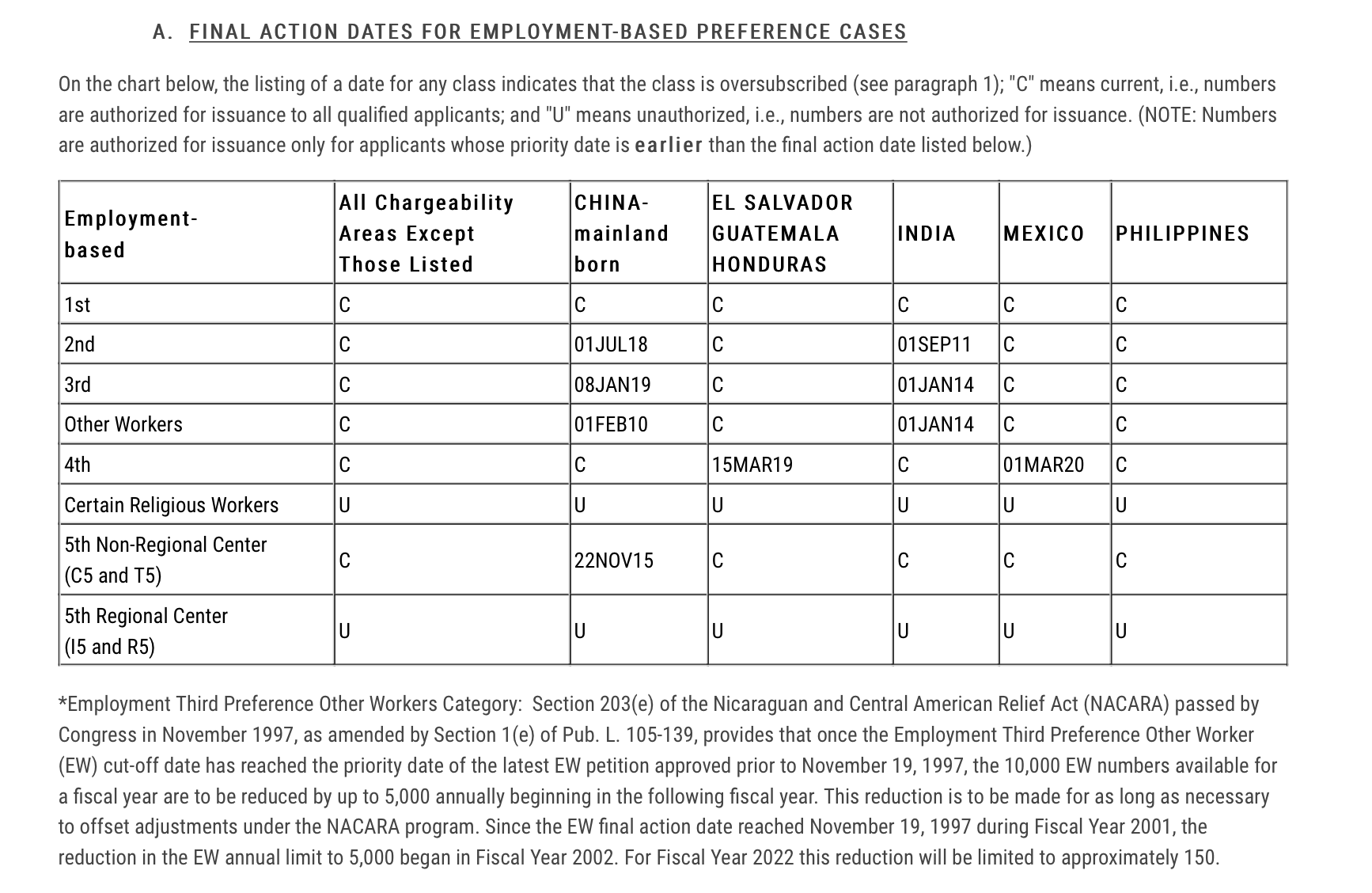
Chart A, “Final Action Dates for Employment-Based Preference Cases”

As of the October 2021 Visa Bulletin, the final action date for China is November 22, 2015. This puts an end to the final action date’s progress in the last few months—after remaining stagnant for more than a year, the date advanced continuously between the June 2021 and September 2021 Visa Bulletins. It may be that another long period of inactivity lies ahead for Chinese EB-5 petition processing. Since Vietnam gained “Current” status in the July 2021 Visa Bulletin, China is the only country subject to a final action date.

Due to the final action date, EB-5 investors from China who filed their I-526 petitions after November 22, 2015, cannot receive conditional permanent resident status. Since China has historically been the country with the most investors, USCIS’s processing inefficiency is detrimental to the EB-5 investment industry.

The values for regional center visas are marked as “U” (unauthorized) because of the regional center program’s expiration on June 30, 2021. However, EB-5 investment stakeholders are confident that the program will be reauthorized in the near future.

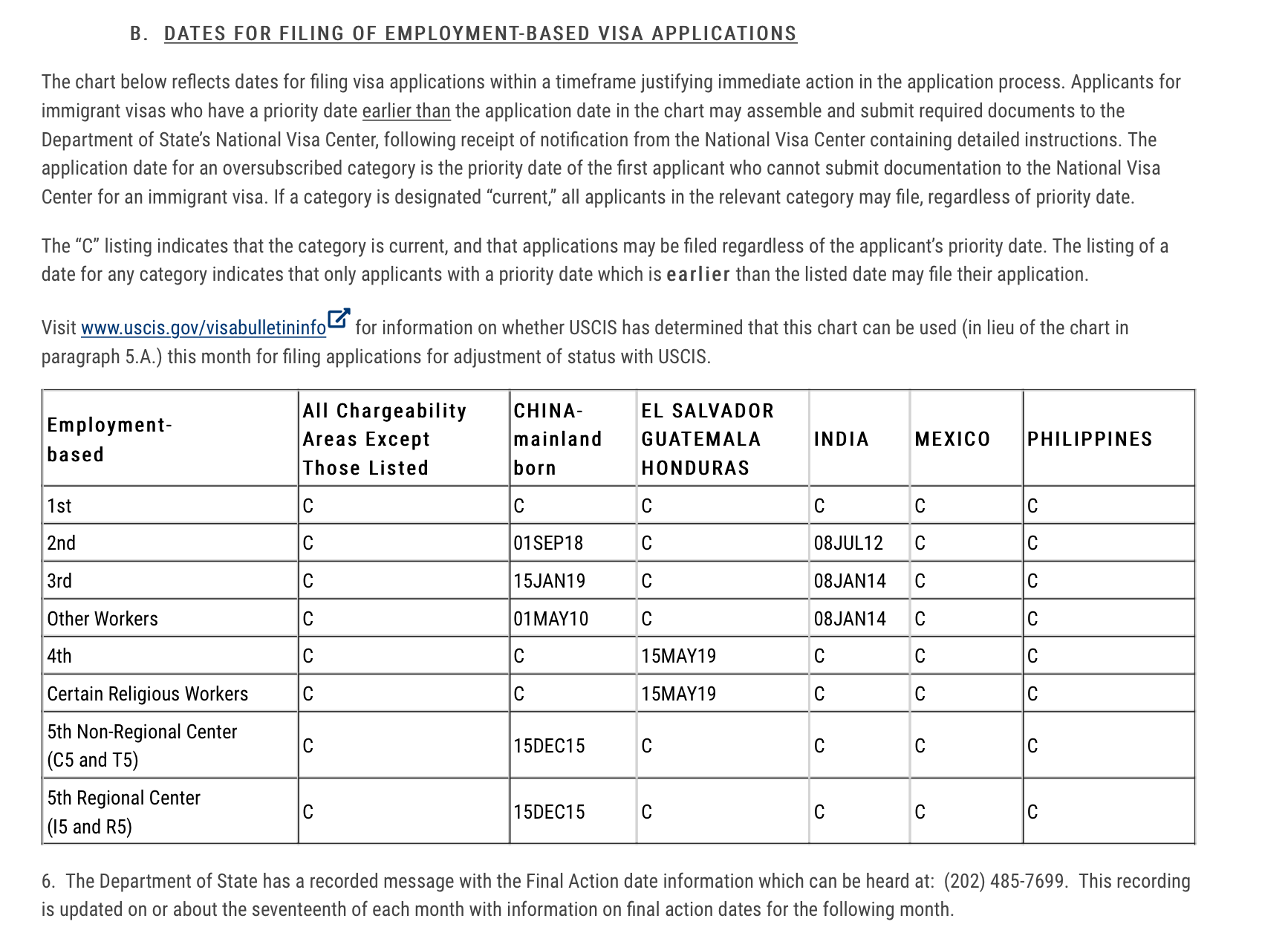
Chart B, “Dates for Filing of Employment-Based Visa Applications”

Chart B of the Visa Bulletin is also devoid of good news—the Chinese date for filing remains at December 15, 2015. It has not moved forward in over 12 months despite the recent progress in China’s final action date. Currently, only Chinese EB-5 investors who filed Form I-526 on or before December 15, 2015, are allowed to apply for their visas. This restriction even applies to Chinese investors whose I-526 petitions have been adjudicated and approved.

Both sections of the October 2021 Visa Bulletin show that USCIS’s processing inefficiency is one of the most critical issues in the EB5 investment industry. Hopefully, the agency will take measures to reduce its adjudication times for Form I-526; USCIS director Ur Jaddou has stated that she will work on reducing the EB-5 petition backlogs.

Free EB-5 Project Evaluation

Requirements for EB-5 Investors

Requirements for EB-5 Investors

Thousands of foreign nationals have obtained permanent resident status and relocated to the United States through the EB-5 Immigrant Investor Program. Even though many other countries offer visa-by-investment programs, the EB-5 program is by far the most practical and efficient. Moreover, the minimum EB-5 investment amounts are $500,000 for targeted employment area (TEA) projects and $1,000,000 for non-TEA projects. These amounts are significantly lower than those required by other investor visa programs.

Once an EB-5 investor’s I-526 petition is approved by United States Citizenship and Immigration Services (USCIS), they are granted conditional permanent resident status for two years. During this period, the investor can live, work, and study anywhere in the United States. To qualify for permanent resident status, the investor must file Form I-829, Petition by Investor to Remove Conditions on Permanent Resident Status, within the final 90 days of the conditional residence period.

Even though obtaining an EB-5 visa may seem like a straightforward process, EB-5 investors must comply with numerous USCIS regulations. This article outlines some of the basic requirements that EB-5 investors must satisfy.

Employment Creation

Perhaps the most important requisite for EB-5 investors is that they create or preserve at least 10 jobs. One of the EB-5 program’s main objectives is to reduce unemployment, so investors should make sure that they will create jobs for qualifying U.S. workers. Direct EB-5 projects are only allowed to count jobs that appear on the new commercial enterprise’s (NCE’s) payroll. In contrast, regional center investors can also count induced and indirect jobs. Induced and indirect employment is a result of the expenditures made by the EB-5 project and its employees in the community. This spending benefits the local economy and thus indirectly creates jobs.

Additionally, each hired worker must have legal authorization for employment in the United States, and the created positions must be full-time (at least 35-hour) jobs.

Documenting Sources of Funds

USCIS requires foreign nationals to provide exhaustive evidence that their EB-5 investment capital was sourced lawfully. Form I-526 should trace the invested funds back to their source and prove its legality. Investors are allowed to fund their investments using a wide variety of sources, including stock proceeds, real estate sales, gifted capital, loans, and even cryptocurrency sales.

The documentation needed to prove the origin of the invested funds will vary for each investor and source of capital. An investor using gifted funds, for instance, would have to submit a copy of the gift agreement and bank statements showing that the gift was deposited. In contrast, an EB-5 investment made using salary payments would require the investor to provide their employment contract, an income certificate, and bank statements reflecting each payment.

The At-Risk Status of Funds

All EB5 investment capital must remain at risk for the duration of the investment. This means that that the invested funds must be subject to normal losses or gains depending on the success of the EB-5 business. For example, an EB-5 investor would violate the at-risk requirement if they received a guarantee that the invested funds would be returned in the event of market failure.

Navigating USCIS’s numerous guidelines can be challenging, but EB-5 investors must take care to comply with all these regulations. Therefore, retaining an experienced immigration attorney is a must for foreign nationals interested in making an EB-5 investment.

Free EB-5 Project Evaluation

Why Direct EB-5 Investments Are Getting More Attention

Why Direct EB-5 Investments Are Getting More Attention

Because of a June 22, 2021, federal court ruling, United States Citizenship and Immigration Services (USCIS) has reversed to the pre-November 2019 EB-5 regulations. Because of this court ruling and the expiration of the regional center program, direct EB-5 investment has come to be the sole option for foreign nationals.

Industry leaders agree that direct EB-5 investments are essentially the only available path for investors—USCIS is not accepting I-526 petitions associated with regional centers. Since the minimum EB-5 investment amounts have been lowered significantly, direct investments are promising for foreign investors who want to gain U.S. green cards.

The Repeal of the Modernization Rule

In the June 22 court ruling, Judge Jacqueline Scott Corley determined that former acting Homeland Security Secretary Kevin McAleenan did not have the authority to implement the EB-5 Modernization Rule. As such, the many controversial changes made by the Modernization Rule have been reversed.

The court ruling effectively overturned the decision to raise the minimum required EB-5 investment amounts. This change had previously caused the number of EB-5 applications to plummet upon its enactment, but foreign nationals can once again invest at $500,000 for targeted employment area (TEA) projects and $1,000,000 for non-TEA projects.

After the ruling, interest in the EB-5 program surged. Although many speculate that the minimum EB-5 investment amounts may be raised once more, it is unclear when such a change could take place.

I-526 Priority Dates

The repeal of the Modernization Rule means that there is no longer priority date retention based on an approved I-526 petition. Also, former USCIS regulations for removing conditions on permanent residency are once again in force. Further, the agency will accept the pre-November 2019 version of Form I-526.

Even though interest in the direct EB-5 investment route increased due to these changes, some industry stakeholders believe that EB-5 investors and companies in the industry will soon realize the disadvantages of making a direct EB-5 investment. The biggest of these is the job creation requirement, which is much stricter for non-regional center projects.

Investing in Franchises

Franchise businesses are valid EB-5 investment opportunities. By choosing this route, investors can replicate a well-established business model and open new locations.

Franchises that are already successful and can offer EB-5 investors the creation of a least 10 new jobs are expected to become more popular. Nonetheless, making an EB5 investment in a new business can be more convenient in many cases.

Free EB-5 Project Evaluation

COVID-19 Vaccines Now Mandatory for Green Card Applicants

COVID-19 Vaccines Now Mandatory for Green Card Applicants

As of October 1, 2021, the Centers for Disease Control and Prevention (CDC) will require U.S. green card applicants to be vaccinated against COVID-19. This means that receiving a COVID-19 vaccine has been added to the Immigration and Nationality Act’s (INA’s) criteria for green card applicants. The INA already required applicants to be vaccinated against several preventable diseases.

This announcement follows the Food and Drug Administration’s (FDA’s) full approval of the Pfizer-BioNTech vaccine.

Foreign nationals planning an EB5 investment should note that this requirement does not apply to investors who file Form I-526, Immigrant Petition by Alien Investor. The I-526 petition is not in itself an application for conditional permanent resident status—EB-5 investors become eligible for conditional green cards only if their Form I-526 is approved by United States Citizenship and Immigration Services (USCIS). The vaccination requirement applies only to green card applicants, such as EB-5 investors with an approved I-526 petition. EB-5 investors who are already in the United States with an immigrant visa and submit Form I-845, Application to Register Permanent Residence or Adjust Status, must also get vaccinated.

To comply with the CDC’s new guidelines, applicants will have to provide proof of vaccination. Proof of vaccination may take the form of a vaccination record or medical chart. If applicants are unable to get vaccinated before undergoing their medical exams, a civil surgeon may administer the vaccine during the exam—the important thing is for applicants to be vaccinated before the medical exam is completed. This extra step in the green card application process may cause delays.

Even though the FDA granted full approval to the Pfizer vaccine, green card applicants are allowed to receive other vaccines that have been approved for use in the United States, such as the Johnson & Johnson/ Janssen vaccine. Additionally, the CDC may allow certain applicants to be exempt from the vaccine requirement. For example, applicants who are too young to get vaccinated or cannot do so for health reasons can receive waivers.

COVID-19’s Impact on the EB-5 Program

The EB-5 investment industry was not exempt from the disastrous effects of the COVID-19 pandemic. The economic impact that the virus wreaked on the U.S. economy in 2020 forced many EB-5 projects to suspend development. Moreover, the increased unemployment rates altered which areas of the United States qualified as targeted employment areas (TEAs), which likely inconvenienced investors in the process of completing their I-526 petitions.

As the world slowly recovers from the pandemic, foreign nationals interested in the EB-5 program should act quickly to identify suitable EB-5 projects. Moreover, the minimum EB-5 investment amount is only $500,000 as of June 22, 2021, so this is the ideal time to make an EB-5 investment.

Free EB-5 Project Evaluation

Making an EB-5 Investment At $500,000

Making an EB-5 Investment At $500,000

The EB-5 investment industry received shocking news on June 22, 2021: the controversial EB-5 Modernization Rule, which made several important changes to the EB-5 program, had been invalidated by a U.S. district court. Most EB-5 stakeholders celebrated the court’s decision—as a result of the ruling, EB-5 investments can now be made at $500,000 for targeted employment area (TEA) projects and $1,000,000 for non-TEA projects (the Modernization Rule had raised these amounts to $900,000 and $1,800,000). The opportunity to make an EB-5 investment at only $500,000 prompted many foreign nationals to participate in the EB-5 program.

Just a few days after the invalidation of the Modernization Rule, the EB-5 Regional Center Program expired temporarily on June 30, 2021. As of that date, United States Citizenship and Immigration Services (USCIS) only accepts direct EB-5 investments. Even though EB-5 regional centers will likely be reauthorized, investors should take advantage of the valuable opportunity to make direct investments at $500,000. In this article, we explain how to make an EB5 investment at the lower minimum amount while reducing the associated financial risk.

How to Invest at the Reduced Amounts Safely

Despite the above-mentioned court ruling, USCIS or the Department of Homeland Security (DHS) could take action to revalidate the Modernization Rule, possibly by taking the case to the Court of Appeals. Interested foreign nationals will have to consider this scenario before deciding to invest at $500,000.

To reduce the risk of failing to meet the minimum investment requirements in the future, a foreign national can invest $900,000 into an EB-5 project that will release $500,000 from its escrow account once Form I-526 is approved. Then, the foreign national can submit two I-526 petitions: one I-526 petition would report an investment of $500,000, while the other would be filed at $900,000. By following this procedure, investors can feel confident about their EB-5 investment even if the minimum required amounts are raised once more.

Investors should also note that they are allowed to use a wide variety of sources to procure their funds—regardless of the source of funds, USCIS mainly focuses on making sure that the funds originated legally. Investors may use gifts, loans, and even cryptocurrencies to fund their EB-5 projects.

The documentation needed to prove the legality of each of these sources varies. For gifted funds, investors will have to provide information regarding the gift giver’s background and the original source of the capital. In the case of loans, investors should submit a copy of the loan agreement and a capital source statement outlining the loan terms (a 2020 court ruling decided that unsecured loans can be used as EB-5 investment capital). EB-5 investors using cryptocurrencies to fund their projects usually convert the digital fund to a conventional currency and then invest this amount into the project. Of course, they must prove that the cryptocurrency was originally sourced lawfully.

How to Reduce the Financial Risk

All EB-5 investments carry a degree of financial risk: foreign nationals can never be completely certain that their EB-5 investment will be returned or that it will result in U.S. permanent resident status. For example, investors may wonder when the EB-5 project will give back their invested funds. This largely depends on the operating agreement signed by the investor. In addition, USCIS dictates that EB-5 investment capital must remain at risk—there cannot be a binding guarantee that the funds will be returned, even if the investor does not ultimately obtain U.S. residency.

Investors need to find out whether their EB-5 project will return the invested funds if their I-526 petition is denied. Fortunately, most projects do have arrangements for returning funds to investors in the case of a Form I-526 denial. The terms of these provisions usually differ among EB-5 projects—for example, the conditions needed to repay the invested funds in their entirety may vary.

EB-5 projects may either offer to hold an investor’s funds in escrow until Form I-526 is approved or release them for use immediately. If an EB-5 project will release invested funds immediately, the investors should make sure that their funds will be repaid in the event of a Form I-526 denial. In most cases, projects that hold invested funds in escrow are safer.

Even though making an EB5 investment does require taking some risks, obtaining a U.S. green card is certainly worth the effort: foreign nationals should act quickly to take advantage of the reduced investment amounts. EB5AN would be delighted to help you identify the best EB-5 investment opportunities.

Free EB-5 Project Evaluation

Differences Between Direct and Regional Center EB-5 Investments

Differences Between Direct and Regional Center EB-5 Investments

Obtaining an EB-5 visa is one of the most popular ways for foreign nationals to gain permanent resident status and relocate to the United States. This is unsurprising in light of the many benefits of participating in the EB-5 investment program, which allows foreign nationals to invest in a wide variety of U.S.-based new commercial enterprises (NCEs) using virtually any legal source of funds. The EB-5 investment industry is full of reliable, lucrative projects in sectors such as hospitality, tourism, and commercial real estate development. Additionally, the controversial EB-5 Modernization Rule was overturned on June 22, 2021. As of that date, foreign nationals can make an EB5 investment at $500,000 for targeted employment area (TEA) projects and $1,000,000 for non-TEA projects. These minimum investment requirements are significantly lower than the previous amounts of $900,000 for TEA projects and $1,800,000 for non-TEA projects.

The investors themselves are not the only ones who benefit from participating in the EB-5 program—their spouses and children are also eligible to receive green cards. What is more, the investor and their family will even be able to apply for U.S. citizenship after holding permanent resident status for five years.

Perhaps the most important decision foreign nationals can make regarding their EB5 investment is to choose between a direct investment or a regional center project. (Even though the regional center program expired on June 30, 2021, investors can be confident that it will be resumed in the near future.) There are many key differences between these two EB5 investment types, including how the investments are made and the investor’s level of involvement in the project. Foreign nationals planning an EB-5 investment would do well to carefully compare regional center and direct investments to decide which one suits their investment goals and availability.

Basic Characteristics of Regional Center EB-5 Investments

Regional centers are agencies approved by United States Citizenship and Immigration Services (USCIS) that promote employment and economic growth. When a foreign national invests in a regional center project, they do so through the intermediation of a regional center, which has set up an investment fund. For these kinds of projects, the NCE and the job-creating entity (JCE) are typically separate.

The main reason regional center investments were so popular before the June 2021 expiration of the program was their flexible job creation criteria. In addition to direct employment (jobs that appear on the NCE’s payroll), regional center projects can count indirect and induced jobs. Indirect employment is generated by the EB-5 business’s purchases of products and services from local companies, and induced jobs are a result of the employees’ spending in the project’s area. As a result of these more relaxed employment creation criteria, it is typically easier for regional center EB-5 investments to create the 10 positions required by USCIS.

Basic Characteristics of Direct EB-5 Investments

Unlike regional center investments, direct EB-5 capital must be invested directly into the NCE. Moreover, the NCE and the JCE must be the same entity, and only directly created jobs can be counted toward fulfilling the employment criteria. Direct projects must hire employees and have them on their payroll. These jobs must last for a minimum of two years, but multiple employees can fill the position during that period—USCIS will focus mainly on the duration and nature of the position, not on how many employees filled it during the two-year period. Due to the absence of indirect or induced employment, direct EB-5 projects will usually have to make a greater effort to create the required number of jobs.

Investor Involvement

Direct and regional center projects also require different levels of involvement from their investors. Most regional center projects allow investors to become limited partners. Even though they must contribute to important management and policy matters, they may not have to oversee the business’s day-to-day activities. In contrast, direct investors are usually more involved in the project’s operations and have more control over how their EB-5 investment is spent. As a result, many foreign nationals who make a direct EB-5 investment want to gain significant profits as well as permanent resident status.

The complex regulations governing the EB-5 investment program can certainly be overwhelming at first, and investors must weigh numerous factors when choosing between direct and regional center investments—each investment type has its own benefits and drawbacks. Foreign nationals who are planning an EB-5 investment should consult with an immigration attorney and EB-5 experts to decide which investment type will be most advantageous.