Author Archives: admineb5

Free EB-5 Project Evaluation

Indian EB-5 Investors to Pay 5% More for EB-5 Visas Starting in April 2020

The Indian government has announced a new 5% tax on remittances out of India, effective April 1, 2020. It’s not an April Fool’s joke: This new regulation will increase the cost of an EB-5 visa for Indian investors by $45,000 for an investment in a project within a targeted employment area (TEA) or by $90,000 for an investment in a project without TEA designation.

The EB-5 program is a convenient pathway to U.S. permanent residency for wealthy individuals and families around the world, with particular popularity in Mainland China, India, and Vietnam. In India, the number of investors has been growing substantially in recent years, making it the second-biggest EB-5 country.

Indian EB-5 investors have to pay tax on their EB-5 transfers eventually anyway, but they can avoid paying the additional $45,000 or $90,000 now by transferring their capital to a U.S. escrow account before April 1.

EB-5 funds can remain in an escrow account until the investor is ready to proceed with his or her investment. That means Indian EB-5 investors can comfortably transfer their capital to a U.S. escrow account while still taking the time to conduct thorough due diligence on their preferred EB-5 project. Time is of the essence for any Indian EB-5 investors who wish to avoid the new 5% tax on remittances, however.

Free EB-5 Project Evaluation

Country-Based EB-5 Statistics in FY2019

Every year, the U.S. Department of State releases the Report of the Visa Office, which offers a peek into the statistics of the U.S. visas, including EB-5 visas, issued throughout the given year. In the report, EB-5 visa statistics are spread out across two different tables: Table V Part 3 (visa recipients who already resided in the US under a different visa) and Table VI Part IV (visa recipients who were granted their visa while abroad). The recently released Report of the Visa Office 2019 offers insights into which countries the EB-5 investors who were granted U.S. permanent residency in FY2019 are from.

One important thing to note is that these statistics do not reveal the current EB-5 demand. Because of the long I-526 processing times, investors receive their green cards only after a few years—and often more for investors from China, India, and Vietnam, who must wait in large backlogs for their opportunity to apply—so the information in these charts is more reflective of the EB-5 demand from a few years ago. Unfortunately, United States Citizenship and Immigration Services (USCIS) does not release any information about the number of I-526 petitions it receives each year, so the most up-to-date information we can access on EB-5 demand is the EB-5 visa statistics. It is also possible to make predictions based on the EB-5 program processing statistics from the past 11 years, however.

The EB-5 Visa Cap

As suggested by the addition of the number in its name, the EB-5 program is not the only EB visa program. USCIS sets a limit on the number of EB visas that can be issued per year, and only 7.1% of those visas are allocated to the EB-5 program. Further dividing up the EB-5 visas—of which there were 10,076 in FY2019—no single country is permitted to account for more than 7% of the yearly EB-5 visa allocation (in this case, 705). Since this restriction does not account for a country’s population or EB-5 demand, it naturally affects some countries—such as China or India—more than others. If, at the end of the fiscal year, there are still EB-5 visas left, USCIS will issue them to countries with backlogs, slightly exceeding the country visa limit. This occurred in FY2019, with India and Vietnam both receiving slightly more visas than the country limit of 705.

EB-5 Visas Granted Domestically vs. Internationally

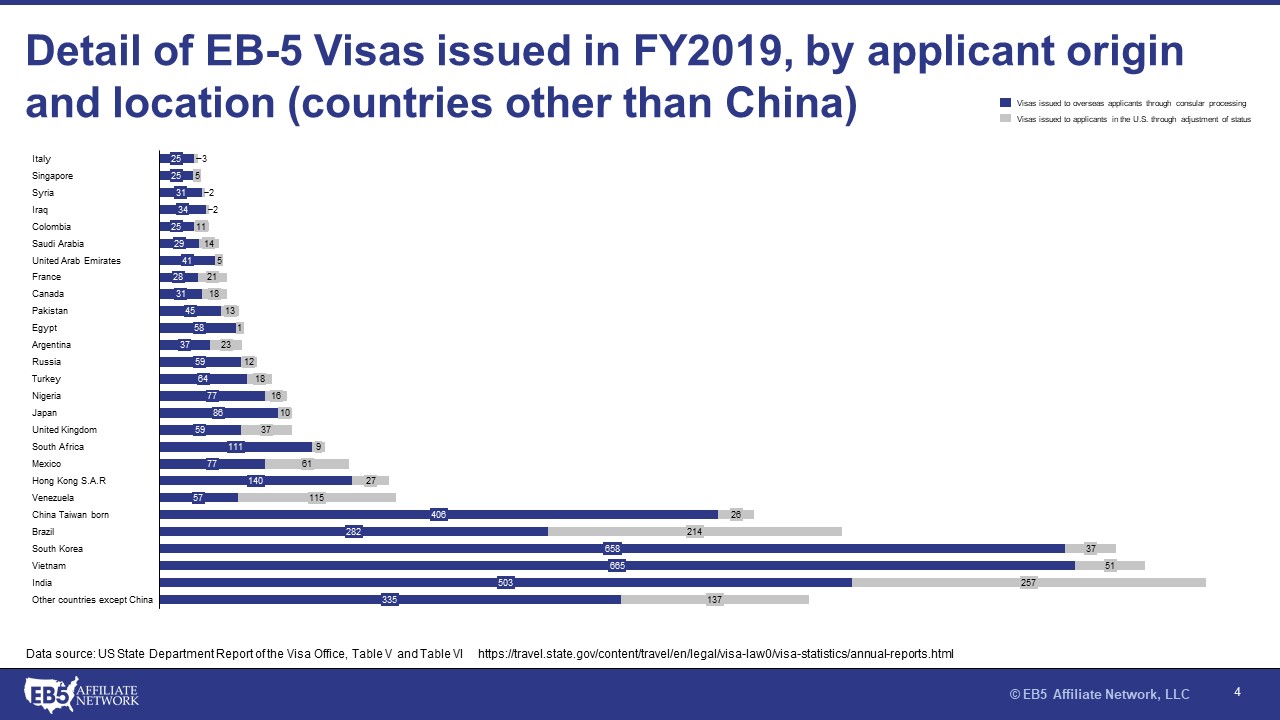
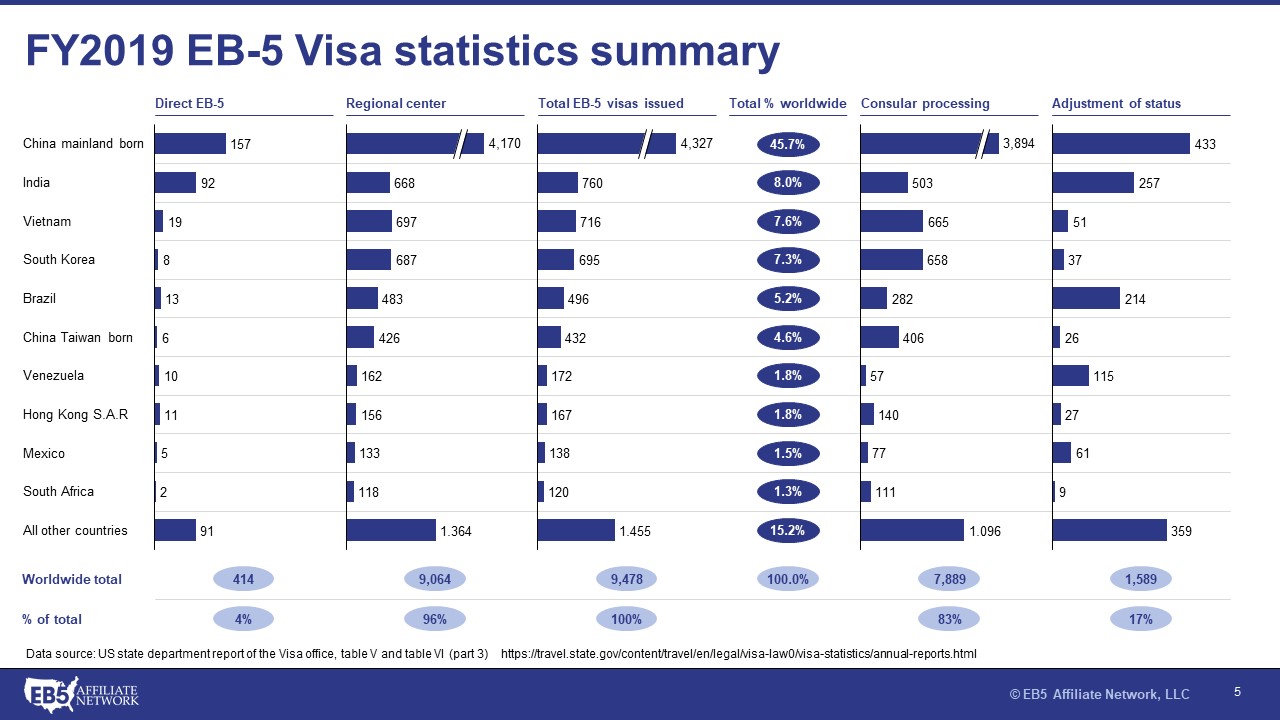
Table showing the number of EB-5 Visas issued in FY2019 by applicant origin and location in countries other than China.

As of 2017, the total migrant population of the United States was nearly 50,000,000—more than the population of many countries. Not all of these immigrants are permanent residents, however, so many EB-5 investors make their investments from within the United States. This way, they can switch their current visa to an EB-5 visa without having to leave the United States. The Report of the Visa Office 2019 reveals that close to one half of all South American EB-5 investors were already living in the United States when they received their green card. European and Indian EB-5 investors were more likely to apply from their home country, with one-third applying for adjustment of status within the United States. Regarding Chinese EB-5 investors, only 10% were already living in the United States when they received their EB-5 visa, but given the huge number of Chinese EB-5 investors, that still accounts for 433 people. Similarly, most Africans who received EB-5 visas in FY2019 did so in their home state, but the total number of African nationals who were granted EB-5 visas was lower than the 10% of Chinese applicants already living in the United States.

Investor Visas vs. Family Member Visas

Despite the EB-5 visa program’s original intentions, the majority of the yearly 10,000 or so available EB-5 visas are not granted to investors. A large portion of investors apply with their spouse and children, especially since the EB-5 program offers benefits such as facilitated access to U.S. colleges and universities, so family members regularly account for a larger share of the available visas. According to the DHS Yearbook of Immigration Statistics, investors only account for around one-third of the EB-5 visas granted—42% go to children and 23% to spouses. This means that in FY2018, instead of the 10,000 investments and at least 100,000 new jobs one might expect, there were 3,363 investments and at least 33,630 new jobs.

EB-5 Visas Broken Down by Country

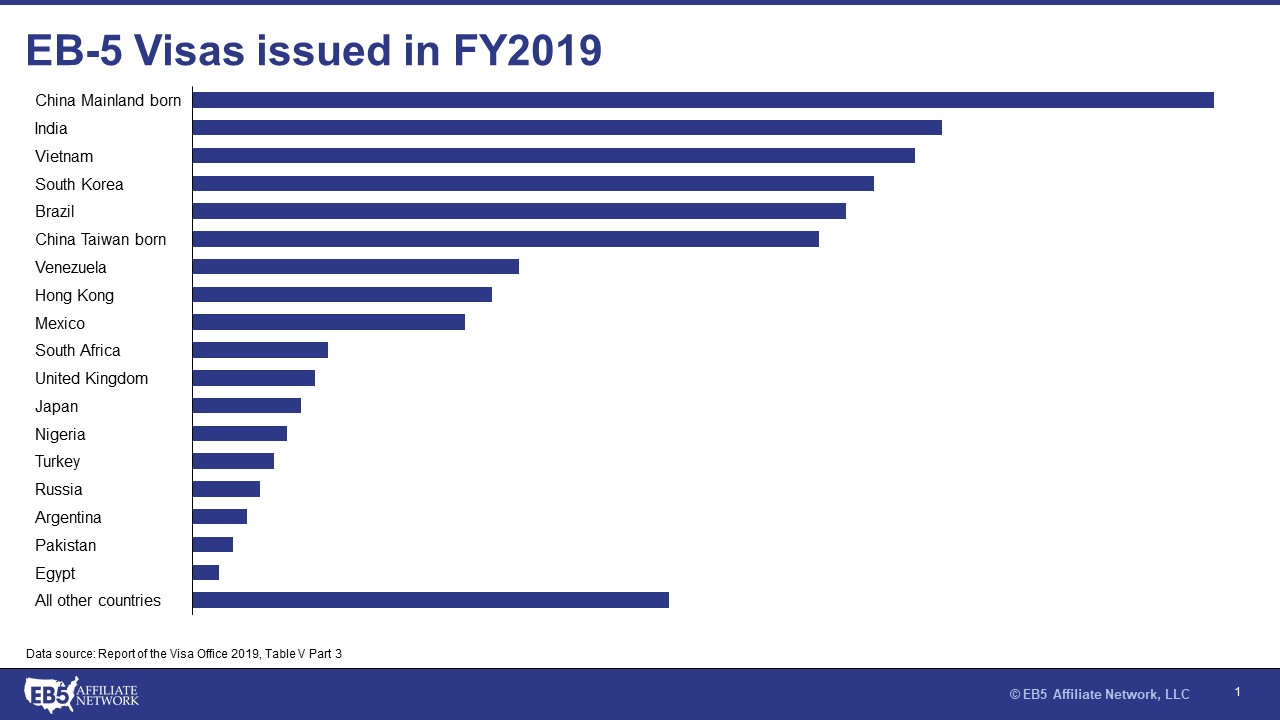
Chart showing number of EB-5 visas issued in Fiscal Year 2019 broken down by country.
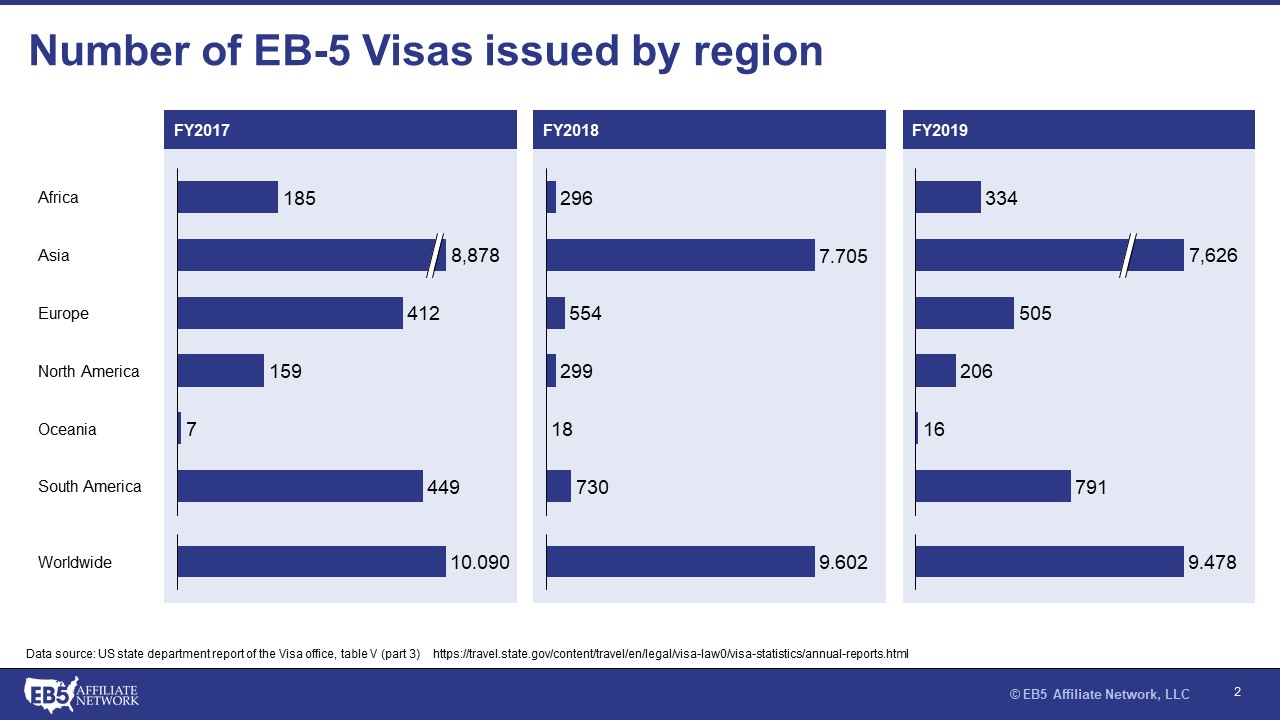
Table showing number of EB-5 Visas issued by multiple regions from Fiscal Year 2017 to Fiscal Year 2019.
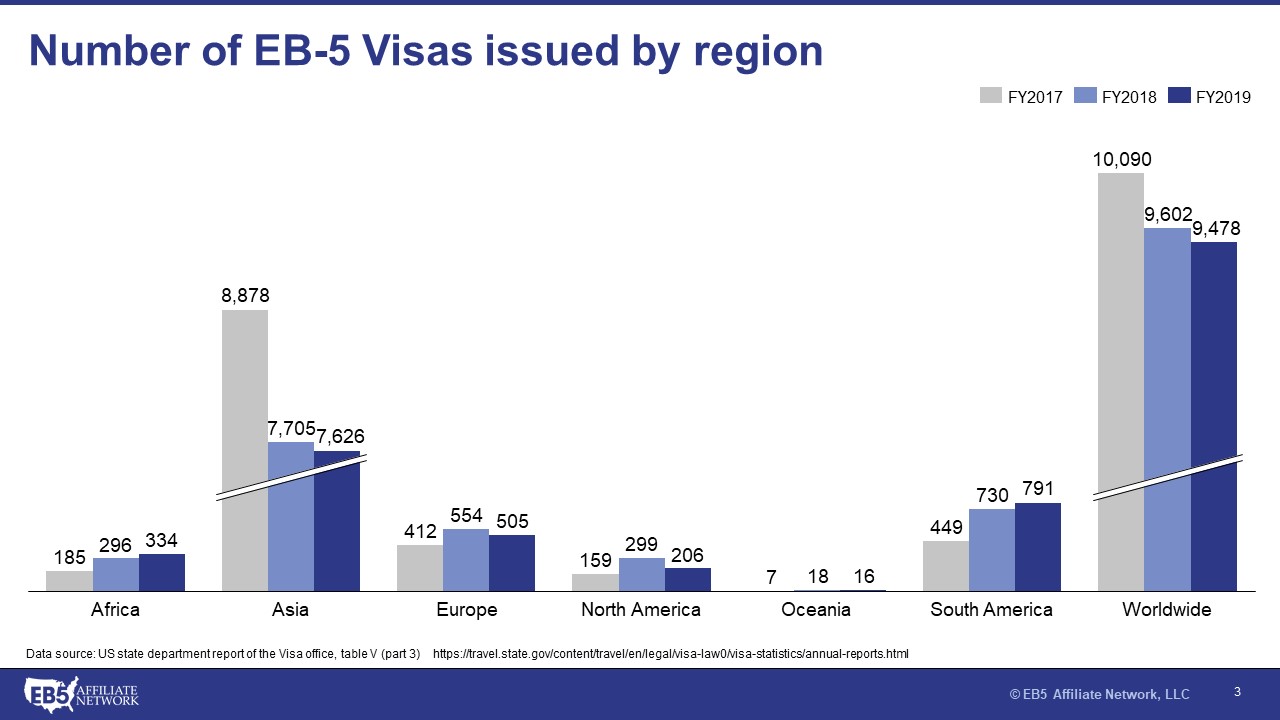
Graph showing number of EB-5 Visas issued by region from Fiscal Years 2017 to 2019 with Asia second to Worldwide.
Graph showing statistics for EB-5 Visas issued in FY2019 by country including direct issues versus regional centers.

The EB-5 visa statistics for FY2019 show that China still maintains its lead by a large margin, but other countries are slowly beginning to catch up, and more and more countries are jumping into the program. India, Vietnam, South Korea, Brazil, and Taiwan are the next in line after Mainland China, with India and Vietnam exceeding the country limit and South Korea dangerously close. The future could see more countries reaching their country limits, not only as a result of the increasing popularity of the EB-5 program but also because of the new visa-availability processing approach that USCIS is adopting from April 2020 onward. Instead of the current first-in-first-out approach, USCIS will begin prioritizing I-526 petitions based on the visa availability of the applicant’s country, which is good news for Brazilian, Taiwanese, Venezuelan, and other EB-5 investors but bad news for Chinese, Indian, Vietnamese, and South Korean investors.

It is interesting to note some of the countries that appeared on the list, such as North Korea. Exactly how four wealthy North Koreans managed to contact EB-5 projects from within their isolated nation with a 30-website-strong intranet is the most fascinating mystery the FY2019 EB-5 country statistics provide.

When the country statistics are broken down further, they reveal that the majority of investors worldwide made EB-5 investments via regional centers instead of working directly with the EB-5 project developer. In several countries, including Nigeria, Japan, Argentina, Turkey, and Egypt, 100% of investors invested through a regional center, even though between 59 and 96 investors from each country received EB-5 visas in FY2019. There are numerous advantages of regional center investment, such as relaxed job creation requirements that allow project developers to include indirect and induced jobs in the calculation, which likely accounts for the clear preference for regional center investment.

Don’t Forget to Work with the NVC

EB-5 investors do not automatically receive conditional permanent resident status in the United States upon the approval of their I-526 petition. Instead, they gain the right to apply for a visa, and they must become documentarily qualified before they are eligible to do so. EB-5 investors living abroad should work with the National Visa Center (NVC) to complete the required forms and file the necessary documentation. The next step for EB-5 investors applying for a visa through a U.S. consulate is to undergo an immigration interview. Many Chinese investors experience additional delays in their EB-5 process because they are ineligible for immigration interviews once their priority date finally becomes current. To ensure a smooth EB-5 journey that is as fast as possible, all factors considered, it is necessary to work with the NVC in a timely manner.

Free EB-5 Project Evaluation

EB5AN’s New Automated EB-5 Program Subscription Agreement

Any government process is accompanied by a large amount of bureaucracy, and the EB-5 visa program is no exception. When an investor decides to commit to a particular EB-5 project, he or she is required to fill out a long, 20-page EB-5 subscription agreement. Filling out a 20-page legal document is a tiresome and error-prone process for anybody, but for investors from top EB-5 countries, such as China, Vietnam, and South Korea, where English is drastically different from the national language and thus extremely difficult to learn, the challenges are even more substantial. There are plenty of opportunities to make mistakes, and even a minor mistake can result in rejection from the escrow bank.

Save Time and Effort With EB5AN’s Automated Subscription Agreement

EB5AN has developed an automated EB-5 subscription agreement to save investors and regional centers time and money. In a manual setup, investors must print out the 20-page agreement and fill in all the fields by hand, with measures to ensure all necessary fields are completed. In contrast, with the automated subscription agreement, investors need only fill out two pages of information, which they can complete easily and comfortably on the computer, with blue-colored text to indicate mandatory fields. Additionally, all fields that require signatures are clearly indicated with red arrows, making them hard to miss.

Thanks to the miracle of computer programming, once the investor has filled in the two pages of information, the code-enhanced subscription agreement fills in all the remaining fields using the provided information, ensuring a consistent and correctly completed document.

To make the process even more convenient, the automated subscription agreement also integrates the NES Financial Subscription Worksheet, which the investor would otherwise have to fill out manually as a separate form.

The form is available for download for free on the EB5AN website.

Free EB-5 Project Evaluation

What the New USCIS I-526 Petition Processing Approach Means for Applicants

An announcement on January 29, 2020, revealed that USCIS will shift its I-526 petition processing approach from first-in-first-in (FIFO) to a “visa availability approach” starting March 31, 2020. The new approach aims to prioritize processing for applicants from countries that have visas immediately available, ensuring more countries fill their annual visa allocations. Otherwise, there are no major requirement changes.

It is already clear who this new change benefits and who it hurts.

Good for I-526 applicants from countries with immediately available visas: EB-5 applicants from countries without backlogs, such as Canada, the United Kingdom, and the Philippines, stand to benefit the most from this new change.

Good for I-526 applicants from backlogged countries with children at risk of aging out: Children may immigrate through the EB-5 program with their family only if they are under the age of 21. However, the Child Status Protection Act (CSPA) protects the children of EB-5 investors by allowing leeway for the amount of time the I-526 petition remained pending with USCIS. On the date a visa becomes available, the number of days it took to adjudicate the I-526 petition, from date of filing to date of approval, is subtracted from the child’s actual age.

In contrast, the clock begins ticking again after I-526 approval while applicants wait for visas to become available. Consequently, for children at risk of aging out of the program, a delay at the point of I-526 processing is beneficial if it potentially reduces the delay before visas becoming available.

Bad for I-526 applicants from backlogged countries: The new changes will further slow processing times for applicants from backlogged countries—Mainland China, India, and Vietnam. Children will be protected from aging out, but the whole family will have to wait even longer to immigrate. As investors are required to keep their investments at risk throughout the entire process, these investors will additionally be exposed to increased financial risk.

Bad for I-526 applicants in mismanaged projects with no priority date retention protection: Under the November 2019 EB-5 rule changes, in some cases an investor who has already received I-526 approval may file a new I-526 petition with the first application’s priority date. This hurts applicants who invested in mismanaged projects and lose their priority date due to fraud or a terminated regional center, increasing the wait time for them.

Bad for USCIS: Though USCIS claims to currently adjudicate I-526 petitions on a FIFO basis, in reality, petitions associated with EB-5 projects with exemplar approval are often given priority. Overall, the current processing statistics reveal that USCIS has hardly been adjudicating anything lately anyway. If USCIS does not pick up the pace, backlogs in additional countries may also form.

On March 13, 2020, USCIS will answer questions and field concerns from the public regarding the new changes in a public engagement. If you would like to attend the engagement in person, send an email to public.engagement@uscis.dhs.gov. There are limited seats, so we recommend registering as soon as possible. You can also send general questions to be addressed as agenda items to the above email address before 5 p.m. EST on February 11.

Alternatively, you can join the engagement via teleconference. You should call in 10 to 15 minutes before the conference begins.

Domestic toll-free number: (888) 946-7792

Toll number for international callers: (517) 308-9375

Participant passcode: 3996336

Free EB-5 Project Evaluation

New EB-5 Visa Availability Approach for I-526 Petition Processing

New EB-5 Visa Availability Approach for I-526 Petition Processing

Important Breaking Announcement from USCIS on January 29, 2020: EB-5 visa I-526 petitions will now start being processed using a visa availability approach instead of using a first-in-first-out (FIFO) approach. Historically, USCIS has always processed EB-5 visa I-526 petitions based on a FIFO process, however this change will radically change the processing approach which will now favor EB-5 applicants from countries not facing retrogression.

The Immigrant Investor Program Office (IPO) will now prioritize processing EB-5 I-526 petitions from applicants from countries where visas are immediately available (non-backlogged countries). The goal of this approach is to speed up processing times for underrepresented countries with no visa backlog [countries that have not used up or are close to using up their per-country annual visa allocation]. Note that there are roughly 770 EB-5 visas available per country for FY 2020. 

Concern for Investors from Backlogged EB-5 Countries

Essentially, EB-5 investors with pending I-526 petitions from backlogged countries [mainland China, India, Vietnam] will now face additional waiting time for approval compared with EB-5 applicants from non-backlogged countries such as the Philippines, Canada, and the UK. This new visa processing approach will go into effect on March 31, 2020.

EB-5 investors from backlogged countries with pending I-526 petitions can voice their concerns at the USCIS public engagement on March 13, 2020, or by contacting the Immigrant Investor Program Office.

Below is the exact text from the press release issued by USCIS on January 29, 2020, which addresses the EB-5 Form I-526, Immigrant Petition by Alien Investor, processing changes:

USCIS Adjusts Process for Managing EB-5 Visa Petition Inventory 

Change Addresses Fairness Issues in Visa Allocation

Release Date: Jan. 29, 2020

WASHINGTON— U.S. Citizenship and Immigration Services today announced a process change for Form I-526, Immigrant Petition by Alien Investor, from a first-in, first-out basis to a visa availability approach.

This new operational approach aligns with other visa-availability agency adjudications processes, is more consistent with congressional intent for the EB-5 Immigrant Investor Program, and increases fairness in the administration of the program.

“Changing our approach from a first-in, first-out adjudication process to one that prioritizes petitions connected to individuals from countries where visas are currently available better aligns the EB-5 program with congressional intent and makes it more consistent with other USCIS operations,” said USCIS Deputy Director Mark Koumans. “This new approach increases fairness, allowing qualified EB-5 petitioners from traditionally underrepresented countries to have their petitions approved in a more timely fashion to receive consideration for a visa.”

This operational change is consistent with the agency’s processing of Form I-130, Petition for Alien Relative, in cap-subject categories. The new visa availability approach simply gives priority to petitions where visas are immediately available, or soon available, and will not create legally binding rights or change substantive requirements. Applicants from countries where visas are immediately available will now be better able to use their annual per-country allocation of EB-5 visas. The new visa availability approach will apply to petitions pending as of the effective date of the change. USCIS will implement the visa availability approach on March 31, 2020.

USCIS will hold a public engagement on March 13, 2020, from 11:00 a.m. to noon Eastern, to provide information and answer questions from the public about these operational changes to the management of Form I-526 petition inventory.

This engagement is part of our ongoing efforts to enhance dialogue with the public on the EB-5 program. USCIS will address program updates, including the agency’s change from a first-in, first-out case-processing approach to a visa availability approach for Form I-526, Immigrant Petition by Alien Investor. You will have an opportunity to ask questions during the engagement.

Participation Details:
You may attend this engagement either in person at USCIS, 111 Massachusetts Ave. NW, Washington, D.C., or by teleconference.

If you wish to attend in person, please email  public.engagement@uscis.dhs.gov. Seating is limited, so we encourage you to email early to request in person registration. Once we process your registration, you will receive a confirmation email with additional details.

To submit non-case-specific questions as agenda items before the engagement, email us at public.engagement@uscis.dhs.gov by 5 p.m. Eastern on Tuesday, Feb. 11.

To join the event via teleconference:
Call in Toll Free number: (888) 946-7792
Toll number for international callers: (517) 308-9375
Participant Passcode: 3996336

We recommend calling in 10 to 15 minutes before the teleconference begins.

Free EB-5 Project Evaluation

EB-5 Program Processing Statistics

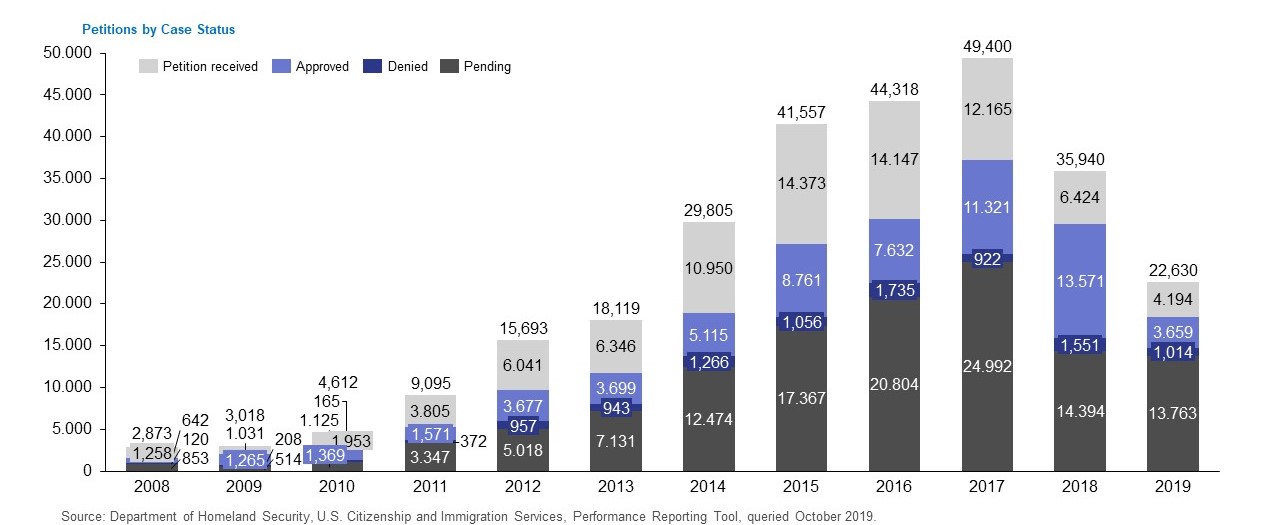
The processing statistics for the EB-5 program have changed dramatically over the past 11 years. The program has grown significantly, with thousands more investors in 2019 than in 2008, but trends are showing a decline from the peak in 2017. The drop could be partially attributed to the backlogs at United States Citizenship and Immigration Services (USCIS), which have also been increasing. The below graphs present a comprehensive overview of the processing statistics in the EB-5 program from 2008 to 2019.

I-526 Petitions Peak in 2017, Drop Dramatically

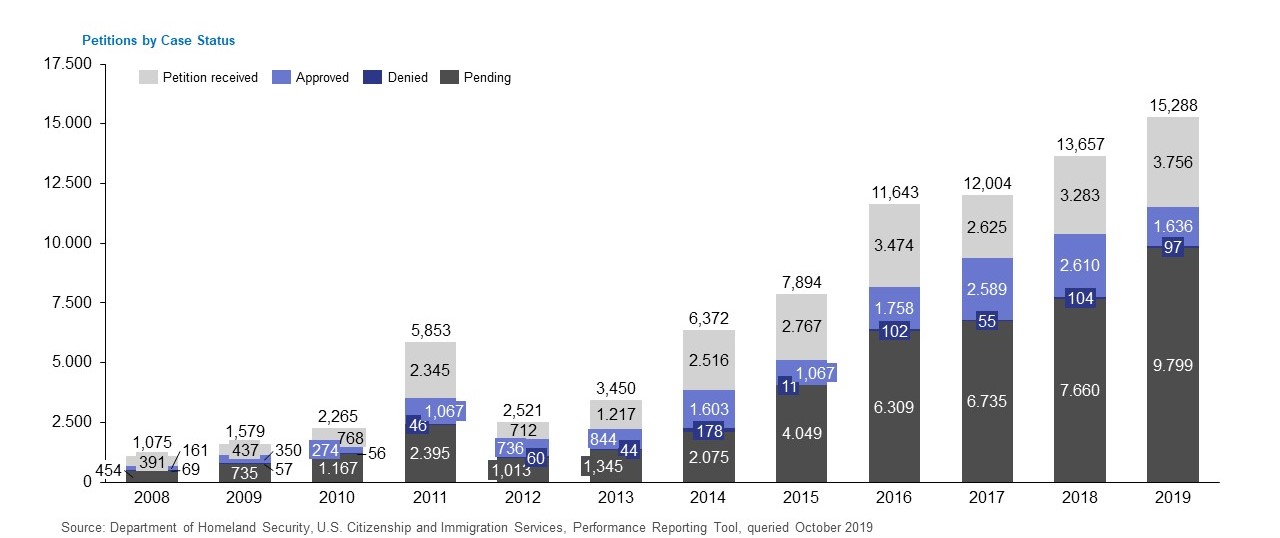
Graph showing I-526 Petitions by Case Status from 2008 to 2019 broken down into Received, Approved, Denied and Pending.

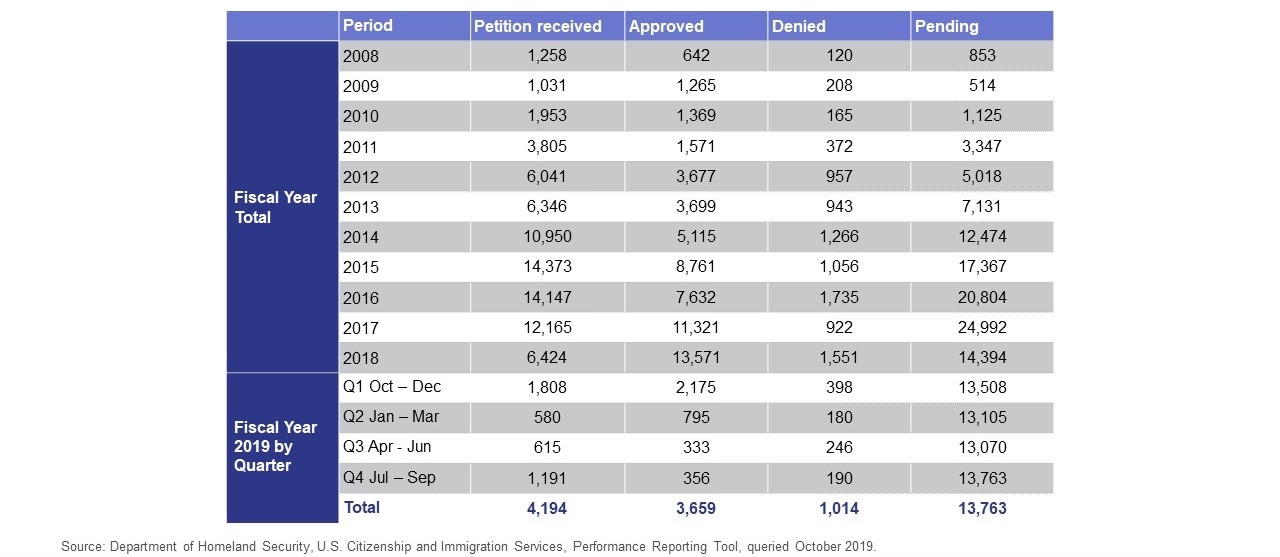
In 2008, a mere 2,873 I-526 Immigrant Petition by Alien Investor petitions were processed (classified as either received, approved, denied, or in pending status), a staggering difference from 2019’s 22,630. The number of petitions received, adjudicated, or in pending status rose steadily and rapidly from 2008 until 2017, when it reached a peak of nearly 50,000. Since 2017, there has been a rapid decline, which may be partially attributable to the large number of petitions in pending status, which totaled close to 25,000 in 2017. In terms of petitions received, 2019 fell below the 2012 figures.

Furthermore, each year, the number of EB-5 approvals has been significantly larger than the number of denials, but the ratio changes from year to year, with 2019 presenting one of the largest denial ratios. The number of petitions adjudicated in 2019 was significantly lower than that of 2018, with the USCIS backlog reduced by only around 600 petitions.

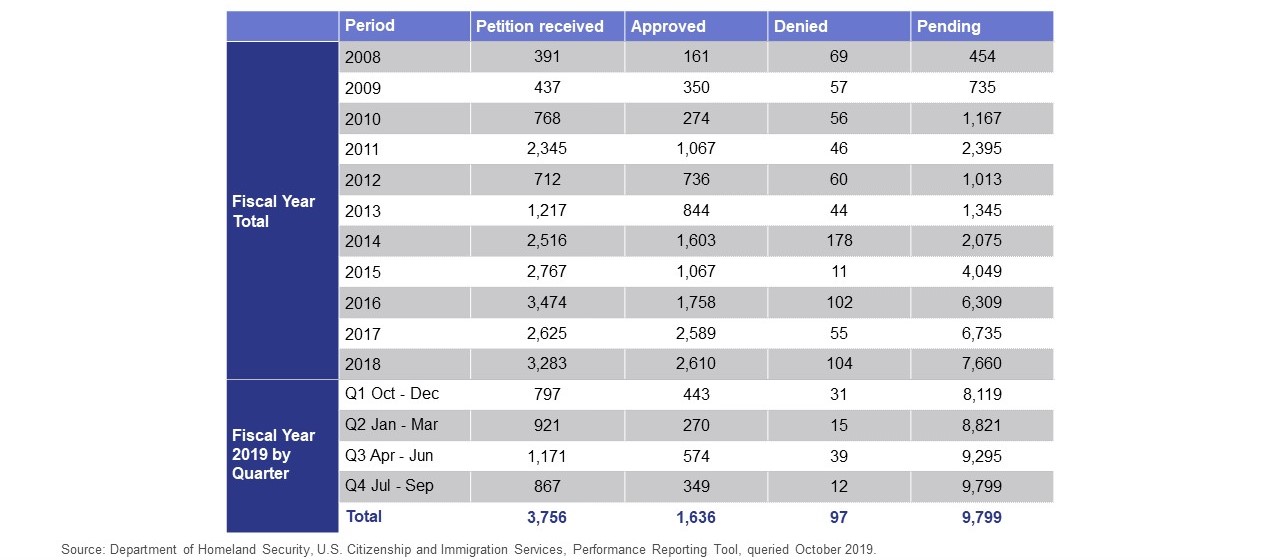
Table shows number of I-526 Petitions received, approved, denied and pending from FY2008 to FY2018 and FY2019 per quarter.

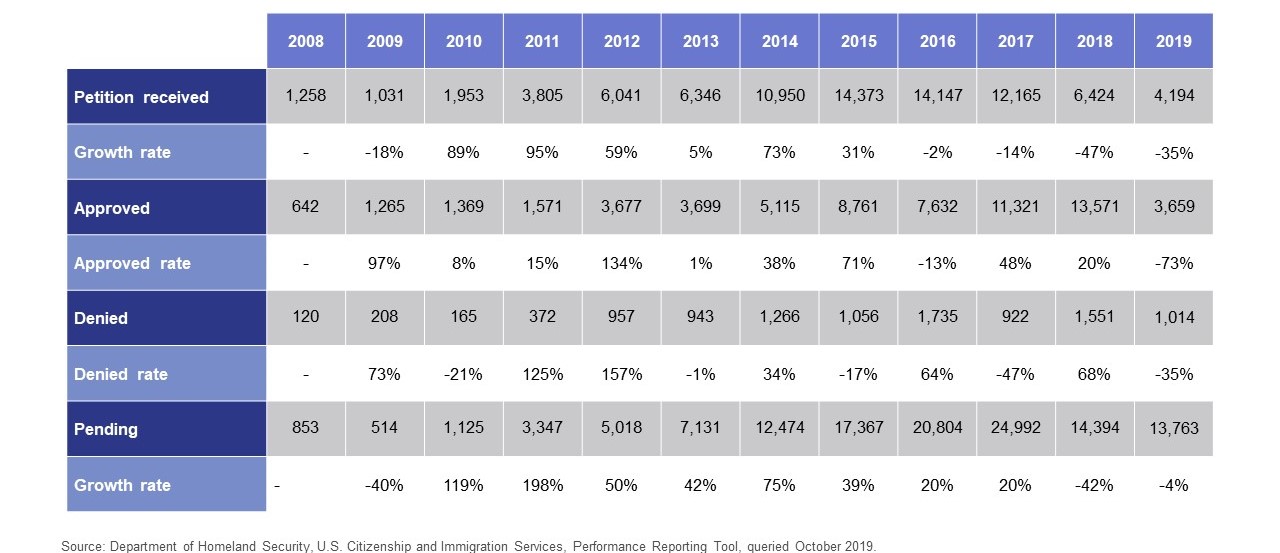
Table showing number of I-526 Petitions received, approved, denied, and pending by USCIS from 2008 to 2019.

For the most part, the EB-5 program has grown significantly over the past 11 years. Regarding the number of I-526 petitions received by USCIS, growth was steady and generally large from 2010 until 2016, with 2011, 2010, and 2014 recording the highest growth percentages. The trend reversed in 2016 with a small decline, increasing to a large 49% decline in 2018 and continuing with a 35% decline in 2019.

In most years, the approval rate has also grown, with 2016 and 2019 being the only years to record a decline. 2012 saw a massive approval growth rate to the tune of 134%, but 2019’s 73% drop in I-526 approvals is in stark contrast. It is worth noting that the denial rate for I-526 petitions also decreased by 35% in 2019, indicating a drop in the overall number of adjudications.

Finally, the backlogs grew rapidly from 2010 until 2017, although growth rates started slowing down in 2015. The number of pending I-526 petitions in 2017 was larger than the total number of petitions processed by the USCIS each year from 2008 to 2013. While the USCIS managed to lower the backlogs by 42% in 2018, it fell by only 4% in 2019.

I-526 Petition Figures Fall in 2019

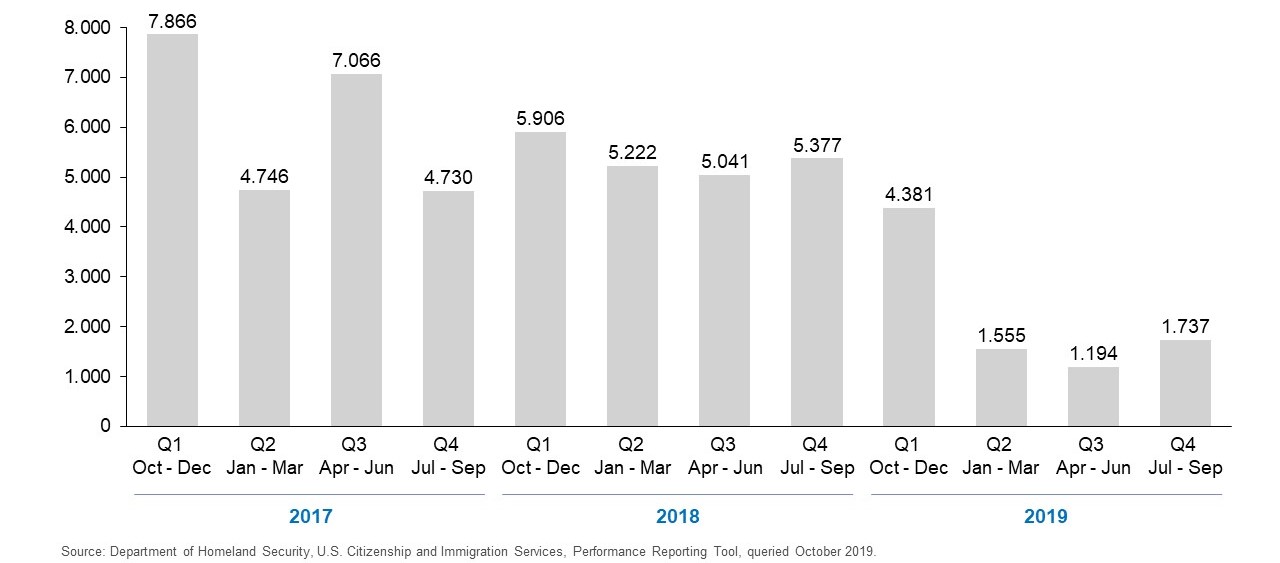
Graph showing the number of I-526 Petitions processed dropping from 7,866 to 1,194 during Fiscal Years 2017 to 2019.

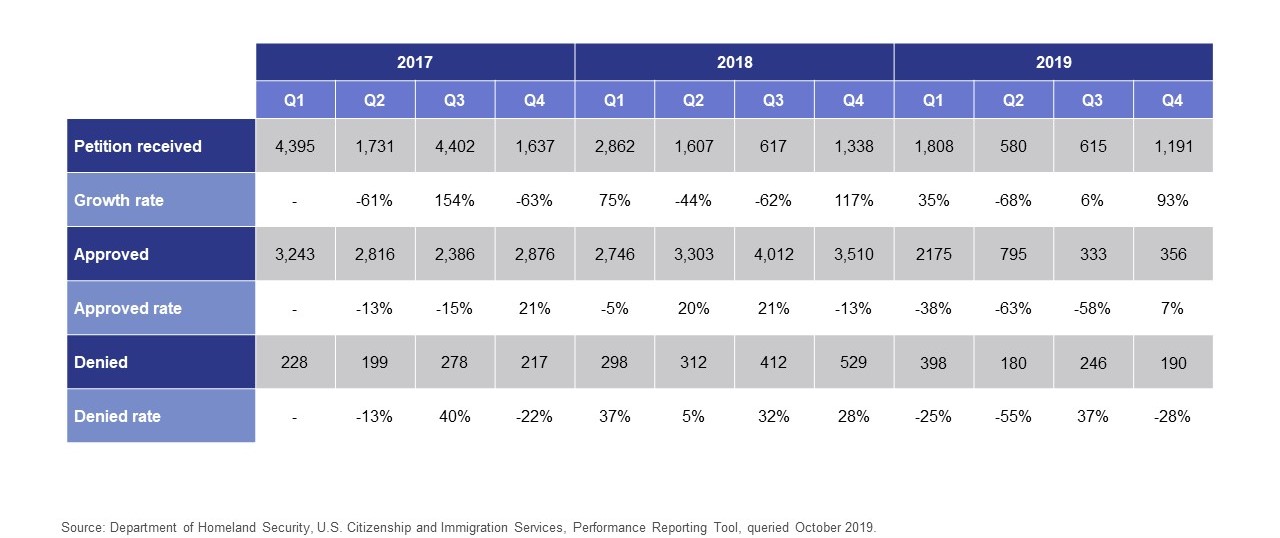
Table showing number of I-526 Petitions received, approved, and denied by the USCIS per quarter from FY2017 to FY2019.

If we look at the total number of I-526 petitions processed by the USCIS per quarter from FY2017 to FY2019, we see that the numbers have generally been decreasing, particularly in FY2019. All FY2019 figures are lower than all figures from the preceding two years, with figures seeing a particularly steep drop starting in January 2019. If USCIS can improve its adjudication rate, the lower number of petitions being received could allow the backlogs to decrease.

Furthermore, while the number of petitions was significantly lower than previous figures in 2019 Q2 and Q3, the number shot back up in 2019 Q4. The number of adjudicated petitions during this time, however, decreased, which does not bode well for the backlogs. Notably, the number of approvals for the last three quarters of FY2019 was also significantly lower than those of previous quarters, while the denial rates have remained fairly average, so it may be wise for EB-5 investors to exercise caution.

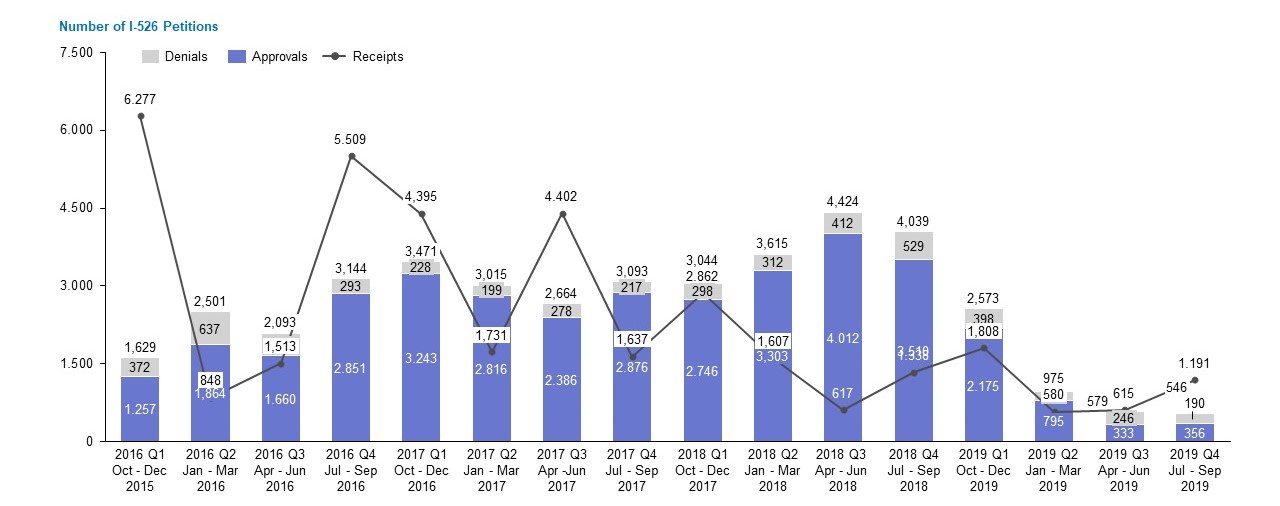
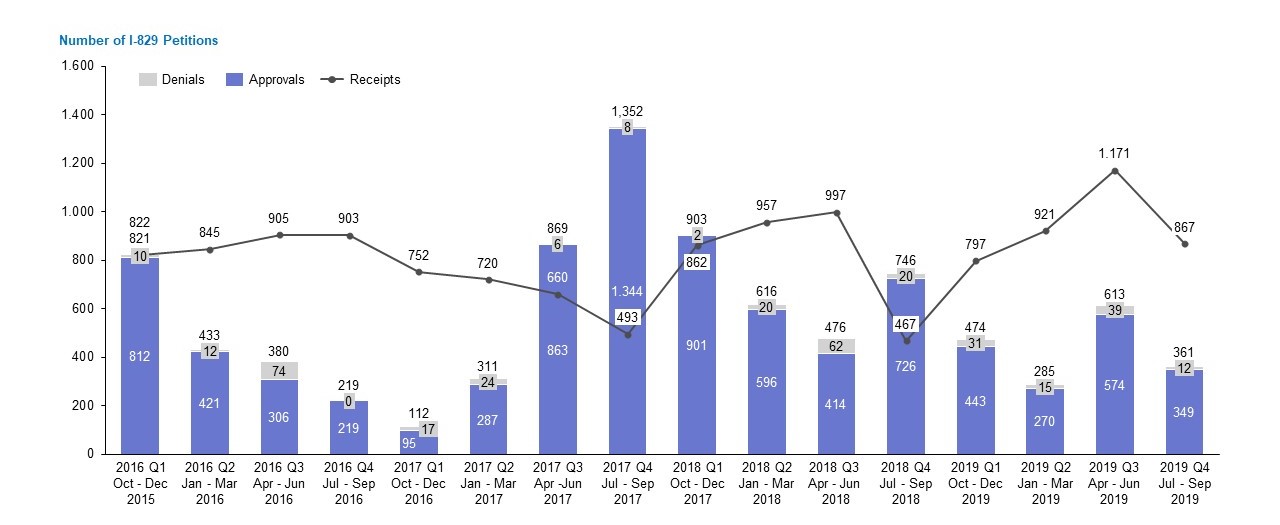
Chart showing I-526 Petitions from 2016 Quarter 1 to 2019 Quarter 4 broken down by Receipts, Approvals, and Denials.

Going back to FY2016, the falling trend for I-526 petition receipts becomes even clearer. In 2016 Q1, 2016 Q4, and 2017 Q3, the number of receipts was significantly higher than the number of adjudications, but since 2017 Q4, the number of receipts has generally been lower. It was higher in 2019 Q4, but that may be only because of the abnormally low number of adjudications throughout the year—had FY2019 seen adjudication rates closer to those of previous years, the adjudication rate would have been higher than the rate of receipt. The number of adjudications reached a peak in 2018 Q3 and has since declined dramatically to a record low for the studied period in 2019 Q3.

I-829 Petitions Experience Steady Growth

Chart shows I-829 Petitions by Case Status from 2008 to 2019 broken down into Received, Approved, Denied and Pending.

The overall growth of the EB-5 visa program is also evident in the number of I-829 Petition by Investor to Remove Conditions on Permanent Resident Status petitions processed by USCIS between 2008 and 2019. With the exception of a sudden boom in 2011, after which figures returned to near 2010 levels, the total number of petitions has grown steadily year after year since 2008. This means the backlog has also grown steadily, reaching almost 9,800 in 2019. The growing I-829 backlogs have not quelled the flow of incoming petitions, however, with 2019 recording the highest figure during the studied period at 3,756.

Chart shows I-829 Petitions from FY 2008 to FY 2019 Quarter 4 broken down into Received, Approved, Denied and Pending.

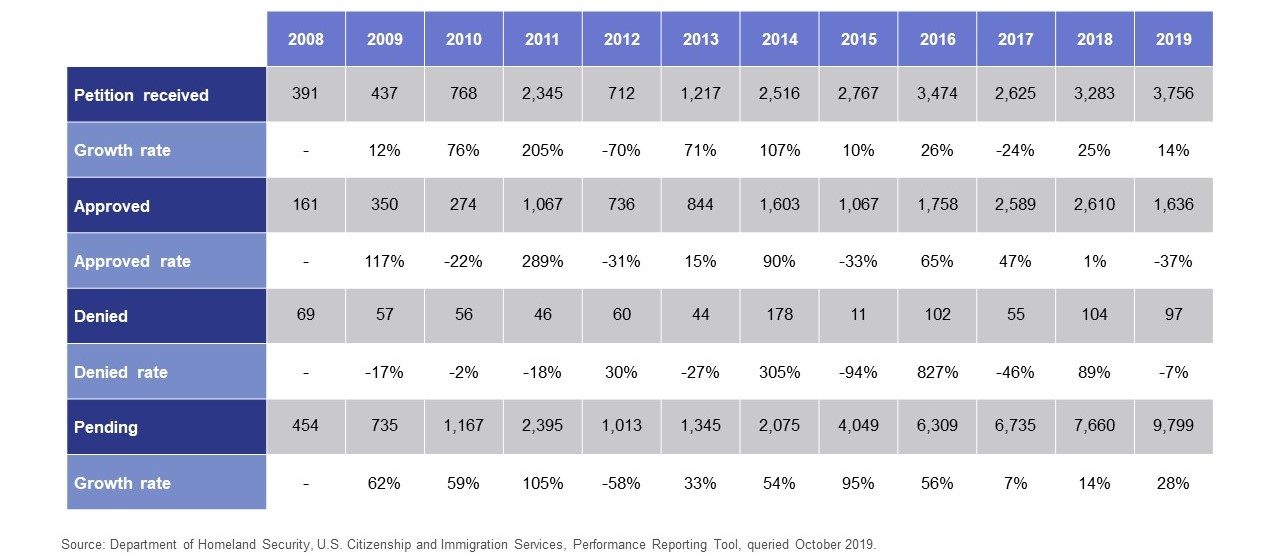
Table shows number of I-829 Petitions received, approved, denied and pending with corresponding rates in 2008 to 2019.

In general, the reception and adjudication of I-829 petitions has grown during the period of 2008 to 2019. The number of I-829 petitions received by USCIS grew each year except for 2012 and 2017, although 2012’s negative growth rate is largely due to the stark difference compared to the abnormal spike in 2011, which recorded a 205% growth rate from 2010.

Approval rates grew in most years as well, with only 2010, 2012, 2015, and 2019 showing declines. 2019’s negative growth rate of -37% for approvals is the largest in the entire 11-year period. Denial rates exhibited more fluctuation, recording massive growth rates of 305% and 827% in 2014 and 2016, respectively. Typically, if approval rates are down for a year, the denial rates are as well, and that is true for 2019, which saw a -7% growth rate for denials to accompany the -37% growth rate for approvals.

Finally, the number of pending applications has grown every year except 2012, which may be attributable to 2011’s spike. Since then, it has risen each year, with a 95% growth rate in 2015 and 28% in 2019. With adjudication rates falling and backlogs continuing to increase, EB-5 investors may be subjected to even longer waiting times.

I-829 Petitions See High Approval and Receipt Rates

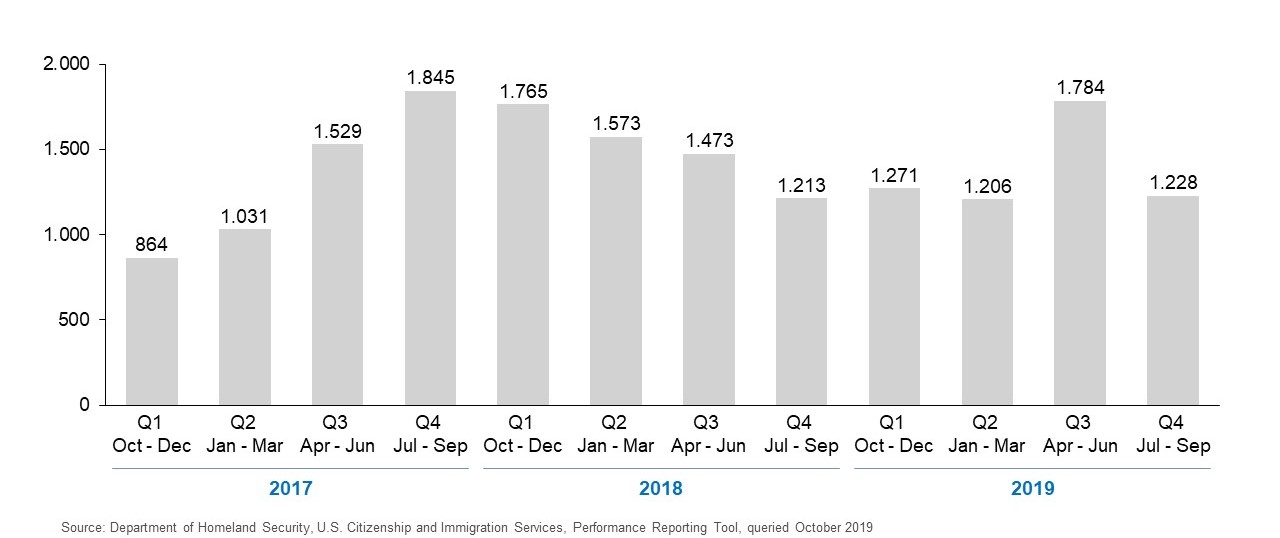
Graph showing the total number of I-829 petitions received, approved, and denied in Fiscal Year 2017 to Fiscal Year 2019.

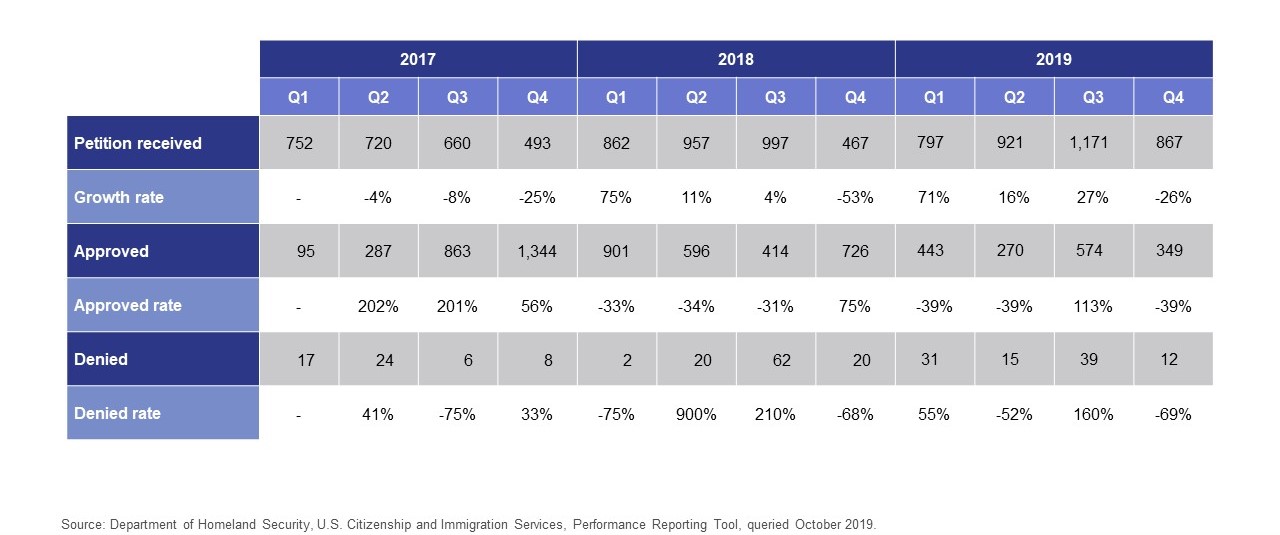
Table showing number of I-829 Petitions received, approved, and denied by the USCIS per quarter from FY2017 to FY2019.

In contrast to the falling numbers of I-526 petitions, figures for I-829 petitions have remained relatively steady over the FY2017–FY2019 period. The total number of petitions peaked in 2017 Q4 at 1,845 and have, since 2018 Q4, remained stable at around the 1,200 level, with the exception of a jump to 1,784 in 2019 Q3.

The number of I-829 petitions received has generally been growing, with FY2019 seeing the highest total figures in the three-year period, including the only number above 1,000 in Q3. Figures grew steadily to 1,171 in 2019 Q3 following a 53% drop in 2018 Q4.

The growth rates for approvals during the 2017–2019 period were generally large, regardless of the direction, with the smallest growth rate at 39% (negative growth) in the first, second, and fourth quarters of FY2019. The largest was in 2017 Q2 at 202% (positive). In the last two quarters of FY2017, as well as the first and last quarters of FY2018, approval rates were higher than the number of I-829 petitions received.

Denial rates have witnessed fluctuating growth rates due to their small numbers: The largest number of denials for any quarter during the period was 62. In all years, the number of denials has been significantly smaller than the number of approvals, with the largest difference in 2018 Q1, where there were 901 approvals and two denials.

Graph showing number of I-829 Petitions received, approved, and denied by the USCIS per quarter from FY2015 to FY2019.

The quarterly bar graph for I-829 petitions makes clear the large number of approvals over denials, with each bar almost entirely blue, signifying approvals. Adjudication rates slowed down in FY2016 but picked up dramatically in FY2017, particularly in Q4, and have fallen with fluctuations ever since. The rate of receipts has also seen fluctuations but has remained at relatively the same level, generally above the number of adjudications for the respective quarter. The clear outlier in this regard was 2017 Q4, which saw 1,352 adjudications and a mere 493 receipts. For the entirety of FY2019, the number of receipts has been well above that of adjudications.

I-526 Receipts Fall, Approval Rates Drop Significantly

I-526 Receipts Fall, Approval Rates Drop Significantly

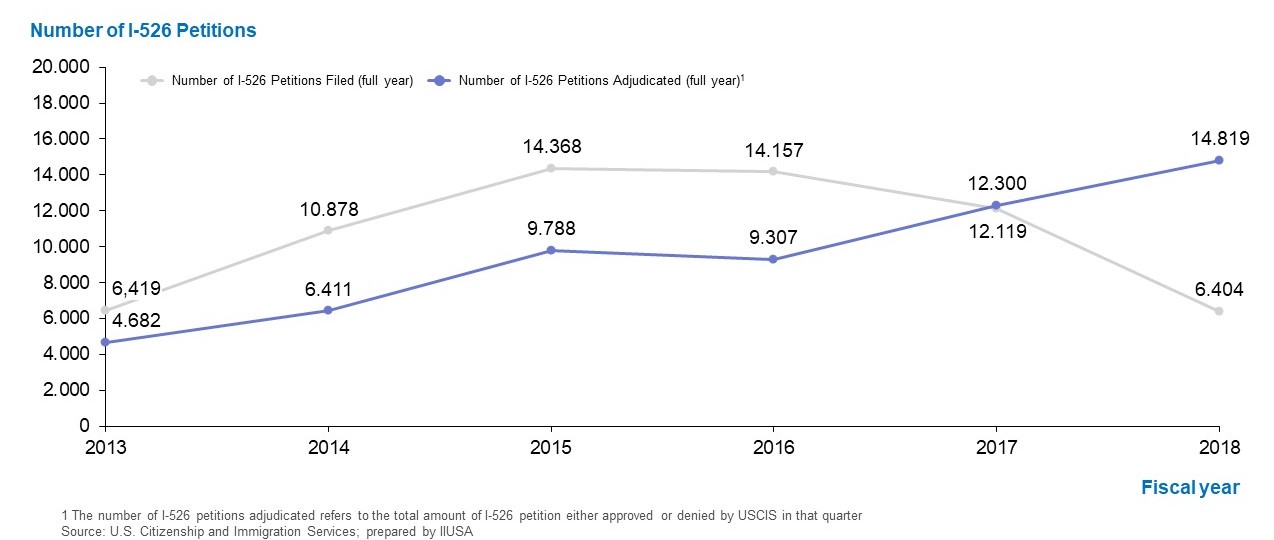
When looking at a line graph of I-526 adjudications vs. receipts for the period of FY2013 to FY2018, we can see what appears to be a trend reversal starting in FY2017. Receipts grew from FY2013 and reached a plateau in FY2015 and FY2016 before decreasing slightly in FY2017. From there, receipts nearly halved, with FY2018 figures even lower than FY2013 figures. Meanwhile, adjudications are shown to have risen almost every year, with the exception of FY2016, when I-526 adjudications were slightly lower than in FY2015. Until FY2016, receipts were significantly higher than adjudications, but the figures were roughly even in FY2017, and FY2018 saw far more adjudications than petitions. However, the omission of FY2019 EB-5 data makes this graph somewhat misleading, as previous graphs have indicated that adjudications dropped drastically in FY2019, falling back below the number of receipts, which also decreased.

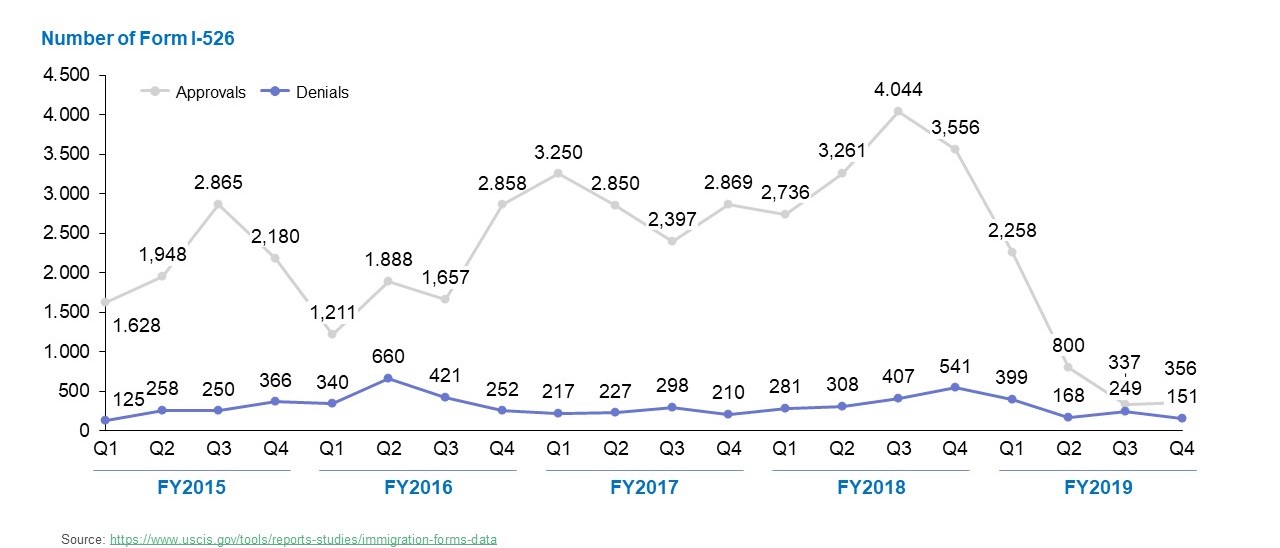
Graph showing that significantly more I-526 Forms were approved than denied from Fiscal Year 2015 to Fiscal Year 2019.

Unlike the previous graph, this line graph of I-526 approvals and denials does include FY2019 data, which starkly contrasts with the data of preceding years. For every year since FY2015, approval rates have been higher than denial rates, significantly so until FY2019. Although FY2016 saw increased denials and fewer approvals, the difference remained high and shot back up in FY2017 and FY2018. Starting in 2019 Q1, the approval rate took a nosedive, which continued in Q2, and in Q3, there were only 88 more approvals than denials. This rate improved slightly in Q4 but remains significantly lower than in all previous years in the period.

I-526 Backlog Begins to Decrease

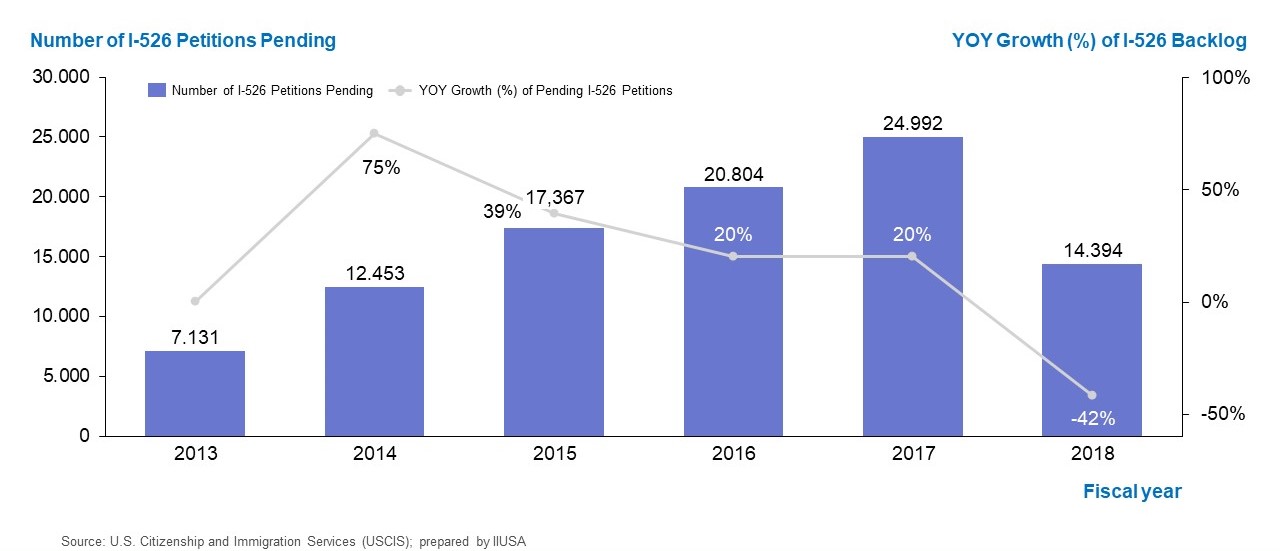
Graph shows the number of I-526 petitions pending and year over year growth rate of I-526 backlog from FY2013 to FY2018.

Regarding the USCIS I-526 backlogs, which have grown to unprecedented heights in recent years, growth rates are shown to be slowing. The most dramatic growth was seen in FY2014, where the backlog grew by 75%. From FY2015 to FY2017, while pending I-526 petitions grew by the same amount as in FY2014 in terms of the actual numbers, the growth percentage was lower, falling to 20% in FY2016 and FY2017. Only FY2018 saw a decrease, and a dramatic one at that, recording a negative growth rate of 42% and taking the number of pending I-526 petitions back down to pre-FY2015 levels. Had the FY2019 data been included, we would see the downtrend continuing but weakening significantly, with the number of pending petitions decreasing by only 4%.

I-829 Approval Rates Remain Staggeringly High

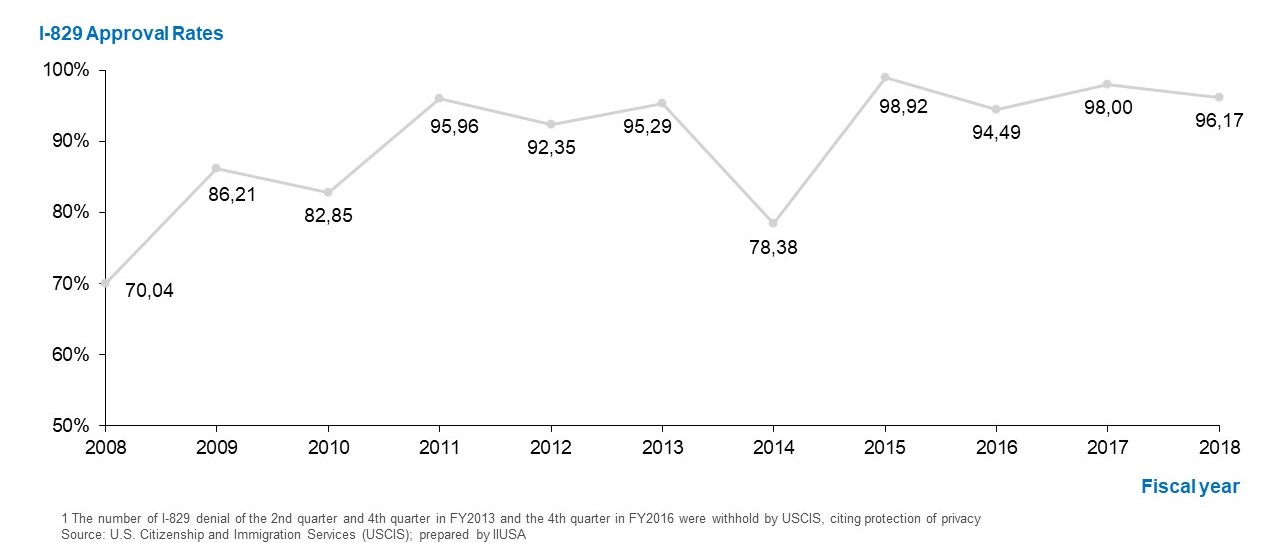
Chart showing that I-829 approval rates have remained high at 70.04% in FY2008 and rising up to 96.17% in FY2018.

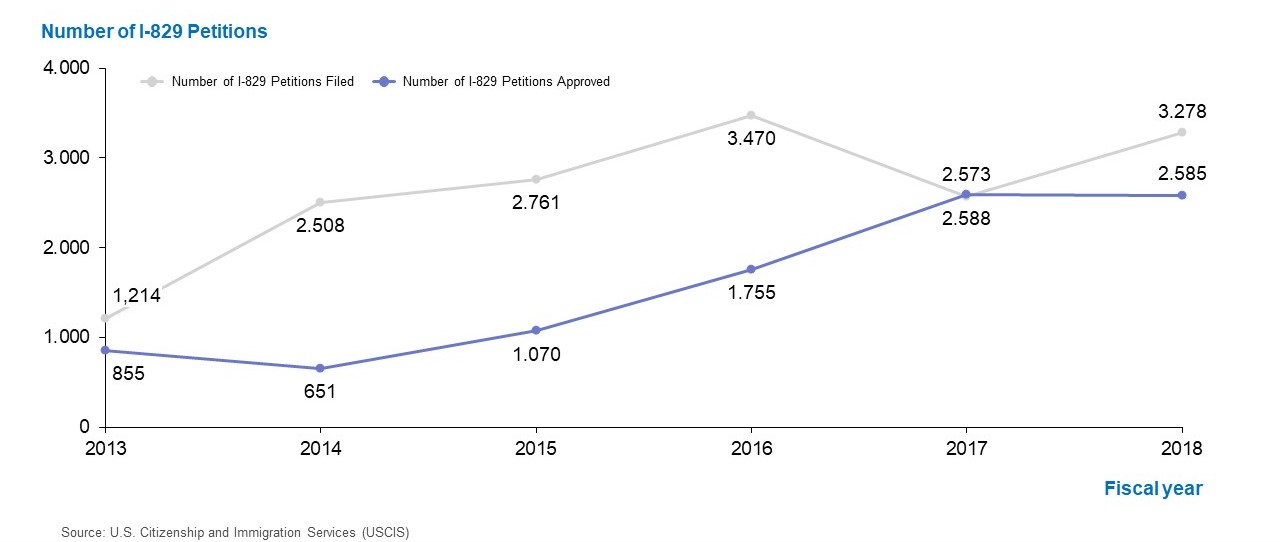
Line graph shows number of I-829 Petitions that were filed versus approved from Fiscal Year 2013 to Fiscal Year 2018.

As the first of these two charts illustrates, the approval rates for the I-829 petition are staggeringly high, with percentages in the 90s for most years between FY2008 and FY2018. The lowest percentage—70%—came in FY2008, after which the rate reached 95% in FY2011. FY2014 saw a sudden dip, shooting back down to 78% from 95%, while FY2015 witnessed an astounding approval rate of nearly 99%.

However, as the second chart reveals, while approval rates are high, the backlog is also steadily growing. For most years from FY2013 to FY2018, approval rates remained consistently below the receipt rate by hundreds of petitions, reversing only in FY2017 by a mere 15 petitions. FY2017’s reversal was due to a drop in receipts rather than an abnormally high increase in approvals, however, and when receipts picked back up in FY2018, approvals plateaued, which is not good news for the ever-increasing I-829 backlog.

USCIS Adjudications Consistently Low in 2019

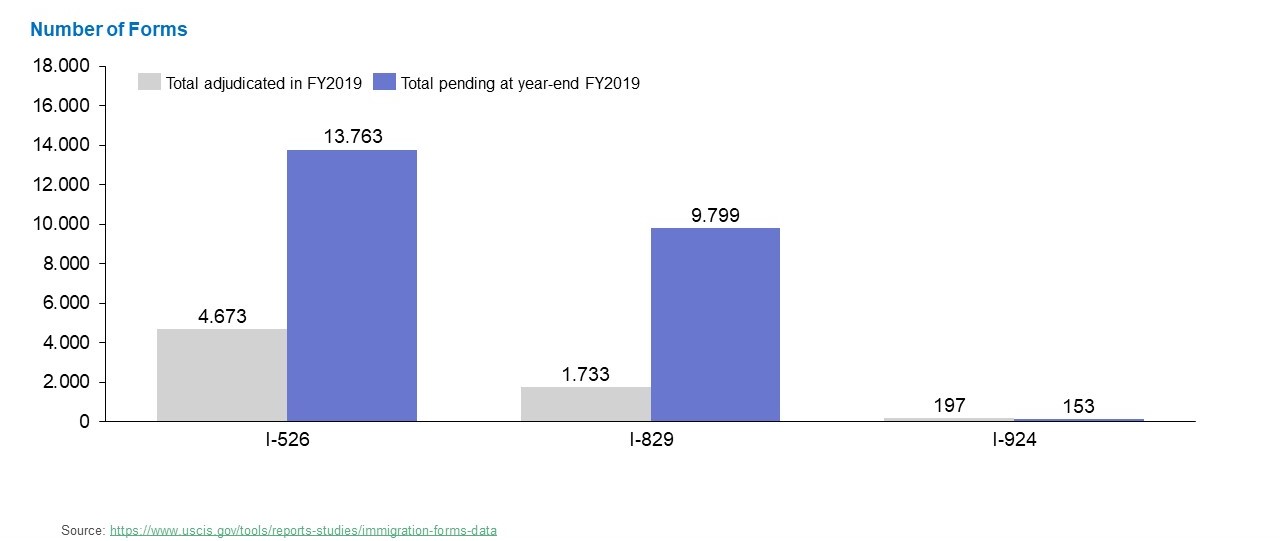
Bar graph showing the total number of I-526, I-829 and I-924 Forms adjudicated and still pending at the end of FY2019.

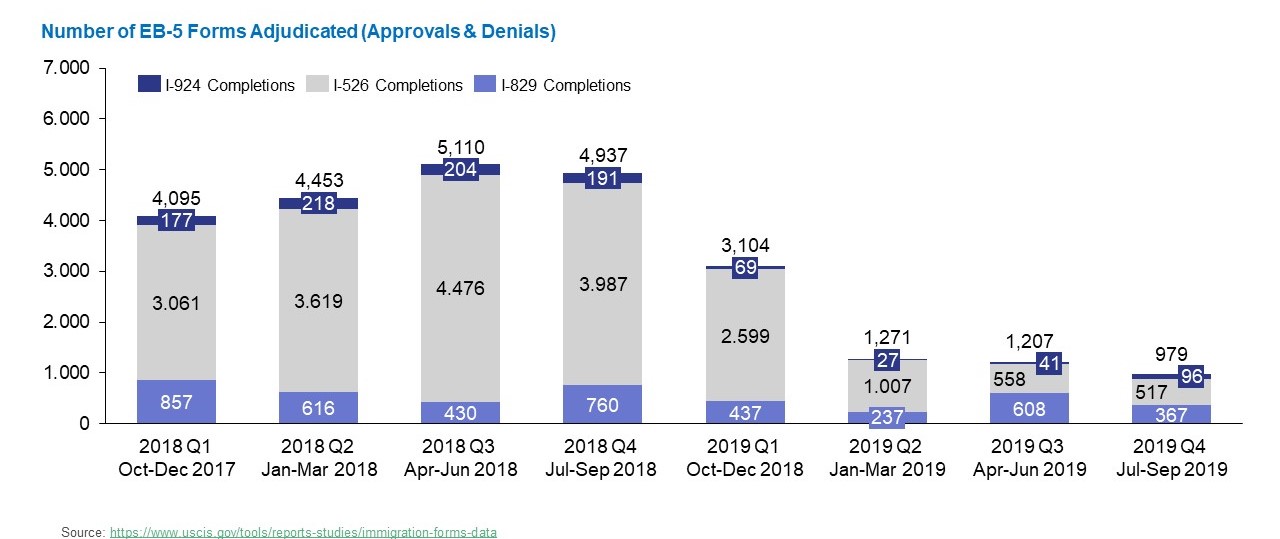
Bar graph shows the number of I-526, I-829 and I-924 forms approved or denied from 2018 Quarter 1 to 2019 Quarter 4.

The USCIS adjudicated an extremely low number of EB-5 forms, regardless of the type, throughout the entirety of FY2019. While previous graphs have shown the beginnings of a downtrend in the I-526 backlogs, sparked by a large number of adjudications in FY2018, the number of I-526 petitions pending is still almost triple the number adjudicated as of the end of FY2019. Similarly, for I-829 petitions, the number of pending petitions is more than five times the number of those adjudicated, and the backlog for I-829 has been exhibiting steady growth. For the much less filed I-924 petition, however, more petitions were adjudicated than are pending.

Completion numbers for all three EB-5 forms are were down in FY2019, dropping to below 1,000 in total in 2019 Q4. While in FY2018, the total figures for each quarter were above 4,000, 2019 Q1 saw a steep drop, which continued in Q2. Figures have remained steady since 2019 Q2, so if USCIS does not pick up the adjudication pace in 2020, the state of the backlogs will depend on the number of petitions received.

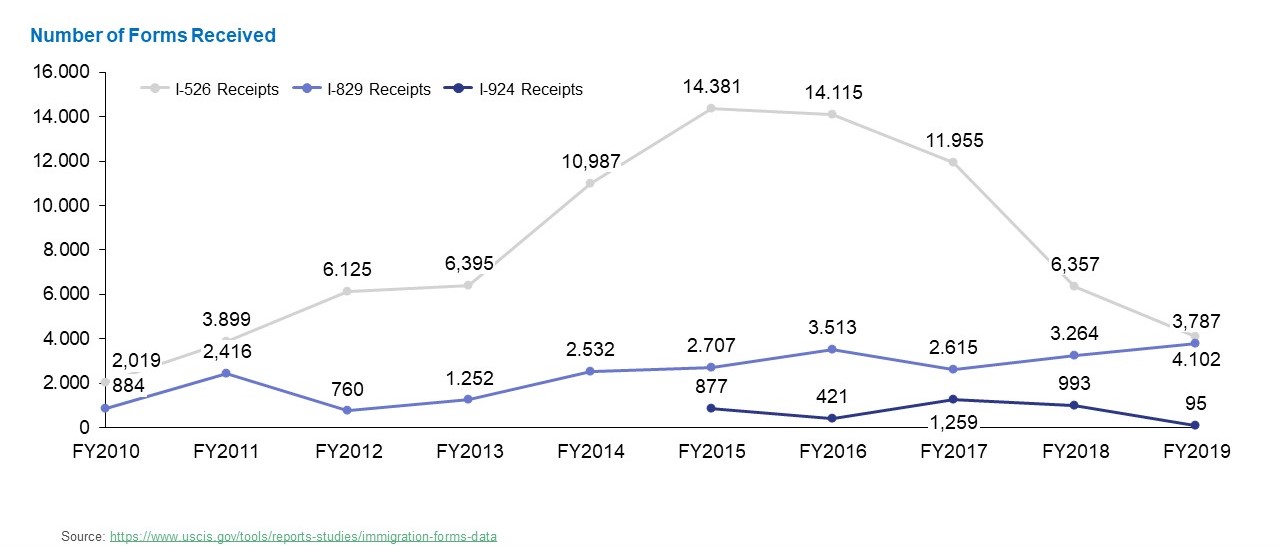
I-526 Petition Receipts Drop While I-829 Petition Receipts Slowly Rise

Line graph shows that from FY2010 to FY2019, I-526 petition receipts drop while I-829 petition receipts slowly rise.

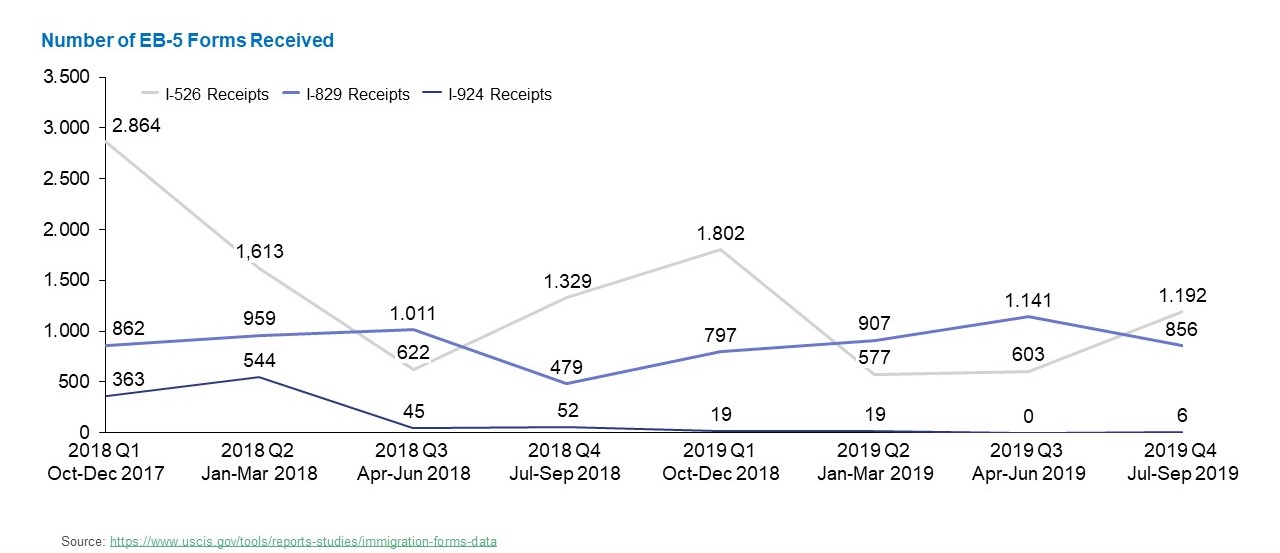
Line graph showing the number of I-526, I-829 and I-924 Forms received by USCIS from October 2017 to September 2019.

Ever since FY2010, the beginning of the studied period, I-526 receipts have been well above I-829 receipts, but this trend threatens to reverse as we move into FY2020. In FY2012, I-526 receipts rose while I-829 receipts fell, and in FY2014, I-526 receipts shot up dramatically, while I-829 receipts continued along a slow upward trend. I-526 receipt rates began to fall in FY2017 before plummeting in FY2018, continuing their fall into FY2019. Meanwhile, I-829 receipt rates have been relatively steady, increasing slowly since a small drop in FY2017. If these trends continue, I-829 receipts are poised to overtake I-526 receipts in FY2020.

Since their introduction in FY2015, I-924 Application For Regional Center Designation Under the Immigrant Investor Program petitions have been significantly lower than their counterparts. While I-924 petition receipts saw an increase in FY2017 to over 1,000, the figure plummeted to an unprecedented low in FY2019 with only 95 receipts.

The quarterly breakdown shows heavier fluctuation, with I-829 petitions overtaking I-526 petitions in 2018 Q3, 2019 Q2, and 2019 Q3. I-516 petition receipts spiked in 2019 Q1 but remained low for the remainder of the fiscal year, although they did see an increase in Q4, putting the I-526 figures back above those for I-829. The I-829 receipt rate remained more stable throughout the period, decreasing somewhat at the end of FY2019.

Particularly noteworthy is the sudden decline in I-924 petitions for regional center designation in FY2019. In no quarter were the figures above 20, and in Q3, not a single I-924 petition was received by USCIS. The sudden drop in I-924 petition receipts is likely related to the new USCIS regulations that have increased the required EB-5 investment amount and restricted TEA designation, which has resulted in an unprecedentedly high number of regional center terminations.

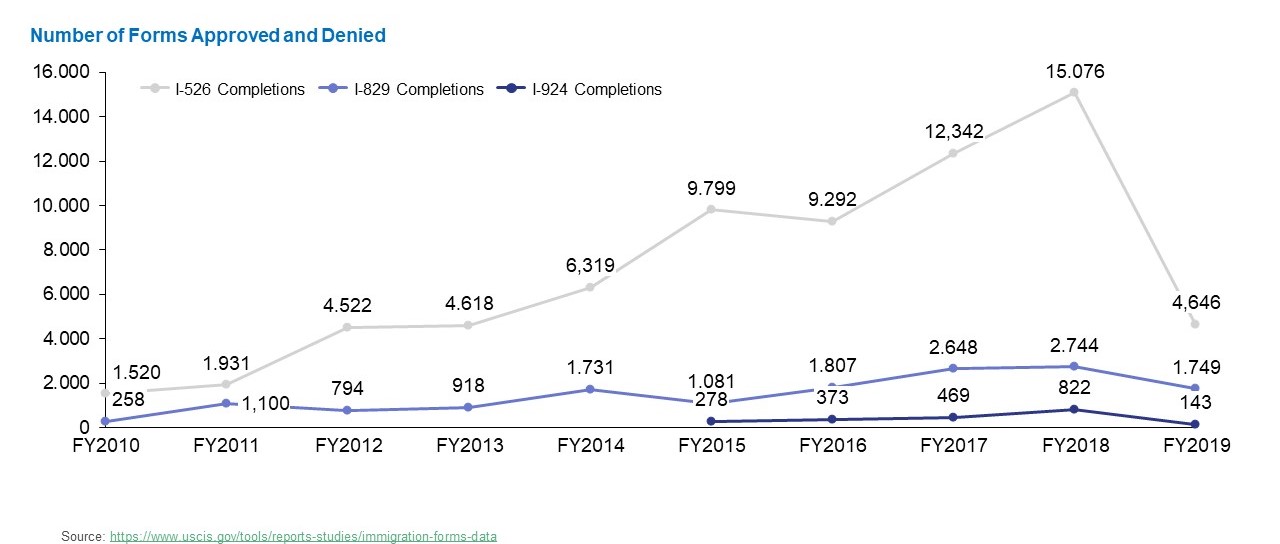
USCIS Adjudications See a Steep Decline, Backlogs Still Large

Number of forms Approved

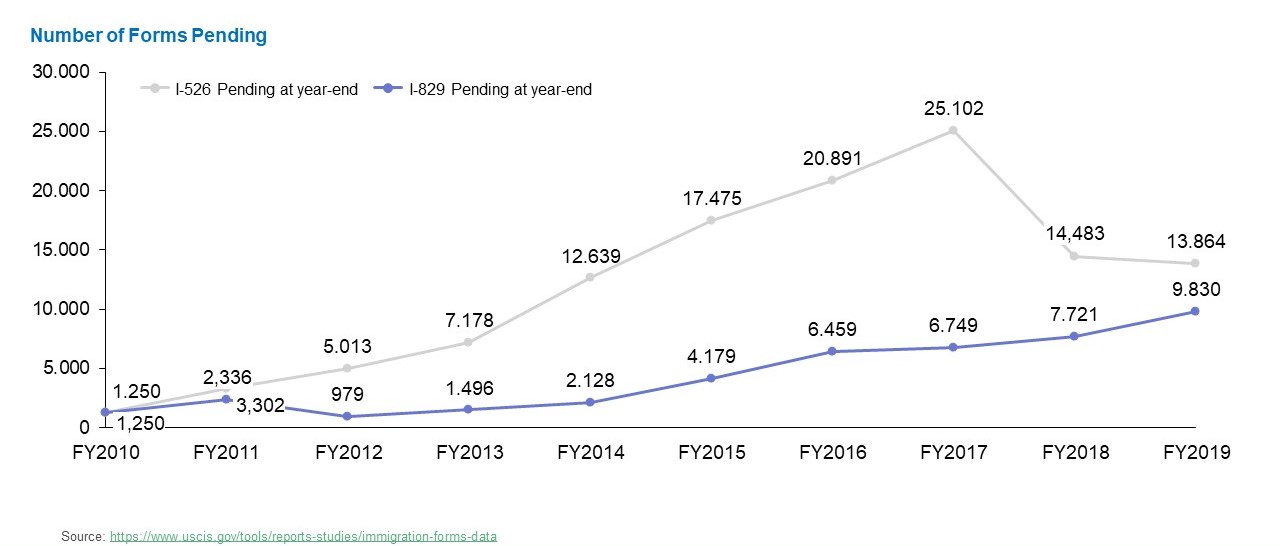
Line graph showing the number of I-526 and I-829 Forms pending by USCIS during the time period of FY2010 to FY2019.

For the majority of the period between FY2010 and FY2019, USCIS adjudicated an increasingly large number of I-526 petitions. For the most part, the number rose year over year throughout the decade, with USCIS adjudicating an impressive 15,076 I-526 petitions in FY2018. However, the trend reversed dramatically in FY2019 with the steepest drop in the entire decade, falling to only 4,656, on par with FY2013 levels. Although receipts also dropped in FY2019, the huge backlog meant that USCIS still had an overabundance of petitions waiting for adjudication, indicating that the drop is due to UCSIS slowing down its adjudication rates.

The number of I-829 petitions adjudicated was also down in FY2019, but not significantly, and the drop is not abnormal for the relatively stable I-829 adjudication rate seen throughout the decade. The I-924 adjudication rate, like that of the I-829 petition, was consistently much lower than that of the I-526 but reasonably stable throughout the period.

It is also clear that while the I-526 backlog was fairly small in FY2010 and FY2011, it started shooting up in FY2012, rising steadily for years until peaking in FY2017. In FY2018, USCIS completed an abnormally high number of I-526 petitions, bringing the backlog down significantly, but it decreased only marginally in FY2019, meaning USCIS is going into FY2020 with a large I-526 backlog still looming overhead. Meanwhile, while the I-829 backlog has never reached the same heights as the I-526 backlog, it has been climbing steadily year over year, with no declines since FY2012. If growth continues at the current rate, the I-829 backlog is poised to overtake the I-526 backlog within a year or two.


Free EB-5 Project Evaluation

EB-5 Quota Backlogs and Long USCIS Processing Times Emphasize the Importance of Choosing Reputable Regional Centers

The EB-5 program has seen some changes in recent years, including increased investment fund requirements and more restrictive targeted employment area (TEA) designation, but these are not the only challenges the program faces. Adding to the problem are the lengthy quota backlogs in major EB-5 investor countries and the ever-increasing United States Citizenship and Immigration Services (USCIS) processing times. Considering the additional factor of record-breaking rates of regional center terminations, EB-5 investors today are faced with unprecedented challenges to receive their EB-5 visa and gain U.S. permanent residency.

Regional Center Terminations Threaten Investors’ Visa Approval

In light of the modified requirements of the EB-5 program, regional centers are being shut down at record-breaking rates. The higher amount of required investment funds reduces the number of investors, which, in turn, results in some regional centers failing to stimulate their local economies to the satisfaction of USCIS.

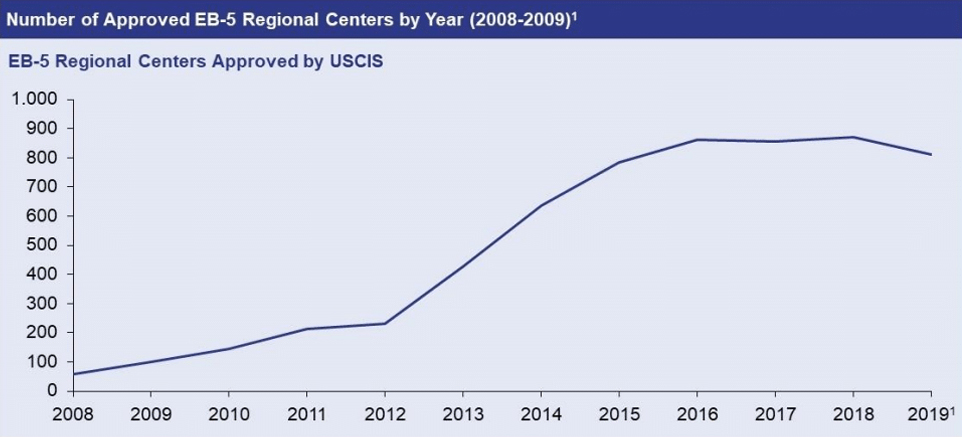
Graph showing the number of EB-5 Regional Centers approved by USCIS increasing from 2008 to 2018, then declining in 2019.

The problem for investors is that if the regional center through which they are investing is terminated mid-project, investors who have not yet received conditional residency may see their EB-5 petitions denied. The long quote backlogs and growing USCIS processing times exacerbate the problem because they require regional centers to remain in operation for longer. Investors beginning the EB-5 investment process now must choose a regional center they believe will still be in operation several years down the road.

For investors outside of China, Vietnam, India, and other countries with major backlogs, the long processing times still pose a risk. In 2010, the processing times were just seven to nine months, but this jumped to 54–90 (4.5–7.5 years) in 2019. Therefore, all EB-5 investors, regardless of country of origin, must carefully select a reputable EB-5 regional center that is likely to continue operations for many years to come.

Choosing a Reliable EB-5 Regional Center

The importance of working with an experienced, reputable EB-5 regional center to safeguard one’s investment and EB-5 visa approval cannot be overstated. Prospective investors need to sufficiently research the regional centers covering the area in which they intend to invest in order to ensure the lowest possible likelihood of premature termination. Working with a network that runs multiple regional centers and possesses vast experience—such as EB5AN (EB5AN)—is the safest bet for any EB-5 investor.

While regional centers are being terminated around the country due to a failure to stimulate the local economy, EB5AN is thriving, with no danger of being shut down. With 14 regional centers that offer coverage of more than 20 states, as well as Washington, D.C., EB5AN is extensively experienced with EB-5 projects and knows the ins and outs of working with USCIS. The team keeps up to date on all metrics and regulations related to the EB-5 program, ensuring continued adherence and, consequently, reliable longevity.

Affiliating with an EB5AN regional center also speeds up the investment process, allowing investors to start raising EB-5 capital immediately. The network’s project documentation services can also facilitate and expedite the paperwork process involved in EB-5 investment, as well as ensure that all the forms are properly filled out, helping investors gain approval.

While the conditions surrounding the EB-5 program may be becoming more restrictive, the program remains a lucrative opportunity for investors with the necessary funds. For those investors, navigating the changing environment in the EB-5 world simply requires more caution, forethought, and careful research to locate a regional center that offers high chances of success. EB5AN, with its vast network of regional centers, proven track record, and 1500+ active investors, represents an opportunity for EB-5 investors to most securely invest in the future for themselves, their family, and the United States.

Free EB-5 Project Evaluation

EB-5 Regional Centers Are Being Shut Down at an Unprecedented Rate, Making Reputable Centers More Important

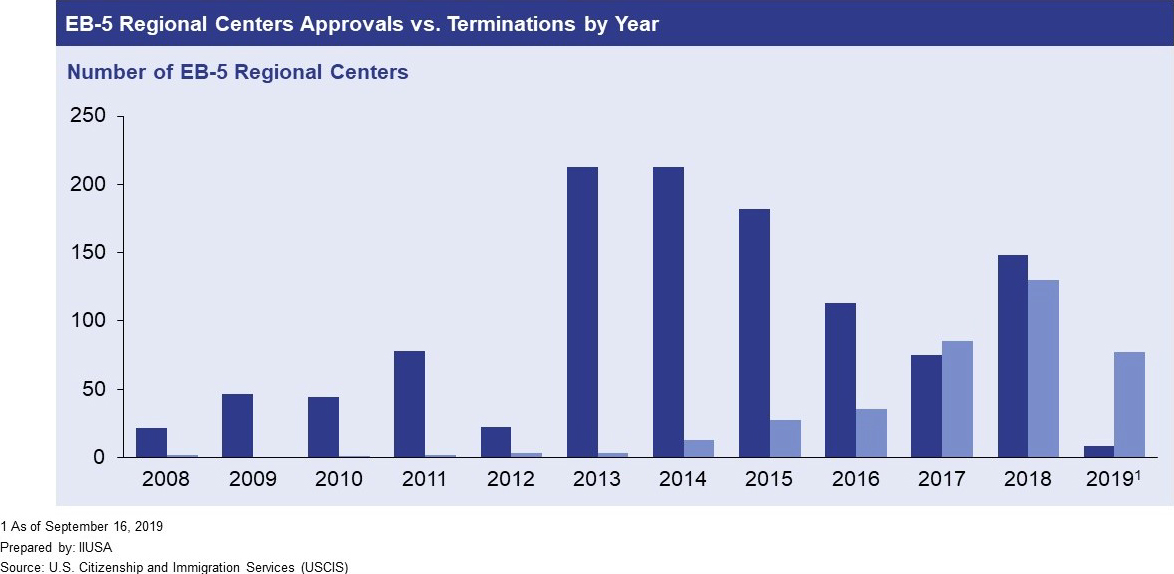
The United States Citizenship and Immigration Services (USCIS) has tightened its regulations, and with the new regulations comes an unprecedentedly high rate of regional center terminations. 2019 saw the termination of 75 regional centers, hardly offset by the approval of a mere six. This represents only the second year since 2008 where more regional centers were terminated than approved, and it is the only year where dramatically more centers were terminated than approved.

This massive drop represents a 6.5% reduction in the nation-wide number of EB-5 regional centers, placing the number at 822. In pure numbers, there were fewer centers terminated in 2019 than in 2018, which witnessed a record high at 130, but the large number of approvals left 2018 with an overall 2% increase.

The trends are alarming, with 80% of all regional center terminations since 2008 having taken place between 2017 and 2019. In contrast, only 20% of all approvals took place during this three-year period.

Bar graph shows number of EB-5 regional centers approved versus terminated by USCIS from 2008 to 2019.

Extraordinarily Long Processing Times

Exacerbating the problem are the increasingly long processing times to become a USCIS-approved regional center. From seven to nine months in 2010, the times jumped to 16–20 months in 2018 and a startling 54–90 months in 2019. Given these extraordinarily long processing times, the growth rate of the number of regional centers is poised to remain low at best and negative at worst.

High-Quality EB-5 Regional Centers

The rapidly decreasing number of EB-5 regional centers makes investment riskier for EB-5 investors. If the regional center an investor works with loses EB-5 regional center status, the investor’s EB-5 visa could be ruined. That is why, to safeguard their investments and maximize the chances of success for their investment project, it is important for investors to affiliate with high-quality, reputable EB-5 regional centers, such as those run by EB5AN.

EB5AN runs 14 EB-5 regional centers across the US, with coverage of more than 20 states as well as Washington, D.C. To cover the remaining states, EB5AN maintains an extensive affiliate network with reputable EB-5 regional centers to ensure that investors have access to reliable assistance for their EB-5 investment journey, offering investors the ability to locate affiliated regional center sponsors through a search feature. As business experts with years of experience working with USCIS, the EB5AN team knows how to maintain USCIS approval to protect their clients and their investments.

In short, while the current termination trends may be alarming, EB-5 investors need not fret so long as they select their EB-5 regional center affiliation carefully. While many centers are being shut down, those that rigorously adhere to the USCIS guidelines are not in danger, and investors can invest safely through these centers. EB5AN is one of the largest EB-5 regional center affiliation networks in the country, and their extensive experience with the USCIS ensures the quality and continued existence of their many regional centers, ensuring a fruitful experience for the 1500+ investors who choose to work with them.

Free EB-5 Project Evaluation

USCIS Lawsuit Challenges the Validity of New EB-5 Program Rules

Regional Center Challenges the Validity of the EB-5 Immigration Investor Program Modernization Final Rule

On November 26, 2019, Florida EB5 Investments, LLC (the “Plaintiff”), filed a civil action against the Department of Homeland Security (DHS) and the United States Citizenship & Immigration Services (USCIS) (the “Complaint”) challenging the validity of the recently implemented EB-5 Immigration Investor Program Modernization Final Rule (the “Final Rule”).

Click here to download the full Complaint seeking a temporary restraining order and preliminary injunction to halt the implementation of the recently implemented Final Rule.

The Plaintiff, a regional center and participant in the EB-5 Immigrant Investor Program, contends that the Department of Homeland Security (DHS) implemented the Final Rule without considering the harmful economic effects the rule change would have. Moreover, the Plaintiff alleges that the program changes violate the Administrative Procedure Act (APA) and the 10th Amendment, and the Final Rule should thus be vacated.

The Plaintiff requests that the Court grant a temporary restraining order and preliminary injunction barring the DHS, USCIS, and the Immigrant Investor Program Office from implementing the Final Rule published in July 24, 2019, and effective from November 21, 2019. The Plaintiff further requests declaratory judgments confirming that the Final Rule is invalid, vacating the Final Rule, and confirming that it violates the APA.

Although the Final Rule introduces numerous changes, the Complaint focuses on two key revisions. The first is the significant increases in investment amounts, which rose from $1 million to $1.8 million for regular investments, and $500,000 to $900,000 within targeted employment areas (TEAs). The second relates to the changes to the TEA designation system that shift the responsibility for designation away from state agencies toward the DHS and USCIS.

The Plaintiff argues that these changes, particularly the increased investment amounts, will make the EB-5 program less attractive to investors and developers alike. According to the particulars of claim, several of the Plaintiff’s affiliates withdrew from the EB-5 program following the announcement of the Final Rule, with some completely abandoning projects. If more affiliates abandon the program, which the Plaintiff expects to happen, the Plaintiff may go out of business.

The Plaintiff further alleges that DHS and USCIS were aware of several studies on the economic impacts of the rule changes, despite their initial claim that they did not have adequate data to make an evidence-based decision. He notes that during the rulemaking process, commenters drew rule makers’ attention to several research studies conducted by reputable organizations, including the Department of Commerce, on the effects of the EB-5 program. However, DHS chose to ignore the findings of these studies when implementing the program changes, allegedly to avoid Congressional oversight of the rulemaking process. Rule changes with an effect of more than $100 million on the economy are classified as major rules, which require Congressional approval.

The studies cited in the Complaint show that in an unconstrained environment, the EB-5 program brings about extensive benefits to the U.S. economy. For example, trade group Invest in the USA (IIUSA) found that during FY2010–2011 the program contributed $2.6 billion to U.S. GDP and created or supported 33,000 jobs. The Department of Commerce’s analysis of FY2012 and FY2013 data indicated that the program created 170,000 jobs and drew $5.8 billion in capital during the study period. Similarly, Economic & Policy Resources Inc. determined that during FY2014–2015, the program provided 2% of all foreign direct investment inflows, contributed $11 billion to the U.S. economy, and created more than 335,000 jobs.

The Plaintiff’s contention that the Final Rule should be vacated is based on three allegations related to violation of the APA: (1) TheFinal Rule violates the APA because it is “arbitrary and capricious.” (2) Under the APA, the Department of Labor should have performed a Regulatory Flexibility Act (RFA) analysis to determine how the changes will affect small businesses like the Plaintiff, which is defined as a small business by the RFA and Small Business Administration. (3) “DHS’s attempts to designate TEAs exceeds its statutory authority,” as the Final Rule does not cite the statute that authorizes the DHS to designate TEAs. Although the DHS claims that its authority stems from its mission to “ensure that the overall economic security of the United States is not diminished by efforts, activities, and programs aimed at securing the homeland,” its mandate is security and protection, not promoting economic development.

The Plaintiff further argues that the Final Rule should be vacated because it violates the 10th Amendment. By shifting TEA designation from state agencies to federal government agencies, DHS limits states’ ability to “conduct their own government and foster economic development within their respective borders.”

The Complaint filed in the U.S. District Court for the District of Columbia names Chad Wolf, acting secretary of the DHS; Kenneth T. Cuccinelli, acting director of USCIS; and Edie Pearson, policy branch chief of the Immigrant Investor Program Office (the “Defendants”) in their professional capacities. The Defendants have 60 days from service of summons to respond, so we can expect an update early in 2020.

Free EB-5 Project Evaluation

EB-5 Updates Now in Force

In July 2019, United States Citizenship and Immigration Service (USCIS) and the Department of Homeland Security (DHS) published updates to the EB-5 visa program in the Federal Register. The new EB-5 rule, implemented to modernize the program, came into effect on November 21, 2019.

While the updates include several technical revisions, the key changes to the EB-5 visa program relate to investment amounts, the designation of targeted employment areas (TEAs), and priority date retention for certain EB-5 investors.

For the first time since the investment green card program began, investment amounts have increased. The full investment amount rose from $1 million to $1.8 million, whereas the reduced investment amount permitted when investing in projects in TEAs rose from $500,000 to $900,000. This change reflects inflation, and a framework has been introduced to facilitate subsequent inflation-based increases in investment amounts every five years.

Previously, individual states and local governments were permitted to designate high unemployment targeted employment areas. Now, USCIS directly reviews and designates these TEAs. Additionally, the rules have changed for combining census tracts to form a single TEA. Although census tracks can still be combined, the TEA must consist of only the contiguous tracts in which the new commercial enterprise will operate and any directly adjacent census tracts. Finally, the definition of a high employment TEA has changed to include areas located outside metropolitan statistical areas (MSAs).

The changes to the TEA designation process mean that EB-5 investors who claim to qualify for the lower investment amount now have to submit supporting evidence that the target project falls within a TEA—rural or high unemployment—when submitting their I-526 petitions. Furthermore, the area must meet the EB-5 green card program criteria at the time of filing the petition or at the time of making the investment. Some areas that previously qualified as TEAs will no longer qualify under the new rules, so investors must confirm TEA status when conducting their due diligence.

Finally, certain EB-5 investors will be able to retain their priority dates—the date on which they filed their I-526 petitions, which determines their place in the visa queue. This EB-5 update applies to investors whose I-526 petitions have been approved but who have not yet obtained conditional permanent residence and whose investment green cards are at risk because of material changes to their applications. The new rules allow them to file new I-526 petitions without losing their place in the visa queue.

Over the coming months the full implications of the EB-5 visa program changes will become clear when new petitions are filed—and new challenges arise. EB-5 practitioners, investors, and developers should keep up with EB-5 news to make sure they know how the implementation of the new rules will affect their participation in the EB-5 green card program.