Author Archives: admineb5

Free EB-5 Project Evaluation

The Implications of USCIS Office Closures for EB-5 Investors

On March 18, 2020, United States Citizenship and Immigration Services (USCIS) announced the nationwide closure of all its public offices due to the COVID-19 pandemic. The global crisis is affecting countries all over the world, upending life on all corners of the globe, and EB-5 investors are also encountering disruptions in their U.S. visa process.

The closures apply to not only domestic USCIS offices but also all U.S. embassies and consulates abroad. While they are still providing emergency services, they have suspended all routine visa services. Thus, EB-5 investors must put their EB-5 visa applications on hold until COVID-19 tapers off and the consulates reopen.

Originally, the closures were planned to continue until May 4, but with the pandemic continuing to rage on as the date neared, USCIS made a new announcement that it was extending the closures to June 4, 2020. Only time will tell whether USCIS really opens back up on June 4, but it’s worthwhile for EB-5 investors to prepare to set their visa journeys back in motion.

What’s important to note about the closures is that they only apply to procedures that involve face-to-face interaction with the public. Visa interviews and other in-person appointments must be rescheduled, but USCIS is still in operation, contactable by email or phone and providing remote services. Since the adjudication of petitions takes place behind closed doors, USCIS continues working hard to adjudicate I-526 petitions and I-829 petitions, among other EB-5-related petitions.

Also affecting EB-5 investors’ ability to immigrate to the United States during the COVID-19 pandemic are the numerous travel restrictions around the world. EB-5 investors must keep abreast of the latest developments to determine whether they are permitted to enter the United States. While the temporary immigration suspension signed into law on April 22 does not affect EB-5 investors, other travel restrictions may.

Free EB-5 Project Evaluation

The U.S. Immigration Ban Doesn’t Affect EB-5 Investors

The novel coronavirus pandemic has halted life around the world, confining ordinary people worldwide to their homes and forcing U.S. consulates globally to close. As the United States begins to look forward, the government is drafting plans to prioritize U.S. workers when the economy opens back up. One such measure President Trump has taken was signing a proclamation on April 22 that temporarily halts immigration to the United States.

In Trump’s own words, the proclamation is meant to ensure that “unemployed Americans of all backgrounds will be first in line for jobs as our economy reopens.” As the United States faces unprecedented economic turmoil while it slowly lays the foundation to return to normal life after COVID-19, the government plans to suspend certain types of immigration for 60 days.

While the proclamation generally prohibits immigration for a short period, it does not ban all immigration, and among the exceptions are EB-5 investors, along with their spouses and unmarried children younger than 21. EB-5 investors must, however, continue to monitor the numerous travel restrictions worldwide during the pandemic, as some may override an EB-5 investor’s exemption to Trump’s new immigration ban. EB-5 investors are advised to seek immigration counsel to determine their situation and options.

Since one of the requirements of the EB-5 program is the creation of 10 new full-time jobs for U.S. workers, the U.S. government likely sees it as a boon to the U.S. economic recovery efforts. The EB-5 program has the power to create new jobs, for which the U.S. will see overwhelming demand, and as EB-5 investors are required to invest a minimum of $1.8 million or $900,000, depending on whether their EB-5 project is in a targeted employment area, the program introduces substantial capital into the U.S. economy. This also means the program exclusively brings in wealthy individuals and families who will not require assistance from U.S. social welfare programs.

In 2008, suffering under the weight of a global recession, developers funded their projects through the EB-5 program because they couldn’t access traditional funding. The program proved a superb way to boost the U.S. economy and helped countless U.S. workers find new jobs. As the United States faces another economic downturn, with skyrocketing unemployment rates, the EB-5 program may be just what the United States needs to get back on track.

Free EB-5 Project Evaluation

What Is an EB-5 Targeted Employment Area?

U.S. Congress created the EB-5 Immigrant Investor Program in November 1990 to spur economic growth in the United States via the capital of foreign investors. In exchange for a large investment that funds the creation of at least 10 full-time jobs occupied by U.S. workers, EB-5 investors receive U.S. green cards for themselves and their immediate family members, giving them the right to live, work, and study in the United States of America.

Since most EB-5 investors participate in the EB-5 program primarily to obtain U.S. permanent residence and not for financial gain, they generally prefer to invest the minimum allowed amount. Until November 2019, the minimum required investment amount was $1,000,000, which was increased to $1,800,000 when the EB-5 Modernization Rule came into effect. However, EB-5 projects in special zones, called targeted employment areas (TEAs), only require a minimum investment of half of the default amount. That means EB-5 investors working with a project in a targeted employment area only need to invest $900,000.

What Qualifies as a TEA?

Targeted employment areas can be found all across the United States. Instead of specifically defining particular areas, United States Citizenship and Immigration Services (USCIS) defines a set of criteria used to determine the TEA status of an area, so it is up to the investor to determine whether a given EB-5 project qualifies for the lower investment amount. There are two types of targeted employment areas: high-unemployment TEAs and rural TEAs.

High-Unemployment TEAs

A high-unemployment TEA is an area that has an unemployment rate 150% higher than the national average. For example, in 2019, the average U.S. unemployment rate was 3.66%, so in 2020, an area must have an unemployment rate of at least 5.49% to qualify as a high-unemployment TEA. Additionally, high-unemployment TEAs must be located in towns or cities with more than 20,000 residents or in an area that the Office of Management and Budget defines as a metropolitan statistical area (MSA).

Rural TEAs

A rural targeted employment area is simply any area outside an MSA that has a population of fewer than 20,000 inhabitants. EB-5 investors must use the most recent 10-year U.S. Census data to determine the population of a given area.

Obtaining TEA Designation

Since USCIS does not make targeted employment area determinations in advance, it is up to EB-5 investors and project developers to obtain TEA designation themselves. In some cases, project developers apply for exemplar status for their EB-5 project, which represents USCIS approval that the project meets EB-5 requirements. If an EB-5 project with exemplar status has TEA designation, EB-5 investors can rest easy knowing USCIS will highly likely accept their documents demonstrating the project’s TEA qualifications.

In other cases, trying to demonstrate targeted employment area status is more uncertain, but with careful preparation, most EB-5 investors are successful. EB-5 investors can include the following forms of evidence in their I-526 petition to demonstrate to USCIS that the area of their EB-5 project qualifies as a TEA:

  • Statistics on population and geographic data compiled by the Office of Management and Budget that indicate the region qualifies as a rural TEA
  • Recent unemployment statistics sourced from the U.S. Bureau of Labor Statistics Local Area Unemployment Statistics (LAUS) office that indicate the region qualifies as a high-unemployment TEA
  • Other third-party data and statistics that indicate the region has an unemployment rate 150% higher than the national average or fewer than 20,000 inhabitants
  • No matter what data an EB-5 investor uses to apply for targeted employment area designation, it must be credible and verifiable. When using data originating from a source other than the U.S. government, the EB-5 investor should demonstrate the credibility of the party, and in all cases, EB-5 investors should explain the methodology used and why it supports their claim for TEA designation.

    TEA Projects at Regional Centers

    Both direct and regional center EB-5 projects can qualify for TEA status, as long as they are in a targeted employment area. However, EB-5 projects associated with regional centers are more likely to be located in a TEA because regional centers specifically seek out the most attractive EB-5 projects to investors. The vast majority of EB-5 investors choose regional center EB-5 projects in targeted employment areas because they offer a wealth of investor benefits, including access to a lower minimum investment amount, lower immigration and financial risk, and the ability to count indirect and induced jobs toward the 10-job job creation requirement.

Free EB-5 Project Evaluation

May 2020 Visa Bulletin: India Leaps Forward

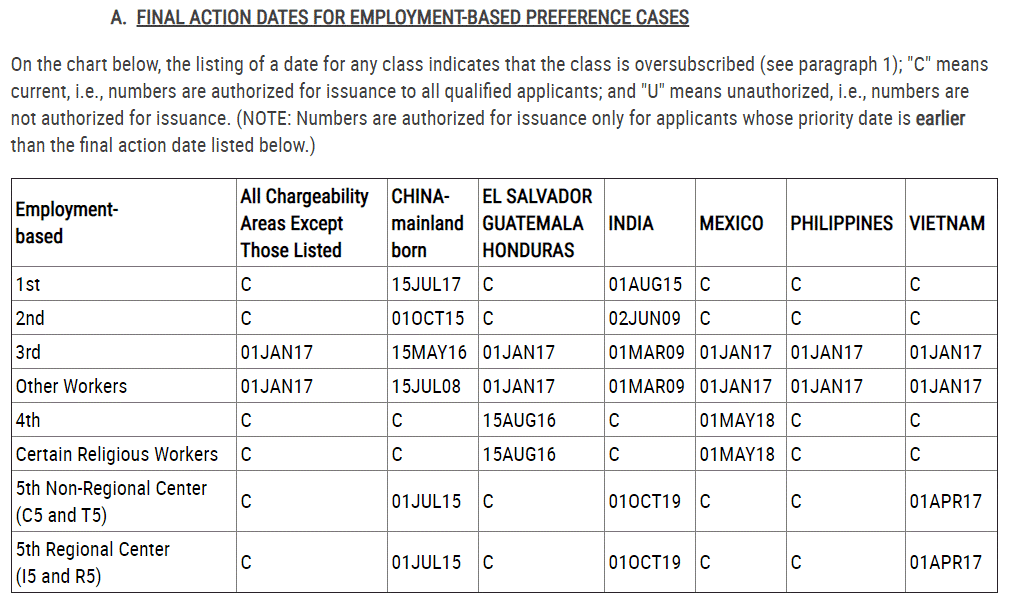
The May 2020 Visa Bulletin is here, and it brings good news for Indian EB-5 investors. The priority date for Indian EB-5 investors has jumped ahead by a whopping nine months, meaning Indian investors can enjoy a much faster EB-5 process than previously anticipated.

China, India, and Vietnam remain the only countries that do not have “current” final action dates, but India is not expected to stay backlogged. In a public engagement on March 13, 2020, United States Citizenship and Immigration Services (USCIS) revealed its prediction that India would become current by summer 2020, and the figures seem to support this projection.

Chart listing final action dates for employment-based preference cases shows a faster EB-5 process for Indian investors.

In the April Visa Bulletin, India had a final action date of January 1, 2019, which has jumped to October 1, 2019, in the May Visa Bulletin. Vietnam and China also continue to move forward, but much more slowly: by two months and 1.5 months, respectively.

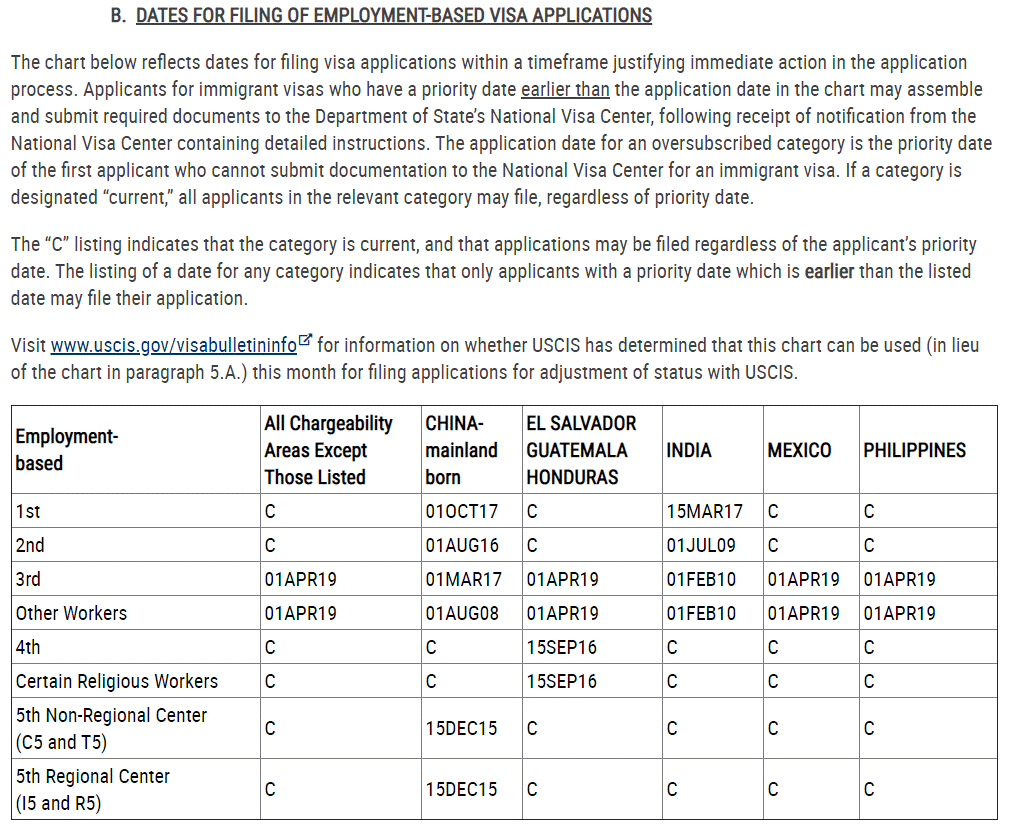
Dates For Filing Of Employment-Based Visa Applications Chart. As to the chart, only investors from China have wait times.

In terms of the Dates for Filing chart, only EB-5 investors from China are subject to wait times. The date has not moved since the April bulletin, sitting steady at December 15, 2015, likely due to the closure of U.S. consulates in China and around the world.

The New Visa Availability Approach

On March 31, 2020, USCIS adopted a new processing approach for I-526 petitions: a new visa availability approach. The visa availability approach prioritizes I-526 petitions whose investors hail from countries that have immediately available EB-5 visas. Since USCIS uses the Chart B dates for this new approach, Indian and Vietnamese EB-5 investors are unaffected.

Extended USCIS Office Closures

In response to the COVID-19 pandemic, USCIS previously shut down its offices to the public until May 4, but it has since extended the closures to June 4. However, USCIS continues to conduct activities that do not necessitate contact with the public, which means it is still steadily adjudicating EB-5 petitions. EB-5 investors who already live in the United States may at an advantage because the global closure of embassies and consulates means more EB-5 visas may be allocated to domestic investors.

Free EB-5 Project Evaluation

EB-5 Visa Petition Processing Data from FY2020 Q1

United States Citizenship and Immigration Services (USCIS) has released statistics about its processing data from the first quarter of FY2020 (October 1 to December 31, 2019). The low rate of adjudications seen in FY2019 has continued in the beginning of FY2020, with only 455 adjudicated I-526 petitions and a whopping 17,000 pending.

USCIS EB-5 Visa I-526 and I-829 Petition Statistics PowerPoint Presentation. Updated April 2020; data through FY2020 Q1.

FY2020 Q1’s I-526 adjudication figures mark a record low, falling even lower than FY2019 Q4’s previous record low of 546. The yearly total for FY2019 was around 5,000 adjudications, but at the current rate, USCIS won’t even reach 2,000 in FY2020. Chief Sarah Kendall, who has been heading the Immigrant Investor Program Office (IPO) since FY2019, has driven down adjudications ever since taking over, instead focusing on integrity and security matters, as she revealed in a March 13 public engagement.

Jump in I-526 Receipts

The massive increase to the I-526 backlog is not entirely Kendall’s fault, as the number of I-526 petitions filed also saw a substantial increase in FY2020 Q1. According to USCIS’s data, 4,264 I-526 petitions were filed from October 1 to December 31, 2019—that’s more than the entire 2019 financial year in a single quarter.

The rise in receipts was entirely predictable. With the passing of the EB-5 Modernization Rule in November 2019 bringing an 80% increase to the minimum required investment amounts—from $1 million to $1.8 million and $500,000 to $900,000, respectively, depending on the targeted employment area (TEA) status of a project—EB-5 investors were expected to rush to file before the November 21 deadline, and they clearly did. Nonetheless, the increase is not overwhelmingly large, since similar increases have been seen in the past following the September 30 conclusion of a fiscal year.

USCIS EB-5 Visa I-526 and I-829 Petition Statistics PowerPoint Presentation. Updated April 2020; data through FY2020 Q1.

What’s disappointing is that despite this jump in I-526 receipts, the IPO has continued its downward trend of I-526 adjudications. Although demand for I-526 petitions is increasing, the IPO is consistently failing to meet it. With 245 employees and an average of 8.5 hours spent on each adjudication, the IPO certainly has the capacity and resources to plow through adjudications like it did in FY2018, which saw more than 15,000 I-526 adjudications.

Drop in I-526 Processing Times

USCIS’s statistics showing record-low I-526 adjudications come just as it simultaneously reports ever-lowering average I-526 processing times. According to the USCIS website, the average historical processing time for I-526 petitions in FY2020 Q1 was just 12.6 months—a five-year record low. Anecdotal reports also suggest faster-than-usual I-526 processing times, at least for some investors. The true picture will only be revealed when USCIS releases the quarterly processing data for FY2020 Q2.

Free EB-5 Project Evaluation

Regional Center Due Diligence Is Crucial to EB-5 Investment Success

EB-5 investors must conduct meticulous due diligence on the EB-5 regional center they choose to work with to ensure the success of their EB-5 investment. Given the growing trend of regional center terminations since 2019, investing through the wrong regional center could cost EB-5 investors their chance at a U.S. green card.

United States Citizenship and Immigration Services (USCIS) reports on its website that as of April 6, 2020, there are 746 USCIS-approved regional centers across the country. Alarmingly, that represents a 26-center drop since March 2020. The two-year period between 2016 and 2018 saw an average of 800 active, USCIS-approved regional centers. The figure reached as high as 900 in 2019 before the trend of regional center terminations picked up.

The EB-5 program has undergone major changes due to the enactment of the EB-5 Modernization Rule in November 2019, and now, with the economy buckling under the mass closures resulting from the COVID-19 pandemic, more terminations are foreseeable. That makes EB-5 regional center due diligence all the more crucial.

Below are a few questions investors should ask themselves when looking for the optimal EB-5 regional center:

  • Is the regional center approved by USCIS?
  • Does the regional center have a solid track record and a strong reputation?
  • How qualified are the principals of the regional center?
  • How long has the regional center been in operation?
  • How many EB-5 projects has the regional center worked with?
  • How many I-526 and I-829 approvals and denials are associated with the regional center?
  • How transparent is the regional center about its finances, statistics, and other data?
  • What methodology does the regional center use to foster job creation?
  • What job-creation buffer does the regional center have?
  • How trustworthy and experienced is the project developer?
  • What are the sources of the non-EB-5 capital in the project?
  • What kind of return on investment does the project offer?

While regional center investment is by far the preferred EB-5 route of investors, with only a minority opting for direct investment, it does not guarantee success. EB-5 investors who do not conduct careful due diligence on the regional centers they are considering investing through may encounter unpleasant surprises later. Regional center due diligence should accompany any EB-5 investor’s general project due diligence.

Free EB-5 Project Evaluation

I-526 Processing Times Drop in 2020

Every cloud has a silver lining, and for some EB-5 investors, the silver lining of the COVID-19 pandemic is faster processing times for I-526 petitions. Because the I-526 petition is a complex form requiring numerous supplementary documents and each EB-5 investor’s circumstances are different, processing times inevitably differ, but recent months have seen a stark decrease in the historical average processing times. While EB-5 investors should not necessarily expect their I-526 petitions to be adjudicated faster, many may find themselves pleasantly surprised.

What Is the I-526?

Form I-526 is the petition that starts a foreign investor’s EB-5 journey. Investors typically file it soon after transferring their EB-5 capital to the account designated in their chosen EB-5 project’s documentation—usually an escrow account. Generally, it takes one to two years to receive an adjudication, although processing times vary based on a number of factors.

EB-5 investors are required to accompany their I-526 petition with a large number of documents. They must not only prove that they have invested the required amount of capital—which varies based on the targeted employment area (TEA) status of the project—but also that they have obtained the funds lawfully. In addition, investors must provide evidence that the new commercial enterprise (NCE) is eligible to participate in the EB-5 program and is conducting business activities.

Another major requirement is proving the NCE will create the 10 new full-time jobs necessary for the successful completion of the EB-5 program. Investors should include a business plan, hiring schedule, and an economic report calculated using accepted methodologies.

Finally, EB-5 investors must demonstrate that they are sufficiently involved in the management of the NCE. For most regional center investors, simply being a limited partner and voting on business matters is sufficient, so such EB-5 investors are not tied to the location of their EB-5 project.

Once an EB-5 investor’s I-526 petition is approved, he or she may apply through the National Visa Center (NVC) for a U.S. green card, if he or she is applying from overseas, or submit Form I-485 to adjust his or her immigrant status, if he or she is applying from within the United States. The conditional permanent resident status the investor and his or her family receive following a successful application is valid for two years, after which the investor must submit an I-829 petition to remove the conditions.

Recent Downtrend in I-526 Average Processing Times

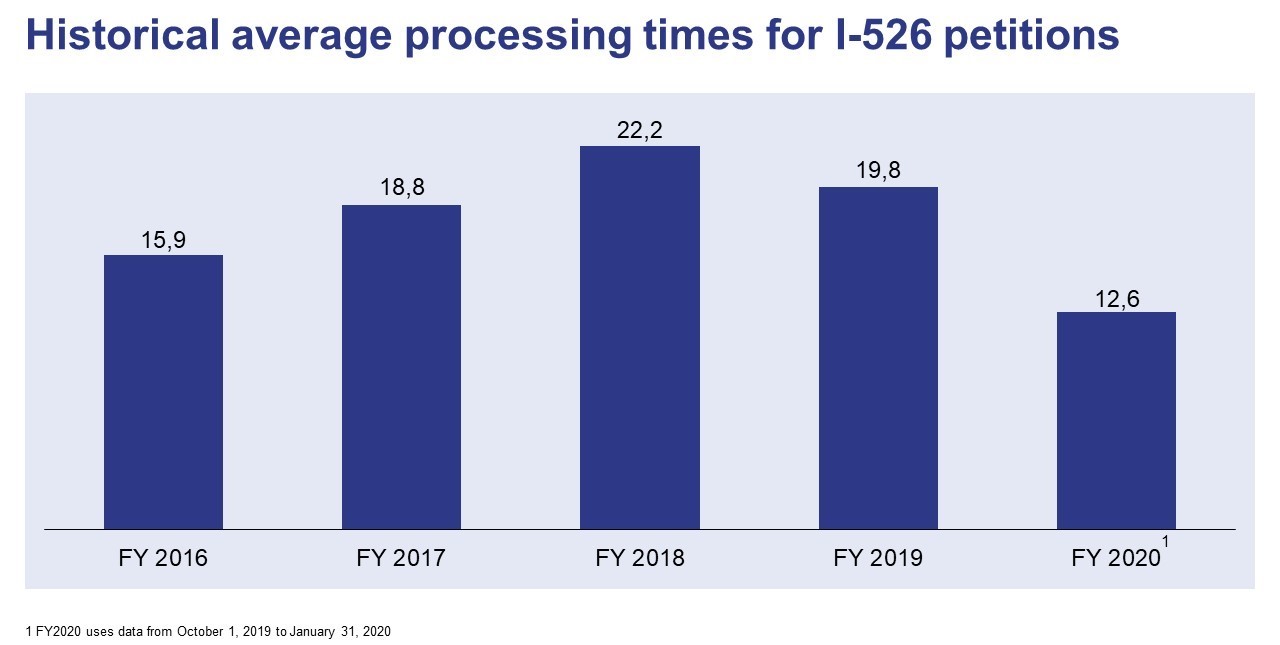
Graph showing historical average processing times for I-526 petitions from Fiscal Year 2016 through Fiscal Year 2020.

I-526 adjudication has never been a fast process, with EB-5 investors almost always required to wait at least a year and often longer. Although processing times rose steadily from FY2016 to FY2018, FY2019 marked the beginning of a downtrend, which has continued strong into FY2020. The current data for FY2020, which spans from October 1, 2019, to January 31, 2020, reveals a five-year record low average processing time for I-526 petitions—just over one year. This is a nearly 40% drop, one of the largest in EB-5 history.

With the COVID-19 pandemic raging on, shutting down U.S. consulates worldwide and United States Citizenship and Immigration Services (USCIS) offices domestically, the Immigrant Investor Program Office (IPO) continues to adjudicate I-526 petitions. It is reasonable to speculate that the pandemic could push the adjudication times down even further, as the IPO may no longer be able to perform activities that otherwise would have diverted its attention from I-526 petitions.

Free EB-5 Project Evaluation

A Guide to Form I-829

Filing Form I-829 is the final step before an EB-5 investor completes the EB-5 visa process and obtains unconditional permanent resident status in the United States. The three main administrative steps in the EB-5 process are filing Form I-526, applying for conditional permanent residence, and petitioning United States Citizenship and Immigration Services (USCIS) to remove the conditions on permanent residence. This guide provides a comprehensive overview of preparing and filing USCIS Form I-829, starting with a brief background of the I-526 process and the path to conditional permanent residence.

Form I-526

The first petition in the EB-5 process is Form I-526, which investors use to launch their EB-5 application with USCIS. EB-5 investors file their I-526 petitions after transferring their EB-5 capital to the designated account in their chosen EB-5 project, and upon adjudication, which typically takes around two years, they can apply for conditional permanent residence for themselves, their spouses, and their unmarried children below the age of 21. EB-5 investors in the United States must file Form I-485, Application to Adjust Status, to secure conditional permanent residence, while those outside the United States must submit Form DS-260 to the National Visa Center in their home countries.

Part of the I-526 petition involves demonstrating that the investor’s EB-5 funds have come from legal sources. The requirement to collect and, where necessary, translate, a large number of documents presents difficulty to many EB-5 investors. Additionally, when preparing an I-526 petition, EB-5 investors must provide the hiring schedule of the new commercial enterprise (NCE) and projections that indicate the creation of at least 10 new full-time jobs for U.S. workers, which is one of the key requirements of the EB-5 program.

When to Prepare and File Form I-829

Once an EB-5 investor and his or her family have received U.S. green cards, the family can relocate to their desired area in the United States. If the associated EB-5 project is affiliated with an EB-5 regional center, the investor is not tied to the project region and has the right to live anywhere in the United States.

The conditional permanent resident status EB-5 investors secure after I-526 approval is valid for two years. Throughout this period, the investor must maintain his or her capital invested in the EB-5 project in an “at risk” status and should refrain from excessive travel abroad to maintain permanent resident status in the United States.

In the last 90 days of conditional permanent residency, the EB-5 investor must file Form I-829. It is strongly recommended to start preparing in advance because if USCIS does not receive an investor’s Form I-829 petition within the specified time frame, the investor’s permanent resident status could be jeopardized.

Preparing Form I-829

Form I-829, Petition by Investor to Remove Conditions on Permanent Resident Status, is an EB-5 investor’s ticket to full permanent resident status in the United States. It is contingent on existing permanent resident status, so the EB-5 investor must present his or her green card on the application.

The main purpose of Form I-829 is documenting that the EB-5 investor has fulfilled the requirements of the EB-5 program. The key requirements are the establishment and continued existence of a new commercial enterprise (NCE) throughout the investment period, an investment in the NCE of the minimum required amount ($1.8 million or $900,000, depending on the project’s targeted employment area designation), and the creation of 10 new full-time, permanent jobs for U.S. workers.

EB-5 investors must submit abundant evidence with their Form I-829 petitions to demonstrate that they have met the outlined requirements. Various documents, including tax returns, bank statements, company licenses, receipts and invoices, payroll records, contracts, and more can be used to prove the validity of each EB-5 investment to USCIS.

If an EB-5 investor has a criminal history, he or she is also required to include documentation such as court records, law enforcement statements, or records of arrest with his or her Form I-829 petition.

Filing Form I-829

Form I-829 costs $3,750 to file, plus an $85 fee for biometric services, if required. Once the I-829 petition is completed, the EB-5 investor must send it to the USCIS Dallas Lockbox in the 90-day period before the expiry of his or her conditional permanent residency. On average, it takes USCIS between two and four years to adjudicate a Form I-829 petition, but the EB-5 investor and his or her family retain the right to remain in the United States as permanent residents while their application is pending.

Upon I-829 approval, the EB-5 investor will receive a new green card without conditions. This marks the end of the investor’s EB-5 journey. After living in the United States as a permanent resident for five years, the investor may apply for U.S. citizenship, if desired.


Free EB-5 Project Evaluation

Reasons to Immigrate to the United States—Even Despite COVID-19

With entry bans, significantly reduced flight schedules, and mandatory quarantines, immigration during the COVID-19 pandemic is more or less impossible, but immigration to the United States after the pandemic is not only possible, it’s a great idea. For investors worldwide, the EB-5 program is the ideal pathway to a U.S. green card. Here’s why you should still relocate to the United States after COVID-19.

Your U.S. family will still be there.

All the isolation and social distancing of the new COVID-19 era has caused many people to long for more companionship. If you have relatives in the United States who you’d like to reconnect with following the COVID-19 crisis, an EB-5 visa represents an excellent opportunity to spend valuable time with your U.S. family. To maintain your U.S. permanent resident status, you’ll need to spend the majority of your time in the United States, refraining from taking long trips abroad. However, after only five years of permanent residency, you can apply for U.S. citizenship, which grants you the freedom to divide your time between the United States and your birth country as you desire.

U.S. post-secondary education institutes are still the best in the world.

Lists of the most renowned universities in the world are always filled with U.S. colleges, many of which—such as MIT, Stanford, and Harvard—reach the highest ranks. While the COVID-19 pandemic has forced campuses to close and classes to move online in many U.S. schools, U.S. colleges remain some of the most prestigious schools in the world and will continue to issue high-quality degrees after COVID-19.

The EB-5 program is perfect for international students who wish to take full advantage of life in the United States. Not only can an EB-5 visa make gaining admission to a U.S. college easier, but it can also potentially save students thousands in in-state tuition savings. Students with EB-5 visas also have the right to seek employment during their studies without restrictions, just like their U.S. peers.

COVID-19 may not hamper the U.S. economy for that long.

Most recessions are the result of diminished consumer demand, but such is not the case in the COVID-19 pandemic. Though many businesses are struggling to stay afloat during the crisis, the government’s generous aid programs and loans will help many survive this deadly virus and bounce back once people are allowed to leave their homes again. The pandemic could also spur the growth of particular industries, such as health care, technology, and online businesses.

The economy may be rife with lucrative investment opportunities following the crisis.

The conclusion of the pandemic may be the right time to jump on the housing market. With the real estate market shrouded in uncertainty, buyers and investors may secure irresistible deals on houses and properties.

The post-coronavirus era could also bring good news for EB-5 investors. The employment landscape of the United States could shift dramatically, driving up unemployment rates in hard-hit areas such as New York City. Such shifts would mean that many more areas of the United States could qualify as targeted employment areas (TEAs), which would permit EB-5 investors to invest a lower minimum investment amount.

The EB-5 program is still going strong amidst COVID-19.

While the coronavirus pandemic has forced the closures of all U.S. embassies and consulates and United States Citizenship and Immigration Services (USCIS) has shut its doors to the public, the processing of EB-5 applications continues. In fact, I-526 petitions may even be processed faster than average, since USCIS now has more time to focus on adjudication.

Free EB-5 Project Evaluation

EB5AN National TEA Map Updated Following Release of Annual BLS Data for 2019

In April 2020, the U.S. Bureau of Labor Statistics (BLS) released the annual employment data for 2019. EB5AN has updated its national EB-5 TEA map to ensure that EB-5 investors and developers have access to the most up-to-date information related to targeted employment area (TEA) designation.

Understanding the Effects of the April 2020 Annual BLS Data Update on EB-5 TEA Designations

Finding the relevant data to calculate unemployment rates for TEA designation, and performing these calculations, can be complex, yet accurately identifying TEAs is a crucial step in the EB-5 investment process. For a better understanding of the BLS annual data update and what it means for TEA designation, watch the video below of the Annual 2020 TEA Map Update and Training webinar presented by Sam Silverman and Mike Schoenfeld, managing partners of EB5AN. Topics discussed include confirming TEA designation, the data sets used to calculate unemployment rates, combining census tracts on the EB5AN TEA map, and more.

How Does the EB5AN National TEA Map Work?

The EB5AN national TEA map is a free tool that allows users to instantly see whether their projects are located within TEAs and thus qualify for the lower EB-5 investment amount of $900,000. In addition to being able to choose rural areas that qualify as TEAs, users can view high unemployment TEAs, with unemployment levels based on both the census-share method and American Community Survey (ACS) five-year data method. Users can also combine census tracts to determine whether a combined area qualifies as a TEA.

Calculating Unemployment Rates for High Unemployment TEAs

To identify high unemployment TEAs, United States Citizenship and Immigration Services (USCIS) accepts two calculation methods: the census-share method and the ACS five-year data method. Moreover, for an area to qualify as a high unemployment TEA, the unemployment rate must be at least 150% of the national unemployment rate.

The ACS five-year data set, which includes unemployment data by census tract, is released each December for the preceding five years. In other words, the ACS data set released in December 2019 contains data covering 2014 to 2018. In December 2020, the five-year data spanning 2015 to 2019 will be released. Thus, this layer of the EB5AN TEA map remains up to date. According to this data set, the relevant base national unemployment rate is 5.86%, so to qualify as a TEA, an area must have an unemployment rate of at least 8.79%.

The census-share method combines ACS five-year data with BLS one-year data to enable users to calculate the employment and unemployment rates at the census-tract level. BLS data typically focuses on larger areas, so ACS data is used to disaggregate the BLS data. Annual BLS data is published in mid-April each year, with the data covering the previous year. In other words, the April 2020 data relates to employment data for 2019. According to the latest data set, the national U.S. unemployment rate is 3.66% for 2019, so to qualify as a TEA, an area must have an unemployment rate of at least 5.49%.

Following the publication of the latest annual BLS data in April 2020, EB5AN has updated the census-share layer of its national TEA map. Therefore, EB-5 investors and developers can keep making informed decisions about project locations and TEA designation.

The Impact of the COVID-19 Pandemic on Unemployment Rates

While the COVID-19 pandemic has had a significant impact on unemployment in the United States and the rest of the world, the full effect on the U.S. unemployment rate will not become clear until April 2021 at the earliest. This delay is due to the publication dates of the BLS and ACS data.

Annual BLS data is published in April each year, so the data released in April 2021 will reflect the current impact of the pandemic on employment. For calculations made using ACS five-year data, updated data that reflects the current employment situation will not be available until December 2021. However, monthly and annual BLS data could be useful in anticipating future TEA status.