



Author Archives: admineb5

Free EB-5 Project Evaluation

2nd Circuit Court Decision’s Effects on Form I-485 Petitions

2nd Circuit Court Decision’s Effects on Form I-485 Petitions

The U.S. Second Circuit Court of Appeals published its decision allowing the Department of Human Services (DHS) to recommence the implementation of the Public Charge Ground of Inadmissibility final rule on September 11, 2020. According to an alert from United States Citizenship and Immigration Services (USCIS), the decision stays the injunction, which was issued in late July 2020, that prevented the public charge final rule from being enforced during a national health crisis (the COVID-19 pandemic).

The final rule is legislation that outlines requirements pertaining to grounds of immigrant inadmissibility based on current or projected status as a public charge. Because the EB-5 program is designed as a path into the United States for qualified immigrant investors – some of whom do have an opportunity to use public services – it is imperative to understand how this decision can affect them.

In this article, you will learn what the U.S. government deems a public charge, which government benefits are included in the public charge final rule, how it can impact their form I-485 adjudication, and ultimately what it means for their EB-5 investment processing.

Determining Whether an Immigrant Will Be a Public Charge

The Immigration and Nationality Act (INA) says that when an immigrant seeks admission into the United States (or to adjust their status to lawful permanent residence), they may be deemed inadmissible if “at the time of application for admission or adjustment of status, [they are] likely at any time to become a public charge.” This translates to a denial of admission or of their petition for adjustment in status. So who, then, is considered a public charge according to the final rule?

Public Benefits Outlined by the INA

When an immigrant is evaluated as someone who is more likely than not to receive one or more of a specifically outlined set of public benefits at any time in the future for more than 12 months in a three-year period, they would be classified as inadmissible. Generally speaking, the public benefits included under this rule are as follows:

  • Income maintenance from federal, state, local, or tribal programs issuing cash benefits
  • Public housing
  • Medicaid benefits
  • Section 8 housing or rental benefits
  • SNAP benefits (the Supplemental Nutrition Assistance Program)
  • Supplemental security income
  • Temporary assistance for needy families

There are two types of applicants most often included: those seeking admission or adjustment of status to lawful permanent residence and non-immigrants who would like to either extend their non-immigrant stay or change their nonimmigrant status in some way.

None of the above-outlined considerations alone will make any immigrant inadmissible other than not providing a sufficient affidavit of support. If you have questions regarding whether a particular set of government benefits are considered applicable to the new legislation, reach out to an experienced EB5 attorney for answers. In the meantime, read on for other considerations adjudicators make when determining whether an immigrant may or may not need to access these benefits in a significant way.

Factors in Determining the Likelihood of Becoming a Public Charge

The factors considered during the adjudication process run the gamut of an immigrant’s circumstances. Here are the most common:

  • An applicant’s age and general health
  • Their family status
  • The assets, financial situation, and access to resources they have
  • Their educational background and skillsets
  • What their prospective immigration status is and the expected period of admission
  • A sufficient affidavit of support

Foreign investors in the EB-5 program (and their qualified family members) who are nearing the end of their investment term sometimes fall under the category of those seeking to adjust their immigration status. Form I-485 and Form I-829 are the specific petitions most likely to be affected by the 2nd Circuit decision, as they are an EB-5 investor’s applications to a) adjust their status from non-immigrant to conditional immigrant status and then b) remove those conditions.

The following is a quick refresher on EB5 program basics, an explanation on when Form I-485 comes into play, and how delays in I-485 processing affect I-829 petitions.

EB-5 Investor Basics and When Form I-485 Comes into Play

The EB-5 Immigrant Investor Program is a pathway to an employment-based visa in the United States. It was created by Congress, was enacted in the 1990s, and is still administered today by USCIS. It was developed as an effort to stimulate the U.S. economy and designed to provide green cards and a path to citizenship to qualified foreign investors. Immigrant investors who are able to infuse lawfully obtained foreign capital into EB-5 program-approved projects around the country in a way that meets all program requirements, especially job creation, can obtain green cards for themselves and their immediate family members.

To gain U.S. permanent resident status through the EB5 program, foreign nationals must meet the following minimum requirements:

  • Invest a minimum of $1.8M in a new commercial enterprise, or a reduced amount of $900K if the project is in a designated TEA (targeted employment area).
  • This capital must prove it has effectively created a minimum of 10 new and sustainable full-time jobs for U.S. workers.
  • All project funding must have been lawfully sourced (and proven as such), and the capital is required to remain “at risk” throughout the investment period.

Although this path to a U.S. green card is straightforward and quicker than most other available options, each part of the investment process has its own set of requirements and can be quite complex. Putting together an I-526 petition—the first petition an EB5 investor files—can be complicated and time-consuming, especially in regard to the source-of-funds requirement. In a later-stage example, when an investment period is extended beyond an investor’s funding terms, often it is most beneficial for them to redeploy their capital in order to maintain the required at-risk status.

Partnering with an experienced EB-5 attorney and using available resources, like the EB5AN TEA map or the EB-5 Project Risk Assessment Questionnaire, can greatly improve an investor’s experience and help them manage the expectations of qualifying family members along the way.

Regarding the recent court decision, there are seven basic steps in the EB-5 process, and the 2nd Circuit Court’s stay is most likely to affect foreign investors in the later stages of EB-5 processing. Specifically, investors who have met all of their investment requirements and have sought to update their status through USCIS form I-485 may have experienced a denial between July 2020 and now. Learn more below.

USCIS Form I-485: An Overview

Via Form I-485, EB-5 participants who are already in the United States can petition USCIS to update their immigration status to a conditional permanent resident. Only after an applicant’s I-526 petition is approved may they file an I-485 petition for this adjustment in status. Questions on the application pertain to biographical information USCIS will use to determine whether an applicant is eligible for permanent residency, and it is typically filed by the applicant’s EB-5 attorney.

Information Included in the I-485 Petition

Information requested can include but is not limited to:

  • All biographic details as required by Form G-325A
  • Biometric service documents like fingerprints, photograph, and signature
  • Copies of passport pages and all documents showing U.S. status has been maintained
  • Criminal history
  • Evidence of the approval received for their I-526 petition (Form I-797C)
  • Familial certificates including birth, marriage, and divorce certificates
  • Medical exams and vaccination records

Fees to Accompany Form I-485

An investor must also include application and biometric requirements fees with their Form I-485 submission. Note that when an applicant is age 78 or older, the biometric fee is waived. Additionally, USCIS application fees were set to change in early October 2020. As of this writing, a judge has imposed a temporary delay on the fee change, but that could change at any time. The current application fee for I-485 petitions is $1,140 per submission, but under the new rules, that fee would be reduced by $10. Depending upon an EB-5 participant’s current address, the application will be mailed to the lockbox facility for USCIS in either Texas or Arizona.

Estimated Processing Times on I-485 Petitions

Adjusting your residency status in the United States is a big step, and not just philosophically. The wait can be long (and difficult), as well. Form I-485 processing times vary significantly based on factors such as proper filing and documentation and USCIS’s caseload in a given area. That said, here is a brief outline of the typical waiting period for each step after filing a Form I-485:

  • 2 TO 3 WEEKS: Notice from USCIS confirming the receipt of an application
  • 3 TO 5 WEEKS: USCIS notice assigning the biometrics appointment
  • 5 TO 8 WEEKS: The biometrics screening appointment (not the interview)
  • 12 TO 16 WEEKS: Petitioner receives their EAD card, if applicable
  • 4 TO 10 MONTHS: Notice from USCIS to attend an adjustment-of-status interview
  • 6 TO 12 MONTHS: The adjustment-of-status interview

During an EB5 investor’s adjustment-of-status interview, one of the considerations made is whether there is any likelihood that they will become a public charge. If there is a concern, the I-485 petition may be denied.

Otherwise, between 8 and 12 months, when USCIS determines an applicant eligible, they are granted permanent residence. In the case of EB-5 investors, two years after securing conditional permanent resident status (if they have met all pertinent program requirements), they must file an I-829 petition to have those conditions removed.

If you are an EB-5 investor who has been impacted by this recent legislation and has ultimately had an I-485 petition denied, here’s how an attorney can help.
Free EB-5 Project Evaluation

Determining TEA Qualification with EB5AN’s TEA Map

TEAMapImageforEB5ANHomepage

Foreign investors interested in relocating to the United States and obtaining U.S. permanent resident status are fortunate that the EB-5 Immigrant Investor Program, one of the easiest and quickest pathways to U.S. immigration, remains in full swing even after 30 years. The program offers foreign investors U.S. green cards in exchange for an investment in a qualifying EB-5 project, as long as the EB-5 investor can prove their investment resulted in the creation of a minimum of 10 new full-time jobs for U.S. citizens or residents.

To qualify for the EB-5 program, an investor must commit a certain minimum amount of capital to their chosen EB-5 project. In general, the minimum required investment amount is $1.8 million, but if the project is in a targeted employment area (TEA), the required amount drops to $900,000. Most EB-5 investors prefer this lower amount, but United States Citizenship and Immigration Services (UCSIS) does not automatically designate areas as TEAs. Rather, USCIS provides a set of criteria and methodologies, and EB-5 investors must demonstrate TEA eligibility on their I-526 petition.

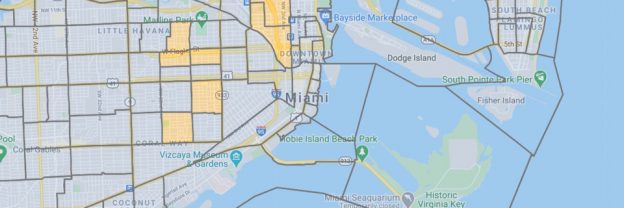
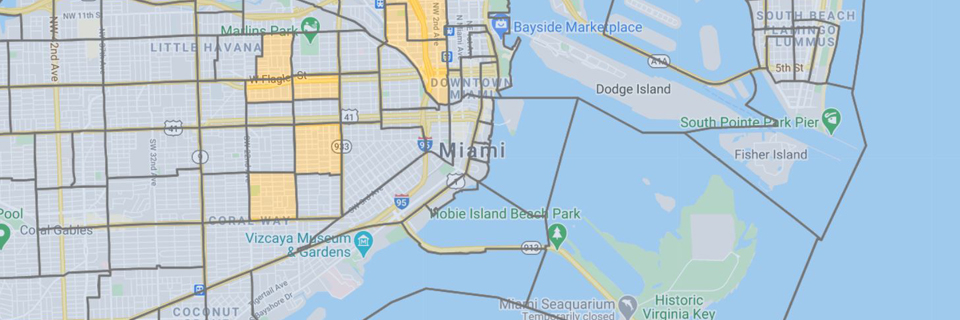
EB5AN, a leading EB-5 consulting firm and regional center operator, has launched an interactive EB-5 TEA map to assist prospective EB-5 investors with locating qualifying TEA EB-5 projects. TEAs are divided into two variants—high-unemployment TEAs and rural TEAs—and EB5AN’s TEA map constitutes an easy-to-use tool that helps investors locate both types of TEA projects.

High-Unemployment TEAs

High-unemployment TEAs are areas that have an unemployment rate at least 50% higher than the national U.S. average. Only urban areas may qualify as high-unemployment TEAs—otherwise, the area may qualify as a rural TEA.

USCIS allows EB-5 investors to choose between four different methodologies to calculate whether an area qualifies as a high-unemployment TEA. The first is the American Community Survey (ACS) method, which examines five-year ACS data by census tract. The second is the census-share method, which combines the five-year ACS census tract data with county-specific data from the Bureau of Labor Statistics (BLS). Finally, the third is the county-level method, which applies BLS data to calculate unemployment in a single county.

Fortunately for EB-5 investors, USCIS is flexible about TEA designation, so even if a particular census tract doesn’t qualify, investors can group together directly adjacent tracts to form a high-unemployment TEA. EB5AN’s TEA map automatically combines adjacent census tracts to create qualifying TEAs, drastically facilitating the investor’s job.

Rural TEAs

Rural TEAs are more straightforward than high-unemployment TEAs. To ascertain rural TEA eligibility, EB-5 investors should use U.S. Office of Management and Budget data to determine geographical boundaries and population data from the most recent 10-year census to determine population levels. To qualify as a rural TEA, a region must be located outside a metropolitan statistical area (MSA) and have a population of less than 20,000. If the population of the area grows beyond 20,000 after the investor submits their I-526 petition, USCIS will still consider the area a valid rural TEA.

Using the EB5AN TEA Map

One of the most significant features of EB5AN’s TEA map is the ability to generate an I-526-ready formal TEA qualification report. If an EB-5 investor is pursuing the lower investment amount of $900,000, they are required to demonstrate in their I-526 that their EB-5 project is in a qualifying TEA, and putting together the documentation and report to prove this is time consuming and complex. Thus, EB5AN’s ready-made formal TEA qualification report is a major time and effort saver for EB-5 investors.

Determining TEA eligibility is a tedious and complicated process, but EB5AN’s TEA map makes it easy for EB-5 investors to see whether their EB-5 project qualifies for TEA status. By highlighting qualifying TEA regions, the map allows EB-5 investors to locate qualifying TEAs all across the United States. By automatically combining adjacent census tracts to create custom TEAs, EB5AN’s map takes most of the guesswork out of TEA calculations.

The EB5AN map also displays whether a given TEA is covered by one of EB5AN’s 14 regional centers. Regional center investment is popular because it frees EB-5 investors from the requirement of participating in the day-to-day management of the new commercial enterprise (NCE) and relaxes the job-creation requirements, making it easier to obtain a U.S. green card. For project developers, this feature also indicates whether affiliation with an EB5AN regional center is possible.

The EB-5 program is a relatively quick and simple pathway to U.S. immigration for foreign nationals around the world, and EB5AN’s TEA map makes the process that much easier. Prospective EB-5 investors and project developers can use the innovative tool to help them plan their EB-5 investments and projects.

Free EB-5 Project Evaluation

Positive EB-5 Trends in Hong Kong

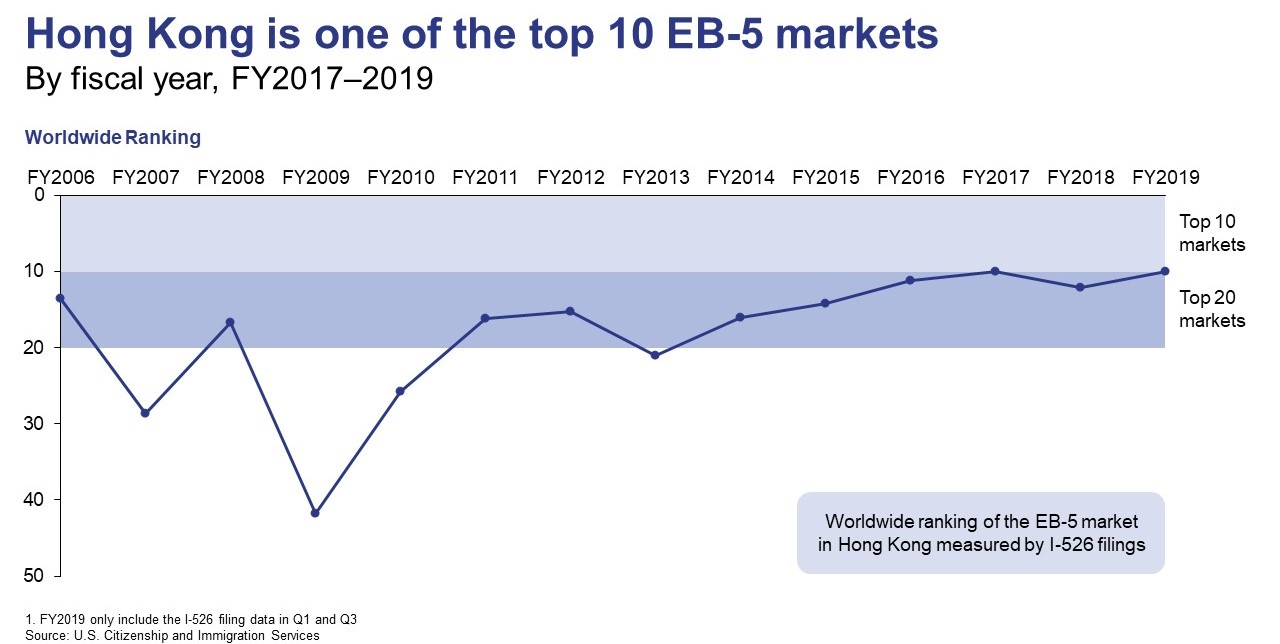
Hong Kong has long been a hotspot of EB-5 demand. Since the early days of the EB-5 Immigrant Investor Program, Hong Kong investors have been eager to invest in qualifying EB-5 projects and obtain permanent resident status in the United States. In the ’90s, Hong Kong was among the top 10 countries for EB-5 demand, and although this ranking dropped from around FY2000 to FY2010, it has since jumped back up, with Hong Kong once again landing among the top 10 EB-5 countries in FY2019.

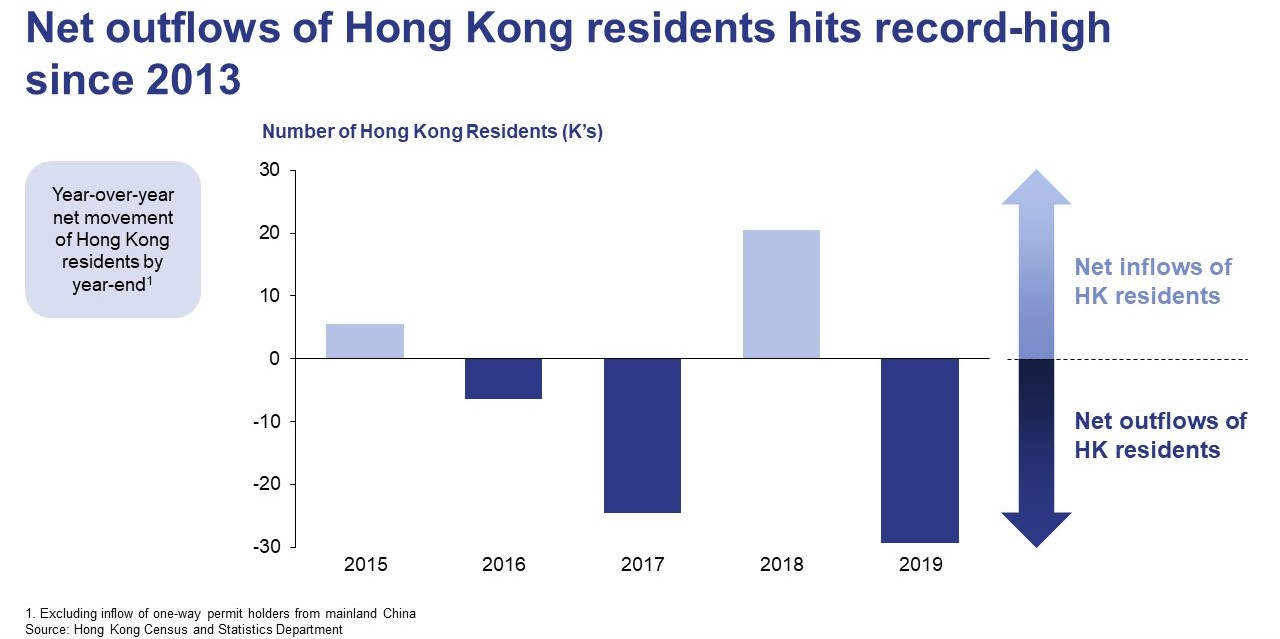
The reasons are many—from political tension with China to an overcrowded living situation. Statistics from the Hong Kong Institute of Asia-Pacific Studies and the Chinese University of Hong Kong indicate emigration intent is high in the special administrative region (SAR). Fortunately for Hong Kong EB-5 investors, investors from the country have also historically enjoyed low rejection rates and speedier adjudication than applicants from most other nations.

Growth in EB-5 Demand from Hong Kong Since FY2015

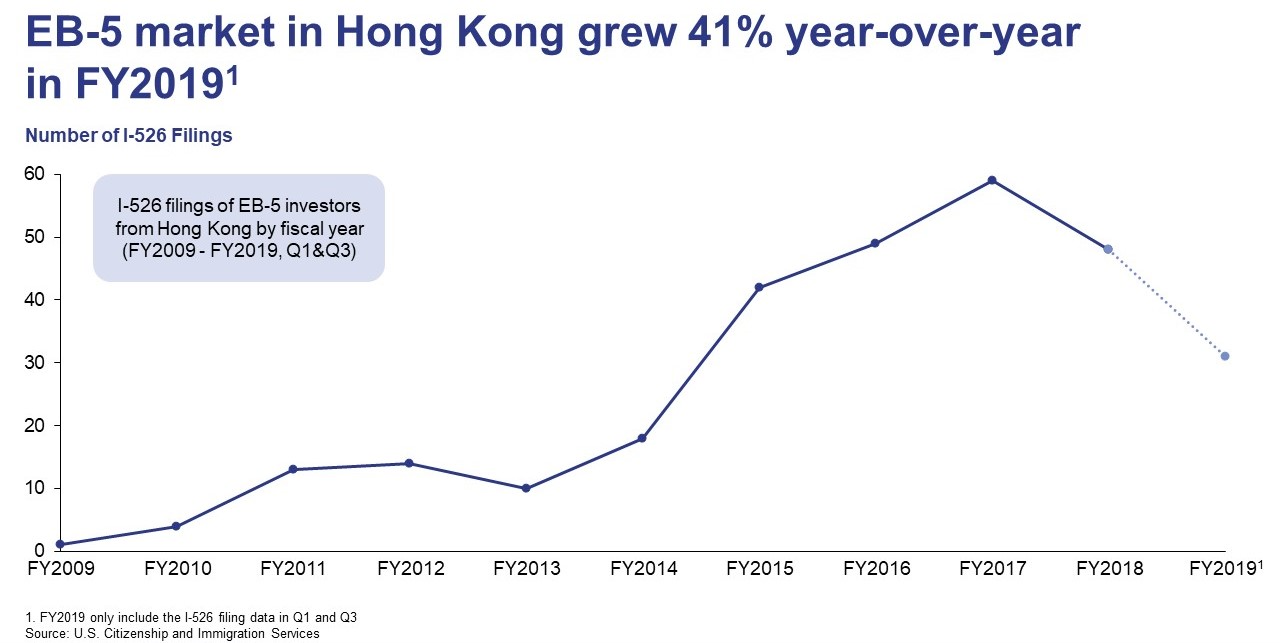
Investor interest from Hong Kong in the EB-5 program was relatively low in the ’00s, with only a single Hong Kong investor participating in FY2009. Demand increased to an average of 12 between FY2010 and FY2014, but FY2015 demonstrated a marked difference: the number of Hong Kong EB-5 investors shot up to 48, from 18 in FY2014. The figure peaked in FY2017 at 59 and has fallen a bit since, but EB-5 demand in Hong Kong remains significantly higher than before FY2015, with an average of 50 investors between FY2015 and FY2018.

Hong Kong EB-5 Investors a Boon to U.S. Economic Stimulation Efforts

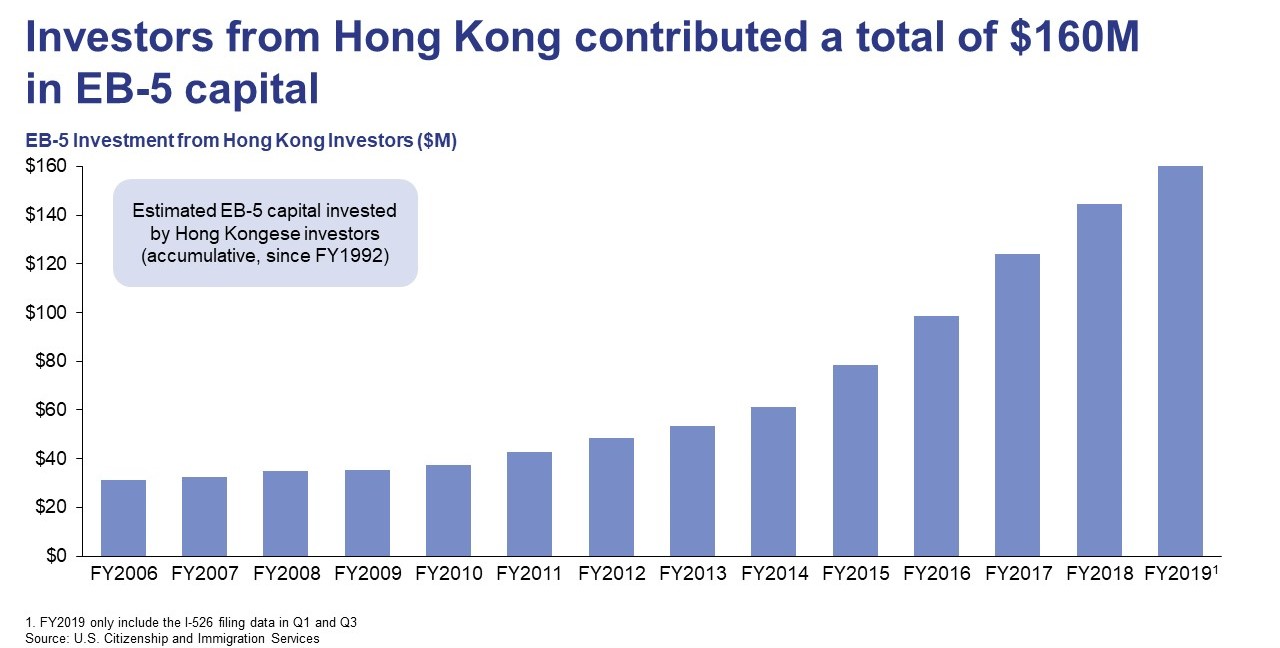
The EB-5 program is fundamentally a method for the U.S. government to stimulate the economy and foster the creation of new jobs, and Hong Kong investors have played an important role in boosting the U.S. economy thus far. As of FY2019, it’s estimated that EB-5 investors from Hong Kong have contributed more than $160 million to the economy, creating countless new jobs for U.S. workers. In fact, given the boom in EB-5 demand in Hong Kong since FY2015, it’s estimated that Hong Kong EB-5 investors pour around $21 million into the United States each year.

Hundreds of Hong Kong Investors Have Successfully Completed the EB-5 Program

Between FY2000 and FY2019, the United States has welcomed around 700 EB-5 investors and their immediate family members from Hong Kong. A large portion of these investors are recent immigrants, with 367 Hong Kong investors and their families gaining permanent resident status in the United States between FY2018 and FY2019. The introduction of a controversial national security law by Beijing authorities and Hong Kong’s subsequent revocation of special status in regard to U.S. immigration may quash future EB-5 demand from the SAR, since it places Hong Kong investors in the massive Chinese EB-5 backlog, or it could fuel demand, given the increased desire many Hong Kongers may have to permanently emigrate.

Hong Kong Investors Overwhelmingly Prefer TEA Projects

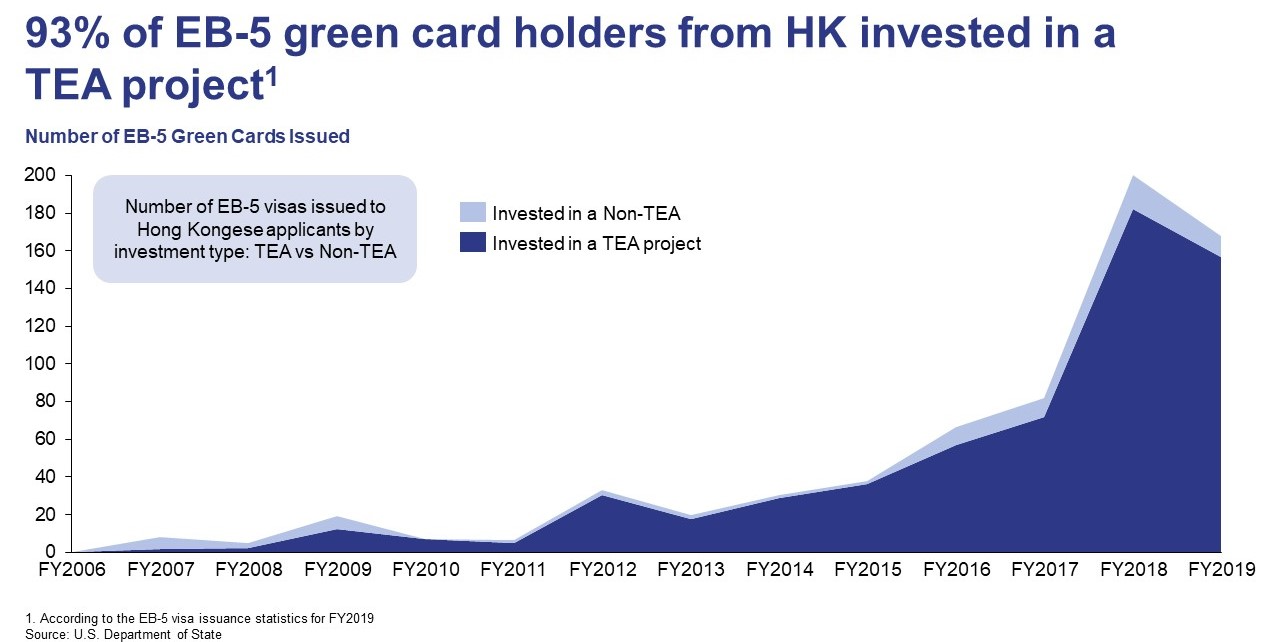
Data shows that EB-5 investors from Hong Kong overwhelmingly invest in EB-5 projects in targeted employment areas (TEAs), which qualifies them for a lower EB5 investment amount. While the general minimum required investment amount is $1.8 million, TEA projects qualify for a lower minimum amount—$900,000. Until FY2010, Hong Kong EB-5 investors generally worked with non-TEA projects, when the general minimum required investment amount was $1 million, reduced to $500,000 for TEA projects (the amounts were increased in November 2019 in accordance with the Modernization Rule). From FY2010 onward, however, investors from Hong Kong have largely opted for the lower EB-5 investment permitted for TEA projects. In FY2019, a whopping 93% of Hong Kong EB-5 investors chose the TEA route.

Hong Kong EB-5 Investors Enjoy Higher-Than-Average Approval Rate

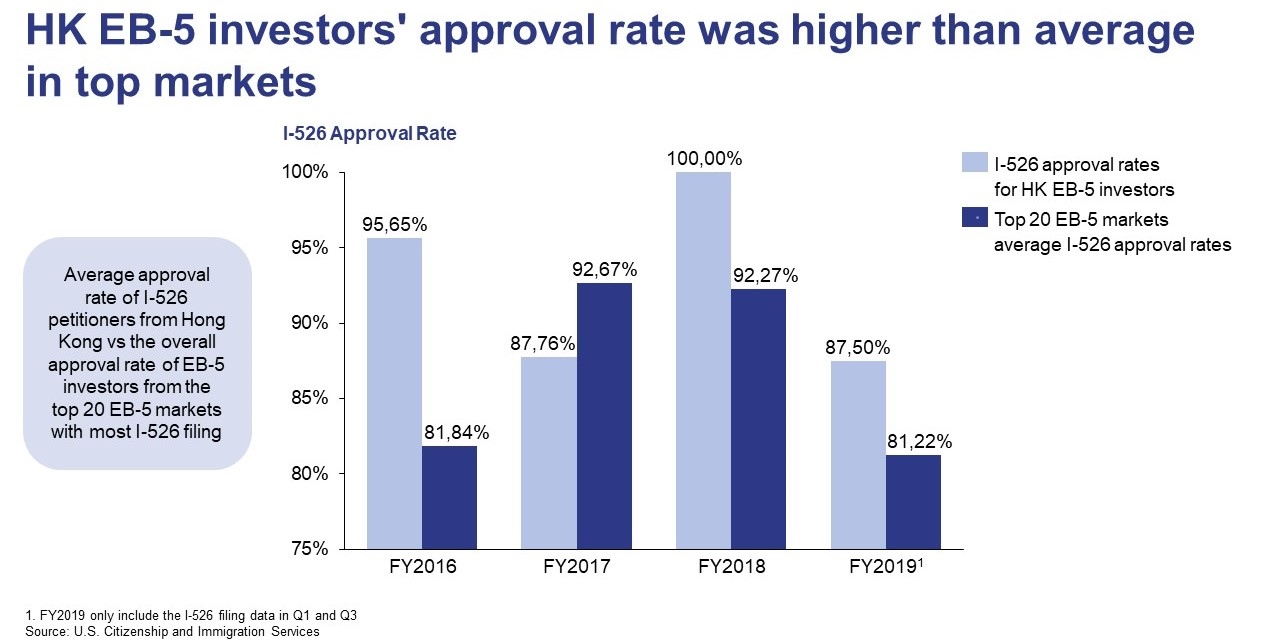
Year over year, the approval rate for Hong Kong EB-5 investors has been high. It’s worth noting that the approval rate for EB-5 investors anywhere is high—proper due diligence, careful adherence to program requirements, and close collaboration with an experienced immigration attorney ensure consistently high outcomes. Looking at Q1 and Q3 of fiscal years 2016 to 2019, however, it’s clear that Hong Kong investors are generally approved at a higher rate than EB-5 investors from the other top 20 EB-5 markets, with the approval rating fluctuating between 87.5% and 100%.

Hong Kong I-526 Petitions Receive Fast Adjudication

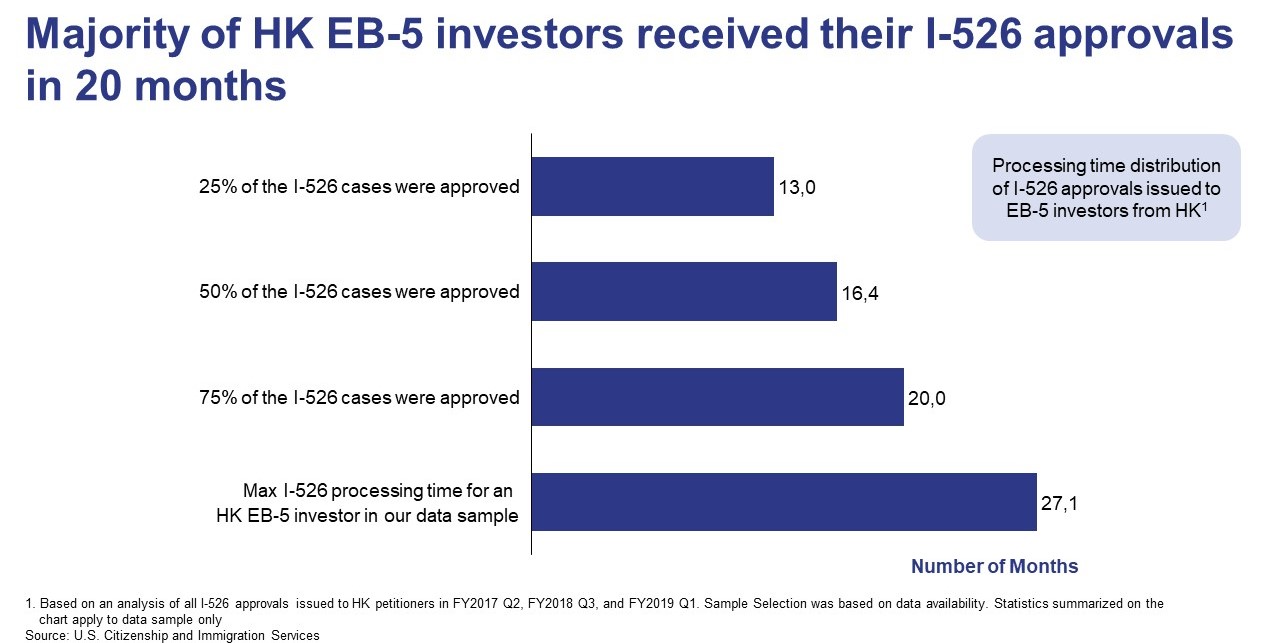
I-526 adjudication speeds can be a tricky subject, with some investors known to wait more than five years, while others receive approval within a few months. Hong Kong EB-5 investors are on the low end of the spectrum, enjoying faster-than-average adjudication times. In different quarters in FY2017, FY2018, and FY2019, a quarter of Hong Kong applicants received I-526 approvals within just 13 months, half received approvals in around 16 months, and three-quarters received approvals in 20 months. The longest wait time was around 27 months—far quicker than the long waiting times for Chinese investors—and some investors had their I-526 petition adjudicated in just 1.8 months.

One significant factor that facilitates the EB-5 process for Hong Kong investors is that it is easy to obtain documentation in English. Investors from any country may participate in the EB-5 program, but United States Citizenship and Immigration Services (USCIS) requires all non-English documents to be translated, increasing the preparation time and effort for investors and complicating the adjudication process for USCIS. With English documentation readily attainable in the SAR, Hong Kong EB-5 investors have a natural advantage over investors from most other countries.

Free EB-5 Project Evaluation

Proving Source of Funds Derived from a Loan Based on Assets During the EB-5 I-526 Petition Process


When applying for an EB-5 visa, the first step in the process is submitting Form I-526, Immigrant Petition by Alien Investor, to U.S. Citizenship and Immigration Services (USCIS). By submitting this petition, the investor proves to USCIS that they meet all the criteria of the EB-5 program—specifically that they have invested the required amount in a new commercial enterprise (NCE) and that their investment will create 10 full-time, permanent jobs for U.S. workers.

While this process sounds simple based on the explanation above, providing relevant supporting documents complicates matters. To support projections related to job creation, the applicant should include a comprehensive business plan and a credible economic report. In addition to providing evidence such as bank statements and loan certificates to show that their capital is irrevocably committed to the investment, the investor must also prove that the investment capital was obtained legally.

The most common source of investor capital in the EB-5 program is asset-based loans. Loans are perfectly acceptable sources of funds, but investors must provide evidence that all assets and loans were obtained legally. If an investor borrows from an individual rather than an institution like a bank, the investor must also prove that the lender’s funds were obtained legally.

We’ve developed a case study that shows a strategy for proving that funds were legally obtained in a case involving a loan secured against an ownership stake in a hotel, with the loan funds derived from the payments an individual received from a company. We also provide a downloadable EB-5 source of funds example that shows how to present supporting documents to USCIS.

EB-5 Source of Funds Case Study: Funding an EB-5 Investment with a Loan Secured against an Asset

An investor—let’s call her Jane Smith—owns a 40% share in a hotel. Jane’s father had owned the hotel, and when he died, he left a 60% share to Jane’s mother and 20% each to Jane and her sister. In March 2020, Jane’s mother gifted Jane 20% of her ownership stake, leaving Jane with a 40% stake. In March 2020, the hotel was valued at $2,500,000. This implies that Jane’s 40% share is worth $1,000,000.

In April 2020, using her stake in the hotel as collateral, Jane received a loan of $900,000 from John Doe. The loan is secured by a mortgage deed on Jane’s collateral in the hotel and on a personal guaranty granted by Jane in favor of John, the lender. Jane then uses this $900,000 loan to invest in an EB-5 project in a targeted employment area (TEA).

Supporting Documents Needed to Prove the Loan Derived from Legal Sources of Funds

  • 1. Proving ownership of the collateral

In Jane’s case, her I-526 petition should be accompanied by documents proving that she owns a share of a hotel that she partly inherited from her father and partly received as a gift from her mother. She also needs to provide proof that her share provides enough collateral to act as security for the loan.

To clearly explain the source of her collateral to USCIS, Jane should include the following exhibits in her cover letter:

  • Certificates of title for the hotel
  • Selection of online booking pages for the hotel (as proof that it exists and is in operation)
  • Death certificate for her father
  • Her father’s will
  • Deed of donation showing that Jane’s mother gifted her shares in the hotel
  • Hotel valuation letter
  • 2. Proving the loan agreement is legal

Jane needs to prove that the loan funds were legally acquired. In other words, she needs to prove to USCIS that she entered into a legal loan agreement, with the loan secured against her collateral in the hotel. To prove the legality of the loan, Jane can provide the following documents:

  • Loan agreement
  • Note
  • Personal guaranty
  • Deed of mortgage
  • Monthly documentary stamp tax declaration return for the recording of the deed of mortgage
  • 3. Proving the funds used for the loan were obtained legally

Finally, Jane needs to provide evidence of the source of John Doe’s funds. Let’s say John is a managing member in a consulting business called XYZ Consulting, which was established with zero start-up capital. The funds he used to provide the loan derived from dividends disbursed by the company.

Jane should confirm John’s identity by providing copies of his passport and most recent tax returns. Next, she should provide a brief overview of John’s involvement in the business and of the business itself. To show that the company started with no start-up funding, Jane can include the company’s bank statement for its first year of operation.

To prove the company exists and is in good standing, Jane can provide the following supporting documents:

  • Certificate of Formation of XYZ Consulting
  • FEIN letter from IRS for XYZ Consulting
  • Operating agreement for XYZ Consulting

Jane can then provide a brief overview of the services provided by XYZ Consulting, relying on the operating agreement as documentary evidence. To show that the company’s income—and thus the dividends disbursed—derives from legal operations and that taxes have been paid on all earnings, Jane can include the following:

  • A selection of client invoices for 2018 (the previous fiscal year)
  • XYZ Consulting’s 2018 bank statements, with the payments relating to the invoices included highlighted for ease of reference
  • XYZ Consulting’s audited financial statements for 2018
  • XYZ Consulting’s tax return for 2018

The documents listed above will include information about the dividends the company paid to its members. However, Jane would still need to show the amounts of the dividends to prove that John had the funds available to provide the loan. Jane should include

  • All tax-related documents for XYZ Consulting
  • John’s personal tax documents showing income received from XYZ Consulting
  • John’s personal bank statements covering the period in which the dividends were paid
  • Letter from the company’s auditor explaining the dividends

Explaining the Source of Funds as Part of an EB-5 I-526 Petition

The I-526 petition is accompanied by a cover letter that explains the significance of the evidence presented to USCIS that the petitioner’s investment complies with the regulations set out in the EB-5 program. It also lists the exhibits included as evidence of the petitioner’s claims.

To develop a clearer picture of how to present source of funds information and exhibits to USCIS, download our example I-526 cover letter section. This sample source of funds section describes how an investor can demonstrate the source of their EB-5 investment funds for funds obtained through a loan secured against real estate, with the loan funds derived from company profits or dividends.

What makes proving the sources of EB-5 investment capital so challenging is that each investor has unique circumstances. Working with an EB-5 professional like EB5AN can greatly simplify the I-526 application process. Contact EB5AN today to learn how we can help you.

Free EB-5 Project Evaluation

The 8 Steps of the EB-5 Visa Program

Introduced in 1990, the EB-5 Immigrant Investor Program offers foreign investors worldwide something that millions dream of—a life in the United States. In exchange for qualifying investments in new commercial enterprises in the United States, wealthy foreign nationals and their families can obtain green cards and, eventually, if they wish, U.S. citizenship.

While the EB-5 process is quite complex, it can roughly be broken down into eight main steps.

Step 1: Conduct Initial Research

As a potential EB-5 investor, you must consider whether you are eligible for the program and whether it aligns with your goals. Because of the complexity of the EB-5 program and U.S. immigration law, we recommend that you engage the services of an experienced immigration attorney in this research.

If you currently reside in the United States on a different visa and wish to participate in the EB-5 program, you must be an accredited investor. To qualify as an accredited investor, you must either have earned $200,000 for two consecutive years and expect the same level of income for the current year, have earned $300,000 between you and your spouse for two consecutive years and expect the same level of income for the current year, or have a net worth of at least $1 million, excluding your primary residence, between you and your spouse. It is recommended to include in your I-526 petition a letter from your accountant or immigration attorney verifying your accredited investor status.

It is also important to consider whether applicants from your country are subject to visa backlogs. Visa backlogs occur when EB-5 demand from a given country exceeds the number of visas available for that country, and it can result in visa retrogression. You can find up-to-date information about visa availability for your country by checking the monthly Visa Bulletin issued by the State Department.

Step 2: Find One or More Potential Projects

Once you’ve determined that the EB-5 program aligns with your goals, you need to look for a suitable EB-5 project. A good EB-5 project poses both low financial risk and low immigration risk.

Another factor you should consider when looking for a suitable EB-5 project is its targeted employment area (TEA) designation. EB-5 projects in TEAs, defined as high-unemployment urban areas or rural areas of fewer than 20,000 inhabitants, are subject to a minimum investment amount of $900,000, half of the otherwise required $1.8 million.

Finally, you must determine whether you wish to invest directly or via an EB-5 regional center. Investors who invest via regional centers have limited management responsibilities, which is ideal for those who wish to invest solely to receive a green card. Another major benefit of regional center investment is the relaxed job creation requirements. To be eligible for a green card, EB-5 investors must create at least 10 new full-time jobs with their investment, but projects working with regional centers can count indirect and induced jobs toward the job count.

Step 3: Conduct Careful Due Diligence on Your Preferred Project

After you’ve selected a project, you will need to conduct due diligence to make sure you’re not putting yourself at financial or immigration risk. To comprehensively evaluate a potential investment project’s financial and immigration risk, you can use our free EB-5 Project Risk Assessment Questionnaire.

To access an EB-5 project’s documents, potential EB-5 investors typically have to sign a confidentiality agreement. Signing a confidentiality agreement allows investors to read a project’s documentation without an obligation to invest in it.

While it is impossible to determine with 100% certainty whether an investment in an EB-5 project will be successful, there are some key indicators to look for. Make sure the prospective project is highly transparent and complies with the relevant EB-5 rules, uses objective third parties to evaluate and assess its assumptions and financial analyses, and predicts job creation numbers well above the requirements of the EB-5 program.

Step 4: Invest the Necessary Capital in the EB-5 Project

Once you’ve selected a suitable project and thoroughly assessed it for risks, you can finally concretely begin your investment. Before handing over your capital, consult with your immigration attorney to make sure you and the project developer are following all applicable laws and regulations. Then, carry out the investment as outlined in the project documents. In many cases, your investment will initially be stored in an escrow account.

Depending on where you reside, the difficulty of this process may differ. For example, Indian nationals are restricted by limitations on capital outflows imposed by the Reserve Bank of India, which complicates the investment process. Often, Indian investors must funnel their investments through foreign banks.

Step 5: Work with Your Immigration Attorney to Compile Personal Documents

Once your EB-5 investment is in escrow, you must file an I-526 petition with United States Citizenship and Investment Services (USCIS) to officially begin the EB-5 process. While it is possible to complete and file the form yourself, it is highly recommended that you seek the assistance of an immigration attorney.

In addition to documentation related to the project and its financial projections, you must include in your I-526 petition copies of personal official documents, such as your passport, birth certificate, and marriage certificate, as well as evidence detailing the source of your investment funds.

Depending on your country of origin, your personal official documents may also need to be translated. In terms of proving the source of your investment capital, a number of different documents are acceptable, including bank documents, employment and wage documents, and documentation of gifts.

Step 6: File Form I-526, Immigrant Petition for Alien Entrepreneur

After you complete Form I-526, the next step is, naturally, to submit it to USCIS. Upon receipt, USCIS will send you a letter notifying you that your petition was successfully filed. The receipt notification will also display your priority date, which determines when you are eligible to apply for a visa.

Once your I-526 petition is approved, you may apply for conditional permanent resident status as soon as a visa becomes available for you. If you are from a country not subject to visa backlogs or retrogression, you may apply for your visa immediately upon I-526 approval. Chinese, Indian, and Vietnamese EB-5 investors may have to wait months or years for a visa to become available.

In the past, when I-526 petitions were processed on a first-in-first-out basis, it typically took around two years until an EB-5 investor received I-526 approval. This has changed with the new visa availability approach, where petitions from countries with available visas are prioritized. This speeds up processing times for investors from countries like Canada, the United Kingdom, and Japan but pushes them back for investors from China, India, and Vietnam.

Step 7: Apply for Conditional Legal Permanent Resident Status

Once you receive I-526 approval and your priority date for your country is current, you may finally apply for your EB-5 green card. The process differs depending on whether you are currently residing inside the United States on a different visa or in your country of origin.

If you are already living in the United States, you will need to file Form I-485 to adjust your resident status. Even if your original resident status expires while your I-485 petition is pending approval, you are permitted to remain in the United States.

If you are living in your home country, you must file Form DS-260 via your local U.S. consulate. Following the processing of your application, you will be required to appear at your local consulate for an immigration interview.

After you complete the visa application process, you will receive a two-year conditional permanent residence card.

Step 8: File Form I-829, Petition by Entrepreneur to Remove Conditions on Permanent Resident Status

The final step in the EB-5 process is to file Form I-829 to remove the conditions from your permanent resident status. You must submit an I-829 petition within the final 90 days of your conditional permanent residency, and on the form, you must demonstrate that your investment has remained at risk for the entire EB-5 process and that it has created the required 10 full-time jobs for U.S. citizens or residents.

Upon approval of the I-829 petition, you will receive your permanent green card. With that, the long, complicated EB-5 process is finally over, and you may enjoy a rich, promising life with your family in the United States.

Free EB-5 Project Evaluation

Rampant Regional Center Terminations Prove the Importance of Working with a Reputable EB-5 Regional Center

Rampant Regional Center

2020 has been an awful year for almost everybody, and EB-5 visa program participants are no exception. The pandemic-induced temporary suspension of routine visa services at U.S. embassies and consulates has prevented thousands of EB-5 investors and their families from receiving their U.S. green cards and starting their new lives in the United States.

But investors aren’t the only ones in the EB-5 world who’ve been suffering in 2020—EB-5 regional center owners are experiencing their own crisis. Since 2019, United States Citizenship and Immigration Services (USCIS) has been cracking down on regional centers, quick to hand out termination notices to those it deems not up to standard. In fact, between February 7, 2020, and September 17, 2020, USCIS terminated 184 EB-5 regional centers.

Trends in Regional Center Terminations and Approvals

The percentage of terminated EB-5 regional centers is significant. From 1,212 approved regional centers on February 7, 2020, the figure has dropped to 1,027 as of September 17, 2020, representing 15% of all approved regional centers. This loss is not offset by new regional center approvals, either—quite the contrary. The last new regional center approvals came in August 2019, meaning USCIS has not approved any new EB-5 regional centers in more than a year. Processing statistics up to FY2019 also indicate that new I-924 petition receipts have been low.

Why have so many regional centers been terminated in 2019 and 2020? Various factors can lead to regional center termination, but the overwhelming majority of regional centers have been terminated due to lack of investor activity. In other words, these regional centers offered EB-5 projects, but investors weren’t signing up to invest in them, and thus they were unable to fulfill their duty of stimulating the U.S. economy.

Why Choosing the Right Regional Center Is So Important

The dismal situation of EB-5 regional centers in 2019 and 2020 highlights the importance of conducting careful due diligence and selecting a reputable regional center you can rely on. If an EB-5 investor’s regional center is terminated, that doesn’t necessarily mean their I-526 petition will be denied, but it does significantly complicate their EB-5 process and necessitates significant amendments to their petition. The easiest, fastest, and least stressful EB-5 journey is with a highly reputable EB-5 regional center with a proven track record of successful projects.

The regional centers run by EB5AN are a good example. EB5AN is a leading EB-5 consultancy business and service provider that operates 14 regional centers across the United States, covering more than 20 states and Washington, D.C. EB5AN has also partnered with other high-quality regional centers around the country to cover the remaining 30 states, offering prospective EB-5 investors a comprehensive network of trustworthy EB-5 regional centers that span the entire United States.

The news of rampant regional center terminations and lack of approvals is concerning to many participants in the EB-5 industry, including investors, but the truth is that investors need not worry so long as they work with a reputable EB-5 regional center with a proven record of success. Regional centers such as the ones managed by EB5AN stay up to date on any changes in USCIS regional center regulations and strictly follow the guidelines to always maintain compliance, providing a seamless EB-5 experience to their investors.

Free EB-5 Project Evaluation

The Mysteries of USCIS’s Estimated Processing Time Range Update

The Mysteries of USCIS’s Estimated Processing Time Range Update

In August 2020, United State Citizenship and Immigration Services (USCIS) split up its estimated processing time range for I-526 petitions into two categories: one for Chinese EB-5 investors and one for investors from any other country. Given that the Chinese EB-5 backlog is massive, with the switch in April 2020 to a visa availability processing approach, the distinction makes sense—Chinese investors may be subject to significantly longer waiting times for I-526 adjudication.

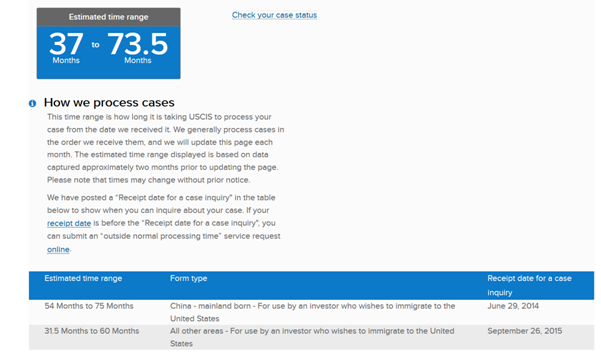
Strangely enough, however, checking the estimated processing times for I-526 petitions on the USCIS website presents users with three time ranges—one for Chinese investors, one for investors from all other areas, and one unspecified time range. With no calculation formula provided, the unidentified time range doesn’t appear to be an average of the other two, making its very existence mysterious. Furthermore, USCIS does not appear to have updated their calculation methodology to reflect the changes in the processing approach, considering that they have left the line “we generally process cases in the order we receive them” unchanged, just as it was under the previous first-in-first-out (FIFO) approach.

Most concerning, however, is the case inquiry dates. At June 29, 2014, for Chinese investors and September 26, 2015, for rest-of-world investors as of September 14, 2020, EB-5 investors must wait five to six years before they’re allowed to inquire about the abnormally long processing times of their I-526 petition. According to the historical processing data, the average processing time for I-526 petitions in FY2020 until June 30, 2020, has been a mere 13.7 months—a far cry from five or six years.

The upper limit for both time ranges also seems strange—both seem far too high to be plausible. Based on country-specific case receipt data USCIS published in October 2018 and subsequently removed in July 2019, assuming USCIS processed I-526 petitions according to the FIFO approach right up until April 2020, the global backlog should have been cleared up to April 2017. That isn’t compatible with the Chinese estimated time range of 54 to 75 months, which would put the receipt date of Chinese I-526 petitions under processing between May 2014 and February 2016. If all these figures add up, USCIS is essentially saying it’s not processing Chinese I-526 petitions.

The calculation that the global backlog should have been cleared up to April 2017 by April 2020 also sheds new light on USCIS’s case inquiry dates of June 29, 2014, and September 26, 2015. If the backlog really was cleared up to April 2017, hardly any EB-5 investors—if any at all—are eligible to file case inquiries. With nontransparent estimated processing time ranges, USCIS seems to be almost entirely preventing case inquiries into its long processing times.

Free EB-5 Project Evaluation

Will the EB-5 Regional Center Program Be Extended at the End of September 2020?

Will the EB-5 Regional Center Program Be Extended at the End of September 2020?

In the EB-5 Immigrant Investor Program, investors have two options for investment: direct investment and regional center investment. While investors can retain more control over their investments through the direct route, engaging in day-to-day management work at the new commercial enterprise (NCE), regional center investment is by far the more popular option. Not only are regional center projects more likely to be located in targeted employment areas (TEAs) and thus qualify for a lower investment amount, but they also offer relaxed job creation requirements, making it easier to qualify for an EB-5 green card.

Despite the popularity of regional centers, the EB-5 Regional Center Program is not permanent in the law. Since 2015, Congress has continually reauthorized the program for periods of one year or less, announced alongside continuing resolutions to fund the program. The program is set to expire on September 30, 2020, but a continuing resolution is in the works and is likely to include a new reauthorization of the program.

Previous reauthorizations have extended the program’s validity without introducing any changes, and it’s expected that the next reauthorization will not bring any changes to the program, either. With the expiration date a mere two weeks away, there isn’t enough time to introduce comprehensive legislation to change the EB-5 program.

EB-5 investors interested in working with regional centers shouldn’t fear this expiration date—in all likelihood, they will be able to proceed with their regional center investment. By far the most popular way to invest in the EB-5 program, the Regional Center Program is not expected to end anytime soon.

Why Invest through a Regional Center?

Even if the Regional Center Program were abolished, the EB-5 program would continue on, albeit with potentially diminished interest from investors. In direct investments, the investor must participate in the daily management of the NCE. This gives the investor more control over their investment but constitutes a major turn-off for investors with little managerial experience or other commitments.

In a regional center investment, investors can generally satisfy the requirement of active participation in the NCE by signing on as a limited partner. While they will be obligated to vote on certain company matters, for the most part, they are uninvolved in the NCE’s operations and even have the freedom to live on the opposite end of the country.

Another important advantage of regional center investment is the relaxed job creation requirements. To receive unconditional permanent resident status in the United States, an EB-5 investor must prove their capital funded the creation of no fewer than 10 full-time jobs for U.S. workers within their two-year conditional permanent residence period. In direct investments, EB-5 investors may only count direct jobs (i.e., those on the payroll of the NCE or directly involved in the construction of the building). In regional center investments, investors may also count indirect jobs (jobs funded by the NCE’s expenses on products and services) and induced jobs (jobs funded by the NCE’s employees spending their wages in the community).

The EB-5 program was a boon to the U.S. economy during the recovery from the Great Recession in 2008. Now, in September 2020, as the nation begins to emerge from the economic damage inflicted by the COVID-19 pandemic, the EB-5 program can once again boost the economy and help create much-needed jobs to help the American people regain their footing.

Free EB-5 Project Evaluation

Common Questions About the EB-5 Program

Common Questions About the EB-5 Program

The EB-5 Immigrant Investor Program is one of the fastest and easiest pathways to permanent resident status in the United States—eligible investments can qualify investors and their immediate family members for U.S. green cards. However, the program is fairly complex, and prospective investors are advised to familiarize themselves deeply with the program before diving into it. Investors typically have various questions about the investment requirements and what the program entails, and this article answers some of the most common questions prospective EB-5 investors ask.

1. How much do I have to invest for an EB-5 visa?

EB-5 investors must invest a minimum required investment amount in a qualifying EB-5 project to attain their U.S. green card, although they may choose to invest more if they wish. The default minimum required investment amount is $1.8 million, but if the project is located in a targeted employment zone (TEA), the minimum required amount drops to $900,000.

TEAs are defined as high-unemployment or rural areas that stand to particularly benefit from the foreign investment capital that EB-5 investors bring in. If an investor invests the lower required amount, they must demonstrate on their I-526 petition that the project meets the requirements for TEA designation by providing data on the region’s unemployment rate or population. TEA projects can work as both direct-investment projects and regional center projects, but they’re easier to find through regional centers. Regional centers concentrate on TEA projects because of their heightened attraction for EB-5 investors.

2. When will my EB-5 investment capital be returned?

One of the requirements of the EB-5 program is that investment capital remains “at risk” for the duration of the investment period (i.e., the investor’s two-year conditional permanent residence period). Therefore, an EB-5 investor’s funds will be tied up for at least two years. However, specifications in the particular project can delay repayment, and some investors don’t see their capital returned for five years or more.

EB-5 investors should carefully read through the documentation of prospective projects and regional centers so they fully understand the terms and conditions of repayment. Some regional projects return the capital in full and others only partially. The most important step a prospective EB-5 investors can take is conducting thorough due diligence to ensure a particular project meets their financial and immigration requirements.

3. Are EB-5 investments safe?

All EB-5 investments must be “at risk,” but that doesn’t mean they have to be risky investments. To be considered “at risk,” an EB-5 investment must incur both the possibility of loss as well as the chance for gain. Investors should carefully study prospective EB-5 projects and regional centers to determine the level of financial and immigration risk an investment with them would entail. The previous track records of regional centers and developers are often a strong indicator of future success, so look for experienced regional centers and developers with a history of successful EB-5 projects.

4. Can I get a loan to fund my EB-5 investment?

Loans are an appropriate source of funds for an EB-5 project and are typically secured with assets the investor owns as collateral. In essence, EB-5 investors can use any source of funds for their investment, including donations from family, but they must prove the capital came from lawful sources. In the case of a loan secured by personal assets, the investor must document the lawful sources of the assets.

5. How does USCIS decide which EB-5 applications to prioritize?

Until April 2020, United States Citizenship and Immigration (USCIS) used a first-in-first-out (FIFO) approach to determine which EB-5 petitions to adjudicate. Petitions were adjudicated in the same order they were received, regardless of the investor’s country of origin.

In April 2020, USCIS switched to a visa availability approach, which prioritizes EB-5 applicants based on the investor’s country of origin. Certain countries—China and Vietnam, as of September 2020—are subject to long backlogs due to high EB-5 demand, and since each country is only allotted about 700 EB-5 visas per year, the FIFO approach had adjudicators working on EB-5 petitions whose applicants weren’t immediately eligible for an EB-5 visa. Under the visa availability approach, USCIS adjudicates petitions based on whether the applicant’s country has visas immediately available.

To determine which countries to exclude, USCIS uses Chart B of the monthly Visa Bulletins. As of September 2020, China is the only country not “current” in Chart B, which means currently, only Chinese EB-5 investors are negatively impacted by the visa availability approach.

Free EB-5 Project Evaluation

Why the EB-5 Visa Is a Good Alternative to the H-1B Visa During the Immigration Ban

Why the EB5 Visa Is a Good Alternative to the H1B Visa During the Immigration Ban

On April 22, 2020, President Trump signed into law an executive order that temporarily suspended various types of immigration for 60 days, spurred on by the COVID-19 pandemic. Two months later, upon the expiration of the proclamation, he expanded the classes of immigrants it covered and extended the ban until the end of 2020, citing the need to save jobs for U.S. citizens and residents.

Among the visa types affected are H-1B visas, one of the most popular work visas. This decision leaves thousands of hopeful immigrants without a pathway into the United States for a better, freer life, and with most other work-based immigration pathways also prohibited, the situation seems hopeless. But there’s still a way: the EB-5 Immigrant Investor Program.

What is the H-1B Visa?

The H-1B is among the most popular work-based visas. Foreign nationals with specialized education and skills who attain sponsorship from a U.S. employer may apply for the visa, although due to the demand, approved applicants are then put through a lottery system. The visa allows a foreign worker to stay in the United States temporarily and work for their sponsor. Each year, 65,000 H-1B visas are available, but the immigration ban complicates matters in 2020.

Companies across the United States, particularly tech companies, were outraged at the ban, as it would have significant impacts on their businesses. On August 12, 2020, limited exceptions to the immigration ban were announced, granting exemptions to foreign national workers whose presence in the United States is deemed to be in the national interest, whether to help combat COVID-19 or aid in the rebuilding of the U.S. economy.

However, exemptions are difficult to achieve, and thousands of H-1B applicants in 2020 are still having their petitions denied. The National Foundation for American Policy (NFAP), the majority of top companies in the United States experienced at least a 10% increase in H-1B denial rates. NFAP data also shows an H-1B denial rate of 29% in 2020, compared to just 6% in 2015.

The EB-5 Program as an Alternative

EB-5 investors have escaped the immigration ban, making it a solid alternative to the H-1B visa. And an H-1B visa can be converted to an EB-5 visa—good news for H-1B visa holders affected by the immigration ban. The EB-5 program grants foreign investors U.S. green cards in exchange for an investment in a qualifying EB-5 project. Investors must commit at least $1.8 million to an EB-5 project, unless it is located within a targeted employment area (TEA), in which case they need only invest $900,000.

Investors can use any number of funds as EB-5 capital, from employment income, to funds from the sale of assets, to money gifted by their parents. EB-5 investors can also choose between a direct investment and a regional center investment. With a direct investment, the EB-5 investor must engage in day-to-day management at the new commercial enterprise (NCE), which allows them to retain more control over their investment. Investors with less managerial experience or who simply desire more freedom are advised to invest via a regional center, which frees them from the need to be actively involved in the NCE’s management.

Whether an investor invests in a direct EB-5 project or in a regional center project, and whether they invest $1.8 million in a non-TEA project or $900,000 in a TEA project, the outcome is the same: U.S. green cards for the investor, their spouse, and their unmarried children younger than 21. This makes the EB-5 program preferable to an H-1B visa, which only offers temporary residency rights. EB-5 visa holders are also unrestricted in their freedom to work anywhere in the United States, whereas H-1B visa holders must confine themselves to working for their sponsor. For those interested in U.S. citizenship, the EB-5 visa also offers a pathway to naturalization: after five years of permanent residency, an EB-5 investor may apply for U.S. citizenship.