



Author Archives: admineb5

Free EB-5 Project Evaluation

August 2021 Visa Bulletin: Vietnam’s EB-5 Backlog Has Ended

August 2021 Visa Bulletin: Vietnam’s EB-5 Backlog Has Ended

United States Citizenship and Immigration Services (USCIS) has released the Visa Bulletin for August 2021, which contains thrilling news for the EB-5 investment industry. In many cases, the monthly Visa Bulletin reports long, stagnant wait times for EB-5 investors from backlogged countries. In contrast, the August 2021 Visa Bulletin has positive news for Chinese and Vietnamese investors.
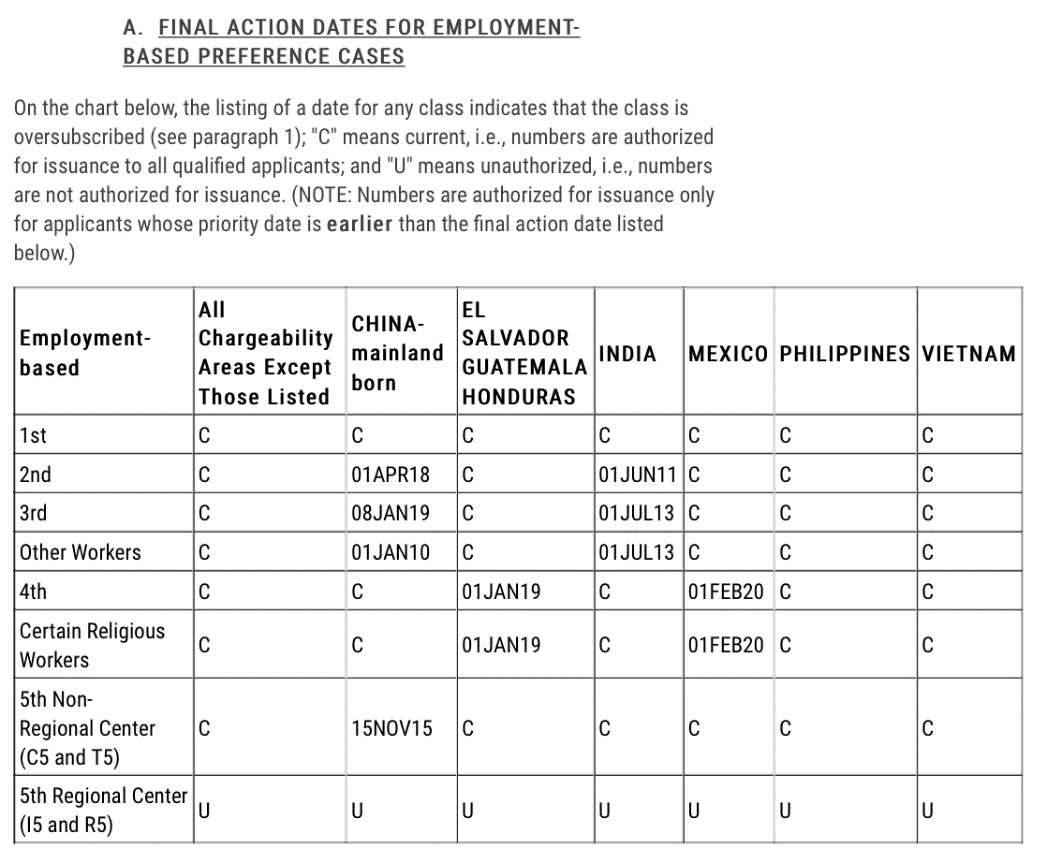
Chart A of the Visa Bulletin, “Final Action Dates for Employment-Based Preference Cases,” shows that Vietnam has finally achieved “C” (current) status. This means that the long backlog for Vietnamese EB-5 investment visas has been resolved, and Vietnamese investors no longer have to wait until the final action date catches up with their I-526 priority date. Now, every Vietnamese investor with an approved non-regional center I-526 petition is eligible to apply for conditional permanent resident status through the EB-5 program. This is certainly wonderful news for all Vietnamese foreign nationals who have made an EB-5 investment. Vietnam had been experiencing a visa backlog since 2018, but its final action date leaped forward by two years in the July 2021 Visa Bulletin.

China’s situation has also taken a positive turn: the final action date for Chinese EB-5 investments advanced one week from November 8, 2015, to November 15, 2015. This may seem like a very small step forward, but any improvements in the final action date for China are always welcome—after all, the final action date for China remained the same for almost a year prior to the June 2021 Visa Bulletin. The one-week jump in the Chinese final action date follows an even more significant two-month advancement in the July 2021 Visa Bulletin.

Foreign nationals planning an EB5 investment should keep in mind that the final action dates for regional center investments are all marked as “U” (unauthorized) because of the June 30 expiration of the regional center program. As of that date, USCIS is not accepting I-526 petitions associated with a regional center. Still, USCIS has asked regional center EB-5 investors to continue to answer requests for evidence (RFEs), which leaves the door open to a future reauthorization of the program. In fact, the regional center program may be reauthorized as part of a fall 2021 spending bill.

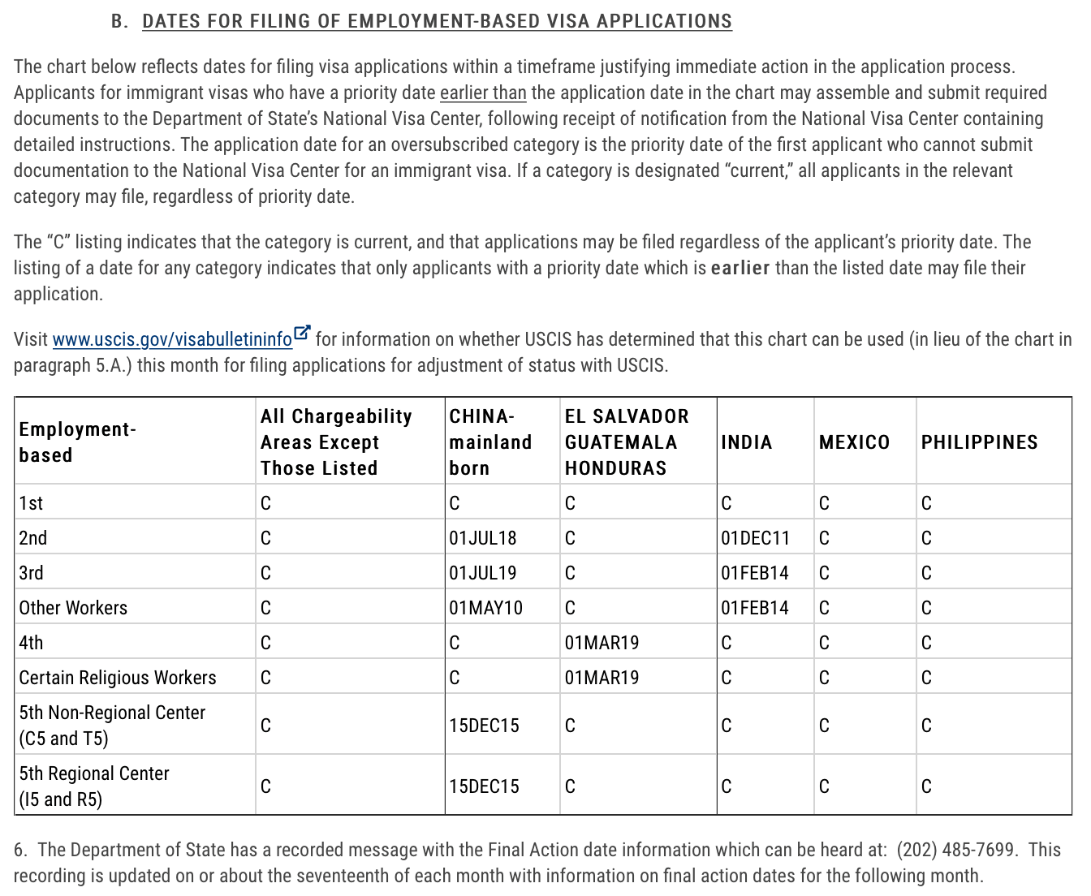
In contrast to Chart A, Chart B of the August 2021 Visa Bulletin, “Dates for Filing of Employment-Based Visa Applications,” is devoid of encouraging news. China’s date for filing of December 15, 2015, has not advanced in over 12 months. This means that Chinese foreign nationals who have made an EB-5 investment and have an I-526 priority date after December 15, 2015, are not allowed to file their visa applications with the National Visa Center (NVC).
The above news indicates that the EB-5 investment industry is changing rapidly. If you are considering an EB-5 investment, schedule a free consultation to learn more about available opportunities. EB5AN is here to guide you through the EB5 investment process and help you enjoy the many benefits of relocating to the United States.


Free EB-5 Project Evaluation

How Has the EB-5 Program Fared in the COVID-19 Pandemic?

How Has the EB-5 Program Fared in the COVID-19 Pandemic?

There’s hardly a person in the world who hasn’t been affected by the worldwide pandemic caused by the COVID-19 virus. With millions of deaths, small businesses decimated, and public life entirely shut down, the world has never seen anything like it. EB-5 investment stakeholders were among those affected—2020 was, in various ways, not a good year for the EB-5 Immigrant Investor Program.

U.S. Embassy and Consulate Shutdowns

The first way the pandemic affected EB-5 investors was through the mass shutdowns. In March 2020, United States Citizenship and Immigration Services (USCIS) closed all offices nationwide, canceling all visa appointments and only partially reopening in June 2020. Overseas, all U.S. embassies and consulates suspended routine visa services, staying open only for emergencies. This meant that EB5 investment participants could no longer schedule or attend visa interviews, even if they already had I-526 petition approval. Unable to complete this final step of securing an EB-5 visa, investors were left in limbo, with no way to claim the conditional permanent resident status they had earned through their EB-5 investment. Services were phased back in starting in August 2020, but decisions were left up to the individual consulates based on the situation in the respective country.

Immigration Bans

Immigration and travel bans around the world have been a key mark of the pandemic, with most countries restricting access to foreign nationals. The United States, under the Trump administration, was no exception: in April 2020, Trump announced a ban on most forms of employment-based immigration for 60 days, eventually extending it to run through the rest of 2020. EB-5 investment participants were initially exempt, much to the disappointment of certain U.S. senators, who wrote to Trump to ask the EB-5 program to be similarly banned, citing hyperbolic allegations of widespread fraud. EB5 investment stakeholders struck back, pointing out all the positive impacts the EB-5 program has had on the U.S. economy and development, all at no cost to the U.S. taxpayer.

When the Trump administration extended the immigration ban, they also tightened it to include more classes of immigrants—but to the relief of EB-5 participants, the EB-5 program was still exempt. Of course, in reality, it wasn’t that simple: investors still had to overcome the various travel restrictions in place in other countries. Some countries had exit bans on their citizens, and others refused to allow layovers, meaning that some investors who were technically permitted to enter the United States still couldn’t travel.

Economic Impacts

When talking about the EB-5 program, it’s important to remember that EB-5 investors aren’t the only stakeholders. EB-5 project developers are also key actors in the program, and in some cases, the devastating economic impact of the COVID-19 pandemic brought their projects to a screeching halt. The hospitality and tourism sectors were particularly decimated, and hospitality happens to be one of the biggest industries for EB-5 projects. The single largest industry is commercial real estate development, which was also badly affected. Not only did these impacts force many projects to suspend development, but they also hurt the ability of EB5 investment participants to create the 10 full-time jobs needed for EB-5 program requirements. The high rates of unemployment that quickly followed the initial shutdowns also altered which areas of the United States qualify as targeted employment areas (TEAs), affecting projects with investors who had yet to file their I-526 petitions.

USCIS Funding Shortages

Unsurprisingly, USCIS saw a steep drop in the number of immigration petitions received in the wake of the COVID-19 pandemic and lockdowns. USCIS largely funds its activities through the processing fees received with petitions, so when this cash supply was suddenly cut off, the agency suffered. USCIS announced massive furloughs in August 2020, although the immigration body was ultimately able to skirt the furlough by reducing spending and upping revenue. The shortfall was addressed in a funding bill for 2021, which approved hikes to premium processing fees to help the agency stay afloat. The bill also required USCIS to provide Congress with a five-year plan to address processing inefficiencies and improve processing times for all types of immigrants. Since premium processing is not available for EB5 investment stakeholders, the change had little impact on the EB-5 program, although the five-year plan will.

Free EB-5 Project Evaluation

EB-5 Petition Statistics for FY2021 Q2

EB-5 Petition Statistics for FY2021 Q2

There is a great deal of uncertainty surrounding the current state of the EB-5 Immigrant Investor Program. June 2021 was a pivotal month in the history of the EB-5 program—on June 22, the U.S. District Court of the Northern District of California ruled to invalidate the EB-5 Final Rule. This measure had raised the minimum investment amounts to $900,000 for targeted employment area (TEA) projects and $1,800,000 for non-TEA projects. The court’s ruling caused the minimum investment amounts to return to their pre-November 2019 status of $500,000 for TEA projects and $1,000,000 for non-TEA projects. Of course, these lower amounts were a great incentive for individuals considering an EB-5 investment.

Just a few days later, on June 30, 2021, the regional center program was suspended because the Senate failed to pass the EB-5 Reform and Integrity Act of 2021, which would have reauthorized the program for three more years. As a result, United States Citizenship and Immigration Services (USCIS) has ceased to process all I-526 petitions associated with a regional center EB5 investment.

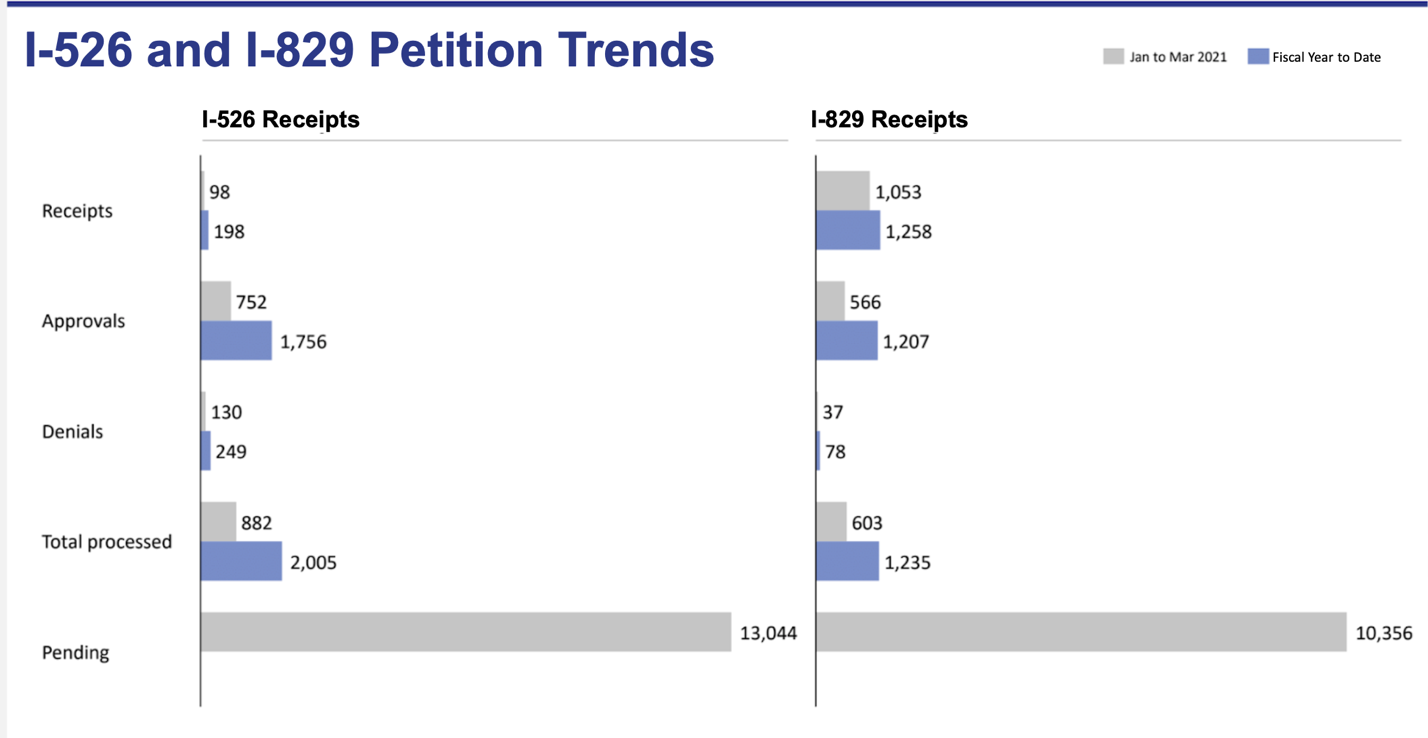
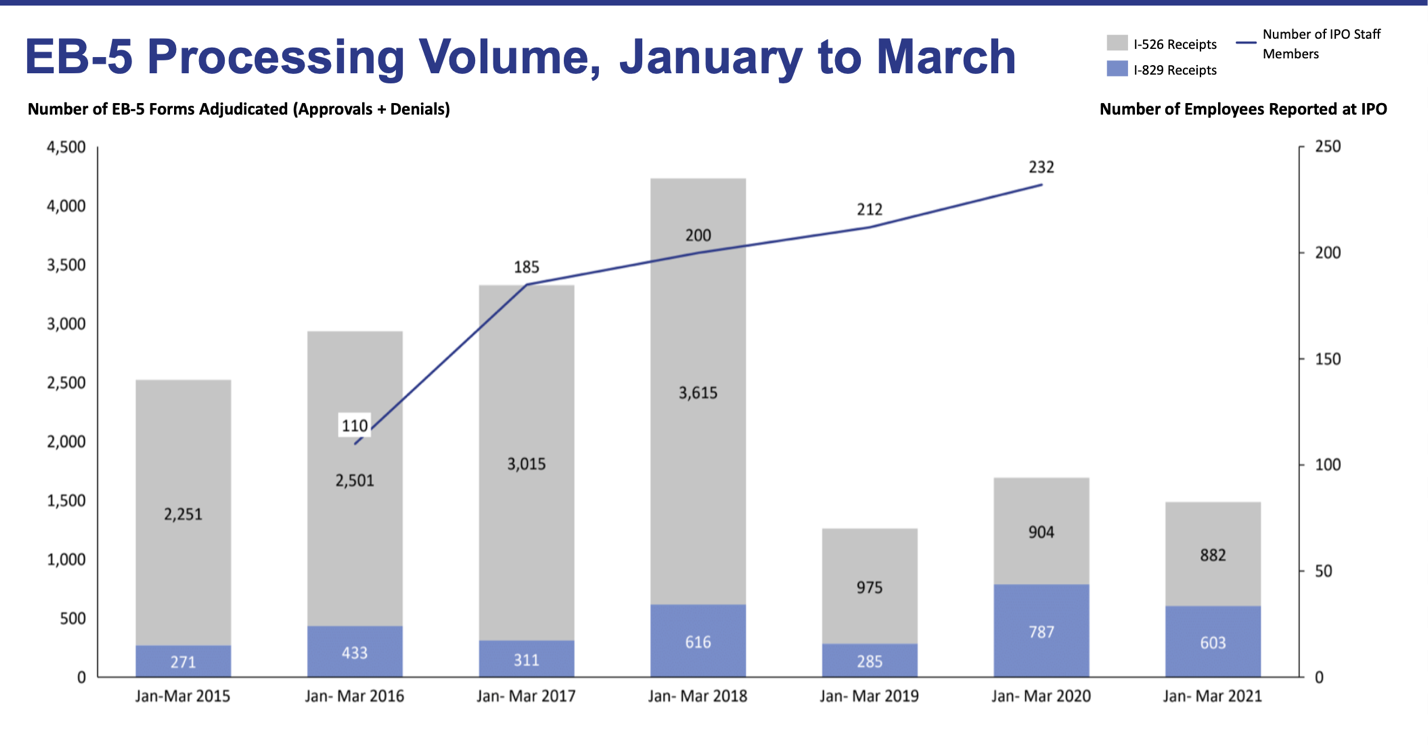
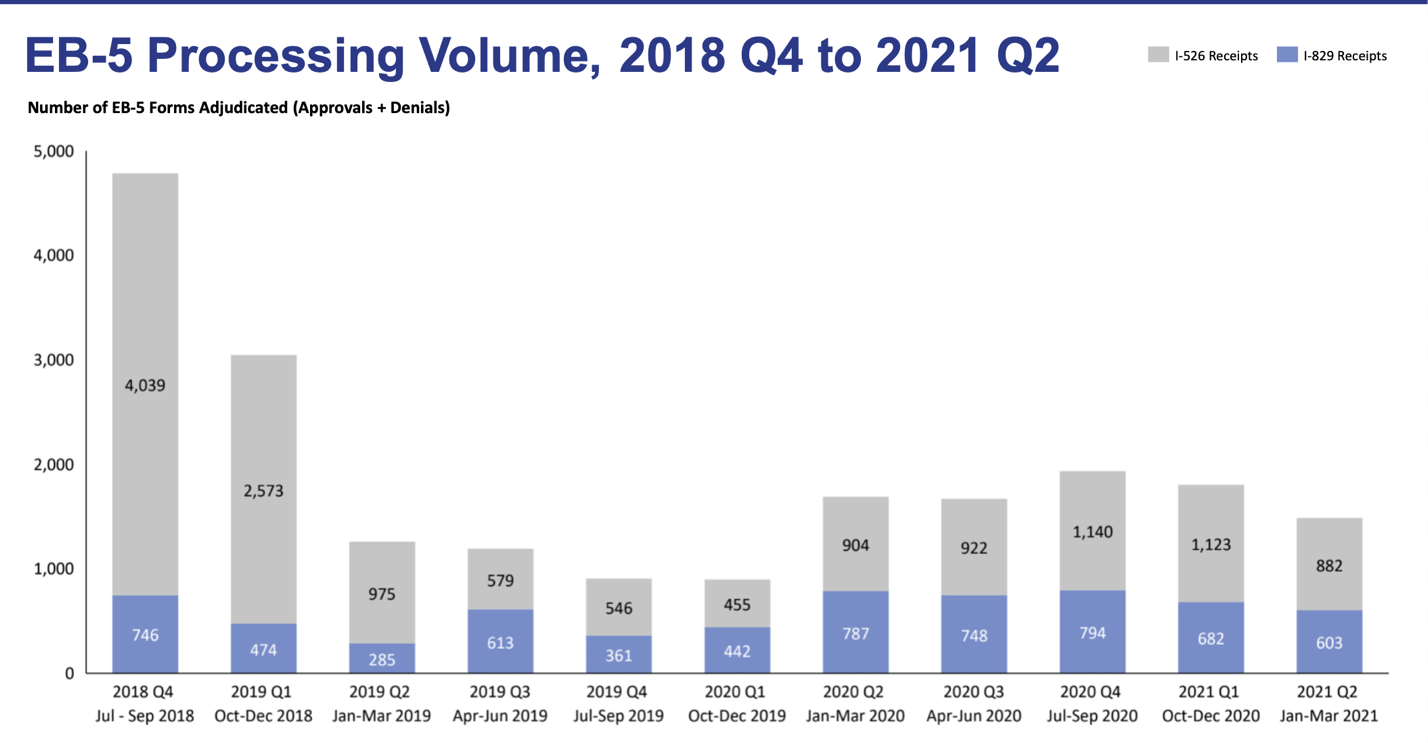
During this tumultuous period for the EB-5 program, USCIS published the processing statistics for January to March 2021 (FY2021 Q2). The number of processed I-526 and I-829 petitions remained remarkably low, which reflects the Immigrant Investor Program Office’s (IPO’s) reduced productivity levels. This trend is especially disappointing in light of the lower demand caused by the ongoing COVID-19 pandemic—in theory, USCIS adjudicators should have more time available to take care of incoming petitions. Still, the receipt statistics do show some improvement for Form I-829.

Possible Effects of the Regional Center Program’s Expiration

The processing data shows how urgent and critical it is for the regional center program to be reauthorized by the government. By the end of March, there were over 13,000 unprocessed I-526 petitions. The regional center program’s suspension has undoubtedly caused difficulties for thousands of investors (past data shows that the vast majority of EB-5 investments are made in regional centers).

The regional center program’s inactive status may be good news for direct EB-5 investors and I-829 applicants. Given that USCIS will no longer accept I-526 petitions associated with regional centers, more adjudicators should be available to work on direct EB-5 investment I-526 petitions and I-829 petitions. If this is the case, then the existing backlog of I-526 petitions could be processed in its entirety by the end of 2021. Of course, these are all conjectures—there is no way of knowing exactly when the reauthorization of the regional center program will take place.

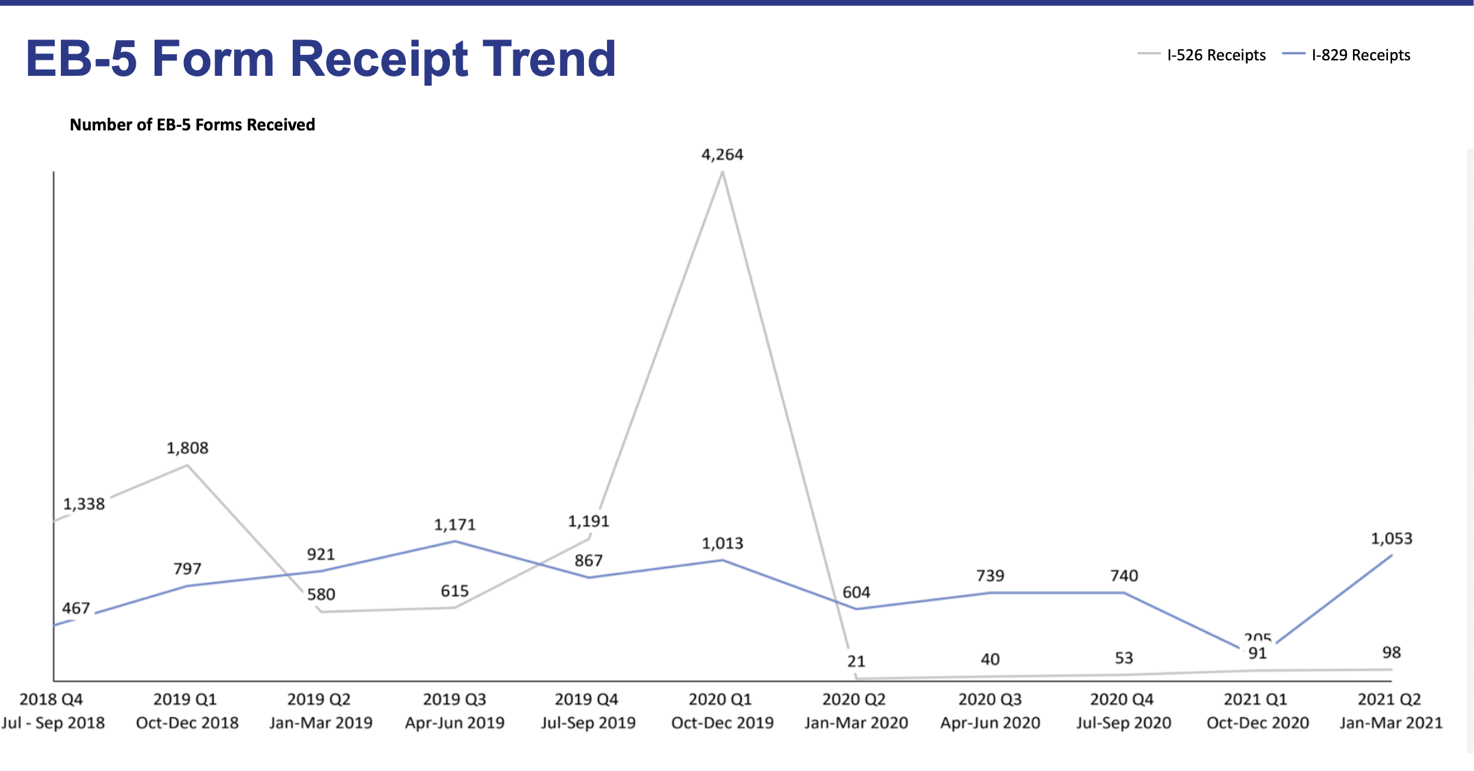
On the bright side, the receipt data for Form I-829 is positive when compared to the statistics from the previous quarter: from January to March 2021, there was a total of 1,053 received I-829 petitions. This means that an increasing number of EB-5 investors are completing their conditional permanent residence period and applying for permanent residence. In contrast, only 98 I-526 petitions were received during this period.

As mentioned, the uncertainty surrounding the regional center program and the EB5 investment minimum amounts makes it difficult to predict what the trends for the following quarter will look like. Nonetheless, investors can be sure that the regional center program will likely be reauthorized in the near future.

Free EB-5 Project Evaluation

EB-5 Modernization Rule: Implementation and Repeal

EB-5 Modernization Rule: Implementation and Repeal

More than 30 years have passed since the EB-5 Immigrant Investor Program was introduced in 1990, and a lot can change over three decades. The program spent its first two decades with little attention, issuing only a small portion of its annual 10,000 EB-5 investment visas. But after the 2008 financial crisis, popularity skyrocketed as projects turned to the EB-5 program to secure financing otherwise impossible to attain. Then, the situation reversed, and the EB-5 program faced more demand than it could handle, with lengthy backlogs forming for EB5 investment participants from high-demand countries like China and Vietnam.

Even as the EB-5 program careened through the 2010s in drastically different circumstances than its first two decades, the program regulations remained the same. EB-5 reform is needed—it’s been necessary for several years, and it’s still necessary in July 2021. But when Congress failed to pass comprehensive EB-5 legislation reform, the Department of Home Security (DHS) took matters into their own hands by releasing the Modernization Rule in November 2019. The new regulations transformed the EB-5 program in three main ways, generally to the displeasure of EB-5 investment participants and other stakeholders.

Priority Date Retention

Priority date retention is the only Modernization Rule change received positively by EB5 investment stakeholders. This change allows EB-5 investors to retain the priority date of their original I-526 petition when filing subsequent I-526 petitions, which may be necessary if, for example, the investor’s affiliated EB-5 regional center is terminated through no fault of their investor. Against the backdrop of ever-increasing backlogs, low productivity at United States Citizenship and Immigration Services (USCIS), and rampant regional center terminations, priority date retention can be invaluable indeed. According to DHS, this change generally received positive feedback.

Minimum Investment Amount Hike

Praise for the priority date retention change paled in comparison to the outrage directed at DHS’s 80% hike to the minimum EB5 investment amount. When the Modernization Rule regulations went into effect on November 19, 2019, the minimum investment amount for regular EB-5 projects leaped from $1 million to $1.8 million overnight. For targeted employment area (TEA) projects, the rate increased by the same percentage, climbing from $500,000 to $900,000. Suddenly, countless prospective investors were priced out of the market, and EB5 investments were nowhere near as attractive as they once had been.

DHS argued the hike was necessary to stay in line with inflation. When factoring in inflation, the $900,000 and $1.8 million amounts are roughly equivalent to the value of $500,000 and $1 million in 1990. The Modernization Rule also implemented measures to continually increase the minimum investment amounts in line with inflation in increments of five years, with the next scheduled increase in 2024.

Naturally, EB-5 investment stakeholders were upset about this new development—some prospective investors had to give up their dreams of U.S. permanent residency, some projects lost access to high-quality EB-5 funding, and some regional centers faced difficulties attracting investors under the higher investment amounts. However, since the regulation had been announced a few months in advance, the industry saw a surge in EB5 investments as applicants rushed to beat the November 19, 2019, deadline.

Tightened TEA Designations

The third and final major change the Modernization Rule introduced to the EB-5 program was restrictions on TEA designations. Traditionally, TEAs have been designated by the respective state, which resulted in uneven designation and different criteria nation-wide. These state-by-state discrepancies, coupled with instances of gerrymandering to designate affluent urban areas as TEAS, were cited as a key reason behind DHS’s decision to tighten DHS regulations and centralize the designation determination at USCIS.

As many as 43% new commercial enterprises (NCEs) with TEA designation were affected by the changes, according to DHS statistics, and not only because USCIS is stricter with designations than some states had been. The new regulation also made it more difficult to group census tracts together to create a TEA, as had been common practice previously. Under the Modernization Rule, an investor can only include census tracts directly adjacent to the one where the NCE is physically located, dramatically cutting down on the ability to create new tracts.

Opposition and Repeal

A few disgruntled EB-5 regional centers challenged the Modernization Rule in court, arguing it had been illegitimately enacted and asking the courts to repeal the regulations. Many EB5 investment stakeholders could empathize with the regional centers grievances but saw the lawsuit as an unnecessary distraction when faced with the dire issue of looming expiry for the EB-5 Regional Center Program. But to the industry’s surprise, the courts indeed overturned the Modernization Rule, reverting the EB-5 program back to its pre-November 2019 state.

For around a week, EB-5 investors rushed to submit their I-526 petitions at the lower $500,000 or $1 million amounts. With the shock ruling having been delivered so shortly before the regional center program expired, there was little time to take advantage of the presumably temporary lower EB-5 investment amounts. On June 30, 2021, the regional center program did indeed expire, and as of July 13, 2021, USCIS is no longer accepting I-526 petitions affiliated with regional centers, although direct investors may still file with the lower minimum investment amounts. The Modernization Rule will likely be reinstated, but the future of the EB-5 program is uncertain in these chaotic times.

Free EB-5 Project Evaluation

Direct EB-5 Investments: A Viable Alternative to Regional Center Projects

Direct-EB-5-Investments-A-Viable-Alternative-to-Regional-Center-Projects.jpg

The U.S. government’s administrative decisions regarding the EB-5 Immigrant Investor Program have occasionally resulted in sudden or unexpected changes to the program’s regulations. For example, the EB-5 industry was rocked by the news that the regional center program had expired on June 30, 2021. Under the program, foreign nationals were able to make EB-5 investments through economic units known as regional centers. EB-5 investment projects affiliated with regional centers enjoyed less strict job creation requirements—they were allowed to count direct, indirect, and induced employment. Therefore, foreign nationals who made a regional center EB-5 investment could create the 10 required jobs more easily than if they were only counting direct employment. Further, these investors only had to show United States Citizenship and Immigration Services (USCIS) that their EB-5 investment funds had been spent according to the regional center project’s business plan. Regional center projects consequently became the most popular way to make EB-5 investments.

However, this changed after the Senate failed to pass the EB-5 Reform and Integrity Act, a bill that would have reauthorized the regional center program through 2026. Senator Lindsey Graham blocked the request for a unanimous consent vote on the bill. The Senate went on summer recess, and the regional center program thus expired on June 30, 2021.

Despite this temporary setback, foreign nationals planning an EB-5 investment can rest assured that the EB-5 program is still up and running. Given the program’s many economic benefits, the U.S. government will likely continue to support EB-5 investments. Interested foreign nationals can still invest in EB-5 projects directly and apply for permanent resident status.

What Are Direct EB-5 Investments?

Direct EB-5 investments are made not through a regional center but directly in the EB-5 project in question. They differ from regional center investments in many other ways. For example, a foreign national who makes a direct EB5 investment is usually much more involved in the day-to-day operations of the business. Direct EB-5 investors gain significant control over their investment but have to spend significant time and resources overseeing the business. As a result, direct investors typically want to make sure that their EB-5 investment yields significant returns, and they are usually responsible for making sure that the project complies with all applicable laws. In contrast, many regional center investors are only interested in gaining permanent resident status through their EB-5 investment and are not heavily involved in business operations.

Perhaps the most important difference between direct and regional center investments is the way job creation is calculated. As mentioned previously, regional center projects can count direct, indirect, and induced jobs. On the other hand, non-regional center EB-5 projects can count only direct employment. Direct employment involves hiring employees on the EB-5 project’s payroll—these must be full-time jobs and last at least two years to be counted toward the requirement of 10 total jobs. For the most part, such jobs are either ongoing operational positions associated with the EB-5 project or construction jobs. In addition to these guidelines, USCIS sets out many other criteria for directly created jobs.

Moreover, foreign nationals who are looking for direct investment opportunities should note that non-regional center EB-5 projects are structured very differently from regional center projects. A major difference is that the new commercial enterprise (NCE) and the job-creating entity (JCE) must essentially be the same. The NCE is the business that receives the EB-5 investment, and the JCE is the project development entity in charge of creating the required jobs. Due to this requirement, the sources of funds, investment terms, and role investors play can be radically different for direct and regional center projects.

All of the above information indicates that making a direct EB5 investment requires careful planning and significant effort to ensure that the project complies with USCIS guidelines. It can be difficult for EB-5 investors to keep track of the plethora of regulations governing direct investments, so they would do well to hire experienced EB-5 consultants and a knowledgeable immigration attorney. The expertise these professionals provide will prove to be indispensable. Many EB-5 investors who did not work with EB-5 professionals or take the time to learn about USCIS regulations were unable to receive their coveted permanent resident status.

Historical Trends in Direct EB-5 Investments

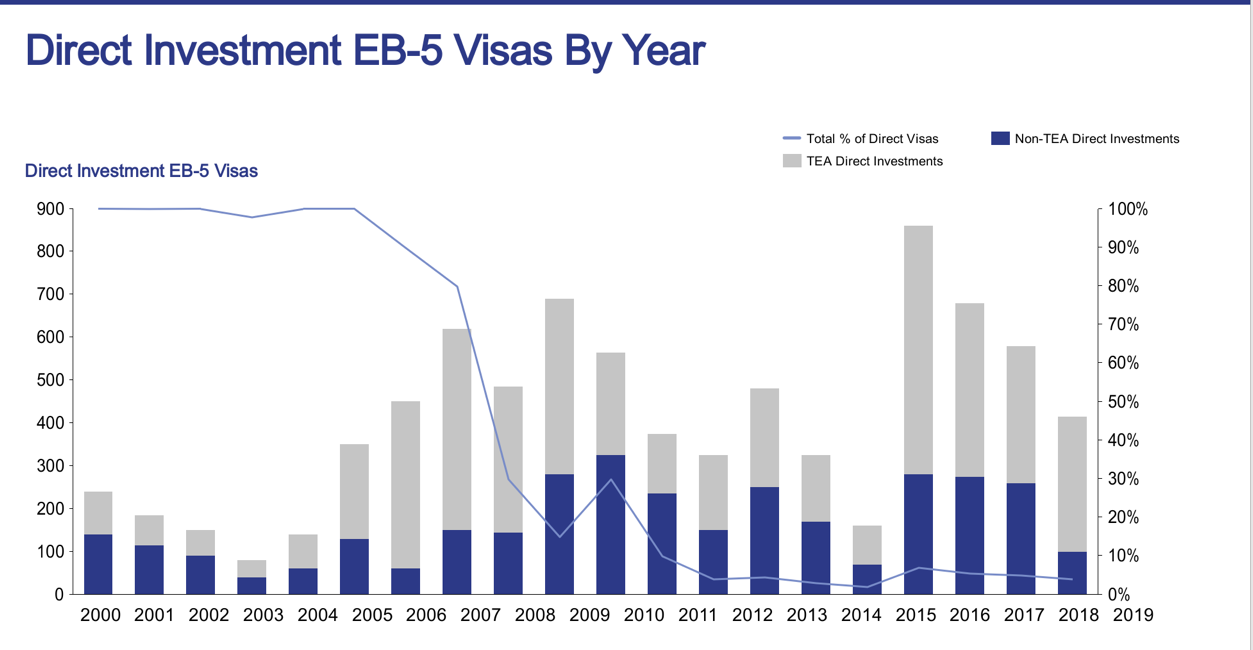
The following graphic shows several intriguing trends in the history of direct EB-5 investments:

direct investments eb5 visa by amonts

Even though regional center investments have usually been more common in recent years, direct investments have enjoyed several periods of popularity—until the 2008 economic crisis, it was more common for EB-5 investors to receive their visas through direct investments. 2015 was another positive year for direct investments because the regional center program’s looming expiration date motivated foreign residents to choose non-regional center projects, which have no expiration date.

Direct EB-5 investments will likely surge in popularity given the temporary suspension of the regional center program, and EB-5 investors will be able to take advantage of the reduced minimum investment amounts of $500,000 for targeted employment area (TEA) projects and $1,000,000 for non-TEA projects. As these investment amounts may be raised, foreign nationals interested in making an EB5 investment should act quickly. Book a free consultation with EB5AN to learn more about available projects.

Free EB-5 Project Evaluation

Economic Impact and Country Analysis of the EB-5 Program

Economic Impact and Country Analysis of the EB-5 Program

When marketed to prospective foreign investors, the EB-5 Immigrant Investor Program is generally framed in terms of its benefits to foreign investors: for a one-time, largely passive EB-5 investment, a foreign national from any country can relocate to the United States and gain permanent residency for themselves and their immediate family members. But an EB5 investment doesn’t just benefit the investor—it’s also good for the U.S. economy and U.S. workers.

U.S. companies structure their projects for EB-5 investment funding, a cheaper alternative to most sources of funding. This extra funding gives them security as they develop their condominiums, hotels, restaurants, and other enterprises. New U.S. jobs are created for the construction workers to build these projects and for employees to staff them. In the case of a new hotel or restaurant, the business may have a positive economic impact on the wider community, driving more traffic to nearby businesses. In this way, the EB-5 program is a fantastic economic stimulant for in-need local U.S. economies, all at zero cost to the U.S. taxpayer.

Economic Impact of the EB-5 Program

Congress’s intention with the EB-5 program was, of course, the economic growth described above. In fact, one of the key requirements of the EB-5 investment program is that every investor must show that their investment has created at least 10 new jobs for U.S. workers. But data on the precise economic impact of this valuable program is scarce. A government study conducted in 2012 and 2013 found $5.8 billion in EB5 investment capital raised by more than 11,000 individual investors, creating an estimated 174,039 jobs for U.S. workers. A later study conducted by EB-5 stakeholder groups showed the flow of roughly $11 billion through the EB-5 program in FY2019, resulting in approximately 355,200 new jobs. Two-thirds of EB-5 investment capital has been poured into construction—real estate projects are particularly popular within the space. Hotels, restaurants, and health care facilities are other fairly common EB-5 industries.

Where the economic impact of EB5 investment strays from Congress’s original aim is in the location of investment. Most EB-5 investment capital has gone to affluent urban districts, with a liberal interpretation of targeted employment areas (TEAs) allowing these regions to qualify for the lower TEA investment amount. In November 2019, the Modernization Rule restricted the previously broad definition of a TEA, reducing the number of projects that qualified for this special status and raising the overall EB5 investment amount by 80% to account for inflation over the program’s first 30 years. In June 2021, the Modernization Rule was challenged and overturned in court, causing the TEA rules to revert back to their broader, pre-Modernization Rule state. As of July 8, 2021, the future of TEA regulations is uncertain.

Who’s Investing in the EB-5 Program?

The EB-5 program is popular for investors around the world—but that wasn’t always the case. For its first decade of existence, the EB-5 program was severely underused, with hardly any foreign nationals making an EB-5 investment. As more people caught wind of the program and it began to be marketed in China, it started to pick up—FY2005 saw 346 EB-5 visas issued, up from only 64 in FY2003. By FY2009, that figure had increased to more than 3000. The key turning point for the EB-5 program was 2008, when the financial crisis prompted project developers to turn to EB-5 for financing they couldn’t get elsewhere.

China has long dominated the EB-5 program, accounting for as many as 85% of all issued EB-5 visas in FY2014. In FY2019, this figure dropped to 47%, but China remains the largest EB-5 country by a large margin. Other key EB-5 countries include India, Vietnam, South Korea, Taiwan, and Brazil, but none have come close to China’s volumes. That’s not necessarily a bad thing—China’s thirst for EB5 investment has created a lengthy backlog for investors from the country. The backlog first surfaced in 2014, and still, in July 2021, thousands of Chinese investors face major delays because of their nationality. Vietnam has also faced a backlog since 2018, but it’s expected to clear up by September 2021.

The backlogs are a result of the country-cap system of United States Citizenship and Immigration Services (USCIS). No one country is permitted to receive more than 7% of EB-5 visas per fiscal year, although they may claim leftover visas if there are no eligible investors from non-backlogged countries. Since this system doesn’t consider the differences in population size and EB-5 demand among countries, certain nations are more susceptible to developing a backlog in the EB5 investment program than others. The fact that spouses and children of EB-5 investors are granted visas from the EB-5 visa pool rather than extra, derivative visas also clogs up the system, since each EB-5 investor, on average, has two dependents also claiming visas.

Free EB-5 Project Evaluation

USCIS Releases Statement on EB-5 Final Rule Deauthorization

USCIS Releases Statement on EB-5 Final Rule Deauthorization

The EB-5 Immigrant Investor Program is widely viewed as an asset to the U.S. economy. Since 1990, the EB-5 program has allowed foreign nationals to apply for permanent resident status after investing the required amount of capital in a qualifying U.S. business. Since every EB5 investment must create the required number of jobs, the program helps reduce unemployment and provides U.S. businesses with invaluable support. Additionally, successful and high-net-worth foreign nationals are able to relocate to the United States through the EB-5 program and further benefit the country with their expertise.

Despite the EB-5 program’s positive impact, it has occasionally experienced turbulent periods due to the government’s administrative decisions. For instance, on June 22, 2021, a U.S. district court ruled that the EB-5 Modernization Final Rule must be deauthorized. The Final Rule, which had come into effect on November 21, 2019, raised the minimum required EB-5 investment amounts to $900,000 for targeted employment area (TEA) projects and $1,800,000 for non-TEA projects. After the June 22 decision, however, these amounts were restored to $500,000 for TEA projects and $1,000,000 for non-TEA projects. These lower minimum amounts were certainly good news for foreign nationals considering an EB-5 investment—many more potential investors would now be motivated to participate in the EB-5 program. However, United States Citizenship and Immigration Services (USCIS), which governs the EB-5 program, did not immediately react to the court’s decision. USCIS’s silence on the matter may have caused some uncertainty among investors wanting to take advantage of the newly lowered EB5 investment amounts. How would USCIS react to the Final Rule’s deauthorization?

USCIS finally broke its silence on July 7, 2021, and released a statement on its website regarding the court decision. The statement says the following:

“On June 22, 2021, the U.S. District Court for the Northern District of California, in Behring Regional Center LLC v. Wolf, 20-cv-09263-JSC, vacated the EB-5 Immigrant Investor Program Modernization Final Rule (PDF). While USCIS considers this decision, we will apply the EB-5 regulations that were in effect before the rule was finalized on Nov. 21, 2019, including:

  • No priority date retention based on an approved Form I-526;
  • The required standard minimum investment amount of $1 million and the minimum investment amount for investment in a Targeted Employment Area (TEA) of $500,000;
  • Permitting state designations of high unemployment TEAs; and
  • Prior USCIS procedures for the removal of conditions on permanent residence.

In other words, we are applying the regulations in effect before Nov. 21, 2019, on this website and in the USCIS Policy Manual, Volume 6, Part G, Investors. In addition, we again will accept the April 15, 2019, version of Form I-526, Immigrant Petition by Alien Entrepreneur, because the Nov. 21, 2019, version of the form reflects updates from the now-vacated rule.”

Evidently, USCIS has accepted the overturning of the EB-5 Final Rule. This statement confirms that USCIS will apply the lower investment amounts and the other pre-November 2019 regulations. Foreign nationals interested in making an EB-5 investment can now rest assured that USCIS is complying with the court ruling and that the reduced investment amounts have indeed come into effect.

However, potential EB-5 investors must act quickly to take advantage of this opportunity. USCIS or the Department of Homeland Security (DHS) may take administrative or legal action to overturn the court ruling and reinstate the higher EB-5 investment amounts. Schedule a free consultation with EB5AN to discover available EB-5 investment opportunities.

Free EB-5 Project Evaluation

Regional Center EB-5 Investments: How Involved Must Investors Be?

Regional Center EB-5 Investments: How Involved Must Investors Be?

The EB-5 Immigrant Investor Program offers foreign nationals a chance to start a new life in the United States in exchange for a qualifying EB-5 investment in a new commercial enterprise (NCE). EB-5 investors hail from all around the world and come from various backgrounds and walks of life, so a one-size-fits-all solution doesn’t accommodate everyone’s needs. Fortunately, the EB-5 program offers a degree of flexibility to those considering making an EB5 investment. Namely, investors have the choice of investing directly in an NCE or investing indirectly via an EB-5 regional center.

Regardless of the path, everyone who pursues an EB-5 investment must fulfill the same requirements to be eligible for the coveted permanent resident status the program offers. One such requirement is involvement in the NCE in which one is investing. This requirement isn’t a major obstacle for most direct investors, who choose the route specifically to exercise more managerial control over their EB-5 investment capital. For those who invest through a regional center, however—and the majority of EB-5 investors do—the requirement can be daunting, as they may not have the time, desire, or experience to carry out substantial managerial work. Luckily, their managerial obligations are significantly lighter.

Managerial Duties in EB-5 Regional Center Investments

Though some investors may be interested in earning a return on their EB-5 investment, most EB-5 participants pursue the program solely for the green card benefit. For many, permanent resident status in the United States means a brighter, safer, more stable future for themselves and their family and is worth more than money. This leads to a significant proportion of EB-5 investors who either don’t want to, or cannot, participate in the day-to-day management of the NCE.

EB-5 regional centers are aware of EB-5 investors’ motivations, and most employ a structure specifically designed to circumnavigate this “active involvement” requirement. Most regional center projects are structured such that the investors sign on as limited partners, endowing them with certain rights, powers, and duties. While investors are then required to vote on pertinent business matters and policy decisions, this setup absolves them of the need to engage with daily managerial tasks.

More Freedom for Investors

Besides escaping the need for grueling daily management work, the limited partnership structure offers numerous benefits for EB-5 investors. With a minimal managerial obligation to the NCE, investors can pursue their own employment, education, or other endeavors in the United States, allowing them to structure their life how they envision it. In a similar vein, the setup allows investors to make an EB-5 investment in a suitable project anywhere in the United States while living in an entirely different state. For example, an EB-5 participant could invest in a Georgia EB-5 project but settle down in Massachusetts.

Before signing a contract with an EB-5 regional center, an investor should carefully read the terms and conditions and consult with a qualified EB-5 immigration attorney to ensure the agreement will satisfy the managerial involvement requirement of the EB-5 program. Failure to demonstrate sufficient involvement in the EB5 investment on the I-526 petition could result in denial, so this step is not to be overlooked.

Free EB-5 Project Evaluation

EB-5 Regional Center Program Suspended—What Now?

EB-5 Regional Center Program Suspended—What Now?

The first half of 2021 has been a suspenseful six months for the EB-5 investment community, with stakeholders bating their breath as they watched the rapidly unfolding developments in the EB-5 space. The EB-5 Regional Center Program has been a hallmark of EB-5’s success throughout the 2010s, when EB-5 demand reached an all-time high and the United States welcomed thousands of EB-5 investors from all around the world. But as successful as the regional center program has been, Congress has yet to make the program permanent, even though the base EB-5 Immigrant Investor Program is. So, when Congress separated the program from the omnibus funding bill it has traditionally been coupled with, it aroused panic in the EB5 investment community. Could the program vie for reauthorization all on its own?

As it turns out, no, it couldn’t—at least not without reform. That has been the concern of EB-5 industry leaders since January, who have steadily warned that failing to enact wide-ranging EB-5 reform would likely result in the suspension of the program. A bipartisan duo—Senators Chuck Grassley and Patrick Leahy—introduced the EB-5 Reform and Integrity Act to the Senate in late 2020, and while the bill wasn’t perfect, it would have implemented the integrity changes necessary for the EB-5 Regional Center’s all-important reauthorization. While most EB-5 investment stakeholders embraced the bill, despite its flaws, some continued holding out for a better option that ultimately never came.

Why Did the EB-5 Regional Center Program Expire?

On June 24, Grassley and Leahy, joined by fellow Senator John Cornyn, requested unanimous consent from the Senate to pass the EB-5 Reform and Integrity Act. They praised the regional center program and the positive impacts it has had on the U.S. economy, including the thousands of jobs it has helped create. The addition of Cornyn was a surprise to many who had been following the developments, as he was an original co-sponsor of the Immigrant Investor Program Reform Act, a different EB-5 reform bill that stood in opposition to the EB-5 Reform and Integrity Act, and it gave many hope for a positive outcome.

Unfortunately, one of the co-sponsors of the Immigrant Investor Program Reform Act—Lindsey Graham—was less willing to be flexible. Graham and another senator objected to the unanimous consent and thus halted the bill from being passed. Senator Chuck Schumer failed to bring forth temporary reauthorization to keep the program afloat until a decision on reform is reached, and that was that—once the clock struck midnight on July 1, 2021, the EB-5 Regional Center Program was officially suspended.

What Happens Now?

Don’t panic—the EB-5 Regional Center Program isn’t over. While the future is uncertain, this fiasco will probably at most cause a few months of delay instead of terminating this valuable program altogether. This isn’t the first time the regional center program has expired—it once expired temporarily in December 2018, remaining suspended for a month. While this temporary suspension resulted in extra delays for EB5 investment participants, many of whom were already stuck in backlogs, it didn’t have any long-term effects on the program, and processing resumed as normal following the reauthorization. In all likelihood, this time will be similar.

On June 30, 2021, United States Citizenship and Immigration Services (USCIS) updated its website to announce the changes coming to the EB-5 program over the period of suspension. The immigration agency will reject any Form I-924 petitions to set up a new regional center and Form I-526 petitions affiliated with a regional center EB5 investment, and processing on any currently pending such petitions has been halted. The announcement did state, however, that USCIS is still accepting I-829 petitions even for EB-5 investments affiliated with regional centers and that investors should continue to respond to requests for evidence (RFEs), notices of intent to deny (NOIDs), and other USCIS correspondence in a timely manner. On July 1, 2021, the agency updated its announcement to add that it would no longer accept I-485 petitions associated with regional center investments, either, even though overseas consulate processing is slated to continue.

As the EB-5 investment community careens into the future of the program, stakeholders should maintain a cool head and continue to push for meaningful reform. It’s not too late to pass the EB-5 Reform and Integrity Act and regain reauthorization for the critical EB-5 Regional Center Program. While the developments as of late are disturbing, they don’t spell the end of the world for the EB-5 program and the thousands of foreign nationals who have made EB-5 investments. Reauthorization is still likely in the future of the regional center program.

Free EB-5 Project Evaluation

Although the Regional Center Program Expired on June 30, 2021, Investors Can Still Invest in Projects Directly

While-the-Regional-Center-Program-Will-Expire-on-June-30-2021.jpg

In light of the EB-5 regional center program’s expiration on June 30, 2021, many EB-5 investors and industry stakeholders are concerned about the EB-5 investment program’s future. However, despite the cause for concern, most industry representatives remain convinced that the regional center program will be reauthorized shortly. Many are pointing to direct investments as a viable option in the interim.

Will the EB-5 Investment Program Be Reauthorized?

Senators Grassley (R-IA) and Leahy (D-VT) have led the push for the reauthorization of the EB-5 regional center program. Their bill, called the EB-5 Reform and Integrity Act of 2021, would have authorized the program through 2023. However, when the senators pushed for a unanimous consent vote, Senator Lindsey Graham (R-SC) blocked the effort. With the Senate on its summer recess, the EB-5 regional center program expired on June 30, 2021.

Despite the program’s expiration, EB-5 industry stakeholders remain confident because the program is unlikely to end permanently. The regional center program has poured billions in foreign capital into the U.S. economy, and many senators’ constituents will not want the program to disappear.

The EB-5 regional center program could potentially be reauthorized as part of a spending bill in Fall 2021. The longer timeframe would give senators and lobbying groups more time to negotiate. Although it may be disappointing for EB-5 industry stakeholders to hear that the program will not be reauthorized immediately, they can be sure that these efforts would secure the long-term authorization of the EB-5 regional center program.

What Happens Once the Program Expires?

Those who have already made an EB-5 investment may find it unsettling to hear that the program is about to expire. However, the recent history of the program’s previous expiration periods shows that there is nothing to fear.

In December 2018, the federal government failed to pass the omnibus spending package to which the EB-5 regional center program was attached. This led to a federal government shutdown and the de facto expiration of the EB-5 regional center program.

Following the regional center program’s expiration, the Department of Homeland Security (DHS) released the following statement.

“The EB-5 Immigrant Investor Regional Center Program expired at the end of the day on Dec. 21, 2018, due to a lapse in congressional authorization to continue the program. All regional center applications and individual petitions are affected. . . We will continue to receive regional center-affiliated Forms I-526, Immigrant Petition by Alien Entrepreneur, and Forms I-485, Application to Register Permanent Residence or Adjust Status, after the close of business on Dec. 22, 2018. As of Dec. 22, 2018, we will put unadjudicated regional center-affiliated Forms I-526 and I-485 (whether filed before or after the expiration date) on hold for an undetermined length of time…. USCIS will provide further guidance to the public if legislation is enacted to reauthorize, extend, or amend the regional center program.”

Even though DHS announced that it would put any incoming I-526 applications on hold, it was implied that these applications would be processed once the program was reauthorized. It seems that DHS will handle pending petitions after June 30, 2021 in a similar manner. Any pending petitions will presumably be put on hold until the program is reauthorized. Once the program is reauthorized, United States Citizenship and Immigration Services (USCIS) will likely resume processing applications.

What Does This Mean for Investors Who Invested at $500K?

On June 22, 2021, just a few days before the regional center program expired, the U.S. District Court for the Northern District of California ruled that former acting DHS Secretary Kevin McAleenan did not have the authority to institute the EB-5 Modernization Final Rule. The new regulations set forth by the Modernization Rule, including the raising of the minimum investment amount for TEA projects from $500,000 to $900,000, were also invalidated by the court ruling.

This court ruling meant that EB-5 regional center investors could make their investments under the pre-November 2019 guidelines during a short period. Under these guidelines, the minimum investment amount was $500,000 for TEA projects and $1,000,000 for non-TEA projects.

While DHS has released no specific information regarding how these investors will be treated until the program is reauthorized, most EB-5 industry representatives believe that these investors will be classified along with those who had invested at the $900,000 minimum amount for TEA projects.

What Does This Mean for Direct Investments?

Even though the vast majority of EB-5 investors choose to make their EB-5 investments through regional centers, there is another way to make EB-5 investments: EB-5 investors can participate in the EB-5 program by investing directly in their projects. Although direct investments have been fairly uncommon, several EB-5 industry representatives have suggested that they will become more widespread until the EB-5 regional center program is reauthorized.