

Free EB-5 Project Evaluation

Wait Times for an EB-5 Visa Amidst COVID-19

Good things come to those who wait. The EB-5 Immigrant Investor Program is complex and popular, so expect to wait at least a couple of years by default before receiving your conditional permanent resident status. The unpredictable situation of COVID-19 may also influence wait times. Here’s how long you can expect to wait in the different stages of the program during the COVID-19 pandemic.

Time Needed to Prepare and Submit an I-526 Petition

Filing an I-526 petition is how you kick off the official EB-5 process. Each investor and EB-5 project is different, so how long this stage takes depends entirely on your individual circumstances. Consult with an immigration attorney to guide you through the process and ensure that you’re doing everything correctly. You can expect this process to take a few weeks to several months, depending on how much due diligence you need to conduct and how difficult it is to prove the lawful sources of your EB-5 capital.

Time Needed to Receive an Adjudication on an I-526 Petition

United States Citizenship and Immigration Services (USCIS) processes I-526 petitions at its Immigrant Investor Program Office (IPO). As of April 9, USCIS has closed its offices to the public until at least May 4, with closures poised to be extended if the outbreak is still not under control by then, but the IPO, which does not need to deal with the public, is continuing its normal operations. According to USCIS’s processing estimates, the processing times in April 2020 are estimated at around 31 to 50.5 months, with 43% of I-526 petitions expected to be adjudicated during this period. However, detailed processing data reveals that up to 80% of adjudications may fall outside the estimated range. Additionally, the estimates are based on data from two months prior, inevitably allowing for inaccuracy.

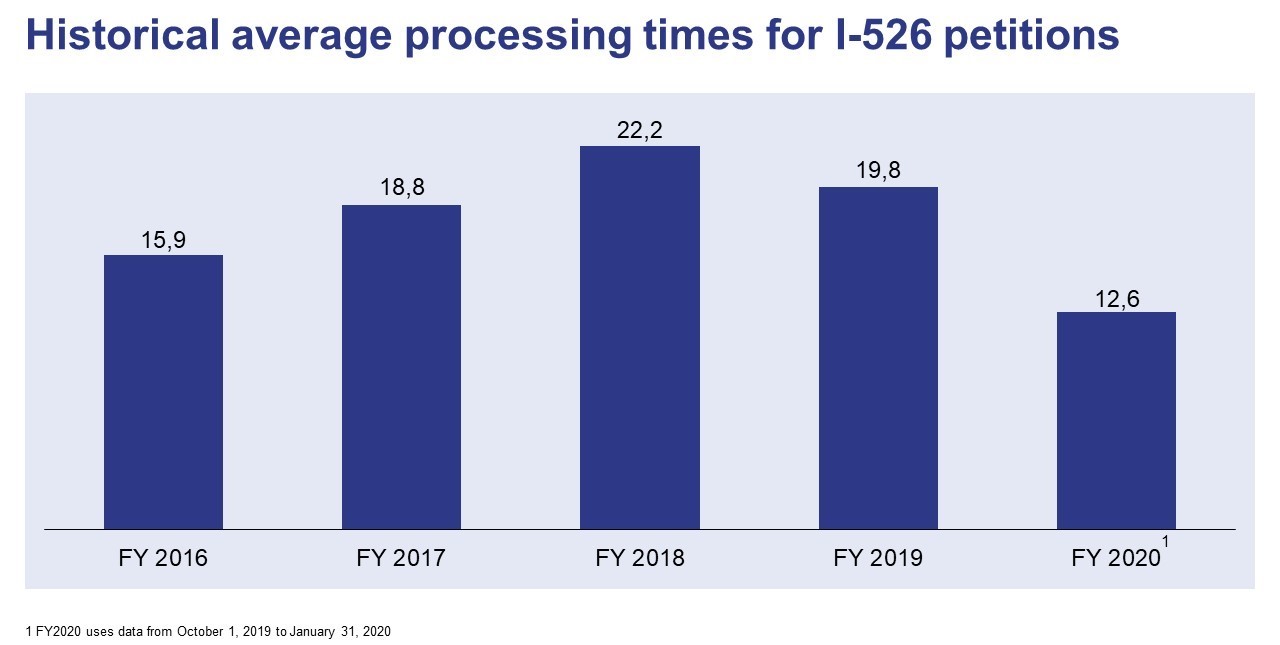
While EB-5 investors should prepare to wait at least two years for their I-526 adjudication, USCIS has also revealed that the average processing time for an I-526 petition from October 1, 2019, to January 31, 2020, was only slightly more than a year. You may receive your adjudication earlier than expected.

How the Visa Availability Processing Approach Affects Processing Times

Traditionally, the IPO assigned I-526 petitions for adjudication on a first-in-first-out basis, but on March 31, 2020, it adopted a visa availability approach. Under the new system, the IPO assigns I-526 petitions for adjudication based on whether there are any EB-5 visas available for the applicant’s country. Since USCIS uses the Chart B dates from the monthly Visa Bulletin, the only investors affected as of April 2020 are those from Mainland China, whose Date for Filing in the April 2020 Visa Bulletin is December 15, 2015. Therefore, Chinese EB-5 investors may face longer wait times, while investors from other countries could potentially see faster processing times.

Wait Times After I-526 Approval

Depending on your country of origin, your wait may continue even after your I-526 petition is approved. For EB-5 applicants outside the United States, USCIS sends approved I-526 petitions to the National Visa Center (NVC) to proceed with the visa application, but if you’re from a backlogged country (as of April 2020, China, India, and Vietnam are the only backlogged countries), the NVC will hold off on contacting you until your priority date is earlier than the final action date of your country. The backlogs move in unpredictable ways, so if you’re from a backlogged country, expect to wait several more months or even years.

Time Needed to File and Receive Adjudication for an I-485 Petition or DS-260

If you’re living outside the United States, you can start the process of filing your DS-260 form to apply for a U.S. green card once the NVC contacts you. You must carry out the process through your local U.S. consulate or embassy, but since all U.S. consulates and embassies are currently closed due to the coronavirus pandemic, you will have to wait until public life opens back up.

If you already live in the United States under a different visa, you can skip the NVC step and simply file an I-485 petition to adjust your immigration status. Since you don’t need to visit a consulate in this case, COVID-19 may have little impact on your EB-5 visa. In fact, EB-5 investors already residing in the United States may even obtain their EB-5 visa faster because they may receive visas originally intended for investors overseas.

Time Needed to Schedule a Visa Appointment and Obtain an EB-5 Green Card

As mentioned above, because USCIS has suspended regular operations at consulates and embassies, overseas investors cannot proceed past I-526 approval until the COVID-19 crisis subsides.

EB-5 investors already living in the United States may also face setbacks if they require an interview or biometric appointment. With USCIS offices across the United States closed until at least May 4, many domestic EB-5 investors will also find their EB-5 process stalled.

Even in the best of times, there is no specific time frame for how long it takes to obtain an EB-5 visa after your visa interview, but with overseas investors unable to proceed with their applications, if you are applying from overseas, you should expect to wait several more months.

Free EB-5 Project Evaluation

What to Do If You Receive a USCIS RFE

One of the most dreaded experiences for participants in the EB-5 Immigrant Investor Program is receiving a Request for Evidence (RFE) from United States Citizenship and Immigration Services (USCIS). Not every EB-5 investor encounters this anxiety-inducing situation, but those who do need to plan their response carefully to not jeopardize their chance of obtaining U.S. permanent residency.

What Is an RFE?

The most important thing to understand about USCIS RFEs is that they do not mean your I-526 petition will be denied. This differentiates them from Notices of Intent to Deny (NOIDs), in which case USCIS does intend to deny your petition unless you clear up any misunderstandings.

You can think of both RFEs and NOIDs as a second chance for an EB-5 visa. USCIS issues NOIDs to warn EB-5 investors that the evidence provided in their EB-5 petition will lead to a denial if they don’t clear up the issues USCIS identifies. USCIS RFEs are less frightening, as they are issued when the evidence in a petition is insufficient to support an adjudication, either positive or negative. USCIS will be forced to deny your EB-5 petition if you do not provide the requested information by the specified due date, but an RFE does not indicate an intention to deny your EB-5 petition.

What Information Does an RFE Contain?

Luckily for EB-5 investors, USCIS RFEs contain ample information to help them formulate a proper response. USCIS explains in detail why it has issued the RFE—typically in response to missing documentation, unclear evidence, discrepancies, or other data-related problems. If the petition is lacking essential documentation, the RFE will identify the necessary documents, and if it contains unclear or contradictory information, the RFE will identify the problem areas. In most cases, RFEs also provide examples of suitable evidence to provide in the RFE response.

In What Situations Might an EB-5 Investor Receive an RFE?

I-526 petitions are complicated, so there are many areas where issues can arise. EB-5 investors often receive USCIS RFEs in response to insufficient evidence documenting the lawful sources of their EB-5 capital or the path of their funds into the EB-5 project. USCIS also sends out RFEs for additional information on the EB-5 investor’s personal background.

While investors often receive USCIS RFEs regarding investor-level information, they may also need to provide supplementary information on the EB-5 project. For example, USCIS may request additional information on the hiring schedule or business plan of the new commercial enterprise (NCE).

In some cases, EB-5 investors may even receive an RFE because USCIS overlooked documentation they provided. USCIS agents are not infallible, and the complexity of I-526 petitions makes it easy enough to overlook information. In this case, all you need to do is resubmit the requested evidence. Don’t waste this opportunity to scrutinize your documentation and make changes if necessary, however. Explain in a cover letter that you are resubmitting an overlooked document, but identify and justify any changes you have made.

How to Respond to an RFE

The first step to responding to a USCIS RFE is to carefully read all the information provided therein. RFEs always include a deadline for responding, which EB-5 investors must consider when preparing their response. Since failure to respond to an RFE will lead to denial, investors cannot afford to delay their response. Stay calm—if you follow USCIS’s instructions and provide a suitable response, your I-526 petition will likely proceed smoothly.

In addition to the requested evidence, an RFE response should always include a detailed cover letter that addresses all the concerns USCIS has identified and clearly organizes all the attached documents. Use your given time wisely and compose a well-thought-out cover letter. Ask others to check it to ensure it’s sufficiently thorough and clear.

When confronted with a USCIS RFE, consult experienced EB-5 experts to help formulate an appropriate response. The EB5AN team consists of long-time professionals in the EB-5 sphere who understand the ins and outs of the program. Our team can assist you with preparing documentation, refining business plans, and other matters related to RFE responses. Reach out to us, and we can help you craft a high-quality response to your RFE.

Free EB-5 Project Evaluation

The Benefits of Investing Through an EB-5 Visa Regional Center

Not all EB-5 journeys are the same. There exist two main pathways to a U.S. green card through the EB-5 visa program—direct investment and regional center investment. Both have advantages and disadvantages, depending on the investor’s goals and wishes, but far more EB-5 investors opt for regional center investment because it is generally considered more advantageous. Below are some of the benefits of investing through an EB-5 visa regional center.

Lower Immigration and Financial Risk

Reputable regional centers select the projects they take on extremely carefully. While investors are always strongly recommended to Conduct their own due diligence on a project, projects offered by EB-5 visa regional centers are likely to be high quality and pose lower immigration and financial risk. Many EB-5 visa regional center projects also have exemplar status, which significantly facilitates the I-526 process for investors.

Regional center projects also tend to be located in targeted employment areas (TEAs). TEAs are urban areas where the unemployment rate is 50% higher than the national average or rural areas with fewer than 20,000 inhabitants. EB-5 investors working with TEA projects need only invest $900,000, while those involved with projects outside of a TEA must invest at least $1.8 million.

Limited Managerial Duties

For EB-5 investors with managerial skills and experience who wish to be heavily involved in the new commercial enterprise (NCE), direct investment is a good idea. For the rest, however, EB-5 visa regional centers are preferable.

One of the EB-5 program’s requirements is that the investor be involved in the management of the NCE, which, for direct investments, typically means conducting day-to-day managerial activities. Depending on the structure of the project, however, investors may also satisfy this requirement by engaging in policy formation (i.e., voting on matters). This option is typically available for investors who invest through EB-5 visa regional centers, lifting the burden of managerial responsibility from their shoulders.

Easier Job Creation Requirements

Regardless of the EB-5 path an investor chooses, all investors are required to demonstrate the creation of at least 10 new permanent, full-time jobs as a result of their investment. One of the biggest advantages of regional center investment is the relaxed requirements surrounding this rule.

Direct EB-5 investors must prove the creation of at least 10 new direct jobs, which are either construction jobs or jobs on the NCE’s payroll (investors can count construction jobs only if construction lasts for at least two years). To satisfy the job creation requirements, direct EB-5 investors should be highly experienced in business management and confident in their ability to help drive the NCE to success.

The job creation requirement is easier for regional center investors. Regional center EB-5 investors are permitted to include indirect jobs (the jobs of external suppliers and service providers) and induced jobs (jobs created in the community by the NCE’s employees spending their wages), as long as they use accepted economic methodologies to calculate job creation. Therefore, the job creation requirement is far easier to meet with regional center investment, which lowers immigration risk.

The Freedom to Live Anywhere in the United States

Most EB-5 investors who directly invest in a project participate in the daily management of the NCE, meaning they are tied to the project’s location. The most attractive EB-5 projects for investment—those located in TEAs—may not be in the most desirable areas to live, and there may be no areas nearby where the EB-5 investor wishes to live.

Regional center investors are free from this burden. With their role as a limited partner being enough to satisfy the managerial involvement requirement, investors who work with an EB-5 visa regional center are free to live anywhere in the United States regardless of the location of their EB-5 project. This gives EB-5 investors the freedom to choose the most promising EB-5 project they can find without restricting their living opportunities. With regional center investment, an investor can invest in an EB-5 project in Florida and live in Massachusetts.

Another bonus of this freedom is that regional center investors can work or study during their investment process. An EB-5 visa offers easier access to U.S. colleges and universities, making it the perfect solution for students. With nothing tying investors to the state of their EB-5 project, they may study anywhere in the United States.

Free EB-5 Project Evaluation

The Benefits of an EB-5 Visa Investment

The United States of America—the name alone conjures up images of wealth and freedom in the minds of people worldwide. Immigration is not easy, however, and with people all over the world clamoring at the chance for a life in the United States, most cannot realize their dream. If you’re a foreign investor, an EB-5 visa investment may be the best way to secure a life in the United States for yourself and your family.

For an investment of $900,000 or $1.8 million, depending on whether your chosen EB-5 project is in a targeted employment area (TEA), the EB-5 program can provide you with permanent resident status in the United States for yourself, your spouse, and your unmarried children below the age of 21. Your EB-5 visa investment will have been successful if it funds the creation of a minimum of 10 new full-time jobs filled by legal U.S. residents. It will typically take at least two years, and sometimes more than five years, depending on your country of origin, to obtain conditional permanent resident status, but the EB-5 program remains one of the easiest ways for foreign investors to obtain a U.S. green card.

U.S. permanent resident status offers countless benefits. Here are a few examples.

Live, Work, Study, and Travel Anywhere in the United States

Once you make an EB-5 investment and become a U.S. permanent resident, the entire country is open to you. You are free to live anywhere in any of the 50 states and may travel freely between them anytime you desire. You can work at a company anywhere in the United States without needing to be sponsored, and you have access to the many top-quality education institutes all across the United States.

You may take advantage of this freedom even before you have removed the conditions from your permanent resident status by filing an I-829 petition. If you invest through a regional center, you will not be bound to the physical location of your EB-5 project, so you can seek out projects with minimal financial and immigration risk without restricting yourself to a particular state. You can invest in an EB-5 project in Florida but live in California—that’s just a taste of the American freedom you’ll enjoy as a permanent resident.

Secure a High-Quality Education for Your Children

One of the things the United States is renowned for is its prestigious post-secondary education institutes. All across the country are phenomenal schools that can provide your child with a life-changing education, but obtaining admission as an international student can be difficult, not to mention pricy. A benefit of EB-5 visa investment that attracts families worldwide to the program is facilitated access to U.S. colleges and universities, which can help propel your child toward professional success.

The educational benefits of an EB-5 visa investment start even before college, too. If your children are grade-school aged, they can significantly benefit from a U.S. public school education. Not only will they receive a high-quality, well-rounded education that helps them hone their talents and prepares them for the U.S. post-secondary environment, but they’ll also learn English to a level otherwise unattainable for most non-native speakers, be immersed in U.S. culture, and develop valuable friendships with locals. The value of a U.S. public education is multifaceted and cannot be overstated.

Become a U.S. Citizen

The only thing better than being a U.S. permanent resident is being a U.S. citizen. While permanent residents must adhere to certain guidelines regarding stays abroad, U.S. citizens may spend as much time abroad as they wish without fear of their citizenship being revoked. Additionally, U.S. citizens may vote and obtain U.S. passports, which are among the strongest in the world.

A foreign national may apply for U.S. citizenship after five years of permanent residence, including conditional permanent residence. That means you may be able to apply for naturalization just four or five years after your initial EB-5 investment, depending on your country of origin.

U.S. law does not require foreign nationals to renounce their citizenship when they become U.S. citizens, which means you may be a dual citizen of the United States and your country of origin, if your country recognizes dual citizenship. This is particularly useful if you would like to continue spending significant time in your birth country but want a safe haven to escape to in case war, civil unrest, disease, or another threat to your wellbeing in your birth country breaks out. U.S. citizenship is perhaps the most valuable return you can earn on your EB-5 visa investment.

Free EB-5 Project Evaluation

The Impact of COVID-19 on the EB-5 Program

The world has been thrust into the largest global disaster since World War II, with countries all over the world seeing high numbers of COVID-19 infections and deaths. The unprecedented catastrophe has ushered in a new era of social distancing and lockdowns, but the EB-5 program continues on.

Since March 18, 2020, United States Citizenship and Immigration Services (USCIS) offices have been closed to the public in part of the national effort to curb the spread of the deadly virus, but the Immigrant Investor Program Office (IPO) continues to adjudicate I-526, I-829, I-924, and I-485 petitions. I-526 processing times are even slightly down, perhaps because forgoing other activities means more time for EB-5 adjudications.

Visa Appointments Postponed

EB-5 investors with biometric appointments will find their EB-5 process delayed, as USCIS has canceled all visa appointments until the economy opens back up. As of March 30, closures have been extended to April 30. EB-5 investors with scheduled visa appointments may receive rescheduling notices, although the future is unpredictable. EB-5 petitioners with upcoming biometric appointments may receive rescheduling notices with instructions.

Electronic Signatures Temporarily Accepted

For the duration of the COVID-19 crisis, USCIS has announced that it will accept electronic signatures in lieu of original “wet” signatures. However, EB-5 petitioners are instructed to keep original copies on hand, and USCIS may request them at any time. Failure to produce requested original documents could result in a denied petition.

Flexible Deadlines for RFEs and NOIDs

A further adjustment USCIS has made is extending the deadline for responding to Requests for Evidence (RFEs) and Notices of Intent to Deny (NOIDs). Any EB-5 investor who receives an RFE or NOID between March 1 and May 1, 2020, is allotted an additional 60 days past the deadline given on the notice to respond. As long as USCIS receives a response within 60 days of the deadline, EB-5 investors will not be subject to any negative impacts.

Consulate and Embassy Closures

As of March 20, 2020, U.S. consulates and embassies all around the world have suspended routine visa services due to the COVID-19 pandemic. Emergency visa services are still available, but EB-5 investors living abroad can no longer attend their visa appointments or apply for their EB-5 visas. While EB-5 investors overseas are facing a setback in their EB-5 process, the pandemic may offer an opportunity to the investors already residing in the United States, since USCIS is continuing to process I-485 Petition to Adjust Status forms. Domestic investors may receive visas originally earmarked for EB-5 investors overseas.

EB-5 Coronavirus Rumors

There are no plans to lower the minimum required investment amount and increase the number of available EB-5 visas as part of the coronavirus relief bill—but nonetheless, the rumors continue to circulate. Senator Lindsey Graham, rumored to be leading the movement, has repeatedly denied the reports, but they are spreading like the virus itself, inviting media criticism of the EB-5 program and damaging the image of the program.

Free EB-5 Project Evaluation

What Are the Advantages of Regional Center Investment?

EB-5 investors have two possible investment methods in the EB-5 program: direct investment in a new commercial enterprise (NCE) or indirect investment through a regional center. Depending on an investor’s goals and skills, direct investment may be suitable, but most EB-5 investors choose regional center investment because it offers several benefits.

Lower Immigration and Financial Risk

One of the primary benefits of EB-5 regional center investment is the higher chances of success, both in terms of obtaining U.S. permanent resident status and earning a lucrative return on investment. Regional center investment offers lowered EB-5 project risk in a variety of ways:

  • EB-5 investors do not need to be heavily involved in the day-to-day management of the NCE, reducing risk for investors with insufficient managerial experience.
  • EB-5 investors who work with a regional center with government preapproval may not need to present as much evidence to prove their investment has met EB-5 requirements.
  • Regional centers rigorously vet projects to ensure high quality and low risk.

Higher Likelihood of TEA Designation

Both regional center projects and direct EB-5 projects may qualify for the lower minimum investment amount ($900,000) if they are located in a targeted employment area (TEA), but regional centers tend to carefully select projects that qualify for TEA designation. Investors who invest directly and wish to invest the lower minimum amount must calculate the TEA qualifications of potential projects themselves.

Relaxed Requirements for Job Creation

EB-5 investors who work with regional centers may include indirect and induced jobs in their job calculation analysis, making it easier to fulfill the job creation requirement. No matter the route investors choose, their EB-5 investment must fund the creation of at least 10 full-time, permanent jobs for legal U.S. workers. The requirement is easier to fulfill when investors are permitted to include the jobs of external suppliers and service providers of the NCE (indirect jobs) and the jobs fostered in the community through the spending of the NCE employees (induced jobs).

The Freedom to Live Anywhere in the United States

Since EB-5 investors who choose the direct investment route are required to participate in the project’s management, they are bound by the geographical location of their EB-5 project. For regional center EB-5 investors, since the regional center takes care of the managerial duties, investors are free to live wherever they please. Investors can even live on the opposite side of the country: If you want to invest in an EB-5 project in Florida but live in Chicago, the regional center program allows you to.

Benefits of Direct Investment

While there are many advantages to regional center investment, direct investment may still be the optimal path for some investors. In particular, EB-5 investors looking to expand their business to the United States may find direct investment more profitable. For investors with managerial experience, direct investment can be a good idea, as they have direct control over their investment and have the potential to make larger profits.

If you’re considering direct investment in an EB-5 project, you should also think about the various downsides:

  • Direct investment projects are less likely to be located in a TEA.
  • You may need to live close to your EB-5 project, which may be undesirable if the project is located in a high unemployment or rural area.
  • You will likely incur higher financial and immigration risk.
  • Your funds must facilitate the creation of at least 10 new direct jobs—either construction jobs or jobs on the NCE’s payroll.

What Makes the EB-5 Program Ideal?

The main reason investors worldwide flock to the EB-5 program is to obtain a U.S. green card, which can eventually lead to U.S. citizenship, if investors choose to apply for naturalization. Below are some of the advantages of the EB-5 visa:

  • EB-5 investors can apply for permanent resident status for their spouse and unmarried children younger than 21.
  • Investors (or their children) can more easily gain admission to U.S. colleges.
  • Investors can take advantage of the many business and investment opportunities in the United States.
  • Investors may work at any company anywhere in the United States.
  • Investors may travel freely around the United States and even abroad.
Free EB-5 Project Evaluation

Gifting Your Child Money to Invest in an EB-5 Visa

Many parents around the world wish to continue their lives in their native country, where they have established social and business contacts, but would like to offer their children the rich opportunities that a life in the United States provides. The EB-5 Immigrant Investor Program is the ideal pathway to procure U.S. permanent resident status for your child, as gifts are accepted as EB-5 investment funds.

Proving the Source of Funds

One of the EB-5 requirements is documenting the source of the EB-5 capital used. While your child can cite a gift from you as the source of their EB-5 capital, you must also prove that you have obtained the funds lawfully. This may include providing tax returns, investment documents, business earning statements, sale of assets documentation, or other documentation. You may also have to officially declare that your child is not required to repay you for the gift.

Tips

  • Some funds are easier to trace than others. Discuss the matter with an immigration attorney to determine which funds to gift as EB-5 capital.
  • Gather the needed documentation, organize it neatly, and prepare copies to give to your child to include in the I-526 petition.
  • Depending on the language of the documents, you may require translation services. Be sure to start early enough in advance to complete the process in a timely manner.

The Benefits of EB-5 for Students

The EB-5 program is a fantastic solution for international students looking to study abroad or remain in the United States following graduation. You may consider preparing fund documentation and other necessary processes while your child is still in grade school so he or she can take full advantage of the simplified admissions process to U.S. colleges that EB-5 offers. Throughout your child’s college career, he or she will be able to work and travel freely, and upon graduation, your child can remain in the United States without requiring sponsorship from an employer.

If you are a student considering the EB-5 program, you may also use inheritance money for your investment. Consult an immigration attorney to discuss what documentation you will need to provide to prove the sources of your inheritance money.

Free EB-5 Project Evaluation

Why the EB-5 Program is Right for Canadians

Canada is an underrepresented nation when it comes to EB-5 investors, but Canadian investors may be missing out on a valuable opportunity. The EB-5 Immigrant Investor Program offers numerous benefits to Canadian investors interested in U.S. permanent resident status.

A Rich Business Landscape

The largest economy in the world, the United States offers Canadian entrepreneurs the optimal landscape for starting new businesses or expanding existing ones. Improving opportunities further, EB-5 investors are eligible to apply for U.S. citizenship after five years of permanent resident status, which is particularly enticing for Canadians, since both the United States and Canada allow dual citizenship.

Access to the World’s Top Educational Institutes

When it comes to post-secondary education, the United States dominates, with several U.S. universities among the highest-ranked in the world. Canadian investors (and their children) who immigrate to the United States on the EB-5 visa can more easily enroll in prestigious U.S. universities. Even better, if they invest through a regional center, they are not bound to the state of their EB-5 investment, so they may study at any institute in the United States without fear of forfeiting their EB-5 visa.

Warm Weather

Even in the Vancouver area, where Canadians can escape the snow volumes seen in the rest of the country, winter temperatures are nowhere near balmy. Canadian investors looking to permanently enjoy the beautiful weather of California, Florida, or Hawaii year-round can invest in the EB-5 program for their ticket to a nice, warm climate. The United States boasts extreme geographic diversity, so Canadian EB-5 investors can choose the right climate for them.

The Right to Live in the United States

There are a variety of reasons Canadian nationals may want to relocate to the United States. Many Canadians have U.S. relatives and may want to move closer to their family. Major U.S. cities such as New York City and Los Angeles also boast some of the world’s best lifestyle and entertainment options, which entices countless Canadian nationals.

The EB-5 visa program is a solid choice for Canadian investors, regardless of why they wish to relocate to the United States. The main program requirements are $1.8 million ($900,000 if the project is in a targeted employment area, defined as a high unemployment or rural location) and the creation of 10 new full-time permanent jobs. Successful EB-5 investors receive EB-5 visas for themselves as well as their spouse and unmarried children below the age of 21.

Free EB-5 Project Evaluation

Indian Priority Date to Become Current by Summer 2020

The recent diminished EB-5 demand from India is good news for Indian EB-5 applicants who have already invested in the EB-5 Immigrant Investor Program. New information from United States Citizenship and Immigration Services (USCIS) suggests the Indian EB-5 priority date will become current by summer 2020.

The Current Final Action Date for Indian EB-5 Investors

The recently released Visa Bulletin for April 2020 reveals a jump forward for the Indian EB-5 priority date. Now, any Indian EB-5 investors whose priority dates are earlier than January 1, 2019, are eligible to apply for their U.S. conditional permanent resident status. A recent decrease in demand has freed up more visas for Indian EB-5 applicants.

Indian Final Action Date to be Current by Summer 2020

On March 13, 2020, USCIS held a public engagement and announced the prediction that the Indian final action date would become current by summer 2020. Unless EB-5 demand in India picks back up, USCIS predicts the Indian final action date to then remain current for the foreseeable future. Applicants from countries with “current” final action dates are eligible to apply for a visa immediately upon approval of their I-526 petition.

A New Processing Approach at USCIS

The visa availability processing approach, announced in January 2020 and taking effect March 31, 2020, is a new I-526 processing method meant to replace the traditional first-in-first-out method. Instead of assigning I-526 petitions for adjudication based on their date of receipt, USCIS assigns petitions for adjudication based on whether there are immediately available visas for the respective country. USCIS uses the dates listed in “Dates for Filing” (Chart B of the Visa Bulletin) to determine the availability of visas per country. As of March 2020, Mainland China is the only country whose “date for filing” is not current.

Current I-526 Processing Time Range

Currently, USCIS estimates the processing times for I-526 petitions to be between 33 and 50 months (2.8 to 4.2 years). However, processing data from the first quarter of FY2019 have revealed that many petitions fall outside the estimated processing time range, with many being adjudicated slightly faster than expected. It is also important to note that the current processing estimates are based on data from two months prior and are thus not a 100% accurate snapshot of the current situation.

New Tax on Indian Remittances

Starting April 1, 2020, the Indian government is levying a new tax on remittances out of India. Indian EB-5 investors will be required to pay 5% of their remittance amount in taxes, which amounts to $45,000 for EB-5 investments of $900,000 or $90,000 for investments of $1.8 million (the minimum investment amount depends on the targeted unemployment area designation of the project). The new tax could push EB-5 demand in India down even further.

Free EB-5 Project Evaluation

The EB-5 “At Risk” Requirement

One of the requirements of a successful EB-5 visa investment is that the investment capital be at risk for the duration of the investment.

This does not mean that EB-5 investors are required to invest in “risky” projects. Quite the contrary—EB-5 investors are strongly recommended to conduct thorough due diligence to minimize their exposure to financial and immigration risk. The “at risk” requirement is in place to ensure investors actually invest their capital in new commercial enterprises (NCEs) that can create jobs and boost the economy and not simply “buying” a U.S. green card. The EB-5 investment must incur a risk of loss as well as a chance of gain.

To be eligible for an EB-5 visa, investors must also demonstrate in their I-526 petition that their investment is at risk according to the requirements of the EB-5 program. Investors must make the investment prior to submitting their application, as intent to invest or prospective investment arrangements are not sufficient to prove an at-risk investment.

Matter of Izummi

Matter of Izummi and provisions in the USCIS Policy Manual 6(G)(2)(A) that cite Matter of Izummi lay out many of the details related to the EB-5 “at risk” requirement. Factors to consider include contractual obligations, the ownership and use of assets, and the transfer of investment amounts.

Any guarantees on the part of the project developer are prohibited—for an EB-5 investment to be at risk, there must be a chance of financial loss. The financial resolution of the investment cannot be artificially determined before the investment. Contractual rights to repayment are not allowed, and the investor must acknowledge the potential of significant financial loss. Profit distributions are permitted, but only if they are not guaranteed and not a portion of the investor’s minimum investment amount.

If an EB-5 investor is guaranteed eventual ownership or use of an asset, the expected value of the asset will be subtracted from the minimum qualifying EB-5 investment. Thus, such guarantees are permitted, but only if the investor transfers more capital than necessary and the value of the asset does not cut into the minimum required EB-5 investment amount.

Investors must also transfer the EB-5 investment amount to the NCE in full. Partial investments or installments are not permitted.

Matter of Ho

Matter of Ho lays out an additional rule for the “at risk” requirement.

For an EB-5 investment to be considered at risk, the investor must provide evidence of the project actually undertaking business activity. Without proof of actual business activity on the part of the project, United States Citizenship and Immigration Services (USCIS) cannot know whether the entity is bona fide and whether the investment will be used to stimulate the economy as intended.

The “At Risk” Requirement in Practice

The following are real-life examples of USCIS enforcing the “at risk” requirement.

Funds Not Made Available to the Job-Creating Entity

It’s not enough to prove the transfer of EB-5 capital in full—the invested funds must also be demonstrated to be fully available to the job-creating entity (JCE). One EB-5 investor found her I-526 application denied after transferring her investment capital to an escrow account for the NCE to loan to the JCE. The problem was that the program description memorandum and loan agreement did not mandate the NCE to loan the amount to the JCE. In this particular case, construction on the JCE was also completed while the applicant’s funds were still in escrow, pending her I-526 approval. Based on the JCE’s lack of reasonable need for the investment capital and the lack of obligation for the NCE to loan the amount to the JCE, the investor’s I-526 petition was denied.

Lack of Demonstrable Business Activities

If a project cannot prove the commencement of business activities, its EB-5 capital is not considered at risk. One JCE landed itself a denial for an application for exemplar status because USCIS could not determine that the entity was conducting business activities. When USCIS visited the project site and found no construction activities, they doubted the legitimacy of the project and issued a denial. The applicant then filed a repeal, providing construction contracts, building permits, inspection records, and other evidence of business activities. The new evidence was sufficient, and USCIS then approved the project’s request for exemplar status.

No Chance for Profits

EB-5 investments must, by EB-5 rules, offer the investor a chance at profits. One EB-5 investor’s petition was denied because the contract she signed with the NCE did not grant her rights to the entity’s profits. Interest payments upon maturity of the loan were optional, at the discretion of general partner, and would come from unspecified sources. The contract did not satisfy USCIS’s requirements for an at-risk investment, resulting in the denial of the applicant’s I-526 petition.

As long as an EB-5 investment offers a chance of profit, there are no rules for how good the investment must be. USCIS once tried to deny an I-526 petition because the investment terms would make it extremely difficult for the EB-5 investor to break even on the investment. However, the Administrative Appeals Office (AAO) disagreed, finding that the investment still incurred the chance for profit and the risk of loss, even though it was a poor investment in terms of financial risk.

Conducting Due Diligence for the “At Risk” Requirement

In addition to evaluating a potential EB-5 project’s financial and immigration risk, EB-5 investors should consider provisions or circumstances that could violate the “at risk” requirements of the EB-5 program. Below are some questions to ask to determine whether the “at risk” requirement will be met.

  • Are there any terms in the investment agreement that are similar to an equity interest?
  • Are the chances to both profit from and lose money on the EB-5 investment evident in the business plan and offering?
  • Are there any guarantees from the NCE for a rate of return or the ownership of an asset that could be subtracted from the qualifying EB-5 investment amount?
  • Is the NCE obligated to make the EB-5 capital available in full to the JCE, and are there any fees in place that could impact the amount of funds that the JCE receives?
  • Does the business plan stipulate the time and manner in which the JCE will deploy the invested EB-5 capital in full?
  • Does the business plan indicate ongoing business activities?
These questions are applicable to due diligence for I-526 petitions. EB-5 investors are also required to meet “at risk” requirements for their I-829 petition, but the rules are somewhat different. Investors must demonstrate that their EB-5 investment funds have remained at risk for the entire period of their conditional permanent residence in the United States.