Free EB-5 Project Evaluation

Disclosures Prospective EB-5 Investors Should See Amid COVID-19

Disclosures Prospective EB-5 Investors Should See Amid COVID-19

U.S. financial market conditions have fluctuated wildly in the wake of the COVID-19 pandemic as well as the governmental and regulatory responses that have followed. Existing operations and prospective businesses across a myriad of industries have seen disruptions in both planning and results. While the true extent of pandemic effects has yet to come to light, one thing is certain—significant changes will generally continue at least as long as the COVID-19 crisis does. This can be especially concerning for foreign nationals who are counting on the EB-5 Immigrant Investor Program as a pathway to U.S. permanent residency.

COVID-Related Disclosures Help Potential EB-5 Investors Evaluate Risk

Projects that use EB-5 investment financing are subject to the same adverse effects any other business would be in this comparatively volatile time. Industry and operational uncertainty, permanent and temporary closures, interruptions in supply chains and travel, hiring freezes and extended medical leave among employees—these are only a few of the most important considerations.

As EB-5 investors continue vetting program-approved projects, it is important to understand there are essential disclosures potential partners should be providing to them so that they may properly evaluate investment risks ahead of submission. Prospective EB5 investment participants should expect certain disclosures regarding COVID-19 and its possible impact on both EB-5 investments and on the project as a whole.

Learn more about what these disclosures mean for an EB5 investment, when they should be received, and under what circumstances consent for change is required. First, we provide an overview of new EB-5 investment offerings in the recent economic climate.

EB-5 Operators Adopt a Wait-and-See Approach

Although the COVID-19 pandemic has clearly impacted EB-5 project business and operations, which seems to have led to a further stifling of new EB-5 offerings by NCEs, this wasn’t the only contributing factor. Rather, an addition to recent years of turbulence from changes such as

  • A lack of definitive policy determinations from U.S. Citizenship and Immigration Services (USCIS)
  • Changes to methodologies and allocation of targeted employment areas (TEAs)
  • Substantial increases in minimum investment requirements
  • Massive visa backlogs in certain countries
  • Political uncertainty in the United States

That said, the uncertainties caused by the global pandemic have essentially become the final straw for may EB-5 operators that hadn’t already slowed, and even a good number of those overseeing the continued success of operating exceptional projects and/or maintaining meaningful relationships with migration agents have come to adopt a wait-and-see approach to new EB-5 investment offerings. This strategy isn’t necessarily a red flag, but instead more likely signals proper fiduciary handling. Additionally, a downturn in the economy doesn’t mean EB-5 investments should discontinue. There are actually a number of benefits from the global pandemic already surfacing. In fact, depending on the project, it may make the most financial sense to invest now. Those operators in an investor’s consideration set who do go ahead with new EB-5 offerings simply have a responsibility to provide the proper disclosures with their offering materials. It is the duty of the investor (and their attorney) to perform due diligence prior to investment.

Legal Obligations of Full and Fair Disclosure According to the SEC

The U.S. Securities and Exchange Commission (SEC) governs by laws, rules and regulations that are designed to protect every investor in the country. One of the core requirements to ensure investor protection is offering documents that contain “full and fair disclosure” of material information as outlined in several federal statutes.

Specifically, the guideline that can be directly applied to prospective EB-5 investors is that the Securities Exchange Act of 1934 prohibits disclosure of untrue statements of material fact and the omission of material facts necessary to prevent previous statements from becoming misleading. There is no hardline quantitative test for materiality under SEC laws, but precedent for evaluating a violation is to determine whether there exists a substantial likelihood for a reasonable investor to consider a misstatement or omission an important factor in the decision to buy or sell a security. So how does that apply to disclosure documents for an EB5 investment offering?

Full and Fair Disclosure within New EB-5 Offering Documents

Within the context of a new EB-5 investment offering documents, there are three hallmarks of full and fair disclosure investors should seek out: cautionary language, investment risk factors, and in the current climate, statements regarding COVID-19.

Cautionary Language and Risk Factors

Offering documents need to include statements of general caution and the various traditional risks and uncertainties associated with the particular type of EB-5 project under consideration. It should also reference in forward-facing statements the safe harbors availed to new commercial enterprises (NCEs) under the Private Securities Litigation Reform Act of 1995 (PSLRA) as well as the Securities Exchange Act itself. NCEs will tailor language to the specific industry under which the project is housed.

Statements Regarding COVID-19

Specifically, in the statements looking forward, the risks and uncertainties a project may be subject to in relation to COVID-19 should exist. Emphasis should also be placed on the accuracy of certain statements that depend upon future events and assumptions. Investors should be able to find notice that COVID-19 may cause expected results to differ materially. The proper documents will also include robust disclosures on exactly how the pandemic might present additional risks and/or exacerbate traditional risks associated with this type of project.

Topics Proper Disclosures May Address

For instance, in addition to disclosure statements traditionally provided, an NCE would clearly disclose how the virus may have caused construction delays on a real estate project or that demand for a hotel project may dwindle following potentially ill effects on the travel and tourism industry due to an additional viral surge. A well-prepared NCE may even provide projections on how they expect operations to change or a project to evolve in various scenarios as the hospitality industry moves through recovery.

What are the impacts upon job creation and allocation? At what points could material changes come into play? Could operational changes lead to material changes? These are all questions that may be addressed within those disclosure documents. Along with potential changes, there should be an outline for an EB-5 investor’s rights and when changes would require their consent. The reason these topics are so important is the potential for material changes to impact USCIS processing of investor petitions.

Material Changes for EB-5 Projects

While some degree of flexibility between original project documents and final outcomes exists with USCIS adjudication of EB-5 petitions, discrepancies that materially affect a project can put an EB5 investment participant’s visa eligibility at risk. Material changes are ones pertaining to significant aspects of an EB-5 project—ones that can affect adjudication decisions. These changes do not in and of themselves equate to petition denial, but the two types of changes that can lead to the biggest processing snags are fund sourcing and business plan elements.

Having an experienced EB-5 professional or immigration attorney review new offering documents and disclosures can help to ensure that solutions are in place that insulate an EB-5 investor for projects that could be negatively impacted by COVID-19 in the future. Additionally, this type of review can confirm the availability of an exit strategy that would allow an EB-5 investor to remain compliant with program eligibility requirements.

From the perspective of an operator’s liability, it is always best practice to disclose to EB-5 investors the greatest amount of meaningful information possible (including updates made necessary by the ongoing pandemic). It is important to realize they are held to a higher standard by the SEC than what USCIS may require.

For this reason, an EB-5 investor is best advised to seek the counsel of an attorney to clarify what information USCIS might deem “material,” exactly how much information should be provided and when, as well as what rights the investor has following the receipt of these disclosures. Ultimately, the proper evaluation of these disclosures will help potential investors more aptly navigate the decision to participate in an EB-5 project.

Free EB-5 Project Evaluation

Congress Extends EB-5 Regional Center Program to Mid-2021

Congress Extends EB-5 Regional Center Program to Mid - 2021

Foreign investors looking to permanently immigrate to the United States would do well to consider the EB-5 Immigrant Investor Program, which is considered among the fastest and simplest ways to attain U.S. permanent resident status. Those who choose to make an EB-5 investment to gain green cards for themselves and their immediate family members are presented with two options: direct investment in an EB-5 project or indirect investment via an EB-5 regional center. While both options have their merits, the undeniable winner is the regional center route, selected by most EB5 investment participants for its relative security and freedom as well as the easier job creation requirements it affords investors.

The problem is that, unlike U.S. permanent resident status, the EB-5 Regional Center Program is not permanent. While Congress has made the EB-5 Direct Investment Program permanent, its far more popular counterpart remains temporary, with Congress issuing continuous reauthorizations to sustain the massive flows of foreign EB5 investment capital into the U.S. economy. Since the EB-5 Regional Center Program represents a key factor in attracting foreign capital and bolstering job creation, EB-5 stakeholders do not anticipate a revocation of the program, especially given that President Trump spared EB-5 investors from his broad immigration ban in 2020. However, until the overwhelmingly popular EB-5 investment program is made permanent, it will be a constant source of uncertainty in the EB-5 industry.

Back-to-Back Regional Center Program Reauthorizations in Late 2020

Upon each reauthorization of the EB-5 Regional Center Program, Congress determines anew the period of validity, so the program is constantly reauthorized for varying periods of time, ranging from years to a single week. In 2020, the first reauthorization came on September 30, the end of fiscal year 2020, having remained steadily authorized throughout the year until that point.

When the EB-5 Regional Center Program was reauthorized on September 30, it was only for a short two and a half months until December 11, 2020. The Regional Center Program’s reauthorization was bundled in with numerous other government funding bills, and Congress was likely attempting to buy itself more time to deliberate over funding issues for 2021 as the government continues to navigate the devastating effects of the COVID-19 pandemic.

However, two and a half months proved too short. On December 11, 2020, Congress pushed the sunset date of the EB-5 Regional Center Program ahead just one week, setting it to expire on December 18, 2020. This way, the government had one more week to iron out the issues in its funding bills and other government programs heading into 2021.

On December 18, 2020, came the first sizeable EB-5 Regional Center Program reauthorization of 2020. Part of the Consolidated Appropriations Act 2021, the Regional Center Program has been secured through June 30, 2021, alongside various other government programs.

Potential Changes on the Horizon

December 18’s EB-5 Regional Center Program reauthorization simply prolongs the period of validity of the popular EB5 investment program—nothing more. Indeed, this is the typical form Regional Center Program reauthorizations assume. But changes could be coming to the EB-5 program, such as the abolition of country-based restrictions in visa numbers or a major EB-5 reform. A bill proposing the elimination of country caps at United States Citizenship and Immigration Services (USCIS) has passed through the Senate with broad, bipartisan support, which could spell major changes to I-526 processing, particularly for the direly backlogged Chinese EB-5 investment participants. Simultaneously, a bill pushing for major EB-5 reform to strengthen integrity measures, better foster job growth, and more strongly protect EB5 investment participants has been presented in the Senate. One of its proposals is to reauthorize the EB-5 Regional Center Program for longer-term periods, such as several years.

While these much-anticipated changes to the EB-5 program have not materialized in the December 18 reauthorization of the Regional Center Program, Congress has introduced one deviation from the norm. Interestingly, the EB-5 Regional Center Program has been reauthorized until the end of June 2021 as opposed to the end of the fiscal year. This separates the EB-5 Regional Center Program from the other federal spending bills it has been grouped together with and could signal a stronger focus on the EB-5 program as a standalone issue in the future. Perhaps, the reforms the EB-5 program so desperately needs are indeed on the way.

Free EB-5 Project Evaluation

January 2021 Visa Bulletin: Slow Start to the New Year for Backlogged EB-5 Investors

January 2021 Visa Bulletin- Slow Start to the New Year for Backlogged EB-5 Investors

The EB-5 Immigrant Investor Program has been a favorite among foreign investors since its debut in 1990. Established by Congress to funnel foreign capital into the U.S. economy and drive job creation, the program attracts foreign nationals from all over who infuse their EB-5 investment capital into qualifying new commercial enterprises (NCEs), in exchange receiving U.S. green cards for themselves and their eligible family members, assuming their EB5 investment meets all the EB-5 program requirements. Over the years, the program has been responsible for bringing billions in foreign capital to the U.S. economy and securing new jobs for hundreds of thousands of U.S. workers.

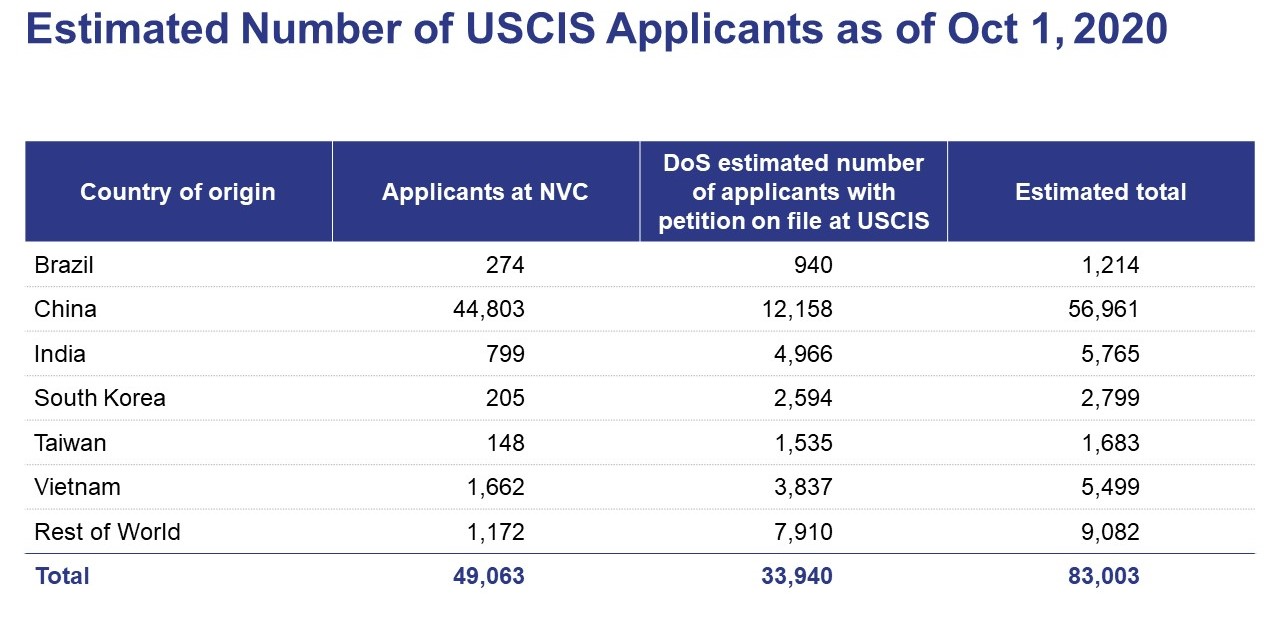
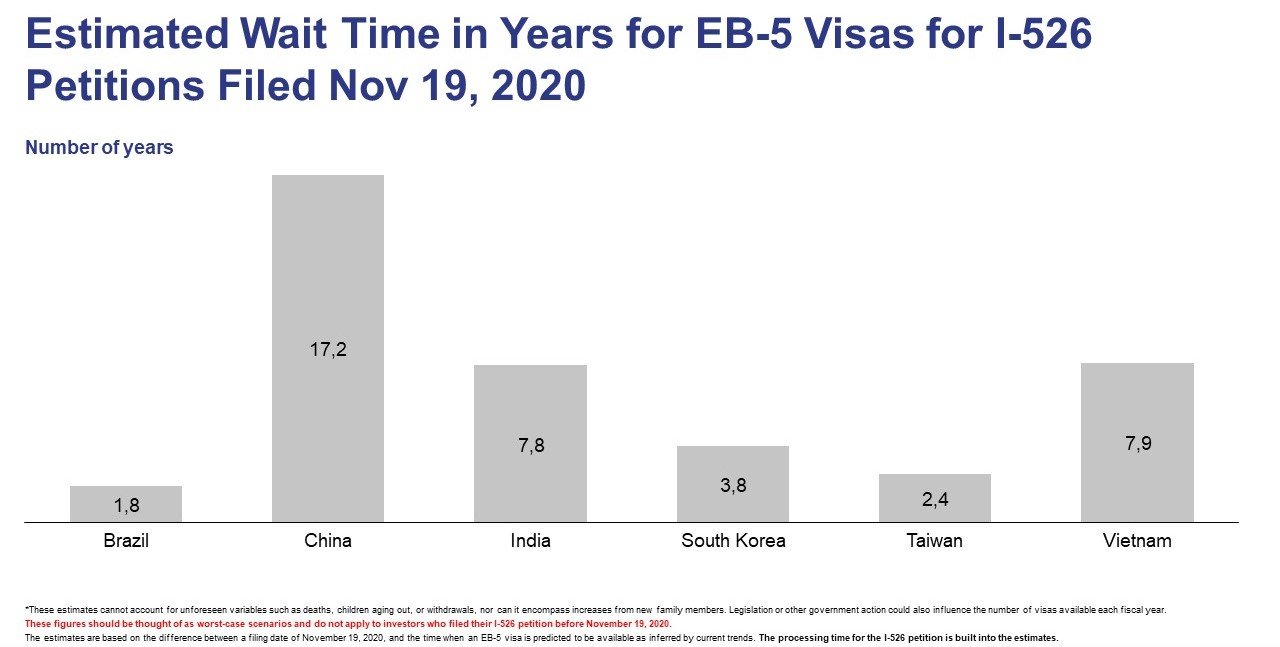
In fact, the popularity of the program is the very cause of one of its primary problems: lengthy backlogs for EB-5 investment participants. United States Citizenship and Immigration Services (USCIS) uses country-based caps on annual visa issuances to ensure balance across countries in immigration matters, but with population sizes and immigration demand differing starkly among nations, this policy quickly results in huge backlogs for nationals from certain countries. In the case of the EB-5 program in December 2020, it’s Vietnamese and Chinese EB-5 investors who are subjected to backlogs.

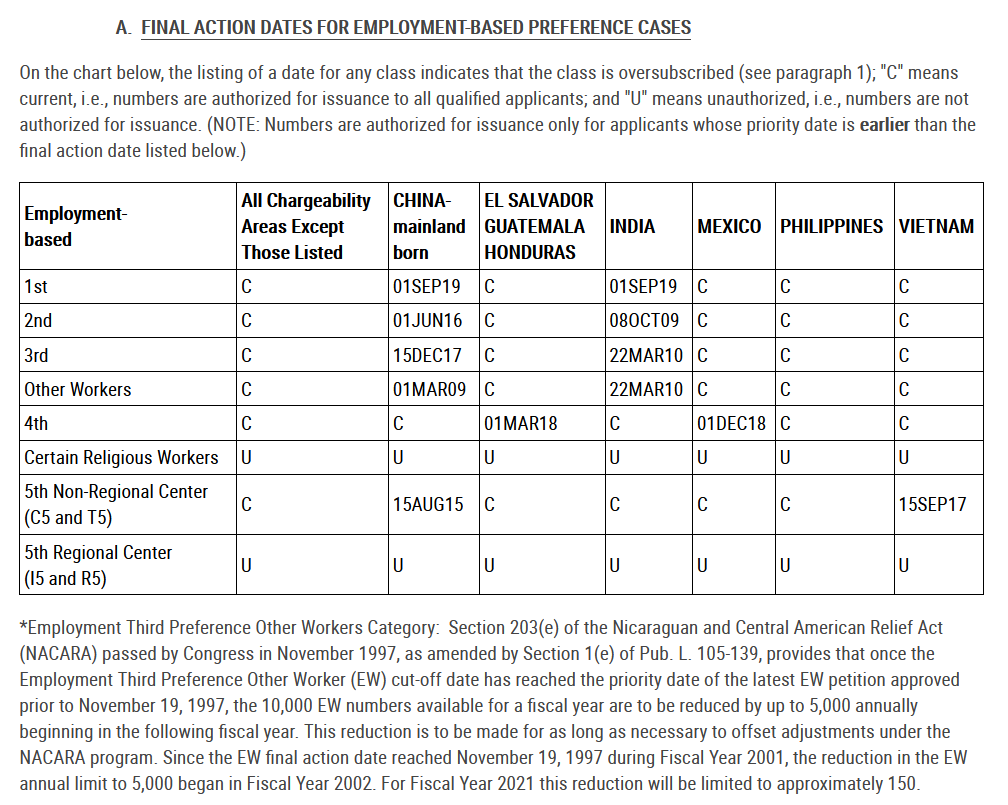
While EB5 investment participants from other countries can simply apply for their U.S. green card after their I-526 petition is approved, Chinese and Vietnamese investors must wait until an EB-5 visa becomes available. Availability is determined by an investor’s priority date—the date on which USCIS received their I-526 petition. Each month, USCIS publishes a Visa Bulletin that outlines the final action dates for petitioners from different countries, and anyone whose priority date is earlier than the indicated date is eligible to receive an EB-5 visa that month.

In 2020, the EB-5 community, just like the rest of the world, was blindsided by the COVID-19 pandemic. The pandemic certainly did not spare EB-5 investors amid its wrath, with temporary shutdowns of U.S. embassies and consulates preventing thousands of investors from completing their visa interview and claiming the U.S. permanent resident status their EB5 investment affords them. Likely also due to the lack of consular activities is the stalling of the Chinese final action date and the slow progress of the Vietnamese final action date. Interestingly, India, which faced a backlog at the dawn of 2020, shot forward rapidly, with the backlog clearing up by July 2020.

The final action dates in January 2021 stand at August 15, 2015, for Chinese investors and September 15, 2017, for Vietnamese investors, with Indian investors remaining “current” for the seventh consecutive month. The Chinese final action date has failed to advance since August 2020, when it moved ahead a single week from August 8, 2015. Not even the earmarking of an astounding 18,000 visas for the EB-5 program in FY2021 at the advent of the new fiscal year on October 1, 2020, could shake the inertia of the Chinese EB-5 final action date. USCIS has an incredible opportunity to issue a previously unfathomable number of EB-5 visas in FY2021 and dramatically shorten the backlogs that have long plagued the program, but so far, it is not acting on this one-of-a-kind opportunity.

Meanwhile, the final action date for Vietnamese EB5 investment participants has moved ahead two weeks to September 15, 2017. While the Vietnamese date, unlike the Chinese one, is moving forward, the progression is disconcertingly slow. The EB-5 world can only hope consular visa progressing resumes quickly and the final action dates begin to shoot forward.

Countries other than China and Vietnam are current in the January 2021 Visa Bulletin, which USCIS signals by entering a C. The dates for regional center investors are listed as U, which stands for “unauthorized,” because Congress had not reauthorized the EB-5 Regional Center Program at the time the figures were drawn up. The EB-5 Regional Center Program has, however, been reauthorized, with a new sunset date on June 30, 2021, so the final action dates for those who have made their EB-5 investment through a regional center should be assumed to be identical to the direct investment dates.

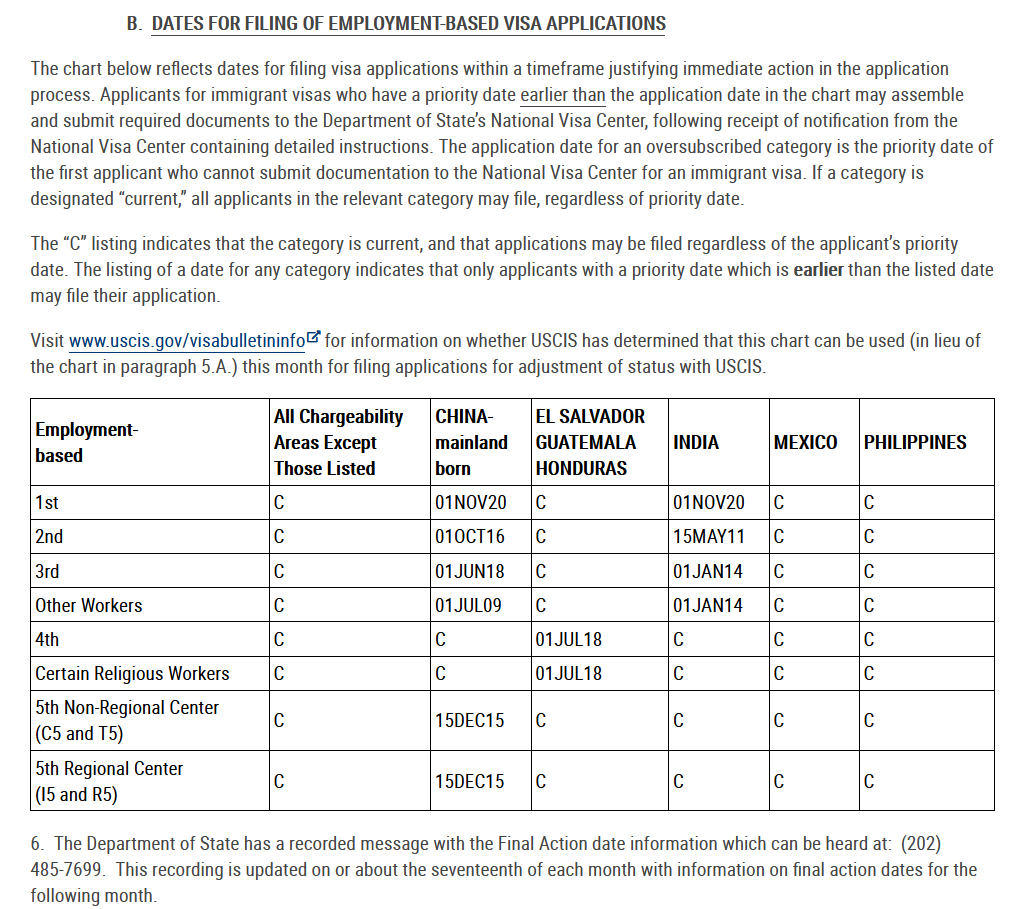
In terms of Chart B, which discloses the date for filing for particularly backlogged countries, China remains the only EB-5 nation without “current” status. With the date for filing staying put at December 15, 2015, for the tenth month in a row, Chinese EB-5 investors whose priority date is later than December 15, 2015, are not even eligible to file their application for a U.S. green card, even if they have already attained I-526 approval. As the EB-5 world hurtles toward the very real possibility of the Chinese date for filing failing to move for an entire year, Chinese nationals with active EB-5 investments can but pray the situation improves.

Free EB-5 Project Evaluation

FY2020 Sees Plummeting Regional Center Numbers, Extreme Fluctuations in I-924 Processing Times

I-829 Processing in FY2020 High but Growing More Unpredictable

With 2020 finally wrapping up after throwing curve ball after curve ball to the entire world, it’s a good time to stand back and take stock of what has happened in the EB-5 industry in 2020. As of December 17, 2020, United States Citizenship and Immigration Services (USCIS) has not released detailed data on petition processing for the latter two quarters of FY2020. However, the statistics for the first half of the year are available, and they paint a distinctive picture for I-526, I-829, and I-924 petitions.

The good news is for EB-5 investment participants with I-829 petitions: I-829 processing volumes have increased, demonstrating the obvious intent of the Immigrant Investor Program Office (IPO) to prioritize I-829 petitions over I-526 petitions. I-526 petitioners find themselves in altogether different circumstances, with the IPO prolonging the slow processing volume it sustained in FY2019. To accompany the low processing figures, I-526 petitioners also experienced record-high estimated processing times, although actual processing times seem to be lower than USCIS’s estimates.

The situation is not so rosy for I-924 petitioners, either. Ever since the Modernization Rule went into effect on November 21, 2019, EB-5 regional centers have faced a tumultuous environment, with USCIS issuing terminations left, right, and center. The added challenge of the COVID-19 pandemic and the subsequent shutdowns made FY2020 a brutal year for regional center operators. With the virus still looming in the air even as 2020 comes to a close, FY2021 isn’t off to a great start, either.

The full picture of FY2020 for EB-5 regional center owners and I-924 cannot be known until USCIS releases the data for the second half of the year, but the figures for the first two quarters were already dismal. With rampant regional center terminations and astonishingly high estimated processing times, the EB-5 regional center landscape could be affected for years to come.

Mass Terminations Bring Regional Center Numbers Down to 2014 Levels

The Modernization Rule encompassed some modifications surrounding the designation of targeted employment areas (TEAs), which had the profound effect of disrupting EB5 investment activity at regional centers across the United States. Lack of investor activity is grounds for termination, and USCIS had no shortage of termination letters to distribute to EB-5 regional centers in 2019 and 2020.

Regional center terminations were increasing even before the Modernization Rule took effect, with regional center numbers falling since 2018. But the starkest decline was after November 2019, with USCIS terminating 140 regional centers and approving none between November 2019 and October 2020. The total number of EB-5 regional centers, which amounted to 646 in October 2020, was down 20% from FY2019 figures.

Most EB-5 regional centers terminated in FY2020 had been approved in FY2015 and FY2017. Given that USCIS tends to terminate regional centers with no investor activity for three to five years, it stands to reason that most were terminated due to lack of investor activity. It is clear, then, that foreign nationals interested in participating in the EB-5 program should carefully vet regional centers before entrusting one with their EB-5 investment capital

Extreme Fluctuations in Processing Times for I-924

The troubles for EB-5 regional centers stem from not only rampant terminations but also the overwhelming lack of new approvals. In March 2019, the estimated processing times for I-924 petitions were steady at 16.5–21.5 months, where they had rested for more than a year prior. But then, they suddenly started shooting up, until they reached a whopping 62–115.5 months in November 2019, when the Modernization Rule went into effect. For reference, that’s 5.1–9.6 years just to gain approval for a regional center.

While estimated processing times did fall back down from their peak at 115.5 months, they never returned to pre-April 2019 levels. With heavy fluctuations from November 2019 to October 2020 taking the estimated processing time range everywhere from 14.5 months to 115.5 months, predicting processing times for I-924 petitions has effectively become impossible. Most months bring strong fluctuations in either direction, so prospective regional center owners are left in USCIS limbo with no indication of when they can actually begin operations. But perhaps it doesn’t matter, because USCIS did not adjudicate I-924 petitions favorably in FY2020 anyway.

Free EB-5 Project Evaluation

I-829 Processing in FY2020 High but Growing More Unpredictable

I-829 Processing in FY2020 High but Growing More Unpredictable

As 2020 winds to a close, the world remains volatile and unpredictable. COVID-19 vaccines are in the works, with the first doses having already been administered in the United States and a handful of other countries, but the pandemic rages on, threatening to keep public life heavily restricted for the foreseeable future. The EB-5 Immigrant Investor Program has not escaped the effects of the pandemic and the associated lockdowns, with temporary suspensions at U.S. consulates and embassies blocking countless foreign investors from claiming the U.S. green cards their I-526-approved EB-5 investments have earned them.

The situation for EB5 investment applicants with pending I-526 petitions is hardly any better, with I-526 processing volumes continuing their downward spiral under Immigrant Investor Program Office (IPO) chief Sarah Kendall. Simultaneously, the estimated processing times for I-526 petitions jumped to unprecedented highs in FY2020, frustrating those with active EB5 investments and discouraging future participation in the program.

FY2020 wasn’t such a bad year for I-829 petitioners, however. I-829 adjudications rose despite the dramatic downturn of I-526 processing, granting many foreign nationals with a successful EB-5 investment their coveted U.S. permanent resident status even in the midst of the most severe pandemic since the Spanish Flu.

High Adjudication and Approval Rates for I-829 Petitions

In contrast to the low I-526 processing volumes, FY2020 saw a jump in I-829 adjudications, surging to 1,229 total I-829 petitions adjudicated and positioning FY2020 as the year with the third-highest I-829 processing volume in its first two quarters since FY2012. This represents a 62% increase over the same period in FY2019, which still saw more I-829 petitions processed than the average since FY2012. The consistently high approval rate for I-829 petitions was also maintained in FY2020, clocking in at 95% for the first two quarters.

The situation in the latter two quarters is unknown as of December 17, 2020. In July 2020, USCIS published a policy memo about redeployment, which directly affected how I-829 petitions are adjudicated. The impact of this policy change will become evident in the latter half of FY2020 and in FY2021, but the EB-5 industry could see I-829 approval rates suddenly falling in the second half of FY2020.

I-829 Estimated Processing Time Range Grew Wider

It’s difficult to predict how long it will take USCIS to adjudicate an I-829 petition. The IPO’s actions in FY2020 make it clear that the organization is prioritizing I-829 petitions over I-526 petitions, but with its snail-like pace under Kendall’s direction, processing times may not have actually decreased since Julia Harrison ran the IPO in FY2018. In January 2020, the estimated processing time range for I-829 petitions was 21–45.5 months, but by October 2020, the range had risen to 35–56 months, despite USCIS’s clear focus on I-829 petitions. Additionally, the range growing wider leaves room for more unpredictability in I-829 processing times. Processing statistics from the latter two quarters of FY2020 and beyond will reveal how the changes to redeployment policy have affected I-829 processing and may offer an indication of the direction processing times will take in the future.

Free EB-5 Project Evaluation

The EB-5 Reform and Integrity Act of 2020: A Potential EB-5 Reform?

The EB - 5 Reform and Integrity Act of 2020- A Potential EB - 5 Reform

Since 1990, the EB-5 Immigrant Investor Program has provided a relatively quick and simple pathway for foreign investors to obtain U.S. green cards for themselves, their spouse, and their unmarried children younger than 21. Even throughout the turmoil of 2020, with much of the United States shut down due to the COVID-19 pandemic, the program has pattered along, infusing new bouts of foreign EB-5 investment capital into the U.S. economy. But the EB-5 program hasn’t been without its fair share of strife in 2020—from the threat of a massive United States Citizenship and Immigration Services (USCIS) furlough to demonization and unfounded claims of fraud from U.S. senators, the EB-5 program needs help to turn around, improve its image, and continue creating new jobs for U.S. workers.

Senators Chuck Grassley (R-IA) and Patrick Leahy (D-VT) have long formed a bipartisan partnership to improve and promote the EB-5 program, serving as living proof of the immigration program’s ability to cross party lines. The two senators have worked tirelessly to strengthen integrity without stifling the program and optimize the benefits that EB5 investment capital can bring to the United States while offering foreign investors and their family members promising new lives in the land of the free. To this end, Senator Grassley has introduced Bill S.2540 – EB-5 Reform and Integrity Act of 2019 to the Senate, cosponsored by Senator Leahy.

What Does Bill S.2540 Propose?

In brief, the EB-5 Reform and Integrity Act of 2020 proposes measures to increase EB-5 program integrity, clamp down on fraud, and reauthorize the ever-popular EB-5 Regional Center Program through 2025. Under the proposed bill, those qualified to make EB5 investments and regional centers operating lawfully would enjoy stronger protections, while fraudsters and others engaging in illegal activities would be more stringently weeded out.

Reauthorization of the Regional Center Program through 2025

While the EB-5 program offers investors two pathways to make their EB-5 investment—direct investment and regional center investment—the majority of investors opt to invest through an EB-5 regional center. The advantages of regional center EB5 investment are manifold—for example, regional center investors are generally not required to involve themselves in the daily management of the new commercial enterprise (NCE) and may count indirect and induced jobs toward the job creation requirement, facilitating the process of obtaining U.S. permanent residency.

Despite its popularity, the EB-5 Regional Center Program is not a permanent U.S. government program, which means it is subject to frequent re-evaluations and reauthorizations. While discontinuation is highly unlikely, the program’s temporary status leaves its future uncertain. The proposed bill would see the EB-5 Regional Center Program extended through 2025, solidifying it in U.S. law for a substantial period.

Stricter Regional Center Integrity Measures

While fraud in the EB-5 program is rare, it does still exist. To more strongly combat fraud in regional centers, the proposed bill would stipulate that 10% of the jobs counted toward a regional center project’s job creation requirement be created directly. It would also require regional centers to retain records for five years and undergo an audit in five-year intervals at a minimum.

Another integrity measure targeting EB-5 regional centers is the proposal to require project-specific business plans with a prospective regional center’s Form I-924 petition. As of December 14, 2020, such inclusion is optional and constitutes an exemplar application, expediting the I-526 approval process for those who have made an EB5 investment in a previously approved project.

Perhaps most importantly in terms of fraud prevention is the preclusion of certain people from work in an EB-5 regional center, as stipulated under the proposed “bona fide requirements” of EB-5 regional center involvement. Those who have previously committed fraud offenses, have received an adverse order from a financial regulator, are inadmissible for immigration to the United States, or have been listed, reprimanded, or disciplined for fraud are not permitted to work with an EB-5 regional center.
A Second Chance at Job Creation

While the majority of EB-5 investors succeed in creating the necessary 10 jobs for U.S. workers within their two-year investment period, not all do. Those worried that their EB5 investment capital will not create all 10 jobs within two years should be cheering on Bill S.2540, as it offers investors an extra year to fulfill the job creation requirements. The same rules apply to the extra investment time as to the standard two-year investment period: the EB-5 investment capital must remain at risk for the duration of the period.

Faster Processing

The EB-5 industry has long lamented the slow processing times for EB-5 petitions, which have even been ruled unreasonably slow in court. USCIS’s snail-like pace, particularly under Sarah Kendall, chief of the Immigrant Investor Program Office (IPO), has contributed to a drop in EB-5 demand, with foreign investors instead opting to pour their capital into countries like Canada or Australia.

Bill S.2540 endeavors to bring changes to the EB-5 program’s longstanding problems with processing times. Under the proposed EB-5 reform bill, USCIS would be required to conduct a fee study no later than one year following enactment. It would then set fees at an appropriate level to carry out petition processing according the following schedule:

  • 180 days for regional center designations and exemplar applications
  • 90 days for regional center designations and exemplar applications in targeted employment areas (TEAs)
  • 240 days for investor petitions
  • 120 days for investor petitions in TEAs

A Promising Future for EB-5

Should Bill S.2540 pass, the EB-5 program will undergo significant changes that will make it more appealing to foreign investors and help it better fulfill its Congress-defined goals of stimulating the U.S. economy and creating new jobs for U.S. workers. Those with EB-5 investments would enjoy swift processing times and an extra year to meet the job creation requirement, reigniting interest in the immigration program.

The bill is only in its beginning stages as of December 14, 2020, so its future is impossible to predict. It’s worth it for EB-5 industry participants to keep an eye on this bill as it moves through the bodies of government, as the changes it can bring to the EB-5 program are significant and more than welcome.

Free EB-5 Project Evaluation

An Analysis of I-526 Processing Figures in FY2020

An Analysis of I-526 Processing Figures in FY2020

As calendar year 2020 comes to an end, fiscal year 2020 already ended on September 30, 2020. The year constituted the most unpredictable and volatile one on record in the EB-5 Immigrant Investor Program’s 30-year history, with the COVID-19 pandemic sweeping the globe, destroying economies, and placing EB-5 investors waiting for visa interviews in limbo. The program managed to escape President Trump’s immigration ban unscathed, but while immigration based on EB-5 investment remained legal, global travel restrictions, reduced flight schedules, and the suspension of routine visa services at U.S. consulates and embassies resulted in a de facto ban.

COVID-19 wasn’t the only change the EB-5 program faced in FY2020. In April 2020, United States Citizenship and Immigration Services (USCIS) introduced the visa availability approach for I-526 processing, shifting away from the classic first-in, first-out approach it had been using since its inception. By prioritizing I-526 petitions from EB5 investment applicants whose countries of origin had immediately available visas, the approach was meant to increase processing efficiency, but it disadvantaged the heavily backlogged Chinese investors.

The enactment of the Modernization Rule on November 21, 2019, was, however, the first blow to the EB-5 program in FY2020. The Modernization Rule entailed a stark increase to the minimum required EB-5 investment amounts, with both regular and targeted employment area (TEA) investment amounts increasing by 80% to $1.8 million and $900,000, respectively. This naturally resulted in the disqualification of countless prospective EB-5 investment applicants. The Modernization Rule furthermore altered the rules surrounding TEA designation, resulting in mass terminations of EB-5 regional centers that continued throughout FY2020.

The unprecedented circumstances of FY2020 created atypical I-526 processing patterns throughout the fiscal year. In this post, we dive into the specifics to discover the full story behind I-526 processing in FY2020.

Major Increase in I-526 Filings Before Modernization Rule Effective Date

Those considering making an EB5 investment were given advance warning of the planned implementation of the Modernization Rule in November 2019. With the 80% fee increase undoubtedly rendering an EB-5 investment unviable for numerous investors, applicants rushed to submit their I-526 applications before November 21, making for a steep increase in I-526 filings in the first half of FY2020. With 4,285 I-526 petitions filed between October 1, 2019, and March 31, 2020, USCIS recorded an 80% increase in I-526 petitions compared to the same period in FY2019.

Of the 4,285 I-526 petitions filed in the first half of FY2020, a whopping 4,264 were submitted in the first quarter, comprising the period of October 1 to December 31, 2019. While a more detailed breakdown of the data is not available, we can assume that most of these petitions were filed before November 21, 2020, when the previous investment amounts of $1 million and $500,000 were still permissible. Subsequent filings were dramatically lower, likely due to both the enactment of the Modernization Rule and the onset of the COVID-19 pandemic.

I-526 Approval Rate Fell, Denial Rate Remained Steady

In the first half of FY2020, USCIS processed a total of 1,359 I-525 petitions, continuing the steep downtrend that began after Sarah Kendall’s takeover as chief of the Immigrant Investor Program Office (IPO) in FY2019. Coming off Julia Harrison’s all-time high in FY2018, Kendall’s abysmal figures were all the more disappointing, and FY2020 brought little improvement. According to the IPO, the low processing volume can be attributed to a greater focus on integrity and fresh training for I-526 adjudicators.

USCIS’s adoption of a visa availability processing approach for I-526 petitions in April 2020 could also have a positive impact on I-526 processing figures, with USCIS focusing its efforts on petitions from countries with readily available visas. But as of December 17, 2020, detailed processing statistics for the latter half of FY2020 remain unavailable. Going by the processing time data published on USCIS’s website, however, the situation does not look to have improved much.

It’s important to note that while adjudications overall have declined significantly, the denial rate has not fallen. The I-526 approval rate in the first half of FY2020 was 81%, the lowest figure since FY2016’s 76%, but the statistics prove that the approval rate is well within EB-5 norms. EB-5 investment applicants have reported increased instances of requests for evidence (RFEs) and notices of intent to deny (NOIDs), but these seem to have largely resulted in delays, not denials.

I-526 Processing Times Hit an All-Time High

With the COVID-19 pandemic wreaking havoc across the globe and I-526 processing almost grinding to a halt, the record-breaking high wait times for I-526 petitions in FY2020 should come as no surprise. One of the many shocks that FY2020 presented to the EB-5 investment industry was the sharp increase in I-526 estimated processing times in August 2020, nearly doubling from 29.5–44.5 months to 46–74.5 months. Fortunately, the range fell back down, standing at 30.5–50 months as of December 17, 2020, but the steady increase of processing times is nonetheless disconcerting.

In August 2020, USCIS also added a separate estimated processing time range for Chinese I-526 petitioners, given that their petitions are deprioritized under the visa availability approach adopted in April 2020. The Chinese processing times have remained far above those for EB5 investment participants from elsewhere, maintaining a gap of roughly two years.

Despite the unprecedentedly high processing times indicated on the USCIS website, actual processing times have been significantly quicker. In many cases, EB-5 investors received their I-526 adjudication sooner than suggested by USCIS, but the trend is still increasing. The EB-5 industry can only hold its breath and wait for USCIS to finally increase its processing capabilities.

Free EB-5 Project Evaluation

EB-5 Heading into 2021: COVID-19 Vaccines and Regional Center Program Sunset Date

EB5-Heading-into-2021-COVID19-Vaccines-and-Regional-Center-Program-Sunset-Date

2020 has been an unprecedented year for everyone, with almost no one on the planet left unaffected by the COVID-19 pandemic. The virus and the subsequent government measures to contain it have upturned economies, destroyed livelihoods, torn apart families, and ended lives. The EB-5 Immigrant Investor program has not escaped COVID-19’s wrath, either, as the pandemic-induced suspension of routine visa services at U.S. embassies and consulates left countless EB-5 investors stranded indefinitely with no pathway to enter the United States.

Surprisingly, the pandemic has also aided the EB-5 program in various ways. For example, the near-total shutdown of immigration also resulted in a lack of family-based visas being issued in FY2020, which saw thousands of unused visas roll over to the EB programs for FY2021. Entitled to 7.1% of all EB visas in a given year, the EB-5 program has been allocated more than 18,000 visas for FY2021 – nearly double the typical number.

With 2020 having been the most unpredictable year in recent history, it’s difficult to foresee what 2021 will bring. The COVID-19 virus still lingers in the air, threatening to further pause public life, so until an effective vaccine is widely distributed, life cannot return to normal as we know it. Below are a couple factors that could influence the EB-5 program as we tumble into 2021.

EB-5 Regional Center Program Sunset Date Fast Approaching

2020 has been the year of the unpredictable, and little would be more unpredictable in the EB-5 program than the discontinuation of the EB-5 Regional Center Program. A temporary program that has been subject to continuous reauthorizations since its debut, the EB-5 Regional Center Program allows foreign nationals to make an EB-5 investment through a qualified regional center rather than directly in an eligible EB-5 project, enabling the pooling of EB5 investment capital for maximum economic stimulation and job creation. Regional centers are heavily favored by EB-5 investors for the relative security they provide, including through relaxed job creation requirements, but until the program is made permanent, it will undergo constant review and reauthorization from the U.S. government.

On December 11, 2020, the Regional Center Program was extended by a single week until December 18, 2020. Throughout the week, Congress engaged in discussions to pass the federal funding bill in which the Regional Center Program reauthorization is included. If the bill fails to pass, a government shutdown will ensue, and the Regional Center Program may expire. Given that the bill likely includes stimulus checks and various forms of aid for struggling small businesses and U.S. workers who have lost their jobs due to the pandemic, it is a complicated matter for Congress, and it’s entirely possible that Congress will pass another short-term extension to win more time for negotiations.

COVID-19 Vaccines to Favor Developed Countries

With COVID-19 vaccines approved by major countries such as the United States, Canada, and the United Kingdom, the world can finally see the light at the end of the long, dark tunnel constructed by the COVID-19 pandemic. With these three countries having already administered their first doses of the highly anticipated vaccine, 2021 is lining up to be a better year than 2020.

However, not all countries will have equal access to a COVID-19 vaccine. While many developed countries have already purchased abundant supplies of the perceived panacea, some developing countries lack the funds and resources to secure doses for their own populations. They can take advantage of excess vaccines redistributed by developed countries and the World Health Organization, but any delays will leave a country in the economic dark longer, and developed countries will inevitably have earlier access to COVID-19 vaccines.

The United States, which leads the world in medical innovation and research, has produced five of the most promising COVID-19 vaccinations, pumping them out at record speed thanks to the billions of emergency dollars funneled into research and development. Naturally, any US-produced vaccinations will be made available to all countries to quash the pandemic globally, but only after the United States has already secured sufficient doses for its own population.

Early access to vaccinations for developed countries presents two opportunities for the EB-5 program. First, with vaccines secured and beginning to be rolled out, it’s time for countries like the United States, Canada, and the United Kingdom to unleash their economic recovery plans. In the United States, the foreign capital from EB5 investments can aid countless companies as they rebuild or help brand-new businesses gain footing in this unstable environment, accelerating the economic recovery and producing new, full-time jobs for the millions of newly unemployed Americans.

The other important role the EB-5 program can play in 2021 is benefiting foreign investors from developing countries. Countries like China, India, and Vietnam may not have the same widespread access to COVID-19 vaccines as the United States, rendering a U.S. green card all the more appealing. Investors the world over may opt to make an EB-5 investment so they can move their life to a highly developed country with the world’s leading economy, state-of-the-art medical facilities, and a strong and early recovery from the debilitating effects of the COVID-19 pandemic.

Free EB-5 Project Evaluation

Bill S.386 May End the Country Cap on EB-5 Visas

Bill-S.386-May-End-the-Country-Cap-on-EB-5-Visas

Since the dawn of United States Citizenship and Immigration Services (USCIS), most immigration programs have been subject to country caps—in other words, only a limited number of visas can be allocated to applicants from a given country in a given fiscal year. Considering the stark population differences among countries—China and Grenada are hardly comparable—this practice has unfairly disadvantaged immigrant hopefuls from high-population nations. The EB-5 Immigrant Investor Program is no different, with EB-5 investment applicants from high-demand countries facing longer wait times due to these country caps.

Every fiscal year, approximately 10,000 visas are allocated to the EB-5 program, representing 7.1% of all EB visas for that year. Among these 10,000 visas, no one country is entitled to more than 7.1%, which amounts to around 700 visas per country. Since applicants can use their EB5 investment to obtain U.S. green cards for their spouse and dependent children as well, the yearly limit of 700 EB-5 visas per country only allows around 300 to 400 immigrant investors per country to start their new, promising life in the United States.

Bill S.386 Offers Hope for Ending the Country Cap

In July 2019, the U.S. government took the first step toward eliminating the discriminatory country caps in the EB-5 program and other U.S. immigration programs by introducing Bill S.386, also known as the Fairness for High-Skilled Immigrants Act of 2019. In 2020, a new version of the bill—Bill H.R.1044 – Fairness for High-Skilled Immigrants Act of 2020—was introduced, and on December 2, 2020, it was passed in the Senate, edging ever closer to the dissolution of USCIS country-based visa limits.

Passing in the Senate is significant, but for a bill of this magnitude, it’s not sufficient to enact the changes. The bill has been sent to the House of Representatives and must gain the approval of both houses to continue. Finally, should both houses pass the bill, it will proceed to President Trump’s desk for a signature, which will officially set it in motion. With broad support from both parties and Vice-President-Elect Kamala Harris as an original cosponsor, Bill S.386 stands a promising chance of passing and ushering in the transformation of U.S. immigration.

What Does the Bill Entail?

If passed, Bill S.386 could redefine the entire EB-5 landscape. The bill would see the country caps on employment-based visas almost completely eliminated, subject to a few conditions. A percentage of the available visas would be reserved for foreign nationals not from the two countries with the largest number of recipients, which, for the EB-5 program as of December 14, 2020, are China (including Hong Kong) and Vietnam. Of the unreserved visas, no more than 85% would be allowed to go to a single country. The passing of this bill represents a significant opportunity for those from China with EB-5 investments, and further improving the situation for Chinese immigrants is the bill’s eradication of an offset that reduces the number of visas that can be issued to Chinese individuals.

If this bill is passed, it will effectively almost void the visa availability processing approach that USCIS adopted in April 2020. The visa availability approach prioritizes the I-526 petitions of applicants from countries with readily available visas and has primarily disadvantaged Chinese investors. If the country caps are removed, significantly more EB-5 visas will be available to Chinese investors, reducing their disadvantage under the visa availability approach.

Free EB-5 Project Evaluation

EB-5 Regional Center Program Extended One Week to December 18, 2020

EB-5-Regional-Center-Program-Extended-One-Week-to-December-18-2020

The EB-5 Immigrant Investor Program is one of the most popular U.S. immigration paths for foreign investors, attracting millions in foreign investment capital to the United States each year. The EB-5 program offers investors two pathways to obtain U.S. green cards for themselves and their immediate family members: direct investment in a qualifying EB-5 program, which entails direct involvement in the day-to-day management of the new commercial enterprise (NCE), or investment through an EB-5 regional center, which relieves the investor of the burden of intensive managerial work.

By far, the regional center route is the more popular one—not only does it offer more freedom, allowing applicants to infuse EB-5 investment capital into an EB-5 project in Florida, for example, yet to settle in New York, but it also loosens the requirements for job creation, making it easier to obtain U.S. permanent resident status.

The only problem is that the EB-5 Regional Center Program is not a permanent U.S. government program. While the Direct Investment Program has been made permanent, the Regional Center Program continues to need periodical reauthorization from the U.S. government. Since its inception, the program has been granted short-term extensions through its inclusion in government funding bills.

Previously, the Regional Center Program was set to expire on September 30, 2020, but Congress breathed new life into it until December 11, 2020. Failing to negotiate funding and legislation for 2021 within the two-and-a-half-month period, Congress extended the Regional Center Program by another week until December 18, 2020, giving them extra time to work out a solution for 2021.

Given the popularity of the Regional Center Program and the efficacy of the EB-5 program in pumping EB5 investment capital into the U.S. economy and stimulating job growth in targeted employment areas (TEAs), it’s highly unlikely that the program will be discontinued. However, until the Regional Center Program is finally made permanent, the EB-5 industry will be required to keep up to date on Congress’s frequent extensions of the program.