



Free EB-5 Project Evaluation

What the Appointment of Alejandro Mayorkas as Secretary of DHS Could Mean for the EB-5 Program

What the Appointment of Alejandro Mayorkas as Secretary of DHS Could Mean for the EB - 5 Program

On January 19, 2021, just a day before President Biden’s inauguration, a Senate confirmation hearing was held for Alejandro Mayorkas, Biden’s choice to head the Department of Homeland Security (DHS). The secretary of DHS performs important work in overseeing U.S. immigration policy, and as a residency-by-investment immigration program, the EB-5 Immigrant Investor Program falls under the purview of DHS. That means EB-5 investment stakeholders should keep tabs on the leadership of DHS, as the secretary of DHS can introduce policy changes that impact the popular investment program.

During the confirmation hearing, Senator Josh Hawley (R-MO) blocked the fast-tracked confirmation of the nominee, citing concerns about Mayorkas insufficiently enforcing laws related to border security. Mayorkas is still expected to be confirmed, but the process is now delayed, with Transportation Security Administration Head David Pekoske taking over the role until Mayorkas’s confirmation. As Mayorkas will likely assume the position in due time, it’s worth it for EB5 investment participants and other stakeholders to take a look at his background.

Who Is Alejandro Mayorkas?

Though Mayorkas was born in Havana, Cuba, in 1959, he has spent most of his life in the United States, as his family fled Cuba in 1960 as a result of the communist revolution. Growing up in Los Angeles, he attended law school and served as an assistant U.S. attorney in California’s Central District for a period, successfully prosecuting various white-collar crimes. He then made the jump into a political career in 1989, eventually being appointed in 1998 by President Clinton as U.S. attorney for the Central District of California. In the period before he left office in 2001, Mayorkas managed a number of high-profile cases.

What Did Mayorkas Do in the Obama Administration?

When the Democrats regained power in 2009 following President George W. Bush’s time in office, Mayorkas was once again appointed in an important role: secretary of U.S. Citizenship and Immigration Services (USCIS). He held the position for most of Obama’s first term, leaving in 2013. As head of USCIS, Mayorkas had a chance to work closely with the EB-5 program, and if his historical achievements are anything to go by, EB-5 investment participants should look forward to Mayorkas’s leadership.

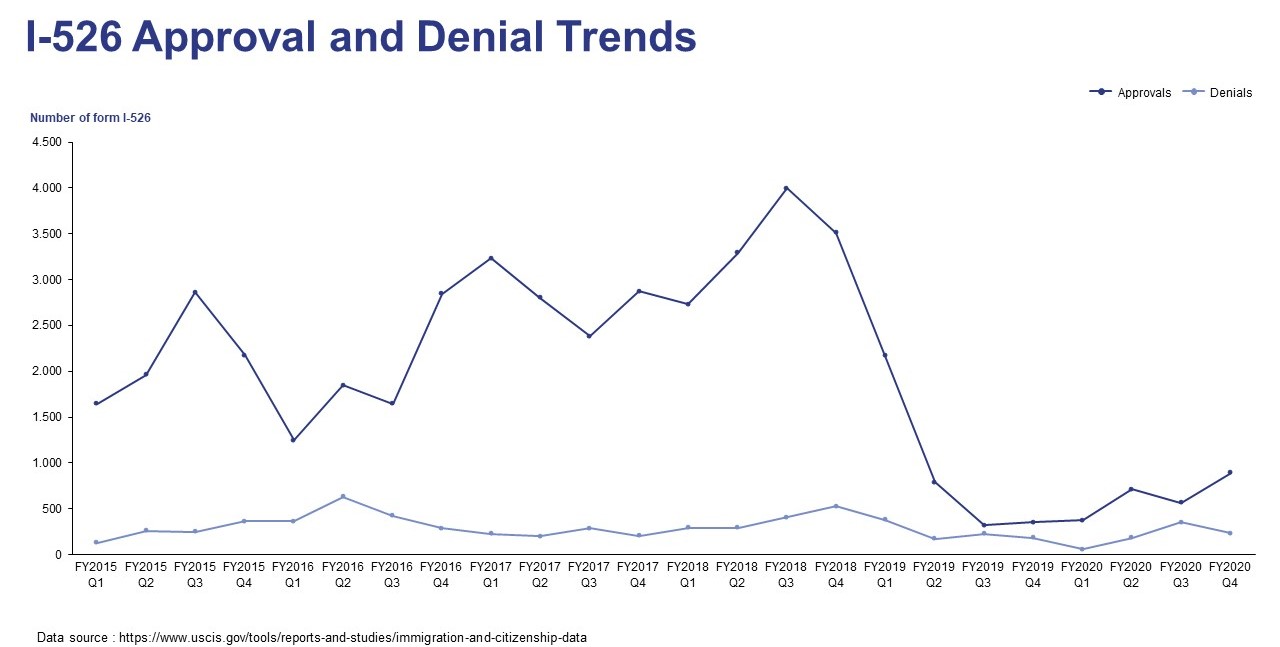
When Mayorkas inherited USCIS in 2009, the EB-5 program was in rough shape—“badly broken,” in Mayorkas’s own words. It was devastatingly underused, with a mere 800 foreign nationals making an EB5 investment in 2007, despite the numerous benefits of U.S. permanent resident status. Taking on the task of reviving the EB-5 program, Mayorkas succeeded magnificently, quadrupling the number of EB5 investment participants in just two years. In his final year as head of USCIS, Mayorkas restructured the way that USCIS evaluates I-526 and I-829 petitions, further strengthening the program and paving the way for explosive growth. Indeed, in 2014, for the first time, the EB-5 program issued all the green cards it had been allocated for the fiscal year.

Mayorkas’s time as head of USCIS ended with a promotion to deputy secretary of DHS in December 2013. Like in January 2021, his confirmation as deputy secretary was stalled on the grounds that he had “exerted improper influence” in the approval of a few EB-5 applications, but the resulting investigation found that he had acted within his powers. His appointment was confirmed in 2014, and he worked in various capacities to improve US–Cuba relations and manage the response to Ebola and Zika.

The Future of EB-5 under Mayorkas

What will happen to the EB-5 program under Mayorkas’s leadership is unknown, but Mayorkas’s qualifications are undeniable. Highly experienced and competent, Mayorkas is a solid choice to lead DHS, and his history with the EB-5 program suggests the development may be great news for those involved with EB-5 investments. With extensive—and personal—experience with immigration, Mayorkas is likely to usher in a period of facilitated immigration for EB-5 investors and other newcomers to the United States.

Free EB-5 Project Evaluation

EB-5 Investors: Have You Received Post-COVID Securities Disclosures?

EB-5 Investors_Have You Received Post-COVID Securities Disclosures
Since the COVID-19 viral outbreak, U.S. financial markets have fluctuated as governmental and regulatory bodies work to respond. Annual business planning and results have already all but gone out the window for many businesses across an exorbitant number of industries this year, and we still have some time before the true impact of these disruptions are known. Still, there’s one variable we can count on: the continuation of significant changes for as long as the COVID-19 crisis goes on. This can be especially concerning for foreign nationals already deeply invested—both in time and resources—in the EB-5 Immigrant Investor Program.

Updated Disclosures Aid EB-5 Investors’ Reassessment of Risk

EB-5 investment participants involved in financed projects are not sheltered from the adverse effects other similar businesses are experiencing in this relatively volatile time. Uncertainty stemming from temporary business closures, hiring freezes and layoffs, an uptick in medical leave across the nation, supply chain interruptions on a global scale, and even travel industry restrictions can all wreak havoc on an EB-5 project’s plans.

This isn’t necessarily the end of the EB-5 journey for those who have invested in an affected project. If they haven’t already, new commercial enterprises (NCEs) and other EB-5 operators should be providing essential updates on various securities disclosures that will help investors remain informed and able to reassess the risks for their projects so that they can react according to their own best interests. These disclosures will pertain to COVID-19 and the possible impacts on the project itself and on the capital that investors have contributed to it.

Any NCE that has EB-5 projects predating the coronavirus outbreak should be preparing or should have already prepared updated securities disclosures. Learn more about what these disclosures may mean for an EB5 investment and when they should be received, as well as what rights and options an investor may have after receiving them.

Offering Documents Prepared Before COVID-19

All EB-5 investment offerings are legally required by the U.S. Securities and Exchange Commission (SEC) to provide certain risk disclosures. This body oversees the execution of the laws and regulations put into place to protect investors in the United States. This legislation typically covers general risks and cautionary language regarding the uncertainties associated with the particular industry under which the project is classified.

An EB-5 investor is likely to see references to safe harbors availed to NCEs under the Private Securities Litigation Reform Act of 1995 (PSLRA), and the disclosures are even likely to include risks related to public health crises and pandemics. They are not, however, likely to address COVID-19 specifically, nor the current nature or severity of its impact on the economy. This doesn’t necessarily signal underhanded activity—how could a business have anticipated this? But now is the time for proper fiduciary handling, and the SEC requires accuracy in its full and fair disclosure statutes.

SEC’s Statements on Full and Fair Disclosure

A core requirement in the protection of investors is offering documents outlining “full and fair disclosure” of material information on an investment. Specifically, the Securities Exchange Act of 1934 not only outlines the prohibition of disclosing untrue statements of material fact but the omission of material facts necessary to prevent previous statements from becoming misleading as well. While no exact quantitative test for materiality exists under SEC laws, the precedent for determining violations is whether there is a substantial likelihood for a reasonable investor to consider a misstatement or omission an important factor in holding on to or selling their investment.

The SEC has cast a wide net when it comes to materiality, and issuers are advised to disclose supplemental offering documents any time there is any doubt as to whether a material fact has the potential to influence investment decisions. Any NCE that does not provide disclosures for significant project changes to its EB5 investment participants would potentially come into violation of Exchange Act laws.

Furthermore, some of the changes that can occur in the wake of a major event like the ongoing COVID-19 crisis may be considered material changes in the eyes of U.S. Citizenship and Immigration Services (USCIS) adjudicators too.

Disclosures on Material Changes from an NCE

Investors need these securities disclosures to ensure they remain eligible for their EB-5 investment visas throughout the allotted investment period. USCIS does offer some flexibility when it comes to discrepancies between original project documents and final outcomes—there are always unanticipated events in business. There are instances in which supplemental disclosures due to updated facts do not trigger findings of material change by USCIS. However, discrepancies that materially affect a project may put EB5 investment eligibility at risk.

Material Changes According to USCIS

Material changes are generally defined as those pertaining to significant aspects of an EB-5 project—ones that can impact adjudication decisions. These changes do not automatically result in petition denial, but they can drastically delay processing. There are several types of material changes that can affect an EB5 investment, including

  • Changes to investment structure or that involve an investor’s capital in any way—source of funds is a common trigger for material change refiling
  • Major shifts in any elements in the business plan, including project scope and timing or staffing structures that change job-creation goals
  • Regional center sponsorship changes, especially when it involves the recent and widespread regional center shutdowns
  • Significant updates to offering documents or any other project documentation

Typically, when a USCIS adjudicator determines that a material change has taken place during an investment period, the EB-5 investment applicant is required to file an updated I-526 petition providing the details of the project’s new circumstances.

Identifying Material Changes in Post-COVID Disclosures

Updates in statements regarding future risks and uncertainties will specifically address COVID-19. EB-5 investors are looking for accuracy of statements that were previously dependent upon future events and assumptions that may no longer be valid. Parts of the disclosure providing notice that COVID-19 may (or has) caused expected results to materially differ are of great interest. More thorough disclosures will outline a robust explanation of how the pandemic could present additional risks or exacerbate traditional risks.

Topics Proper Disclosures May Address

An NCE should clearly disclose how the virus may cause construction delays on a real estate project, for example, or that demand for a hotel project may dwindle following adverse effects on the travel and tourism industry due to an additional viral surge. They may then provide projections on expected operational changes or project evolution to successfully more through recovery.

The impacts upon job creation and allocation, direct references to material changes—these are the signals that an investor may find addressed in those disclosure documents. Additionally, there should be an explanation of EB-5 investors’ rights and when changes would require their consent. All these topics have the potential to affect material changes and impact an investor’s USCIS processing.

Steps Following Updated Securities Disclosures

An experienced EB-5 professional or immigration lawyer can review an investor’s disclosures to help them determine whether any updates signal a significant material change that needs to be addressed with USCIS. They can also advise on solutions to insulate an EB-5 investor from being negatively impacted by COVID-19. This may incorporate any updates from shifts in organization staffing, plans for new fund sources, or capital redeployment strategies as a few examples.

Ultimately, the EB-5 Immigrant Investor Program was designed to aid the U.S. economy in circumstances just like this. An EB5 investment is meant to help create jobs in areas where they are needed most, and to ensure compliance is in the best interest of all parties involved. Facing material changes due to economic and financial challenges is simply a hurdle, and everyone is rooting for success. With timely securities disclosures and a team of seasoned EB-5 professionals at the helm, the situation becomes nothing more than a matter of properly navigating choppy waters.

Free EB-5 Project Evaluation

Perfect EB-5 Project or Marketing Ploy to Pique Investor Interest?

Perfect EB-5 Project or Marketing Ploy to Pique Investor Interest

The choice to participate in the EB-5 Immigrant Investor Program is a decision that has the potential to change the trajectory of a prospective foreign investor’s life (not to mention that of their eligible immediate family members). The stress of navigating the complexities of today’s EB-5 marketplace and all the decisions involved in making the right EB5 investment can leave potential investors feeling anxious about such a bold move.

But ample resources and trustworthy assistance are available to help every interested investor down the path to permanent residency in the U.S. That said, it is important to understand that working with the right EB-5 investment partners is imperative and that proper due diligence in selecting who to turn to for advice is the first step to ensuring the smoothest EB-5 journey possible.

There are generally two ways a foreign national may elect to invest through the EB-5 program—direct and indirect EB5 investments. Which road to travel depends on the investor’s investment and business goals, but by and large, the most popular option among foreign investors seeking an EB-5 visa is to invest through an EB-5 regional center. Selecting a qualified project through the right regional center often eliminates much of the stress associated with U.S. Citizenship and Immigration Services (USCIS) petition submissions and compliance issues because investors work with people who are already familiar and have experience with the adjudication process.

Long-standing, experienced regional centers with established track records can be a godsend on the path to U.S. residency. However, some bad actors work in the EB-5 landscape. Learn how to determine the difference between finding the perfect project and recognizing a marketing strategy.

What Are Preapproved EB-5 Projects?

As an investor searches for the right project, they are likely to encounter EB-5 regional center projects that have been preapproved by USCIS. One of the greatest advantages of working through a regional center is easier access to preapproved projects, but it is important to understand what that means.

Saying a project is preapproved may give some prospective investors the impression that USCIS has somehow granted preference to their EB5 investment project over others in the market. This is not true. While reputable regional centers have worked hard to establish solid relationships with USCIS, understand that the agency does not offer any preference for one project over another. Every single project must be presented in the proper format, must be evaluated against the same set of guidelines, and must be officially adjudicated and approved.

The marketing tactic of framing investment in a preapproved project as guaranteeing successful immigration outcomes stems from regional centers securing approval on an I-924 petition which, in reality, involves the evaluation of a preliminary business plan. This approval is known as an I-924 exemplar.

Marketing the I-924 exemplar to entice investors doesn’t necessarily mean a regional center should be immediately stricken from a consideration set, but it may send up a red flag depending on how far into the discussion they communicate what this approval actually means and where your project of interest actually is in the process.

If they explain exactly what they mean early on in your initial inquiry, then the project may be worth further exploration. If you don’t hear a word about what an I-924 exemplar actually means, you may be safer to pass on the investment.

Approved I-924 Exemplar and “Deference”

In December 2009, USCIS introduced the notion of an I-924 exemplar. The rationale was that if an EB5 investment project submission (through an I-924 petition packet) included a business plan that was evaluated and deemed to sufficiently meet EB-5 program requirements before Form I-526 submission, then USCIS provides “deference” to the I-526 petitions that use the same business plan and documents later on in the process.

Deference is simply the acknowledgement of previous evaluation of a business plan, meant to conserve already scarce USCIS agency time and resources. When an EB-5 regional project has deference, it means that when a new EB-5 investor submits their I-526 petition for adjudication, USCIS is not required to reevaluate the business plan portion of their application, but can instead focus on an applicant’s source-of-funds verification and other personal information.

Furthermore, deference does not shield a later investor’s submission from denial. An I-924 exemplar is granted when the project outlined in the original submission met all EB-5 program requirements—it was “approvable” at the time of that original filing. Because an I-924 petition can sometimes take years to process, by the time a new investor files their I-526 petition, it is quite possible that components of that original I-924 have become irrelevant or invalid.

When Policies Change After I-924 Approval

Some common aspects of a business plan that can change include economic and financial projections and project feasibility studies. Thus, it is nearly impossible to guarantee a project as preapproved and compliant with all current policies and regulations—especially with the current political and economic state of the U.S. In fact, the newest regulatory reforms for the EB-5 visa program went into effect in November 2019. So, if an investor is considering a regional center partnership on a project that was preapproved before then, chances are there would need to be changes to the plans before final USCIS project approval.

Again, an older I-924 exemplar doesn’t necessarily mean an investor should cross a current project off the list. Rather, they need to ask important questions about the validity of its supporting documents, whether a project meets the latest compliance guidelines, and if updates are available or in queue before proceeding with an EB-5 investment submission. As with any type of investment, the key is always clear communication of risk. If, however, a regional center is promising an expedited process based on outdated I-924 approvals prior to November 21, 2019, with no mention of the risks involved, it should certainly signal a hard pass.

Communicating Risks in an EB-5 Project

The primary goals of every EB-5 investment are to successfully obtain green cards for investors and their eligible family members and to have their capital investment successfully returned. To ensure both these goals are met, each investor and their immigration attorney must engage in proper due diligence at the core of their endeavors. Even when an investor uncovers risk through their own investigation, their project partners should be openly disclosing it to them as well. A lack of transparency means even further increased risk and quickly leads to questions of ethics and mistrust—neither of which is acceptable when working with the U.S. government.

On the other hand, when a regional center is open and upfront about the current status of a project, the exemplar (no matter its approval date) can become a roadmap for the success of each subsequent investor’s I-526 petition. As a leader in the EB5 investment industry, EB5AN retains a 100% approval rate with USCIS, in large part due to its level of transparency among all its partners. These include 14 EB-5 regional centers with operations in more than 20 states across the nation and over 1,800 foreign investors from 60-plus countries around the globe, as well as the governing bodies of the residency-by-investment field.

Why Investors Choose EB5AN

Besides its long-standing EB-5 industry relationships and its proven track record, foreign investors who choose an EB5 investment look to EB5AN because of the wealth of cost-free resources available to all of our partners. Whether an investor is still vetting projects and needs access to an up-to-date national TEA map, wants to pass a project through an EB-5 project risk assessment questionnaire, or is ready to run their plans through an EB-5 job creation calculator, EB5AN can help! The network also maintains a digital library chock full of industry news and insider advice.

Furthermore, the top-notch team of EB-5 investment professionals has extensive expertise in areas ranging from business and investment evaluation and strategy to immigration, securities, and tax law. Every foreign national seeking answers to EB-5 program questions is welcome to reach out. Begin to see the difference EB5AN can offer from first contact!

Free EB-5 Project Evaluation

How Will a Biden Administration Change the EB-5 Program?

How Will a Biden Administration Change the EB-5 Program

On January 20, 2021, President-Elect Joe Biden will take over the White House, signaling the end of the Trump administration. Assuming office in the midst of the most severe pandemic since the early 20th century, Biden will undoubtedly have his hands full, overseeing far more than just the EB-5 Immigrant Investor Program. Nonetheless, the impending change of office has prompted those involved with EB-5 investments to question what changes the Biden administration will bring to the United States’ popular green-card-by-investment program.

Biden’s History with the EB-5 Program

A quick glance back through history reveals that President-Elect Biden has traditionally acted favorably toward the EB-5 program. In fact, he contributed to the program’s creation in 1990. As a U.S. senator representing Delaware, Biden voted in 1990 to pass the Immigration Act of 1990, which proposed the establishment of a residence-by-investment program, in conjunction with a number of other immigration programs. While it’s not possible to derive Biden’s opinion of the EB-5 program specifically based on his support for the act, it can at least be assumed that he didn’t oppose it.

The EB-5 program also came up during Biden’s time as vice president in the Obama administration. The administration indicated its support for the program, highlighting the economic advantages EB5 investment capital affords the United States, and acknowledged the EB-5 program’s role in creating new employment opportunities in targeted employment areas (TEAs). However, despite the administration’s clear support for the program, it failed to introduce long-awaited changes, including much-needed reform and a permanent reauthorization of the EB-5 Regional Center Program.

How Will the Biden Administration Treat the EB-5 Program?

Biden has not indicated his feelings toward the EB-5 program in recent times, but he has stressed his support of various forms of immigration. Given that the EB-5 program is a somewhat controversial program in the media, Biden may not directly voice his support, but if he lumps the EB-5 investment program in with the rest of his immigration plans, EB-5 stakeholders may enjoy a more favorable EB5 investment environment in the years to come.

Biden Wants to Modernize the U.S. Immigration System

Biden’s website states clearly that he intends to immediately work to modernize the U.S. immigration system, expanding economic opportunity across all 50 states by facilitating various routes of legal immigration. Fostering the EB-5 program and providing the reforms and changes it so desperately needs would certainly help expand economic opportunity across the United States, so hopefully Biden will consider the immense benefits of EB-5 investment in his immigration endeavors.

Biden Wants to Revitalize In-Need U.S. Cities with Immigration

The Biden administration recognizes the economic, cultural, and social advantages immigrants bring to their new cities. Employment-based immigration is a key factor in fostering entrepreneurship and growth in communities across the United States, including in cities that have suffered major job losses or economic decline over the past years or decades. Since the EB-5 program heavily incentivizes EB-5 investment in TEAs, the program can certainly leverage the benefits of immigration to foster the economic and population growth of in-need U.S. communities, including by creating new full-time employment opportunities. Hopefully, the Biden administration also recognizes this.

Biden Wants to Leverage the Economic Advantages of Employment-Based Immigration

The United States has long prided itself on its spirit of innovation and entrepreneurship, and immigrants contribute immensely to the innovative and entrepreneurial nature of the United States. The Biden administration states on its website that foreign-born workers add around $2 trillion to the U.S. economy each year, and some of the most lucrative sectors of the U.S. economy, including technology, benefit heavily from the contributions of immigrant workers. Biden’s website explains that his government hopes to leverage the benefits of employment-based immigration to further the U.S. economy. Hopefully this ambition includes the EB-5 program, which injects millions of foreign EB5 investment capital straight into the U.S. economy annually.

The EB-5 Program Can Help Rebuild the U.S. Economy

With the world still in the throngs of the COVID-19 pandemic as Biden assumes office, rebuilding the U.S. economy will fall squarely on Biden’s shoulders. Facing the worst economic downturn since the Great Depression, the United States desperately needs foreign capital and successful, wealthy immigrants to help get its economy back on track. The EB-5 program can contribute significantly to “building back better,” as the Biden motto goes, particularly given its focus on TEAs, categorized by higher unemployment than the national average. As Biden steps into the White House, the EB-5 program stands ready to contribute millions in EB-5 investment funds to the U.S. economy, and Biden would be wise to facilitate this valuable source of foreign capital.

Free EB-5 Project Evaluation

What Would Happen If Congress Did Not Reauthorize the EB-5 Regional Center Program?

What Would Happen If Congress Did Not Reauthorize the EB - 5 Regional Center Program

Since 1992, two years after the dawn of the EB-5 Immigrant Investor Program, the regional center route of the EB-5 investment journey has been the preferred pathway to the United States for foreign nationals. The EB-5 Regional Center Program’s popularity is attributable to a number of factors, including the following:

  • the relative security of making an EB-5 investment through an approved EB-5 regional center with experienced business, investment, and EB-5 professionals
  • the freedom associated with not needing to be involved in day-to-day management at the new commercial enterprise (NCE), allowing investors to, for example, make an EB5 investment in a project in Florida but set up home in Oregon
  • relaxed job creation requirements that allow investors to count indirect and induced jobs, instead of just direct jobs, toward the minimum 10 jobs their EB5 investment must create

Given the obvious advantages of EB-5 regional center investment, it has become the clear favorite, with most EB-5 investment participants opting for the regional center route. However, regional center investments face one uncertainty that those who invest directly in an NCE bypass: the possibility of termination of the EB-5 Regional Center Program.

The History of EB-5 Regional Center Program Reauthorizations

The problem with the EB-5 Regional Center Program is that it is not a permanent U.S. government program, leaving open the possibility of termination without warning. Considering that the EB-5 Regional Center Program funnels billions of foreign capital directly into new U.S. businesses, generally in rural or high-unemployment areas in need of economic stimulation (also known as targeted employment areas, or TEAs), a sudden termination of the program is almost unthinkable. Nonetheless, while EB-5 investment participants and stakeholders act on the assumption that it will be continually reauthorized, the EB-5 world must acknowledge the possibility, however slim, of an abrupt sunset of the program.

Congress introduced the EB-5 Regional Center Program in 1992, two years after the creation of the EB-5 program itself. It was initially approved for five years until 1997, undergoing periodic reauthorization, typically of a few years at a time, until 2015. Matters then took a turn toward chaos, with the appropriations process leading to short-term reauthorizations of just a few months at a time. Bundled in with a myriad of other government funding bills and immigration programs, the EB-5 Regional Center Program fell victim to bureaucratic inefficiency, with deliberations on other programs impacting the reauthorization of the lucrative Regional Center Program.

As of January 2021, the latest EB-5 Regional Center Program sunset date suggests Congress may be gearing up to consider the program independently. Since 2015, the program has typically been reauthorized for only a few months or until the next September 30, which marks the end of the fiscal year. With the most recent reauthorization announced in December 2020, the EB-5 Regional Center Program is set to expire on June 30, 2021, separating it from the rest of the programs in the appropriations bill. Time will tell how Congress treats the program going forward.

What Would Happen If the EB-5 Regional Center Program Were Terminated?

The uncertainty of Congress’s sporadic extensions of the EB-5 Regional Center Program begs the question of what would happen in the event of sudden termination. The EB-5 world has faced this question before, such as in 2012, when a three-year authorization period was coming to an end and EB-5 investment participants were not yet accustomed to constant extensions. When the issue was raised in a January 2012 stakeholder meeting, United States Citizenship and Immigration Services (USCIS) sidestepped the question, responding merely that it did not have a response at the time and would address the matter when and if it occurred.

Clearly dissatisfied with UCSIS’s non-answer in January, EB5 investment stakeholders brought the question back in a May 2012 stakeholder meeting, this time receiving a more detailed—although still vague—response. USCIS explained that all regional center designations would automatically expire (i.e., all EB-5 regional centers would automatically be terminated) and USCIS would no longer possess the authority to issue new regional center designation.

The clear lack of policy regarding a possible sunset of the EB-5 Regional Center Program should be construed positively—it suggests Congress has no intention of terminating the popular EB5 investment route. Undoubtedly, if the EB-5 Regional Center Program were terminated, the United States would lose out on billions in foreign investment capital, and lawsuits from disgruntled foreign investors whose pathway to a permanent life in the United States was suddenly pulled out from under them could begin to pile up. That’s not to mention regional center operators and lobbyists, who rally passionately to maintain the popular EB-5 investment pathway, as well as supportive politicians such as Lindsey Graham (R-SC).

IIUSA Government Affairs Webinar

On the subject of government affairs and how they may affect the EB-5 program, industry association group Invest in the USA (IIUSA) is holding a free webinar on February 3, 2021. Interested EB-5 stakeholders should consider attending and even emailing questions in advance to info@iiusa.org. The webinar will cover, among other topics, updates to legislation, the EB-5 reform bill proposed by Senators Grassley and Leahy, ongoing litigation related to the Freedom of Information Act, and the June 30 sunset date of the EB-5 Regional Center Program.

Free EB-5 Project Evaluation

Special USCIS Measures for Pending EB-5 Petitions During COVID-19

Special USCIS Measures for Pending EB - 5 Petitions During COVID - 19

The COVID-19 pandemic ripped through the world mercilessly in 2020, leaving economies and livelihoods across the globe in ruin. Even now in January 2021, the pandemic rages on, with strict lockdowns and rigorous border restrictions from the UK to Japan. The EB-5 Immigrant Investor Program and the thousands of foreign nationals involved in active EB-5 investments were not spared, as the pandemic-induced temporary shutdowns of U.S. embassies and consulates effectively halted the issuance of new EB-5 green cards.

The development and distribution of COVID-19 vaccines, which, as of January 2021, is already being rolled out in developed countries with strong health care systems, such as the United States, is expected to curb the debilitating impacts of the crisis and trigger a much-awaited return to normal life. However, a large-scale vaccination initiative sufficient to bring about herd immunity is likely to be lengthy, and the ultimate result depends largely on the effectiveness of the vaccines.

Until the pandemic has finally subsided and the world can get back to living, those involved in EB5 investments will need to adjust to the ever-changing circumstances as they progress toward a better life in the United States. Unforeseen obstacles are likely in the midst of the COVID-19 pandemic, but fortunately, United States Citizenship and Immigration Services (USCIS) has introduced special accommodations for EB-5 investment participants affected by the COVID-19 pandemic or the resulting restrictions.

Longer Deadlines

The various shutdowns resulting from the pandemic can delay—or, in some cases, render impossible—the execution of certain tasks, even though that may be necessary for the EB5 investment journey. The unpredictable nature of the pandemic further means that new lockdowns or restrictions could be implemented at any time, potentially cutting off an EB-5 investor’s access to resources.

USCIS has responded to this unprecedented period of uncertainty with deadline extensions for requests for evidence (RFEs), notices of intent to deny (NOIDs), and certain other notices the agency sends. Anyone who receives an RFE or NOID between March 1, 2020, and January 31, 2021, is given an extra 60 calendar days to compile and submit a response. Note that the deadline indicated on the notice will be the regular deadline—simply add 60 days to determine the due date under the extended deadline.

Case-By-Case Considerations for Extenuating Circumstances

Various problems related to EB-5 investment and immigration can arise as a result of the COVID-19 pandemic at no fault of the individual investor. USCIS has taken a compassionate stance on such cases, stating it will consider extenuating circumstances on a case-by-case basis.

As an example, the pandemic could impact the ability of a foreign national residing in the United States and participating in an EB5 investment domestically to extend or change their immigration status as initially anticipated. Such an EB-5 investor may present their case to USCIS, who may deem their action or lack thereof as justified given the special circumstances. USCIS added that it may excuse delays in changing or extending immigration status if the delay was similarly due to special circumstances.

Accommodations for Missed Interviews or Biometrics Appointments

As scores of EB-5 investment participants experienced in 2020, attending a visa interview or biometrics appointment is often impossible in the new era of COVID-19. Acknowledging this limitation, USCIS has taken to offering accommodations for those who have missed certain interviews or biometrics appointments as a result of COVID-19 circumstances.

USCIS stresses that EB5 investment participants should aim to make their appointments but recognizes the pandemic could present unsurmountable obstacles to doing so. For example, if an EB-5 investor tests positive for COVID-19 or develops symptoms reflective of COVID-19, USCIS will deny them entry to its facilities. The immigration body similarly advises anyone with an illness similar to COVID-19, such as a cold, to cancel their appointment and reschedule. USCIS will not penalize anyone for rescheduling their appointment for illness-related reasons.

Free EB-5 Project Evaluation

The Impact of the Pandemic on Citizenship Planning

The Impact of the Pandemic on Citizenship Planning

As custodians of public health during the COVID-19 crisis, governmental bodies all around the globe have found necessity in the temporary limitation of their citizens’ personal freedoms. This is most visible through adjustments to social benefits, the application of travel restrictions, and mandates on who can work and where they may do so, as well as by defining what constitutes essential needs.

A collateral consequence of navigating the global pandemic is that these limitations have forced prospective immigrant investors to re-evaluate whether possessing global mobility options remains important at this time. These kinds of decisions among foreign nationals with the resources to invest can have a rippling effect upon an already shaky global economy.

The same holds true for one of the most popular U.S. residency-by-investment initiatives, the EB-5 Immigrant Investor Program. A program implemented in 1990, it has provided hundreds of thousands of immigrant investors with a path toward lawful permanent residency in the United States. Simultaneously, it has garnered billions in foreign investment capital, stimulating job growth and the economy overall in the United States. Since the financial fallout in 2008, the EB-5 program has only seen exponential gains in popularity.

The U.S. Remains a Top Choice for Prospective Foreign Investors

The United States leads the world in COVID-19 infection rates, its last four years of leadership have been less than friendly toward immigrants around the globe, and racial and political tensions seem to have reached a fever pitch. Despite all of this, the nation remains a top contender for foreign investors, and here’s why.

Better Education and Healthcare Options

Access to world-class education and health care are cited as leading reasons foreign nationals keep the United States on their immigration wish list. The United States is the home base of many of the top universities in the world. Real estate investment is better than anywhere else, according to EB5AN survey of 300 wealthy Chinese investors, and Newsweek’s 2020 report shows three of the world’s best hospitals on U.S. soil.

Relative Political and Economic Stability

Despite what seems to its own citizens to be real political strife and economic downturn, compared to the rest of the world, the United States is still a beacon to immigrants from all over. It remains the land of the free, and through the EB-5 program, eligible EB5 investment participants can work and live freely in the country without additional requirements. Furthermore, more often than nearly anywhere else, diligent study and hard work are still rewarded.

A Closer Look at Turmoil Outside U.S. Borders

A number of political circumstances outside U.S. borders are increasingly becoming drivers of EB-5 investment. Latin America, for instance, has always dealt with cyclical politics and economics. But those ups and downs have been exacerbated by COVID-19, and individuals on the high end of the economic gap have sought stability through residency-by-investment programs. Economic and political shifts in Mexico, Chile, and Argentina in particular have left wealthy citizens under critical pressure.

New tax proposals aim to increase the tax burden on the wealthy to help cover costs for oversized and inefficient governments. New policies appear to abandon private capitalism in favor of more socialist-leaning legislation. As a result, high-net-worth individuals are transferring their wealth outside of their home countries in an effort to protect the value of their estates. Moving away from their countries of origin is a strategy to be free from their own governments’ burdening requests.

These foreign nationals who prefer to seek shelter for themselves and their eligible family members in the United States are setting their sights on the E-2 and EB-5 programs. The industry can reasonably expect considerable growth over the next few years from these applicants.

A Win-Win Investment Model

The EB-5 Immigrant Investor Program offers more than just meaningful incentives for foreign nationals—it also provides Americans with crucially important benefits. The jobs and economic wellness attained through the infusion of EB5 investment participants’ capital are key to this symbiotic investment model. This win-win initiative is a viable solution to quelling at least some of the unemployment burden brought on by the pandemic, and its viability has been proven time and time again over the course of its implementation.

The other key variable in this formula is the folks who support EB-5 investors. To maintain the well-earned momentum of this residency-for-investment program, the support systems in place for citizenship planning must remain strong.

The Journey to Residency-by-EB-5 Investment Is Complex

Tying up the normal loose ends of life and packing can end in logistical crises for anyone planning an international move. Being strategic in one’s financial, investment, and other estate planning endeavors adds whole new layers of challenges. Savvy foreign investors not only plan for the short-term but also set themselves up for the long game. For all of these reasons, it is crucial for EB-5 investors to partner with the right support team when they begin their EB-5 investment.

For international families and entrepreneurs seeking out an EB-5 investment team, there are a range of logistical solutions a network of EB-5 professionals should provide. Here are a few of them:

  • Accounting and administration
  • Corporate formation
  • Local tax and regulatory compliance
  • Preimmigration tax and legal guidance
  • Trust information and establishment

One of the most complex and important aspects of planning a move to the United States is the tax implications it presents. The United States maintains a worldwide income tax model, which means each taxpayer is required to provide information on all U.S. and foreign income on every annual return. Global reporting is necessary for all foreign accounts, assets, and investments, as well. Every business owner and investor understands the importance of delegation and the importance of using trusted advisors and team members.

Free EB-5 Project Evaluation

Navigating EB-5 Distressed Business Investments During COVID

Navigating EB-5 Distressed Business Investments During COVID

The COVID-19 viral outbreak that began in early 2020 has been a major catalyst in the continued fluctuations in the U.S. financial markets. All the careful planning and projecting EB-5 investment teams performed for the year has likely gone out the window, and we won’t understand the extent of the pandemic-related disruptions for quite some time. EB-5 investment participants would do well to expect ongoing changes as government and regulation bodies’ responses are rolled out in the coming months, as well.

This kind of uncertainty can be especially unsettling for foreign nationals already deeply entrenched in the EB-5 Immigrant Investor Program process. While the challenges faced in 2020 have been difficult on everyone in the industry, the impact on investors who elected to participate in EB-5 distressed business projects may be compounded.

The State of the Market for EB-5 Distressed Projects

A great number of projects within the recreational and entertainment market sectors that were already struggling to meet the financial projections laid out in their original offering materials are now experiencing even greater difficulties doing so. Additionally, the overall number of distressed or “troubled” businesses – especially in hospitality and real estate – has surely increased in the midst of the COVID-19 pandemic.

Financial Market Strain Can Have Devastating Outcomes

All of these businesses are particularly subject to greater distress following significant reductions in workforce, temporary operation restrictions, and disruptions in various supply chains. The financial markets’ reluctance to issue new bonds and other government-backed financing options is also disrupting the funding landscape for these types of projects. Interest rates are trending historically low as well. Unfortunately, even the most diligent EB-5 investors couldn’t have anticipated a sudden viral outbreak, and the culmination of all of these factors can lead to devastating outcomes.

Unexpected financial market fluctuations such as these have made it even more challenging to sell an EB-5 distressed project seeking EB-5 financing. When EB-5 project construction and operation activities cease, jobs can no longer be created, investors are unable to service their financing obligations, and EB-5 investment participants’ visa eligibility is placed at risk.

EB-5 Distressed Business Investors Need to Remain Well Informed

The savvy NCE operator will likely continue re-evaluating the impact of distress factors and determine whether continuing an EB-5 offering is prudent. Note that every NCE has a fiduciary duty to preserve its EB-5 investment participants’ capital as well as their visa eligibility, and they must do their best to identify the best potential remedies through their analysis. This isn’t, however, a failsafe. Every investor has a responsibility to stay abreast of the goings-on with their project, and a primary source of information is the security disclosure updates they should be receiving.

EB-5 Distressed Business Investors Must Continually Reassess Risk

EB-5 investment participants involved in financed projects are not sheltered from the adverse effects other, similar businesses are experiencing in this relatively volatile time. While the uncertainty stemming from temporary business closures, hiring freezes and layoffs, an uptick in medical leave across the nation, supply chain interruptions on a global scale, and even travel industry restrictions can be absolutely unnerving to an investor in an EB-5 distressed business, it isn’t necessarily the end of their EB-5 journey.

NCEs and other EB-5 operators involved with program-approved troubled businesses should all be providing essential updates for securities disclosures. These documents are the backbone of EB-5 investment participants’ resources for the continuous reassessment of the risks for their projects. Staying well informed allows them to be nimble in their actions and to react according to their own best interests.

Every investor should expect disclosures that specifically pertain to COVID-19 and how it may affect both EB-5 projects and the EB5 investment capital they have contributed to them. All distressed EB-5 projects predating the coronavirus outbreak should be preparing or have already prepared updated securities disclosures. Learn more below about what these disclosures could mean for EB5 investments in distressed projects, when investors should receive them, and what rights and options an investor has.

Troubled Business Investment Offerings Prepared Before the Outbreak

All EB-5 investment offerings are legally required by the U.S. Securities and Exchange Commission (SEC) to provide certain risk disclosures during the signing of an EB-5 investment agreement. This body oversees the execution of the laws and regulations put into place to protect investors in the United States. These disclosures usually cover general risks and cautionary language about the particular uncertainties associated with the industry for that specific project. Look for:

  • References to safe-harbors availed to NCEs under the Private Securities Litigation Reform Act of 1995 (PSLRA)
  • Disclosures on risks related to public health crises and pandemics

What you won’t see is COVID-19 named exactly. You also won’t see the current severity – or even the nature of – the impacts of this pandemic on the U.S. economy. Now is the time, though, for proper fiduciary handling. The SEC requires full and fair disclosure. Find out what that means below.

Full and Fair Disclosure According to the SEC

In its “full and fair disclosure” guidelines, the Securities Exchange Act of 1934 plainly states that both disclosing untrue statements of material fact and the omission of material facts necessary to prevent previous statements from becoming misleading are expressly prohibited. There are no exact quantitative tests to determine that materiality exists under SEC laws. However, there is a precedent for determining violations – that is, whether there exists the substantial likelihood for a reasonable investor to believe an omission or misstatement was an important factor in the decision to hang on to or sell an investment.

The SEC’s scope on materiality is not narrow. As such, issuers are always advised to disclose supplemental offering documents in any situation where doubt may exist as to whether a material fact might influence investment decisions. NCEs that do not provide disclosures for significant changes (like the ones that are occurring within distressed EB-5 projects across the nation due to the pandemic) are potentially violating Exchange Act laws. Additionally, some COVID-19-related changes may be considered material in the eyes of USCIS adjudicators. Both need to be addressed promptly in order to maintain EB5 investment eligibility status.

Disclosures for Material Changes in an EB-5 Distressed Project

Securities disclosures can be very important in ensuring an investor remains eligible for their EB-5 investment visas throughout their project investment period. USCIS offers some level of flexibility on discrepancies between original project documents and final outcomes because there are always unanticipated events in business. Furthermore, some scenarios that require supplemental disclosures do not actually trigger material change findings by USCIS. That said, discrepancies that do materially affect a project can put EB5 investment eligibility at risk.

How USCIS Defines a Material Change

A material change is defined as one that pertains to the consequential aspects of an EB-5 project. These are the changes that may impact an adjudicator’s decisions. While material changes do not always result in a denial of a petition, they can significantly delay processing. So, what types of material changes can affect an EB5 investment? Here are some of the most common ones:

  • Major offering document updates or any other project documentation
  • Significant changes to regional center sponsorships
  • Clear shifts in business plan elements like project scope and timing or employment structures that could change job creation
  • Any investment structure or capital sourcing changes

When USCIS adjudication results in a material change during the EB-5 investment period, EB-5 investors are required to refile their I-526 petition with updated details of the project’s circumstances. There are certain signals within post-COVID-19 securities disclosures that may clue you in to those material changes.

Clues to Material Changes in Post-COVID-19 Disclosures

At first glance, an EB-5 investor should be able to pick up specific references to COVID-19. From there, there are a number of topics that should be addressed within the updated disclosures they receive, including:

  • The accuracy of statements that depend on projections and assumptions that the pandemic may have rendered invalid
  • Parts of the disclosure that provide explicit notice that COVID-19 may have or has caused expected results to differ materially
  • More robust explanations of how the pandemic could present additional risks or exacerbate traditional risks associated with a distressed EB-5 project
  • New projections on expected operational changes or the evolution of a project for the successful continuation of the project
  • Impacts on job creation or allocation and other direct references to USCIS material changes

These are the clues to potential material changes that could impact an investor’s USCIS processing. Besides these signals to material changes within new disclosure documents, look for an explanation of EB-5 investors’ rights as well as an outline of when changes would require EB5 investment participants’ consent.

What to Do After Updated Disclosure Review

Especially when evaluating next steps for EB5 investment in a troubled business, an experienced EB-5 legal professional is a tremendous help in understanding updated securities disclosures and determining how an investor should proceed if significant material changes need to be addressed with USCIS. More importantly, EB-5 immigration attorneys can offer valuable advice on solutions to insulate an EB-5 investor from becoming ineligible for the program, which might include plans for new sources of funds, effective shifts in organization charts to maintain job requirements, or strategies for capital redeployment.

No matter the impact, EB5 investors should find some comfort in the understanding that the EB-5 Immigrant Investor Program was made for circumstances like this. It was designed and implemented specifically to aid the U.S. economy in less-than-ideal circumstances. It is meant to create jobs in areas where high unemployment exists and to stimulate the local economy, all the while ensuring the best interests of all parties involved. Because of this, everyone is rooting for the success of EB-5 projects. Facing any material changes due to pandemic-related challenges is nothing more than a hurdle for most. Timely securities disclosures and seasoned EB-5 professionals in your corner will mean the best possible outcome for every distressed business investor.

Free EB-5 Project Evaluation

How EB-5 Immigrant Investors Find Success in the Era of COVID

How EB-5 Immigrant Investors Find Success in the Era of COVID

The impacts of COVID-19 on the global economy and the changes to day-to-day life on the planet – from social connections and health care to employment and how, when, and where we travel – are topics of conversation at every table. But, as we do in the face of every crisis, the world continues to adapt. In our personal spaces, we work from home and attend class by Zoom. We stick to online shopping and wear masks when we have to go out.

Likewise, affected industries everywhere have made necessary adjustments, too. A downtick in transportation and hospitality reservations is balanced by the uptick in merchant fulfilment centers, their distribution channels, and medical equipment manufacturing. E-commerce businesses and the industries that support it are booming. And savvy investors see the opportunity. Many are wondering if consumer purchasing habits are likely to be altered permanently by the pandemic.

What does that mean exactly for the EB-5 industry? How can prospective EB5 investment participants tailor their decisions to a quickly and ever-changing U.S. market? Let’s take a cue from current EB-5 investors who are achieving success even during a global pandemic, but first, let’s dive into a brief industry review of 2020.

Redefining EB-5 Operations for Recovery

At the forefront of global markets impacted by COVID-19 crisis are hospitality, retail, and tourism. All three of these industries are a big part of EB-5 Regional Center investment offerings across the United States. Although specific effects vary greatly by project, EB-5 investors on the whole have not been immune to the weight of the pandemic. However, there are clear benefits to immigrating post-COVID-19.

Business Survival Depends on Adaptability

Regional centers and NCE operators have been left scrambling in the face of government and public health mandates to redefine their operations before it’s too late to recover. Many have been forced to delay their plans or shutter their operations for good. The projects that have managed to stick it out have largely done so by making bold and nimble moves, shifting revenue streams from brick-and-mortar to the digital space.

The Shift from Brick-and-Mortar to Digital

Online business has been a true lifeline for adapting businesses, and we’ve seen more than significant growth in the e-commerce industry. The sharp increase in consumer demand for the at-home delivery of everything from groceries to automobiles has consequently driven demand for investment in current-market inventory and the logistics and distribution business sectors.

As custodians of EB5 investment participants’ capital and program eligibility, the EB-5 Regional Centers that remain in operation are diligently working to adapt to market changes while continuing to connect the right project operators with the right immigrant investors.

Basic EB-5 Investment Requirements

There are four basic requirements for successfully obtaining a green card through the EB-5 visa program:

  1. Applicants must make a minimum capital investment of $1.8 million (or a reduced investment amount of $900,000 in a rural or high-unemployment area designated as a targeted employment area, abbreviated TEA).
  2. Capital must be infused into a program-approved new commercial enterprise (NCE) or a qualified distressed business.
  3. The EB-5 investment must preserve or create a minimum of 10 full-time employment positions for U.S. workers that remain viable for a minimum of two years.
  4. Lawfully-sourced EB5 investment capital must remain at-risk for the entirety of the investment period.

To avoid (or at least partially quell) the trepidations the fluctuating markets can spur on, many prospective EB-5 investors are choosing experienced industry professionals to counsel them throughout the investment process and best ensure their EB-5 immigration success.

EB-5 Investors Choose Experienced Partnerships for Success

EB-5 networks historically offer investment opportunities across a variety of market sectors. This diversification strategy has been valuable for both aligning with the diversity of client rosters and their individual goals as well as for ensuring the security of the capital they bring to the table. Taking advantage of market trends in this manner provides EB5 investment opportunities that offer greater likelihood for successfully obtaining an EB-5 visa as well as the greatest chances at financial success.

Although the circumstances surrounding the current pandemic have been rather unprecedented, if you step back and take a bigger-picture view, it is easy to see that this strategy still holds strong in the face of challenges brought on by COVID-19. The way EB5AN operates, for instance, hasn’t changed. Our primary goal is still to ensure our clients’ pursuit of permanent residency in the United States, and the projects we elect to present are ones that we are confident will meet (and maintain) all eligibility requirements of the EB-5 Immigrant Investor Program.

Equally important, our next priority is to ensure the security of our investors’ capital. Seeking out projects in sectors that are running strong and projected to continue that way is an obvious choice for EB5AN. For example, more straightforward investment opportunities may involve the creation of at least 10 new jobs at the outset of an project. Or, in riskier opportunities, job creation may depend upon operation of a facility once it’s been constructed.

In either situation, rest assured our team of experienced EB-5 industry professionals will make recommendations based on sound market research and forward-minded analysis. To learn more about how EB5AN helps prospective EB5 investment participants navigate the uncertainties of a post-pandemic immigration scenario, don’t hesitate to reach out!

Free EB-5 Project Evaluation

Oppenheim’s Take on EB-5 Estimated Wait Times

Oppenheim’s Take on EB-5 Estimated Wait Times

Industry expert Charles Oppenheim, who heads the United States Department of State’s Visa Control & Reporting Division, provided insights for FY2021 with a virtual keynote address on EB-5 investment visa availability in November 2020. In it, he presented his thoughts on the future effects of consulate activity slowdowns in 2020 and how adjustment-of-status protocols may be a viable solution to the bottlenecking of EB-5 visas expected in 2021 (but likely won’t be implemented as such). He also delved into an area of great interest but that involves little concrete science—EB-5 visa wait times.

As with any investment, very little is ever 100% guaranteed in the EB-5 Immigrant Investor Program. Dealing with predictions on EB-5 visa wait times is a less than absolute science, and that uncertainty lies squarely in the variables—visa availability, backlogs, petition withdrawals and denials, and the time it takes for the investor to develop a petition packet, just to name a few. While published wait times do not officially guarantee a timetable, they should not be entirely dismissed, either. Rough (but educated) estimations are especially helpful for identifying issues with visa availability.

Basic Wait Time Theory: The Law of Supply and Demand

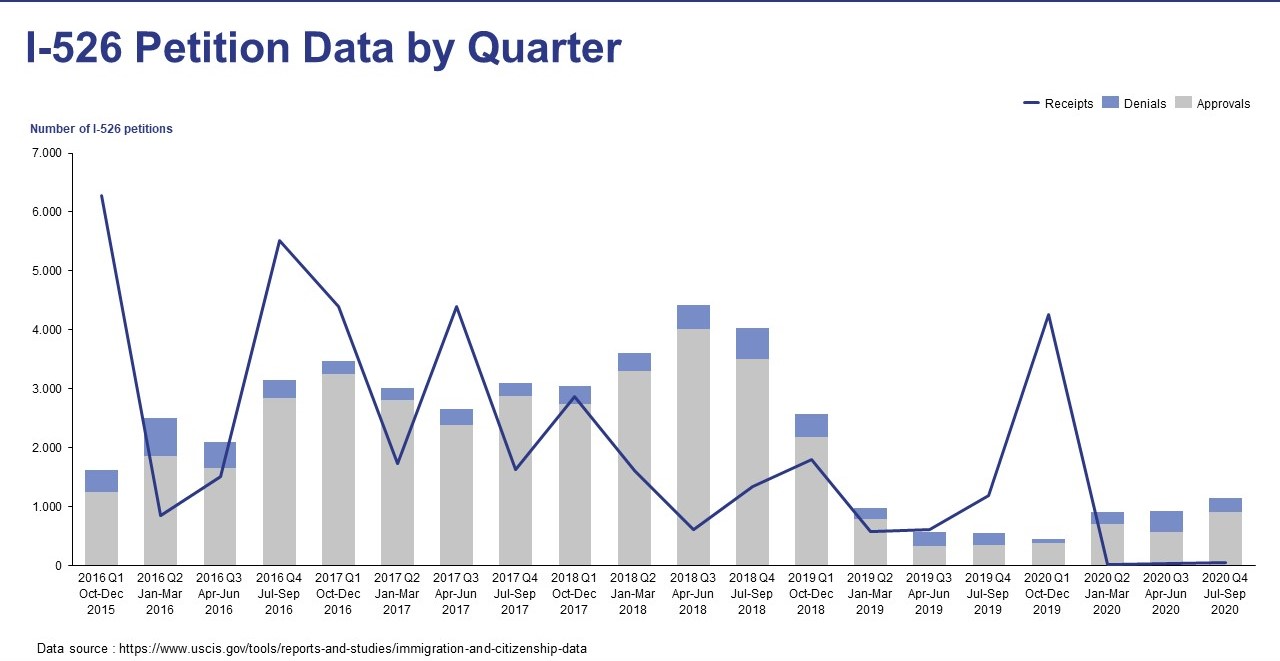
The greatest influencer of EB-5 investment visa wait times is I-526 petition volume. The I-526 petition the submission that initiates the EB5 investment process through United States Citizenship and Immigration Services (USCIS). In the best-case scenario, if many prospective investors file this petition, eventually many prospective investors will be deemed eligible for EB-5 visas. However, the fluctuating volume of I-526 forms to be processed affects the volume of available visas. Increased numbers of eligible investors mean increased wait times due to annual visa quota constraints. Additionally, folks who file early on during a demand surge will experience shorter wait times than those who submit later on.

The Supply of EB-5 Visas Typically Underserves Demand

In a typical fiscal year (October 1–September 30), only around 10,000 visas are earmarked for the EB-5 Immigrant Investor Program. This relatively small number of visas may be allocated to both eligible investors and their qualifying family members. On average, USCIS sees applications for two family members per EB5 investment participant, which amounts to roughly 3,300 visas being available for different EB-5 investments each year.

These visas are also evenly divided among participating countries, regardless of overall population, with 7% assigned to each country of origin. Simple math shows that this leaves about 700 visas available to each country in a normal fiscal year. Any unclaimed visas are reassigned to countries with higher demand for the program. Overall, EB-5 investment visa demand has outpaced supply, thus impacting EB-5 visa wait times.

EB-5 Visa Bulletin Attempts to Balance Supply and Demand

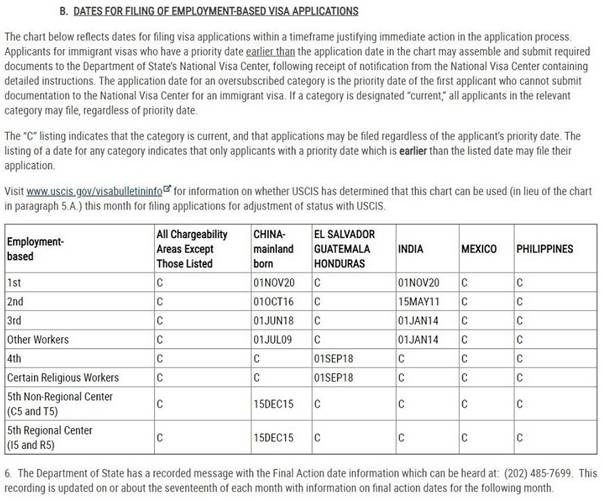
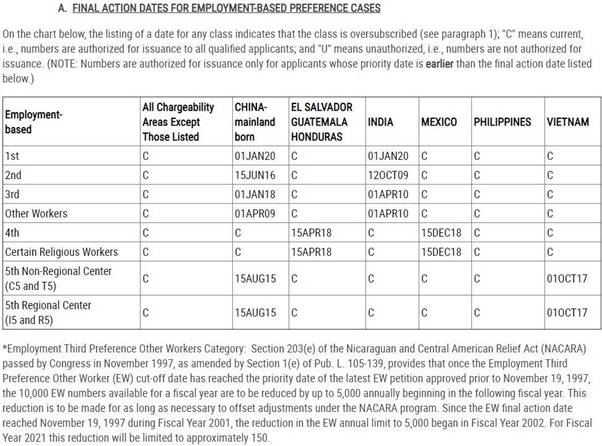
The Department of State (DOS) publishes its Visa Bulletin monthly, wherein it lists cut-off dates by country, which are meant to determine visa availability. USCIS establishes a cut-off date each month for individual countries in which demand significantly exceeds visa availability, which is supposed to ensure fair distribution across all 10,000 visas. Only applicants with priority dates (the date by which USCIS received their application) falling before the cut-off date listed in the bulletin are eligible for EB-5 investment visas or green cards during that month. Eligible applicants with priority dates earlier than the published cut-off date are allowed to apply for permanent residency in the United States. Furthermore, according to USCIS, in order for an adjustment in status to occur, an EB-5 visa must be available to the applicant from the time of submission to the time adjudication is complete.

Visa Retrogression

Visa retrogression is the state in which application volumes (demand) begin to exceed visa availability (supply). For the EB-5 program, if visa retrogression occurs, it usually continues through to the end of the fiscal year but then returns to pre-retrogression levels. Throughout a fiscal year, high-demand EB-5 countries like China or Vietnam may exhaust their allotted limit of EB-5 visas for the year, triggering visa retrogression, but they are also the first candidates for any leftover visas at the end of the year. Thus, most years, once the fiscal year ends on September 30 and the new fiscal allocation takes effect on October 1, dates return to pre-retrogression dates. Additionally, cut off dates typically move forward depending on the current supply and demand of a given country.

Predicting the Ebb and Flow of EB-5 Wait Times

Essentially, a review of the monthly Visa Bulletin offers a glimpse into how long other EB-5 investment participants have had to wait and which priority dates are currently being processed. This is not exactly a concrete foundation for how long it will take to process applications in the future, true. However, considering backlogs and current visa limits in an investor’s country of origin can at least offer insight into how long it will take.

Standard Formula for Calculating EB-5 Visa Wait Times

Here is the industry standard for estimating EB-5 visa wait times:

A ÷ B = C

A: Estimated number of EB-5 investment participants currently in line for a visa
B: Estimated average number of visas available each year (generally ~700)
C: Estimated wait time

Oppenheim’s Use of Standard Calculations

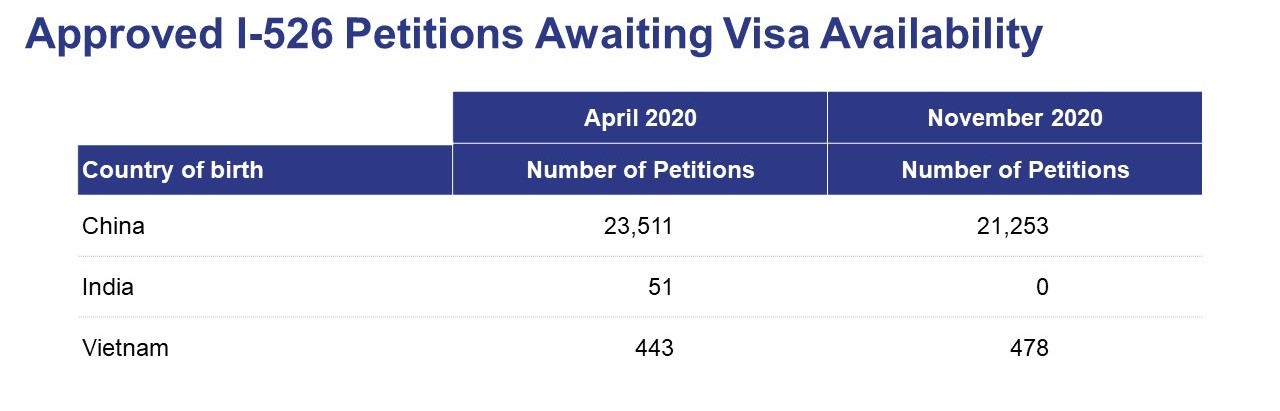
This same calculation is used in Oppenheim’s November 2020 presentation. The last column in the first graphic represents variable A, and the gray bars in the second one equal variable C. Oppenheim’s assumptions in B may be inferred by dividing A by C.


Even Charles Oppenheim’s predictions aren’t fail-proof, however. Let’s take a closer look at why…

The Primary Issue with Oppenheim’s Predictions

Oppenheim’s timing predictions are specifically applicable to a single point in time: October 1, 2020. As petitions are adjudicated daily, the estimated years to visa availability are technically subject to change every day, too. As a queue issue, at any other point in time, the remaining wait time of each individual investor standing in line is uniquely dependent upon how close or far they are from the front of the queue. Thus, instead of saying “the wait time for China,” a better way to conceptualize the queue would be to day “the wait time for a Chinese EB-5 investor who entered the queue at this certain point in time.”

Moreover, Oppenheim’s calculations are specifically based on the very back of the queue on October 1, 2020. EB-5 investors who have been in the queue longer than others will have a shorter wait time than the estimated wait time for the country as a whole. One way to obtain a more accurate estimate is by factoring in data from the DOS on the number of applicants who have earlier I-526 filing dates than a specific investor.

Oppenheim Also Discounts Applicants

Also note that the the first two columns in the above tables do not equal the total inventory of future EB-5 applicants. He only counts EB-5 investors in two categories: USCIS’s pending I-526 petitions and the National Visa Center’s pending documentarily qualified applicants. In other words, those with pending I-485 petitions and those who have already received I-526 approval but are experiencing delays in some other part of the process are left out of the calculation.

While he may have valid reasons for discounting the other applicants, these missing categories of EB5 investment participants can significantly alter wait times. For instance, an estimated 50% of Indian EB-5 investment applicants are working on status adjustments inside the United States.

For those who wish to leverage the extensive experience Charles Oppenheim brings to the table, the real question then becomes whether an EB-5 investor thinks he overestimates or underestimates EB-5 visa wait times in his calculations.

Are Oppenheim’s EB-5 Wait Times Over- or Underestimated?

The easiest way to answer this question is that it’s complicated. Going back to the industry standard equation, A ÷ B = C, Oppenheim’s estimations for C (wait times) are dependent upon the accuracy of the data used in variables A and B. There’s no way around the fact that there must be assumptions about future filings in order to settle on those variables. Anyone who wishes can challenge his calculations with questions regarding future family size and the entire categories of applicants discounted.

An entirely new job description could be made of EB-5 industry professionals laying out tables and playing what-if games with the variables and formulas to estimate how long it will take for EB-5 visas to be processed. A better use of time, however, is to assist individual EB-5 investors on a case-by-case basis, evaluating their unique circumstances to better derive an estimated wait time.

A great starting point for any individual EB-5 investment participant is to understand each of the five basic steps in the EB-5 process and to work with an experienced EB-5 professional to ensure extended waits can be avoided wherever possible.

Five Steps to the EB-5 Investment Process

Generally speaking, from start to finish, an EB5 investment usually takes several years to complete. Below are the five main steps in the process.

Step 1: I-526 Petition Packet Submission

When an EB5 investment participant files their I-526 petition packet and USCIS receives it, the investor is assigned a priority date. Any eligible investor may initiate the process at any time.

Step 2: Awaiting I-526 Adjudication and Approval

The processing of petitions is based on visa availability. Investors from countries that still have visas available are prioritized. I-526 processing often takes years, depending on visa supply and demand and the efficiency of USCIS adjudication.

Step 3: Consular Processing

Applicants who live abroad must visit the closest National Visa Center to become documentarily qualified after receiving I-526 approval. After applying for a U.S. green card and undertaking a visa interview, they are eligible to receive an EB-5 visa, if available.

Step 4: I-485 Petition for Adjustment of Status

Once the previous steps have been completed, EB-5 investment participants already living in the United States may file an I-485 Adjustment of Status application when visas become available. This is the stage in which the monthly Visa Bulletin becomes relevant. Applicants whose countries have a “current” status in the bulletin are least likely to be at risk for missing the 700-visa limit. For others, this step can also cause delays that span years.

Step 5: Petition to Have Conditions Removed

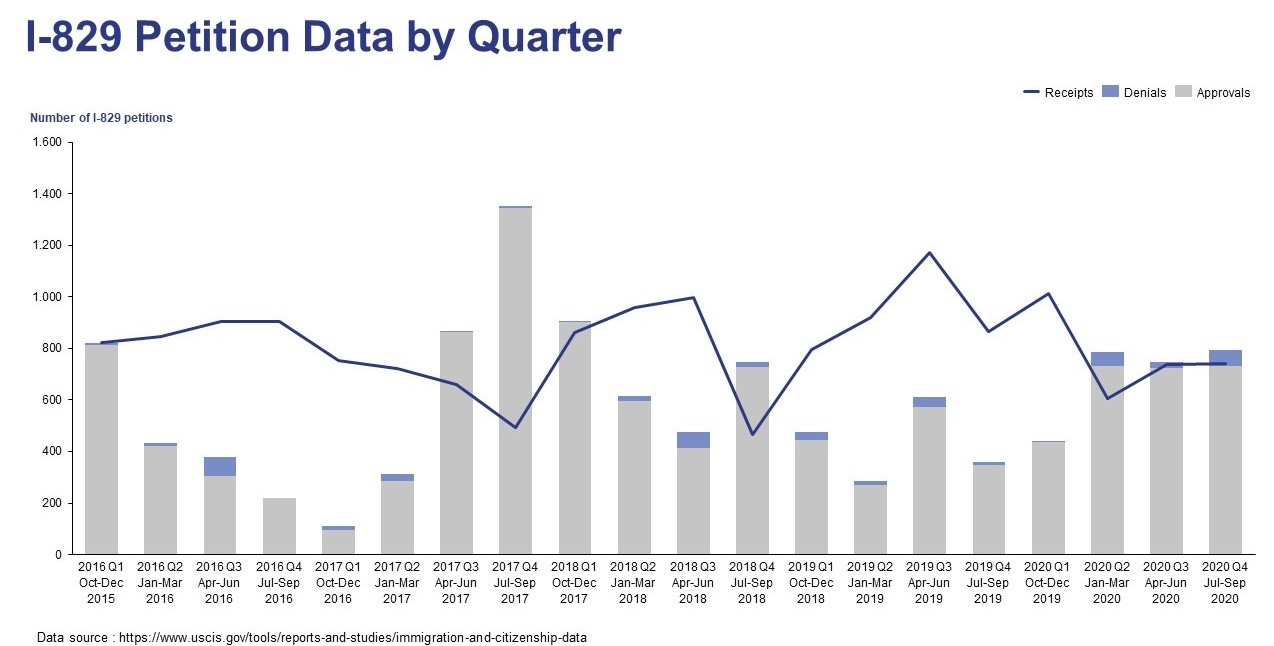
Within the last 90 days of an EB-5 investor’s two-year conditional residency period, they must submit a Form I-829, which petitions to have their conditions removed and their residency in the United States made permanent.