



Free EB-5 Project Evaluation

What Documents Are Required for an I-526 Petition?

What Documents Are Required for an I-526 Petition?

Any foreign national interested in the EB-5 Immigrant Investor Program as a relatively quick and simple way to gain U.S. permanent residency rights for themselves and their qualifying family members should familiarize themselves with the I-526 petition. This important petition is an immigrant investor’s first contact with United States Citizenship and Immigration Services (USCIS), and it’s essential an investor understands the many nuances of the application to avoid jeopardizing the success of their EB-5 investment. Careful preparation can help an investor avoid requests for evidence (RFEs) and delays, accelerating their permanent move to the United States.

What’s Involved in an I-526 Petition?

Of course, an investor needs to fill out USCIS’s Form I-526, specifying various information about themselves, their accompanying family members, and the project they have chosen for their EB5 investment. But the form is only the beginning—investors must also submit a mountain of supplementary documents with their I-526 petition.

Anyone making an EB-5 investment must append documentation on the EB-5 project they are investing in—this can include a business plan, hiring schedule, market analysis, any required licenses or certification, and more. In essence, USCIS must be satisfied that the project is viable and will indeed create the 10 full-time jobs necessary for an EB5 investment. It’s important to note that even if a project has I-924 exemplar status, meaning the regional center has already submitted and received approval for the project documents, investors must still submit the project documentation in their personal I-526 petitions. Those investing through an EB-5 regional center will generally be provided with the required papers.

Anyone making an EB-5 investment in a targeted employment area (TEA) project also needs to include accompanying documents that justify the project’s TEA status. TEA projects are eligible for a lower minimum investment amount ($900,000 as opposed to $1.8 million), rendering them highly sought-after EB-5 projects. The documents needed to prove TEA eligibility depend on the type of TEA one is making an EB-5 investment in—high-unemployment TEAs and rural TEAs are both possible. High-unemployment TEA projects are more common but more difficult to document. Regional centers can often help their investors with the TEA paperwork.

Finally—and this is the trickiest part—all investors must provide comprehensive proof of the lawful sources of their EB5 investment capital. USCIS accepts funds from any number of sources, from employment income, business income, and capital gains to loans, gifts, and inheritance, but in all cases, investors must demonstrate that the capital came into their possession legally.

The source-of-funds requirement is far more in depth than investors often initially assume. For example, in the case of gifted or inherited EB-5 investment capital, not only must investors prove that they lawfully received the gift or inheritance, but they must also demonstrate that the donor or decedent legally obtained the funds. In the case of capital gains—such as through the sale of real estate—investors must show how they obtained the funds used to originally purchase the asset. For business income, evidence documenting the legal obtainment of the initial seed capital is required.

The complicated nature of the I-526 petition, particularly the source-of-funds documentation, means investors would be wise to hire an immigration lawyer to help guide them. Immigration attorneys who specialize in EB-5 can expertly guide an investor through the I-526 process.

What Supporting Documents Are Necessary for an I-526 Petition?

Once you’ve selected your EB-5 project and committed your capital to the project’s escrow account, it’s time to dive into the I-526 petition. Here’s a quick overview of the information and documents you’ll need for this EB5 investment application.

Personal Information

Form I-526 asks investors to provide personal information—both basic information such as age, citizenship, and place of birth, as well as more detailed information, such as personal history. For example, USCIS uses Form I-526 to learn an investor’s employment and address history throughout the past five years. If any dependents are accompanying the investor—their spouse or unmarried children under the age of 21—they must also provide information on these family members.

Project Documentation

Investors must provide information on the project they have chosen to make an EB-5 investment in. The required documents include the above-mentioned project paperwork, such as the business plan and hiring schedule, as well as its business address. If the project is in a TEA, the investor must also include the relevant population or unemployment data to justify this designation. Finally, if the investor is working with an EB-5 regional center—and most EB-5 investors do—they must provide information on the regional center as well.

Source-of-Funds Documentation

The source-of-funds requirement is generally considered the most difficult part of the I-526 process. Precisely what documents an investor might require to prove the lawful sources of their EB5 investment capital varies depending on the investor’s personal situation, including how they sourced the funds and in what country, and the process is more difficult for some investors than others.

Investors should work with an experienced EB-5 immigration lawyer to determine the best fund sources to use. A competent immigration attorney can streamline the process as much as possible and minimize the chances of receiving an RFE, causing delays in the EB-5 investment process. Documents could include bank statements, tax returns, employment records, investment records, property deeds, loan documentation, gift records, accounting records, and more.

Managerial Involvement Documentation

USCIS requires investors to be actively involved in the project in which they make an EB5 investment, but what exactly this entails depends on the particular project. While direct EB-5 investors typically have to engage in day-to-day management work, regional center investors usually just sign on as limited partners, vote on pertinent matters, and call it a day. Such a setup allows investors to live anywhere in the United States—even far away from their project—but documentation to prove their policy-making role is always required.

Translations

Unless an investor’s documents are in English, they will need to obtain certified translations for them. Alongside the translator’s signature certifying the translation, investors must include the name and contact information of their translator.


Free EB-5 Project Evaluation

The Steps to an EB-5 Green Card

The Steps to an EB-5 Green Card

Interested in forging a new life in the land of the free? The EB-5 Immigrant Investor Program makes it possible. Tens of thousands of immigrant investors and their families have already set up house in the United States after completing a successful EB-5 investment. Investors need only make a largely passive investment of $900,000 (if the project is in a targeted employment area, or TEA; otherwise the minimum investment amount is $1.8 million) and satisfy certain program requirements, such as the creation of at least 10 jobs for U.S. workers. Upon successful completion of an EB5 investment, the investor and their immediate family members are eligible for U.S. green cards.

Step 1: Read Up on the Program

The first step to an EB-5 investment is ensuring the EB-5 program is the right choice for you and your family. Understand the key EB-5 requirements: an investment of $1.8 million or $900,000 (depending on the TEA status of the project), the creation of at least 10 full-time jobs for U.S. workers, comprehensive documentation proving the lawful sources of the investment capital, and the maintenance of the capital at risk for the duration of the EB5 investment. Investing through a USCIS-approved regional center can facilitate some of the requirements, such as the creation of 10 full-time jobs, and make it easier to obtain an EB-5 visa.

Step 2: Conduct Due Diligence to Select a Project

Once you decide to undertake an EB-5 investment, you’ll have to carefully select the right EB-5 project for you, which requires meticulous due diligence. Unlike a typical investment, when you make an EB5 investment, you have to consider not just financial risk but also immigration risk. How likely is it that a prospective project will create enough jobs to account for all participating EB-5 investors?

To protect your finances, it’s also important to consider the conditions of the investment, the exit strategy, and other financial considerations. However, investors must ensure their EB-5 investment capital remains at risk throughout the entire investment period, which may even involve redeploying the capital, depending on United States Citizenship and Immigration Services (USCIS) processing speeds. Failure to maintain the capital at risk can jeopardize an investor’s immigration eligibility.

Step 3: Make the Investment and File Your I-526 Petition

After choosing a suitable EB-5 project, it’s time to commit your capital to the designated escrow account and start compiling your I-526 petition, which is the first form an EB-5 investor formally files with USCIS. Putting together an I-526 petition can be difficult and time-consuming, and EB-5 investors are advised to seek immigration legal counsel as they navigate this process.

For those making an EB5 investment through a regional center, the regional center will generally provide the project-side documentation. However, investors are also responsible for demonstrating the legal sources of their EB-5 investment capital, and depending on the sources and country, this process can be tricky. Working with an EB-5 immigration lawyer can dramatically facilitate the process and reduce the likelihood of receiving a request for evidence (RFE) from USCIS.

Investors making an EB-5 in a TEA project must also provide documentation justifying the project’s TEA designation. The necessary documents will depend on the type of TEA at hand: a rural TEA or a high-unemployment TEA. USCIS outlines strict rules for the TEA designation documentation procedure, but again, regional centers will generally provide their investors with the necessary papers.

Once an investor submits their I-526 petition, they receive a priority date. For investors from high-demand countries, who may face backlogs, the priority date determines eligibility to receive (or even just apply) for an EB-5 visa.

Step 4: Apply for an EB-5 Visa

Once an investor receives I-526 approval on their EB5 investment, they’re finally eligible to apply for a U.S. green card. Investors residing overseas must file a DS-260 with their local U.S. embassy or consulate and undergo an in-person visa interview. Investors who already live in the United States on a different visa have an easier process, as they may simply file an I-485 petition to adjust their U.S. immigration status.

Investors from backlogged countries—as of April 2021, China and Vietnam—will have to keep an eye on the final action dates and dates for filing in the monthly Visa Bulletins. Given the excessive demand for EB-5 investments among Chinese and Vietnamese nationals, supply is insufficient, and investors must wait until an EB-5 visa becomes available for them. When the date for filing moves ahead of their priority date, they may submit their EB-5 visa application, and when the final action date moves beyond their priority date, they are finally eligible to receive their EB-5 green card.

Step 5: Live in the United States for Two Years and File an I-829 Petition

As soon as an investor and their qualifying family members receive their green cards, they may relocate to the United States and reap all the benefits of U.S. permanent resident status. However, initially, they are residing on two-year conditional permanent resident status. Throughout these two years, the investor must keep their EB-5 investment capital at risk, and within the final 90 days of their conditional permanent residency period, they must submit an I-829 petition to remove the conditions. On the I-829 petition, they must demonstrate that they kept their EB5 investment funds at risk for the entire two years and created the necessary 10 new jobs for U.S. workers. Investors are encouraged to work with an EB-5 immigration lawyer at this stage as well.

Step 6: Obtain U.S. Permanent Resident Status

Upon approval of the I-829 petition, an investor’s EB5 investment journey is finally over, and they may live indefinitely in the United States with their spouse and qualifying children. As a permanent resident, a green card holder may live, work, study, and travel freely anywhere in the United States, and they may enjoy many of the same privileges that U.S. citizens do, such as in-state tuition savings for universities, access to state-of-the-art health care facilities, and free public education for their children. An optional additional step is to apply for U.S. citizenship, which is possible after five years of permanent residency (including the two years of conditional permanent residency).

Free EB-5 Project Evaluation

Chinese Final Action Date Finally Moves Ahead in June 2021 Visa Bulletin

Chinese Final Action Date Finally Moves Ahead in June 2021 Visa Bulletin

Every month, the U.S. Department of State – Bureau of Consular Affairs releases a new Visa Bulletin for employment-based and family-based immigration to the United States. With demand for immigration to the United States far outpacing the supply of visas, country-based annual visa caps result in lengthy backlogs for nationals of certain countries, and the EB-5 Immigrant Investor Program is no exception. Since 2014, Chinese investors, who have, throughout the residency-by-investment program’s history, accounted for the majority of EB-5 investments, have faced a backlog. Vietnamese EB-5 investors have similarly been stuck in a backlog since 2015, and an Indian backlog also formed in 2019 before clearing up in July 2020.

After the tumultuous year of 2020, with the effects of the COVID-19 pandemic still lingering throughout the world in 2021, EB5 investment stakeholders have faced mounting hardship and uncertainty. Although, for FY2021, the EB-5 program was granted almost double the typical number of visas, United States Citizenship and Immigration Services (USCIS) has failed to issue a large number of EB-5 visas, with EB-5 final action dates in the Visa Bulletin barely budging. Movement in the Chinese final action date in particular was slow, with Charles Oppenheim, chief of the Immigrant Visa Control and Reporting Division of the Department of State, even stating the high probability of the Chinese final action date failing to move throughout the entire fiscal year of 2021.

That’s what the June 2021 Visa Bulletin is so surprising. Much to the EB5 investment world’s surprise, the Chinese final action date jumped ahead one month, landing at September 15, 2015. Finally, after months and months of inaction, Chinese EB-5 investment participants are seeing forward momentum. Perhaps, finally, USCIS is issuing the large numbers of EB-5 visas at their disposal for FY2021.

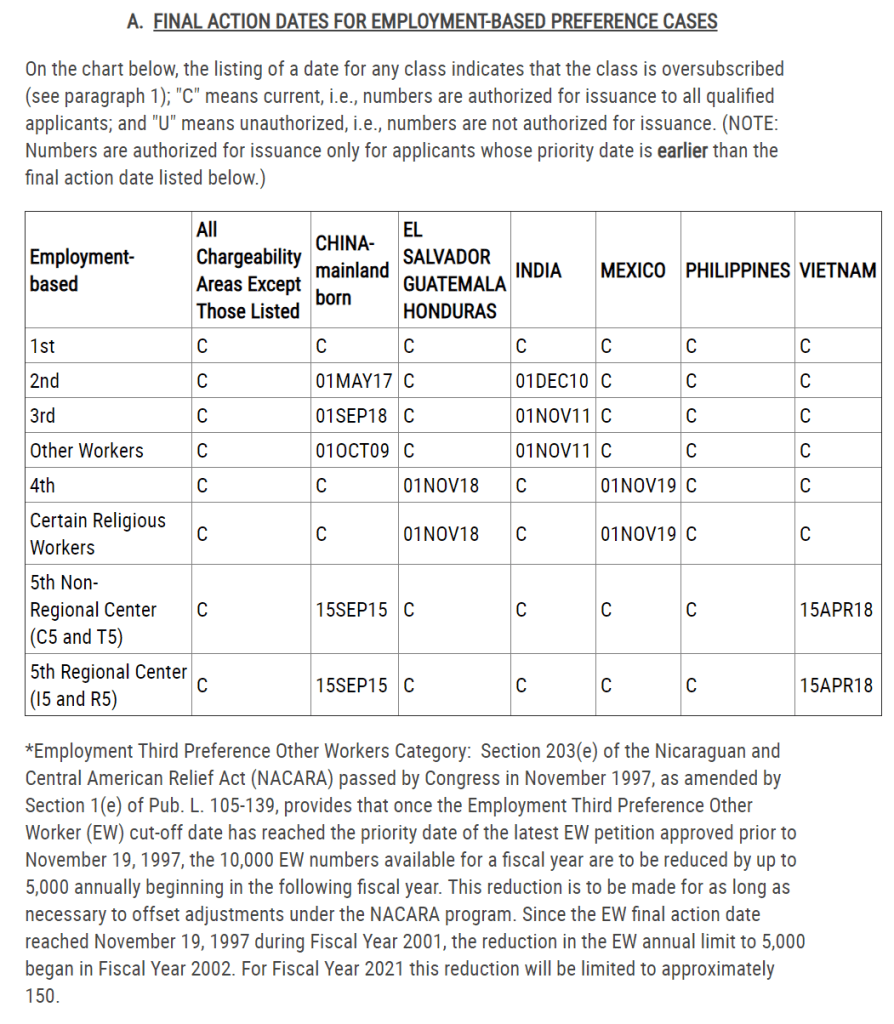
In Chart A, which displays the final action dates for June 2021, both China and Vietnam have advanced—hopefully a sign of good things to come for backlogged EB-5 investors. China’s final action date has advanced one month from August 15, 2015, to September 15, 2015. Vietnam’s, conversely, has moved ahead by two months, taking the date from February 15, 2018, to April 15, 2018. All other countries are current, including India, which has maintained its much-coveted “current” status for 11 months now. If this condition remains true in the July 2021 Visa Bulletin, it will mark one year since the south Asian country cleared up its backlog.

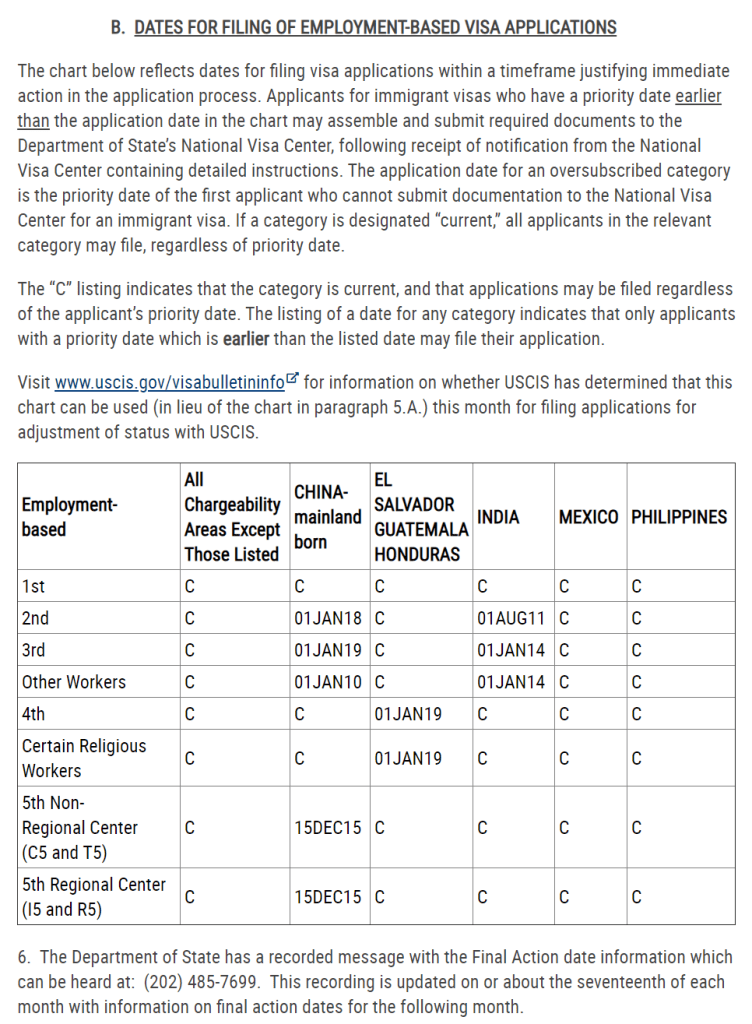
In Chart B, the news isn’t as good. While the Chinese final action date has finally advanced, there nonetheless remain countless Chinese nationals with active EB5 investments and approved I-526 petitions who are unable to file their application for an EB-5 visa. The Chinese date for filing has remained in place for more than a year, but with the advancement of the Chinese final action date comes hope for these EB-5 investment participants. If advancement in the Chinese final action date continues in future Visa Bulletins, advancement in the Chinese date for filing will be sure to follow—at least eventually.

Free EB-5 Project Evaluation

What Is a TEA, and Why Should You Make an EB-5 Investment in One?

What Is a TEA, and Why Should You Make an EB-5 Investment in One?

If a foreign national makes an EB-5 investment in a qualifying project and fulfills the various requirements laid out by United States Citizenship and Immigration Services (USCIS), they—and their immediate family members—will receive permanent resident status in the United States. In terms of qualifying for a green card, all EB-5 projects are equal—all successful EB5 investments lead to the same outcome. But depending on the type of project one invests in, their EB-5 investment journey may be simpler, easier, or more attainable. For many investors, this means making their EB5 investment in a targeted employment area (TEA).

A TEA is an area—usually a census tract or a conglomeration of census tracts—that Congress has determined to be particularly in need of economic stimulation and job creation. TEAs come in two flavors: high-unemployment TEAs and rural TEAs. Directing EB-5 investment capital into TEAs is, of course, in the government’s best interest, as it can drive economic growth in America’s most in-need communities. But thanks to a special incentive introduced by Congress, it’s also in the best interest of EB-5 investors, as it cuts the minimum required investment amount in half.

How Are TEAs Defined?

Rural TEAs are the easier of the two types to define and calculate. To be classified as a rural TEA, an area must simply house fewer than 20,000 inhabitants, not be within a metropolitan statistical area (MSA) as defined by the Office of Management and Budget, and not directly border a city or town with a population of 20,000 or more. The population statistics must be derived from the most recent ten-year U.S. census.

High-unemployment TEAs, however, are the more common of the two. To be considered a high-unemployment TEA, an area must be urban (i.e., not rural) and exhibit an unemployment rate of at least 150% of the national average. Historically, individual states designated TEAs, but regulation changes in July 2019 ushered in a new era, in which the Department of Homeland Security (DHS) oversees TEA designation. Under this system, individual investors are required to submit evidence to justify halving their EB5 investment amount.

High-unemployment TEAs are far more challenging to achieve designation for than rural TEAs. Investors must provide the most recent unemployment statistics for the area in question as well as for the United States as a whole. The measured period must be identical, and the data-collecting body must be the same. Generally, USCIS accepts American Community Survey (ACS) and Bureau of Labor Statistics (BLS) data, but both are imperfect—ACS data is available at the census tract level, but it spans five years. BLS data covers annual time periods, but it is only published at the national, MSA, and county levels. This typically leaves EB-5 investors with a choice: use the five-year ACS data solely, or combine the ACS and BLS data to derive a one-year unemployment rate estimate. While investors usually use BLS’s annual unemployment report, released each year in April, creating a rolling average using monthly BLS data over a one-year period may also be plausible.

Why Should EB-5 Participants Invest in a TEA?

EB5 investments aren’t cheap—a foreign national needs to inject at least $1.8 million into a non-TEA project to be eligible for a U.S. green card. When fees for immigration lawyers and, if applicable, EB-5 regional center operators are factored in, the amount is even higher. Depending on their country of origin, a foreign national may also need to spend some money obtaining the documentation to prove the lawful sources of their funds, a key requirement for any EB-5 investment. A minimum required investment amount of $1.8 million is simply too much for some investors.

When the minimum required investment amount is halved to $900,000, an EB-5 investment suddenly becomes much more affordable. Whether they can afford a $1.8 million EB5 investment or not, most investors feel more comfortable with the lower amount—but this incentive is only available to those who invest in a TEA project.

How Do Investors Prove TEA Designation?

When an applicant making an EB5 investment in a TEA project compiles their I-526 petition—the first petition filed by any EB-5 investor—they must enclose evidence justifying the TEA designation of the project. Regardless of the type of TEA they are working with, they must provide documentation showing where the project principally conducts business and maps that make clear the census tract(s) included in the proposed TEA.

If the TEA is a rural TEA, the investor must then show, based on the most recent ten-year U.S. census, that the area contains fewer than 20,000 inhabitants. If it is a high-unemployment TEA, the investor must provide the above-mentioned five-year ACS data, paired with BLS one-year data if desired, to show that the TEA has an unemployment rate at least 50% higher than the national average during the same period.

USCIS is aware that statistics and demographics can change, so even if the population or unemployment data of a given TEA changes after the submission of the I-526 petition, the investor is safe. However, any changes before the submission of the petition could jeopardize the TEA approval, so an investor must be careful to include the most recent data available.

Those who make an EB-5 investment through a USCIS-approved EB-5 regional center—and most EB-5 investors do—have an easier time with the TEA designation process, as the regional center will usually provide the necessary evidence to prove TEA designation. Investors can lean on the regional center’s expertise to craft a detailed TEA designation application with a maximized chance of success.

Free EB-5 Project Evaluation

Why Make an EB-5 Investment? Three Major U.S. Green Card Benefits

Why Make an EB-5 Investment? Three Major U.S. Green Card Benefits

Permanent resident status in the United States is something most people in the world can only dream of. Boasting the world’s largest economy, unparalleled freedom, and state-of-the-art health and education facilities, the United States is the number one destination of immigrants worldwide. The problem is that immigration is difficult, especially when it’s to such a sought-after nation. Most education- or employment-based visas come with stifling restrictions and only allow a temporary stay, with the visa holder obliged to return to their home country upon visa expiration. With permanent resident status, such obstacles can be avoided.

Some foreign nationals—especially those from visa-free or visa-waiver countries—may question the utility of an EB-5 visa when they can attend school in the United States (or send their children to school in the United States), purchase property in the United States, and vacation in the United States without permanent resident status. Indeed, permanent resident status isn’t required to take advantage of these opportunities. However, making an EB5 investment is worth it for a number of reasons—and savvy investors may even earn a handsome return on investment in the process.

Studying as a Green Card Holder: In-State Tuition Savings, Higher Admission Rates, Employment Freedom

It’s absolutely possible to earn a degree from a prestigious U.S. university as an international student—in fact, every year, hundreds of thousands of international students do. An F-1 student visa allows foreign nationals to enter the United States for the purpose of studying at their college of enrollment, but upon graduation, they must return to their home country or quickly find a company willing to sponsor them for an employment-based visa. F-1 visa holders are also severely restricted in the types of employment they may undertake in the United States, usually only able to take jobs offered by their university or required as part of their study program.

With an EB-5 visa, students are free to take any job during their studies, just as a U.S. citizen can. They can freely apply for internships and other positions to bolster their resume for their post-graduation job search, making them more employable than their peers on F-1 visas. Permanent residents also enjoy a less stressful job search after earning their degree, as they can stay indefinitely in the United States regardless of their success in securing employment.

Holding a green card also offers advantages before a student enrolls in a U.S. post-secondary education institute. Permanent residents applying to schools in their state of residence may be eligible for in-state tuition savings, which can save them tens of thousands of dollars a year. U.S. universities also favor U.S. citizens and permanent residents in the application process, making the admissions process easier and less competitive than for international students. Considering this, making an EB-5 investment could indeed be the difference between admission and rejection for a prospective student.

Investing as a Green Card Holder: Safer Investments, More Legal Protections, Easier Access

The United States allows individuals to purchase real estate, make investments, and deposit capital into bank accounts regardless of nationality or residency, but permanent resident status makes the process far easier and more secure. For one thing, having a green card would significantly facilitate travel between the United States and the foreign national’s home country, giving them more access to their own investments. These travel privileges extend beyond the United States to the various countries that hold travel treaties with the United States, so a foreign national may find that after making a successful EB-5 investment, they may travel visa-free to numerous countries they previously required a visa for. And not just that—an EB5 investment participant’s spouse and unmarried children below the age of 21 also gain these travel privileges.

Another advantage that permanent resident status offers to foreign nationals making investments in the United States is easy access to their U.S. bank accounts in the event of U.S. sanctions against their country. EB5 investments are particularly popular among nationals from politically unstable countries, and U.S. sanctions can be a major threat for temporary visa holders, but green card holders avoid such obstacles. Holding permanent resident status also offers a foreign national more legal rights in any legal procedures that may arise with their financial transactions.

Traveling as a Green Card Holder: Unlimited Stay, Freedom to Go Anywhere, Hassle-Free Entry to the United States

Every year, millions of foreign nationals flock to the United States for a visit—but visitor visas are the most restrictive of all. Visa waiver travelers can stay in the country for up to 90 days, and a B2 visa permits a maximum stay of six months (though an extension is possible). However, in both cases, travelers are extremely limited in what they can do while in the United States—study, employment, and paid performances are all forbidden.

Those who make an EB-5 investment and earn a U.S. green card, however, face no such restrictions. They may stay in the United States indefinitely and have the freedom to engage in any educational or employment activity they wish. They may also enjoy facilitated travel to countries with which the United States holds travel treaties, and they can always enter the United States easily by showing the border officer their green card.

Permanent residents do face one restriction that citizens do not: they must be careful spending too much time outside of the United States. To maintain permanent resident status, a green card holder must demonstrate an intention to permanently live in the United States, and this intention may be questioned if a permanent resident spends more than six months of a year outside of the United States. However, with strategic planning, after making a successful EB5 investment, a green card holder may split their time between the United States and their homeland, enjoying a life divided between the two countries.

Free EB-5 Project Evaluation

What Makes the EB-5 Program Better Than Most U.S. Immigration Programs?

important-decision-ahead-sign

All around the world, foreign nationals have their sights set on immigrating to the United States. There are indeed many immigration programs in the United States that allow talented foreign nationals to set up house in the land of the free, whether permanently or just for a temporary period. But not all U.S. immigration programs are made equal. Some offer clear benefits over others—and it just so happens that the EB-5 Immigrant Investor Program presents considerable advantages compared to many other U.S. employment-based immigration programs.

What Is the EB-5 Program?

The first thing one must understand about the EB-5 program is that it is not a conventional immigration program. The basic premise of the EB-5 program is that a foreign national makes an EB-5 investment in a qualifying project and, contingent on the fulfillment of program requirements, earns a U.S. green card, allowing them to live in the United States permanently. To avoid fraud and ensure the EB5 investment capital is used to the benefit of the U.S. economy, Congress has introduced a number of requirements for investors to satisfy.

One requirement involves the EB-5 investment amount. To be eligible for the EB-5 program, a foreign national must commit a minimum of $1.8 million to their chosen new commercial enterprise (NCE)—but this amount is halved to $900,000 if the NCE is located in a targeted employment area (TEA). Most EB-5 regional centers work exclusively or almost exclusively with TEA projects, so finding a suitable TEA project is relatively simple.

Further requirements include proving one’s EB5 investment capital is derived from lawful origins, which can be challenging and time-consuming, depending on the sources used. The best practice for proving the lawful sources of EB-5 investment funds is to hire an experienced EB-5 attorney. An attorney can also help a prospective investor select the best EB-5 project for their needs and assist them with conducting the necessary due diligence to maximize the chances of investing in an NCE that will meet the job creation requirements. Indeed, one of the most important requirements to United States Citizenship and Immigration Services (USCIS) is the creation of at least 10 new full-time jobs for U.S. workers, meaning EB-5 investments are a boon to the everyday American public.

The EB-5 program also offers a number of benefits that other U.S. immigration programs may not. Three are outlined below.

EB-5 Investors Can Come from Anywhere

Some employment-based U.S. programs restrict applicants by nationality. This is the case with, for example, the E-2 program, which issues two-year visas for substantial investments in U.S. companies by foreign nationals from treaty companies. Conversely, the EB-5 program offers any foreign national the opportunity to make an EB5 investment and gain permanent residency rights. It should be noted that certain nationalities are indeed disadvantaged, as backlogs for certain countries have resulted in longer waits for EB-5 investors from those countries. However, anyone is free to make an EB-5 investment.

An Investor’s Family Is Also Eligible for Green Cards

One of the most important benefits of the EB-5 program is that an investor’s immediate family members—defined as their spouse and unmarried children younger than 21—are also eligible for EB-5 visas. While some other U.S. immigration programs do allow minor dependent children to enter the United States with their parents, they must apply for permanent resident status on their own when they turn 18. EB-5 investor children gain permanent resident status simply as a result of their parent’s EB5 investment.

The advantages of permanent resident status for minors in the United States are many. EB-5 investors can send their children to public schools for free, immersing them in English and U.S. culture. When the children become college-aged, they will have an easier time gaining admission to U.S. universities, and they may be eligible for in-state tuition savings, depending on the school they are applying to. They will also be able to work freely during their studies, giving them a pronounced edge over F-1 visa students.

EB-5 Investors Can Earn Passive Income

The EB-5 Immigrant Investor Program is the only U.S. immigration program that offers foreign nationals immigrant status while earning them passive income. Most employment-based immigration programs offer status in the United States in exchange for an employed position at a U.S. company, but only the EB-5 program offers the same (or better) immigration benefits for a passive investment.

Not all EB5 investments are passive—if an investor elects to invest directly in an EB-5 project, they will be required to engage in the day-to-day management of the NCE. However, most program participants instead make their EB-5 investment through an EB-5 regional center, which allows them to sign on as a limited partner. Under such an arrangement, the investor needs only vote on important matters and are not even required to live near their project.

How much an investor can earn on their EB5 investment capital depends on the project, of course. However, an investor concerned about the return on investment should comb through the NCE documentation carefully and discern the interest rate. Traditionally, EB-5 investors have earned limited returns on their investments due to low interest rates, but the 80% increase in the minimum investment amount, as directed by the Modernization Rule enacted in November 2019, could result in higher investment amounts until EB-5 demand returns to pre-enactment levels. Thus, acting soon could allow an investor to earn higher-than-normal returns on their passive EB-5 investment.

Free EB-5 Project Evaluation

Becoming American: How EB-5 Investors Can Apply for U.S. Citizenship

Becoming American: How EB-5 Investors Can Apply for U.S. Citizenship

For many EB-5 investors, the ultimate objective is not U.S. permanent resident status but rather U.S. citizenship. While permanent residents enjoy most of the same rights and freedoms as U.S. citizens, there are limitations: permanent residents are barred from taking up political office, and they must avoid spending too much time abroad, lest they risk their permanent resident status. Citizens, however, may run for office and spend any amount of time outside of the United States without jeopardizing their citizenship.

However, the first step to U.S. citizenship is gaining permanent resident status, which, for most foreign investors, is most easily obtained through an EB-5 investment. By making an EB5 investment in a qualifying EB-5 project, proving the creation of at least 10 full-time jobs for U.S. workers, and meeting all other EB-5 Immigrant Investor Program requirements, an investor can obtain U.S. permanent residency rights for themselves, their spouse, and their unmarried children younger than 21. Then, after five years of living in the United States under permanent resident status (including conditional permanent resident status), the investor and their family may apply for naturalization and become U.S. citizens.

Making an EB-5 Investment

Though the EB-5 program is largely seen as one of the quickest and simplest pathways to a U.S. green card, it nonetheless remains a complex program, and due diligence is imperative for any prospective EB-5 investor. Most EB5 investments are successful and garner their investors a green card, but without proper due diligence, an investor could be putting both their EB-5 investment capital and immigration eligibility at risk.

Other obstacle prospective investors should be mindful of is the long processing times they may encounter. Although there are indications that processing times may shorten significantly in 2021—thanks to the EB-5 Reform and Integrity Act and the U.S. Citizenship Act of 2021, two proposed yet as of March 2021 unpassed bills—throughout the 2010s, long wait times have plagued the program. The situation is particularly dire for investors from China and Vietnam, which have experienced heavy backlogs for several years.

There are no guarantees in the EB-5 program, but those considering making an EB5 investment should familiarize themselves with the best practices for a smooth EB-5 journey.

Work with a Reputable Regional Center

Affiliating with an EB-5 regional center is not mandatory, but it is recommended, and it’s indeed the path taken by most foreign nationals who make an EB-5 investment. Regional centers pool together EB-5 investment capital from a number of different investors, allowing them to funnel investment funds into larger projects. Those investing through a regional center need not involve themselves in the daily management of the new commercial enterprise (NCE), and the job creation requirement is easier for them because they can count indirect and induced jobs. Another benefit is, naturally, the expertise and experience of the regional center operators, who can help protect an investor’s interests and streamline their EB5 investment experience.

When seeking an EB-5 regional center to invest through, an investor should examine a prospective regional center’s track record of approved I-526 and I-829 petitions, the center’s relationship with the project developer, and its history with similar projects. Determining whether past investors have received repayments for their EB5 investment is also wise. Look through the backgrounds and credentials of both the regional center operators and the project developers, and inspect the business plan of the NCE. It’s also a good idea to check the job creation buffer, whether the project qualifies for targeted employment area (TEA) status, and the exit strategy of the EB-5 investment.

Apply Strategically

Applying to the EB-5 program strategically can also have an impact on the speed and smoothness of the process. One area that trips up a lot of investors is the requirement to prove that all their EB-5 investment capital was obtained legally, which, depending on the sources, can be extremely difficult and time-consuming. Investors would be wise to work with an experienced EB-5 immigration attorney to determine which fund sources are easiest to document—failure to do so increases an investor’s risk of receiving a request for evidence (RFE).

Another strategy involves backlogged countries, but the option is only available to a minority of investors. As of March 2021, the countries with EB-5 backlogs are China and Vietnam, but more countries, such as India, South Korea, Brazil, or Taiwan, could join in the future. If an investor hails from a backlogged country but their spouse does not, they are advised to use their spouse’s country of origin on their I-526 petition, which could dramatically accelerate their path toward a green card.

Applying for U.S. Citizenship

Following five years of permanent residency in the United States, starting with the two-year conditional permanent resident status an investor applies for after obtaining I-526 approval, EB-5 investors and their immediate family members may apply to become citizens of the United States. To be eligible, they must maintain their permanent resident status, which generally prohibits travel outside of the United States for more than six months of the year. Permanent residents must also pay all U.S. taxes they owe and abide by U.S. laws to be eligible to apply for citizenship.

To file for U.S. citizenship, a green card holder must file Form N-400, alongside all supporting documentation, and pay the associated fees. Online applications are possible, though an in-person biometrics appointment may be required. The next step is an interview, a citizenship test (which tests an applicant’s knowledge of U.S. history and politics), and an Oath of Allegiance ceremony. The processing times for naturalization applications vary by location.

Free EB-5 Project Evaluation

What Does Indirect Job Creation Mean in the EB-5 Program?

What Does Indirect Job Creation Mean in the EB-5 Program?

The EB-5 Immigrant Investor Program represents one of the most popular ways for foreign nationals with the financial means to gain permanent residency in the United States, offering permanent resident status in exchange for a substantial, lawfully sourced, job-creating investment in a qualifying EB-5 project. But it is simultaneously demonized in the press and branded a “citizenship-by-investment” scheme, with opponents hurling commonly cited criticisms left and right. The problem is that most of these criticisms are, in fact, misconceptions.

EB-5 applicants have two choices to make an EB-5 investment: either directly in the new commercial enterprise (NCE) or indirectly through a qualifying EB-5 regional center. The regional center route is selected by the overwhelming majority of EB-5 investors for a number of reasons, not least the relaxed job creation rules that allow investors to count indirect jobs toward the EB-5 job creation requirement. “Indirect job creation? Why, how can we be sure real jobs are truly being created?” the critic may protest, but only because they don’t understand how EB-5 indirect job creation works.

EB-5 Regional Center Legal Structure Renders ALL Jobs Indirect

In EB-5 law, an indirect job is defined as a job created by EB-5 investment capital but not a W-2 job at the particular business entity where the EB-5 investor holds equity membership. This makes it different from the definition of “indirect job” as used by both economists and everyday people, as it can very well include direct payroll jobs registered at the job-creating entity (JCE).

The difference between the EB-5 definition and the economist definition of “indirect job” is best illustrated through an example. Say a foreign national makes an EB-5 investment in a hotel development project. Various construction workers and hotel employees may actively work at the hotel site, but if they are listed on the payroll of contractors or a hotel management company and not the NCE itself, they are considered indirect jobs for EB-5 purposes. However, given that they are dedicated jobs served at the hotel in question, they would be considered direct jobs from an economist’s perspective.

In direct EB5 investment projects, the investor makes an investment directly in the NCE, which doubles as the JCE. Thus, when employees are hired, they are listed on the payroll of the NCE, in which the EB-5 investor is a member, and therefore can be counted as direct jobs. Conversely, a regional center investor makes their EB5 investment through a regional center, which pools the funds of its various EB-5 investors into a dedicated EB-5 fund, structured as a limited partnership, which serves as the NCE. This NCE then funnels the EB-5 investment capital into the JCE. As a limited partnership EB-5 fund, the NCE cannot create any direct jobs, and all jobs listed on the payroll of the JCE are considered, for the purposes of the EB-5 program, indirect jobs.

This means that effectively all regional center jobs are classified as indirect, even if a common-sense definition would see them as direct. The misconception that indirect jobs are solely those on the payroll of NCE suppliers is so pervasive that even government officials subscribe to it, and some politicians even draft anti-EB-5 proposals based on this misunderstanding.

EB-5 Regional Center Investors Cannot Fall Back on Direct Job Creation

Supporters of the abolishment of the EB-5 Regional Center Program—or at least the ability of EB-5 regional center investors to count indirect jobs—often believe that regional center investors could simply fall back on direct job creation to support their U.S. green card eligibility if they were to lose EB-5 regional center sponsorship. After all, that would simply put them on the same playing field as direct investors and constitute proof of real job creation… right?

What these critics don’t understand is the specific wording of EB-5 law and the structure of regional center EB5 investments, as elucidated above. The strict definition of “indirect job” in EB-5 law effectively prevents regional center investors from counting any direct jobs, so if the regional center program were to be discontinued, the thousands of EB-5 investors yet to receive I-526 petition approval would suddenly find their job creation counts drop to 0, even if the JCE has hired a number of payroll employees.

With the EB-5 Regional Center Program’s legal status set to expire on June 30, 2021, the entire EB-5 industry is rallying together for reauthorization. Industry leaders suspect only far-reaching reform will achieve reauthorization, and with a proposed EB-5 reform bill on the table, it is likely that the popular program will ultimately be extended. Reauthorization of the program is critical to the thousands of investors with pending I-526 applications and the millions of EB5 investment capital they have injected into the U.S. economy—termination would effectively result in the nullification of these EB-5 applications. The U.S. government would surely be flooded with lawsuits from rightfully disgruntled EB-5 investment participants, and Congress would have killed a lucrative tool for economic stimulation that created countless new jobs for U.S. workers, whether they were officially counted as direct or indirect.

Free EB-5 Project Evaluation

How Likely Is EB-5 Approval?

How Likely Is EB-5 Approval?

While an EB-5 investment can be a lucrative financial decision that generates a handsome return on investment, most EB-5 investors participate in the EB-5 Immigrant Investor Program primarily—or even solely—to obtain a U.S. green card and live permanently in the United States. This makes the likelihood of EB-5 approval the driving factor behind many foreign nationals’ decision to make an EB5 investment. There are no guarantees in the EB-5 program—denial is always a possibility. But fortunately, for most EB-5 investment participants, it’s an extremely slim possibility.

The First Step: Filing an I-526 Petition

The first form an EB-5 investor must file with United States Citizenship and Immigration Services (USCIS) is Form I-526, which officially sets their EB5 investment journey in motion. To file an I-526 petition, an investor must have already identified a desired EB-5 project and committed their EB-5 capital to the designated escrow account.

The I-526 is intimidating for many EB-5 investment participants due to its numerous stipulations and required supplementary documents. USCIS uses the I-526 petition to learn more about an investor, their immediate family members, and the project they are making an EB5 investment in, and petitioners must satisfy three key requirements to move forward in their EB-5 journey. First, they must prove that the new commercial enterprise (NCE) receiving their EB-5 investment truly exists and features a viable job creation plan, that they have committed their EB-5 funds to the NCE and will participate in the NCE’s management, and that all their EB-5 capital has been derived from lawful sources.

The source-of-funds requirement is generally the most difficult and time-consuming, depending on the fund sources an investor is documenting. This process can, however, be streamlined by hiring an EB-5 immigration attorney, who can advise an investor on the best fund sources to use and otherwise assist in the I-526 process.

Another tip for compiling a successful I-526 petition is to make an EB-5 investment through an EB-5 regional center, which are USCIS-approved commercial entities that group together EB-5 investments to fund major projects. Reputable regional centers can offer professional guidance to elevate an investor’s chances of I-526 success. A further advantage of regional center investment is that it relaxes the requirement to be involved in the management of the NCE: merely signing on as a limited partner is sufficient for regional center investors.

The Last Step: Filing an I-829 Petition

The I-526 process is the most harrowing part of the EB-5 journey, and I-526 approval makes an investor—and their spouse and dependent children—eligible for two years of conditional permanent resident status in the United States. But investors must follow up with Form I-829 at the end of their two-year residency period to remove the conditions and obtain the right to reside in the United States indefinitely.

With the I-829 petition, USCIS is interested in determining whether the EB5 investment has met all the requirements necessary for a U.S. green card. The most important requirement is the creation of at least 10 full-time jobs for U.S. employees, but the immigration body will also check whether an investor has maintained their EB-5 investment capital at risk throughout the full period of investment. For investors from backlogged countries—especially China—this can lead to the necessity to redeploy EB-5 capital in a new project so that it stays at risk.

Aligning with an EB-5 regional center proves beneficial once again in the I-829 process, facilitating the ever-important count of created jobs. Those who invest directly in an EB-5 project are limited to direct jobs (i.e., those listed on the NCE’s payroll or construction jobs that last more than two years). Those who invest through a regional center, conversely, have the option to additionally count indirect and induced jobs (i.e., those created through the procurement of goods and services by the NCE or by the wages spent by NCE employees in the community). The relaxed job creation rules for regional center investors are the biggest reason for its popularity over direct EB-5 investment.

I-526 and I-829 Approval Statistics

As the above sections illustrate, the I-526 and I-829 processes are long and involved. An investor may wonder whether the approval rates are high enough to justify all the time and effort necessary for an EB5 investment—and the answer is an overwhelming yes. Since 2008, USCIS has approved I-526 petitions at an average rate of 82.9%. Those who invest through regional centers are even better off—most regional centers boast approval ratings exceeding 90% for their investors’ I-526 petitions. This highlights the importance of seeking out a reputable EB-5 regional center, as a long track record of I-526 approvals is a strong indicator of future approval.

The situation is even rosier for I-829 petitioners. Those who have passed the first stage of USCIS adjudication with I-526 approval are highly unlikely to lose their permanent residency rights with the filing of their I-829 petition. Since 2016, USCIS has approved 96% of I-829 petitions, and the lowest approval rate since 2013 was a whopping 90%.

While guarantees are impossible, with the risk of delays, setbacks, and even denial always present, foreign nationals can embark on an EB-5 investment journey with little fear of rejection. As long as an investor earnestly works to fulfill the program requirements and hires an experienced EB-5 immigration lawyer to guide them through the process, they can be confident that they will soon reap the many benefits of U.S. permanent resident status.

Free EB-5 Project Evaluation

Make the Most of University in the United States with an EB-5 Visa

Make the Most of University in the United States with an EB-5 Visa

The United States is the most sought-after destination for students around the world, with top-ranked Ivy League colleges and other highly esteemed institutes dotting the country. Every year, thousands of foreign nationals enter the United States on an F-1 student visa to pursue a four-year university degree and, hopefully, obtain a job in the United States upon graduation. But the reality is that life as an international student can be difficult.

Those residing in the United States on an F-1 visa may study freely at the university they have enrolled in, but they have limited rights regarding work, generally restricted to taking on employment positions specifically offered by the university. Exceptions do exist for programs that require internships or contain a practical component, but for the most part, an international student’s earning options during their academic career in the United States are limited. This also disadvantages them in the post-graduation job hunt, equipping them with emptier resumes than their U.S. counterparts.

The best solution for international students in the United States looking to improve their status in the United States and procure a richer learning environment is to obtain a U.S. green card through the EB-5 Immigrant Investor Program. U.S. permanent resident status offers a student numerous advantages before, during, and after their university studies—they can enjoy an easier admissions process, potentially qualify for in-state tuition rates, work freely during their studies, and stay indefinitely in the United States even after graduation.

How to Make an EB-5 Investment During College

In most cases, youth themselves don’t possess the amount of capital needed for an EB-5 investment ($1.8 million or $900,000, depending on the targeted employment area, or TEA, designation of the project), but their parents might. Parents routinely donate EB5 investment capital to their college-aged children so they can sponsor their own one-way ticket to the United States. United States Citizenship and Immigration Services (USCIS) accepts funds from a number of sources as EB-5 investment capital, and gifts are a highly established and commonly used one.

All that is needed to make an EB5 investment through gifted funds is to present an agreement specifying that the transaction constitutes a gift and that the recipient is not obliged to repay the donor, along with documentary evidence from the donor that the capital originated from lawful sources. Gathering source-of-funds documentation for the EB-5 investment process can be challenging and time-consuming, and it may be wise for the donor to first consult an EB-5 lawyer to determine the best sources to use.

EB-5 Processing Times

The slow processing times of the EB-5 program are no secret, but in most cases, an international student should be able to complete their EB-5 investment prior to graduation. Investors from backlogged countries—as of February 2021, China and Vietnam—may face additional challenges and delays, but investors from any other country should receive their conditional permanent resident status before their degree.

Additionally, while processing times for I-526 petitions—the initial petition an EB-5 investor must file—have been worryingly long in the late 2010s and beyond, proposed reform legislation promises to hasten USCIS adjudication times. Presented by long-time EB-5 allies Chuck Grassley and Patrick Leahy, the bill aims to, among other measures, reduce processing times, tighten security regulations, and reauthorize the EB-5 Regional Center Program for five years, a far cry from the short-term reauthorizations the program has seen since FY2015. Though not passed as of February 2021, EB-5 industry leaders are optimistic that the bill will see the light of day.

Making an EB-5 Investment from Within the United States

Most foreign nationals who make an EB5 investment do so from their home country, waiting until they obtain U.S. conditional permanent resident status before becoming eligible to make the move to the United States. A minority, however, engages in an EB-5 investment from within the United States, having already obtained temporary residency rights through another visa.

International students fall into this category—nothing prohibits F-1 international students from participating in an EB5 investment and applying for associated permanent resident status. As long as a student’s status remains valid, they have not violated any conditions thereof, they were admitted to the United States lawfully, and they have not committed any crimes that would render them ineligible to apply for permanent resident status, they may apply to switch their F-1 status to permanent residency under the EB-5 program.

Obtaining U.S. permanent resident status prior to graduation is the ideal situation for international students involved in an EB-5 investment. While F-1 international students have a limited window to find employment in the United States and apply for a work permit, U.S. green card holders can take a more leisurely approach, knowing they have the permanent right to residency in the United States. The job search is also easier for those with a green card—employers are disincentivized from hiring foreign workers, making it significantly more difficult for them to obtain employment than it is for citizens and permanent residents.