Free EB-5 Project Evaluation

September 2021 Visa Bulletin: Chinese Final Action Date Advances Slightly

September 2021 Visa Bulletin: Chinese Final Action Date Advances Slightly

United States Citizenship and Immigration Services (USCIS) has released the September 2021 Visa Bulletin. This monthly publication shows which investors are eligible to apply for and receive an EB-5 visa. Since USCIS is known for its notoriously slow processing times and each country is allotted only a limited number of EB-5 visas, the Visa Bulletins often reflect significant backlogs. However, USCIS’s processing efficiency has shown moderate signs of improvement in recent months. For instance, Vietnam, which had experienced a backlog since 2018, finally achieved “Current” status in the August 2021 Visa Bulletin.

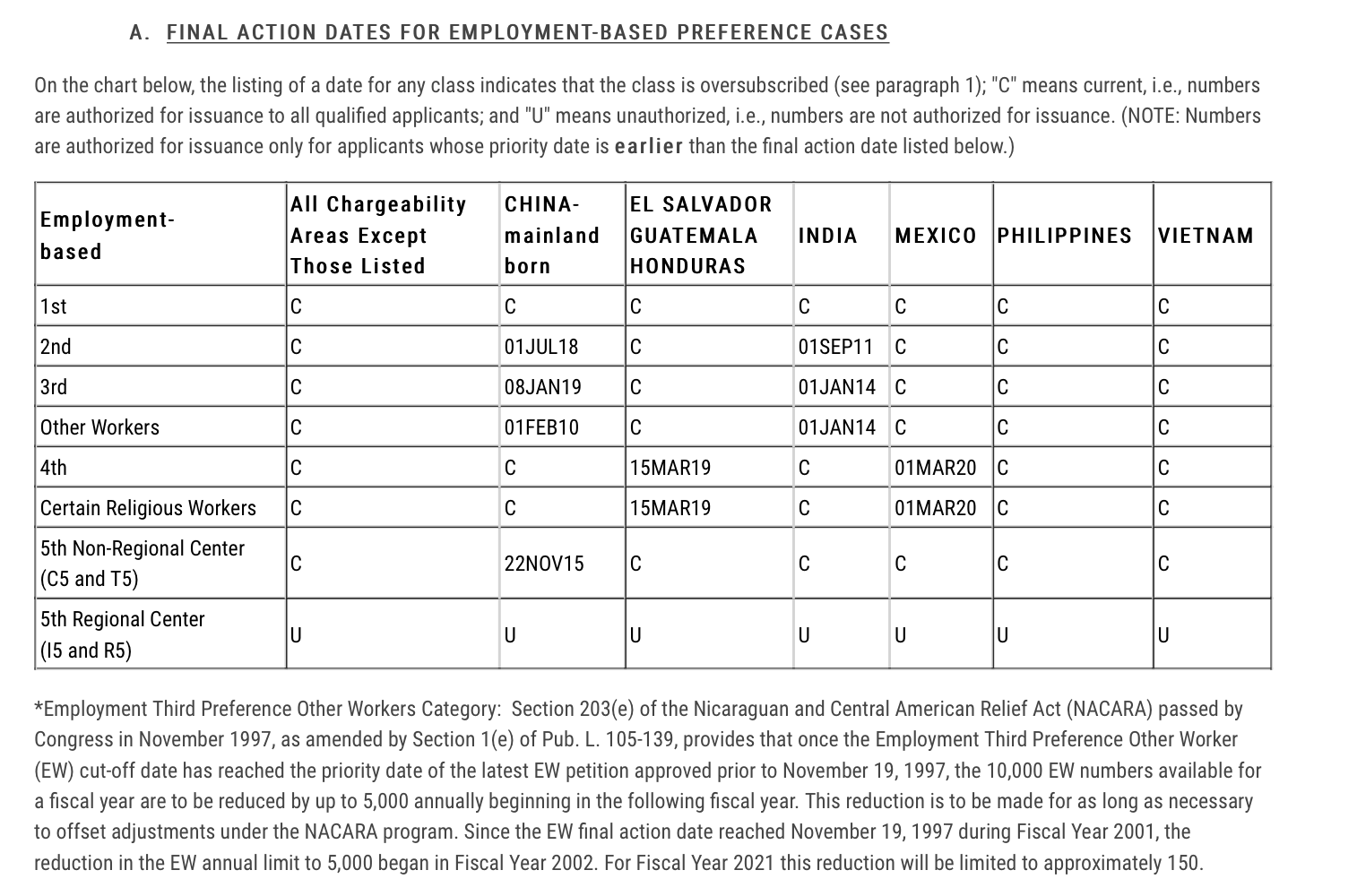
Chart A, “Final Action Dates for Employment-Based Preference Cases”

Chart A of the Visa Bulletin indicates that the final action date for Chinese investors has moved forward one week, from November 15, 2015, to November 22 of that year. Even though this is a small improvement when compared to the Vietnamese final action date’s huge leaps in the July and August Visa Bulletins, any advancement for China is always good news—until the June 2021 bulletin, China’s final action date had not budged for over a year.

This news means that Chinese foreign nationals who made an EB-5 investment, successfully filed Form I-526 on or before November 22, 2015, and applied for an EB-5 visa are now eligible to receive conditional permanent resident status. Interestingly, the Chinese final action date also advanced by one week in the August 2021 Visa Bulletin. If this trend continues, it will take several years before the Chinese EB-5 backlog is cleared.

Foreign nationals planning an EB-5 investment should note that the regional center values in Chart A are marked as “U” (unauthorized) because the regional center program was suspended on June 30, 2021. Congress failed to pass the legislation necessary to reauthorize regional center projects, but EB-5 investment stakeholders are confident that the program will be revalidated in the coming months.

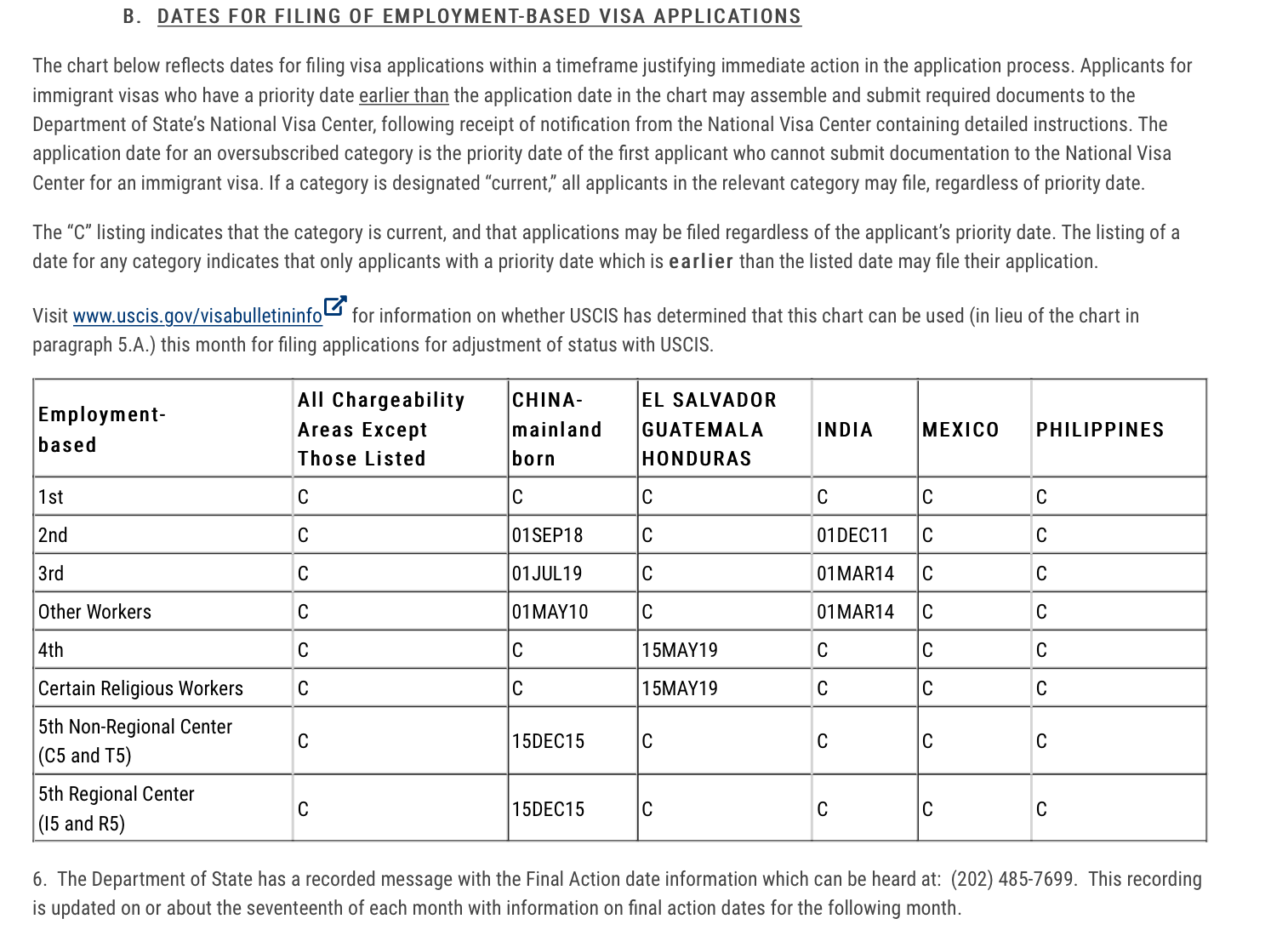
Chart B, “Dates for Filing of Employment-Based Visa Applications”

Unlike Chart A, Chart B does not contain much good news for the EB-5 investment industry. China’s date for filing remains the same: December 15, 2015. Disappointingly, this date has remained stagnant for over 12 months. Even though improvements in the final action date should ostensibly push forward the date for filing, this has not been the case for China. As a result, Chinese investors who filed Form I-526 after December 15, 2015, are not allowed to submit their visa petitions to the National Visa Center (NVC).

Even though USCIS backlogs continue to plague the EB-5 investment industry, the September Visa Bulletin reflects some progress toward clearing the Chinese backlog. Still, Chinese foreign nationals who have made an EB5 investment must exercise extraordinary patience—they may have to wait for several years before applying for their well-deserved visas. Since the EB-5 industry is in a constant state of flux, interested foreign nationals should work with experienced consultants such as EB5AN, who can help them identify the most reliable and convenient EB-5 projects.

Free EB-5 Project Evaluation

What Drives the Popularity of the EB-5 Program?

What Drives the Popularity of the EB-5 Program?

Although the EB-5 Immigrant Investor Program came into existence in 1990, it took the residency-by-investment program around 20 years to gain traction and witness a large number of investors pursuing a U.S. green card through an investment. In fact, for many years, the program issued far fewer than the annual 10,000 visas it was allocated. That changed in the 2010s, when EB-5 demand skyrocketed, particularly in China. In 2021, China is still a major EB-5 market, but the landscape has diversified, with the EB-5 program attracting investors from more and more nations.

Why has the EB-5 program exploded in popularity? The increasing demand for an EB-5 investment is attributable to a number of reasons. Here are four key factors.

1. A Quick and Simple Pathway to U.S. Permanent Residency

U.S. immigration is almost never quick or easy. That said, an EB5 investment offers a quicker, easier way to obtain a green card than most paths available to investors. Even though United States Citizenship and Immigration Services (USCIS) has processed EB-5 applications notoriously slowly since 2019, indications are positive that new legislation and new leadership may soon restore processing times to their originally intended lengths, taking processing from a matter of years to months. For example, the proposed U.S. Citizenship Act of 2021, if passed, would enact measures toward clearing up the long backlogs in the EB-5 program and other USCIS programs.

As of July 2021, those making EB-5 investments from China face backlogs, but investors from other countries do not. Thus, depending on USCIS processing productivity, most EB-5 investors could see their I-526 petition approved in just months. Following I-526 approval, EB-5 investors may schedule a visa interview at their local U.S. embassy or consulate, if they are living abroad, or submit Form I-485 to adjust their immigration status, if they are already in the United States on a different visa.

2. Green Cards for the Whole Family

The EB-5 program is a family-friendly program—principal investors are allowed to include their spouse and unmarried children younger than 21 on their EB-5 application. Assuming the EB-5 investment is successful, the entire family is eligible for EB-5 visas, meaning family members obtain access to a permanent life in the United States at the same time as the investor, avoiding delays that might be associated with other programs. There is no limit to the number of children an investor can add, as long as they are all unmarried and younger than 21.

3. A Bright Future for Your Kids

In many cases, foreign nationals engage in EB-5 investments not necessarily to secure benefits for themselves but to provide a better future for their children. School-aged children who hold green cards can be enrolled in U.S. public schools, which provide a high-quality, holistic education that doubles as linguistic and cultural immersion for immigrants. College-aged green card holders enjoy a much less competitive admissions process to U.S. post-secondary education institutes, as they are considered alongside U.S. citizens, not international students, and they may be eligible for in-state tuition savings, depending on their school.

Education is not the only benefit—foreign nationals who make an EB5 investment are also securing a better health care landscape for their family, as well as economic and political stability. U.S. medical facilities are the most technologically advanced in the world, sometimes offering treatments not available elsewhere, and Americans enjoy a high quality of life with strong economic and political institutions. In this way, EB-5 investors can protect their children from potentially volatile situations in their home country, providing an environment for them to thrive.

4. Access to the World’s Largest Economy

The United States dominates the global economy, commanding the largest economy in the world. Though the devastating COVID-19 pandemic has set the entire world back, the U.S. economy is recovering steadily and is forecast to return to pre-pandemic levels by summer 2021. The United States’ economic growth following the destruction of COVID-19 has been phenomenal, indicative of a strong, resourceful economy that can shoulder major challenges like the worldwide shutdowns enacted in response to the pandemic. A green card lets a foreign national freely take employment anywhere in the United States, tapping into this valuable economy. In fact, EB-5 investors can live and work anywhere in the United States upon receiving their two-year conditional permanent residency rights, and in most cases, investors can earn passive income from their EB5 investment.

Free EB-5 Project Evaluation

What Are Partial EB-5 Investments?

Since 1990, the EB-5 investment program has made it possible for foreign nationals to relocate to the United States by investing in qualifying businesses. Foreign nationals who make a successful EB-5 investment are given a green card and can even apply for citizenship after holding permanent resident status for five years. Of course, the EB-5 investment industry is not only good for investors—since each EB-5 investment must generate at least 10 jobs, the U.S. economy also benefits from this much-needed source of capital.

The EB-5 program is also popular because of the flexibility that it grants to investors: foreign nationals from any country can participate, and their family members are also entitled to receive permanent resident status. In addition, United States Citizenship and Immigration Services (USCIS) allows investors to use a wide variety of sources of funds to obtain EB-5 capital.

USCIS is also flexible regarding the way EB-5 investments are made. In some cases, foreign nationals are not required to provide all of the EB5 investment capital right away—instead, they can make what is known as a partial or installment investment.

How Partial Investments Work

A partial EB-5 investment occurs when a foreign national makes an initial investment and later provides the rest of the funds in installments. After providing the initial funds, the investor will be given a set period (usually 6 to 12 months) to contribute the rest of the EB-5 capital.

The investor must give the EB-5 project a promissory note with a pledged security interest in assets worth at least as much as the amount of capital that will be paid in installments. The EB-5 project that holds this promissory note will have an enforceable lien on the investor’s pledged asset(s). Therefore, if the investor fails to provide the needed capital within the agreed period, the EB-5 project will be able to liquidate the pledged asset(s) and receive the promised funds.

USCIS allows partial investments because they constitute an irrevocable commitment of the EB-5 funds. The USCIS Policy Manual states that EB-5 investors “must document the path of the funds to establish that the investment was made, or is actively in the process of being made, with the immigrant investor’s own funds.” In light of this policy, partial investments are considered as “actively in the process of being made.”

Still, USCIS carefully examines partial EB-5 investments to make sure that the pledged funds will indeed be provided within the approved period. Therefore, investors must document the terms of their partial investment in great detail when they file Form I-526E and submit other documents to USCIS. It is especially important to prove that the lien is enforceable by the promissory note holder—doing so indicates that the EB-5 investment funds have been irrevocably committed to the project.

A Hypothetical Example of a Partial EB-5 Investment

In practice, how could a foreign national make a partial EB-5 investment? Suppose that a potential investor only has $300,000 to invest. The minimum EB5 investment amount for targeted employment area (TEA) projects is $800,000, so the investor would need an extra $500,000 to make an investment. However, he has the means to provide the $500,000 in installments. The investor also owns a liquid asset: a hotel property that has a market value of more than $500,000. The investor controls 100% of the hotel’s equity.

Now, the investor can make an EB-5 investment of $300,000 and provide a promissory note for $500,000 with a pledged security interest in the hotel. Through the promissory note, the EB-5 project will have an enforceable lien on the hotel. Of course, an independent report will have to prove that the hotel property is worth at least $500,000.

The investor will be given a period of 6 to 12 months to pay the remaining $500,000 in installments. If he fails to do so, the EB-5 project will be able to enforce the lien against the hotel.

To help guide EB-5 visa applicants through the partial investment process, EB5AN and Beshara Global Migration Law Firm presented a joint webinar explaining how to make a partial EB-5 investment. Download the presentation below or watch the webinar on YouTube to learn more about partial investments.

Why Make a Partial EB-5 Investment?

If an EB-5 investor cannot invest the full amount of $800,000 straightaway, making a partial investment and then completing the investment amount in installments can avoid unnecessary delays in the immigration process. The investor and their dependent family members may be able to relocate to the United States sooner through a partial investment.

Moreover, under the EB-5 Reform and Integrity Act of 2022, EB-5 investors who already live in the United States under a non-immigrant visa can now file the I-526E and I-485 petitions concurrently. Since Form I-485 is used by EB-5 investors to adjust their immigration status, filing the petitions concurrently can allow investors to change their status to “pending adjustment” and apply for employment authorization.

EB-5 investors who file forms I-485 and I-526E concurrently may be able to obtain employment authorization in six months—or less. This provision can also be useful to investors whose non-immigrant visas are nearing expiration.

EB-5 investors who hold non-immigrant visas such as the H-1B, L-1, E-2, F-1, and TN categories may consider making a partial investment.

Wohali Utah: An Institutional-Quality EB-5 Project Accepting Partial Investment

EB5AN is currently accepting partial investments in its Wohali Utah project near Park City, Utah. This residential golf community in a scenic natural location offers EB-5 investors high chances of immigration and financial success: more than 300 EB-5-compliant jobs have already been created, and EB-5 investors in Wohali Utah will receive job creation and I-526E approval refund guaranties. In addition, the Wohali Utah development follows a proven and profitable business model in the housing sector.

Wohali Utah’s designation as a rural TEA puts investors in line for set-aside EB-5 visas, which can remove years-long delays in the immigration process for investors from countries with an EB-5 visa backlog. Investors will also receive priority processing of Form I-526E.

For more information on how to make a partial investment in Wohali Utah, or for further information on partial EB-5 investments, please schedule a call with EB5AN. Partial EB-5 investment can accelerate the EB-5 immigration process and help EB-5 investors relocate to the United States sooner than would otherwise be possible.


Free EB-5 Project Evaluation

Why Direct EB-5 Investments Will Likely Surge in Popularity

Why Direct EB-5 Investments Will Likely Surge in Popularity

The EB-5 Immigrant Investor Program renders invaluable assistance to the U.S. economy by providing local businesses with much-needed EB-5 investment capital. Due to the thorough source-of-funds evaluations carried out by United States Citizenship and Immigration Services (USCIS), project developers can be sure that their EB-5 investment funds were sourced legally by qualifying foreign nationals.

Despite the massive success of the EB-5 program and the thousands of foreign nationals that have obtained permanent resident status through it, the EB-5 investment industry has been subject to ever-changing government regulations. This has been particularly true since November 2019, when the controversial EB-5 Modernization Rule came into effect. To the disappointment of most industry members, the Modernization Rule significantly raised the required minimum investment amounts.

June 2021 was an even more volatile period for the EB-5 program. On June 22, the U.S. District Court of the Northern District of California ruled that the Modernization Rule had been implemented improperly by the Department of Homeland Security (DHS), thereby invalidating the higher investment amounts. As the EB-5 program returned to its pre-November 2019 status, investors and project developers alike celebrated the court’s ruling. However, another abrupt change to the EB-5 industry came shortly afterward: on June 30, the regional center program expired because the Senate had failed to pass a critically important EB-5 reform bill. The regional center program and the Modernization Rule could potentially be reauthorized in the future, but it is unclear if or when this will happen.

These cataclysmic events in the EB-5 investment industry have changed the way investors and project developers operate. As of June 2021, investors can only make direct EB-5 investments due to the suspension of the regional center program. Direct EB-5 investments have been a part of the EB-5 program since its beginning in 1990, and they will likely experience a surge in popularity.

Advantages of Making a Direct EB-5 Investment

When compared to regional center investments, direct projects usually offer investors more control over how their EB-5 investment capital will be used. Therefore, foreign nationals who are looking to gain significant profits through the EB-5 program as well as permanent resident status often choose to invest directly. Further, direct EB-5 projects are allowed to receive investments at the reduced amounts of $500,000 for targeted employment area (TEA) projects and $1,000,000 for non-TEA projects.

Perhaps the greatest benefit direct investments offer is their stability—unlike the regional center program, the direct EB-5 investment industry does not depend on periodic government reauthorization. In light of the events that transpired in June 2021, many foreign nationals will likely opt for the stability of direct investments.

Requirements for Direct EB-5 Investments

A successful direct EB-5 investment must fulfill all the basic requirements of the EB-5 program—the investment must be made to a qualifying new commercial enterprise (NCE), create or preserve at least 10 full-time jobs, and use legally sourced funds. The principal difference between direct and regional center EB-5 investments is that the former are made directly to the NCE in question and not through a regional center.

Moreover, foreign nationals who make a direct EB5 investment must fulfill strict job creation requirements. Direct EB-5 projects are not allowed to count indirect or induced employment toward creating the needed jobs. Rather, the NCE must create 10 full-time jobs directly, and these positions must appear on the project’s payroll. Jobs created by a direct EB5 investment must last for a minimum of two years and be filled by qualifying U.S. workers.

Foreign nationals interested in making a direct EB-5 investment have many options. Direct investors often choose to work with technology, infrastructure, hospitality, or construction projects. Despite the wide variety of EB-5 projects available, investors should carry out thorough research on each project to ensure its legitimacy and verify that it will be able to create the needed jobs. EB5AN has a 100% I-526 and I-924 approval rate, offering some of the most reliable projects in the EB5 investment industry.

Free EB-5 Project Evaluation

What Do TEA Map Searches Reveal?

What Do TEA Map Searches Reveal?

EB5AN offers a free interactive targeted employment area (TEA) map that allows users to determine whether an address is in a TEA. In addition to determining TEA eligibility, users can also download a free TEA qualification report to include with their United States Citizenship and Immigration Services (USCIS) petitions.

Why Is TEA Designation Important?

The EB-5 investment program’s most challenging requirement is usually the minimum investment amount. Foreign nationals interested in becoming permanent U.S. residents must put up at least $1,000,000 of their lawfully sourced capital if their project is located outside a TEA.

However, the minimum EB-5 investment amount is only $500,000 for projects located in TEAs. Due to this reduced investment requirement, TEA projects are far more popular among EB-5 investors—in fact, 95% of all EB-5 investors choose TEA projects.

How Are TEAs Designated?

An area is designated as a TEA if it is rural or has high unemployment. A rural TEA cannot be in a metropolitan statistical area (MSA) or on the outskirts of a city or town with a population greater than 20,000. High-unemployment TEAs must have an unemployment rate at least 150% above the national average.

USCIS accepts four calculation methods for TEA eligibility. Only one of these methods relates to rural TEA designation: rural TEAs must use regional data from the U.S. Office of Management and Budget and the most recent 10-year U.S. census.

The three other methods all deal with high-unemployment TEAs:

  1. The ACS calculation method uses census tract data from the five-year American Community Survey (ACS).
  2. The county-level method uses Bureau of Labor Statistics (BLS) data for an entire county.
  3. The census-share method uses a combination of census tract data from the five-year ACS and county-level data from the BLS.

EB-5 investors must provide documentation in their I-526 petition proving that their project is in a TEA.

Data from TEA Map Searches

Most EB5AN TEA map searches carried out from October 26, 2020, to May 13, 2021, looked for addresses located in just three states—Florida, California, and Texas. California has the highest percentage of addresses that qualify as TEAs: a remarkable 64%. Across the United States, approximately 60% of searched prospective project sites currently qualify as TEAs.

If you are interested in finding out whether an address falls within a TEA, please visit EB5AN’s interactive TEA map.

Free EB-5 Project Evaluation

The Benefits of Making a Direct EB-5 Investment

The Benefits of Making a Direct EB-5 Investment

Thousands of foreign nationals have benefitted from participating in the EB-5 Immigrant Investor Program and are currently enjoying the benefits of obtaining U.S. green cards for themselves and their immediate family members. The EB-5 program enables foreign nationals to invest in qualifying U.S. businesses, create at least 10 full-time jobs, and thus apply for permanent resident status. Since 1990, the EB-5 investment industry has had a remarkably positive impact on the United States, providing businesses with invaluable investment capital. Moreover, the successful and wealthy foreign nationals who relocate to the United States through their EB-5 investments become valuable assets to the country.

Despite their positive effects, the EB-5 program’s regulations are subject to government modification, which has occasionally resulted in sudden changes to the EB-5 investment industry. Two of the most notable examples of such policy changes took place in June 2021. On June 22, a federal court ruled to invalidate the EB-5 Final Rule, a controversial set of regulations that had made several important changes to the EB-5 program. The most significant change brought about by the Final Rule was the raising of the minimum required investment amounts. As of the June 22 ruling, foreign nationals are allowed to make an EB5 investment at $500,000 for targeted employment area (TEA) projects and $1,000,000 for non-TEA projects.

Just a few days after the court ruling, the EB5 investment industry received another shock when the regional center program expired on June 30, 2021. The Senate had failed to pass the EB-5 Reform and Integrity Act, a bill that would have reauthorized regional center investments for several more years. Even though this suspension is likely temporary, many foreign nationals interested in making an EB-5 investment may have been discouraged by the news—after all, regional center investments had been the most popular way to participate in the EB-5 program. Despite these abrupt changes, EB-5 investors still have at their disposal a promising alternative to regional center projects: direct EB-5 investments.

What Are Direct EB-5 Investments?

Direct EB-5 investments are made directly to the EB-5 business in question and not to a regional center. United States Citizenship and Immigration Services (USCIS) has set stricter job creation requirements for direct EB-5 projects—direct investors can only count jobs that are created by the EB-5 business and appear on its payroll. Since indirect and induced jobs do not count toward fulfilling the employment creation requirement, it is usually more difficult for direct EB-5 investors to generate the necessary number of jobs.

Interested foreign nationals should note that, as of June 30, 2021, they are only allowed to make direct EB-5 investments. In fact, USCIS released a statement on its website confirming that they will no longer accept I-526 petitions associated with regional centers. In contrast, the direct EB5 investment industry does not depend on periodic renewal.

Why Make a Direct EB-5 Investment?

Despite the stricter guidelines for calculating employment creation, direct EB-5 projects do qualify for the above-mentioned reduced investment amounts. Moreover, many foreign nationals find that direct EB-5 investments may better suit their needs if they want to gain significant profits as well as permanent resident status: direct projects typically offer investors more control over operations and management decisions than regional center projects, in which investors do not necessarily have to be involved in day-to-day operations.

Direct EB-5 investors are allowed to invest in a wide variety of businesses. They may even choose to invest in a troubled business, an existing business, or a new branch of a franchise. The latter option offers several enticing benefits for investors, allowing them to enjoy the existing franchise’s marketing, experience, and successful branding.

As the above facts indicate, direct EB-5 investments are a promising alternative to regional center projects. Keeping in mind that the minimum investment amounts may be raised once more, potential investors would do well to identify suitable direct EB-5 investment opportunities as soon as possible.
Free EB-5 Project Evaluation

Exploring Current Trends in the Chinese EB-5 Visa Market

A group of immigrant investors from China posing in front of screens with graphs on them.

For years, China has been the country with the largest overall number of applicants to the EB-5 Immigrant Investor Program. As a result, Chinese investors seeking a Green Card in the United States through the EB-5 program have had to contend with challenges and delays, unlike foreign nationals from any other country in the world.

This article will examine the historical and current trends in the Chinese EB-5 visa market, exploring the number of unique challenges Chinese investors face—from visa retrogression to long processing times—while also explaining a key strategy to help overcome some of the most persistent obstacles.

How Interest in the EB-5 Visa Program From Chinese Investors Has Evolved Over Time

A Chinese woman and child against a red background, representing the largest nationality of eb-5 visas issued.

The demand for EB-5 visas among Chinese investors has been high for many years, but interest has fluctuated over time due to various factors. From 2010-2014, demand from Chinese investors for EB-5 visas surged as rapid economic growth swept across mainland China, increasing wealth and leading to a spike in high-net-worth individuals. In 2014, Chinese investors were issued more than 9,000 of the 10,000 available EB-5 visas.

Beginning in 2018, the EB-5 visa processing time for Chinese applicants slowed down considerably, leading to a drop in demand. Additionally, certain policy changes, particularly increased scrutiny about what constitutes a lawful source of funds (SOF), led to further declines in demand among Chinese investors.

However, Chinese investors’ demand for EB-5 visas began to rise again after the enactment of the EB-5 Reform and Integrity Act (RIA) in 2022, which introduced policy changes that increased visa availability while speeding up processing times. More on the impact of the RIA’s reforms will be explored later in this article.

The EB-5 Visa Challenges Facing Prospective Chinese Applicants

Because demand among Chinese citizens for EB-5 visas has been high for so long, they have had to face many unique challenges. This section will explore some of those challenges in greater depth.

EB-5 Visa Retrogression

Because of the sheer number of Chinese investors who are interested in the EB-5 visa program, there has been a backlog in Chinese EB-5 petitions since May 2015. As of May 2024, the backlog is still far from being cleared.

This backlog is the result of “visa retrogression,” which occurs when the demand for EB-5 visas exceeds the per-country limit in a given year. Historically, there are only 10,000 EB-5 visas available during each immigration fiscal year (October 1 to September 30). Those 10,000 available EB-5 visas include those available for the investor as well as their spouse and any unmarried children under 21. As a result, the number of families that are eligible to apply for conditional Green Cards through the EB-5 program each year may actually be much lower than 10,000.

Furthermore, the government imposes a per-country quota on available EB-5 visas to make the distribution from one country to the next more equitable. If that limit has already been reached for a particular year, then prospective EB-5 investors need to wait one additional year for their Form I-526E to be processed—a situation known as “visa retrogression.” For backlogged countries like China, where visa demand far outpaces visa supply, many investors may have to wait several years just to begin the process of applying for U.S. permanent resident status through the EB-5 program.

Long EB-5 Visa Processing Times

An alien entrepreneur looking at her watch, representing the long processing times eb5 china applicants face.

Chinese investors face longer wait times than foreign nationals from any other country. In fact, the situation for Chinese investors is so unique that, in 2020, the United States Citizenship and Immigration Services (USCIS) website introduced a separate estimated processing time range for Chinese investors.

The most recent estimated EB-5 visa processing times can be found on the USCIS website. These wait times indicate the amount of time it typically takes to process 80% of all applications received. That means that the vast majority of applications will be processed more quickly than the wait time provided by USCIS. However, USCIS does not give any information on the longest or the shortest EB-5 visa wait times.

When EB-5 investors submit Form I-526E, they are given a priority date, which is the date that USCIS receives the form. EB-5 investors from every country other than China and India are eligible to apply for their visas as soon as their I-526E petitions are approved. However, Chinese EB-5 investors are subject to a final action date—they must wait until this date, which is periodically pushed forward, catches up with their I-526E priority date. As a result, EB-5 investors from mainland China may have to wait several years before they can even apply for their EB-5 visas.

The U.S. State Department’s July 2024 Visa Bulletin announced that China’s final action date remains December 15, 2015. Therefore, Chinese EB-5 investors who submitted their I-526E petitions after that date are not yet allowed to apply for their EB-5 visas as of July 2024.

Chinese EB-5 investors do not only have to wait for the final action date to advance—they must also factor in the immigration agency’s adjudication times for their I-526E petitions. USCIS (or the State Department’s National Visa Center) may take several years to evaluate a Chinese EB-5 investor’s application.

Difficulties Funding Projects and Proving Source of Funds

A stack of money on top of Chinese envelopes, symbolizing capital investment in exchange for permanent residency by many Chinese investors.

Restrictions on annual remittances can also be a major challenge for potential investors from mainland China. China imposes a limit of $50,000 that can be transferred out of the country each year. To combat these restrictions, Chinese investors have relied on various methods to get around the limit, such as combining funds with other Chinese nationals or transferring their money through accounts in Hong Kong. However, Chinese authorities have been tightening controls, making these transfers more challenging. Still, Chinese investors continue to explore new ways to transfer funds for investments in the United States.

These government limitations also have an impact on Chinese investors’ ability to prove the lawful source of their investment funds. This has become especially challenging as USCIS has increased its own scrutiny, demanding detailed documentation to prove the legal source of capital investment for the EB-5 program. It is highly recommended that Chinese investors—as well as investors from other countries—consult with an experienced immigration attorney to ensure their investment funds are lawfully sourced.

How Can Chinese Nationals Invest in the EB-5 Program?

Foreign investors on a regional center infrastructure projects site.

When the RIA was enacted in 2022, it introduced several policy changes that made the process easier for EB-5 investors, particularly those from mainland China. The law provided the option of EB-5 concurrent filing, allowing investors to file Form I-526E and Form I-485 at the same time, helping to significantly streamline the EB-5 process.

In addition, the RIA introduced new minimum investment thresholds. The updated amounts currently stand at $800,000 for projects located in targeted employment areas (TEAs), as opposed to a minimum investment of $1,050,000 for a new commercial enterprise in other areas. A TEA is defined as:

  • An area with a population of fewer than 20,000 people; and
  • An unemployment rate of at least 150% of the national average.

These areas are designated based on U.S. census information. The most important aspect for Chinese investors, however, is the potential to avoid visa backlogs and obtain a fast-tracked Green Card by investing in rural TEA projects. The RIA allocated 20% of available EB-5 visas to applicants investing in rural TEA projects—along with an additional 10% for high-unemployment TEAs and 2% for public infrastructure projects. As a result, while there are still some significant backlogs of EB-5 applications in the unreserved category, these set-aside visa categories have been a promising development for investors from mainland China.

Invest in TEA Projects With EB5AN

A group of happy investors taking advantage of set-aside visas by investing in a targeted employment area regional center project.

Currently, there is no additional waiting period or backlog for the reserved EB-5 visa categories. However, the availability of these visas is limited, and there is a possibility that these categories could become oversubscribed in the future. Prospective Chinese EB-5 investors are strongly advised to submit their petitions promptly to secure their place while these reserved visas are still accessible.

EB5AN has helped more than 2,300 families from 60 countries obtain U.S. Green Cards, and we can do the same for you. To begin your family’s journey toward becoming U.S. Green Card holders, schedule a free meeting with our expert team today.

Free EB-5 Project Evaluation

Why You Should Participate in the EB-5 Program

Why You Should Participate in the EB-5 Program

For many years, the EB-5 Immigrant Investor Program has been considered one of the most practical and rewarding visa-by-investment programs in the world. Even though the EB-5 investment industry is governed by numerous regulations, the basics of the program are relatively straightforward: Foreign nationals must make an investment in a qualifying new commercial enterprise (NCE) or a troubled business. This EB-5 investment must comply with all United States Citizenship and Immigration Services (USCIS) guidelines—for instance, the EB-5 capital must remain at risk and be sourced legally. As of July 2021, the required minimum amounts for EB-5 investments are $500,000 for targeted employment area (TEA) projects and $1,000,000 for non-TEA projects. Moreover, each EB5 investment must generate or preserve at least 10 full-time jobs.

Foreign nationals who comply with the above regulations become eligible to apply for conditional permanent resident status. Later, they can become lawful permanent residents of the United States. Even though some other countries offer investor visas, the minimum required investment amounts may be significantly higher than those of the EB-5 program. Clearly, the EB-5 investment visa is the best way for foreign nationals to fulfill their dream of relocating to the United States.

However, some interested foreign nationals may hesitate to make an EB5 investment due to the uncertainty caused by the COVID-19 pandemic, which resulted in difficulties for many EB-5 investment projects in 2020. Additionally, the sudden changes in EB-5 regulations that took place in June 2021 may cause foreign nationals to question the program’s stability—after all, the regional center program expired temporarily on June 30, just a few days after the controversial Modernization Rule was overturned on June 22.

Despite these factors, potential EB-5 investors can be sure that the program is still up and running. In fact, now may be the ideal time to make an EB-5 investment. Interested foreign nationals would do well to consider the main benefits of participating in the EB-5 investment program.

The EB-5 Program Continues During the Pandemic

Even though the COVID-19 pandemic has not ended as of August 2021, USCIS continues to process I-526 petitions, which means that EB-5 investments can still be made. The pandemic may even have benefitted the EB-5 investment industry to some extent: Since unemployment has increased throughout the United States, many more parts of the country could potentially be considered as TEAs. As a result, more investors might be able to invest at the lower minimum amount of $500,000.

Family Members Also Qualify for Green Cards

The EB-5 investor is not the only one who will benefit from participating in the program—their immediate family members will also qualify to receive permanent resident status. The investor’s spouse and any unmarried children under the age of 21 will be entitled to enjoy life in the United States. Further, this opportunity will enable the investor’s children to experience the United States’ world-class education system.

EB-5 Investors Can Apply for U.S. Citizenship

Undoubtedly, one of the most significant benefits of making an EB5 investment is the opportunity to obtain U.S. citizenship. After holding permanent resident status for at least five years (this period includes two years of conditional permanent residency), the investor and their family can submit Form N-400 and apply to become citizens of the United States. U.S. citizenship will enable the family to vote in the United States, travel abroad without restrictions, and even hold dual citizenship if their country of origin allows it.

These are just some of the many advantages of participating in the EB-5 program. Of course, foreign nationals who want to begin the path to permanent resident status will need guidance to navigate the many regulations on the EB-5 industry. To that end, they should consult EB-5 specialists and immigration attorneys, who can help them identify suitable projects and comply with all USCIS guidelines.

Free EB-5 Project Evaluation

The Enduring Success of the EB-5 Program

The Enduring Success of the EB-5 Program

The EB-5 investment program is undoubtedly the best way for foreign nationals to begin a new life in the United States. The program enables foreign nationals to obtain U.S. green cards by investing in qualifying new commercial enterprises (NCEs). After making an EB5 investment that generates or saves at least 10 jobs and uses at-risk, legally sourced funds, foreign nationals will be able to apply for permanent resident status. Becoming a lawful permanent resident of the United States will entitle the investor to many privileges. For instance, they will be allowed to live and work anywhere in the country and benefit from the United States’ federal and state laws.

Even though the U.S. government established the EB-5 program in 1990, it wasn’t until 2008 that EB-5 investments gained their current popularity—the economic crisis that took place that year likely made EB-5 investment capital all the more appealing. Since then, the program’s popularity grew exponentially, and 2018 saw a record number of EB-5 investment applications.

Challenges Faced by the EB-5 Program

Admittedly, the EB-5 industry faces certain challenges, which cast a shadow over the program’s positive impact on the U.S. economy. In 2020, the financial crisis generated by the COVID-19 pandemic caused several EB-5 projects to be suspended or even canceled altogether. Additionally, EB-5 investment applications have been subject to pitifully slow processing times—even though USCIS has made admirable efforts to speed up the adjudication process, I-526 petitions may still take years to be approved. In fact, Chinese EB5 investment applications have been backlogged since May 2015, so EB-5 investors from China will have to wait far longer to obtain their visas.

Despite these flaws in the EB-5 program, thousands of foreign nationals have made EB-5 investments and successfully relocated to the United States—the advantages of participating in the EB-5 program far outweigh any drawbacks. Three key benefits motivate many foreign nationals to participate in the EB5 investment industry.

Obtaining an EB-5 Visa Can Lead to U.S. Citizenship

Many foreign nationals who make their EB-5 investments are not only interested in securing permanent resident status—after holding their green cards for at least five years, EB-5 investors can file Form N-400 and apply to become citizens of the United States. U.S. citizenship will entitle investors to travel outside the country without restrictions, vote, and obtain U.S. passports.

Investors from Any Country Can Participate

The vast majority of immigration programs have restrictions on what kinds of foreign nationals can apply. In contrast, the EB-5 investment program is truly global and open to foreign nationals from all countries and of any occupation. USCIS is primarily concerned with making sure that each EB-5 investment is legally sourced and generates the 10 required jobs.

Family Members Also Receive Green Cards

The EB-5 program also grants permanent resident status to an EB-5 investor’s immediate family—that is, their spouse and any unmarried children under the age of 21. This benefit is free and does not require the investor to provide any additional capital.

Since the minimum investment amounts for EB-5 projects were lowered on June 22, 2021, there has never been a better time to make an EB-5 investment and enjoy the above rewards. Contact EB5AN for information on open EB-5 investment opportunities.

Free EB-5 Project Evaluation

What Basic Requirements Do EB-5 Investors Have to Satisfy?

What Basic Requirements Do EB-5 Investors Have to Satisfy

Making an EB-5 investment is one of the best ways a foreign national can pave the way to permanent immigration to the United States. EB5 investments are relatively straightforward and are open to nationals of any country, as long as they possess the capital means to make an EB-5 investment. However, it’s not quite as easy as funneling capital into a qualifying EB-5 project and relocating permanently to the United States. EB-5 investors do face stringent requirements that shield against fraudulent activity and ensure the EB-5 Immigrant Investor Program benefits the U.S. economy as originally intended by Congress.

Failure to meet the requirements of the EB-5 program generally results in the denial of an investor’s I-526 petition or I-829 petition, depending on where in the EB5 journey the infraction occurs. United States Citizenship and Immigration Services (USCIS) may first issue a request for evidence (RFE), however, if the information in an applicant’s petition is unclear or inconsistent, giving the investor a second chance to clarify their fulfillment of the program requirements. For the most part, an investor can satisfy the requirements by being an honest, good-faith investor using lawfully obtained capital. To avoid becoming entangled in a fraudulent project, investors are encouraged to conduct careful due diligence of any EB-5 project and regional center they consider working with. (Even though the regional center program expired on June 30, 2021, industry experts are confident that it will be reauthorized shortly.)

Minimum Required Investment Amount

The most straightforward EB-5 investment program requirement is the minimum required investment amount. While there is no maximum amount, an investor must commit at least the minimum amount to their EB5 investment project to qualify for the immigration benefits. As of June 22, 2021, the minimum investment amounts are $500,000 for targeted employment area (TEA) projects and $1,000,000 for non-TEA projects.

Eligible New Commercial Enterprise

When Congress drew up the EB-5 program in 1990, they introduced certain conditions on which organizations applicants could funnel their EB-5 investment capital into. New commercial enterprises (NCEs), as they are termed in EB-5 law, must be for-profit entities conducting ongoing lawful business activities. As long as the activities are legal and ongoing, there are few restrictions, although the most popular types of EB-5 projects tend to be real estate development and hotels. The investment object must also have been created after 1990—hence the “new” in “new commercial enterprise”—or, if formed before 1990, must be using the EB5 investment capital to expand or restructure the enterprise.

Alternatively, an EB-5 investor can take the less-traveled route of investing in a troubled business. Congress has defined strict terms for what qualifies as a troubled business—the entity must have been established at least two years prior to the applicant’s EB-5 investment and have suffered a net loss of at least 20% of the entity’s value within the one- to two-year period preceding the investment.

Whether an investor invests in an NCE or a troubled business, they always face the requirement to be involved in the management of the entity. This can turn prospective investors with little managerial experience—or those who simply don’t have the time or desire to manage the business—away from the EB-5 program. However, regional center investors usually work around this requirement by signing on as a limited partner, fulfilling this requirement simply by voting remotely on policy formation decisions.

Job Creation

The EB-5 job creation requirement is arguably the most important to Congress—it’s the primary reason why the EB-5 program is a boon to the U.S. people. Indeed, the EB-5 rules stipulate that to reap the immigration benefits the EB-5 program offers, a foreign national’s investment must fund the creation of at least 10 new jobs for U.S. citizens or permanent residents. The jobs must be held for at least two years. The job creation requirement is somewhat flexible, with those who make an EB5 investment through a regional center presented with a relaxed route to job creation.

Direct EB-5 investors must show the creation of at least 10 new jobs on the payroll of the NCE—and depending on the type of business, hiring 10 full-time employees may not be realistic. This effectively restricts the type of businesses that can qualify as direct EB-5 investment projects. The solution is regional centers, which allow investors to count indirect and induced jobs toward the job creation requirement. Under this model, the NCE’s expenditures on goods and services, as well as the wages its employees spend in the local community, are calculated to determine the job creation impact the EB-5 investment has likely had on the region. A third-party economist using approved job calculation methodology must be hired for this calculation.

Job creation is proven in the I-829 petition—the final petition of an EB-5 investment journey. Investors file the I-829 petition after living in the United States as a conditional permanent resident for two years, and approval of the I-829 petition sees the conditions on the applicant’s permanent resident status removed. In the I-526 petition, investors must simply demonstrate the likelihood of the project to generate the 10 jobs.