Free EB-5 Project Evaluation

Major Increase to I-526 Petition Processing Times

Major Increase to I-526 Petition Processing Times

With the global economic shutdowns brought on by the COVID-19 pandemic, United States Citizenship and Immigration Services (USCIS) has had more time to dedicate to processing immigration petitions such as Form I-526. The chief of the Immigrant Investor Processing Office (IPO), Sarah Kendall, also announced in a public engagement in March 2020—before the pandemic had substantially impacted the United States—that the office was better positioned than in FY2019 to process EB-5 petitions. Processing data from FY2020 Q2 indeed bears out the prediction of increased productivity, although the true state will not be known until data is released for the latter two quarters.

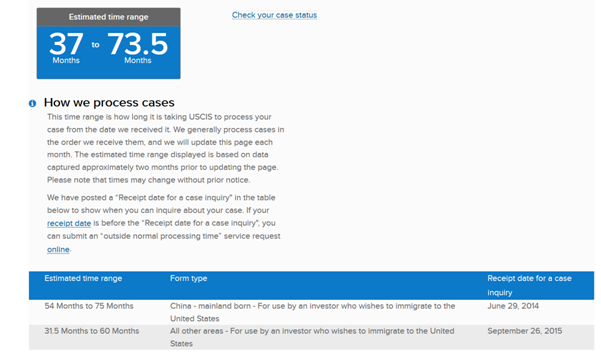
If USCIS’s estimated processing time range is any indication of processing productivity, the outlook for EB-5 investors may be bleak. USCIS has updated the estimated time range for I-526 processing to 46 to 74.5 months—an increase of more than a year. In May 2020, the estimated processing range was only 29.5 to 44.5 months, meaning the entire range has nearly doubled as of July 2020.

The range also starkly contrasts the most recent estimated processing range update, which was 29.5 months to 61 months. While the latter estimate increased significantly, the former remained stable, but in the newest iteration, both have surged forward, leaving EB-5 investors to expect wait times of 3.8 to 6.2 years for I-526 processing.

When looking at USCIS’s estimated time ranges for petition processing, EB-5 investors must understand what they represent. Not all investors have their petitions adjudicated within the estimated time range—in fact, the majority don’t. Half of investors receive an adjudication before the first number in the range, and 93% of investors receive an adjudication before the second number in the range. Thus, many EB-5 investors can expect a far faster adjudication than seemingly indicated.

Not Necessarily a Slowdown in I-526 Processing Volume

While the initial assumption most people have upon looking at these figures is that the processing volume at the IPO has slowed drastically, that isn’t necessarily the case. With some I-526 petitions seemingly forgotten, left unadjudicated for years on end, the IPO may be taking measures to prevent applicants from filing inquiries or even pursuing litigation.

Also important to note is that the estimated processing time range may not be entirely accurate, since USCIS does not factor the newly implemented visa availability approach into its calculations. The new approach, introduced in April 2020, prioritizes I-526 adjudications based on the number of readily available visas for the EB-5 investor’s country, meaning petitions from countries without backlogs may be adjudicated more quickly than those from backlogged countries (which, as of July 30, 2020, consist of China and Vietnam). The EB-5 community will not know the true picture of EB-5 processing volume until detailed statistics are released for FY2020 Q3 and Q4.

Free EB-5 Project Evaluation

Can an EB-5 Investor Immigrate to the United States with Their Family?

Can an EB5 Investor Immigrate to the United States with Their Family

A life in the United States is a bright prospect for foreign nationals around the globe, but most wouldn’t dream of relocating without their family. Fortunately, the EB-5 Immigrant Investor Program allows investors to include their spouse and unmarried children below the age of 21 on their I-526 petition, making the whole family eligible for U.S. permanent resident status. The EB-5 offers various benefits to families, making it ideal for young families looking to offer their children the best, brightest future possible.

The first hurdle to overcome in the EB-5 process is I-526 approval. Form I-526 is the initial petition an EB-5 investor files, and it officially launches their EB-5 journey. On the I-526 petition, the investor must demonstrate that they have invested the appropriate amount of capital in their EB-5 project—either $1.8 million or $900,000, depending on the targeted employment area (TEA) status of the project. They must furthermore provide evidence of the lawful sources of their EB-5 capital.

Once the investor receives approval for their I-526 petition, they may apply for their EB-5 visa, assuming they have a “current” final action date in the monthly Visa Bulletin. The investor and any immediate family members—spouse and unmarried children under 21—apply for their U.S. green cards simultaneously. Each applicant may be required to fill out forms, submit specific documentation, undergo a medical examination, receive vaccinations, and pay application fees. Once the National Visa Center (NVC) receives a foreign national’s visa application, it provides them with a time and date for their visa interview, which determines their eligibility for a U.S. green card.

Upon receiving visas, the EB-5 investor has a certain amount of time to enter the United States. The investor must enter either before or at the same time as their family members. Initially, EB-5 investors and their immediate family members receive conditional permanent resident status, which expires after two years. To remove the conditions and obtain indefinite permanent resident status, the EB-5 investor must file an I-829 petition within 90 days before their conditional permanent resident status expires. In the petition, the investor must provide evidence that their EB-5 investment met the requirements of the EB-5 program, most importantly the creation of at least 10 full-time jobs for U.S. citizens and residents.

It’s important to note that conditional permanent resident status is only conditional in terms of length—during their two years of conditional permanent residency, EB-5 investors and their family enjoy all the same rights and freedoms as any other U.S. green card holder. They may live, work, study, travel, and conduct business anywhere in the United States.

Children Who Are Ineligible for the EB-5 Program

United States Citizenship and Immigration Services (USCIS) employs a narrow definition of “child,” excluding married or adult children from the definition. So, if an EB-5 investor would like to bring their married or adult child to the United States, their only option is to live as a permanent resident in the United States for five years, apply for U.S. citizenship, and sponsor their child as a citizen.

To bring an ineligible child to the United States faster, parents may consider donating EB-5 funds to their child so they can make their own EB-5 investment. In fact, this is a common route for young EB-5 investors—in some cases, the parents don’t even wish to immigrate themselves and simply want to give their child the gift of a bright future in the United States.

The EB-5 program is a particularly attractive option to prospective students who wish to study at one of the many world-renowned universities in the United States. An EB-5 visa offers prospective students an easier admissions process and potential in-state tuition savings, depending on their university of choice. It also allows them to pursue unrestricted employment opportunities during and after college and alleviates the pressure international graduates have to immediately find an employer willing to sponsor them to maintain immigration status in the United States.

Free EB-5 Project Evaluation

Hong Kong EB-5 Investors Join Mainland Chinese Backlog

Hong-Kong-EB5-Investors-Join-Mainland-Chinese-Backlog

In July 2020, following the introduction of a controversial Beijing-backed national security law into the Hong Kong special autonomous region, President Trump signed the Executive Order on Hong Kong Normalization, which essentially eliminated any special treatment Hong Kong received as a separate nation from China. Hong Kong previously received separate treatment from China in terms of immigration, but with this executive order, Hong Kongers have lost this privilege and are now on the same level as Mainlanders. In the EB-5 Immigrant Investor Program, Hong Kong investors similarly face a new setback: they are now subject to the same extremely large EB-5 backlog as Mainlanders. Agencies impacted by the new policies were also instructed to update their regulations accordingly by July 30, 2020. And with that, immigration into the United States from Hong Kong has suddenly become far more difficult.

In effect, from a U.S. immigration perspective, Hong Kongers have become Chinese. Unless the U.S. government introduces new legislation addressing the special treatment of Hong Kongers or President Trump (or a future president) reverses the order, Hong Kongers have lost their special status within the EB-5 program, which is bad news for both Hong Kongers and Mainland Chinese EB-5 applicants. Chinese EB-5 investors must contend with massive backlogs that prevent thousands from moving forward with their journey toward U.S. permanent resident status.

Hong Kong EB-5 applicants are encouraged to contact their immigration attorneys to discuss their next steps in the face of the legislation changes. Any Hong Kong EB-5 investor in the system at the time of the legislation change would have foreseen a relatively fast EB-5 process at the time they applied, expecting to immigrate within two to three years, but now, they may be required to wait five or more years. The policy changes could cause severe disruption to these investors’ lives and plans and is, in any case, extremely disheartening for Hong Kong EB-5 investors.

Prospective EB-5 investors from Hong Kong should also plan their investments more carefully going forward, taking into account the long wait times they can expect from being mixed in with the Mainlanders. While EB-5 investor children are generally protected from “aging out”—i.e., turning 21—because the I-526 petition processing time is subtracted from the child’s age to determine eligibility, the longer a family must wait to obtain their U.S. green cards, the more benefits of life in the United States they miss out on. Even more significantly, if an EB-5 investor’s child marries or develops significant business ties in their home country before obtaining U.S. permanent residency, they may no longer be eligible for or interested in an EB-5 visa.

The policy changes are still new, so they may incur changes going forward. For now, Hong Kong EB-5 investors should consult with their immigration attorney and ensure they can still achieve their goals under the new regulations.

Free EB-5 Project Evaluation

The Merits of the EB-5 Program for Families

young-couple-covering-by-american-flag-min-scaled

The EB-5 Immigrant Investor Program was established in 1990 to foster foreign investment in the U.S. economy and create new jobs for U.S. workers. In exchange for their investment, foreign investors are granted U.S. green cards for both themselves and their immediate family members, which is defined as spouse and unmarried children under the age of 21. While a U.S. green card offers plenty of benefits to an individual investor, the majority of EB-5 investors cite family reasons as a major motivation for their desire to immigrate to the United States.

When an individual has children, planning the future becomes all the more important. Any parent wants to ensure a safe and prosperous future for their child, and this is one of the key motivations of many EB-5 investors. While EB-5 investors can come from any country, the countries with the highest EB-5 demand as of August 2020 are China, Vietnam, and India, and the United States offers more safety, freedom, and opportunity than these countries. For parents, investing in the EB-5 program to secure a better future for their children is undoubtedly a worthwhile investment.

The minimum required investment amount to qualify for an EB-5 visa is $1.8 million, although EB-5 projects in targeted employment areas (TEAs) qualify for a lower minimum investment of $900,000. This amount stays the same regardless of how many family members an investor is applying with, so an EB-5 investment can be an extremely good deal for investors with many children.

The key requirements to receive an EB-5 visa are that the investor provides proof the funds were obtained legally and, at the end of the investment period, that the funds created at least 10 new full-time jobs for U.S. workers. EB-5 investors can, depending on their country of origin, immigrate to the United States in just a few years, making the EB-5 program an ideal option for young families.

Prospective EB-5 investors with young children should consider all the benefits of U.S. permanent residency for their offspring, including the following:

  • A safe environment with a lower crime rate than many other countries
  • Affordable and reliable options for childcare
  • A diverse culture accepting of people from different walks of life
  • A top-notch education system that immerses immigrant children in American culture and provides a high-quality education
  • An abundance of recreational sports options to keep kids active and healthy
  • A wealth of opportunities to explore different activities and hobbies
  • Valuable opportunities for internships and practical programs
  • Tuition savings for in-state college applicants

Given the strong U.S. business environment, there is also financial motivation to relocate to the United States. While $900,000 may sound like a lot to many prospective investors, the ROI includes a better, brighter future for you and your family, and conducting business in the United States is likely to prove financially lucrative in the long run. All in all, an investment in a qualifying EB-5 program may be the most important investment you ever make.

Free EB-5 Project Evaluation

Who Is Eligible for a U.S. Green Card under the EB-5 Program?

Who-Is-Eligible-for-a-US-Green-Card-under-the-EB5-Program.jpg+++

The EB-5 Immigrant Investor Program is one of the quickest and easiest ways for foreign nationals to gain permanent resident status in the United States. Established in 1990, the program continues to be a popular option for foreign investors, with thousands obtaining U.S. green cards through the program throughout its 30 years.

The program was introduced to stimulate the U.S. economy and create new jobs by bringing in foreign capital. To incentivize foreign investment, the program promises investors U.S. green cards for themselves and their immediate family members as long as they meet certain requirements, including a minimum investment amount, proof that all their capital was obtained lawfully, and the creation of at least 10 new full-time jobs for U.S. workers.

EB-5 investors can invest in an EB-5 project in one of two ways: either directly or through a regional center. While both pathways lead to the same outcome—a U.S. green card—as long as the EB-5 investor meets all the requirements, their preferences will dictate which is more suitable for them. Investors with substantial managerial experience who wish to have more control over their investment may prefer to opt for direct investment, which generally entails active involvement in the day-to-day management of the new commercial enterprise (NCE).

Conversely, EB-5 investors seeking minimal managerial involvement in the NCE and who do not wish to be tied to a particular location may prefer investing through a regional center. Regional center investment, by far the more popular EB-5 investment route, offers additional benefits, as well. Regional center projects are more likely to qualify for targeted employment area (TEA) status, allowing the investor to invest only $900,000 in the project, as opposed to the $1.8 million otherwise required. Additionally, regional center EB-5 investors can count indirect and induced jobs toward their EB-5 job creation, making the requirement far easier to satisfy.

Key Requirements of the EB-5 Program

The EB-5 program is open to all foreign nationals with the fiscal means to invest. The minimum required investment amount is $1.8 million, unless the project is in a TEA, in which case it is halved to $900,000. A qualifying EB-5 project is a for-profit commercial enterprise conducting legal business activity. To be eligible for a U.S. green card, an EB-5 investor must show, at the end of their investment period, that their capital resulted in the creation of a minimum of 10 new full-time jobs for U.S. citizens or residents.

Another factor of eligibility is the requirement to provide proof-of-funds documentation to prove the lawful source(s) of the EB-5 capital. EB-5 funds can come from any number of sources as long as the investor can present a preponderance of evidence that they were obtained within the law.

While most EB-5 projects are new business ventures, in certain cases, troubled businesses may also qualify for the program. In these cases, the EB-5 investor’s job is to save at least 10 full-time jobs. It’s okay if jobs are lost as long as enough new jobs were created to offset the losses—the total number of jobs at the business must not be lower at the end of the investment period than it was at the beginning.

Green Cards for Investors and Their Families

In many cases, EB-5 investors have a spouse and children they wish to move to the United States with. Throughout the EB-5 process, the investor can include their spouse and unmarried children younger than 21 on their petitions and obtain U.S. green cards for them, as well.

First, EB-5 investors must file Form I-526. Upon approval, they may apply for two-year conditional permanent resident status for themselves and their family. Then, within 90 days before their conditional permanent resident status expires, they must file Form I-829 to remove the conditions. If they can demonstrate their investment met all the requirements, including the job creation (or maintenance) requirement, they are granted unconditional permanent resident status.

U.S. green cards offer EB-5 investors and their families numerous advantages, including the freedom to live, work, study, and travel freely within the United States. After five years of permanent resident status, EB-5 investors and their family members may even apply for U.S. citizenship.

Free EB-5 Project Evaluation

New Filing Fees at USCIS

New-Filing-Fees-at-USCIS

EB-5 Immigrant Investor Program participants who file immigration petitions with United States Citizenship and Immigration Services (USCIS) will face increased fees starting on October 2, 2020. The immigration agency has announced adjustments to most of its filing fees to varying degrees, depending on the petition. For EB-5 investors, however, the new fees are generally higher, particularly for the I-526 and I-829 petitions.

USCIS is largely funded by form and application fees, and every two years, the agency launches a review to determine whether the fees adequately meet the operating costs. In a news statement, USCIS explained that if it did not adjust these fees, it anticipated a deficit of roughly $1 billion in the coming year. Significantly reduced travel and President Trump’s 2020 immigration ban are likely additional factors behind USCIS’s expected deficit, since they result in fewer immigration petitions.

The below EB-5 petition filing fees will be adjusted as follows:

I-526 Immigrant Petition by Alien Investor

Current fee: $3,675

New fee: $4,010

Difference: $335

I-485 Application to Register Permanent Residence

Current fee: $1,140

New fee: $1,130

Difference: -$10

Biometrics Services

Current fee: $85

New fee: $30

Difference: -$55

I-829 Petition by Investor to Remove Conditions

Current fee: $3,750

New fee: $3,900

Difference: $150

I-924 Application for Regional Center Designation under the Immigrant Investor Program

Current fee: $17,795

New fee: $17,795

Difference: $0

I-924A Annual Certification of Regional Center

Current fee: $3,035

New fee: $4,465

Difference: $1,430

For the average EB-5 investor, filing fees have increased by a few hundred dollars. What investors lose in the I-526 petition filing fee increase they can partially compensate for with the lower biometrics service fee. However, regional center owners have been hit with a fairly substantial increase for their annual certification renewal. 2019 and 2020 have been difficult years for regional center owners to begin with, given the large number of regional center terminations the industry has been struck with.

Nonetheless, the EB-5 program remains a viable path to a new life in the United States. The fee increases are minimal compared to the drastic increases in life quality investors can expect in the United States, including high-quality health care and unparalleled freedom. Through the EB-5 program, foreign investors can foster the U.S. economy and, in turn, receive the right to reside in the United States indefinitely.

Free EB-5 Project Evaluation

What Kind of Documents Do You Need for the EB-5 Source-of-Funds Requirement?

What-Kind-of-Documents-Do-You-Need-for-the-EB5-Source-of-Funds-Requirement

Every year, countless investors from around the world start their journey toward U.S. permanent residency status through the EB-5 Immigrant Investor Program. The program, established in 1990, allows foreign nationals to apply for a U.S. green card in exchange for an investment in a new commercial enterprise (NCE), contingent on certain requirements.

EB-5 investors must invest a minimum of $1.8 million in a qualifying EB-5 project to receive an EB-5 visa. If the NCE is located within a targeted employment area (TEA), the minimum investment amount falls to $900,000. Regardless of the amount, all EB-5 investors must prove on their I-526 petition that all their investment capital was obtained lawfully.

EB-5 investors must document the path of their investment capital from acquisition to investment in the qualifying EB-5 project. This is often one of the most difficult and time-consuming aspects of the EB-5 program, and investors are encouraged to seek out immigration counsel to determine the best funds to trace. Some types of funds are easier to trace than others, so investors can save a significant amount of time by consulting an EB-5 lawyer on the source-of-funds requirement.

EB-5 investors can use many types of funds in their investment. Below are some of the most common sources of funds and the documentation investors may need to present for each.

For income from real estate, source-of-funds documentation can include purchase or sales contracts for the property, documents certifying a mortgage, deeds, appraisals, proof of income from renters, and bank account statements.

For income from business ownership, EB-5 investors should provide records of business ownership, appraisals, business registration documents, and accounting and sales records.

For income from investments, applicable documentation includes tax returns, stock certificates, brokerage statements, and retirement account statements.

For loans, EB-5 investors must prove the source of the loan if it is not a bank loan. This may also require documenting the collateral. Bank loans must also be documented, although this can be satisfied easily with documentation from the loaning bank.

For income from employment, EB-5 investors can satisfy the source-of-funds requirement by providing W-2s, earnings statements, bank account statements, employment contracts, and deposit records over the past few years.

For donations—which are common from parents to a child—the EB-5 investor must present a donation letter where the donor states the recipient is under no obligation to return the gift. The donor must also document the legal sources of the funds they gifted to the recipient.

For inheritance, EB-5 investors must present source-of-funds documentation as relevant, including estate or business documentation.

This is not an exhaustive list of the sources of funds EB-5 investors may use. Since each EB-5 investor has a different situation, it’s imperative that they reach out to an experienced EB-5 attorney to assist them in this grueling process, who can offer advice and guidance in choosing and documenting funds.

EB-5 investors must also bear in mind that, while the minimum investment amount is $1.8 million (or $900,000, depending on TEA status), they must be prepared to dish out around $50,000 to $75,000 more for administrative fees. Before diving into an EB-5 investment, investors must makes sure they have enough funds to cover all the supplementary costs.

Free EB-5 Project Evaluation

How Much Does an EB-5 Investor Need to Invest?

How Much Does an EB-5 Investor Need to Invest

Since its enactment in 1990, the EB-5 Immigrant Investor Program has been a popular way for foreign nationals to obtain U.S. green cards for themselves and their immediate family members. At a glance, the program is quite straightforward—a foreign national invests in a qualifying EB-5 project, and if their investment fuels the creation of at least 10 full-time jobs for U.S. workers, they obtain permanent resident status in the United States.

Investors must pour a certain amount of capital into their chosen EB-5 project to qualify for an EB-5 visa. The minimum required amount varies depending on whether the EB-5 project is in a targeted employment area (TEA), which can be defined as either a high-unemployment area, with an unemployment rate 50% higher than the national average, or a rural area, with a population of fewer than 20,000. For projects located outside of TEAs, EB-5 investors must invest at least $1.8 million, but for projects inside TEAs, the minimum required investment amount is $900,000.

After carefully conducting due diligence and selecting the most suitable EB-5 project, an investor initiates the process by filing Form I-526. In this petition, the investor must provide personal information and documentation proving the lawful sources of their investment capital, as well as documents proving the legitimacy and business potential of the new commercial enterprise (NCE) they are investing in.

While EB-5 investors must document the source of their investment funds, any legal source is permitted as long as it can be sufficiently traced. Investors often combine funds from numerous sources to meet the minimum investment amount requirement. Common sources include the following:

  • wage earnings
  • investments
  • business income
  • sale of assets
  • retirement funds
  • loans

The investment funds can even be a gift—it’s common for parents to donate EB-5 investment capital to allow their children to pursue permanent residency in the United States. In such a case, the recipient should provide a document certifying the transfer of the gift money, including a statement from the donor freeing the recipient from obligations to pay the money back, and the onus of tracing the lawful sources of the funds is then placed on the donor.

EB-5 investors are advised to work with an experienced EB-5 immigration attorney to determine the best sources of funds to document in their I-526 petition. Since documenting the lawful sources of EB-5 capital can be tiresome and time-consuming, knowing the easiest sources to trace can significantly expedite an EB-5 investor’s I-526 journey. Simpler source-of-funds documentation also facilitate the petition adjudicator’s job, potentially resulting in shorter wait times.

Free EB-5 Project Evaluation

U.S. Consulates and Embassies Beginning Phased Reopening

Reopening

Good news for the many EB-5 investors abroad who have been waiting eagerly to resume their journey to an EB-5 green card: the U.S. Department of State – Bureau of Consular Affairs has announced the phased resumption of routine visa services at U.S. consulates and embassies. Consulates have been closed since March 2020 following the outbreak of the COVID-19 pandemic, which has wreaked havoc on public life in most countries, including the United States.

The effects on the EB-5 Immigrant Investor Program have also been profound, with United States Citizenship and Immigration (USCIS) offices in the United States being closed to the public for several months and EB-5 investors abroad stalled in their EB-5 process due to the closure of embassies. While investors already residing in the United States under different visas have still been able to file I-485 petitions and receive EB-5 visas, investors living abroad have been unable to attend visa interviews and thereby unable to move forward.

While the announcement is good news for some, it doesn’t help all EB-5 investors. According to the Department of State, each embassy or consulate will determine its own opening based on the local situation. Investors are encouraged to check the website of the individual embassy or consulate for details. The Department of State will also post on its official website updates of when various consulates resume specific visa services.

Advancing in the EB-5 Program as Consulates Reopen

As a result of the presidential proclamation signed into law on June 22, 2020, that suspends many forms of employment-based immigration until the end of 2020, U.S. consulates and embassies should have lighter workloads than normal. Since EB-5 investors are exempt from the immigration ban, this may significantly speed up their wait times for visa appointments and interviews.

The EB-5 program can also be beneficial to the United States as it navigates the aftermath of this unforeseen crisis. As U.S. businesses begin to reopen, a damaged economy stares back at them, and millions of freshly unemployed Americans no longer have the necessary disposable income to buy nonessential goods. EB-5 investors and the millions in foreign capital they bring to the United States can help revitalize the U.S. economy and help it flourish once again.

It’s also an opportune time for new investors to consider the lucrative opportunities the EB-5 program offers. Due to the hardships the program has faced throughout 2020, fewer I-526 petitions have been filed, resulting in shorter wait times for the investors who do decide to pursue the program. Furthermore, since the COVID-19 pandemic has particularly ravaged major cities such as New York City and Los Angeles, more areas in these cities may now qualify as targeted employment areas (TEAs).

If you’re an Indian national, it’s an especially good time to invest in the EB-5 program. In July 2020, the Indian EB-5 final action date finally became current, and it’s projected to maintain this status for the foreseeable future. That means EB-5 visas are expected to be readily available for Indian investors, and they may begin their lives in the United States sooner than their counterparts in backlogged countries.

Free EB-5 Project Evaluation

The Implications of the EB-5 Capital Redeployment Policy Update Announced by USCIS

On July 24, 2020, United States Citizenship and Immigration Services (USCIS) published a Policy Alert announcing long-awaited clarification of the guidelines surrounding the redeployment of capital under the EB-5 program. The new guidance, which comes into effect immediately, focuses on Volume 6, Part G, Chapter 2 of the USCIS Policy Manual (A(2)). The update substantially influences the redeployment of EB-5 capital, not only for EB-5 investors but also for regional centers and developers working with project sponsors.

Why Do EB-5 Investors Need to Redeploy Capital?

To qualify for a permanent green card, an investor must show that their EB-5 investment remained at risk throughout the conditional residence period. Conditional permanent residence usually last two years, and in the last 90 days, investors must file their I-829 petitions to apply for removal of conditions and prove that they have met the requirements of the EB-5 program. An EB-5 investor’s funds cannot be released until the end of the investor’s two-year conditional permanent residence period, which begins only when the conditional green card is issued and not upon the approval of the I-526 petition.

Usually, EB-5 regional center investments are structured as loans or equity investments with five-year terms, where the new commercial enterprise (NCE) invests in a job-creating enterprise (JCE). This period initially related to the amount of time it took for most investors to complete the immigration process. However, because of the delays investors have experienced in recent years due to visa backlogs and retrogression and increased USCIS processing times, some investors can wait from three to 15 years to become eligible for permanent residence. During this time, their EB-5 capital must remain at risk for them to keep meeting the requirements of the EB-5 program. According to USCIS policy, an investment in the NCE, with the money simply sitting in an account, is not enough—the money must be deployed again. Thus, EB-5 investors who face significant delays in the immigration process must redeploy their capital to ensure that it remains at risk.

Redeployments must also meet several criteria to avoid USCIS viewing them as a material change. Capital can be redeployed only after the initial investment has met the requirements of the EB-5 program and the capital is available to the NCE or has been returned to the NCE. In other words, this implies that redeployment can occur only once the entire investment has been deployed to the JCE, the JCE has created all the required jobs, and most of the goals set out in the original business plan have been met.

Until now, USCIS has not provided clarity about redeploying funds in such a way that investors remain in compliance with the requirements of the EB-5 program. The July 2020 clarifications address in which types of activities and enterprises, where, and when capital should be redeployed.

5 Key Points Contained in the EB-5 Capital Redeployment Policy Update

The clarification of the guidelines covers five key points.

1. The EB-5 capital must be redeployed into a commercial activity. If an investor redeploys the capital into a purely financial activity by investing in securities or financial instruments on the secondary market, the investment does not meet the at-risk requirement of the EB-5 program. Thus, investors should not redeploy their capital by, for example, placing it in a brokerage account or buying stock on the stock exchange.

2. The capital must be redeployed through the NCE in which the investor made the original investment.

3. Investors can redeploy capital into any commercial activity that aligns with the purpose of the NCE to engage in the conduct of lawful business. The most important consideration is that the NCE must engage in commerce that falls within its stated scope. The good news is that USCIS seems to be flexible regarding the kinds of activities that would qualify and that it is willing to allow amendments to NCE operating and partnership agreements to adjust the scope of the business.

4. The NCE must operate within the approved geographic area of the same regional center. However, this includes areas that fall under any amendments to expand the geographic scope of the regional center that are approved before redeployment.

5. Redeployment should occur within 12 months, but USCIS may consider longer periods if the delay was out of the control of the investor, NCE, and regional center. In other words, USCIS will consider evidence that the delay was reasonable.

The Main Implications of the EB-5 Capital Redeployment Policy Update

While EB-5 investors should be aware of the criteria for redeployment to ensure that their capital remains at risk and that they continue to meet the requirements of the EB-5 program, the clarifications have the greatest implications for regional center operators and developers who work with regional center sponsors. Because of the restrictions relating to the geographic scope of regional centers, the latter two groups must consider the future redeployment of capital by expanding the scope of existing regional centers or working with regional centers that offer extensive geographic coverage.

1. Expanding the Approved Geographic Scope of a Regional Center

To expand the existing scope of a regional center, a regional center operator must file a Form I-924 amendment. Doing so is especially important for regional centers with limited coverage. For example, if a regional center covers only three counties, redeployment will have to occur in only those three counties. If the regional center can expand its coverage area by adding another 20 counties, redeployment can occur anywhere within the 23-county area.

2. Working with a Regional Center that Offers Extensive Geographic Coverage

EB-5 project developers who are considering regional center sponsorship must select a regional center with a large geographic coverage area, as this will ensure flexibility for future redeployment. Project developers should factor in this criterion when conducting their due diligence during their search for the ideal regional center sponsor.

How Can EB5AN Help You to Facilitate EB-5 Capital Redeployment?

EB5AN owns and operates 14 regional centers that cover 20 states. Many of our regional centers cover entire states, and some even extend across multiple states. Thus, if you choose one of our regional centers to sponsor your EB-5 project, you can maximize redeployment flexibility—in addition to benefiting from our best-in-class transparency and fund management practices.

If you’re the owner of a regional center, you can benefit from our experience: USCIS has approved more than 150 Form I-924 regional center formation and expansion amendments we’ve worked on. We specialize in expansion applications for larger geographic areas.

To ensure that your EB-5 investors remain in compliance with the EB-5 program by effectively redeploying their capital if the need arises, file a Form I-924 amendment as soon as possible. This will ensure that you can offer them the best investment options and flexibility available when the time comes.

Contact EB5AN today to learn more about the services we offer and to discuss your unique needs with a member of our team.