




Author Archives: admineb5

Free EB-5 Project Evaluation

All Direct EB-5 Investors Granted “Current” Status in December 2021 Visa Bulletin

All Direct EB - 5 Investors Granted “Current” Status in December 2021 Visa Bulletin

The Visa Bulletin for December 2021 contains important news for the EB-5 investment industry: as of December 2021, all direct EB-5 investors with approved I-526 petitions will be able to apply for and receive their conditional residence visas. This development is particularly significant for Chinese EB-5 investors, who had been subject to a final action date and a date for filing since 2015.

However, regional center investors with pending I-526 petitions are unable to benefit from the Department of State’s (DOS’s) removal of the cutoff dates. Since the EB-5 Regional Center Program has been suspended, United States Citizenship and Immigration Services (USCIS) is no longer processing I-526 petitions associated with regional centers.

Chart A, “Final Action Dates for Employment-Based Preference Cases”
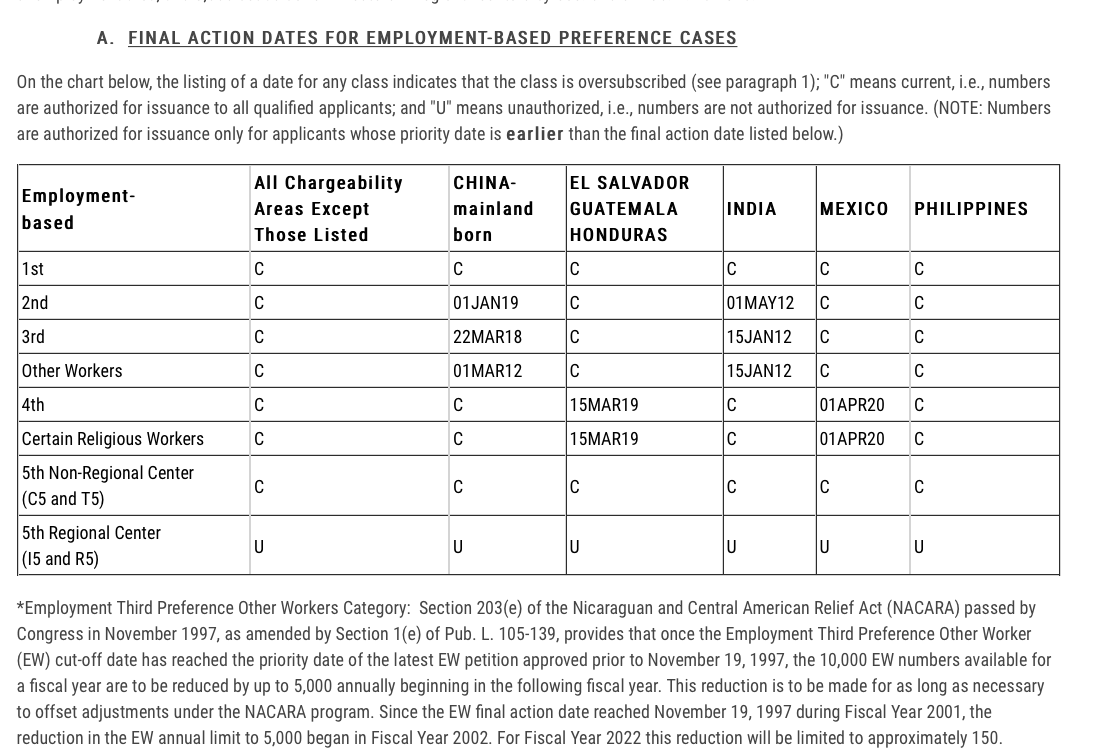
Chart A of each Visa Bulletin indicates the final action dates for backlogged countries, which dictate when investors can receive their EB-5 visas. As of December 2021, direct investors from every country, including China, have achieved “C” (current) status. They are no longer subject to a final action date and can receive their EB-5 visas as soon as these are available. (Investors should note that the DOS may reestablish a final action date for China if the demand from that country threatens to exceed the overall number of available EB-5 visas.)

The regional center values in Chart A are marked as “U” (unauthorized) due to the expiration of the regional center program. Still, the Visa Bulletin states that Chinese regional center investors will be subject to a November 22, 2015, final action date if the program is revalidated.

Chart B, “Dates for Filing of Employment-Based Visa Applications”
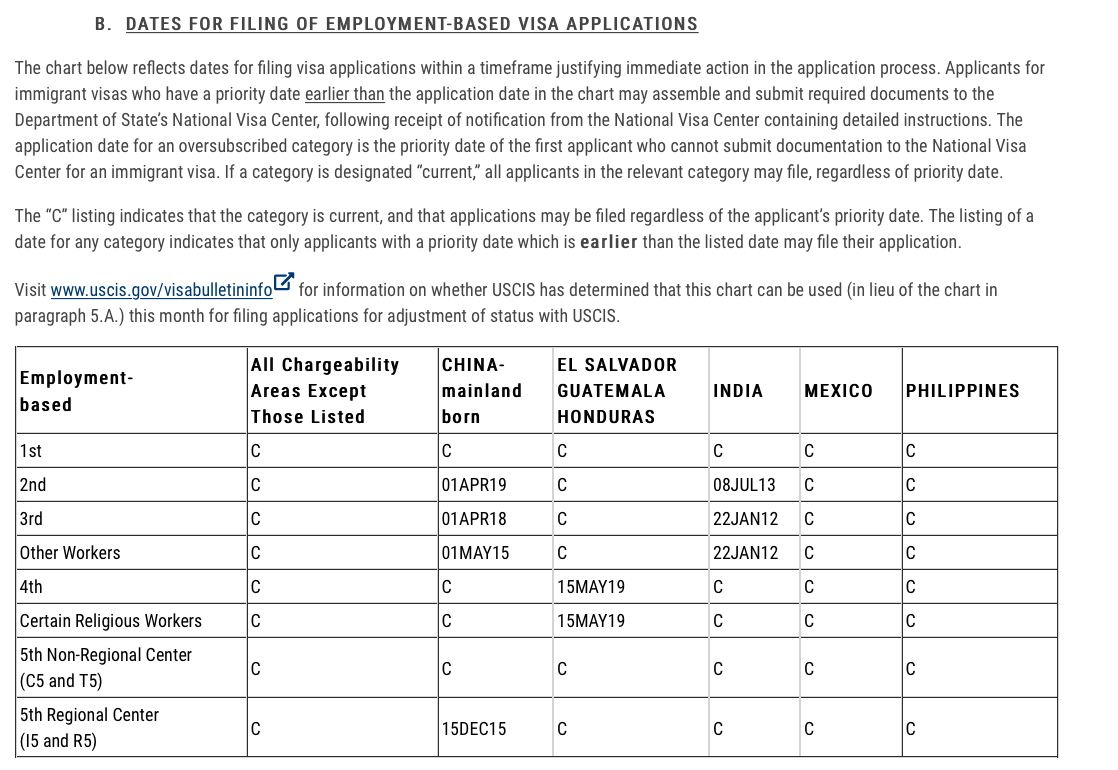
Chart B contains the dates for filing, which determine when EB-5 investors from backlogged countries can apply for their visas. As of December 2021, direct investors from all countries are no longer subject to a date for filing, so they can apply for their visas upon receiving approval for their I-526 petitions. The date for filing for Chinese regional center investors, however, remains at December 15, 2015; it has not advanced in more than a year.

The Importance of Reauthorizing the Regional Center Program

The suspension of regional center EB5 investment has prevented numerous visa applicants from moving forward with the EB-5 process. Moreover, the EB-5 investment program was allotted a record number of 19,880 visas for the 2022 fiscal year. Once the regional center program is reauthorized, USCIS and the DOS will be able to take advantage of the large number of available visas and reduce the EB-5 backlog substantially.

An Ideal Time to Make a Direct EB-5 Investment

Foreign nationals now have a valuable, and likely temporary, opportunity to invest in direct EB-5 projects at only $500,000 and without being subject to a cutoff date. Potential investors should act quickly to identify a suitable direct EB-5 investment project and begin the EB-5 process.


Free EB-5 Project Evaluation

The Benefits of Obtaining TEA Designation

The Benefits of Obtaining TEA Designation

Many U.S. business owners and foreign nationals have been drawn to the EB-5 investment industry. The EB-5 Immigrant Investor Program offers businesses in the United States a convenient source of funding that is often available at below-market rates. Moreover, foreign nationals can qualify for permanent U.S. residency in exchange for making an EB-5 investment in a qualifying business.

The EB-5 industry’s popularity was boosted on June 22, 2021, when a court ruling lowered the minimum investment threshold from $900,000 to $500,000. However, only EB-5 projects that are located in targeted employment areas (TEAs) can receive investments of $500,000.

Consequently, the vast majority of EB-5 investors prefer TEA projects. (Non-TEA projects can receive minimum investments of $1,000,000). Since every EB-5 investment must create at least 10 full-time jobs for U.S. workers, TEA projects benefit communities in need of economic development and funding.

Types of TEAs

TEAs can either be rural or high unemployment. To qualify as a rural TEA, an area cannot be located inside of a metropolitan statistical area (MSA) delineated by the Office of Management and Budget. In addition, rural TEAs cannot be on the borders of a city or town with a population greater than 20,000.

On the other hand, high-unemployment TEAs must have an unemployment rate that is, at a minimum, 150% greater than the U.S. national average. Moreover, a high-unemployment TEA will only qualify as such if it is located within an MSA or in a city or town with a population greater than 20,000.

How to Obtain TEA Designation

Many EB-5 project developers seek TEA designation. State agencies are in charge of granting TEA status; these entities must receive copious demographic evidence showing that an area is indeed a rural or high-unemployment TEA.

Proving rural TEA status is relatively straightforward; state agencies only need information on the area’s location and population. In contrast, obtaining high-unemployment TEA status requires doing further research. Many investors choose to use unemployment data from the American Community Survey (ACS), the Bureau of Labor Statistics (BLS), or a combination of both sources. Since the BLS updates its data more frequently, investors may choose to use that source. In any case, the unemployment statistics should be as up to date as possible.

Obtaining TEA designation can make the EB-5 process far more practical for both investors and project developers. Moreover, TEA projects provide economic stimulus to areas that need it the most, thus contributing to the EB5 investment program’s goals of reducing unemployment and strengthening U.S. businesses.

Free EB-5 Project Evaluation

Is Reauthorization for the Regional Center Program Getting Closer?

Is Reauthorization for the Regional Center Program Getting Closer?

The EB-5 investment industry underwent a significant change on June 30, 2021: the EB-5 Regional Center Program expired. Regional center investment had been the EB-5 program’s most popular investment type; the vast majority of EB-5 investors used to choose regional center-sponsored projects. As of November 9, 2021, the regional center program is yet to be revalidated.

Only a few days before the regional center program was suspended, a court ruling overturned the EB-5 Modernization Rule and thus lowered the EB-5 investment threshold to only $500,000. This decision has made the EB-5 program accessible to more foreign nationals around the world.

Direct EB-5 investment, the program’s other investment type, is now the sole option for investors and project developers. Many foreign nationals have chosen to make direct investments of $500,000 during the second half of 2021. Since direct investment is an integral component of the EB-5 program and does not rely on government renewal, many foreign nationals now prefer this investment model. Direct investment is ideal for businesses with smaller offerings, and direct EB-5 investors are often involved in day-to-day business management.

However, many investors still prefer regional center projects.

Recent developments indicate that regional center investment may be nearing reauthorization. If the regional center program is indeed revalidated, the EB-5 industry will benefit greatly.

How Reauthorization Could Take Place

Many EB-5 industry stakeholders agree that Congress will only reauthorize the regional center program if a bill to that effect is included in a larger legislative vehicle. It seems that Congress may have to pass such a legislative vehicle soon to avoid a shutdown of the U.S. government due to lack of funds. Some analysts believe that Congress will pass an omnibus bill, which could well include new regulations for the EB-5 program, such as the reauthorization of its regional center component.

Of course, the EB-5 industry can only speculate about how Congress will avert the possible government shutdown, and there is no guarantee that their legislation will reauthorize regional center investment. If, however, Congress does choose to address the EB-5 program, it may also make unwelcome changes such as raising the minimum investment amounts.

Why Reauthorization is Urgent

Many EB-5 investors and project developers have been inconvenienced by the lapse in the regional center program. United States Citizenship and Immigration Services (USCIS) announced that it would cease to process pending I-526 petitions associated with regional centers and that it would no longer accept such petitions from regional center investors. This policy could cause investors to lose confidence in the EB-5 program and try to get their capital back, which would put project developers in a difficult position. Moreover, many of the visas allotted for the EB5 investment program could go unused.

Even though the EB-5 industry has been hindered by the expiration of the regional center program, the EB-5 program as a whole still retains its popularity. Even more investors and project developers are expected to join the EB-5 industry once regional center investment can resume.

Free EB-5 Project Evaluation

U.S. International Travel Ban Lifted

International Travel Ban

The United States’ international travel ban, which had been in force since early 2020, was lifted on November 8, 2021. Now, travelers from 33 formerly banned countries can once again enter the United States.

Due to the ongoing pandemic, the U.S. government has instated several new rules designed to minimize the spread of COVID-19. The foremost of these is the requirement for all noncitizens to be fully vaccinated before entering the United States. U.S. citizens will not need to be vaccinated, and exceptions will also be made for noncitizens who are unable to get vaccinated due to health reasons. Regardless of their vaccination status, all travelers entering the United States must present a negative COVID test.

What This Means for the EB-5 Program

The COVID-19 pandemic has had a profound impact on EB-5 investors and project developers. Due to the widespread travel bans and lockdowns, many EB-5 projects found themselves in financial trouble. Moreover, United States Citizenship and Immigration Services (USCIS) nearly laid off about 70% of its employees due to reduced income during 2020.

The gradual economic recovery from the pandemic is undoubtedly beneficial to the EB-5 industry. Now, many more foreign nationals who are considering the EB5 investment program can come to the United States and visit open EB-5 projects. The return of international travel will also make it easier for potential EB-5 investors to meet project developers in person and learn about their offerings. Countries with high historic numbers of EB-5 investors, such as Vietnam and Brazil, had been banned from nonessential travel to the United States.

2021 has been a significant year for the EB-5 investment industry; EB-5 stakeholders have experienced many policy changes and new developments in recent months. June 2021 was a particularly eventful month that saw the repeal of the EB-5 Modernization Rule and the expiration of the regional center program.

The repeal of the Modernization Rule was welcome news for EB-5 investment stakeholders because it lowered the minimum investment threshold. Now, EB-5 investments of only $500,000 can be made in targeted employment area (TEA) projects. In addition, the temporary suspension of the regional center program has shifted investors’ focus toward direct EB-5 investment, which does not depend on periodic reauthorization. Interested foreign nationals should act quickly to make a direct EB-5 investment and begin the EB-5 process.

Free EB-5 Project Evaluation

Is the EB-5 Program Right for You?

Is the EB-5 Program Right for You?

The EB-5 investment industry is thriving, and many U.S. business owners are realizing that the EB-5 program can provide them with a secure and convenient source of funding. Moreover, foreign nationals interested in relocating to the United States are often drawn to the EB-5 investment industry. Despite its success, the EB-5 program regularly undergoes changes; EB-5 regulations can be modified quickly, and potential investors need to be aware of recent developments in the industry. For example, the EB-5 Modernization Rule, which had significantly altered EB-5 guidelines, was repealed in June 2021. In addition, the regional center program, a key component of the EB-5 industry, was suspended the same month.

Potential EB-5 investors must also become familiar with the numerous United States Citizenship and Immigration Services (USCIS) regulations governing the program. It can be challenging to make an EB-5 investment that complies with all of USCIS’s requirements. Further, it is important to realize that the EB-5 process takes years and requires careful planning. Considering the following factors will help potential investors decide whether to participate in the EB-5 program.

Risk Factors

Making an EB-5 investment does not guarantee permanent resident status. USCIS examines every EB-5 investment thoroughly, and an investor’s visa petitions must provide copious evidence of compliance with all the applicable rules. For instance, Form I-829 must show that an EB-5 investment was used to create at least 10 full-time jobs for U.S. workers. If the EB-5 project fell short of creating the 10 needed jobs, then the I-829 petition will be denied, leaving the investor without a U.S. green card. Due to this immigration risk, interested foreign nationals should evaluate potential projects thoroughly, making sure that they will fulfill all of USCIS’s criteria.

Participating in the EB-5 program also entails a degree of financial risk. USCIS dictates that all EB-5 funds must be at risk: the financial resolution of the investment cannot be predetermined, so all EB-5 investors must be subject to either gains or losses. There is no guarantee that an EB5 investment will result in significant returns or even in a profit.

Choosing Sources of EB-5 Funds

Many EB-5 investors and immigration attorneys agree that proving the legality of the EB-5 capital is one of the most challenging stages of the EB-5 process. In Form I-526, investors must trace their capital back to its source using abundant evidence. Even though USCIS allows investors to use any legal source of funds, interested foreign nationals should try to obtain their capital from a source that is easy to document. For instance, salary payments would likely be easier to document than capital from real estate sales or an inheritance.
Additional Expenses

As of June 22, 2021, the EB-5 investment threshold is $500,000 for targeted employment area (TEA) projects and $1,000,000 for non-TEA projects. However, EB-5 investors are sure to incur many additional expenses, including filing fees for USCIS visa petitions, immigration counsel fees, and relocation costs associated with conditional permanent resident status. Potential investors must be prepared to pay more than $500,000 or $1,000,000 during the EB-5 process.
The risks associated with the EB5 investment program, USCIS’s strict source-of-funds requirements, and additional EB-5 costs must all be factored in when deciding whether to make an EB-5 investment. However, foreign nationals who have the time and resources to go through the EB-5 process should participate—enjoying U.S. permanent residency and even citizenship is well worth the time and effort.

Free EB-5 Project Evaluation

Why Are Many EB-5 Visas Going Unused?

Why Are Many EB-5 Visas Going Unused?

The EB-5 investment industry is highly regarded among foreign nationals and U.S. business owners in need of funding. Since EB-5 investors become eligible for permanent residency while injecting valuable capital into the U.S. economy, the EB-5 program’s merits have long been recognized.

However, the EB-5 industry does face several challenges, many of which are related to bureaucratic issues. For example, United States Citizenship and Immigration Services (USCIS) is known for its slow processing times and substantial backlogs for Form I-526 and Form I-829, the two visa petitions that foreign nationals must submit during the EB-5 process. Moreover, the regional center program, the most popular EB5 investment option, was suspended on June 30, 2021.

A webinar released by the Department of State (DOS) on October 26, 2021, shows a great disparity between the number of visas allotted to the EB-5 program for the 2022 fiscal year and the number of investors eligible to receive these EB-5 visas. According to Charles Oppenheim of the DOS, the EB-5 program has 19,880 visas at its disposal—this is an all-time record for the EB-5 industry, even surpassing the 18,500 visas allocated for the 2021 fiscal year. However, as of early September 2021, only 368 EB-5 investors have received approval for their I-526 petitions and can thus move forward in the visa process. In this article, we explore two of the main factors causing this large number of unused visas.

The Expiration of Regional Center EB-5 Investment

As of October 28, 2021, the regional center program has been suspended for nearly four months. Congress’s failure to reauthorize this investment model has caused industry-wide setbacks. After the program’s expiration, USCIS announced that it would no longer accept I-526 petitions associated with regional centers. In addition, the agency ceased to process pending I-526 petitions from regional center investors.

The regional center program had been the most popular investment option; the flexible job calculation criteria, reduced managerial duties, and other benefits of regional center EB-5 investment made it far more popular than direct investment. Therefore, USCIS now has a large backlog of regional center I-526 petitions filed before the June 30, 2021 expiration. Had the regional center program been reauthorized by now, there would likely be many more investors eligible for EB-5 visas.

USCIS Processing Inefficiency

The second reason behind the low number of eligible EB-5 investors is USCIS’s slow visa petition processing. The agency has become known for allocating insufficient internal resources toward petition adjudication. Since USCIS is no longer working on regional center I-526 petitions, it should, in theory, be able to adjudicate direct I-526 petitions relatively quickly. Instead, direct EB-5 visa petitions are being processed as slowly as ever. Unfortunately, USCIS has not taken advantage of the opportunity to reduce its backlog of direct I-526 petitions.

Even though the EB-5 investment industry is currently facing many setbacks, direct EB-5 investment has never been more popular. All EB-5 projects must be direct because of the regional center program’s suspension, and the June 2021 repeal of the EB-5 Modernization Rule lowered the minimum investment amounts significantly. Therefore, many foreign nationals have made direct EB-5 investments at only $500,000. If the regional center program is reauthorized in the coming months, many new investors will likely be able to benefit from the lower investment threshold.

Free EB-5 Project Evaluation

Risks Associated with Making an EB-5 Investment

Risks Associated with Making an EB-5 Investment

Many foreign nationals are eager to get started on the EB-5 investment process and obtain U.S. permanent resident status. After all, the EB-5 program has enabled thousands of investors to relocate to the United States while benefitting U.S. businesses and reducing unemployment.

Despite the obvious benefits of participating in the reliable and highly-regulated EB-5 program, investors need to comply with numerous criteria. United States Citizenship and Immigration Services (USCIS) evaluates every EB5 investment thoroughly when examining Form I-526 and Form I-829. These visa petitions must prove that an EB-5 investor is in compliance with all USCIS guidelines. If the information provided is ambiguous or does not show adherence to USCIS regulations, the investor will be unable to obtain permanent resident status.

Moreover, the EB-5 industry is complex, and interested foreign nationals may feel overwhelmed by the many investment opportunities available to them. Fraud has occasionally been an issue for EB-5 investors, so interested foreign nationals should work with an experienced immigration attorney. Additionally, the many regulations governing EB-5 funding restrict the way EB-5 investments can be made. Therefore, participating in the EB-5 program may not be a viable option for everyone.

Before making an EB-5 investment, foreign nationals need to evaluate the EB-5 industry carefully to determine whether they will be able to comply with USCIS’s requirements. The financial and immigration risk associated with EB-5 projects must be considered when deciding whether to participate in the EB-5 program.

Financial Risk

One of the most important restrictions on the use of EB-5 funding is that the capital must remain at risk. This means that EB-5 investors must be subject to either loss or gain; there can be no guarantees that the invested amount will be returned. Any contractual rights to repayment are forbidden and would disqualify an EB-5 investor from obtaining U.S. residency. In light of this requirement, interested foreign nationals must realize that there is no guarantee that an EB-5 investment will result in a profit. Of course, many EB-5 investors are comfortable with a degree of financial risk; they are primarily concerned with obtaining U.S. green cards, not gaining high returns on their EB-5 investment.

To avoid fraud, EB-5 investors must do background research on potential EB-5 projects and their management, focusing on the individuals in charge of managing the EB-5 funds. Visiting the EB-5 business and finding third-party information on it is highly recommended.

Immigration Risk

Making an EB-5 investment does not guarantee permanent resident status. When evaluating Form I-526, USCIS will determine if the EB5 investment was made in a qualifying project, complies with the at-risk requirement, and can create at least 10 jobs. If Form I-526 is approved, the EB-5 investor will receive a two-year conditional residency. Toward the end of their conditional residency, the investor must submit Form I-829 and prove that the EB5 investment created 10 jobs and remained at risk. The evidence provided in these applications must be detailed and thorough.

The success of these visa petitions partly depends on the EB-5 project’s management. The most reliable EB-5 businesses from an immigration standpoint (1) offer ample job cushions and (2) have alternative sources of funding in case they fail to raise all the expected EB-5 capital. When examining an EB-5 investment opportunity, foreign nationals must pay close attention to these two factors.

Evidently, the EB-5 process implies taking some risks, and EB-5 investors need professional consultation to succeed. Still, foreign nationals who can tolerate a degree of financial and immigration risk should participate in the EB-5 program. Making an EB-5 investment has enabled many to begin a new life in the United States.

Free EB-5 Project Evaluation

How the EB-5 Program Benefits Families

How the EB-5 Program Benefits Families

The EB-5 Immigrant Investor Program is undoubtedly the best way for foreign nationals to relocate to the United States. Since 1990, the EB-5 program has enabled thousands of foreign nationals to gain permanent resident status and enjoy a new life in the United States. In addition, the minimum EB-5 investment requirements were lowered on June 22, 2021. Now, EB-5 investments can be made at only $500,000 for targeted employment area (TEA) projects and $1,000,000 for projects outside TEAs.

Interested foreign nationals may wonder whether the EB-5 program offers any provisions for investors’ family members. The answer is yes—an EB-5 investor’s family members (that is, their spouse and unmarried children under 21) are also entitled to receive U.S. green cards.

Benefits for Families

Families with children that relocate to the United States will gain access to a world-class education system. In fact, university students who hold permanent resident status are entitled to in-state tuition fees and certain scholarships and grants. Moreover, the college acceptance rate for green card holders is much higher than that of international students, and green card holders can work without restrictions before, during, and after their studies. Obtaining U.S. permanent resident status will make the college admissions process smoother and more economical—it will also make it easier to start a successful career in the United States.

There are countless other advantages to relocating to the United States. For instance, families will be able to enjoy the country’s diverse culture, safety, and wide-ranging options for entertainment and recreation. In addition, the United States possesses the world’s largest economy, enjoys relative political stability, and boasts a strong and reliable infrastructure. These factors make it a safe haven for foreign nationals.

The EB-5 Visa Process

Potential EB-5 investors who would like to relocate to the United States with their families should become familiar with the EB-5 visa process before making an investment. The first step is to submit Form I-526, Immigrant Petition by Alien Investor. Form I-526 must prove that the foreign national has made an EB-5 investment in a qualifying business using legally sourced funds.

Then, the EB-5 investor must wait for USCIS to approve their I-526 petition. Once USCIS reviews and approves Form I-526, the investor and their family are allowed to apply for conditional permanent resident status. Since these green cards are conditional, they only last for two years. During this period, the investor and their family are entitled to virtually all the rights enjoyed by permanent residents—they can live, work, and travel anywhere in the United States without restrictions.

After the two-year conditional residence period ends, the EB-5 investor will then have to take action to remove the conditions from their visa. The investor must submit Form I-829 within 90 days after their conditional permanent residence expires. I-829 petitions should provide ample evidence that the EB-5 investment was successful and complied with all USCIS requirements, such as creating or preserving a minimum of 10 jobs and remaining at risk. If USCIS approves Form I-829, then the investor and their family will receive permanent resident status, which does not expire. After five years, they will even be eligible to apply for U.S. citizenship.

Factors That Families Should Consider

Interested foreign nationals may wonder which family member should make the EB-5 investment and file the visa petitions. This will depend on their situation, but generally the petitioner should be a family member who plans on relocating to the United States permanently.

It is also important to keep the EB-5 program’s regulations in mind. As mentioned previously, an investor’s children must be unmarried and under 21 to receive EB-5 visas. Adult or married children are ineligible for these benefits. However, if parents are primarily interested in enabling one of their children to relocate to the United States, they may simply gift the child the necessary funds to make an EB-5 investment. Then, the child could make the EB5 investment themselves and begin the journey toward permanent resident status.

Evidently, foreign nationals and their families have much to gain from participating in the EB5 investment program. The United States’ strong economy, delightful culture, and political safety make it a true safe haven. Interested foreign nationals should act quickly to identify available EB-5 projects.

Free EB-5 Project Evaluation

Backlogs Will Continue: EB-5 Visas Placed in Tier 4

Backlogs-Will-Continue-EB-5-Visas-Placed-in-Tier-4.jpg

The COVID-19 pandemic has had a severe impact on bureaucratic processes around the world, and visa petition adjudication by United States Citizenship and Immigration Services (USCIS) has felt the strain. Global travel restrictions, closures of embassies and consulates, and restrictions on in-person interviews have led to a significant backlog of EB5 investment visa petitions.

The situation intensified as USCIS’s revenue from application fees plummeted. Ur Jaddou, who became the new USCIS director in July 2021, has stated that she will prioritize solving USCIS’s financial situation and implement measures to address the backlog of visa applications.

Four Priority Tiers for Visa Petitions

The United States Department of State (DOS) has announced a new prioritization system for visa applications. The system prioritizes family reunion visas over work- or business-related applications. The categories are the following:

  • Tier One: Intercountry adoption visas for immediate relatives; certain Special Immigrant Visas; cases where an applicant will no longer be eligible because of age restrictions; and other emergency cases
  • Tier Two: Fiancé(e) visas; immediate relative visas; and returning resident visas
  • Tier Three: Family preference immigrant visas and SE Special Immigrant Visas for certain U.S. government employees
  • Tier Four: All other immigrant visas

The hope is that this structured prioritization will make processing visa petitions more straightforward and efficient. Nevertheless, relative and adoption visa petitions will be processed before applications related to the EB-5 investment program.

The Outlook for EB-5 Visa Petitions

The EB-5 investment industry has faced several disruptions since 2020. Notably, the temporary closure of the EB-5 Regional Center Program suspended this popular investment route. This means that EB-5 investors can make only direct investments.

The news that the EB-5 petition backlog is not being prioritized by the DOS may cause some concern. However, since regional center I-526 petitions are no longer being processed by USCIS, it is possible that more adjudicators will be available to process direct EB-5 investment petitions.

Other developments in the EB-5 industry have been positive. For instance, the repeal of the Modernization Rule means that foreign nationals can once again participate in the EB-5 investment program at only $500,000 for targeted employment area (TEA) projects. Qualifying projects outside of TEAs must now receive minimum investments of $1,000,000.

As USCIS has filed an appeal to revalidate the Modernization Rule, it is uncertain how long the current minimum investment amounts will be valid. Foreign nationals interested in making an EB-5 investment should start the process before the regulations change once more.

Free EB-5 Project Evaluation

How to Avoid an EB-5 Petition Denial

How to Avoid an EB-5 Petition Denial

For over 30 years, the EB-5 investment program has offered foreign nationals a convenient and secure way to relocate to the United States. Many consider the EB-5 program to be the best visa-by-investment system in the world. Additionally, its beneficial effect on the U.S. economy has secured its continued popularity.

Still, the EB-5 investment industry can be difficult to navigate. Even though the EB-5 program’s basic criteria for investors are straightforward, proving compliance with all of them can be challenging even with the help of an experienced immigration attorney. EB-5 investors must provide evidence that they have created at least 10 jobs, used at-risk capital, and sourced their funds legally.

United States Citizenship and Immigration Services (USCIS), which governs the EB-5 program, requires investors to submit two important forms during the EB-5 process: Form I-526, Immigrant Petition by Alien Investor, and Form I-829, Petition by Investor to Remove Conditions on Permanent Resident Status. In these forms, EB-5 investors must show compliance with the above-mentioned requirements. Unfortunately, USCIS denies many EB-5 visa petitions, usually due to common recurring mistakes made by investors. In this article, we show EB-5 investors how to avoid USCIS denials.

Provide Consistent and Accurate Information

It can be challenging to keep track of the minute details and figures that must be included in Forms I-526 and I-829. For example, I-526 petitions must contain details about the EB-5 investment project’s business plan and approach toward creating jobs. If financial projections, employment estimates, or other information is presented inconsistently, USCIS will likely send a request for evidence (RFE) or deny the I-526 petition outright.

The immigration attorney in charge of compiling and filing an investor’s EB-5 visa petition should take great care to ensure internal consistency. Investors should check their petitions several times before filing them.

Evaluate EB-5 Projects Carefully

USCIS also sets out several requirements for EB-5 businesses. Unfortunately, not all available EB-5 projects comply with USCIS regulations, so potential investors should examine every EB-5 investment opportunity carefully. For example, EB-5 investment capital must be at risk and irrevocably committed to the project; all EB-5 investors must be subject to financial gains or losses. In its Policy Manual, USCIS states, “If the immigrant investor is guaranteed a return, or a rate of return on all or a portion of his or her capital, then the amount of any guaranteed return is not at risk.” Therefore, EB-5 businesses that offer a guaranteed return to their investors should be avoided. The at-risk requirement for EB-5 funds applies to both Form I-526 and Form I-829.

Provide Abundant Source-of-Funds Evidence in Form I-526

One of the most time-consuming aspects of compiling Form I-526 is the source-of-funds documentation. EB-5 investors must prove that their funds are lawful and submit numerous documents tracing the capital to its source. USCIS has high evidentiary standards, so the submitted documentation must be thorough and convincing. For example, EB-5 investors who use capital from a real estate sale do not only have to prove that they sold the property—they must also show how they came to acquire it in the first place.

In addition, the needed evidence will depend on each investor’s source of capital, so there is no universal list of required documents for Form I-526. An immigration attorney’s assistance will be invaluable at this stage.

EB5 investment regulations may seem overwhelming, but the program is still a comparatively easy way to relocate to the United States. Before making an EB-5 investment, interested foreign nationals should carefully evaluate USCIS requirements and consult with immigration counsel.