

Author Archives: admineb5

Free EB-5 Project Evaluation

Preparing for Changes in the EB-5 Program

Recent uncertainty regarding the future of the EB-5 Program harkens back to temporary shakeups in 2013 brought about by the publication of the May 30 memorandum by United States Citizenship and Immigration Services (USCIS). While EB-5 practitioners were quick to adapt to the adjustments outlined in the memo, similar concerns have arisen in the present day regarding the potential for policy changes to blindside investors, regional centers, and other practitioners within the context of the EB-5 Program.

In an attempt to face any changes proactively, as investors and regional centers will need to adapt immediately following any upheavals, practitioners are investigating novel strategies regarding the creation of business plans and other documentation provided to USCIS for adjudication. This article therefore reviews the impact of the May 30 memo to illustrate how changes in USCIS policy can result in innovation in the EB-5 market as well as improvements in the way projects are evaluated, leading to a more transparent investment environment overall.

The past three years have fostered an evolution in the design of EB-5 business plans, and better understanding these changes can help practitioners develop tactics to address any potential upcoming policy changes. The recent spike in the shuttering of regional centers has illustrated that USCIS aims to ensure all actors within the EB-5 Program fulfill their roles, and practitioners have noted that requests for evidence (RFEs) often concern information gaps that could have been avoided through more diligent regard for USCIS guidelines.

By examining reactions to the May 30 memo within the EB-5 market, practitioners can better develop strategies to face future changes as well as current USCIS trends in adjudication. Successful responses to changes introduced in the May 30 memo are therefore outlined here.

Changes in Adjudication Standards

The May 30 memo signified that USCIS would be adopting a more rigorous stance in evaluating the viability of EB-5 projects. While the Matter of Ho ruling provided comprehensive guidelines on the information necessary in an EB-5 business plan, and USCIS continues to adjudicate petitions based on these standards, the level of scrutiny has intensified as USCIS aims to combat fraud and misrepresentation within the program. Whereas practitioners once viewed the Matter of Ho guidelines as suggestions rather than requirements, recent RFEs have driven home the importance of supporting each project with thorough documentation.

Prior to the May 30 memo, investors and regional centers generally relied on the experience of project management teams to create financial projections and support the assumptions for revenue and expenses stated in the business plan. Indeed, before 2013, I-526 petitions for conditional permanent residence were adjudicated and approved based on little data concerning the viability of EB-5 projects. The May 30 memo therefore clarified that USCIS would be evaluating projects much more intensively in the following years.

Introduced with the memo was a focus on the standard of a “preponderance of evidence” regarding all information submitted with I-526 petitions. This signified that USCIS would be turning a more critical eye to any assumptions presented in EB-5 business plans, and investors and regional centers would therefore need to provide more legitimate data and support from sources outside the projects themselves moving forward.

Use of Third-Party Data

The most significant change in strategy was the move toward using third-party data to support EB-5 business plans. The type of data used varies by industry but must reflect current and historical trends specific to the project and must be integrated effectively into the business plan. Some projects additionally commission a third-party feasibility study to better support their economic viability and ability to fulfill the goals of the EB-5 Program.

Because the capacity of a project to fulfill the EB-5 job creation requirement is so crucial to the success of the I-526 petition, regional centers must model the financial aspects of a project on relevant and accurate data to ensure the right amount of investment funds are sought for the capital stack. Experienced economists can use this data to create financial projections as a basis for economic inputs and thereby calculate the necessary capital to sustain the job creation requirement and the project itself.

Third-party data also allows project managers to make any adjustments necessary during the preliminary planning stages to ensure the project remains viable. While providing credible data to USCIS greatly increases the likelihood of the successful adjudication of investors’ I-526 petitions, this data can also serve to provide a foundation upon which to build the capital stack and avoid later significant changes once a project is underway.

Evaluating RFEs

Recent RFEs provide guidelines upon which investors and regional centers can base their project development and documentation. Whereas RFEs have previously focused on a lack of information regarding economic viability, job creation potential, and licenses and permits, current RFEs center on the ability of new commercial enterprises to compete with competitors in the U.S. market. Developers have therefore begun to include comprehensive marketing strategies with their business plans and have undertaken SWOT analyses to determine areas for improvement in this regard.

These RFEs have demonstrated that USCIS is evaluating documents much more intensely than in previous years in an effort to ensure EB-5 projects meet the central job creation requirement of the program and remain accountable to investors.

The evolution of business plans following the May 30 memo illustrates the ability of EB-5 practitioners to adapt to changing circumstances and evaluation criteria. The more sophisticated business plans required of current EB-5 projects make use of multiple data sources and are the result of collaboration with experienced economic and legal professionals. Any future changes will likewise be geared toward fostering more transparent and sustainable EB-5 projects to protect investors and the goals of the program, and through significant developments in business plan design following the May 30 memo, practitioners have demonstrated that they are eager to embrace such challenges.
Free EB-5 Project Evaluation

Primary Elements of a Safe EB-5 Project

The evolution of the EB-5 market has encouraged investors to undertake increased levels of due diligence prior to committing to projects. Aside from assessing whether a project will remain financially viable throughout the visa application period and beyond, investors have been encouraged by recent actions concerning EB-5 projects by the Securities and Exchange Commission (SEC) to further investigate which financial controls and immigration compliance strategies each project has adopted to encourage approval of the I-829 petition for removal of the conditions of an investor’s permanent residence in the United States.

As such, investors have turned a more critical eye on project structure. The following are two key areas requiring due diligence of investors who consider funding EB-5 projects:

Security of the Investment Funds 

Management of investment funds is a key area of concern for investors. Use of funds must be transparent so as to guard against mismanagement or fraud, and investors benefit from working with projects that make use of an established and credible third-party administrator to set up an escrow structure compliant with EB-5 requirements. A qualified fund administrator will also track and provide an auditable record of all uses of the investment to facilitate a review by United States Citizenship and Immigration Services (USCIS) if necessary.

After an investment is released from escrow, projects must ensure funds are used as outlined in the materials provided with the I-526 petition. Namely, the investment amount must be used for job creation. In regional center projects where the new commercial enterprise and job-creating entity are managed by the same actors or some of the same actors, the opportunity for mismanagement increases. Investors must remain aware of this risk and thoroughly review projects’ financial plans to safeguard their investments.

As such, investors should be provided with ongoing accurate information on the use of their investment funds. These funds must be linked directly to job creation under EB-5 requirements, and as this element of the project is crucial for the success of the I-829 petition, continual information provides an additional level of confidence for investors. Similarly, investors should seek out projects that retain part of the investment in escrow in the event the initial I-526 petition is denied. However, this holdback structure must also be in compliance with the requirements of the EB-5 Program.

Lastly, investors must have a viable exit and repayment strategy. Recent increases in visa application processing times for foreign investors from China have illustrated the importance of properly managing investment funds until the conditions of permanent residence have been removed. Projects must set up concrete timelines for the use and repayment of investment funds within the confines of the program. Proper security of investment funds and oversight of their release from escrow are crucial considerations for foreign investors considering making an otherwise risky EB-5 investment.

Project Management and Documentation 

The first area of concern for investors in this regard is that the project has secured a capital stack sufficient to ensure its completion. Some EB-5 projects involve multiple senior loans, and investors in these projects must carefully review any subordination agreements to ensure their investments are protected. Especially in cases where the EB-5 investment is released from escrow prior to a senior loan, investors must ensure funds are used as required by the EB-5 Program and as laid out in the project offering.

Regional centers and other project managers should additionally demonstrate a willingness to work with investors and provide the documentation necessary to submit a successful I-829 petition to USCIS. By working with immigration attorneys and other professionals experienced with the requirements of the program, regional centers can better track and report on the use of funds and proactively ensure any points of concern for USCIS adjudicators are addressed and remedied.

In this regard, some regional centers undertake compliance reviews to identify such potential problem areas and devise strategies to rectify them. The following are two key points investors should look into when reviewing a project’s compliance with EB-5 Program requirements:

  • Are regional center staff aware of which information should be retained for review by auditors or later submission to USCIS with the I-829 petition materials? Removal of the conditions of an investor’s permanent residence hinges on proper documentation of how investment funds are used throughout the residence period, and regional centers must thus institute protocols for organizing and retaining relevant information to support investors’ residence petitions.
  • Are documents reviewed by a third party on a regular basis? Whereas regional centers should be experienced in project management, meaning the management of new commercial enterprises, they should also work with third parties to audit records often and pinpoint any areas of concern that would otherwise be identified during the adjudication of investors’ petitions.

Investors must additionally conduct due diligence by verifying the backgrounds and industry experience of project management teams, meaning principal actors within the new commercial enterprise and the job-creating entity alike. Before entering into any financial agreements, investors should be satisfied of the integrity of all those who will have access to the investment funds. It is worth keeping in mind that an experienced financial advisor can assist in identifying risks and project structures conducive to mismanagement in this regard.

Increased competition in the EB-5 Program brought about by Chinese retrogression quotas and further USCIS oversight of regional centers has encouraged investors to be more selective in their investment commitments. In adopting the strategies outlined above, investors can therefore take the necessary steps to protect their investments and make a successful visa adjudication more likely.

Free EB-5 Project Evaluation

Marketing the EB-5 Program in India

India has a long history of emigration beginning in colonial times and culminating in the recent migration of educated laborers to the West, Southeast Asia, and the Arabian Gulf. With its booming population and substantial middle class, India currently poses a significant opportunity for EB-5 developers.

The Indian Economy

In 2013, India was facing its worst economic crisis in twenty years, with the economy having grown only 4.4% in the second quarter and the banking system in disarray. That year, the United States Federal Reserve had tightened the reins on foreign investment, and global investors had reacted by transferring billions from developing economies, leading the rupee to fall in value by almost 40%. Additionally, capital controls introduced in India that year concerned foreign investors, who feared the new limits on how much could be transferred out of the country would affect their returns.

In an attempt to confront the worsening economic situation, the Reserve Bank of India eased restrictions on banks, allowing them to borrow in dollars rather than rupees, and instituted reforms to improve fiscal policies and strengthen the manufacturing sector. Perhaps because of tight regulations on banking and debt, most Indian investors bank through Singapore, and financial analysts have estimated that half of all rupee trading occurs outside India. Investors have taken advantage of this lack of government oversight on trading activity, and a large number benefit from banking in countries like Mauritius, which has a 0% tax rate.

Despite its economic woes and its climate of political friction, India was home to 182,000 millionaires and 103 billionaires as of the financial crisis in 2013, meaning this unstable economy nonetheless provides opportunities for EB-5 developers willing to adopt innovative strategies.

Obstacles to EB-5 Marketing in India

Developers keen to enter the market of potential Indian EB-5 investors must overcome a number of obstacles:

  • India lacks a network of immigration agents familiar with the EB-5 Program and its benefits and requirements. This means that few wealthy Indian investors, unlike their Chinese counterparts, are already aware of the EB-5 Program.
  • Indian investors are already able to access a number of international immigration programs, meaning EB-5 developers face more competition in India than they might elsewhere. As these investors also generally seek out higher returns on investment than do the Chinese, they might not perceive risky EB-5 investments as attractive.
  • The current $75,000 cap on capital outflows, mentioned briefly above, restricts the amount an investor can contribute to an EB-5 project. Additionally, developers often have difficulty tracking the sources of investment funds, given Indian investors’ propensity for offshore banking.
  • Wealthy Indian investors typically enjoy a good quality of life in India and may be reluctant to emigrate to the United States.

Each of these obstacles is discussed in further detail below along with relevant strategies developers can use to take advantage of this underrepresented market.

Establishing an EB-5 Immigration Network

Developers would benefit from establishing networks of immigration agents in large developed cities such as New Delhi and Mumbai. Indian immigration agents are generally already familiar with U.S. visa programs, and developers can work with these agents by educating them on the EB-5 Program and its benefits for wealthy investors hoping to emigrate. Developers can also leverage their connections with business representatives in India, and because a majority of Indians also speak English, developers are generally able to maintain direct relationships with these contacts.

Competing Internationally

A number of European, Caribbean, and Southeast Asian countries offer foreign investor residence and citizenship programs that compete directly with the EB-5 Program from the United States. Most notable among these are the programs in Canada, Australia, England, and New Zealand, all of which offer investors the opportunity to exceed by a large margin the $500,000 investment limit of the EB-5 Program.

Indian investors also often aim for a high return on investment and are not content to play a passive managerial role in development projects, unlike the Chinese. Additionally, they generally have ample opportunities for investment within India and can benefit from the high interest rates offered by Indian banks, as well, making investment in the United States less attractive.

To combat these factors, EB-5 developers might focus on advertising direct and pooled-direct investment projects, which generally offer higher returns for investors as well as equity. Lower agent fees in India also lead to a higher return for investors, meaning further opportunities for developers.

Sourcing Funds

The current capital outflow limit of $75,000, meant to stem the flight of capital following the 2013 Indian financial crisis, poses somewhat of an obstacle for foreign investors. While this measure is meant to be temporary according to the current Indian finance minister, EB-5 investors are meanwhile left to grapple with the issue of transferring funds abroad. Fortunately, many wealthy Indian investors maintain foreign bank accounts not subject to the cap, meaning this may not pose as significant a problem as anticipated.

This leads to a second issue, which is the difficulty of tracing the path of funds from Indian investors. To avoid taxation, many wealthy Indians underreport their earnings, meaning the country currently faces the issue of “black money,” this being assets not disclosed to government authorities. As with investors from any country, developers must be careful to document the source and path of EB-5 investment funds with the necessary proof to satisfy United States Citizenship and Immigration Services (USCIS) and Office of Foreign Assets Control (OFAC) regulations.

Encouraging Emigration

The high standard of living and status accorded to wealthy investors in India, especially in comparison to what their wealth would afford them abroad, means these individuals are generally not interested in emigrating. However, the United States is the premier education destination for wealthy Indian students, and developers can benefit from stressing the opportunity inherent in the EB-5 Program because of this factor.

The limitations of a work visa may prevent Indian students from gaining work experience in the United States following graduation from a college or university. As such, the possibility of permanent residence under the EB-5 Program can be a draw for the wealthy Indian parents of these students, as can the lower tuition fees offered to U.S. residents. An additional point of interest is that the parents would benefit from the EB-5 Program in this way without being subject to Internal Revenue Service (IRS) oversight of their other assets. Developers can add both these points to their arsenals.

India is a land of opportunity for EB-5 developers willing to adopt innovative marketing strategies to overcome the aforementioned host of obstacles. This as yet untapped market is home to thousands of wealthy candidates for the EB-5 Program, yet developers have been unable to surmount existing cultural and economic factors, the most significant among which concern international competition, a reluctance to emigrate, and an inability to document fund sources.

While Indian participation in the EB-5 Program is unlikely to overtake that of the Chinese in the near future, this market does offer significant potential for diversification of EB-5 investment sources in the face of Chinese quota retrogression and the potential lack of sustainability of the Chinese real estate market. Developers and regional centers willing to establish local immigration networks, conduct their due diligence on fund sources, and advertise the unique benefits of the EB-5 Program for wealthy investors are poised to take advantage of this climate of uncertainty.


Free EB-5 Project Evaluation

Marketing the EB-5 Program in Latin America

Recent delays in the processing of EB-5 visa petitions from Chinese investors have encouraged regional centers to focus on Latin America as a potential investment source. Despite political and social instability over the past decades, many Latin American countries are now experiencing economic growth, and the United States has emerged as an appealing destination for investors because of its geographic proximity, large Hispanic community, and strong legal system.

Opportunities for EB-5 Regional Centers in Latin America

China stands out as the source of a majority of EB-5 applications. For example, in the 2013 fiscal year, 86% of I-526 petitions were filed by Chinese investors and only 1.8% by Latin Americans, with the largest numbers of investors coming from Mexico, Venezuela, and Brazil. This can be partly attributed to strong economic conditions in Latin American countries during that year, meaning investors did not feel the need to look abroad.

However, with 605,000 millionaires, Latin America represents a significant opportunity for regional centers. Targeted marketing and education on the benefits of the EB-5 Program could bring about a capture rate, referring to the percentage of EB-5 applicants among all millionaires, identical to that in China. This would result in 1,600 applications per year and a significant boost in investment for U.S. regional centers.

Challenges of Marketing the EB-5 Program in Latin America

Many potential EB-5 investors in Latin America remain unaware of the program and its benefits. This situation is mainly the result of a lack of marketing initiatives and a climate of caution among wealthy investors in Latin American countries due to historical safety concerns. In some regions, unlike in China, where roadshows are a common way to attract investors, it would be unsafe to host a large gathering of millionaires to explain the requirements of the EB-5 Program.

Additionally, Latin American investors may balk at the required investment amount of $500,000, as well as the significant legal fees associated with applying to the EB-5 Program. Unlike Chinese investors, who often have family and colleagues who have successfully navigated the application process, Latin American investors are generally unfamiliar with the requirements and skeptical of the risk when investing such a large sum.

An increased tax burden is also a concern for potential EB-5 candidates. Taxes are high for nonresident aliens in the United States, and in cases where no tax treaties exist with an investor’s country of origin, the investor may face double taxation. While this drawback can be averted through tax planning, it does add an additional complication to the EB-5 application process.

Lastly, quality of life for wealthy investors is generally high in Latin America, and familial and cultural bonds may make emigration unattractive. While Latin Americans may indeed wish to invest in the United States, take advantage of temporary visas for business purposes, and own property in large U.S. cities, many do not wish to relocate permanently.

Benefits for Latin American EB-5 Investors

For some potential EB-5 applicants, the benefits of living and working in the United States far outweigh the drawbacks. Investors from countries that frequently undergo economic or political upheaval may wish to conduct business in a more stable system, as would those who face safety concerns or other quality of life issues. Similarly, students currently studying in the United States may wish to remain there as investors to avoid the restrictions of a working visa, and their parents may wish to join them in their new communities.

Regional centers would benefit from working through Latin American professional networks in cities like New York and Miami, which can facilitate more efficient marketing to potential investors. While the number of EB-5 applicants from Latin American countries is unlikely to spike in the coming years excepting a significant economic downturn in that region, a steady increase in applicants will encourage other investors to take the plunge over time.

Successfuly Marketing Strategies for EB-5 Regional Centers

Because regional centers must establish qualified networks of immigration attorneys and local agents and face significant costs in due diligence while familiarizing themselves with local markets, immigration and taxation laws, and cultural customs, they benefit from working in larger markets, where their efforts will reach more potential candidates. Brazil and Mexico are excellent examples of countries where this strategy may prove useful.

With over 225,000 millionaires, Brazil stands out as a target for marketing of the EB-5 Program by regional centers. The recent contraction of the Brazilian economy, which has resulted in a trade deficit and high inflation rate, has caused extreme poverty in certain regions, and this climate of economic uncertainty poses challenges for investors. Those wishing for a more stable business environment may see the benefits of applying for the EB-5 Program and immigrating to the United States, though transferring capital out of the country remains an obstacle.

Mexico is a second candidate for EB-5 marketing, with 150,000 millionaires and an open economy with significant ties to the United States and other regional trading partners. As a result of recent tragedies perpetrated by criminal organizations as well as politicians and law enforcement officials, wealthy Mexican investors may wish to immigrate to the United States for reasons of safety. Protests and widespread discontent have also cast into doubt the stability of the Mexican government, meaning potential EB-5 candidates may see the benefit of working and living elsewhere.

Other large countries in Latin America face additional challenges conducive to EB-5 marketing efforts. The weak economy in Argentina, political unrest in Venezuela, and crime rates in Honduras and Guatemala all present opportunities for regional centers to encourage immigration by wealthy investors.

Key Points: EB-5 in Latin America

Unstable economic and political conditions in some Latin American countries may encourage potential investors to look into the opportunities presented by the EB-5 Program. While a cautious investment outlook and generally high quality of life in most Latin American countries has historically precluded the need to immigrate to the United States, regional centers can capitalize on conditions in larger markets by working with stateside Latin American professional networks to educate investors on the requirements of the EB-5 Program and the opportunities it presents.

Free EB-5 Project Evaluation

EB-5 Regional Center Investments for Brazilian EB-5 Investors

The EB-5 Program offers unique opportunities for investors in Brazil to immigrate to the United States. However, despite the fact that Brazil has the largest economy and population in Latin America, few Brazilian EB-5 investors have applied for EB-5 visas over the past years. The reasons for this are twofold: Firstly, the booming economy in Brazil has not encouraged foreign investment. Secondly, there is little awareness of the EB-5 Program among investors in Brazil.

Considerations for Brazilian EB-5 Investors

As no network of migration agents exists in Brazil, investors hoping to apply for the EB-5 Program can benefit from working with an approved regional center, which will typically provide information on the U.S. immigration system as well as putting applicants in contact with qualified tax planning experts to help navigate U.S. tax requirements for foreign investors.

Brazilian investors should consider the obstacle of the U.S. tax on worldwide income. Unlike in Brazil, where the top income tax rate is 29%, the estate tax is between 4% and 8%, and there are no taxes on dividends to shareholders, nonresident aliens (NRAs) in the United States must pay high income and estate taxes. Immigration tax experts can help investors devise strategies to effectively reduce their tax burdens under the EB-5 Program, and regional centers can play a key liaising role in this regard.

The EB-5 Program offers rewards for ambitious Brazilian investors hoping to establish and manage businesses in the United States. Both Brazil and the United States have established legal systems through which to conduct business and enforce contracts, and the United States therefore stands out as a promising market for Brazilian EB-5 investors. However, an investor is not able to manage a business in the United States until his or her I-526 petition has been approved and permanent residence has been established.

Approaching the EB-5 Program as a Brazilian EB-5 Investor

Brazilian EB-5 investors often prefer to take a hands-on approach to conducting their due diligence on potential investments, regional centers, and immigration and tax planning attorneys. Familiarizing themselves with the various U.S. systems at play in the EB-5 Program allows investors to better understand the process of applying for an EB-5 visa and successfully investing in a U.S. business.

A crucial aspect of a successful EB-5 application is the ability to prove the legitimacy of funds sourced for the EB-5 investment. Immigration attorneys will play a key role in this step of the application, but investors can benefit from an understanding of the various documents required to establish credibility. These include documents to prove the founding and operation of a business, the leasing or purchase of property, and the sourcing of funds. Examples of these are listed below:

  • Contrato Social and Contrato de Constituição de Sociedade Limitada
  • Comprovante de Inscrição e de Situação Cadastral
  • Contrato de Locação de Imóvel Não Residencial
  • Records from the Cartório de Registro de Imóveis
  • Contrato de Compra e Venda
  • Declaração de Informações Econômico-Fiscais da Pessoa Jurídica
  • Comprovante de Pagamento de Swift
  • Any bank statements
  • Any declaration of joint assets, as for a married couple

An experienced Brazilian EB-5 investor will be familiar with these documents, which will substantially expedite the processing time for his or her I-526 petition and thus immigration to the United States.

Immigration and Tax Planning

Once a Brazilian investor has decided to live and work in the United States, he or she might benefit from obtaining an L-1 or E-2 visa so as to immigrate quickly and establish a business. Other types of visas, such as the B-1 and B-2 visas, allow Brazilians to spend up to six consecutive months in the United States, while the F-1 and F-2 student visas may also prove helpful in that they allow dependents to attend school in the United States. Regardless, building ties to the United States is a crucial part of establishing residence under the EB-5 Program, and this often means investors choose to immigrate along with their families.

As mentioned above, NRAs face a complex hurdle with the U.S. tax system, and Brazilian investors must therefore educate themselves prior to immigration on their potential tax obligations and plan accordingly. Although the tax systems of the United States and Brazil are similar, the services of an experienced tax attorney specializing in both can prove invaluable in helping EB-5 investors prepare for immigration. For example, various strategies involving the sale or transfer of assets and the deferment of expenses allow investors to minimize their tax burdens once residing in the United States.

While the EB-5 Program was designed to attract capital at low cost from China and other countries, it has developed into a significant opportunity for investors worldwide and especially in Brazil. Regional centers can thus benefit from approaching Brazilian EB-5 investors, who are often motivated and willing to take educated risks to create successful business ventures. Increasing awareness of the EB-5 Program will result in further growth of Brazilian foreign investment in the coming years.

Brazilian EB-5 investors should seek the assistance of qualified immigration attorneys as well as tax planning and financial advisors to ensure they are in compliance with all the requirements of the EB-5 Program as well as U.S. tax and immigration laws. For investors, regional centers can act as an excellent resource as well as an avenue to achieve their investment goals.

Free EB-5 Project Evaluation

Overcoming the Challenges Facing Iranian EB-5 Investors

Although Iranian EB-5 investors currently represent a small percentage of the overall number of EB-5 cases, only 0.7% as of 2014, recent changes brought about by the issuance of a general license by the Office of Foreign Asset Control (OFAC) have opened a door for this untapped market. However, immigration attorneys and Iranian investors poised to take advantage of this opportunity must nonetheless be aware of remaining challenges in such EB-5 cases.

The general license issued on October 22, 2012, allowed U.S. projects to accept funds from Iranian investors without the need for a specific license for each, as had been the case prior to that date. For Iranian EB-5 applicants, this meant a significant reduction in processing time of approximately eight months, making the EB-5 visa a more attractive option for investors hoping to work and live in the United States.

This article outlines how immigration attorneys and investors might overcome common challenges inherent to Iranian EB-5 applications.

Sourcing and Transferring Funds

While the general license allows U.S. projects to source funds from Iran in general, regional centers must still ensure that funds originate from legitimate financial institutions and investors, not those the OFAC has categorized as Specially Designated Nationals (SDN). Economic sanctions against Iran remain in place, and regional centers face harsh legal penalties for violating them by accepting funds from individuals or organizations on the SDN list.

For instance, under 50 U.S. Code § 1705 (b) and (c), violating economic sanctions carries a criminal penalty of up to $1 million in fines or a maximum prison term of 20 years, or both, and fines for civil violations are the greater of $250,000 or twice the value of the transaction. For this reason, to ensure compliance with U.S. law as well as a successful EB-5 application, attorneys representing investors or regional centers must examine and document the path and source of funds at every step of the transfer process.

Before taking on the representation of an Iranian investor, an attorney should verify that the investor does not fall on the SDN list. While U.S. attorneys are legally allowed to provide services to Iranians under the OFAC general license, they can face criminal charges if found to have represented an SDN. For this reason, if an attorney discovers that he or she has inadvertently represented an SDN, the attorney must file a report with OFAC within ten days. Each investor should also be made aware that under OFAC regulations, once he or she becomes a permanent resident of the United States following a successful EB-5 application, he or she must divest any interests in Iranian businesses to remain within the bounds of U.S. law.

The first step in representing an Iranian investor is to ensure he or she can prove the legal origin of the investment funds. The standard of proof in EB-5 cases is a preponderance of evidence, but as filing of tax returns is not common in Iran, regional centers and attorneys may need to rely on professional licenses, bank records, and personal sworn statements to outline a legitimate path of funds and vet EB-5 candidates.

Additionally, no banking relationship exists between the United States and Iran, so Iranian investors are cautioned against initiating any fund transfers without first consulting an attorney. Some investors attempt to use the hawala system, which operates outside licensed financial networks, to transfer funds from Iran to the United States. Under this system, a sarafi, a money exchange house, accepts a sum in return for facilitating a transfer through local contacts in the United States. The contacts in turn generally wish to send money to family in Iran.

However, the hawala system is considered money laundering and is illegal in the United States. More importantly for EB-5 applicants, the system obscures the source and path of investment funds and is not conducive to proving their legitimacy. Investors and attorneys should therefore be diligent in working with only a reputable sarafi who will transfer funds through an intermediary bank in a third country, thus documenting the source and path of the funds as required.

USCIS Requests for Evidence (RFEs)

United States Citizenship and Immigration Services (USCIS) may return a Request for Evidence (RFE) if an adjudicator believes further information would clarify the EB-5 application and potentially lead to approval. Among Iranian investors, a majority of RFEs concern the source and path of investment funds, and for this reason attorneys should seek an OFAC opinion from a third party and include that letter with the EB-5 application to USCIS.

This becomes more relevant in light of the fact that USCIS and the OFAC use different criteria to determine the legality of funds. While both organizations require that investment funds be transferred from a bank not on the SDN list, USCIS also considers the path of funds prior to this last bank, meaning funds must not have travelled through an SDN at any point prior to transfer to the United States. USCIS therefore takes a more broad approach to determining the source and path of funds and will deny EB-5 applications where investment funds have travelled through an SDN.

This disagreement between USCIS and the OFAC leads to RFEs as well as the possibility for EB-5 applicants to dispute any denials based on the fact that only the OFAC can determine the legality of funds entering the United States, and the OFAC holds that an SDN’s interest in funds ends at the point at which those funds are transferred to a legitimate bank. A reduction of oversight from the OFAC following the 2012 general license additionally means that aside from reviewing the legality of funds when granting an I-526 petition, the petition to immigrate to the United States as an investor, USCIS adjudicators may also revisit fund sourcing when granting an I-829 petition to remove the conditions of permanent residence. Because of this difference of opinion, investors and attorneys should err on the side of caution when sourcing investment funds.

Free EB-5 Project Evaluation

EB-5 Petition Processing Statistics USCIS: Q2 2016

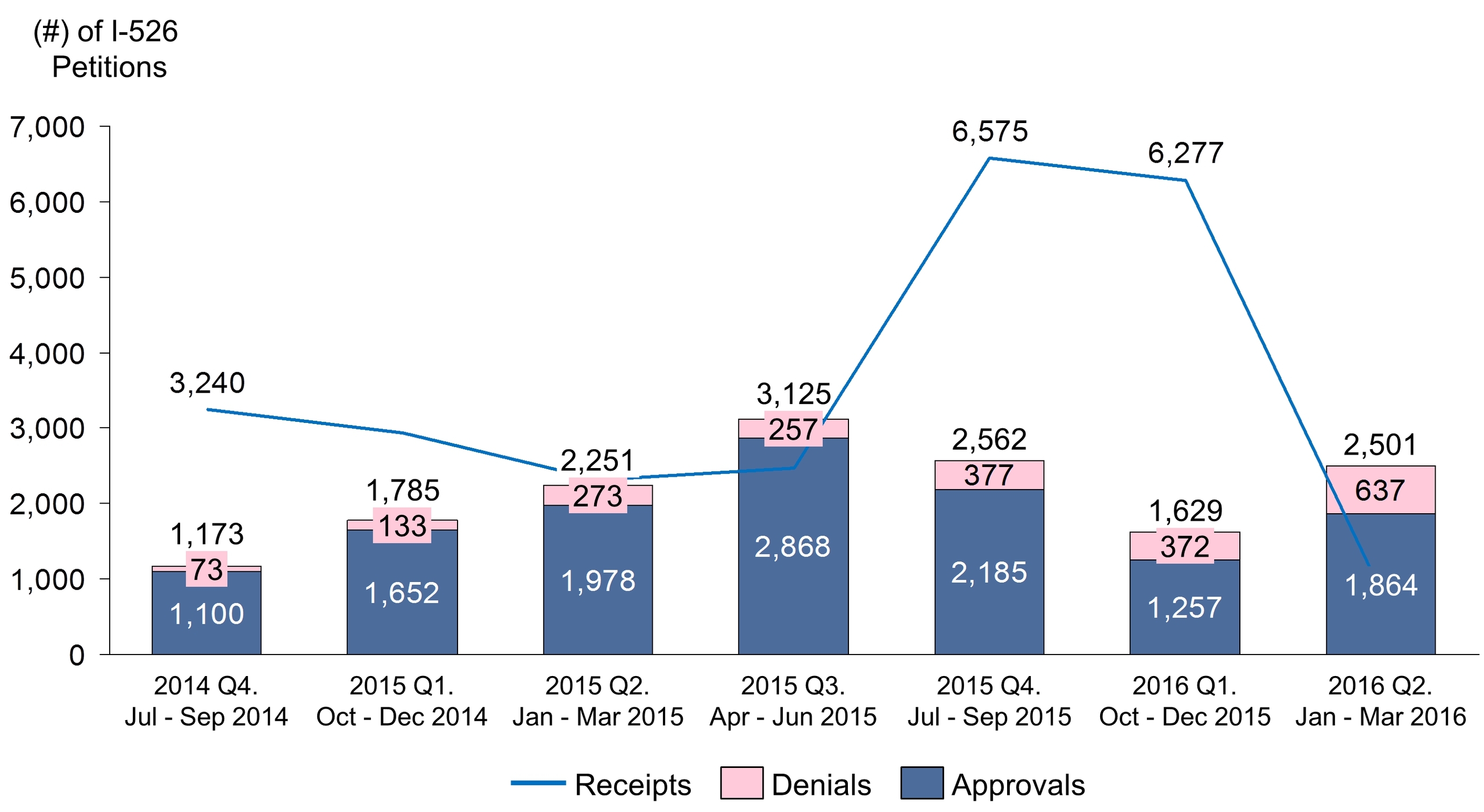
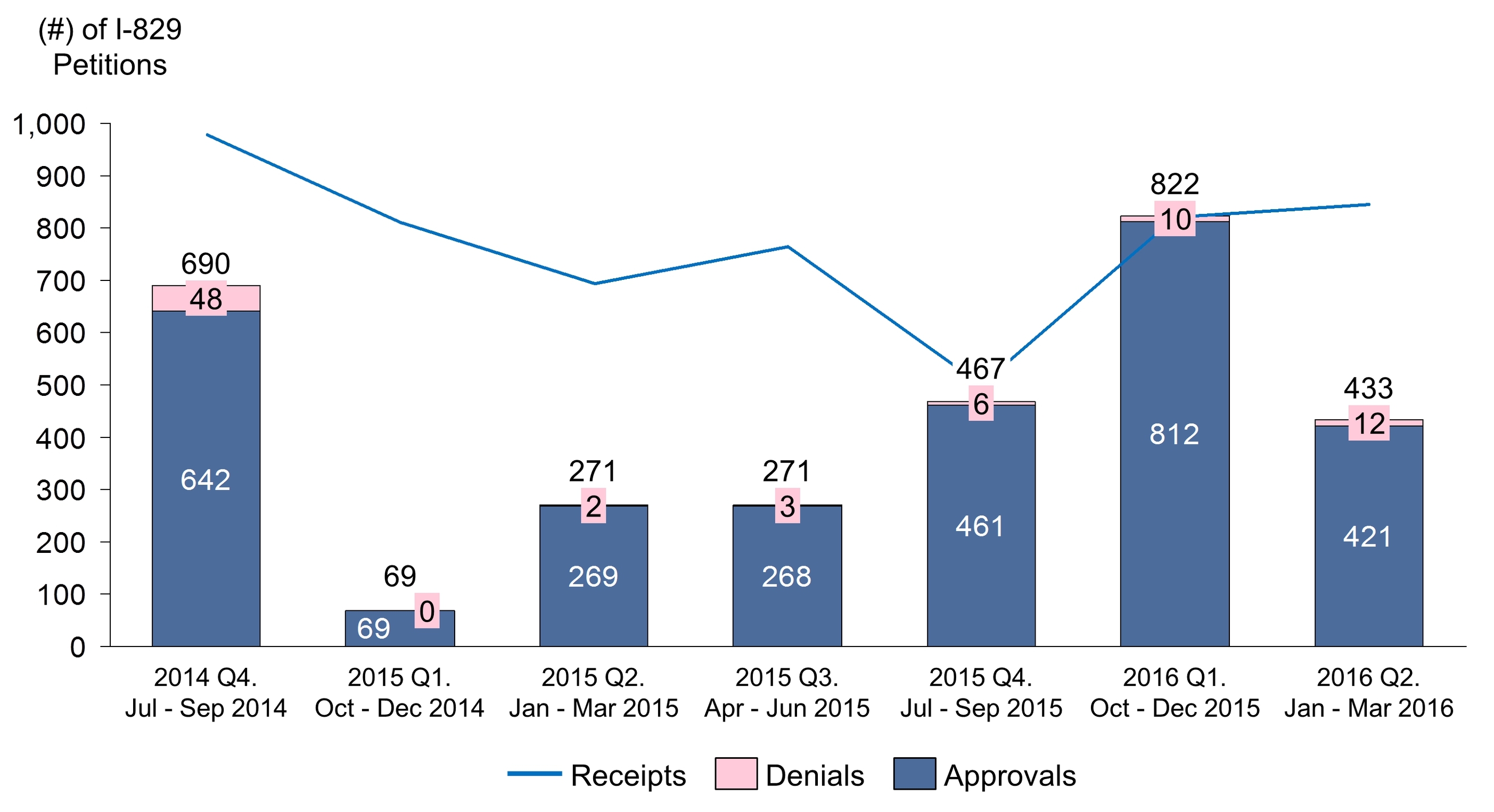
On May 31st, 2016 USCIS released official statistics on current I-526 and I-829 processing through March, 2016 (Q2 of FY2016).

I-526 Petition TrendsUSCIS Filing Blog Post 6.2.201601 CROPPED

The most recent quarter (Q2 FY2016) showed a substantial decrease in new I-526 filings due to the extraordinarily high number of filings in the previous two quarters. I-526 filings spiked at the end of 2015 due to proposed regulatory changes that did not go into effect when Congress renewed the EB-5 program on September 30th, 2015. The data also help illustrate that increases in USCIS adjudicator personnel appear to be making an impact on I-526 processing as the number of processed I-526 Petitions increased ~50% from Q1 FY2016 to Q2 FY2016.

I-829 Petition TrendsUSCIS Filing Blog Post 6.2.201602 CROPPED

I-829 Petitions for Q2 FY2016 decreased over the past quarter to 421 approved I-829 petitions with only a small percentage of denials, approximately 5%. Receipts of new I-829 petitions appear to have stabilized at approximately 800 I-829 petitions per quarter and we do not expect this trend to change in the near future.

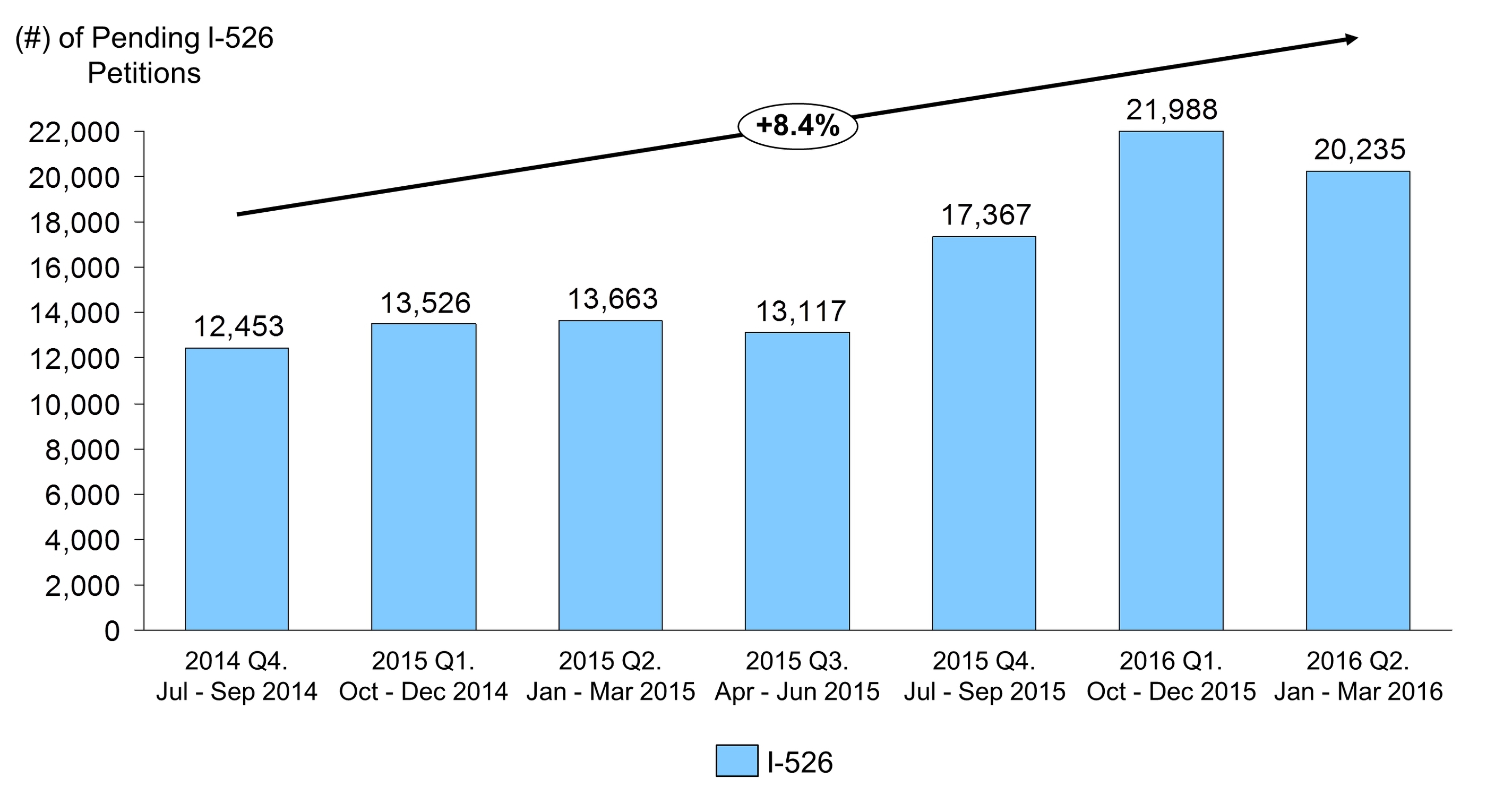
Pending I-526 PetitionsUSCIS Filing Blog Post 6.2.201603 CROPPED

The latest I-526 data shows that the number of currently pending I-526 Petitions stands at 20,235 – a decrease of almost 10% over the last quarter. Looking back over the past 7 most recent quarters, there is an 8.4% CAGR of new I-526 Petitions pending with USCIS, a trend that we expect to continue as the number of new I-526 Petitions picks up in the second half of 2016.

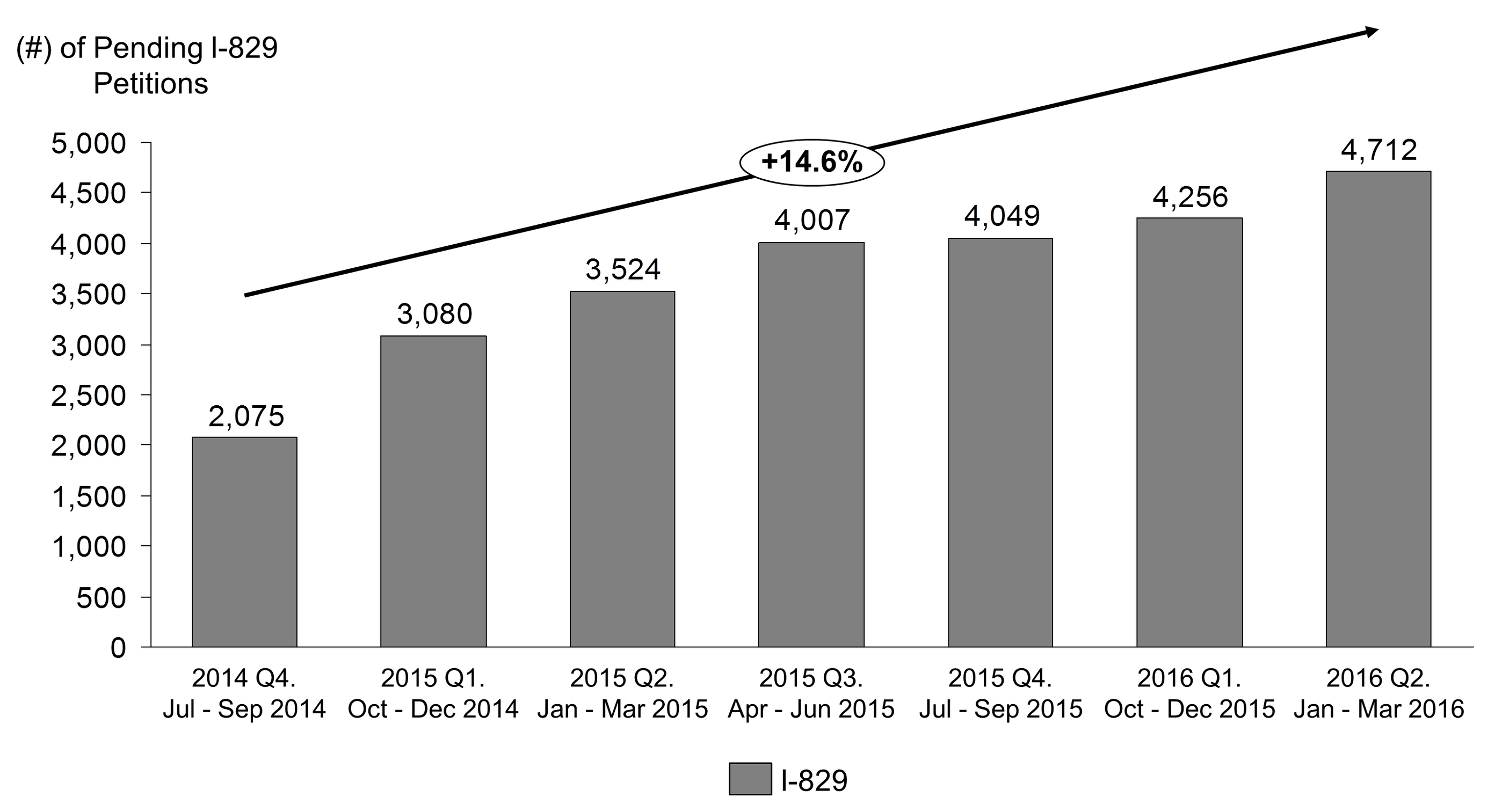
Pending I-829 PetitionsUSCIS Filing Blog Post 6.2.201604 CROPPED

The latest I-829 data shows that the number of currently pending I-829 Petitions stands at 4,712 – an increase of almost 10% over the last quarter. Looking back over the past 7 most recent quarters, there is a 14.6% CAGR of newly pending I-829 Petitions pending with USCIS, a trend that we expect to continue as the number of newly filed I-829 Petitions continues in the second half of 2016.

Free EB-5 Project Evaluation

EB-5 Petition Filings Stronger than Ever and Growing

EB-5 Petition Filings Stronger than Ever and Growing

According to recently released data from United States Citizenship and Immigration Services (USCIS), an increased number of EB-5 filings has resulted in a growing backlog of pending petitions.

The updated data from USCIS provides numbers for Q1 of FY2016.

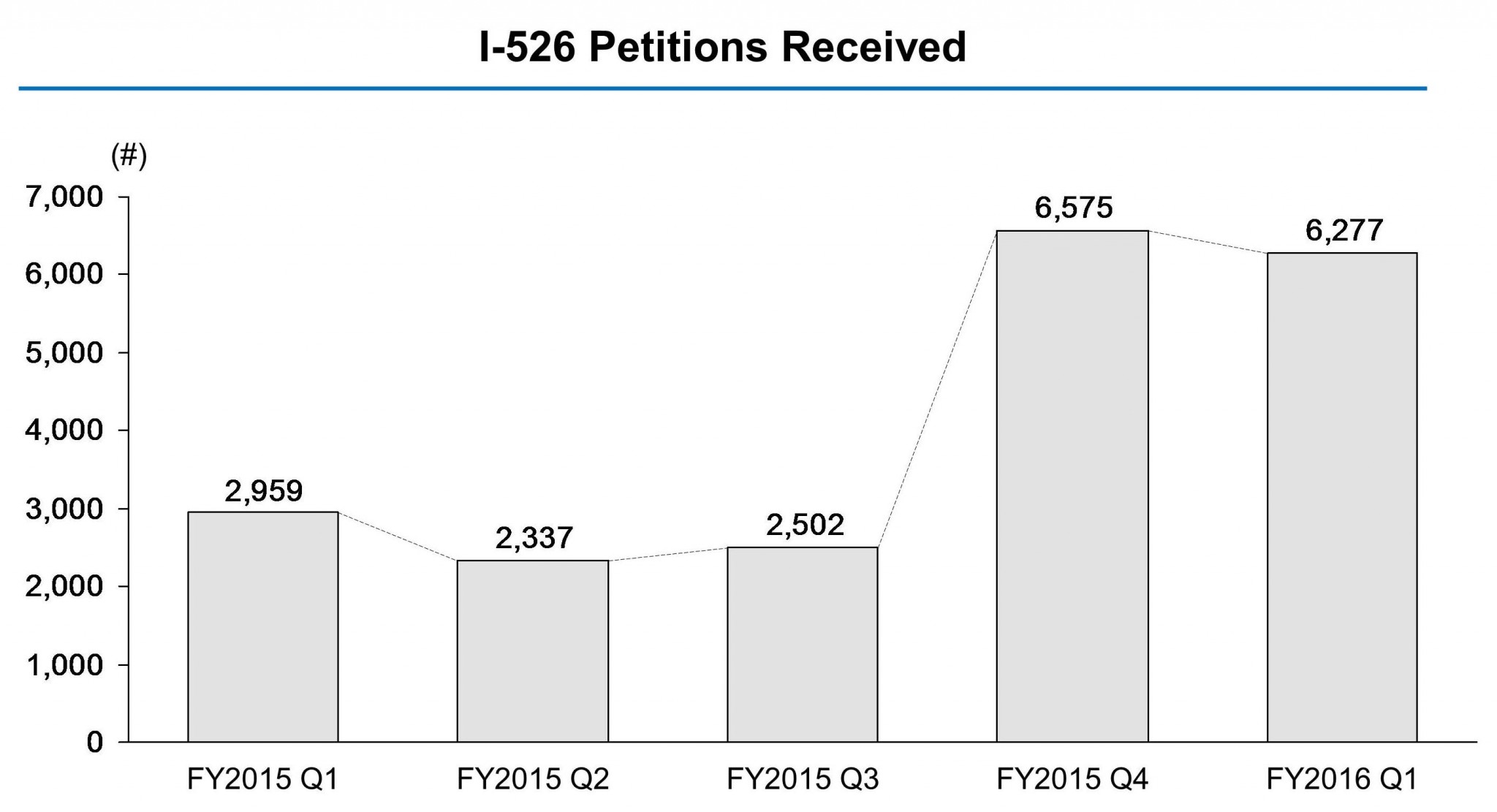
Slide0 CROPPED
 

Increased Number of I-526 Petitions

The record number of I-526 Petitions filed at the end of 2015 and beginning of 2016 has been attributed to uncertainty surrounding the continued efforts of Congress to reform the EB-5 Program.

The total number of petitions received by USCIS in 2015 was 14,373—approximately 46% of these were received in quarter four. The increased number of filings continued into 2016, with the first quarter seeing 6,277 I-526 Petitions filed. It’s worth noting that only two years ago, in 2013, the total number of filed I-526 Petitions was 6,346, which is equivalent to the number of petitions filed in each of the two most recent quarters.

Increased Backlog of Pending Petitions

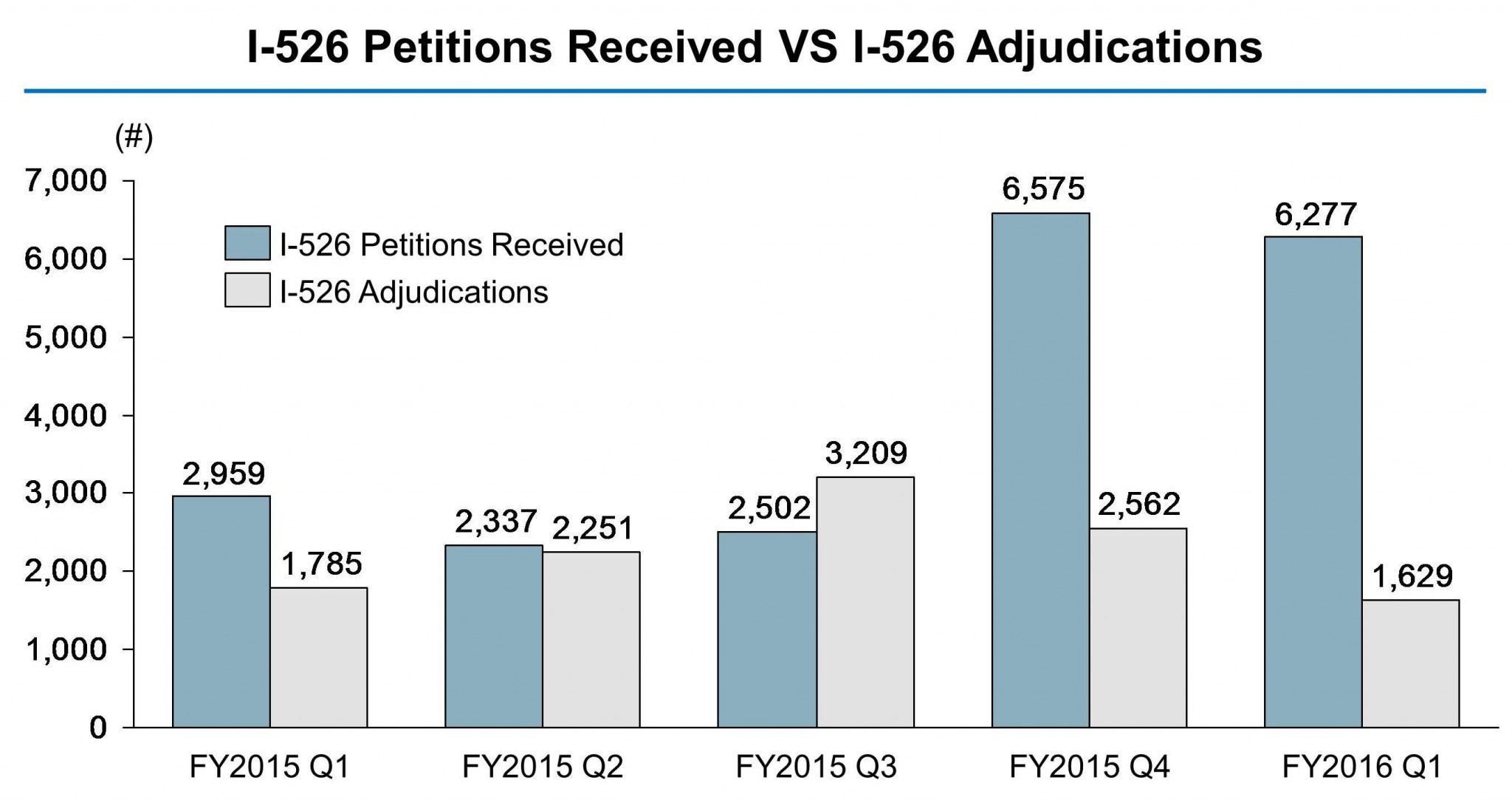
The increased number of filings in the past two quarters has created a growing backlog of petitions awaiting adjudication by USCIS. As demonstrated in the chart below, the number of petitions vastly exceeds the number of adjudications.

Slide1 CROPPED

Currently, the number of I-526 Petitions awaiting USCIS adjudication is 21,988, and the number of I-829 Petitions awaiting adjudication is 4,526. This backlog is expected to grow as the number of petitions filed with USCIS is likely to remain above the agency’s adjudication capacity.

Quarter Pending I-526 Pending I-829
FY2015 Q1 13,569 3,080
FY2015 Q2 13,731 3,524
FY2015 Q3 13,129 4,007
FY2015 Q4 17,367 4,049
FY2016 Q1 21,988 4,256

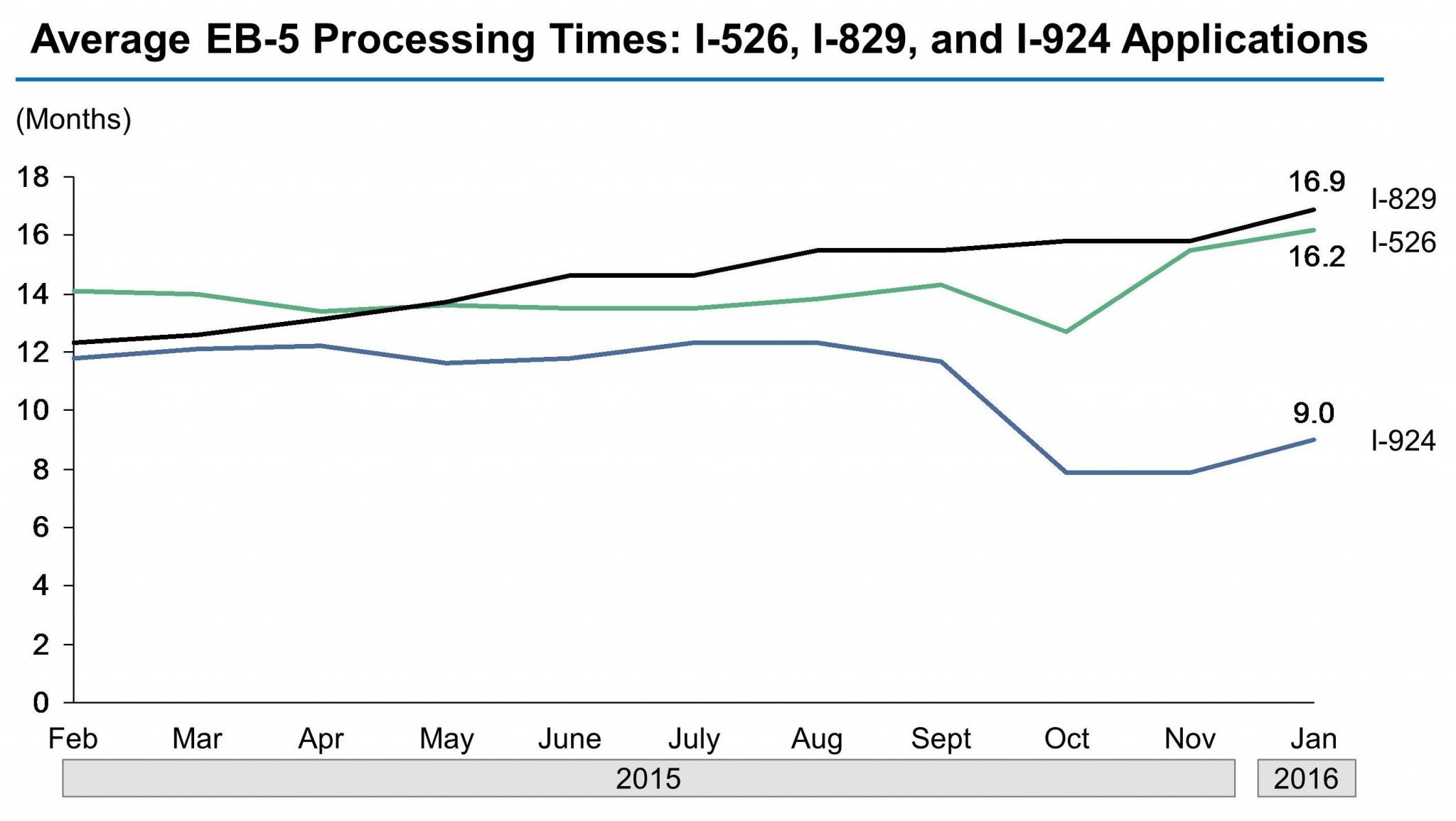
Since the beginning of 2015, the backlog has increased by more than 60% for I-529 Petitions and nearly 40% for I-829 Petitions. This growing backlog has resulted in even longer average processing times, demonstrated in the graph below.

Slide2 CROPPED

In November of 2015, the adjudication wait times were, on average, 15.5 months for I-526 Petitions, 15.7 months for I-829 Petitions, and 7.9 months for I-924 Petitions. These wait times are now 16.2 months, 16.9 months, and 9 months, respectively—an increase of about one month across the board.

Free EB-5 Project Evaluation

USCIS Proposed Fee Changes for the Regional Center Program  

Department of Homeland Security (DHS) has recently published a notice on proposed changes to USCIS’ fee schedule for the EB-5 Regional Center Program. 

Key Highlights of the Proposed USCIS Fee Changes: 

  • Annual Form I-924A Filing: $3,035 fee – – Additional new fee for all existing Regional Centers
  • Form I-924 Application Filing: Increase from $6,230 to $17,795 – – For New Regional Center Designation or Amendment (including Amendment to Geographic Coverage, Project Exemplar Application)
  • Form I-526 Petition Application: Increase from $1,500 to $3,675 
  • Form I-829 Petition Application: No change (still $3,750) 

A Few Thoughts our Team has on Value Add Strategies before Any Proposed USCIS Fee Changes go into Effect: 

  1. If you are considering filing a Regional Center, file it now. The fee will be over 3x the current amount in the future ($6,230 to $17,795) 
  1. If you are considering expanding your existing Regional Center through an amendment, file the amendment now and do not delay 
  1. If you have an existing Regional Center, you should confirm that you are fully compliant with any potential regulations to keep your Regional Center in good standing. In the event of an avoidable Regional Center termination, applying for a new Regional Center in the future will be much more expensive. 

It isn’t clear these will be the final fees implemented by USCIS, but in the event that these fees are implemented there are several recommended actions Regional Center operators and EB-5 project sponsors can take in the near future before fees go into place. 

Starting from yesterday, there will be a minimum 60 days for the public to comment before any changes go into effect.

There is good news and bad news with these proposed changes. 

Good News: (i) there is time to prepare for these changes and take the appropriate actions to avoid increased fees where possible, and (ii) the ongoing fees associated with existing Regional Centers are much more reasonable than previously contemplated in prior legislation, and (iii) ideally this should enable USCIS to operate more efficiently and provide more consistent and reasonable processing times. 

Bad News: It will be more expensive to start, maintain, and file projects for Regional Centers going forward.

Official USCIS Fee Announcement 

The Department of Homeland Security (DHS) proposes to adjust certain immigration and naturalization benefit request fees charged by U.S. Citizenship and Immigration Services (USCIS). USCIS conducted a comprehensive fee review, after refining its cost accounting process, and determined that current fees do not recover the full costs of the services it provides. Adjustment to the fee schedule is necessary to fully recover costs for USCIS services and to maintain adequate service. DHS proposes to increase USCIS fees by a weighted average of 21 percent and add one new fee. In addition, DHS proposes to clarify that persons filing a benefit request may be required to appear for biometrics services or an interview and pay the biometrics services fee, and make a number of other changes. 

Click Here to Read the Entire USCIS Fee Proposal 

Free EB-5 Project Evaluation

Secrets to Bringing an EB-5 Project to Market

The EB5Investors conference in Las Vegas in January, 2016 had 800+ attendees and was the largest EB-5 gathering in US history.

One of our founding partners, Mike Schoenfeld, participated on the EB-5 Myth-busters panel. This was a panel geared at newer members of the industry and the content was focused on helping participants understand the realities of EB-5 project development and marketing.

The key questions addressed are:

  • What are the steps before Sponsors can market their project (including Regional Center access, Project Documentation, Marketing materials and a Marketing Plan)?
  • How long does it take for a Sponsor to have access to the EB-5 funding?
  • What makes a project appealing and what can a Sponsor do to have the best chance of having their EB-5 project funded?

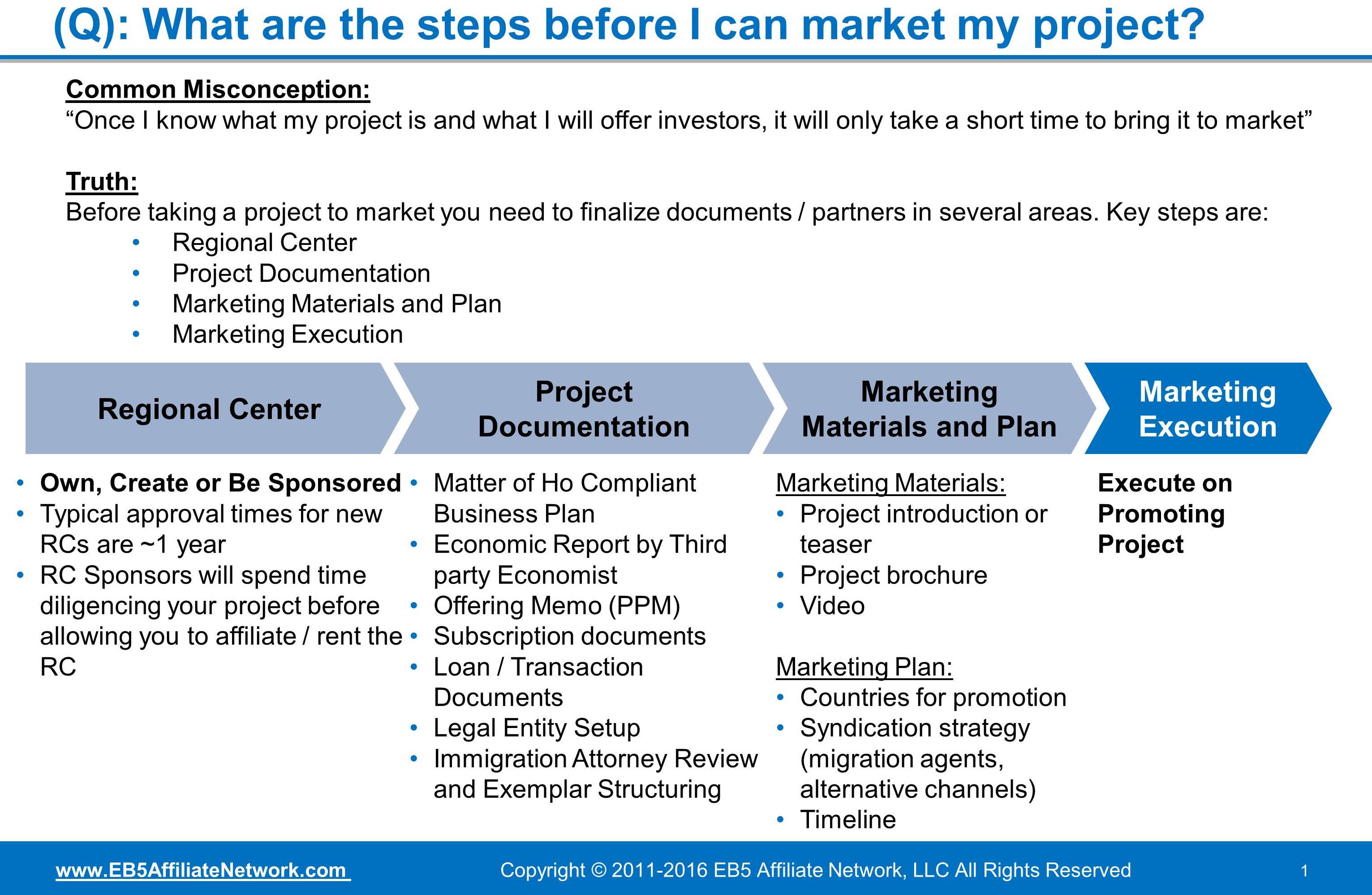
Q&A. What are the steps before I can market my project? Answer includes common misconception and then the truth.
 
Mike spoke about EB-5 from the regional center and project Sponsor perspective regarding what actually occurs before a project is taken to market. As depicted above, the key discussion points centered around 1) the choice of regional center, 2) project documentation, 3) the marketing plan and materials, and 4) the marketing execution.

Choice of Regional Center

For the choice of regional center, the key issues to consider are the number of projects one plans to undertake, the timing requirements of these projects, and the cost constraints. If a Sponsor already owns a Regional Center, that is the logical choice for the project. If they do not own an approved regional center, the key considerations are as follows:

  • Timing – When starting a new regional center, it can take 10 or more months to get approved, and approval times are unpredictable. If a Sponsor plans to begin marketing without having to wait 10 months or more, then they should consider rental.
  • Cost –Rental costs are lower up front, but they end up being higher upon a successful raise after the per-investor cost is factored in.

We have seen many developers use a hybrid approach in which they submit an application for a new hypothetical regional center and at the same time affiliate with an existing regional center until their regional center is approved. This approach is both cost-effective and time-effective.

Project Documentation 

The second key step in getting a project to market is completing project documentation. These documents can be broken into two key components – The USCIS required Business Plan and Economic report and the Securities offering documents. A project Sponsor has a few choices on how to complete the project documentation. Following are two options:

Developer Coordinates Documentation

In this case, the developer will hire all key service providers and ensure everyone is working together and exchanging information. They will play quarterback. Following are the key vendors they will engage:

  • Business Plan Writer
  • Economist
  • Securities Attorney
  • Immigration Attorney
  • Paralegal or Law Firm (to set up corporate entities)

Documentation Consultant Serves as Single-point of Contact

In this case, the developer will provide their market study, appraisal, or other similar documentation that a senior lender would require, and the consultant manages the process.

Our recommendation is that in a majority of cases, the single point of contact consultant is the better option. Key benefits include consistent work product, structuring expertise, cost efficiency (only 1 company needs to make a profit vs. 5 separate companies). EB5AN is one of the industry leaders in documentation consulting, and you should reach out if you have any questions about the process.

Marketing Materials and Plan

Overall, having a well-defined plan and creating strong materials is critical for ensuring the project has the highest likelihood of success in the market.

Marketing Plan

The marketing plan is one of the key pieces of the EB-5 process. This plan needs to be carefully tailored to the specific project and to the expected investor marketing approach. Investors in different regions expect various key terms in the offering, and packaging the project correctly is vital in order to gain traction in the targeted markets. 

Marketing Materials

The materials for marketing a project can range from a simple brochure to an extensive video marketing presentation with 3D renderings, celebrity or government figure interviews, etc. The materials will vary depending on the project, its budget, and other specific needs.

Marketing Execution

After the project is Sponsored by a regional center, is fully documented, and the marketing materials are put in place, the project is ready to hit the market. It’s not a simple process, but with some guidance from experienced service providers, a developer can get their project into the market relatively quickly and cost effectively!

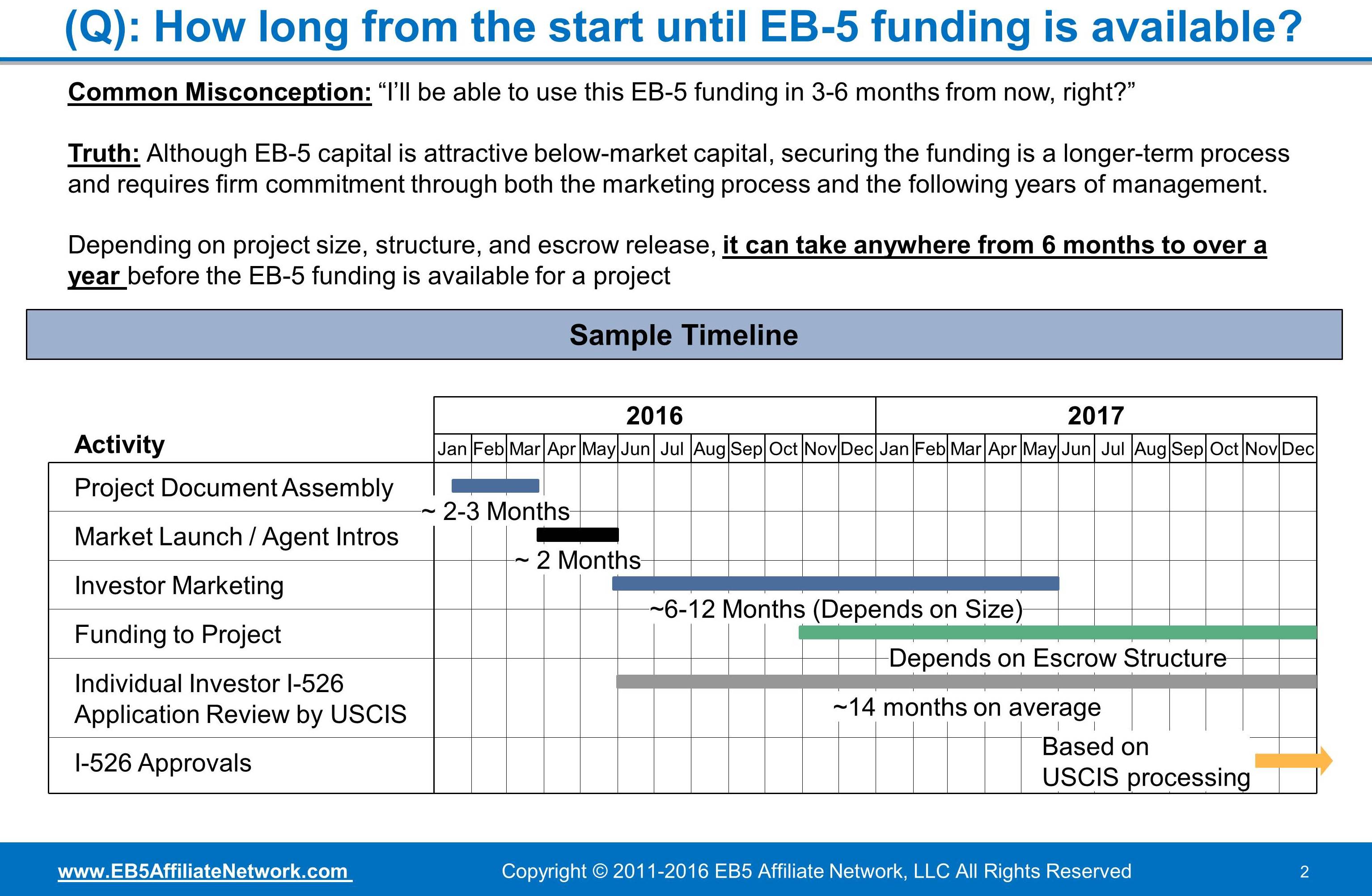
Q&A. How long from the start until EB-5 funding is available? It can take anywhere from six months to over a year.
 
One of the most common questions in the EB-5 space is, “How long until the EB-5 funding is available?” Although there isn’t a simple answer for this and the timeline will vary project to project, some reliable advice is that the process will take longer than expected. The previous portion of this post addressed documenting a project, and that is just the first step in getting a project to market.

After a project is documented and the marketing materials are created, the project must be introduced to the Sponsor’s chosen syndication network. This network may include Broker Dealers, Marketing Consultants, Migration Agents, Wholesalers, and potentially even personal contacts in foreign countries. Each marketing approach has significant securities law implications, and Sponsors should rely on securities counsel for advice on the correct marketing and syndication approach.

One of the potential syndication network paths is to work with migration agents, and this article will provide an example of this process.

  • Documentation and Marketing Material Creation (2–3 months) –  The length of time required will depend on how prepared the developer is with project material.
  • Market Launch – This part of the process typically involves the initial launch of the project into the market through either conferences and events in China or direct agent project introductions. A team can spend 2 or more months getting migration agents to study and diligence their Getting migration agents to engage in the process is the key here.
  • Agent Training – Depending on the agents, the project Sponsor may need to train their sales team regarding how to market the projects and on all the key aspects of the EB-5. This can take as little as 1 week or several weeks.
  • Seminar Launch / Investor Fundraising – After migration agents and partners have diligenced the project and their staff is trained, they can launch the investor fundraising effort. This stage of the process may not occur until 4 or more months from the start of the project.
  • Investor Subscription – Once investors are interested and plan to invest in the project, they will sign the subscription agreement. Although you have an interested investor, they haven’t sent their money yet. An investor may not wire their money into the project for anywhere from 1 month to 4 or more months. Do not be surprised by delays here, even from committed investors.
  • Escrow Release – The escrow terms will vary from project to Some projects have no escrow, and other projects hold investor money in escrow until individual I-526 approval is received. This topic is too involved and requires in-depth discussion, and so it will be discussed in a future blog post.
    • Depending on the escrow terms, the money could be available as soon as each individual investor wires their money into the project, but it could be as many as 14 or more months until all the funding is available.

While EB-5 offers many other benefits, typically, the EB-5 fundraising process is not a quick source of capital.

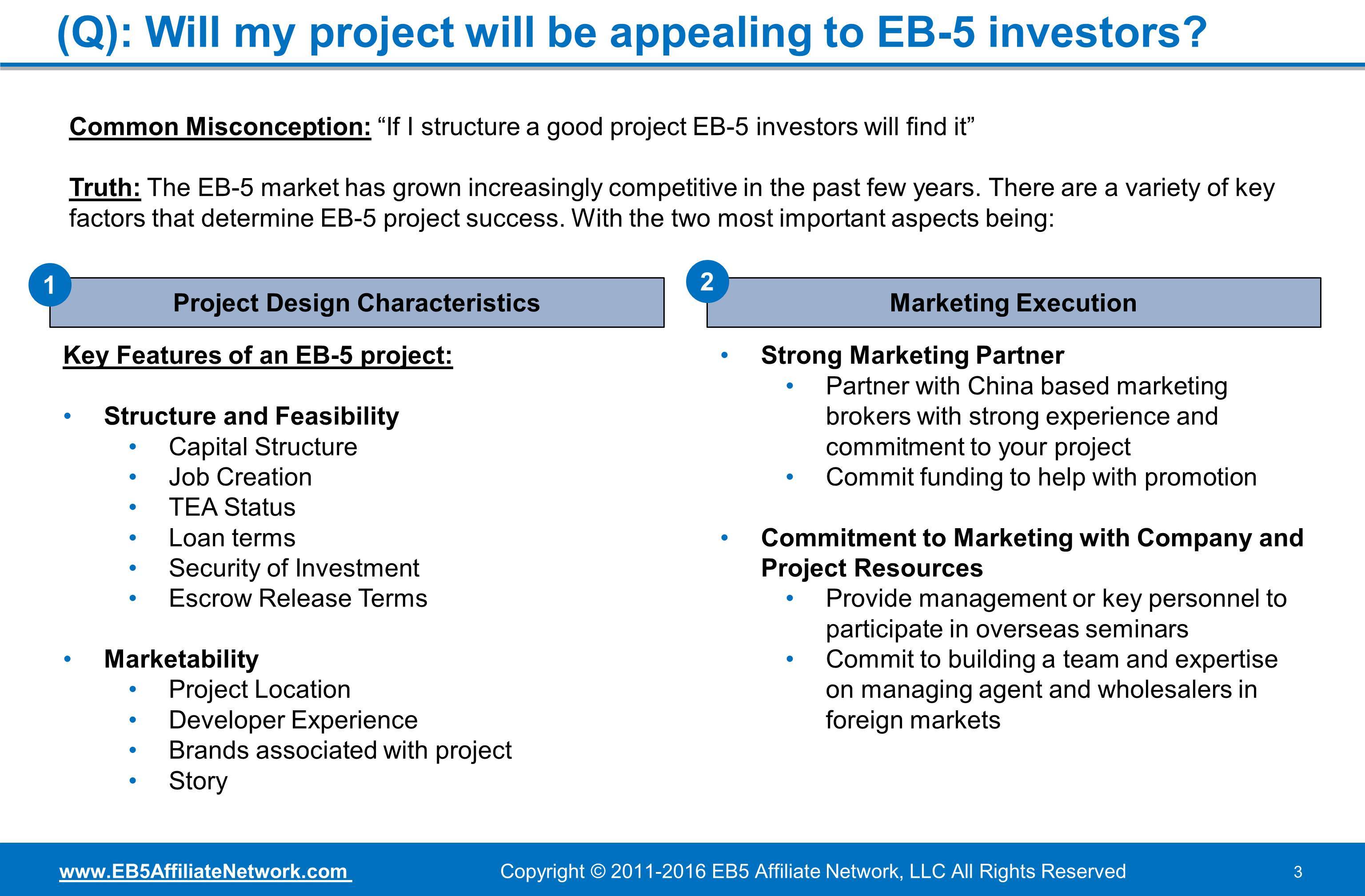
Q&A. Will my project be appealing to investors? The 2 key factors that determine success are Project Design and Marketing.
 
Two key questions when starting to conceptualize an EB-5 project are, “Will the project be appealing to investors?” and “Will my project find EB-5 funding?” An entire book could be written on this subject (and I think there may be one or two out there) – this blog post will keep it short.

(1) Will the project be appealing to investors

To start, two key project design characteristics make a project attractive to investors:

These two key project design characteristics are the structure and marketability of the project. Within these two characteristics are all the intrinsic features of the project. These elements can be broken into the following:

Structure

This is where the design of the project comes into play. Key factors for making a project attractive include (but aren’t limited to):

  1. EB-5 as a small portion of the capital structure
  2. Significant developer equity in the project
  3. A large number of jobs likely to be created
  4. A substantial job-creation cushion for EB-5 investors (desired)
  5. Project’s location in a TEA
  6. PPM Terms, which include the following:
    • Loan term
    • Return to investors
    • Investor rights
    • Investor security
    • Escrow structure

Marketability

In addition to the more rigid structuring questions, many variables can make the project more or less attractive to investors. Below are some examples:

  • Project location – Is the project in NYC? Is the project in a location the investor hasn’t heard of?
  • Developer track record
  • Recognizable brands attached to the project
  • Project summary and story

(2) Will my project find EB-5 funding?

To address the second key question, “If my project is structured well and is marketable, will it find EB-5 funding?” the Sponsor should think about the marketing execution. The key to marketing an EB-5 project is patience.

In addition to patience, finding strong marketing and syndication partners is a must. No one-size-fits-all answer is available here—and no magic bullet. Each project Sponsor needs to understand that they are their own best champion of the project, and they shouldn’t be 100% reliant on a third party for the marketing execution. It is helpful to provide international marketing partners with the support they need. This help could be in terms of financial support, marketing material support, or even on-the-ground roadshow support in which a key executive attends seminars or meetings to help close brokers or promote the project. Strong Sponsor commitment helps ensure the success of the project.

Historically, the EB-5 space has been relatively opaque, although it is shifting toward transparency. EB5AN has the goal of providing transparent solutions to all participants in the industry and welcomes any questions. Please contact us at 1-800-288-9138 or via email at info@EB5AN.com with any questions.