


Author Archives: admineb5

Free EB-5 Project Evaluation

The Use of Digital Currency in EB-5 Investments

507-The Use of Digital Currency in EB-5 Investments

There has been a recent increase in problems arising during the transferring of investment funds for EB-5 immigrant investors. Several countries, including China, Vietnam, and Ethiopia, have instituted regulations regarding how much currency they will allow to be changed into U.S. dollars and have imposed stringent requirements regarding the transfer of investment funds to the United States. In addition, United States Citizenship and Immigration Services (USCIS) has imposed additional requirements regarding how investment funds are sourced, making it difficult to use traditional methods of transferring international funds to meet the investment requirement. Several similar changes in local currency laws have also contributed to the difficulties.

As just one example, China created regulations at the beginning of 2017 that mandated discovery of the reason for the requested currency exchange and proof that it is not for immigration or on behalf of another individual. Several months later, additional regulations instituted a maximum transfer amount of RMB 50,000 each day per person, which is equivalent to $7,500, when transferring funds out of China. At the same time, USCIS now requires any third parties assisting investors in exchanging currency to provide proof of legitimate fund sources. This further complicates the process of transferring funds.

With all these barriers to investment fund transfers, what solution is there to be able to move forward?

One Possible Solution: Digital Currency

Digital currency allows individuals to send funds electronically without using a bank or other financial institution. Its value is based on supply and demand rather than individual exchange rates of various currencies. Also known as cryptocurrency, this type of currency is entirely electronic.

How Does It Work?

Digital currency transactions are recorded on a ledger of sorts, referred to as a “block chain” ledger. The ledger is maintained by companies commonly known as “mining companies.” Any changes to recorded transactions can only be completed by the stipulation of all involved parties.

As payment for maintaining the ledger, mining companies receive digital currency, which they will frequently turn around and sell to specialized brokers, who will then sell the currency to individual buyers through a cryptocurrency exchange market.

The most popular digital currency in today’s market is bitcoin.

Bitcoin as an Example

In order to use bitcoin, an individual must first set up an online bitcoin wallet that will allow for an exchange with the currency used in the individual’s country of origin. He or she can then use the local currency to purchase the bitcoin and store it in the wallet. The mining companies record the transaction onto a public ledger. The ledger, while recording details about the transactions, does not record information regarding the names of the parties involved, so these parties can maintain anonymity.
After depositing bitcoin into his or her wallet, an individual is then able to transfer it as a form of payment to other bitcoin users or exchange it through a cryptocurrency exchange. In the case of EB-5 investments, investors would need to use a cryptocurrency exchange in the United States and then exchange the bitcoin for the correct amount of U.S. dollars based on the current market rate. This method bypasses using a bank or other financial institution that may otherwise have limits on amounts or types of transactions. Once the foreign investor has successfully purchased U.S. dollars with bitcoin, he or she can then invest the money into a selected EB-5 project to begin the EB-5 immigration process.

Using a cryptocurrency exchange is not always necessary for the transfer of bitcoin. Individuals can sell or transfer bitcoin and other forms of digital currency directly by self-publishing the transaction on the publicly accessible block chain ledger.

Difficulties Associated with the Use of Digital Currency

While the use of digital currency to exchange or transfer funds seems relatively simple, changes in government regulations in some countries are complicating its use. China, for example, recently passed a regulation banning the use of digital currency to exchange funds. Bitcoin and other forms of digital currency may still be used in China for purchases by those who already “own” the currency, but the use of cryptocurrency exchanges has been prohibited. While the decision was made in an apparent effort to protect China’s economy, it creates difficulties for EB-5 immigrant investors trying to transfer investment funds from China to the United States.

Despite these regulations, the digital currency market attempted to remain afloat through the increase of direct transactions that did not require the use of cryptocurrency exchanges. It was successful in its efforts to circumvent the regulations imposed by the Chinese government. As a result, the Chinese government has recently suggested that it has plans to permit the use of cryptocurrency exchanges in the future but with added restrictions. Plans include the development of a licensing program so that the government will still be able to oversee the digital currency market. At this point in time, it is unknown what type of effect government oversight will have on the digital currency market. However, the digital currency market has proven its resilience by continuing to grow despite efforts by various countries to restrict its use.

Government regulations in select countries are not the only concern regarding the use of digital currencies. There are several other factors that may create difficulties for EB-5 immigrant investors who wish to use digital currency to be able to transfer funds for their investments. Three of these factors are listed as follows:

The Ever-Changing Exchange Value of Cryptocurrencies
The exchange values of digital currencies, unfortunately, are not stable. Since they are based on a constantly fluctuating market value, the potential for a drastic decrease in value after an EB-5 investor has purchased the currency and before he or she is able to exchange it for U.S. dollars is very real. If this occurs, the investor will no longer have the required funds for an EB-5 investment, resulting in a delay in the process while the investor obtains additional needed funds.

Additional Costs Related to Government Regulations
As exchange rates for some currencies are controlled by local governments (such as the Chinese RMB/Yuan), an investor may be confronted with additional costs due to inequivalent exchange rates. Digital currency exchange rates are controlled solely by the supply and demand of the market; thus, they may differ substantially from individual country exchanges rates.

Restrictions on How Much Digital Currency Can Be Purchased at a Time
Most digital currency exchanges have placed limits on the amount of digital currency an individual can purchase at one time. Limits may cover the purchases in a day, a week, a month, or more. Even the most popular exchanges in the United States impose such limits. For example, in the state of New York, an individual cannot purchase more than $8,000 bitcoin in a single week, which is approximately 21 bitcoins at the current exchange rate. These limits may pose a challenge to investors, as they make it difficult for investors to exchange the needed amount of funds in a timely manner.

Where Digital Currencies are Headed

The use of digital currency as a means of transferring funds is expected to continue to grow globally. While it is currently only one way to transfer funds, its use has increased rapidly over the years as well-known companies have begun to permit its use. Microsoft and PayPal are among those, as they now accept bitcoin as an appropriate form of payment.

However, digital currencies are still relatively new and, as such, carry with them unknown variables and have not yet gained the trust of investors. There is not a lot of detailed information available to potential investors about the process of digital currency transactions, and many are concerned about the fluctuating market value of the currency and the lack of global acceptance of its use. However, as more difficulties arise in the process of exchanging currencies through traditional methods, digital currencies are expected to rise in popularity. Countries may continue to attempt to regulate the use of digital currency, much like China already has. However, ways have been found to circumvent regulations in a way that is impossible to do with direct exchanges of local currencies. Due to this, it is expected that digital forms of currency will be in greater demand by EB-5 immigrant investors who are located in countries that have rigid regulations regarding the exchange of local currency in an effort to protect their economy.


Free EB-5 Project Evaluation

SEC Regulations and Their Relevance to EB-5 Investments

506-SEC Regulations and Their Relevance to EB-5 Investments

There are two questions regarding EB-5 dealings that commonly come up in the legal arena. The first is whether individuals or entities who are recruiting EB-5 investors are permitted compensation if they are not registered broker-dealers. The second is whether a limited liability company (LLC)’s interest in an EB-5-funded new commercial enterprise (NCE) can legally be considered a “security.” These are complicated questions, and looking at recent federal court cases can clarify how these situations are viewed from a legal standpoint. In a recent June 2017 ruling in the case SEC v. Hui Feng and Law Offices of Feng & Associates, the U.S. District Court for the Central District of California found that the LLC interest in that case was indeed a “security” and that the attorney and his firm had acted as broker-dealers without being registered as such.

The Application of Securities Laws to EB-5 Investments

Within federal securities laws, a “security” encompasses a wide range of instruments that could be sold as investments. Many EB-5 investments are in the form of partnerships or LLC interests, and while neither of these terms are specifically listed in the laws as being “securities,” they can be considered as falling under the umbrella term “investment contracts,” which is listed as a qualifying security. If an investment does not qualify as a security, investors lose out on having the protection of securities laws and are more vulnerable to being taken advantage of. Thus, it is important to determine whether or not the EB-5 investment can qualify as a security. In the SEC v. Hui Feng and Law Offices of Feng & Associates, the defendants contended that the LLC interests in their case should not qualify as securities and thus should not be protected by securities laws.

Investment contracts were defined by the U.S. Supreme Court in SEC v. W. J. Howey, 328 U.S. 293, 298-99 (1946). The Supreme Court established three requirements for an instrument to be categorized as an investment contract: 1) Money must be invested 2) in a common enterprise 3) with an expectation of profits. The defendants in the Feng case argued that in their situation, the third requirement was not met, as the investors did not expect any profitable return, and making a profit was not their motive since their expected return was less than the original investment combined with all the fees they had to pay. Since the motive was purely permanent resident status in the United States, they argued that this type of investment was not covered under securities laws.

When the court decided to rule against the defendants’ arguments, it pointed to EB-5 program regulations, specifically statements that investors had to keep their capital at risk for the entire investment term with the goal of receiving a return. It was also noted that the paperwork involved in this particular case referred to possible profit and also described the EB-5 investments using the term “securities.” The court also drew a clear line between fees associated with the program and the actual investment, stating that the fees would not be calculated in when calculating the actual return amount and that there was nothing given in their arguments that would support the defendants’ position.

While the Feng case defendants lost their arguments in court, they did make some reasonable points. It is a no-brainer that EB-5 investors have permanent resident status as their primary goal rather than obtaining a profit from their investment. However, because just the potential for a profitable return is generally adequate to satisfy the requirements, most court rulings would support the position of the Securities and Exchange Commission (SEC).It’s a reasonable assumption, therefore, that EB-5 investments are considered as “securities” in a court of law and subject to securities laws regulations and protections.

Entities Acting as Broker-Dealers Without Registering

Individuals and entities are prohibited from brokering securities transactions unless they have completed the required registration to become broker-dealers. This ensures that brokers are trained and educated on relevant regulations and their responsibilities towards the parties involved in the transaction, particularly the vulnerable investors. According to securities laws, a broker is any individual who is actively engaged in processing securities-related transactions on behalf of someone else. At the federal level, the courts typically refer to SEC v. Hansen in 1984 to decide if an individual or entity has acted as a broker. The ruling in this case set forth several factors that can be evaluated to determine this. All but one of these factors were identified in the Feng case and are listed below.

  1. Did the individual or entity receive transaction-based compensation (like commission) rather than regular pay (like salary or hourly wages)? In the case of Feng, the individuals did receive commissions or referral fees when they sent clients to regional centers.
  2. Did the individual or entity sell securities from other issuers? In the case of Feng, EB-5 transactions had been conducted since 2010, with additional securities transactions being conducted from 2003 to 2014.
  3. Was the individual or entity involved in negotiations between the parties involved in the transaction? In the case of Feng, the individuals negotiated terms on behalf of their clients and worked with various regional centers.
  4. Did the individual or entity advertise on behalf of clients? In the case of Feng, they did.
  5. Did the individual or entity advise the investors or provide appraisals regarding the investment? Yes, this did occur in the Feng casewhen the defendants recommended particular EB-5 regional centers to individual clients and also researched potential EB-5 projects on behalf of their clients.
  6. Did the individual or entity actively seek out investors? Yes, they did.
  7. Does the individual or entity regularly participate in securities-related transactions. Yes, they do.

With only one factor from the Hansen case not being relevant in the Feng case, the court affirmed that the defendants had acted in the role of brokers and would not be exempt from registering as such.

With a total of eight factors that decide whether an individual or entity has acted as a broker, the process of making this determination is complicated and lengthy. There have been cases where individuals receiving compensation for a transaction have not been classified as brokers for various reasons (e.g., SEC v. Kramer). Since the SEC generally argues that compensation equals broker status, parties to securities transactions can safely assume that they will be treated as such.

Disclosure Decisions: What Is Required?

According to U.S. securities laws (both state and federal), all securities offerings must be promptly registered with the appropriate securities commissions if they are not exempt. EB-5 offerings are usually considered exempt and thus not registered. While this removes certain disclosure requirements that normally apply to securities offerings, it does not eliminate the requirement to disclose all material facts to investors as a protection from fraud.Deciding whether or not a fact is material many times falls on courts after the fact, and this can be a difficult decision to make. As a general rule, if a fact is significant to an investor’s investment decision, it should be disclosed.

In the case of Feng, the defendants had neglected to disclose the commissions they received for referrals to the investors and, in fact, had indicated to investors that they were not seeking to find investors at all. They were found guilty of securities fraud because the court determined that if the investors had known about the commissions, they may have selected a different investment that would have been less costly or asked for a portion of the commissions that the defendants received. The court also ruled that commissions for making referrals could create a conflict of interest for the parties and should be disclosed to the investors.

For securities offerings that have to be registered, issuers are mandated to provide detailed information about any form of commission, fees, or compensation that is paid to any agents involved in the process of recruiting or completing the transaction. While that mandate does not specifically include information about commissions earned by EB-5 middlemen, most agree that those amounts should be disclosed to the parties. How much detail must be disclosed is a subject of contention, however. Disclosure may include a brief statement that a middleman has been retained to guide investors or it could name the parties involved and give amounts of commission received. Once concern regarding too much disclosure is that it creates a disadvantage for the issuer during negotiations. If the compensation being received is a reasonable amount, minimal disclosure may be all that is required, whereas more detailed disclosure is needed when there are high amounts of compensation or some other uncommon aspect to the commissions being received.

Despite the current state of ambiguity regarding the need for disclosure, it is expected that legislative changes in the future will clarify regulations and mandate specific disclosures.

Violations of Securities Laws

Individuals or entities that violate securities laws are punishable by sanctions. In the resent Feng case, the defendants had to pay back all of their commissions in addition to interest and additional penalties, which added up to a substantial amount of money.

In addition to monetary sanctions, both registered broker-dealers and unregistered individuals acting as such could also be suspended from the entire industry for fraudulent behavior. Attorneys and accountants committing misconduct could be barred or suspended from cases involving the SEC. Criminal sanctions can be imposed as well, including possible fines and jail time, on individuals or entities deliberately violating securities laws.

As seen in the above case, the determination of whether an EB-5 investment qualifies as a security and whether individuals or entities receiving commission are classified as brokers” is a complicated process that takes many factors into consideration. To avoid errors and potential ramifications, all parties involved with EB-5 investments should seek out experienced counsel to understand the regulations and receive guidance on how to adhere to them.

Free EB-5 Project Evaluation

Advance Preparation is Essential to Minimize U.S. Taxes for EB-5 Immigrant Investors

505-Advance Preparation is Essential to Minimize U.S. Taxes for EB-5 Immigrant Investors

While the EB-5 program offers a way to achieve resident status in the United States more rapidly than other immigration options, one downside is the taxes that investors become subject to. Relevant taxes include both income tax and transfer tax. It is important for investors to be aware of what these taxes entail prior to beginning the EB-5 program so they can take appropriate steps to reduce the amount of taxes they will need to pay.

Income Tax for U.S. Permanent Residents
In most cases, a U.S. permanent resident, i.e., someone who has obtained their “green card,” must pay income taxes like any U.S. citizen. Not only do they have to pay this on income received from within the United States, but taxes can also be assessed on income received from other countries (unless there is a tax treaty in place that prohibits this). In contrast, most other countries only assess taxes on income obtained within the country’s borders.

In addition to income tax on earned income, EB-5 investors who have obtained green cards also have to pay taxes on any gains from worldwide assets. For example, if an investor has a business in his or her country of origin and sells that business after receiving his or her green card, both federal and state capital gain taxes will be assessed on the total amount received in the sale.

If the investor cannot provide evidence of the purchase price of the asset, then taxes are assessed on the entire proceeds from the sale of the asset. The investor is required to provide documentation of what was originally paid for the asset if he or she wishes to deduct that amount from the total gains. Keep in mind that this only applies to assets sold after the green card has been received, but it does apply to all gain obtained outside the United States after a green card has been issued.

Preparation for Immigration
In order to reduce or eliminate the amount of taxes that end up being assessed, there are several steps that EB-5 investors can implement prior to beginning the EB-5 process. First, EB-5 investors should get rid of assets and monetary gain prior to applying for permanent resident status. One way this can be done is through gifts deposited in trust accounts. It is important to keep in mind that if trusts are foreign and the beneficiary applies for permanent resident status within five years of the trust’s formation, he or she will be taxed on the trust upon receiving resident status. To avoid taxation, trust assets can be deposited in an investment that is either non-taxable (like insurance policies) or minimally taxable (like certain tax-efficient investments).

Transfer Tax Assessment
If no tax treaty to the contrary has been established between the United States and the investor’s country of origin, any transfer of property that is located in the United States but owned by an individual who is not a U.S. citizen is subject to a transfer tax, i.e., gift tax, equal to 40% of the transfer amount if the total transfers are greater than $15,000 and transferred to someone who is not a spouse and $152,000 if the transfer is to a spouse who is not a U.S. citizen. Amounts above $60,000 that are still owned at death are again subject to a 40% estate tax.

In contrast to the tax requirements imposed on immigrants, U.S. citizens and legal residents are permitted through a unified credit to transfer up to $5 million to another individual without being taxed on it. In addition, gifts up to $14,000 each year are exempt from gift taxes. Once that $14,000 is surpassed, the unified credit kicks in. This also applies to assets located outside the United States.

To complicate things further, the definition of “residency” for tax purposes is different for transfer tax and income tax. For transfer tax, a “resident” is an individual living in the United States who has no intention of leaving at the time of transfer or death. Since EB-5 investors are required to declare their intent to stay in the United States, they are considered to be U.S. residents for the purpose of assessing transfer tax as soon as they begin residing in the United States.

If the immigrant investor has not yet qualified as a resident under transfer tax regulations, steps can be taken prior to moving to the United States to reduce or eliminate future transfer tax with the help of a tax professional. If assets are purchased through the correct structure, usually using a trust, that will eliminate any transfer taxes. However, the trust needs to be used from the initial purchase in order to qualify for this exception. Any property purchased in the investor’s name (other than the EB-5 investment, which is always in the investor’s own name) is much more likely to be subject to transfer tax assessment.

EB-5 immigrant investors come from many different countries and backgrounds, and their situations vary. While there isn’t any single best way to minimize or eliminate U.S. taxes for investors, it is important to plan ahead of time with the help of a tax professional who knows the ins and outs of U.S. tax laws. It is also important to be very clear about what the investor’s primary goals are regarding the ownership of assets.

As an example, if the investor intends on keeping the property or assets purchased, a trust structure like the above mentioned one would be the ideal way to eliminate any transfer taxes. If, however, the investor plans to sell the assets in the near future, income tax should also be taken into careful consideration. Again, the use of a trust would come into play, but the investor may also want to place ownership of the assets with a partnership or LLC through the trust.

Carefully planning must take place before EB-5 investors enter the EB-5 process and become residents of the United States for tax purposes. A qualified tax professional can assist with this process and help immigrant investors know what steps to take in order to eliminate or at the very least reduce U.S. taxes.

Free EB-5 Project Evaluation

Choices to Make: The Risks and Benefits Associated with Various EB-5 Investment Models

504-Choices to Make
Making decisions involving large amounts of money is never a simple process. For immigrant investors interested in participating in the EB-5 program, this process usually involves researching hundreds of available projects and investment options. One consideration for investors is whether to put their money into a regional center project or to invest directly into an EB-5 project, perhaps their own project.

While there are many project options for you to investment, the low predicted return might be a deterrent. You might also want to have more control over the project. If your thinking starts heading in that direction, you will inevitably toy with the idea of creating your own project to invest in, either by using a direct investment model or a regional center investment model.

If you’re giving it some thought, there are a few things you should take into consideration before branching out on your own. Direct investments and regional center investments each have their own set of benefits and risks. Regardless of the type of project you select, you will benefit from the help of an experienced team of professionals who can help you with structuring your project model and associated documents and giving you valuable advice along the way.

Direct Investment or Regional Center: Pros and Cons
Investment Expectations
Currently, a minimum investment of $500,000 is required for EB-5 investments in projects that are located in targeted employment areas (TEAs). However, if you choose to invest directly into a project that you develop yourself, be aware that you will likely end up contributing far more than the $500,000 as well as many hours of your time. You will need to keep extensive documentation and ensure that all aspects of the project remain compliant with various federal, state, and local laws.

Total Investment Amounts
While a direct investment, especially in your own project, will give you more control over the project, it is also important to consider the extra costs that may be involved. Direct investments may give you a higher return on investment (ROI), but those costs may offset that. If you are running your own project, you will be required to not only invest your minimum $500,000 but also obtain the remainder of the needed capital for construction and operation of your new enterprise. Investors should also consider regulations that govern what jobs can be included in the job creation requirement of the EB-5 program. Direct investments require the creation of 10 full-time direct jobs for each investor. While some investors may wish to have their own project as a way to start a “family business,” family members who are employed may not be counted toward the 10 full-time jobs. It is also important to take into consideration the amount of minimum wage in the area and how much capital will be needed to pay for 10 full-time employees.

Documentation Requirements
The job creation requirements for the EB-5 program are stringent and add to the difficulty of complying with various local, state, and federal regulations that govern the new commercial enterprise (NCE).

As an example, if the NCE is a restaurant, you must turn a profit (or at least avoid losses) and maintain customers like for any other restaurant, but you must also document all jobs created directly from the NCE and maintain detailed documentation showing that the jobs were not only created but maintained for a full two years. That information needs to be included with the I-829 Petition to prove that EB-5 Program job creation requirements have been met.

While this is certainly a time-consuming and stressful process for an investor who has chosen to invest directly in his or her own project, investing through a regional center can cut out some of that. Regional center investments allow for more job types to be counted, including indirect and induced jobs. The process is thus much simpler and less nerve-wracking, since there is a much greater job cushion. In addition, the investor is no longer solely responsible for ensuring job creation for every single investor; the regional center takes over that responsibility.

Why Retain a Team of EB-5 Professionals?
The EB-5 immigrant investor process is one process you shouldn’t attempt to do on your own. The success of the process is the sole determinant of your ability to become a permanent U.S. resident through the program. It is important to surround yourself with a competent team to provide you with guidance throughout the process. You will need a qualified immigration attorney, an experienced business plan drafter, and additional financial and legal advisors regardless of the type of investment you make.

The Role of the Business Plan Writer Even if you have developed your own business model and have obtained all the needed documents to support your plan, an EB-5 business plan writer will take that one step further and turn your model into a detailed plan that complies with all of the USCIS regulations that govern the EB-5 program. Full compliance is necessary to ensure the success of the investment process and immigration.

EB-5 business plans must be “Matter of Ho” compliant. Matter of Ho refers to a decision in 1998 that established precedence for determining the standards of an EB-5 business plan. Your plan will be measured against this precedent, and your business plan writer will make sure that your plan is fully compliant with those standards. A business plan writer can also help you with your business model and other aspects of your plan, but if there isn’t enough documentation to back up your proposal, you may want to consider investing through a regional center to increase the likelihood of successful immigration.

Both direct investment business plans and regional center business plans require a business plan writer to prepare an EB-5 compliant business plan. An economic analysis for the EB-5 project or a job creation study may provide added benefits. For regional center projects, all direct, indirect, and induced jobs created as result of the project can be included to meet the job creation requirement. Many of these jobs come from construction. Certain construction costs, such as expenditures for materials, furnishings, etc., can be used to count jobs beyond direct employees. This provides a greater chance of petition approval, as it is easier to count estimated jobs based on expenditures than it is to provide documentation of ten full-time direct employees for each investor at the time of petition filing.

Other than construction-related jobs, the rest of the qualifying jobs usually will come from the operations of the project once it is completed. For example, staff employed by a hotel after it has been completed would be included in this category. Direct employees of the enterprise can be used for all types of projects, and regional center projects can also count indirect and induced jobs associated with the operations of the enterprise.

While direct jobs can be proven with documentation such as payroll stubs and W-2s, they can also be calculated (along with indirect and induced jobs) with the help of economic models. These models use revenues to estimate job creation, and thus it is easier to prove that job creation requirements have been met since you simply need to produce financial statements that have been audited to show that the desired revenues have been achieved. An experienced economist can aid in the use of economic models. If using an economic model, however, it is important to have realistic revenue goals that you are sure you will be able to achieve.

The Need for Offering Documents

Offering documents describe the terms of the investment in detail. Contrary to the common belief that offering documents are only required for large numbers of investors or substantial offering amounts (several million dollars or more), offering documents are required in most EB-5 investment situations. It also improves a project’s marketability and decreases securities liability.

According to U.S. securities laws, securities offerings must be registered with the U.S. Securities and Exchange Commission (SEC). All investments are considered securities unless they are in one of the exempted categories. Most EB-5 investments fall under the Regulation D exemption.

Even though most EB-5 investments are exempt from the required securities offerings registration, anti-fraud regulations still apply. These regulations provide protection to parties by placing legal responsibility on those who state incorrect information or omit material contents on offering documents or any point during the sale of securities. Both entities and any individuals involved with the issuer can be held accountable for misrepresentations regardless of the extent of the involvement. Thus, it is important to include accurate and complete information in offering documents.

Preparing offering documents for an EB-5 project requires due diligence on the part of the document preparer. Preparers should exercise caution to ensure that all material information that investors may need is included within the documents and is an accurate representation of the investment details. Not doing this can lead to fraud claims and offering rescission and may lead to fines imposed on the parties involved.

The SEC has become increasingly involved in overseeing EB-5 projects and investigating fraud and similar issues. The risk of liability due to violation of anti-fraud regulations is very real, and a securities attorney can help reduce the risk by making you aware of any applicable regulations and instruct you as to how to remain compliant.

While careful preparation of offering documents can be a time-consuming and costly process, the cost of facing fraud charges for omissions or misrepresentation is far greater for all key players involved with the issuer.

Before deciding on which type of EB-5 project to go with, investors should carefully consider the risks and benefits involved with each project. Attorneys and other professionals can be valuable consultants during this process, as well as keeping in mind the primary goal of the investment—to obtain a green card.

Risk is unavoidable in any business venture, but because of inherent risks in the immigration process, care should be taken to minimize the risks associated with the investment. Implementing your own direct EB-5 project can complicate the process and increase the risks you may face. If you choose to use a regional center model for your own project, be mindful of timeframes. A regional center must be approved before investors can begin filing their initial petitions.

In the end, it’s your decision as an investor, but it is important to keep in mind the many factors involved. You may get a higher return with a project you direct yourself, but that also comes with a greater risk to you and your ultimate goal of obtaining permanent resident status.

Free EB-5 Project Evaluation

How Much Does an EB-5 Visa Cost?

A hand filling out a visa application form with a passport, money for travel and relocation costs, and boarding passes on a desk.

The EB-5 immigrant investor program is one of the quickest ways for foreign nationals to gain lawful permanent residency in the United States.

However, navigating its process and requirements can be confusing. In addition to the minimum required investment amount, investors are responsible for paying EB-5 administrative fees and filing fees, which can vary between individuals and also change from time to time.

Because of this, it’s not surprising that many EB-5 investors ask us how much an EB-5 visa costs.

You’ll want to be aware of these fees to ensure your budget will accommodate them at each stage of your EB-5 journey.

This article explains the different fees you can expect to pay throughout the application process.

What Fees Does an EB-5 Investor Need to Pay?

A person sitting at a desk with some equity investment documents, a cup of coffee, a small clock, a tablet, and money for eb5 visa cost, administrative fees or uscis filing fees.

Investing in a New Commercial Enterprise

The main EB5 visa cost is the investment in a new commercial enterprise that will create 10 full-time jobs for American workers.

Ordinarily, the minimum investment amount is $1,050,000. EB-5 investors can invest a lower minimum of $800,000 for a project located in a targeted employment area (TEA), which is typically a rural or high-unemployment area. Certain infrastructure projects are also eligible for this lower investment amount.

Investors are likely to get this money back after the project they invested in achieves success.

Administrative and Professional Costs

Administrative and professional services costs make up the rest of what an EB-5 investor must pay.

Most of the funding for United States Citizenship and Immigration Services (USCIS) comes from filing fees. The agency reviews them every two years to ensure it is bringing in enough revenue to cover its costs and avoid excessive processing delays.

Some of these fees have increased recently. On January 31, 2024, USCIS announced in the Federal Register that it would raise immigrant petition filing fees, among some others.

Altogether, these additional administrative and professional expenses can add up to $100,000 or more. However, we cannot give precise figures because some of these fees (for example, the charges from your lawyer) will vary depending on your individual circumstances.

Let’s explore the EB5 visa cost breakdown in greater detail.

Form I-526 or I-526E Filing Fee

Close-up of a Form I-526, Immigrant Petition by Standalone Investor.

At the time of writing, an investor must pay USCIS an application fee of $11,160 to submit either the initial I-526, Immigrant Petition by Standalone Investor, or I-526E, Immigrant Petition by Regional Center Investor.

This is a 204% increase over the previous fee of $3,625 from before 2024.

Additional Fee for Investors Outside the United States

Note that an investor physically located outside the United States must also pay a supplementary fee of $345 for Form DS-260 consular processing.

This would bring the total up to $11,505.

EB-5 Integrity Fund Fee

According to the new edition of USCIS’s fee schedule, an investor also needs to pay a fee of $1,000 to the EB-5 Integrity Fund of the U.S. Treasury while filing their initial Form I-526E.

Other Fees

In addition, an investor may have to pay legal fees, money transfer fees, etc., as part of the I-526/I-526E application process.

Form I-485 Visa Application Fee

A Form I-485 Application to Register Permanent Residence or Adjust Status, with glasses, a pen, a U.S. Green Card, a wallet, and other items on a desk.

Most EB-5 investors file Form I-485, Application to Register Permanent Residence or Adjust Status, to adjust their immigration status concurrently with Form I-526E. Doing so saves time. Approval of this form confers conditional permanent resident status.

Each family member at or above the age of 14 can expect to pay $1,440. Those who are under 14 will pay $950.

These fees have also increased recently. Prior to 2024, they were $1,225 (including a separate biometrics services fee) and $750 respectively.

In addition, investors will pay other USCIS processing fees that should come out to about $490.

Attorney fees and money transfer fees may be applicable at this stage, too. Typically, an immigration attorney will file Form I-485 on your behalf.

Form I-829 Filing Fee

Toward the end of the EB-5 visa process, an investor will file Form I-829, Petition to Remove Conditions on Permanent Resident Status. This is the final step for a foreign investor and their qualified family members who want to become lawful permanent residents of the United States under the EB-5 program.

This form must be submitted within the 90-day period at the end of the two-year conditional permanent residency window.

The USCIS processing fee is $9,525, plus other legal fees, processing fees, and money transfer fees. This is a 148% increase over its previous cost of $3,835.

Your immigration attorney will probably file Form I-829 on your behalf, too.

Immigration Lawyer Legal Fee

The hand of an immigration attorney or judge holding a gavel, next to the American flag.

The EB-5 application process can be complicated and time-consuming even for experienced immigration attorneys. You can expect to pay at least $20,000 in such legal fees.

However, this amount can vary considerably, depending on the attorney you hire and the complexities of your individual circumstances.

Business Plan Costs

An EB-5 investor must have a business plan to prove to USCIS that the project meets EB-5 requirements. A successful business plan must be detailed, comprehensive, credible, and well-organized.

The cost of a business plan may range between $3,000 and $5,000. Regional center investors typically don’t need to worry about providing a business plan themselves, as it is handled by the regional center.

Regional Center Administration Fee

EB-5 participants can make a direct investment or invest via regional centers. Most investors choose the regional center route. This approach requires fewer day-to-day management responsibilities because regional centers handle much of the documentation, recruitment of additional investors, and EB-5 program compliance requirements.

These expenses make up the regional center administration fee. These admin fees vary between regional centers. The amount typically ranges from $30,000 to $70,000.

Documentation Translation

A magnifying glass with the word translate in the center, with different languages around it.

As part of the EB-5 application process, you may need to hire someone from a certified document translation company to translate certain documents (such as financial statements or birth certificates) into English. The translator must also include a signed statement indicating the translation was done accurately.

The fees to translate these documents are variable, depending on the translator you hire, the urgency of your request, and the volume of material you must have translated.

Save Time and Money With EB5AN

An EB-5 expert examining a stack of documents.

It’s worth it for foreign investors to make sure they understand the assorted fees that must be paid under the EB-5 program in advance. It takes a substantial investment of time and money to obtain lawful permanent resident status in the United States.

Trying to do this alone means you’ll end up paying far more than you need to in time and money for your immigrant visa.

That’s why it’s critical to work with EB-5 professionals who have a proven record of success.

EB5AN has helped more than 2,300 families from 60 countries relocate to the United States as lawful permanent residents. Our expert team has more than a decade of experience, and offers clients first-rate, low-risk EB-5 regional center projects with a 100% USCIS project approval rate to date.

Please book a free call with us today to learn more.

Free EB-5 Project Evaluation

Grenada’s CBI Program Expedites EB-5 Investment

502-Grenada’s-CBI-Program-Expedites-EB-5-Investment_preview

The bottleneck created by EB-5 retrogression has prompted prospective Chinese investors to seek another path to US investment and citizenship. As the sole possessor of both a citizenship-by-investment program and a bilateral investment treaty with the US, the tiny island nation of Grenada provides another option for these investors in the form of the E-2 investment visa.

How Does It Work?

Grenada’s citizenship-by-investment (CBI) program designates two ways for investors to gain citizenship: The first option allows individual investors to donate $150K, or investors with families to donate $200K, directly to the National Transformation Fund (NTF). For the second option, they can choose to invest a total of $400K in a government-approved project that’s beneficial to Grenada’s economy.

The simplicity of this program makes it possible for investors to become Grenadian citizens, eligible to apply for E-2 visas as well as travel to 121 countries visa-free, without ever setting foot in Grenada.

The NTF option is the more popular of the two. It’s also the option recommended by EB5AN, whose examination of the available development projects reveals that many are high risk at best and traps at worst. Commonly, properties are priced above market value, lack a history of profitability to assure investors of success, or are planned but never built. Investors are also required to maintain ownership of the property for at least three years after citizenship is granted.

Besides the advantage of a shorter waiting period to get into the United States, the E-2 doesn’t carry minimums for the amount that must be invested or the number of jobs that must be created. It does, however, require the investor to play an active role in business operations. It also doesn’t lead to permanent citizenship, but can be renewed or extended endlessly as long as its qualifications are met.

How Long Does It Take?

Investors can secure Grenadian citizenship within two to three months, and an E-2 visa within two to three months more. This total of six months is a far cry from the six to ten years a Chinese investor can expect to wait for an EB-5 visa during retrogression.

Can an E-2 be converted to an EB-5?

There are multiple ways to get from point E-2 to point EB-5, such as investing more money, investing in an EB-5 regional center project, or being sponsored by an employer or family member.

Punctilious planning makes all the difference. As soon as the investor has established E-2 status in the US, he or she should aim to fulfill the requirements of the EB-5 program, understanding that careful documentation is crucial.

Still, have questions? We’re here to help. Contact EB5AN today to learn more about Grenadian citizenship, EB-5 investing, and the E-2 route through Grenada.

Free EB-5 Project Evaluation

The EB-5 And Africa’s Economic Boom

The EB-5 and Africa’s Economic Boom

Since the global financial meltdown of 2008, foreign direct investment (FDI) in the southern hemisphere has risen steadily, coinciding with explosive economic growth on the African continent. African countries such as Egypt, South Africa, Morocco, and Ethiopia have become both sources of wealthy investors and destinations for investment from other nations.

African Investment Barriers

Though African leaders have a stated goal of greater ease of travel between African nations (a vital component of economic development), progress toward this goal has been sluggish. In 2016, less than a quarter of African countries allowed visa-free entry or issued visas on arrival to all fellow Africans. North Americans were able to travel to 55% of African countries without a visa, while Africans themselves could travel to just 45% of their continent’s nations without one.

African countries with more welcoming visa policies have seen greater economic growth and more foreign investment than those with more restrictive policies, in part because these policies encourage wealthy Africans to invest within their own continent. Unfortunately, continued resistance to more open borders and ongoing political instability still stand in the way of intra-continental investment for Africans, leading them to look elsewhere for investment opportunities.

While the UK has been a popular FDI destination for African investors, the advantages offered by the EB-5 program in the United States have turned their heads. A glance at the statistics from 2014 to 2016 elucidates this trend.

  • FDI investments by Africans into the US shot up from $1.69 billion to $4.39 billion (Statista 2018)
  • The number of EB-5 visas issued to Africans grew from 89 to 110 (US Dept of State)

The Next Emerging Market

Growing foreign investment by Africans, coupled with gathering economic momentum, is why financial analysts have dubbed Africa “the next emerging market.” At the head of the pack are South Africa, Nigeria, Algeria, and Egypt.These nations are some of the most populous on the continent and account for more than half of its GDP.A combination of factors has facilitated their growth, including political changes, investment from other continents, West African economic recovery, and improved communications infrastructure.For South Africa and Nigeria, inclusion in the BRICS (Brazil, Russia, India, China, and South Africa) and MINT (Mexico, Indonesia, Nigeria, and Turkey) alliances have brought increased trade and security. These leading nations have established themselves as models and harbingers of the future for other African nations.

Advantages of EB-5 Investment

What are the perks of the EB-5 visa program for African investors?

  • Itallows the investor a fast-track to permanent residency, with an unrestricted freedom to live and work anywhere in the continental US.
  • It includes green card provisions for the investor’s spouse and children under 21. For investors seeking to give their families respite from political or economic instability, the American Dream is often appealing.
  • It makes American schools available to African immigrant investors, including a discounted rate for college tuition—a bonus for the many African parents who want their children to be educated in the United States.
  • It provides a route to potential citizenship, requiring only five years of permanent residency.
  • It’s easier to obtain compared with similar programs in other countries. For example, Canada, Australia, Britain, and New Zealand have higher minimum investment requirements than the $500K required by the EB-5 program, and Canada awards only 570 investor visas, in contrast to the US’s 10,000.
  • It gives investors access to economically beneficial infrastructure and technology that may be lacking in their home country, as well as the ability to transfer the technology and resources they’ve cultivated in the US back home.
  • It requires no special knowledge or skills and no sponsor.
  • It’s a relatively quick process. Chinese EB-5 applications are subject to retrogression because of the high demand for visas among Chinese investors, but there are no such restrictions for African investors.
  • It offers a choice between investing in an individual project or combining funds on a larger project through an EB-5 regional center.

Africans who are interested in foreign direct investment have much to gain by applying for an EB-5 visa. With eventual seamless travel between countries, continued local economic growth, technological development, and greater political security, Africa’s expanding economic power will continue to provide profitability and comfort for its people. For investors who are ready to contribute to its flourishing now, the EB-5 paves the way to myriad investment opportunities.

African immigration to the US is on the upswing. According to the US Department of State, between 2014 and 2016, immigrant visas issued to Nigerians, Ethiopians, Egyptians, and Ghanaians increased by approximately 63%, 54%, 6%, and 48% respectively.As an African investor, you can not only be among the Africans seeking a better life in the US, you can enrich both your family and your home country by becoming an EB-5 investor.

Contact EB5AN today to learn more about the EB-5 immigrant investor program and find projects you can invest in.

Free EB-5 Project Evaluation

I-829 Petition Approval Requirements

101_03-01-18_Top 2 Requirements for Successful I-829 Submissions

Getting the I-829 petition approved is the final hurdle that EB-5 investors need to clear to complete the EB-5 process and become legal residents of the United States, on their way to full citizenship. In order to get his or her I-829 petition approved, the applicant must prove that the requirements of the EB-5 Program have all been met within the allotted timeframe.

Typically, regional centers will put together the documents required to prove program compliance. They must first provide documentation that investment funds remained invested in a qualifying new commercial enterprise for the entire duration of the investment period. This is usually done through the use of either proprietary or third-party programs that are able to follow the investment funds throughout the investment period.
Regional centers must also provide evidence that the required 10 jobs were created for each EB-5 investor. This is the most difficult evidence to provide, however, as there is no easy tool that can calculate job creation, taking into consideration all the direct, indirect, and induced jobs that result from the investment.

To calculate job creation, regional centers can use the initial economic report as a framework to record both direct and indirect costs of construction as well as any returns once the project is completed and under operation. If the actual amounts differ substantially from those in the initial economic report, a new one may need to be created.This will not negatively affect petition approval; USCIS does not require the ending economic report to be identical to the original as long as adequate proof of job creation is submitted with each I-829 Petition.

Unfortunately, predicting a construction timeline is not an exact science, and occasionally, the actual timeline ends up being longer or shorter than the predicted one. If the physical construction ends before the two years are up, those construction jobs cannot be used to meet the 10-job requirement and more work will need to be done to identify additional jobs that have been created. If construction takes longer than the planned two years, this can make it easier to meet the job requirement, as there will be a higher number of construction-related jobs. In either case, whenever the actual construction timeline differs from the predicted one, care should be taken to develop a new, accurate economic analysis.

EB-5 investors may enter projects at different times, thus staggering the submission of I-829 Petitions. Because the petitions for all investors are not submitted simultaneously, job creation documentation should be prepared before the first applicant is able to submit his or her final I-829 application. Our organization can assist developers and regional centers in putting together economic analyses and job creation documentation to accompany I-829 Petitions. Contact us to get started now.

Free EB-5 Project Evaluation

The Uncertain Future of the EB-5 Program

04-Image_The Uncertain Future of the EB-5 Program

To avoid a long-term government shutdown, the President and Congress just agreed to a defense spending budget for FY 2018 and FY 2019.The agreement also included a decision to provide continuing funding to several federal programs, including the EB-5 Program,through March 23, 2018. Labeled as the “Continuing Resolution,” this portion of the legislation also laid out an outline of a long-term budget agreement, which is expected to be included in an omnibus spending bill before the funding expiration date.

This latest Continuing Resolution is part of apattern that has been ongoing since September 2015. There has not been a long-term extension of the EB-5 Program since President Obama signed S.3245, granting a three-year extension to the program beginning in September 30, 2012.

Unfortunately, a short-term continuation like this recent one leaves the long-term future of the EB-5 Program up in the air. Truth be told, we don’t know exactly what will happen to the Program. There have been several bills passed around between the House and Senate over the past couple of years, but none have gone anywhere. In the first part of 2018, there have been several proposals related to immigration, but none directly related to the EB-5 Program.

EB-5 Changes Looming Ahead

The direct investment option of the EB-5 Program has been permanent since 1990 and does not require the same renewal process that other aspects of the program do. The Immigrant Investor Pilot Program, however, is another story. This part of the EB-5 Program involves indirect investments through regional centers and was created in 1992. Unlike the direct investment option, the Pilot Program allows project managers to count direct, indirect, and induced jobs in the job creation total instead of just direct jobs. This allows projects that may not result in businesses with multiple direct hires to obtain EB-5 funding.

Over the years since the implementation of the Pilot Program, Congress has become concerned with the rapid growth of the program, and as a result, there have been several proposed bills to modify the program. Up to this point in time, none of these bills have been passed, but there are several recent proposals that are still pending and may affect the future of the program.

One such bill, the American Job Creation and Investment Into Public 4 Works Reform Act of 2017 (H.R.3471), which was introduced on July 27, 2017, proposesincreasing the minimum investment amounts from $500,000 to $800,000 (for investments in projects in targeted employment areas and infrastructure and manufacturing projects) and $1 million to $1.2 million (for all other investments) as well as an extension of the Pilot Program throughSeptember 30, 2022.

A similar bill, the American Job Creation and Investment Promotion Reform Act of 2017,proposes a similar increase for target employment area investments but no increase for other investments (the $1 million would remain the same). It suggests the same extension of the Pilot Program and also proposes including military areas, rural areas, and priority urban areas in the definition of targeted employment areas and setting aside a certain number of EB-5 visas specifically for projects in rural and priority urban areas.

A third bill, the EB-5 Immigrant Investor Visa and Regional Center Program Comprehensive Reform Act of 2017,proposes an additional year’s extension for the Pilot Program and suggests changing the minimum investments from $500,000 to $800,000 and $1 million to $925,000. It also proposes setting aside EB-5 visas for rural projects and including military areas, distressed rural areas, and distressed urban areas as three separate categories of targeted employment areas.

There are additional proposed bills floating around, but these are the most recent and thus the most likely to have an impact on the future of the EB-5 program.

What Comes Next

Frustrated with the delay in reforming the EB-5 Program, United States Citizenship and Immigration Services (USCIS) has stated that it will implement its own reforms to the EB-5Program if Congress does not take action to do so by April 2018. Also campaigning for urgent reforms are Senator Grassley (R-Iowa) and Representative Bob Goodlatte (R-Virginia), who are acting Chairs of the Senate and House Judiciary Committees, respectively. Senator Grassley pushed several months ago to have a proposed reform bill passed by February 2018 and implemented in 30 to 90 days following approval.

Senator Grassley and Representative Goodlatte have specifically pushed for adjustment of the definition of targeted employment areas to include rural and urban distressed areas. Their proposed reform would also increase the minimum investment amount for projects specifically in the new category of TEAs to $925,000 instead of $500,000. It would also increase the minimum amount for other projects by $25,000. Unconfirmed rumors have circulated about additional proposals, such as setting aside EB-5 visas for projects in rural areas, requiring a minimum number of direct jobs, changing some of the interview procedures, and more.

While there is very little information currently available about all the details of the proposed reforms, it is expected to become public information before April 2018. Several EB-5 stakeholders have been actively involved in working with Senators and Representatives to advocate for reforms that include small, gradual increases in the minimum investment amounts rather than large leaps that could hamper the success of the program as well as a greater number of EB-5 visas set aside. We’ll keep you apprised of all changes as the news trickles in.

Free EB-5 Project Evaluation

Fiscal Year 2017 Data for I-526 and I-829 Petitions Updated with Fourth Quarter Stats

USCIS has completed its online presentation of FY2017 data for I-526 and I-829 petitions with the recent addition of Q4 data.

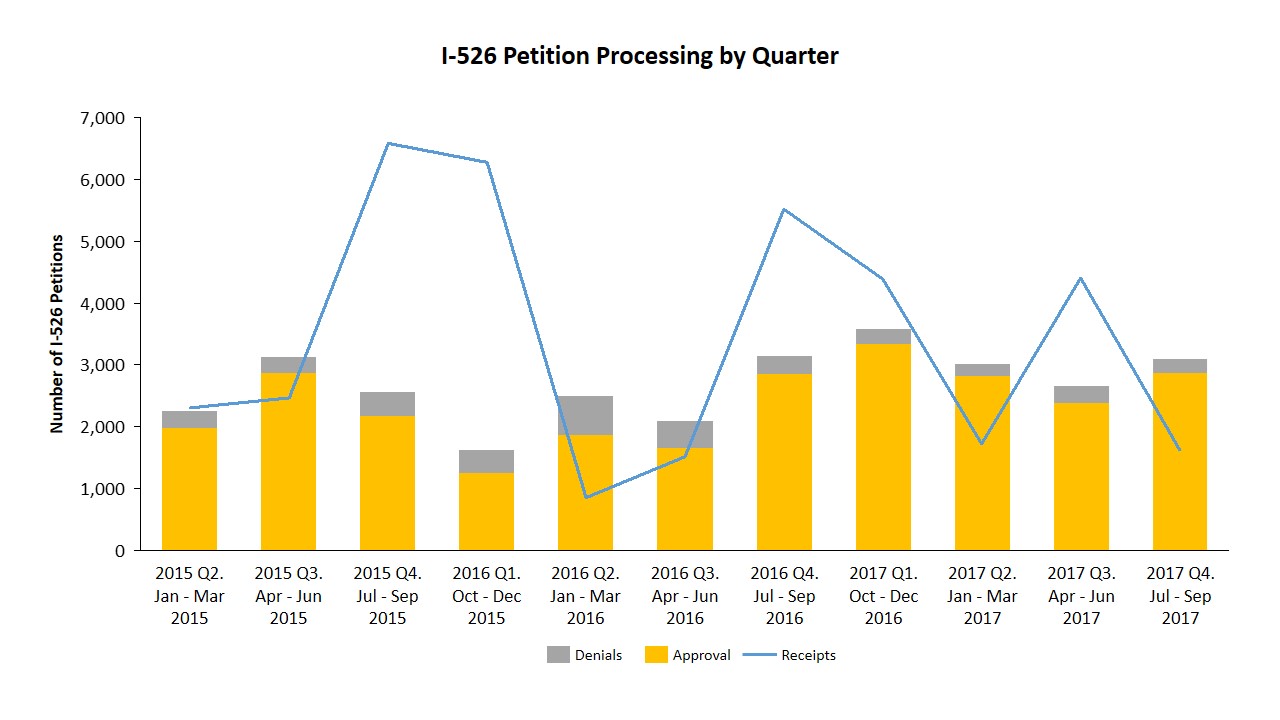
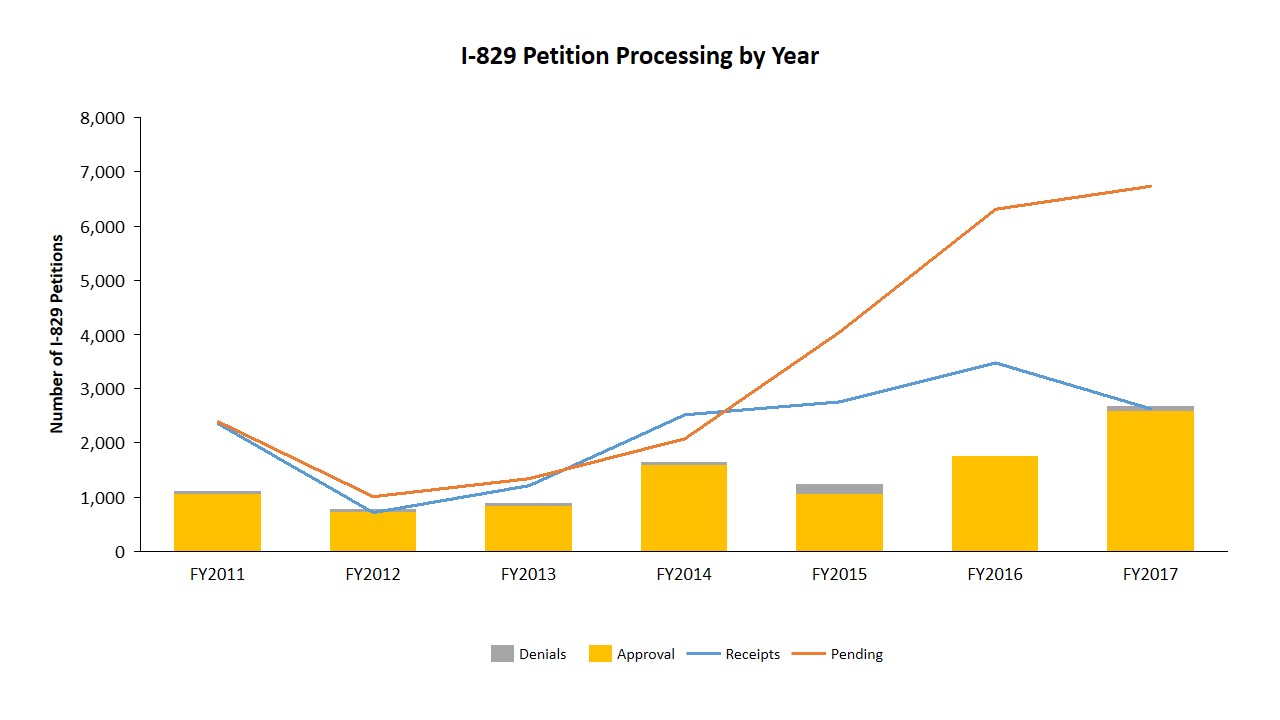
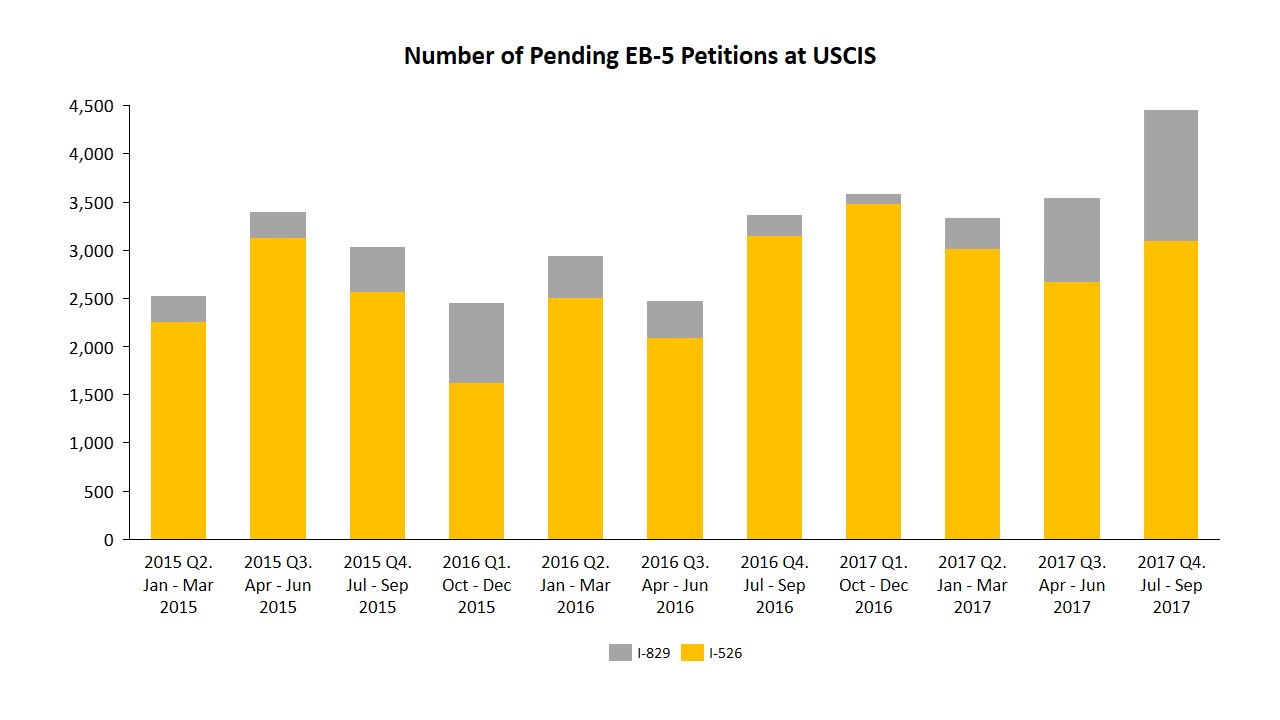
Fortunately, the USCIS Immigrant Investor Program Office (IPO) managed to reduce its backload of I-526 and I-829 petitions by processing more than it received during the 2017 fiscal year. This is the first time it has been able to do this since 2009, and continuing this pattern will hopefully reduce future petition processing times.

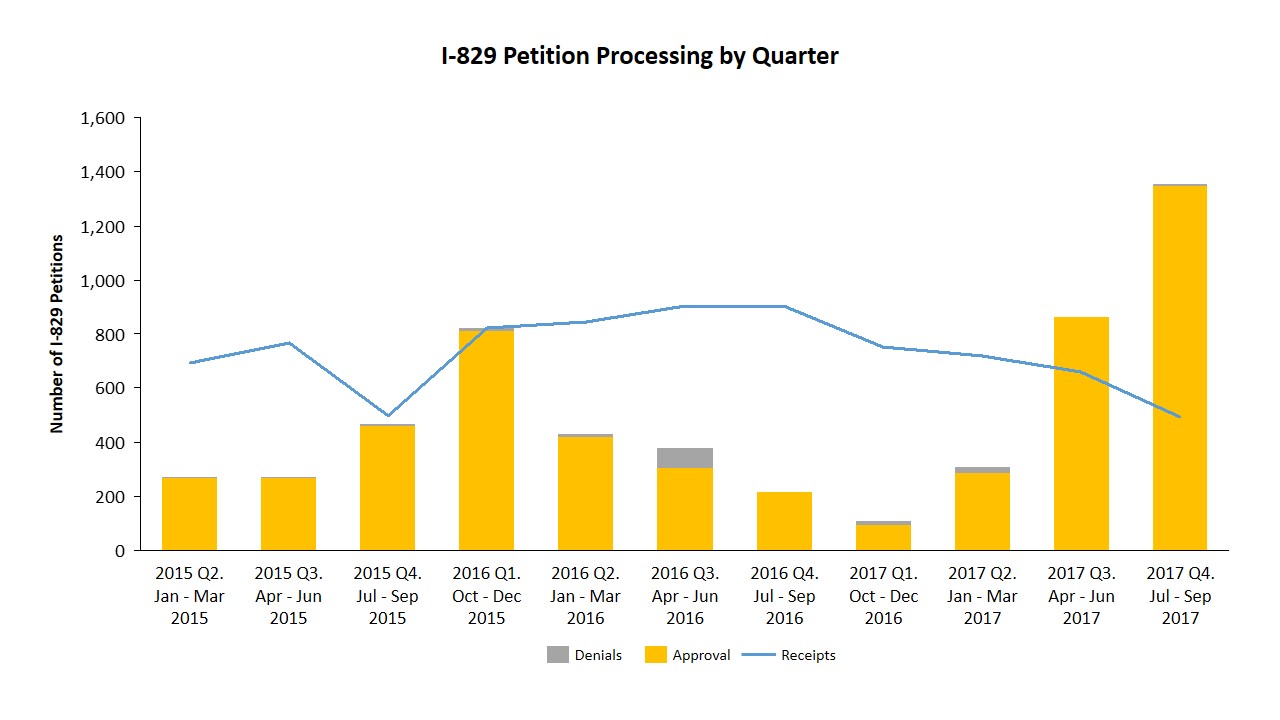
Slide1Slide2Overall, the number of I-526 forms received during the 2017 fiscal year decreased by 14% from the 2016 number, and the number of successfully processed forms increased by 31%. Similarly, 24% fewer I-829 forms were received, and 42% more were adjudicated. Despite the positive changes, the high number of I-526 forms received in 2017 combined with the number of still-pending petitions will take years to process with the current annual immigrant visa issuance limit of 10,000.
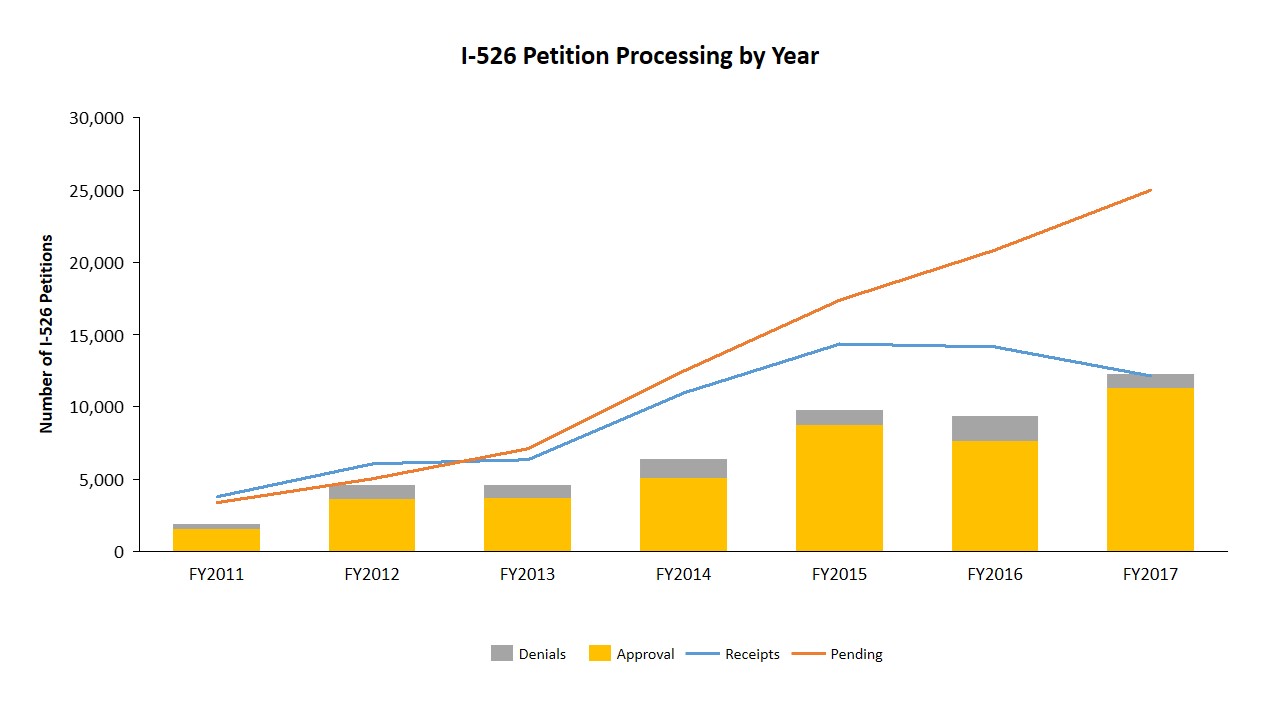
The trend over the four quarters of the 2017 fiscal year is similar to trends of previous years: sudden influxes of petitions correspond with sunset dates for regional center programs.
Despite the continued low rate of denial for I-829 petitions, it appears that fewer people with existing conditional permanent residence are filing the necessary paperwork to finalize the EB-5 process; somewhat unexpectedly, the number of I-829 petitions submitted during 2017 consistently fell each quarter.

While I-526 processing has continuously improved for several years, I-829 processing has not, making its improvement in 2017 much more impressive. In addition, I-829 processing in 2017 consistently improved as the year progressed, which differs from the less predictable quarter-to-quarter trend of I-526 processing.

Slide5Slide4Slide3The expectation is that processing times will continue to improve during the next fiscal year, adhering to the trend of the past five years. IPO is in the process of adding to its staff in its efforts to continue reducing those times.



The updated data report also displays corrected numbers for previous years and quarters, indicating recent improvement in USCIS’s ability to maintain accurate records. However, it is interesting to note that there does still appear to be some discrepancy between the sum of the reported still-pending petitions and processed petitions and the reported number of petitions received, i.e., some petitions appear to be unaccounted for.