



Author Archives: admineb5

Free EB-5 Project Evaluation

How Involved Must an Investor Be in an EB-5 Project?

How-Involved-Must-an-Investor-Be-in-an-EB-5-Project

Foreign nationals who make an EB-5 investment in a qualifying EB-5 project must satisfy numerous requirements to be eligible for U.S. permanent residency, including providing evidence of the lawful sources of their investment capital and ensuring at least 10 new, full-time jobs for U.S. workers are created through their investment. One additional requirement that EB-5 investors must fulfill is proving on their I-526 petition that they will engage to some extent in the management of the new commercial enterprise (NCE).

To what degree must an EB-5 investor engage in the management of the NCE that they invest in? That depends on the EB5 investment pathway the investor has chosen. If an investor invests directly in an EB-5 project, they are typically required to take on a larger role, involving themselves in the daily managerial activities of the NCE. The benefit of this route is that it allows the investor to retain more control over their EB5 investment, making it the optimal pathway for EB-5 investors with significant managerial experience and who place high value on the financial returns on their EB-5 investment.

NCE Engagement in Regional Center Investment

Overwhelmingly, the EB-5 regional center investment route is the more popular way for foreign investors to participate in the EB-5 Immigrant Investor Program. The reasons investors prefer regional center investment are many—from easier job creation requirements to a higher likelihood of finding an EB-5 project in a targeted unemployment area (TEA), regional center investment offers numerous advantages.

One of the most popular incentives of the regional center route is the more passive managerial role investors may take on. Generally, if an investor works with a regional center to pursue an EB-5 visa, they need only join the NCE as a limited partner to satisfy the engagement requirement. As a limited partner, the EB-5 investor is involved in policy formulation and may vote on important business issues, but they do not have to sacrifice significant amounts of time to engagement at the NCE. In fact, an investor may choose to live in an entirely different state from their chosen EB-5 project—it’s possible to invest in an EB-5 project in Florida but live in Hawaii.

Each EB-5 project has its own project documents that lay out the responsibilities and rights granted to EB-5 investors. Investors, whether they’re making an EB-5 investment through a regional center or not, should work with an experienced EB-5 immigration lawyer to verify that the arrangement stipulated in the EB-5 project’s offering documents or agreements meet the EB-5 program requirements for investor engagement.

Whatever an EB-5 investor’s role is in the NCE, they must provide evidence of their involvement in the NCE on their I-526 petition. The I-526 petition is the first form an EB-5 investor files with United States Citizenship and Immigration Services (USCIS), marking their official embarkment toward an EB-5 visa. If USCIS deems the investor to satisfy all the EB-5 requirements, the I-526 petition will be approved, and the investor and their immediate family members may apply for U.S. conditional permanent resident status.


Free EB-5 Project Evaluation

2019 I-526 Adjudicator Retraining Documents Released

I-526-Adjudicator-Retraining-Documents-Released

In September 2020, documentation regarding a May 2019 I-526 “reset training” held by the Investor Program Office for USCIS adjudicators was partially released. The I-526 petition is the form every foreign investor must submit to show they have invested the required capital in an eligible EB5 investment project, either directly or indirectly, through an EB-5 regional center. Documentation must also support that the enterprise will ultimately create the minimum number of full-time jobs required by the EB-5 investment program.

The long-awaited release of this training content comes on the heels of what was initially a Freedom of Information Act request and later a lawsuit due to the agency’s refusal of the request. While the first batch of training materials only amounts to a quarter of the training materials adjudicators were required to cover, 500 pages is certainly a start.

A key sticking point is that the judgment for that FOIA lawsuit only required the documents to be released to the party that filed suit (Invest in the USA, or IIUSA). IIUSA is an EB-5 industry trade association focused on benefiting U.S. workers and their communities (and thus the U.S. economy). Although they are a not-for-profit organization, IIUSA has unfortunately elected to limit access to the reset training materials solely to its members, meaning they are only accessible via the IIUSA Member Portal.

So, what do we know about the materials that have been released so far, and why are they important to EB-5 immigrant investors?

What Important Updates Have Been Released So Far

The first 500 pages of training materials covers quite a bit of ground, beginning with a series of I-526 and I-924 exercises designed to allow adjudicators to practice identifying scenarios in which they should deny deference to previously approved petitions and how to properly request additional evidence for questions surrounding sources and paths of funding. Sections of particular interest for foreign nationals executing an EB-5 investment include new content surrounding the following subject areas:

Why These Materials Are So Important for EB-5 Program Participants

Foreign investors spend years following immigration processes and requirements to enjoy a life in the United States. Training materials like these can provide valuable information for both program participants and the experienced legal teams with which they partner on an EB5 investment. These texts offer guidance, interpretation, and sample scenarios that are not provided anywhere else. Frankly, in the name of transparency, these U.S. government materials are exactly the type of information that should be available to the public at large – or at least to the foreign investors and other immigrants who are affected by any changes in the adjudication process.

While most content in these kinds of updates remains the same, nuances in the way USCIS adjudicators are trained to interpret existing policies and the precedents laid out in the presentations they are given can make a huge difference in the way final decisions on EB-5 investment petitions are reached. Not only do these training materials provide basic outlines of information, but interpreters may also glean additional insights from notable angles, emphasis, and even omissions of previously provided information.

When updates are made, those who prepare documentation for adjudicators’ review should be able to access the standards and perspectives adjudicators are asked to use for the documents. It saves time, energy, and resources not only for the immigrants submitting petitions for their EB5 investment but also for the adjudicators required to analyze them.

Free EB-5 Project Evaluation

October 2020 Visa Bulletin: Final Action Date Stalled for China and Vietnam

October-2020-Visa-Bulletin-Final-Action-Date-Stalled-for-China-and-Vietnam

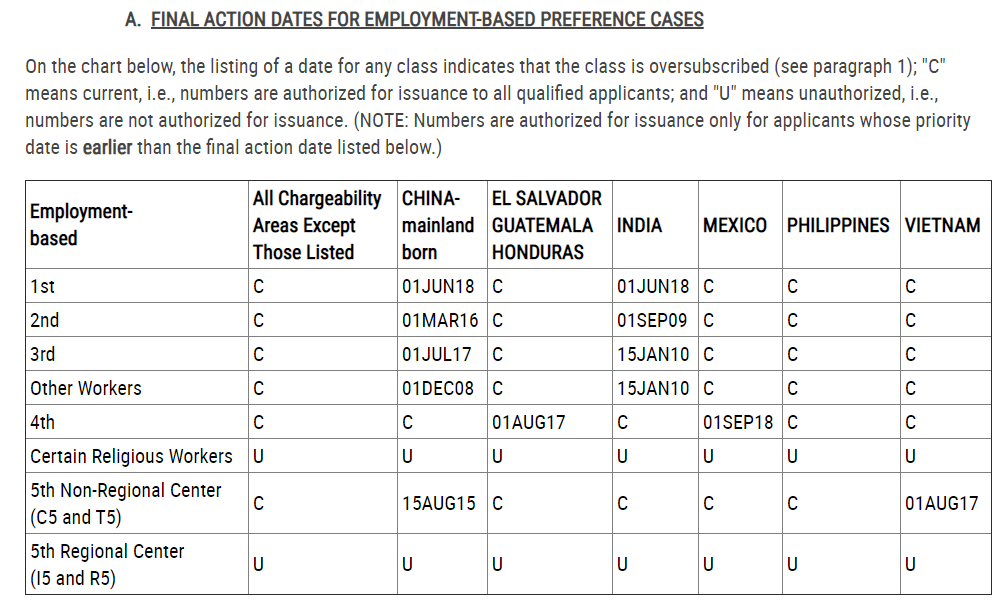
October 2020’s Visa Bulletin brings dismal news to EB-5 investors from China and Vietnam. Investors from the two backlogged countries must face an even longer wait for adjudication on their I-526 petitions, as the final action dates have not budged from the September 2020 Visa Bulletin. This could change dramatically in November 2020: October marks the beginning of FY2021, a year that will see far more EB-5 visas distributed than any year in the EB-5 program’s history since establishment in 1990. Each year, any unused family-based visas roll over to the EB visa category, and since the COVID-19 pandemic effectively halted immigration, a surge of unused family-based visas have been allocated to the EB-5 program in FY2021, putting the total at more than 18,500—nearly double the average annual number.

The Visa Bulletin for October 2020 is also unusual for an additional reason: when it was drafted, the EB-5 Regional Center Program had yet to be reauthorized. The Regional Center Program accounts for the vast majority of those with EB-5 investments, given that regional centers offer numerous advantages, including relaxed job-creation requirements. However, despite its popularity, it is not a permanent United States Citizenship and Immigration Services (USCIS) program, meaning it’s subject to expiration and reauthorization every so often. The program had been set to expire on September 30, 2020, but was reauthorized at the last minute.

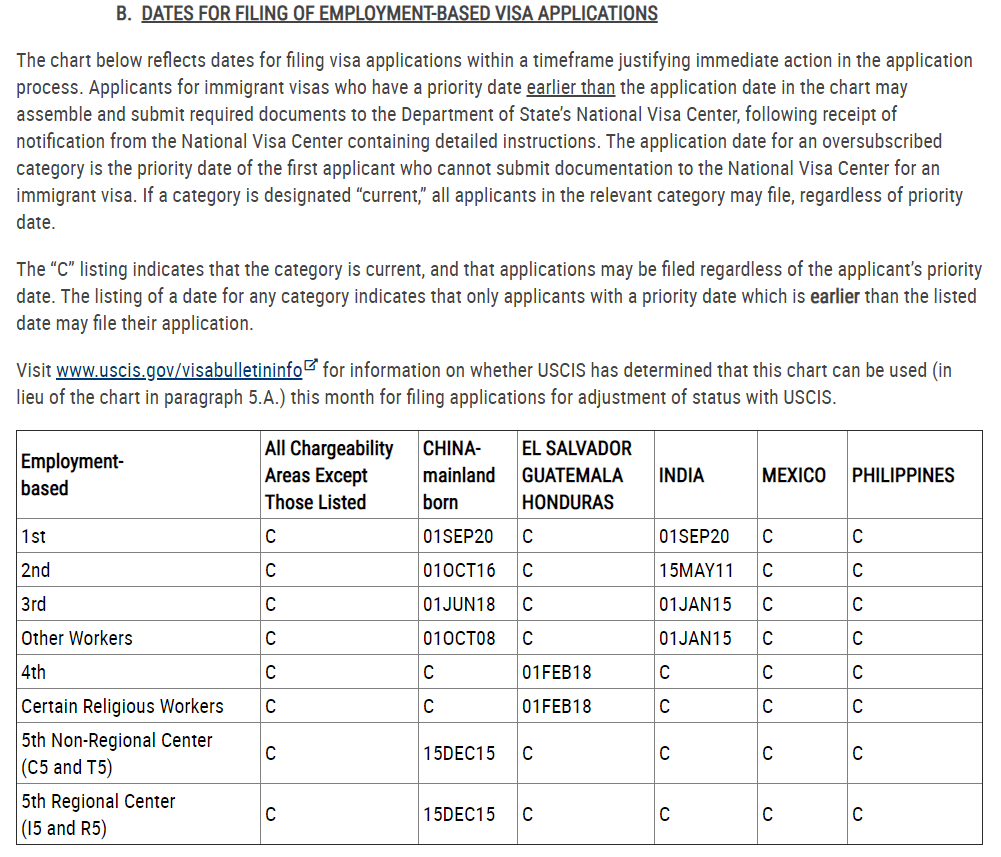
Nonetheless, since the future of the EB-5 Regional Center Program was unknown at the time of publication of the October 2020 Visa Bulletin, all columns in the EB-5 Regional Center category in Charts A and B contain “U,” standing for “unauthorized.” Since the program was indeed reauthorized, investors can assume the final action dates and dates for filing for regional center applicants are the same as those for those with direct EB5 investments.

Final Action Dates

India remains current, having finally achieved the status in July 2020. The situation for Chinese and Vietnamese EB-5 applicants is less sunny: the final action dates for both countries have not moved since September 2020. For EB-5 applicants from China, the final action date is August 15, 2015. For those from Vietnam, it is August 1, 2017. EB-5 investors stuck in the queue will have to wait for November 2020’s Visa Bulletin to see whether the huge increase in available EB-5 visas will help them advance in their EB-5 journeys.

Dates for Filing

For Chinese EB-5 investors waiting to file their application for a U.S. green card, the wait continues. The Chinese date for filing remains December 15, 2015, where it has rested for the better part of a year. However, since the massive uptick in EB-5 visas in FY2021 offers an opportunity for USCIS to reduce the Chinese backlog, those stuck waiting to file may finally see progress in the coming months.

Free EB-5 Project Evaluation

U.S. Government Extends EB-5 Regional Center Program Until December 11, 2020

US-Government-Extends-EB5-Regional-Center-Program-Until-December

Every year, thousands of foreign nationals from around the world pour their dreams—and $1.8 million, or $900,000 if their selected project is in a targeted employment area (TEA)—into the EB-5 Immigrant Investor Program. Since 1990, the program has allowed countless foreign investors to obtain U.S. permanent resident status for themselves, their spouse, and their unmarried children younger than 21, as long as they invest enough money in a qualifying EB-5 project and meet various program requirements, including the creation of at least 10 full-time jobs for U.S. workers.

Program participants can choose to make their EB-5 investment directly in a project or indirectly via an EB-5 regional center. While both pathways, if successful, lead to the same outcome—a U.S. green card—the requirements differ slightly, and both pathways offer different advantages. Those with substantial managerial expertise may prefer to make an EB5 investment directly in a project because it allows them to participate directly in the day-to-day management of the new commercial enterprise (NCE) and exercise more control over their capital.

EB-5 regional center investment is, however, overwhelmingly the more popular option. Not only are regional center EB-5 projects more likely to be in TEAs, qualifying the investor for the lower investment amount of $900,000, but they also generally eliminate the need to be heavily involved in the NCE’s management by simply signing the investor on as a limited partner. Another major benefit of EB-5 regional center investment is softer requirements for job creation—indirect and induced jobs can be counted toward the 10-job requirement.

It is important to note that the EB-5 Regional Center Program is not a permanent program—since its instantiation, it has simply been renewed continually, for varying lengths of time. The EB-5 Regional Center Program was set to expire on September 30, 2020, but as the date approached, most EB-5 participants weren’t concerned—historically, the program has always been renewed.

Spending Legislation Passed by the House

On September 22, 2020, the House overwhelmingly passed a continuing resolution in a bipartisan vote. Called H.R. 8337, the Continuing Appropriations Act, the bill dealt with continuing government funding for a variety of critical government programs, including the EB-5 Regional Center Program. The legislation also encompassed the Emergency Stopgap USCIS Stabilization Act, which proposed expanding premium processing fees for some types of immigration. Such fee hikes are necessary to help United States Citizenship and Immigration Services (USCIS) stay afloat during a difficult time in which immigration has been largely halted due to the COVID-19 pandemic. USCIS already narrowly avoided a massive furlough in August 2020, scraping by thanks to reduced expenditure and increased revenue and receipts.

EB-5 Regional Center Program Extended to December 11, 2020

Late September 30, 2020, President Trump finally signed the continuing resolution the House had passed a week earlier in an overwhelming bipartisan victory. With that, several government programs were extended until December 11, 2020, including the EB-5 Regional Center Program. The passing of this bill allows the government to skirt a shutdown, which could be disastrous during a time of crisis catalyzed by the COVID-19 pandemic.

EB-5 investors and regional center managers may now breathe a sigh of relief, expected as this extension may have been. Come December 2020, investors, project developers, regional center owners, and others involved in EB-5 investment should tune into the latest EB-5 news to see whether the EB-5 Regional Center Program will be extended once again.

Free EB-5 Project Evaluation

Huge Uptick in EB-5 Visas Available for FY2021

Huge-Uptick-in-EB5-Visas-Available-for-FY2021

The COVID-19 pandemic has devastated the world, crippling economies, destroying livelihoods, and wreaking havoc on people’s physical and mental health alike. The EB-5 Immigrant Investor Program has not escaped the virus’s wrath, with thousands of investors unable to proceed with their EB-5 journey due to the temporary suspension of routine visa services at U.S. embassies and consulates.

However, the impact of the pandemic on EB-5 investors is not all negative—in fact, in certain ways, it has provided important advantages for those who have made EB-5 investments. From more EB-5 visas for investors from backlogged countries to a lower risk of EB-5 capital redeployment, for certain investors, it’s a good time to have an active EB5 investment. Investors with pending I-526 petitions or those with I-526 approval awaiting their visa interview are also in luck going forward: the number of available EB-5 visas for FY2021 has skyrocketed.

Annual Distribution of EB Visas

At the beginning of each fiscal year—October 1—United States Citizenship and Immigration Services (USCIS) earmarks a certain number of visas for the five EB programs. The EB-5 program, which has fifth-place preference, receives 7.1% of those visas. Typically, that results in around 10,000 EB-5 visas per year, which is generally enough to cover roughly 3,000 investors every year, considering that the majority also apply for EB-5 visas for their spouse and dependent children.

However, thanks to the wide-ranging effects of the COVID-19 pandemic and the subsequent lockdowns, FY2021 is different. Though the pandemic limited the number of EB-5 visas granted throughout FY2020, it also halted family-based immigration, and each fiscal year, any unused family-based visas from the previous year are rolled over to employment-based visas. In the average year, around 140,000 visas are made available through EB programs. In FY2021, the figure has almost doubled to 261,500. Of that, 7.1% is allocated to the EB-5 program, representing a visa budget of about 18,556 EB-5 visas.

Major Benefits to Chinese EB-5 Investors

While the huge increase in EB-5 visa allowance in FY2021 benefits everyone pursuing an EB-5 investment, it’s particularly beneficial to Chinese and Vietnamese EB-5 investors, who, as of October 2020, are the only foreign nationals subject to EB-5 backlogs. Due to the addition of Hong Kong EB-5 investors to the Chinese queue, the backlog has grown even larger, making the news of extra EB-5 visas even more welcome to Chinese EB-5 investors.

Every year, countries are entitled to up to 7% of the total number of EB-5 visas for the fiscal year. Since the number of available EB-5 visas has jumped so sharply in FY2021, so too has the number of visas available to a single country, increasing from roughly 700 to roughly 1,300. Furthermore, since USCIS estimates the number of pending I-485 petitions and documentarily qualified EB-5 visa applicants is significantly lower than 261,500, EB-5 investors can expect a large number of otherwise unclaimed EB-5 visas to be dished out to Chinese investors waiting in a several-year backlog. FY2021 is USCIS’s opportunity to dramatically reduce EB-5 backlogs, and it may be a great year for Chinese EB-5 investors, notwithstanding the switch to a visa availability processing approach in April 2020, which has, as of October 2020, negatively affected only investors from China.

Free EB-5 Project Evaluation

Filing a Writ of Mandamus to Force USCIS to Adjudicate an EB-5 Petition

Filing-a-Writ-of-Mandamus-to-Force-USCIS-to-Adjudicate-an-EB5-Petition

The long processing times for EB-5 petitions at United States Citizenship and Immigration Services (USCIS) are no secret. EB-5 investors regularly have to wait years—as many as five for those from severely backlogged countries such as China—and as of October 2020, USCIS gives little indication of processing times decreasing. Besides the missed opportunity costs of delaying their new life in the United States, EB-5 investors face various downsides due to USCIS’s long processing times, including the possibility of their dependent children marrying and thus losing eligibility for a U.S. green card.

What can someone with an active EB-5 investment do if USCIS is taking an excessively long time to adjudicate their I-526 petition? Recourse for EB-5 investors stuck in USCIS processing limbo is limited—filing a case inquiry is possible but only if the petition was filed before USCIS’s date for case inquiry, which is displayed alongside USCIS’s estimated case processing time ranges. However, the listed date for case inquiry is so far back that it hardly encompasses any investors, virtually rendering it useless.

Filing a Writ of Mandamus

USCIS’s broken case inquiry system leaves filing a writ of mandamus as the only really viable course of action to force USCIS to adjudicate a pending petition. In the EB-5 context, a writ of mandamus is an order for USCIS to adjudicate a given I-526 or I-829 petition. EB-5 investors must be aware of the inherent danger of forcing USCIS to immediately adjudicate a petition: if there is insufficient or inconsistent information in the petition, USCIS will reject it rather than send a request for evidence (RFE), which offers an investor a second chance to salvage their EB-5 dreams.

Filing a writ of mandamus should be a last-resort measure in cases of excessively long wait times because it’s an expensive, risky endeavor that certainly doesn’t guarantee EB-5 success. Any EB-5 investor who feels that filing a writ of mandamus may be the right step for them is encouraged to consult their EB-5 immigration lawyer to review their situation and determine whether it’s a good idea. Additionally, EB-5 investors from backlogged countries—as of October 2020, China and Vietnam—must also keep in mind the naturally longer waiting times they must incur as a result of the high EB-5 demand from their country.

Precedent for Success in USCIS EB-5 Lawsuits

EB-5 investors may be concerned about filing a lawsuit against USCIS if their petition is still listed within the estimated processing time range. After all, USCIS can argue that their normal, or average, processing times are “reasonable.” However, two lawsuits against USCIS—Raju et al v. Cuccinelli and Keller Wurtz v. USCIS—show that judges disagree.

Together, the lawsuits included 11 EB-5 investors who had filed their I-526 petitions between 22 months and 29 months prior to the lawsuit date. Based on USCIS’s estimated processing time range, it’s far from abnormal to not receive an adjudication in such a time period, so by EB-5 standards, these investors were not facing excessively long wait times.

Indeed, USCIS chose to argue that delays of up to four years were “reasonable.” As evidence, they referenced their estimated case processing time ranges, which at the time spanned from 29.5 to 74.5 months (2.5 to 6.2 years). In both cases, the judges sided with the investors, arguing that the fact that USCIS takes just as long or longer to adjudicate other I-526 petitions does not prove that the waiting times are indeed “reasonable.” In this way, the judge essentially ruled that most of USCIS’s EB-5 adjudications are made with unreasonable delays.

Both judges also referenced the congressional decree that immigration applications should generally be processed in no more than 180 days. They argued that “reasonable processing times” should be counted in weeks or months, not years, and thus both lawsuits ended in victory for the EB-5 investors.

USCIS Already on Shaky Ground

These two defeats in court only add to USCIS’s hardships in 2020. Barely staying afloat financially, in August 2020, the immigration agency already narrowly avoided carrying out a major furlough where around 70% of its employees would have lost their jobs. Thousands of USCIS employees managed to hold onto their jobs thanks to reduced spending and upticks in revenue and receipts, but the longevity of these measures is unknown. The immigration body proposed filing fee increases for certain immigration petitions, including the I-526, I-829, and I-485 petitions, but the legislation was enjoined on September 29, 2020, costing USCIS millions in lost funds each day the proposal is enjoined.

Now, with the ruling of these two lawsuits USCIS may be forced to adjudicate EB-5 petitions faster. USCIS’s already unreasonably long processing times have only increased in 2020, with the agency citing the effort and changes made to avert the August 2020 furlough as reasons for further delays. However, the agency may have no choice but to straighten itself out and get to work on EB-5 petitions—the precedent set by the successes of these two lawsuits may inspire more applicants with active EB5 investments to file a writ of mandamus, and if judges continue to side with the investors, USCIS will find itself in hot water.

Free EB-5 Project Evaluation

USCIS Fee Increase Averted

USCIS-Fee-Increase-Averted

2020 has been a rocky year for just about everyone, individuals and organizations alike, and United States Citizenship and Immigration Services (USCIS) has suffered significantly due to the lull in immigration spurred on by the COVID-19 pandemic. Family-based visa processing has been largely suspended, President Trump’s immigration ban on most types of employment-based immigrants has slowed down immigration to the United States, and fear, travel restrictions, and scarcely available flights have curbed tourism. Against this background, it’s no wonder that USCIS, which largely funds its operations through filing fees, has been struggling to stay afloat.

In August 2020, fears of a massive USCIS furlough, which would see 70% of its staff let go, were rampant among U.S. immigration professionals and prospective immigrants. With only 30% of its workforce left, the immigration body would hardly have had the resources to continue adjudicating EB-5 petitions, such as Form I-526. Fortunately, to the relief of EB-5 investors everywhere, USCIS managed to narrowly avoid the scheduled furlough by cutting expenses and upping revenue and receipts. How long the agency can continue to avoid such dramatic measures is unknown.

To address its financial woes, in August 2020, USCIS announced the August 2020 Final Rule, which included plans to increase the filing fees of certain petitions, set to go into effect on October 2, 2020. Fees for forms I-526 and I-829, filed by those who make an EB-5 investment, were set to increase by $335 and $150, respectively, and fees for Form I-924, filed by those who wish to launch an EB-5 regional center, were supposed to jump up by a whopping $1,430.

August 2020 Final Rule Enjoined

On September 29, 2020, a district court enjoined the August 2020 Final Rule, preventing it from being implemented. Thus, USCIS filing fees did not increase as planned on October 2, 2020. While this may initially come as a relief to those planning to make an EB5 investment, it could spell a disastrous future for the immigration body.

USCIS Deputy Director of Policy Joseph Edlow warned the enjoinment could have grave consequences for USCIS and the future of U.S. immigration. Each day the fee hike is enjoined, USCIS loses millions of dollars, which may trigger a furlough like the one averted in August 2020. USCIS funds itself primarily through filing fees, and every two years, the organization conducts a fee review to determine whether the fees need to be adjusted and by how much. Thus, Edlow stressed, the fee increase is completely normal. In fact, USCIS is behind in its biennial fee reviews, and the proposed fee increases are smaller than they have been in previous years. Blocking the fee hike from taking place could harm USCIS’s long-term endeavors and is overall bad for the United States and its development.

In lieu of the proposed fee hike, USCIS is now obligated, under the new Continuing Appropriations Act, 2021 and Other Extensions Act (H.R. 8337), to increase premium processing fees. The legislation was signed into law on September 30, 2020, and covered the extension and funding of various government programs, including the EB-5 Regional Center Program. USCIS also has the option of adding more premium fees, but whether the organization will do so is as of October 6, 2020, unknown. Either way, EB-5 investors are not included in any of the listed case types for premium fees, so any changes to premium fees are not likely to affect EB-5 investors.

Free EB-5 Project Evaluation

COVID-19 Highlights the Importance of Due Diligence in Selecting an EB-5 Project

Hardly anywhere on the planet has been left unaffected by the COVID-19 pandemic, and unfortunately, the United States has not emerged unscathed, either. Millions have lost their jobs, numerous companies have gone out of business, and countless livelihoods have been lost. Industries across the country have endured financial hardship, resulting in furloughs, loan defaults, and more. EB-5 investors have had their lives in the United States delayed due to worldwide closures of U.S. embassies and consulates.

Given that the majority of countries shut their borders and requested—in some cases, demanded—that their populace stay home, industries such as hospitality, travel, and tourism have borne the brunt of the pandemic’s financial impact. Even as countries open up domestically, many touristic businesses continue to suffer without the revenue of foreign tourists, crippling their organizations. Hotels, tourist attractions, and other travel-related enterprises are suffering, including EB-5 projects in these industries. The COVID-19 pandemic has been an unforeseen disaster, and those who made an EB5 investment in the hospitality sector are paying the price.

Of course, it’s not only the tourism industry that’s hurting in the COVID-19 era—countless types of businesses have suffered economic hardships throughout these trying times. The struggling economy only serves to highlight the importance for EB-5 investors to conduct thorough due diligence on EB-5 projects, project developers, and regional centers before committing to ensure they’re investing in a strong enterprise that can withstand economic uncertainty.

What to Look For in an EB-5 Project Developer and Regional Center

These tips come too late for those who have already made an EB-5 investment in a project that has fallen victim to the COVID-19 pandemic, but it’s important for prospective EB-5 investors to exercise vigilance going forward—even after the pandemic. The pandemic has proven anything can happen, so it’s crucial to be prepared for the unexpected.

In conducting due diligence, it’s important to consider two factors: financial risk and immigration risk. Most EB-5 investors are primarily interested in gaining U.S. permanent resident status for themselves and their immediate family, so they place more value on low immigration risk and are willing to incur higher financial risk. However, if earning a lucrative gain on your EB5 investment is important to you, be sure to consider the financial risk of any prospective EB-5 project as well.

When evaluating a project developer or EB-5 regional center to determine whether you should invest your $1.8 million—or $900,000 for targeted employment area (TEA) projects—you should keep various factors in mind. Your job is to figure out whether the entity is financially strong enough to carry itself through economic hardship—such as a once-in-a-century global pandemic. Verify that the entity has access to additional cash equity infusion and does not rely solely on EB-5 investors. Another important question to consider is whether the project developer or regional center has ever defaulted on a loan.

Also vital is a strong management team of seasoned professionals with the long-term picture in mind and a track record of previous EB-5 successes. Without strong leaders backed up by years of experience heading the charge, any organization is at risk of failure, especially during uncertain times. EB-5 experts such as those at EB5AN, who boast extensive experience in finances, project development real estate, the EB-5 program, and more, can help a project navigate unstable economic cycles and achieve long-term success.

EB5AN and Kolter: The Ideal EB-5 Team

EB5AN is one of the leading EB-5 networks, offering consultancy services and operating a many EB-5 regional centers across the country, offering coverage in more than 20 states. As serial EB-5 regional center founders, the professionals on the executive team are extensively experienced in the EB-5 program and have already helped thousands of foreign nationals attain U.S. green cards for themselves and their family members through an EB-5 investment.

Despite the challenges presented by the COVID-19 pandemic, EB5AN’s many EB-5 regional centers and the projects they oversee with the Kolter Group have continued to function properly, with EB5AN reporting that as of April 15, 2020, all projects continue to make their debt service payments as required. Though the pandemic has revealed many poorly equipped EB-5 project developers and regional centers, EB5AN and the Kolter Group are not among them—they have demonstrated financial and managerial strength and resilience and have kept their EB-5 investors’ dreams of a life of freedom in the United States alive.

EB5AN and Kolter Group represent the ideal EB-5 team—strong, resilient organizations comprised of experienced professionals with the business know-how to thrive even in economic hardship and the EB-5 expertise to safeguard investors and their EB-5 applications even throughout times of difficulty. EB-5 investment post-pandemic should be more straightforward, but always be prepared for the worst—anything could happen at any time, and meticulous due diligence can help protect your investments in the United States.

Free EB-5 Project Evaluation

Student Visa Proposed Rule Change Shines a Light on the Educational Benefits of the EB-5 Program

Student-Visa-Proposed-Rule-Change-Shines-a-Light-on-the-Educational-Benefits-of-the-EB-5-Program

The Department of Homeland Security (DHS) has announced a new proposed rule change that would negatively affect the over one million international students currently in the United States. The Notice of Proposed Rulemaking; Establishing a Fixed Time Period of Admission and an Extension of Stay Procedure for Nonimmigrant Academic Students, Exchange Visitors, and Representatives of Foreign Information Media would replace a proven, flexible policy that brought millions of international students to the United States along with billions of dollars to the economy.

Studying in the United States has always been a dream of foreign nationals worldwide because of the exceptional post-secondary academic institutions, cutting-edge technology, and the freedom to share thoughts and ideas.

The current policy which has been in effect for decades, states that student visas are good for “duration of status,” which means students can stay in the U.S. indefinitely if they remain enrolled in school and comply with the terms and conditions of their immigration status.

Under the proposed rule, the DHS would set fixed terms of up to four years for student visas and all international students who wished to continue their studies beyond their authorized term would be required to file for an extension directly with U.S. Citizenship and Immigration Services (USCIS) or depart the country and reapply for admission with U.S. Customs and Border Protection (CBP). Students from countries with high visa overstay rates (greater than 10% for student and exchange visitors) and those who were born in or have citizenship from countries on the State Sponsors of Terrorism list will be limited to an initial two-year fixed period of stay in order to enhance monitoring, deter immigration violations, and encourage timely departure, the official statement said. Applications for extensions of stay could be approved “if the additional time needed is due to a compelling academic reason, documented medical illness or medical condition, or circumstance that was beyond the student’s control,” but the grounds for an extension are very limited.

According to the Trump administration, “this proposal would provide the DHS with additional protections and mechanisms to exercise the oversight necessary to vigorously enforce our nation’s immigration laws, protect the integrity of these nonimmigrant programs, and promptly detect national security concerns.”

Instead of worrying if or when this proposed rule goes into effect, there is currently a better and more flexible option—The EB-5 Immigrant Investor Program. The EB-5 Program offers foreign investors with the required capital a simple path to a U.S. Green Card and permanent residency. One of the many benefits of obtaining a green card is that permanent residents have a greater chance of being accepted to U.S. colleges and universities. With competition for international student spots at U.S. universities increasing, applying as a domestic applicant increases a student’s chance of admission by 350%. Additionally, green card holders can significantly lower tuition costs by qualifying for in-state college tuition, financial aid, and scholarships. Permanent residents also don’t have to worry about completing their studies in four years or less before being sent back home—because they are home.

By using gifted funds from family, an international student interested in pursuing an undergraduate or graduate degree can invest in his or her dream of a first-class education in the best university system in the world through the EB-5 Program. The program is open to anyone who can meet its requirements—investing $900,000 or $1.8 million in a new commercial enterprise, with the investment creating 10 full-time, permanent jobs for U.S. workers. Applicants don’t need to be sponsored by a U.S. employer, and they don’t need any specific knowledge, skills, or experience.

The value of a U.S. post-secondary education is multifaceted and cannot be overstated. It can be a life-changing experience for students from all over the world and will put them on the right path to professional success. An investment in the EB-5 Immigrant Investor Program is an investment in the future.

Free EB-5 Project Evaluation

Common Reasons for EB-5 Petition Denial


EB-5 investors who conduct proper due diligence are generally successful. Indeed, most EB-5 investors end their EB-5 journey by obtaining U.S. green cards for themselves and their immediate family members. That being said, each year, some EB-5 investors face denial, halting their dreams of a better life in the United States.

The reasons an EB-5 petition may be denied are manifold, but some are more common than others. Below are a few of the most common reasons EB-5 investors have their petitions rejected.

Investing less than required or investing in an ineligible project

The minimum required EB5 investment amount is $1.8 million, although this drops to $900,000 if the project is in a targeted employment area (TEA). If an EB-5 investor fails to invest the minimum required amount, their I-526 petition will be denied.

It’s also crucial to invest in a project that qualifies for the EB-5 program and, if you’re investing through an EB-5 regional center, to conduct thorough due diligence to ensure you work with a highly reputable developer and regional center. In 2019 and 2020, regional center terminations have skyrocketed, putting investors who fail to carefully vet regional centers before diving into an investment at risk.

Willfully misrepresenting information in an EB-5 application

Even if an EB-5 investor feels inclined to skew the facts to produce a better-looking application, they must resist the urge. If they intentionally misrepresent any material facts or otherwise submit a fraudulent EB-5 application, they may be permanently prohibited from obtaining a U.S. green card and may even be barred from entering the United States.

Not providing accurate or consistent information

It’s crucial to ensure the information an investor includes on their I-526 petition is as accurate as possible. Investors should collaborate with an experienced EB-5 immigration lawyer to gather all the necessary documentation and compile a suitable I-526 petition. Investors are also advised to double- and even triple-check all the information in their petition before filing it. While inconsistent information may lead to a request for evidence (RFE) rather than a denial, it’s best to prepare well in advance to avoid any delays.

One aspect of the I-526 petition that’s particularly tricky is the source-of-funds requirement. All EB-5 investors must demonstrate that their investment capital derives from lawful sources, but depending on the source of their funds, this can be a difficult and time-consuming endeavor. On the I-829 petition, filed later in the EB-5 process to remove the conditions of the investor’s permanent resident status, an investor must provide evidence that their EB-5 investment has remained “at risk” for the duration of the investment period, which is another area where meticulous care is warranted.

Children aging out or getting married

With an EB5 investment, a foreign national can secure a U.S. green card not only for themselves but also for their spouse and children. However, the ability to add children to one’s EB-5 application is contingent on the child being younger than 21 and unmarried, and the long wait times associated with the EB-5 program, especially for investors from backlogged countries, can complicate familial immigration matters.

For the purposes of immigration, the ages of dependent children of EB-5 investors are frozen until I-526 approval is granted, which means a child aged 21 or older may still be eligible for an EB-5 green card as long as they were younger than 21 when the I-526 petition was filed. However, in the case of delays in receiving a visa appointment—such as the closure of U.S. embassies and consulates due to a global pandemic—children are not protected from aging out. Similarly, the longer investors must wait for EB-5 approval, the higher the likelihood that a child will marry and become ineligible.

The ineligibility of a child won’t cause USCIS to deny the investor’s EB-5 petition for the entire family, but the child in question will not be qualified to receive permanent resident status in the United States, so it’s important for families to make careful considerations regarding their children.

Other reasons for denials

EB-5 investors may face denial for any number of other reasons as well, including health reasons, previous criminal convictions, or security-related concerns. EB-5 investors can get a more comprehensive idea of the reasons for potential denial on the U.S. Department of State – Bureau of Consular Affairs website.

What do you if you receive a denial?

Having your EB-5 petition denied is disheartening, but depending on the reason, it doesn’t necessarily mean your EB-5 dreams are over. USCIS should specify the reasons for denial, giving the investor a clear picture of the situation and what they did wrong (if anything). EB-5 investors still have various options, including filing an appeal or seeking alternative immigration pathways, if their EB-5 petition is denied. Consult an experienced immigration attorney to determine the best solution for you.