



Author Archives: admineb5

Free EB-5 Project Evaluation

Switching from an E-2 Visa to an EB-5 Investment Visa

Switching-from-an-E2-Visa-to-an-EB5-Investment-Visa

A life in the United States is highly sought after among foreign nationals around the world. For foreign investors and entrepreneurs, there exist multiple pathways to gain residency in the world’s largest economy, each with its own pros and cons. Two popular U.S. immigration programs for foreign investors and entrepreneurs include the E-2 visa program and the EB-5 Immigrant Investor Program. Prospective immigrants should consider their individual situation and determine whether the E-2 program, the EB-5 program, or a combination of both is the best route for them.

EB5AN collaborated with Beshara Global Migration Law Firm to present a webinar on making the switch between these two visas and how to make an EB-5 investment by installments. Watch the webinar on YouTube, download the PDF slides of the presentation, or read on to learn more about the process.

The E-2 Visa

The E-2 program is open to entrepreneurs from specific treaty countries to looking to temporarily operate a business in the United States. The visa is valid for two years but may be renewed indefinitely, and spouses and dependent children are also eligible for status. Spouses may apply for work permits within months, but while dependent children may qualify for better chances in college admissions and in-state tuition savings, they cannot apply for work permits.

The E-2 program does not entail any minimum required investment amount, although $200,000+ is often cited as a general recommendation. What the program does require is that the investor owns at least 50% of the investment business. The investor may launch the business themselves or acquire an existing business—all that matters is that they own at least 50% of the business entity. If the primary purpose for purchasing a business is the opportunity to live in the United States, the investor may set up the terms of purchase such that it is only executed if their E-2 visa is approved.

For many prospective investors, the most significant obstacle of the E-2 program is the nationality restriction. Only investors from 81 treaty countries may participate in the program, closing the doors to countries with massive populations and high demand, such as China, India, and Vietnam. Fortunately, there is a solution: Some treaty countries, such as Grenada, offer quick citizenship-by-investment programs.

The EB-5 Visa

The EB-5 Immigrant Investor Program grants U.S. permanent resident status to foreign investors who inject $1.8 million into a qualifying EB-5 project, with the minimum required investment amount dropping to $900,000 if the project is in a targeted employment area (TEA). Permanent resident status is also available to an investor’s spouse and dependent children and comes with a myriad of benefits, including the right to live indefinitely in the United States and work, study, and travel anywhere in the country.

To participate in the EB-5 program, an investor must demonstrate to United States Citizenship and Immigration Services (USCIS) that their investment capital was derived from lawful sources and that they themselves have a clean criminal record. Permanent resident status is initially granted on a two-year conditional basis, and investors can remove the conditions after the two-year investment period if they can prove that their EB-5 investment funded the creation of at least 10 new full-time positions for U.S. workers.

The new commercial enterprise (NCE) into which the EB5 investment capital is injected may be the investor’s own business or a third-party entity—as long as the funds have been lawfully sourced, remain at risk for the duration of the investment, and create the required 10 jobs, the investor and their family are eligible for EB-5 visas.

Converting an E-2 Visa to an EB-5 Visa

For some foreign nationals, the best option may be to combine these two immigration pathways. One key advantage of the E-2 visa is the fast processing times—typically, E-2 petitions are adjudicated within just three months. Given that the average processing time for the EB-5 program is around two years—and even longer for investors from backlogged countries—the E-2 program enables a must faster relocation to the United States.

The first step is to obtain an E-2 visa, which can be completed in a matter of months (a bit longer if the investor must acquire a new citizenship first). Once the investor has settled in the United States and their E-2 business has been operating for at least a year, they may then invest additional funds into the business to meet the EB-5 minimum required investment amount or, alternatively, make an EB-5 investment in a separate business.

To qualify for a green card, the EB5 investment must create 10 new full-time jobs. If the investor is investing in their own business, they may expand their hiring timetable to account for these 10 new positions or partner with an EB-5 regional center to count indirect and induced jobs toward the requirement. Those who opt for the “separate business” route may choose to either directly manage the EB-5 investment or passively invest through an EB-5 regional center, but both options are open to regional center affiliation to reduce immigration risk and relax the job creation requirements.

Partial EB-5 Investments

It is still possible to make an EB5 investment even if an investor doesn’t have the entire $1.8 million or $900,000 available in liquid capital. In such cases, the investor may invest a portion of the EB-5 capital and present a promissory note with a pledged security interest covering the remaining investment funds. The investor then makes installment payments on the rest of the capital, with the note holder retaining the right to force the liquidation of asset in the event of failure to inject the full EB-5 capital amount.

With this setup, a foreign investor can easily obtain an E-2 visa and begin their life in the United States and then switch to an EB-5 investment to attain permanent resident status and stay in the United States indefinitely. The EB-5 program also opens the door to naturalization, as foreign nationals may apply for U.S. citizenship after five years of permanent residency.


Free EB-5 Project Evaluation

Proving the Lawful Sources of Funds for “Currency Swap” EB-5 Investments

Proving-the-Lawful-Source-s-of-Funds-for-Currency-Swap-EB5-Investments.jpg

One of the many requirements the EB-5 Immigrant Investor Program imposes upon those who make an EB-5 investment, the obligation to prove the lawful source of funds of the full EB-5 investment has long represented one of the most challenging aspects of an EB-5 investor’s I-526 petition. While EB-5 investors can use EB-5 investment capital derived from any number of sources, whether employment income, funds derived from the sale of assets, or gift money from parents, the need to document its legality remains consistent. Depending on the source, this requirement can be difficult and time-consuming to fulfill.

Then, on top of the onerous task of carefully documenting the lawful sources of all $1.8 million ($900,000 for targeted employment area, or TEA, projects) in EB5 investment capital, investors from certain countries may have an additional source-of-funds burden thrust upon them. Certain countries, often in Asia, the Middle East, and Africa, impose restrictions on the transfer and handling of U.S. dollars within their jurisdiction, with some countries even ruling it illegal to purchase U.S. dollars. Notably, China, Vietnam, and India—the top three nations in terms of EB-5 demand, as of October 2020—all impose some level of restrictions on the transfer of U.S. dollars.

EB-5 Currency Swaps

To bypass the restrictions on U.S. dollars in their home countries, EB-5 investors have taken to engaging in “currency swaps” to invest their capital in a qualifying EB-5 project. The process is straightforward: the EB-5 investor transfers the equivalent of $1.8 million or $900,000 in their local currency to a third-party intermediary, and upon receipt of the transfer, the intermediary transfers the amount in U.S. dollars to the designated escrow account of the EB-5 investor’s project. The problem is that, in 2016, after years of implicitly understanding that a currency swap is the only means many foreign nationals have to make an EB5 investment, United States Citizenship and Immigration Services (USCIS) began to issue requests for evidence (RFEs) demanding that investors provide lawful source-of-funds documentation for the intermediary’s U.S. dollars.

The ease of documenting the legal sources of third-party currency swap dollars depends on the type of currency swap that has occurred. Currency swaps can largely be broken down into three overarching categories:

  • A currency swap with an individual personally known to the investor, such as a relative or friend
  • A currency swap through a company acting as a licensed money exchanger
  • A currency swap with an individual or company not personally known to the investor and not licensed as a money exchanger but who agrees to exchange the capital for a fee

Currency Swaps Through a Known Individual

The first type of currency swap is common among EB-5 investors from China and entails the investor asking a relative or friend with U.S. dollars outside of China to accept their payment of an equivalent amount in yuan and transfer the necessary capital in U.S. dollars to the designated escrow account. If an investor receives an RFE requesting documentation of the legality of the third-party individual’s U.S. funds, they are typically required to prove either how the person earned the U.S. dollars in the third country or how they earned the money in the restricted country and then transferred it to the third country.

Generally, USCIS requests employment records and tax returns from the third party, as well as bank statements from the investor showing the transfer of their local currency to the third party. At the very least, USCIS requires evidence of the third party’s employment. If the friend or family member agrees to provide their personal information and funds documentation to USCIS, the investor is usually approved, assuming no other problems with the I-526 petition. However, if the friend or family member refuses, the EB-5 investor’s petition may be denied.

Currency Swaps Through a Licensed Money Exchanger

When an EB-5 investor contracts a licensed money exchanger to transfer their EB-5 capital to their project’s escrow account, proving the lawful source of the third party’s funds is generally straightforward and simple: typically, all that’s needed is evidence of the company’s license to operate as a currency exchange agent. In countries such as Hong Kong, Singapore, and Australia, money exchangers are subject to strict anti–money laundering regulations, so a valid license is sufficient to prove the lawfulness of the capital.

EB-5 investors who receive an RFE to demonstrate the path of funds in this type of currency swap should supply USCIS with the contract of their deal with the exchange house, the license of the money exchanger, the wire transfer of local currency from the investor to the exchange house, and the wire transfer of U.S. dollars from the money exchanger to the investor’s U.S. bank account or the designated escrow account.

Currency Swaps Through an Unlicensed, Unknown Third Party

Whereas it is relatively easy to demonstrate the lawful source of funds for the first two types of currency swaps, problems arise in the third type, where the investor contracts an unknown, unlicensed individual or company to conduct the transfer for a fee. This may be the only option for EB-5 investors from certain countries in the Middle East, Asia, and Africa, where licensed exchange houses may not operate. Typically, these individuals or companies cannot present source-of-funds documentation or a money exchanger license, although these informal exchange houses sometimes do have business licenses to operate as a currency exchanger, which USCIS may consider acceptable. In some cases, a business with U.S. funds may also be willing to provide business records to justify the lawful acquisition of the currency, allowing the investor to satisfy the source-of-funds requirement for this third-party capital.

Barring these two possibilities, it is often impossible for applicants who have conducted their EB-5 investment through this means to prove the lawful sources of the third-party capital, leading to the denial of their I-526 petition. Thus, EB-5 investors in countries with restrictions on U.S. dollar transfers and no regulatory body for currency exchangers must conduct careful due diligence into their options for transferring their EB-5 capital to the United States. Failure to do so can come with a major cost: the loss of a bright, prosperous future in the United States.

Free EB-5 Project Evaluation

How to Sponsor Your Own EB-5 Project – Podcast with Mona Shah & Associates

The EB-5 Immigrant Investor Program has always been complicated, with various pathways for foreign nationals to choose when making their EB-5 investment and pursuing U.S. permanent resident status for themselves and their immediate family members. With so many moving parts, every EB5 investment looks different, but successful every EB-5 path, no matter starkly it deviates from others, leads to the same outcome: a bright, prosperous future in the United States.

In October 2020, Michael Schoenfeld of EB5AN and fellow guest Bernard Rojano of Xecute Business Plan Solutions joined Mona, Rebecca, and Mark of Mona Shah & Associates to discuss how to go about successfully sponsoring your own EB-5 project. The 40-minute podcast episode is jam-packed with valuable information for those considering sponsoring their own EB-5 project to gain U.S. green cards for themselves and their family. Read on to learn about some of the topics discussed.

A Push Toward EB-5 Investments with Friends and Family

When the Modernization Rule came into effect in November 2019, it increased the minimum required EB5 investment amounts by 80%, pushing the amount for regular projects from $1 million to $1.8 million. The targeted employment area (TEA) minimum required investment amounts increased at the same rate, jumping from $500,000 to $900,000. This massive change to EB-5 regulations naturally resulted in major changes in the EB-5 landscape.

The majority of investors prefer to invest in TEA projects, but at the $900,000 level, investors prefer to be more involved than with $500,000 EB5 investments. Since the amount of capital at stake is significantly higher, investors often want to take a more proactive role in their investment to avoid possible financial loss. As a result, more and more investors are opting to enter into self-sponsored EB-5 investment projects with their family and friends. For example, a family with two nondependent children may elect to invest in an EB-5 project together in three separate investments: one for the parents and one each for the two children.

EB-5 investments with family and friends are typically more informal than average and are based on trust, not strict operating documents. Of course, United States Citizenship and Immigration Services (USCIS) doesn’t operate on trust: Investors in such arrangements must still produce comprehensive operating documents for USCIS.

Family and friend EB-5 investments typically also forgo escrow accounts, which are par for the course in projects conducted between strangers. In an EB5 investment arrangement where everyone trusts each other, there is no need to leave EB-5 capital unused until I-526 approval, eliminating the risk of the project being completed prior to the funds being deployed.

Direct Projects vs. Regional Center Projects

Those looking to sponsor their own EB-5 project must choose between the two available project models: the direct model or the regional center model. The regional center model reigns superior in nearly every aspect, from the complexity of the paperwork to the ease of job creation. The relaxed job creation requirements offered through regional center investment is the most vital factor: Depending on the type of project, it may not be possible to create enough direct jobs to satisfy the EB-5 requirements.

For example, say a family of EB-5 investors is undertaking the construction of a shopping mall as an EB-5 project. The jobs created through the construction can be counted as direct jobs, but finding enough operating jobs could be a challenge. EB-5 rules specifically stipulate that in direct investments, the jobs must be created by the new commercial enterprise (NCE), so jobs created by the companies leasing space in the mall cannot be counted as direct jobs.

Renting a Regional Center vs. Acquiring a Regional Center

For those looking to sponsor their own EB-5 project, the regional center path is clearly superior, but should investors rent a center or buy their own? It depends on the investors’ goals for the future. If they’re only interested in sponsoring a single project and will stop participating in the EB-5 project after obtaining U.S. permanent resident status, renting is the best option, but for those hoping to undertake more EB-5 projects in the future, whether with friends and family or strangers as investors, buying a regional center is a better bet.

Those considering buying a regional center should, however, be aware of what acquisition entails. Given the rapid pace of EB-5 regional center terminations in 2019 and 2020 following the enactment of the Modernization Rule, it’s important to acquire a regional center that has been approved relatively recently. Additionally, although the price is typically around $20,000 to $30,000, prospective buyers must consider the lawyer fees involved, which can reach as high as $80,000, not to mention the $19,000 filing fee to register the new ownership of the regional center with USCIS. Then, those who own a regional center must remember to file annual paperwork to USCIS on the regional center and all ongoing projects, including information on all involved EB-5 investors.

Free EB-5 Project Evaluation

November 2020 Visa Bulletin Shows Little Movement

November-2020-Visa-Bulletin-Shows-Little-Movement

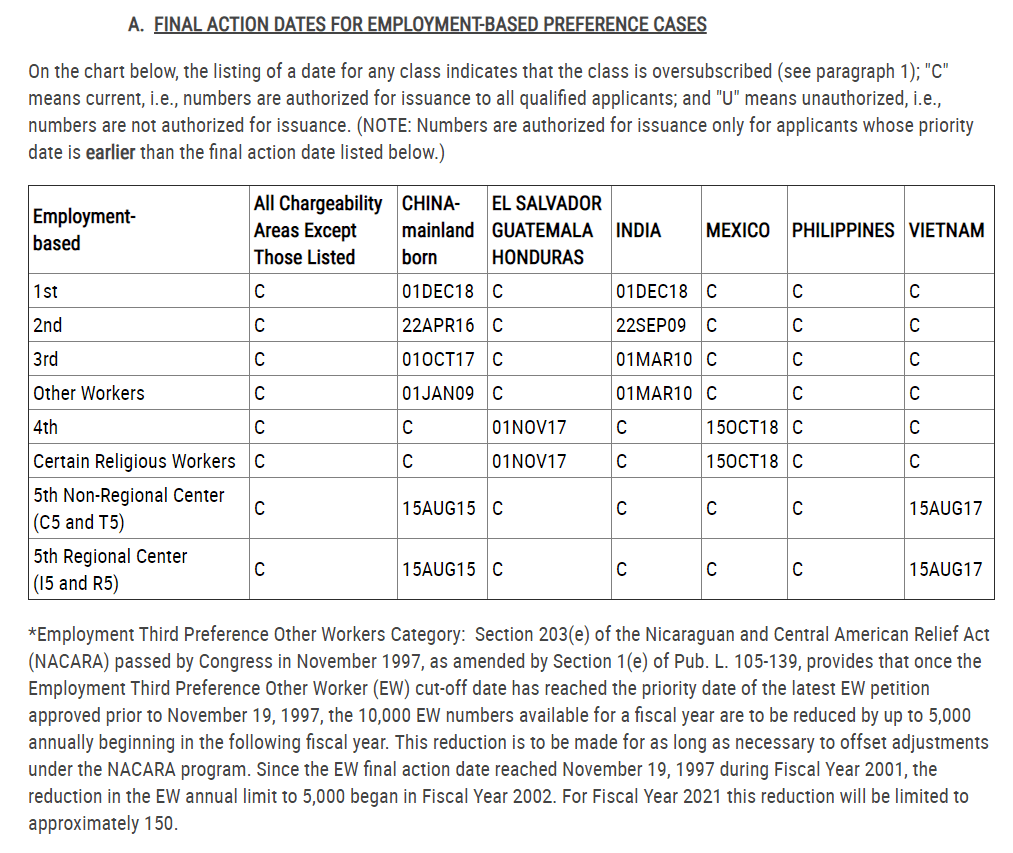
As we enter the second month of FY2021, the EB-5 final action dates show no sign of jumping forward rapidly. The figures come as a disappointment to the many Chinese and Vietnamese applicants with EB-5 investments waiting to finally begin their new lives in the United States. FY2021 has potential to be a phenomenal year for EB-5 investors, considering that nearly twice as many EB-5 visas than average are available in FY2021—a beneficial side effect of the COVID-19 pandemic and its devastating effects on travel and immigration. With this news released at the beginning of the fiscal year in October 2020, investors hoped the surge in available EB-5 visas would spur rapid forward momentum in the November 2020 Visa Bulletin. Alas, this was not the case.

Generally, United States Citizenship and Immigration Services (USCIS) releases the monthly Visa Bulletin around two weeks before the respective month begins, but the November 2020 Visa Bulletin showed up barely before November began. This delay indicates possible difficulties in determining the final action date figures this time around. Temporarily suspended visa services at U.S. consulates and embassies have left countless EB-5 investors unable to proceed with their EB-5 journey, regardless of the Visa Bulletin dates, while domestic investors have encountered no obstacles in filing Form I-485 to adjust their immigration status. Thus, moving the final action dates forward generally helps only I-485 applicants. This leaves USCIS with a dilemma: push the final action dates forward and risk major retrogression when routine visa services resume, or keep the pace slow and risk countless EB-5 visas going unclaimed?

The final action dates in the November 2020 Visa Bulletin indicate USCIS’s decision to pursue the latter option. The dates are almost identical to those of the October 2020 Visa Bulletin, with the Chinese final action date staying put and the Vietnamese final action date moving ahead by two weeks. That puts the Chinese final action date at August 15, 2015, and the Vietnamese one at August 15, 2017. India has once again retained its “current” status after initially achieving it in July 2020, but retrogression in the future is possible.

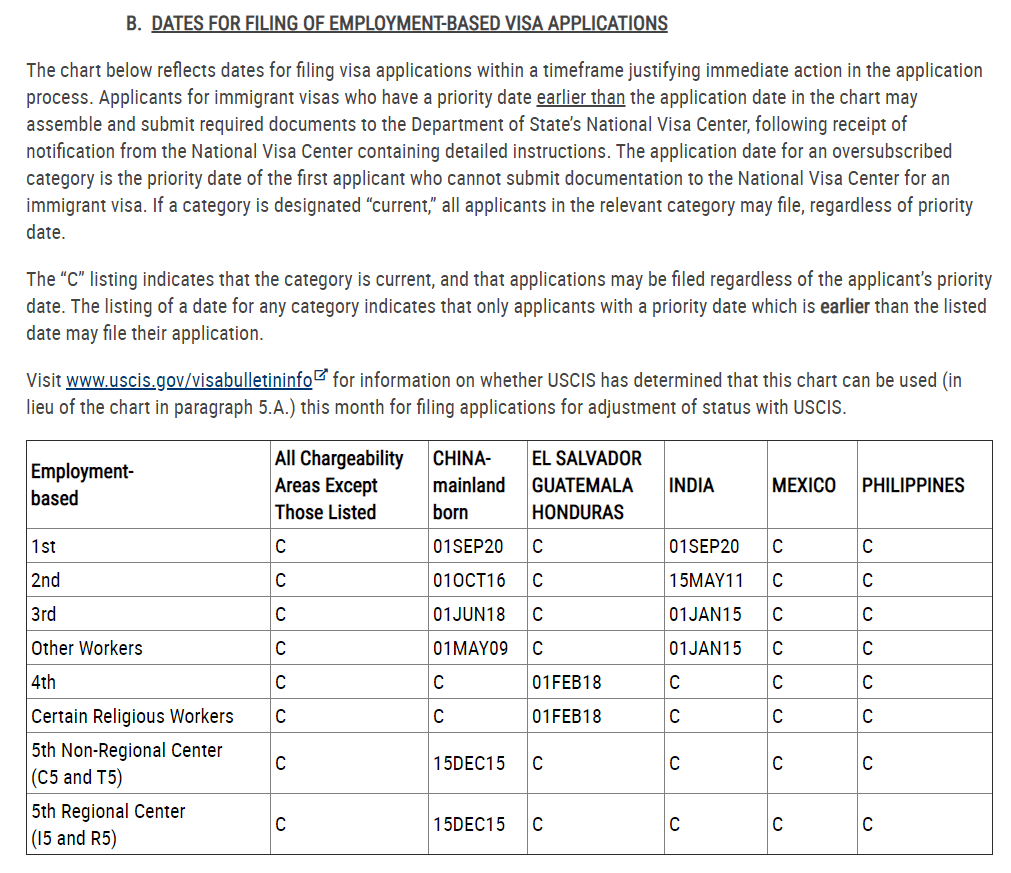
China remains the only country with an EB-5 date for filing, which has remained at December 15, 2015, for the ninth month in a row. Those from China with EB5 investments who are waiting to file their application for a U.S. green card have been stuck in limbo since the onset of the COVID-19 pandemic in the United States, and their frustration is not set to end for at least another month.

Considering the dismal news of the November 2020 Visa Bulletin, individuals making EB-5 investments from backlogged countries should hope for eased COVID-19 restrictions to trigger forward movement in the Visa Bulletin. At least in November, USCIS has clearly chosen to let EB-5 visas go unclaimed to avoid potential visa retrogression in the future.

Free EB-5 Project Evaluation

How to Determine TEA Status without a TEA Designation Letter

How-to-Determine-TEA-Status-without-a-TEA-Designation-Letter

The EB-5 Immigrant Investor Program, which carves out a pathway for foreign investors to obtain U.S. green cards for themselves and their immediate family, offers two types of investment projects: those located within a targeted employment area (TEA), and those that are not. The majority of foreign nationals who make an EB-5 investment to obtain permanent resident status in the United States invest in a TEA project because it halves the amount of required capital from $1.8 million to $900,000.

In the past, EB-5 investors would obtain a TEA designation letter from the state labor department attesting to the project’s TEA status. They would then include this letter with their I-526 petition to United States Citizenship and Immigration Services (USCIS), solidifying their EB5 investment in the lower required amount.

That all changed when the Modernization Rule kicked in on November 21, 2019. The new regulation introduced a slew of new rules for TEAs, including the elimination of the state-issued TEA designation letter. The new set of rules places the onus for TEA status justification squarely on the shoulders of the EB-5 investor, requiring them to submit documentation supporting the designation of the project as a TEA project alongside their I-526 petition.

Investors can still obtain a letter to show USCIS that their project is in a TEA, but it can’t come from the state—it must now come from a private expert. And a letter alone won’t suffice—an investor must provide a myriad of documentation to justify their lower EB-5 investment amount.

EB5AN’s TEA Map

Proving the TEA status of an EB-5 project can be challenging—but EB5AN’s TEA map dramatically facilitates the process. EB-5 investors are required to use official data and figures from the U.S. Census Bureau and Bureau of Labor Statistics, but it can be difficult for the uninitiated to scour these sites to cull the relevant pieces of data. The price of mistakes is high, too—insufficient or inaccurate data can cost an EB-5 investor an extra $900,000—or, if they don’t have the funds to double their EB5 investment, their bright future in the United States.

EB5AN’s TEA map is the ideal solution for EB-5 investors looking to justify the TEA designation of their investment project. It’s simple and straightforward to use: simply enter an address, and the map will display the TEA status of the region. The map is designed for the easy and instantaneous identification of TEAs, with census tracts that qualify as TEAs highlighted in orange.

It’s important to note that even if the individual census tract that an EB-5 project is located in does not qualify for TEA status, it may when combined with adjacent census tracts. The EB5AN TEA map automatically combines census tracts when necessary to create a custom TEA. This maximizes the potential of any EB-5 project to qualify for TEA status.

If an investor’s EB-5 project is indeed located in a TEA, they can also download a free TEA letter template, further facilitating the process of demonstrating TEA status to USCIS. By simply filling in the details of the specific project, an EB-5 investor can easily craft a professionally written and succinct TEA letter that offers clear argumentation for the TEA designation of the given project.

Free EB-5 Project Evaluation

What Can EB-5 Investors Expect When Compiling Their I-526 Petition?

What-Can-EB5-Investors-Expect-When-Compiling-Their-I526-Petition

The I-526 petition is the first step to initiating the EB-5 process with United States Citizenship and Immigration Services (USCIS). In an I-526 petition, an EB-5 investor outlines details about themselves and their chosen EB-5 project, including the likelihood of the new commercial enterprise (NCE) to create at least 10 new full-time jobs for U.S. workers with the invested capital. If USCIS approves the investor, they are deemed eligible for an EB-5 visa and may apply for conditional permanent resident status for themselves, their spouse, and any unmarried children below the age of 21.

Foreign nationals who have committed to making an EB-5 investment, whether for $1.8 million or the reduced $900,000 amount for targeted employment area (TEA) projects, must compile and submit an I-526 petition to formally launch their EB-5 application process. Although the precise procedure differs from project to project and can be found outlined in a given project’s documentation, EB-5 investors generally file their I-526 petition after transferring their EB-5 capital to a designated escrow account. Should an investor receive a denial on their EB-5 petition, the capital in the escrow account is returned to them.

Once an EB-5 investor has consulted an immigration lawyer about the suitability of the EB-5 program for their goals, conducted meticulous due diligence to select a trustworthy EB-5 project with low immigration and financial risk, and tentatively committed their EB-5 funds to the NCE in the form of a transfer to the escrow account, it’s time for them to put together their I-526 petition. The first step is to locate the latest version of the form on the USCIS website. The next step is to carefully fill out the form and gather the accompanying documentation, which can be time-consuming.

Required Information for Form I-526

Those making an EB5 investment are required to divulge substantial amounts of information about themselves, their investment, and their family. Below are a few examples of the information EB-5 investors must include in their I-526 petition:

  • Personal details, such as country of citizenship, current and past addresses, and employment history
  • Personal information about the applicant’s spouse and dependent children
  • Details about present U.S. immigration status, for those applying domestically as a holder of a different visa
  • Information about previous U.S. immigration dealings and visas the investor has received or applied for
  • Information regarding the EB-5 investment

Most of this information should be easy for an EB-5 investor to obtain and include in an I-526 petition. Far more challenging is collecting the supplementary documentation, including proof of the lawful sources of the EB-5 capital.

Collecting the Required Documentation for an I-526 Petition

Applicants are required to submit substantial documentation to support their EB-5 investment. While the most daunting and time-consuming is usually the source-of-funds documentation, which demonstrate the legality of an investor’s EB-5 capital, investors must also include documentation on their chosen EB-5 project, including financial reports and hiring timetables to showcase the expectation of creating 10 new full-time jobs for U.S. workers during the investor’s two-year conditional permanent residency window. If the project is in a TEA, the investor must also append the appropriate documentation to prove the project’s status as being in a high-unemployment or rural TEA.

Gathering the source-of-funds documentation can be tricky, depending on the type of capital involved. Applicants may derive their EB5 investment from any number of sources, including loans, inheritance money, and donations, but in all cases, the lawful sources of the funds must be demonstrated. If the capital is derived from a gift, the investor must provide a note outlining the donation and waiving the recipient’s obligation to repay the money, and the donor’s lawful acquisition of the funds must be documented.

EB-5 investors are urged to consult an experienced EB-5 immigration attorney about the source-of-funds requirement. Some fund sources are significantly easier to trace than others, so an EB-5 immigration lawyer can help an investor determine which of their fund sources are best suited to the EB-5 program. In addition to facilitating the source-of-funds requirement, working with an EB-5 immigration expert can also help an investor compile a comprehensive I-526 petition that includes all the required information and documentation, reducing the likelihood of receiving a request for evidence (RFE) or notice of intent to deny (NOID). Collaborating with an EB-5 immigration attorney can put EB-5 investors that much closer to their dream of a life of freedom in the United States.

Free EB-5 Project Evaluation

Virtual EB-5 Q&A with IPO Chief Sarah Kendall on November 10

Virtual-EB5-QA-with-IPO-Chief-Sarah-Kendall-on-November-10

While the EB-5 Immigrant Investor Program is generally the quickest and easiest pathway for a foreign national to gain U.S. permanent resident status, that doesn’t mean the program isn’t complex. Each EB-5 project and each EB-5 investment involves a multitude of factors that an investor must navigate to ultimately emerge victorious with U.S. green cards for themselves, their spouse, and their unmarried children below the age of 21. Questions abound, and on November 10, 2020, investors may finally receive the answers to their pressing EB-5 inquiries.

Starting November 10, Invest in the USA (IIUSA), an EB-5 trade association, is holding a two-week virtual conference on major EB-5 topics, including request for evidence (RFE) and denial trends, redeployment, and challenges caused by the COVID-19 crisis. In a typical year, such a forum would be hosted at an in-person venue, but due to the health regulations surrounding the COVID-19 pandemic, the trade association has opted to host 2020’s forum online. Featuring guest of honor speakers Sarah Kendall (chief of the Immigrant Investor Processing Office, or IPO) and Charles Oppenheim (chief of the Visa Control and Reporting Division at the U.S. Department of State), the virtual forum, insists IIUSA, promises to be just as engaging and informative as an in-person event.

The forum spreads five days of EB-5-related presentations and content across two weeks to better fit participants’ busy schedules. Participants need not be IIUSA members to join, but tickets for non-members cost around $200, while tickets for IIUSA members cost $150. One ticket provides access to all panels, so participants may freely choose when to tune in.

IIUSA members have also had the opportunity to send in questions for Sarah Kendall to answer during the forum. The questions touch on a number of EB-5 and IPO topics, such as the follow:

  • Why are there incongruencies between the estimated processing time ranges and the historical national average processing times?
  • What happens to investors with active EB5 investments who followed the former redeployment guidelines before they were modified in July 2020?
  • Why does every EB-5 investor in a project have to submit project documentation even when there have been no changes to the project?
  • Does United States Citizenship and Immigration Services (USCIS) anticipate furloughing employees due to budget constraints in FY2021?
  • How will the IPO ensure states and regions with low populations, such as Maine, South Dakota, and Alaska, can continue to enjoy EB-5 regional center coverage in the face of rampant terminations related to activity level?

Interested investors may purchase a ticket and tune in to the virtual forum starting November 10 for a wealth of information on the EB-5 program and the direction of its next steps into a COVID-19-plagued world.

Free EB-5 Project Evaluation

Unclear USCIS Adjudication Instructions Open the Door to Requests for Evidence

Unclear-USCIS-Adjudication-Instructions-Open-the-Door-to-Requests-for-Evidence

Foreign nationals making EB-5 investments to obtain U.S. green cards for themselves, their spouse, and their unmarried children below the age of 21 have enough to worry about between the long wait times for I-526 petition adjudication, the rampant EB-5 regional center terminations in 2019 and 2020, and the financial instability of United States Citizenship and Immigration Services (USCIS). So, unclear instructions for adjudicators that leave room for broad interpretations that could further delay I-526 approval, posing an additional hurdle for EB-5 investors to overcome, is hardly welcomed by the EB-5 world.

In May 2019, USCIS released new training materials for I-526 petition adjudicators. Believing that EB-5 stakeholders, such as those with an active EB5 investment or those operating an EB-5 regional center, should be privy to such information, Invest in the USA (IIUSA), an EB-5 industry trade association, filed a lawsuit against USCIS to publish the documents. Ultimately, USCIS released the documents only to IIUSA, who elected to offer them only to their own members as a member benefit.

The documents provide insights into the EB-5 adjudication process and can shed light on the decisions adjudicators make. In some cases, however, the adjudication instructions are not cut and dry, which can lead to confusion and inconsistent actions taken by the Immigrant Investor Program Office (IPO).

Confusion Around the Source-of-Funds Requirement

In 8 CFR 204.6 (g)(1) of the May 2019 EB-5 adjudicator training material, one can find the following paragraph:

“The establishment of a new commercial enterprise may be used as the basis of a petition for classification as an alien entrepreneur even though there are several owners of the enterprise, including persons who are not seeking classification under section 203 (b) (5) of the Act and non-natural persons, both foreign and domestic, provided that the source(s) of all capital invested is identified and all invested capital has been derived by lawful means.”

The wording of the clause is unclear: what does “all capital invested” mean? Commonly, it’s understood to mean all EB-5 capital invested by the applicant investor, and indeed, this is how most investors carry out their EB5 investment process. Nevertheless, some adjudicators interpret this cause as requiring all capital invested in the EB-5 project, including that of other EB-5 investors as well as non-EB-5 investors, to be documentarily derived from lawful sources.

Common sense dictates that any given EB-5 investor should not be responsible for the EB-5 investment capital of another EB-5 investor in the same project. Each investor is required to document the lawful source of funds for their own EB-5 capital, so USCIS can still uncover illegitimately acquired capital even if each investor does not document the sources of all capital invested in the project. No EB-5 investor should be penalized for the wrongdoings of separate, unrelated investors who happen to be involved in the same project. Similarly, the source of funds of non-EB-5 capital is outside of an individual EB-5 investor’s purview.

Nonetheless, this has not stopped some EB-5 investors from receiving requests for evidence (RFEs) based on broad interpretations of the above paragraph. In December 2019, one EB-5 investor received an RFE requesting government ID or business registration documentation for each other NCE owner, another investor was sent an RFE asking for ID and filed income tax returns for each other NCE owner, and another investor yet was the recipient of an RFE seeking ID and a comprehensive description of the business activities and bank statements of each other NCE owner.

EB-5 investors are not officially required to submit documentation and source-of-funds evidence pertaining to the EB5 investments of other NCE owners, but a broad interpretation of this paragraph by an adjudicator could mean significant stress and processing delays for investors. This unclear instruction opens the door to inconsistency and unfairness in the EB-5 process, leaving each EB-5 investor’s fate up to the interpretation of the particular USCIS adjudicator their petition lands with. With more attention called to this unfair practice, USCIS may clarify their instructions, but until then, EB-5 investors beware.

Free EB-5 Project Evaluation

Number of Approved EB-5 Regional Centers Continues to Dwindle

Number-of-Approved-EB5-Regional-Centers-Continues-to-Dwindle

Foreign nationals who participate in the EB-5 Immigrant Investor Program have two pathways to make their EB-5 investment: directly in a qualifying EB-5 project or indirectly through an approved EB-5 regional center. The EB5 investment pathway doesn’t change the outcome for successful investments: U.S. permanent resident status for the investor and their immediate family members.

However, it does influence how the investment plays out. Those who invest directly are generally required to take on heavier managerial workloads at the new commercial enterprise (NCE), but in return, these investors can exercise more control over their investments. Conversely, those who make an EB-5 investment through a regional center approved by United States Citizenship and Immigration Services (USCIS) enjoy a smaller managerial obligation at the NCE and loosened job-creation requirements that facilitate the attainment of a U.S. green card.

These benefits make EB-5 regional center investment by far the preferred EB5 investment method of program participants. But it is important to bear in mind a few caveats. For example, the EB-5 Regional Center Program is not a permanent USCIS program—it’s only temporary and is continually extended by the government, leaving room open for potential termination in the future. Furthermore, the approved status of individual regional centers is not set in stone, either. USCIS routinely terminates previously approved regional centers, and in fact, it’s terminated a record number of regional centers in 2019 and 2020.

Regional Center Terminations in Numbers

The total number of approved EB-5 regional centers has fallen considerably since 2018, when the program boasted around 800 approved regional centers across the United States. The problems for regional center owners began in November 2019, when the Modernization Rule kicked in and changed the rules for targeted employment area (TEA) designation. The regulation also nearly doubled the minimum required investment amount to $1.8 million ($900,000 for projects in TEAs), resulting in diminished investor interest. With these two changes together, the rule spelled disaster for EB-5 regional centers, and the terminations began rolling in.

In March 2020, there were a total of 772 approved regional centers nationwide. March 2020 is also when the COVID-19 pandemic struck, crippling the economy, destroying jobs and livelihoods, and temporarily pausing routine visa processes at U.S. embassies and consulates. As the pandemic raged on, another 44 regional centers met their demise, bringing the total to 728.

By August 2020, the world had begun to reopen and U.S. embassies and consulates had introduced a phased resumption of visa processes, even though the COVID-19 pandemic continued to ravage various countries. The total number of approved EB-5 regional centers had dropped by 36, leaving only 692 approved regional centers.

Now, in October 2020, there remain only 678 approved EB-5 regional centers, down 14 from August. Though the pace of termination is slowing, there is no indication of the trend reversing anytime soon, and the number of approved regional centers is expected to continue its descension as 2020 comes to a close.

Careful Due Diligence Is Imperative

With more than 100 regional center terminations since 2018, countless EB-5 investors are facing severe complications in their EB-5 investment journey. The rapid pace of regional center terminations highlights the necessity for EB-5 investors to conduct meticulous due diligence on prospective regional centers.

When considering whether to make an EB5 investment through a particular regional center, prospective investors should consider a number of factors. Examining the track record of the regional center is imperative—what is the success ratio of previous investors? Is this project similar to previous projects the regional center has worked with? How many I-526 and I-829 petitions for investors working with the regional center in the past have been approved?

It’s also important to consider the details of the specific project and project developer. Has the regional center worked with this project developer before? What is the project developer’s track record? EB-5 investors should always consult an EB-5 immigration attorney to determine whether the project and regional center work for them and their EB-5 investment goals.

Free EB-5 Project Evaluation

Why Investing in the United States through the EB-5 Program Makes Sense

Investing-in-the-United-States-through-the-EB-5-Program-Makes-Sense.jpg

The United States boasts the largest economy in the world and is heralded as a beacon of freedom and liberty—so it’s no wonder foreign nationals from around the world dream of a new life in the United States. Unfortunately, for most, it’s but a pipe dream—immigration is difficult. Foreign investors with the necessary means, however, are in luck: an investment through the EB-5 Immigrant Investor Program can grant an investor and their immediate family members U.S. permanent resident status.

Join the Leading Global Economy

The United States’ stronghold on the global economy is no secret: the nation accounts for more than 24% of the global GDP, first by a large margin, with runner-up China claiming only around 16%. The 2019 Global Competitiveness Report also ranked the United States in second place after taking into consideration a number of factors, including institutions, infrastructure, labor market, business dynamism, innovation capacity, and more. Only Singapore outpaced the United States, which placed first in the 2018 rankings.

Major metropolises such as New York City and Los Angeles are hubs for business innovation, with talented professionals and entrepreneurs setting their sights on such global hotspots and establishing their successful companies in these jurisdictions. This makes such cities magnets for global talent and inspires even more innovation, further boosting the economic power of these areas.

Thanks to the EB-5 program, foreign investors from around the world can take advantage of the economic prowess of the United States. While other major developed countries, such as the UK, Canada, and Australia, also offer visa investment programs, they pale in comparison to the EB-5 program, which dramatically outranks them in terms of popularity. For an EB-5 investment of $1.8 million, or $900,000 if the project is located in a targeted employment area (TEA), foreign nationals can obtain a U.S. green card and forge a new life in the United States of America.

Enjoy a Top-Notch Legal System That Protects Intellectual Property Rights

In the United States, intellectual property rights are protected by strict laws, which fosters an innovative culture and results in a high proportion of inventors and entrepreneurs. Knowing that in the United States, their intellectual property will be stringently protected, the best and brightest of countries around the world flock to the United States to put their creative ideas into action. In fact, in 2015, a total of 52% of patents issued in the United States were granted to inventors born in other countries.

If you’re a foreign investor looking to launch an innovative new business, the legal protections the United States offers are invaluable. Copyrights, trademarks, and patents can safeguard your intellectual property and technology so you can ensure that you’re the beneficiary of your own creativity. To legally bind your employees to the protection of your intellectual property, you can issue non-disclosure agreements and licensing contracts.

Launching a business in the United States without resident status could be tricky, but with the EB-5 program, you can invest in permanent residency for yourself and your family, paving the way to set up your new business in New York, California, Florida, or anywhere else in the United States. It’s an investment not only in the United States but also in yourself, your family, your business, and your future.

Provide Your Children with a Cutting-Edge Education

The United States is by far the most popular destination for international students, and it’s no surprise why—the majority of the top universities are in the United States. An education at a leading U.S. institute of higher education can open all sorts of doors for young scholars with high aspirations, and a U.S. green card makes these opportunities all the more attainable thanks to benefits such as an easier admissions process and the potential for in-state tuition savings.

From Harvard University, to Massachusetts Institute of Technology, to Stanford University, to the University of California, Berkeley, the educational opportunities in the United States are truly high-quality, and any foreign national who wishes to offer their children a brighter future should be interested in U.S. universities like these. Educational opportunities are one of the driving forces behind EB5 investments—in fact, it’s common for parents to donate EB-5 investment capital to their children to make their own EB5 investment. This is a perfect solution when the parents don’t want to abandon their established life in their home country but wish to build a brighter future for their child.

The reasons to invest in the United States through the EB-5 Immigrant Investor Program are numerous, but in the end, it comes down to investing in a better future for yourself and your family. From lucrative business opportunities, to state-of-the-art educational institutes, to unparalleled freedom and security, the United States promises a better life for foreign investors around the world.