

Free EB-5 Project Evaluation

Marketing the EB-5 Program in India

India has a long history of emigration beginning in colonial times and culminating in the recent migration of educated laborers to the West, Southeast Asia, and the Arabian Gulf. With its booming population and substantial middle class, India currently poses a significant opportunity for EB-5 developers.

The Indian Economy

In 2013, India was facing its worst economic crisis in twenty years, with the economy having grown only 4.4% in the second quarter and the banking system in disarray. That year, the United States Federal Reserve had tightened the reins on foreign investment, and global investors had reacted by transferring billions from developing economies, leading the rupee to fall in value by almost 40%. Additionally, capital controls introduced in India that year concerned foreign investors, who feared the new limits on how much could be transferred out of the country would affect their returns.

In an attempt to confront the worsening economic situation, the Reserve Bank of India eased restrictions on banks, allowing them to borrow in dollars rather than rupees, and instituted reforms to improve fiscal policies and strengthen the manufacturing sector. Perhaps because of tight regulations on banking and debt, most Indian investors bank through Singapore, and financial analysts have estimated that half of all rupee trading occurs outside India. Investors have taken advantage of this lack of government oversight on trading activity, and a large number benefit from banking in countries like Mauritius, which has a 0% tax rate.

Despite its economic woes and its climate of political friction, India was home to 182,000 millionaires and 103 billionaires as of the financial crisis in 2013, meaning this unstable economy nonetheless provides opportunities for EB-5 developers willing to adopt innovative strategies.

Obstacles to EB-5 Marketing in India

Developers keen to enter the market of potential Indian EB-5 investors must overcome a number of obstacles:

  • India lacks a network of immigration agents familiar with the EB-5 Program and its benefits and requirements. This means that few wealthy Indian investors, unlike their Chinese counterparts, are already aware of the EB-5 Program.
  • Indian investors are already able to access a number of international immigration programs, meaning EB-5 developers face more competition in India than they might elsewhere. As these investors also generally seek out higher returns on investment than do the Chinese, they might not perceive risky EB-5 investments as attractive.
  • The current $75,000 cap on capital outflows, mentioned briefly above, restricts the amount an investor can contribute to an EB-5 project. Additionally, developers often have difficulty tracking the sources of investment funds, given Indian investors’ propensity for offshore banking.
  • Wealthy Indian investors typically enjoy a good quality of life in India and may be reluctant to emigrate to the United States.

Each of these obstacles is discussed in further detail below along with relevant strategies developers can use to take advantage of this underrepresented market.

Establishing an EB-5 Immigration Network

Developers would benefit from establishing networks of immigration agents in large developed cities such as New Delhi and Mumbai. Indian immigration agents are generally already familiar with U.S. visa programs, and developers can work with these agents by educating them on the EB-5 Program and its benefits for wealthy investors hoping to emigrate. Developers can also leverage their connections with business representatives in India, and because a majority of Indians also speak English, developers are generally able to maintain direct relationships with these contacts.

Competing Internationally

A number of European, Caribbean, and Southeast Asian countries offer foreign investor residence and citizenship programs that compete directly with the EB-5 Program from the United States. Most notable among these are the programs in Canada, Australia, England, and New Zealand, all of which offer investors the opportunity to exceed by a large margin the $500,000 investment limit of the EB-5 Program.

Indian investors also often aim for a high return on investment and are not content to play a passive managerial role in development projects, unlike the Chinese. Additionally, they generally have ample opportunities for investment within India and can benefit from the high interest rates offered by Indian banks, as well, making investment in the United States less attractive.

To combat these factors, EB-5 developers might focus on advertising direct and pooled-direct investment projects, which generally offer higher returns for investors as well as equity. Lower agent fees in India also lead to a higher return for investors, meaning further opportunities for developers.

Sourcing Funds

The current capital outflow limit of $75,000, meant to stem the flight of capital following the 2013 Indian financial crisis, poses somewhat of an obstacle for foreign investors. While this measure is meant to be temporary according to the current Indian finance minister, EB-5 investors are meanwhile left to grapple with the issue of transferring funds abroad. Fortunately, many wealthy Indian investors maintain foreign bank accounts not subject to the cap, meaning this may not pose as significant a problem as anticipated.

This leads to a second issue, which is the difficulty of tracing the path of funds from Indian investors. To avoid taxation, many wealthy Indians underreport their earnings, meaning the country currently faces the issue of “black money,” this being assets not disclosed to government authorities. As with investors from any country, developers must be careful to document the source and path of EB-5 investment funds with the necessary proof to satisfy United States Citizenship and Immigration Services (USCIS) and Office of Foreign Assets Control (OFAC) regulations.

Encouraging Emigration

The high standard of living and status accorded to wealthy investors in India, especially in comparison to what their wealth would afford them abroad, means these individuals are generally not interested in emigrating. However, the United States is the premier education destination for wealthy Indian students, and developers can benefit from stressing the opportunity inherent in the EB-5 Program because of this factor.

The limitations of a work visa may prevent Indian students from gaining work experience in the United States following graduation from a college or university. As such, the possibility of permanent residence under the EB-5 Program can be a draw for the wealthy Indian parents of these students, as can the lower tuition fees offered to U.S. residents. An additional point of interest is that the parents would benefit from the EB-5 Program in this way without being subject to Internal Revenue Service (IRS) oversight of their other assets. Developers can add both these points to their arsenals.

India is a land of opportunity for EB-5 developers willing to adopt innovative marketing strategies to overcome the aforementioned host of obstacles. This as yet untapped market is home to thousands of wealthy candidates for the EB-5 Program, yet developers have been unable to surmount existing cultural and economic factors, the most significant among which concern international competition, a reluctance to emigrate, and an inability to document fund sources.

While Indian participation in the EB-5 Program is unlikely to overtake that of the Chinese in the near future, this market does offer significant potential for diversification of EB-5 investment sources in the face of Chinese quota retrogression and the potential lack of sustainability of the Chinese real estate market. Developers and regional centers willing to establish local immigration networks, conduct their due diligence on fund sources, and advertise the unique benefits of the EB-5 Program for wealthy investors are poised to take advantage of this climate of uncertainty.
 

Free EB-5 Project Evaluation

Marketing the EB-5 Program in Latin America

Recent delays in the processing of EB-5 visa petitions from Chinese investors have encouraged regional centers to focus on Latin America as a potential investment source. Despite political and social instability over the past decades, many Latin American countries are now experiencing economic growth, and the United States has emerged as an appealing destination for investors because of its geographic proximity, large Hispanic community, and strong legal system.

Opportunities for EB-5 Regional Centers in Latin America

China stands out as the source of a majority of EB-5 applications. For example, in the 2013 fiscal year, 86% of I-526 petitions were filed by Chinese investors and only 1.8% by Latin Americans, with the largest numbers of investors coming from Mexico, Venezuela, and Brazil. This can be partly attributed to strong economic conditions in Latin American countries during that year, meaning investors did not feel the need to look abroad.

However, with 605,000 millionaires, Latin America represents a significant opportunity for regional centers. Targeted marketing and education on the benefits of the EB-5 Program could bring about a capture rate, referring to the percentage of EB-5 applicants among all millionaires, identical to that in China. This would result in 1,600 applications per year and a significant boost in investment for U.S. regional centers.

Challenges of Marketing the EB-5 Program in Latin America

Many potential EB-5 investors in Latin America remain unaware of the program and its benefits. This situation is mainly the result of a lack of marketing initiatives and a climate of caution among wealthy investors in Latin American countries due to historical safety concerns. In some regions, unlike in China, where roadshows are a common way to attract investors, it would be unsafe to host a large gathering of millionaires to explain the requirements of the EB-5 Program.

Additionally, Latin American investors may balk at the required investment amount of $500,000, as well as the significant legal fees associated with applying to the EB-5 Program. Unlike Chinese investors, who often have family and colleagues who have successfully navigated the application process, Latin American investors are generally unfamiliar with the requirements and skeptical of the risk when investing such a large sum.

An increased tax burden is also a concern for potential EB-5 candidates. Taxes are high for nonresident aliens in the United States, and in cases where no tax treaties exist with an investor’s country of origin, the investor may face double taxation. While this drawback can be averted through tax planning, it does add an additional complication to the EB-5 application process.

Lastly, quality of life for wealthy investors is generally high in Latin America, and familial and cultural bonds may make emigration unattractive. While Latin Americans may indeed wish to invest in the United States, take advantage of temporary visas for business purposes, and own property in large U.S. cities, many do not wish to relocate permanently.

Benefits for Latin American EB-5 Investors

For some potential EB-5 applicants, the benefits of living and working in the United States far outweigh the drawbacks. Investors from countries that frequently undergo economic or political upheaval may wish to conduct business in a more stable system, as would those who face safety concerns or other quality of life issues. Similarly, students currently studying in the United States may wish to remain there as investors to avoid the restrictions of a working visa, and their parents may wish to join them in their new communities.

Regional centers would benefit from working through Latin American professional networks in cities like New York and Miami, which can facilitate more efficient marketing to potential investors. While the number of EB-5 applicants from Latin American countries is unlikely to spike in the coming years excepting a significant economic downturn in that region, a steady increase in applicants will encourage other investors to take the plunge over time.

Successfuly Marketing Strategies for EB-5 Regional Centers

Because regional centers must establish qualified networks of immigration attorneys and local agents and face significant costs in due diligence while familiarizing themselves with local markets, immigration and taxation laws, and cultural customs, they benefit from working in larger markets, where their efforts will reach more potential candidates. Brazil and Mexico are excellent examples of countries where this strategy may prove useful.

With over 225,000 millionaires, Brazil stands out as a target for marketing of the EB-5 Program by regional centers. The recent contraction of the Brazilian economy, which has resulted in a trade deficit and high inflation rate, has caused extreme poverty in certain regions, and this climate of economic uncertainty poses challenges for investors. Those wishing for a more stable business environment may see the benefits of applying for the EB-5 Program and immigrating to the United States, though transferring capital out of the country remains an obstacle.

Mexico is a second candidate for EB-5 marketing, with 150,000 millionaires and an open economy with significant ties to the United States and other regional trading partners. As a result of recent tragedies perpetrated by criminal organizations as well as politicians and law enforcement officials, wealthy Mexican investors may wish to immigrate to the United States for reasons of safety. Protests and widespread discontent have also cast into doubt the stability of the Mexican government, meaning potential EB-5 candidates may see the benefit of working and living elsewhere.

Other large countries in Latin America face additional challenges conducive to EB-5 marketing efforts. The weak economy in Argentina, political unrest in Venezuela, and crime rates in Honduras and Guatemala all present opportunities for regional centers to encourage immigration by wealthy investors.

Key Points: EB-5 in Latin America

Unstable economic and political conditions in some Latin American countries may encourage potential investors to look into the opportunities presented by the EB-5 Program. While a cautious investment outlook and generally high quality of life in most Latin American countries has historically precluded the need to immigrate to the United States, regional centers can capitalize on conditions in larger markets by working with stateside Latin American professional networks to educate investors on the requirements of the EB-5 Program and the opportunities it presents.

Free EB-5 Project Evaluation

EB-5 Regional Center Investments for Brazilian EB-5 Investors

The EB-5 Program offers unique opportunities for investors in Brazil to immigrate to the United States. However, despite the fact that Brazil has the largest economy and population in Latin America, few Brazilian EB-5 investors have applied for EB-5 visas over the past years. The reasons for this are twofold: Firstly, the booming economy in Brazil has not encouraged foreign investment. Secondly, there is little awareness of the EB-5 Program among investors in Brazil.

Considerations for Brazilian EB-5 Investors

As no network of migration agents exists in Brazil, investors hoping to apply for the EB-5 Program can benefit from working with an approved regional center, which will typically provide information on the U.S. immigration system as well as putting applicants in contact with qualified tax planning experts to help navigate U.S. tax requirements for foreign investors.

Brazilian investors should consider the obstacle of the U.S. tax on worldwide income. Unlike in Brazil, where the top income tax rate is 29%, the estate tax is between 4% and 8%, and there are no taxes on dividends to shareholders, nonresident aliens (NRAs) in the United States must pay high income and estate taxes. Immigration tax experts can help investors devise strategies to effectively reduce their tax burdens under the EB-5 Program, and regional centers can play a key liaising role in this regard.

The EB-5 Program offers rewards for ambitious Brazilian investors hoping to establish and manage businesses in the United States. Both Brazil and the United States have established legal systems through which to conduct business and enforce contracts, and the United States therefore stands out as a promising market for Brazilian EB-5 investors. However, an investor is not able to manage a business in the United States until his or her I-526 petition has been approved and permanent residence has been established.

Approaching the EB-5 Program as a Brazilian EB-5 Investor

Brazilian EB-5 investors often prefer to take a hands-on approach to conducting their due diligence on potential investments, regional centers, and immigration and tax planning attorneys. Familiarizing themselves with the various U.S. systems at play in the EB-5 Program allows investors to better understand the process of applying for an EB-5 visa and successfully investing in a U.S. business.

A crucial aspect of a successful EB-5 application is the ability to prove the legitimacy of funds sourced for the EB-5 investment. Immigration attorneys will play a key role in this step of the application, but investors can benefit from an understanding of the various documents required to establish credibility. These include documents to prove the founding and operation of a business, the leasing or purchase of property, and the sourcing of funds. Examples of these are listed below:

  • Contrato Social and Contrato de Constituição de Sociedade Limitada
  • Comprovante de Inscrição e de Situação Cadastral
  • Contrato de Locação de Imóvel Não Residencial
  • Records from the Cartório de Registro de Imóveis
  • Contrato de Compra e Venda
  • Declaração de Informações Econômico-Fiscais da Pessoa Jurídica
  • Comprovante de Pagamento de Swift
  • Any bank statements
  • Any declaration of joint assets, as for a married couple

An experienced Brazilian EB-5 investor will be familiar with these documents, which will substantially expedite the processing time for his or her I-526 petition and thus immigration to the United States.

Immigration and Tax Planning

Once a Brazilian investor has decided to live and work in the United States, he or she might benefit from obtaining an L-1 or E-2 visa so as to immigrate quickly and establish a business. Other types of visas, such as the B-1 and B-2 visas, allow Brazilians to spend up to six consecutive months in the United States, while the F-1 and F-2 student visas may also prove helpful in that they allow dependents to attend school in the United States. Regardless, building ties to the United States is a crucial part of establishing residence under the EB-5 Program, and this often means investors choose to immigrate along with their families.

As mentioned above, NRAs face a complex hurdle with the U.S. tax system, and Brazilian investors must therefore educate themselves prior to immigration on their potential tax obligations and plan accordingly. Although the tax systems of the United States and Brazil are similar, the services of an experienced tax attorney specializing in both can prove invaluable in helping EB-5 investors prepare for immigration. For example, various strategies involving the sale or transfer of assets and the deferment of expenses allow investors to minimize their tax burdens once residing in the United States.

While the EB-5 Program was designed to attract capital at low cost from China and other countries, it has developed into a significant opportunity for investors worldwide and especially in Brazil. Regional centers can thus benefit from approaching Brazilian EB-5 investors, who are often motivated and willing to take educated risks to create successful business ventures. Increasing awareness of the EB-5 Program will result in further growth of Brazilian foreign investment in the coming years.

Brazilian EB-5 investors should seek the assistance of qualified immigration attorneys as well as tax planning and financial advisors to ensure they are in compliance with all the requirements of the EB-5 Program as well as U.S. tax and immigration laws. For investors, regional centers can act as an excellent resource as well as an avenue to achieve their investment goals.

Free EB-5 Project Evaluation

Overcoming the Challenges Facing Iranian EB-5 Investors

Although Iranian EB-5 investors currently represent a small percentage of the overall number of EB-5 cases, only 0.7% as of 2014, recent changes brought about by the issuance of a general license by the Office of Foreign Asset Control (OFAC) have opened a door for this untapped market. However, immigration attorneys and Iranian investors poised to take advantage of this opportunity must nonetheless be aware of remaining challenges in such EB-5 cases.

The general license issued on October 22, 2012, allowed U.S. projects to accept funds from Iranian investors without the need for a specific license for each, as had been the case prior to that date. For Iranian EB-5 applicants, this meant a significant reduction in processing time of approximately eight months, making the EB-5 visa a more attractive option for investors hoping to work and live in the United States.

This article outlines how immigration attorneys and investors might overcome common challenges inherent to Iranian EB-5 applications.

Sourcing and Transferring Funds

While the general license allows U.S. projects to source funds from Iran in general, regional centers must still ensure that funds originate from legitimate financial institutions and investors, not those the OFAC has categorized as Specially Designated Nationals (SDN). Economic sanctions against Iran remain in place, and regional centers face harsh legal penalties for violating them by accepting funds from individuals or organizations on the SDN list.

For instance, under 50 U.S. Code § 1705 (b) and (c), violating economic sanctions carries a criminal penalty of up to $1 million in fines or a maximum prison term of 20 years, or both, and fines for civil violations are the greater of $250,000 or twice the value of the transaction. For this reason, to ensure compliance with U.S. law as well as a successful EB-5 application, attorneys representing investors or regional centers must examine and document the path and source of funds at every step of the transfer process.

Before taking on the representation of an Iranian investor, an attorney should verify that the investor does not fall on the SDN list. While U.S. attorneys are legally allowed to provide services to Iranians under the OFAC general license, they can face criminal charges if found to have represented an SDN. For this reason, if an attorney discovers that he or she has inadvertently represented an SDN, the attorney must file a report with OFAC within ten days. Each investor should also be made aware that under OFAC regulations, once he or she becomes a permanent resident of the United States following a successful EB-5 application, he or she must divest any interests in Iranian businesses to remain within the bounds of U.S. law.

The first step in representing an Iranian investor is to ensure he or she can prove the legal origin of the investment funds. The standard of proof in EB-5 cases is a preponderance of evidence, but as filing of tax returns is not common in Iran, regional centers and attorneys may need to rely on professional licenses, bank records, and personal sworn statements to outline a legitimate path of funds and vet EB-5 candidates.

Additionally, no banking relationship exists between the United States and Iran, so Iranian investors are cautioned against initiating any fund transfers without first consulting an attorney. Some investors attempt to use the hawala system, which operates outside licensed financial networks, to transfer funds from Iran to the United States. Under this system, a sarafi, a money exchange house, accepts a sum in return for facilitating a transfer through local contacts in the United States. The contacts in turn generally wish to send money to family in Iran.

However, the hawala system is considered money laundering and is illegal in the United States. More importantly for EB-5 applicants, the system obscures the source and path of investment funds and is not conducive to proving their legitimacy. Investors and attorneys should therefore be diligent in working with only a reputable sarafi who will transfer funds through an intermediary bank in a third country, thus documenting the source and path of the funds as required.

USCIS Requests for Evidence (RFEs)

United States Citizenship and Immigration Services (USCIS) may return a Request for Evidence (RFE) if an adjudicator believes further information would clarify the EB-5 application and potentially lead to approval. Among Iranian investors, a majority of RFEs concern the source and path of investment funds, and for this reason attorneys should seek an OFAC opinion from a third party and include that letter with the EB-5 application to USCIS.

This becomes more relevant in light of the fact that USCIS and the OFAC use different criteria to determine the legality of funds. While both organizations require that investment funds be transferred from a bank not on the SDN list, USCIS also considers the path of funds prior to this last bank, meaning funds must not have travelled through an SDN at any point prior to transfer to the United States. USCIS therefore takes a more broad approach to determining the source and path of funds and will deny EB-5 applications where investment funds have travelled through an SDN.

This disagreement between USCIS and the OFAC leads to RFEs as well as the possibility for EB-5 applicants to dispute any denials based on the fact that only the OFAC can determine the legality of funds entering the United States, and the OFAC holds that an SDN’s interest in funds ends at the point at which those funds are transferred to a legitimate bank. A reduction of oversight from the OFAC following the 2012 general license additionally means that aside from reviewing the legality of funds when granting an I-526 petition, the petition to immigrate to the United States as an investor, USCIS adjudicators may also revisit fund sourcing when granting an I-829 petition to remove the conditions of permanent residence. Because of this difference of opinion, investors and attorneys should err on the side of caution when sourcing investment funds.

Free EB-5 Project Evaluation

EB-5 Petition Filings Stronger than Ever and Growing

EB-5 Petition Filings Stronger than Ever and Growing

According to recently released data from United States Citizenship and Immigration Services (USCIS), an increased number of EB-5 filings has resulted in a growing backlog of pending petitions.

The updated data from USCIS provides numbers for Q1 of FY2016.

Slide0 CROPPED
 

Increased Number of I-526 Petitions

The record number of I-526 Petitions filed at the end of 2015 and beginning of 2016 has been attributed to uncertainty surrounding the continued efforts of Congress to reform the EB-5 Program.

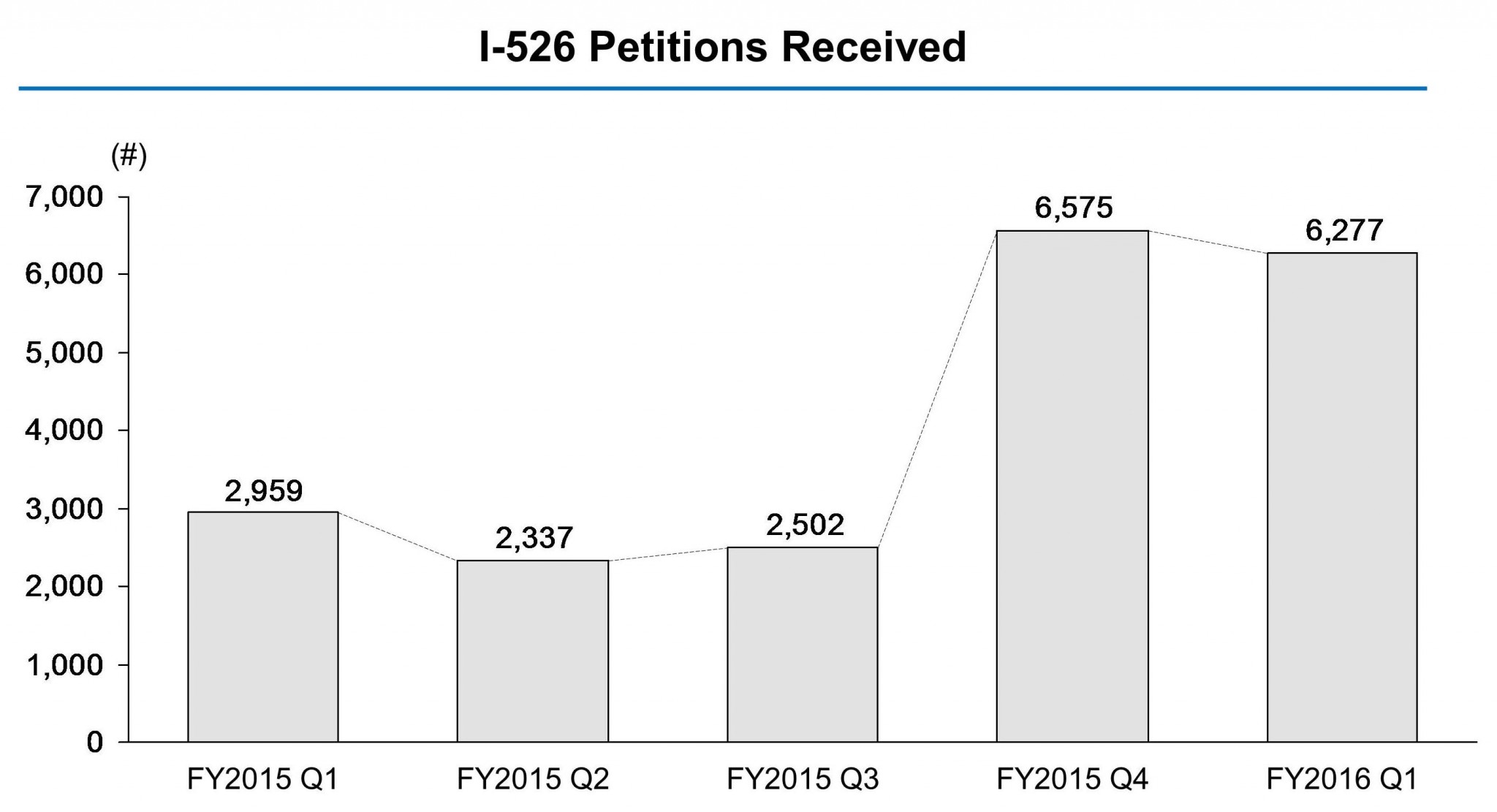
The total number of petitions received by USCIS in 2015 was 14,373—approximately 46% of these were received in quarter four. The increased number of filings continued into 2016, with the first quarter seeing 6,277 I-526 Petitions filed. It’s worth noting that only two years ago, in 2013, the total number of filed I-526 Petitions was 6,346, which is equivalent to the number of petitions filed in each of the two most recent quarters.

Increased Backlog of Pending Petitions

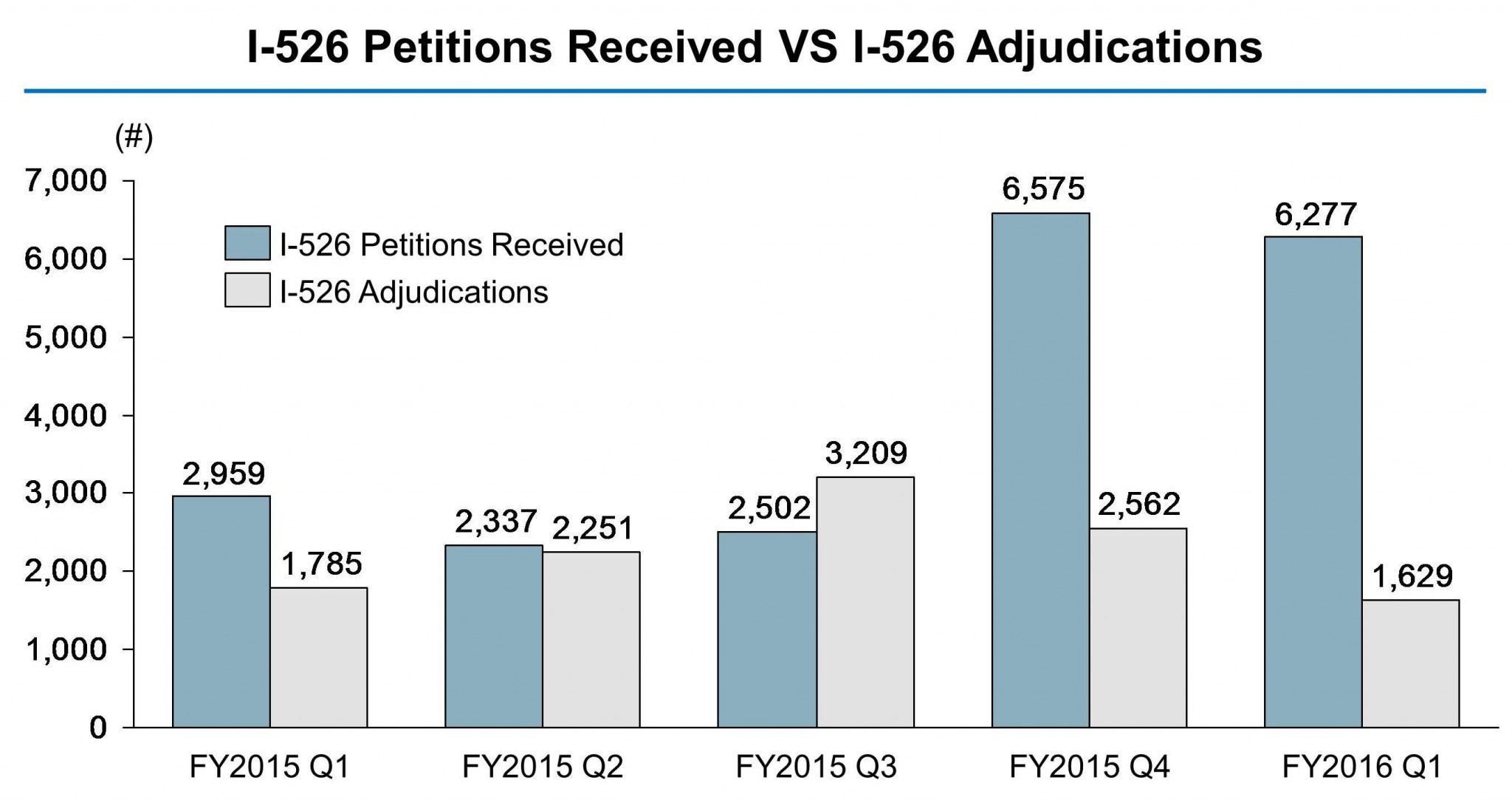
The increased number of filings in the past two quarters has created a growing backlog of petitions awaiting adjudication by USCIS. As demonstrated in the chart below, the number of petitions vastly exceeds the number of adjudications.

Slide1 CROPPED

Currently, the number of I-526 Petitions awaiting USCIS adjudication is 21,988, and the number of I-829 Petitions awaiting adjudication is 4,526. This backlog is expected to grow as the number of petitions filed with USCIS is likely to remain above the agency’s adjudication capacity.

Quarter Pending I-526 Pending I-829
FY2015 Q1 13,569 3,080
FY2015 Q2 13,731 3,524
FY2015 Q3 13,129 4,007
FY2015 Q4 17,367 4,049
FY2016 Q1 21,988 4,256

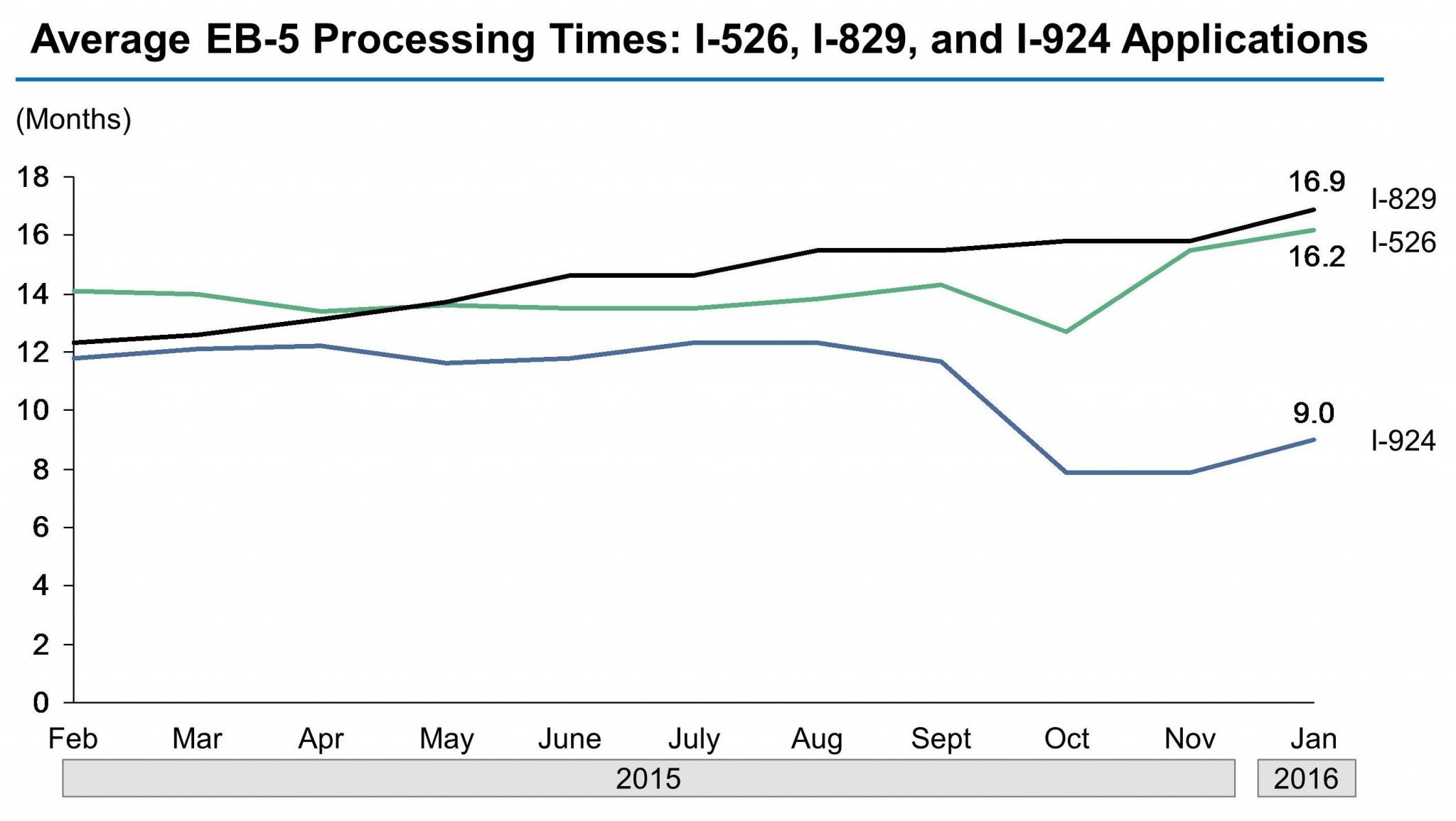
Since the beginning of 2015, the backlog has increased by more than 60% for I-529 Petitions and nearly 40% for I-829 Petitions. This growing backlog has resulted in even longer average processing times, demonstrated in the graph below.

Slide2 CROPPED

In November of 2015, the adjudication wait times were, on average, 15.5 months for I-526 Petitions, 15.7 months for I-829 Petitions, and 7.9 months for I-924 Petitions. These wait times are now 16.2 months, 16.9 months, and 9 months, respectively—an increase of about one month across the board.