

Free EB-5 Project Evaluation

EB-5 Immigrant Investor Program Modernization Rule Is Moving to the Final Stage

On June 27, 2019, the Office of Management and Budget (OMB) announced that EB-5 Immigrant Investor Program Modernization (RIN: 1615-AC07) has reached the final stage in the rulemaking process. Therefore, we expect the Final Rule to be published in the Federal Register within the next few days.

United States Citizenship and Immigration Services (USCIS) will announce the publication of the Final Rule on the USCIS Federal Register Announcements page. Interested parties can sign up on the page to receive email updates.

The Content of the Final Rule

Although the specific content of the Final Rule will not be publicly available until its publication, based on the proposed rule published in January 2017, we expect changes to EB-5 investment amounts and the regulations governing targeted employment areas (TEAs). For example, we expect minimum investment amounts to increase to $1.35 million or $1.8 million, depending on the location of the project. Nevertheless, because we do not know what changes OMB and USCIS have made to the rule since it was first proposed in January 2017, these amounts are an educated guess rather than a certainty.

The Effective Date of the Final Rule

The Final Rule will include a date on which the changes come into effect. This date will probably be 30 to 60 days after publication. It is important to note that the changes will affect only future I-526 filings. In other words, the new regulations on minimum investment amounts will not affect I-526 applications filed before the effective date set out in the Final Rule.

Additionally, after publication and before the effective date, Congress and the Government Accountability Office review the regulation. This may lead to delays in implementation. Similarly, implementation could be delayed if someone institutes legal action in federal court that necessitates judicial review. However, it is impossible to anticipate either type of delay.

The Implications of Changes to the EB-5 Program

The key implication of the looming changes is that those who want to take advantage of the lower EB-5 investment amounts need to do so now. It is important for investors to bear in mind that this news is likely to lead to a filing surge, so those who were born in countries that are currently experiencing backlogs and who are not part of the initial surge may find themselves facing even longer visa wait times. For example, during the grace period, several thousand investors are likely to submit EB-5 petitions, with half expected to be Indian nationals. For Indian nationals, this could add years to the current backlog.

To discuss your EB-5 investment options, including the advantages and disadvantages of beginning the investment process now, schedule a call with Sam Silverman, our managing partner, today.

Free EB-5 Project Evaluation

EB-5 Investment from Turkey

Despite social and political upheaval, Turkey’s economy has continued to grow rapidly over the last few years and is still seen as a strong force in the region. It now boasts the eighteenth highest GDP in the world, but rising debt makes this continued pace of growth uncertain. Turkey also faces increasing inflation that hit a 15-year high of 25.2% in October 2018. The Turkish lira is now trading at a rate of 5.5 lira per U.S. dollar, providing incentive for potential Turkish EB-5 investors to leave the country.

Wealth and Economy

In the last few years, Turkey has seen the highest emigration rate of wealthy citizens of any major economy, with a full 12% of its millionaires leaving the country in 2017. This mass departure can be attributed to high inflation, intensifying security and economic issues, and President Recep Tayyip Erdogan’s clampdown on his political opponents.

Political Landscape

Turkey was founded as a secular republic in the early 1900s and has made strides towards becoming a full democracy. However, President Erdogan has been accused of attempting to establish an autocracy, and he has gained notoriety for limiting dissent and free press. A failed coup in 2016 resulted in the arrest of thousands of soldiers and professionals seen as threatening to Erdogan’s government, and hundreds of journalists have been detained for criticizing his administration. Nevertheless, a 2017 referendum switched Turkey’s government to a presidential system, giving Erdogan significantly more power. In addition, Turkey’s attempts to join the EUhave been held back by its dubious human rights record, including the oppression of Kurds who make up a fifth of its population. In these circumstances, the fleeing of Turkey’s elite is quite understandable.

Crime and Safety

Turkey’s crime rate over the last two decades has increased significantly, even when taking into account its growth in population. Its number of prisoners almost quadrupled, with a 400% rise in robberies, homicides and drug-related offenses. Armed violence also increased by 61% from 2015 to 2017, leading affluent residents to search for more secure places to live and raise their families.

Environmental Conditions

Turkey’s rapid industrialization has led to unsafe levels of air pollution for at least 97% of Turkish city-dwellers, with the country quickly becoming one of the world’s largest producers of greenhouse gases. Coupled with water pollution and overfishing, Turkey’s abundant biodiversity is in jeopardy.However, the Turkish government has already begun plans to adopt more sustainable energy sources, including wind, solar, and hydropower.

Educational Quality

Primary school is free for all Turkish citizens, and 12 years of education are required for both boys and girls. However, as in Vietnam, Turkish education tends to emphasize memorization over critical thinking. Furthermore, curricula and educational materials are determined by the government’s education ministry11, and in 2017 the decision was made to remove evolution from all high school biology textbooks. Many critics accuse the Turkish government of trying to influence Turkey’s youth with religious ideology, which was compounded by the firing of 33,000 teachers after the failed coup in 2016. Therefore, many wealthy Turkish parents are looking elsewhere for more secular educational opportunities for their children.

EB-5 Project Selection Preferences

Turkish EB-5 investors are wary of their country’s high inflation rate and the current political crisis. With the clock ticking, wealthy Turks are most concerned with getting their money out of the country and into the U.S.as soon as possible. Asa result, EB-5 investors in Turkey tend to favor EB-5 projects that can move quickly, with returns on investments being a lower priority.

Capital Flow and Other Challenges with the EB-5 Process

Foreign exchange brokers can be found in most Turkish cities and can help facilitate money transfers into and out of the country. However, Turkish EB-5 investors should be prepared to answer questions about the source and destination of their funds, as the Turkish government is trying to crack down on financing to terrorist organizations. EB-5 investors in Turkey can transfer up to $50,000 before their bank has to notify the Turkish Central Bank of the exchange

Marketing Channels for Investors

The Turkish EB-5 market tends to be scattered, with only a handful of established immigration brokers. The majority of Turkish investors are connected through networks of small companies, such as chartered accountants, travel agencies, real estate brokers, and wealth managers. In addition, many Turkish EB-5 investors are sourced directly by regional centers and project sponsors through in-person seminars in Turkey. These groups also target Turkish investors who are already in the U.S. on alternative visas.

Free EB-5 Project Evaluation

EB-5 Investment from Iran

Iran is home to the world’s fourth-largest reserve of oil and second-largest reserve of natural gas, and it is within the top 10 world producers of both of these natural resources. As such, it has become the second largest economy in the MENA region behind Saudi Arabia. However, Iran has been the subject of increased international sanctions due to its interference in neighboring countries’ affairs, as well as skepticism over the promised discontinuation of its nuclear program.

Wealth and Economy

Sanctions lifted in Iran in early 2016 led to a dramatic increase of overseas Iranian spending on real estate in London and other European locations. Iran contains 1,300 individuals with at least $10 million in assets, and the number of millionaires after the initial removal of sanctions was expected to reach 55,000 by 2025. Some analysts at the time predicted a total of $8.5 billion would be spent on overseas property within 10 years of the sanctions being lifted. However, all of this predicted growth has been thrown into doubt now that the U.S. has reinstated international sanctions. Iran could now be headed for a recession, pushing wealthy Iranians to leave before it is too late.

Political Landscape

Iran is an Islamic theocracy headed by a president and a powerful supreme leader. Political instability in Iran has driven many residents to seek other countries in which to live, including America. However, tensions with the U.S. have intensified over the last two years, culminating in President Trump pulling the U.S. out of the landmark Iran nuclear deal in May 2018. Iran is also one of seven countries included in the current U.S. travel ban, rendering it highly improbable that Iranian EB-5 investors could earn an EB-5 visa even if their applications were approved.

Crime and Safety

Iran is considered very safe for foreign tourists, and its rate of violent crimes is quite low. However, Iran has one of the largest prison populations in the world and is a hotspot for narcotics and human trafficking. Hundreds of people are incarcerated for political reasons, and executions are common. As in Turkey, the Iranian government regulates freedom of expression and often penalizes journalists and activists for speaking out against the regime.

Environmental Conditions

Frequent dust storms, water contamination, and high air pollution are all plaguing Iran, leading to burgeoning health costs for its population. Tehran in particular faces some of the world’s highest air pollution due to a combination of outdated vehicles, power plants and factories, and the city’s higher altitude. Iran’s government took action by passing the Clean Air Law in 2017, which has slowly implemented changes to reduce pollution and prevent premature deaths.

Educational Quality

Primary education in Iran is required for all children, although the schools are separated by sex. The country has a very high literacy rate and schools are quite competitive, involving multiple entrance exams and heavy parental participation. English is a compulsory second language throughout high school, and women make up the majority of college students.Because Iran has a larger college-educated population than its economy can accommodate, it has a very high youth unemployment rate and one of the highest rates of brain drain in the world. This dilemmahas led to widespread social unrestamong young people inIran.

EB-5 Project Selection Preferences

The vast majority of Iranian EB-5 investors prefer to work through regional centers, although there are significant barriers that prevent most regional centers from accepting Iranian money. It is especially important for Iranian EB-5 investors to prove that their funds come from a legal source. EB5AN works with Iranian EB-5 investors to assemble the proper I-526 documentation, and can provide regional center sponsorship under its 14 USCIS-approved regional centers.

Capital Flow and Other Challenges with the EB-5 Process

As described above, Iranian investors were eager to start moving their money out of Iran as soon as sanctions against the country were lifted in January 2016. However, matters have been complicated by the sanctions’ reinstatement, in addition to the U.S.’s already existing sanctions related to Iran’s human rights abuses and missile programs. Navigating this complicated field of regulations and their associated compliance costs has discouraged many U.S. banks from accepting Iranian money despite its legality.

Marketing Channels for Investors

Like in Saudi Arabia, the Iranian EB-5 market consists of a limited number of established and experienced agents. The majority ofIranian EB-5 investors are culled through networks of small companies that work with investors, includingreal estate brokers, travel agencies, andwealth managers. Iranian EB-5 investors are also targeted through seminars within Iran held by regional centers and project sponsors.Wealthy Iranians already living in America on other visas are targeted as well.

Free EB-5 Project Evaluation

EB-5 Investment from Saudi Arabia

Although the United States surpassed Saudi Arabia and Russia in 2018 to become the world’s largest producer of crude oil, Saudi Arabia has amassed great wealth over the last half century with its own plentiful oil reserves. This has enabled it to maintain a large presence on the world stage, and it is home to an abundance of moneyed residents. Nonetheless, the recent crackdowns by the Saudi government against dissenters and perceived corruption have led to increased interest in Saudi EB-5 investing.

Wealth and Economy

As a result of its large oil reserves, Saudi Arabia is known for containing some of the world’s richest people, especially among the royal family and its associates. It currently is home to more millionaires than any other Middle Eastern country, totaling 176,000 in 2017. Saudi Crown Prince Mohammed bin Salman (MBS) has also launched an ambitious plan called Vision 2030 to diversify the Saudi economy, reduce its dependence on oil, and expand public service sectors throughout the country.

Political Landscape

MBS has been seen by many as a reformer for the Saudi people, purging corruption within the government and royal family and ushering new changes into the kingdom. The most publicized reform has been the repeal of a long-held ban on female drivers. However, it is still common for Saudi activists to be detained and tortured for expressing dissent, and the Crown Prince has been heavily criticized for his country’s role in the humanitarian crisis in Yemen. MBS has also been embroiled in the scandal surrounding the 2018 murder of Washington Post columnist Jamal Kashoggi in the Saudi consulate in Turkey. Political instability in Saudi Arabia has prompted many potential EB-5 investors to seek safer ground in a more liberal environment.

While Saudi Arabia welcomes expatriates into its workforce, their presence in the country must be tied to a sponsor and a specific work contract. The government offers no visas for retirees or opportunities for naturalization, making it quite difficult for non-Saudis to stay in the country after retirement5. This policy was enacted to prevent non-Saudi citizens from taking advantage of the country’s retirement and health benefits. As such, EB-5 visas might be an appealing option for wealthy non-Saudis after they retire.

Crime and Safety

Crime rates among the Saudi population are low, but this is likely due to the extreme punishments given to criminals or those who dare to speak out against the government. Penalties include lashings, torture, amputations, excessive prison sentences, and public beheadings6. Another issue of concern in Saudi Arabia is the ballistic missiles being launched across the border by Houthi rebels in Yemen since 2015. This is in response to Saudi Arabia’s continued military presence in Yemen. There is also an increased risk of terrorist attacks in the country, though the Saudi government has strengthened its security forces in response7. Still, many wealthy Saudis prefer to move their families to a more stable location.

Environmental Conditions

As the home of the largest desert on Earth8, Saudi Arabia’s frequent sandstorms compound the air pollution already emitted by factories and vehicles in its cities. The Saudi capital of Riyadh is now one of the most polluted cities in the world9, with current pollution levels shortening the average Saudi’s life by 1.5 years10. Agricultural practices and city expansion risk threatening the country’s rich biodiversity as well. Other large risks are oil spills, desertification, and shrinking underground reservoirs of water. The Saudi government is making some effort to transform the country into a more environmentally friendly economy, but sustainability is not yet a popular concept among the Saudi public8.

Educational Quality

Elementary through high school education is free for all Saudis, with a slightly lesser enrollment rate for girls than boys. Saudi Arabia is also creating more than 150 vocational training centers across the country so as to decrease its economic dependence on oil11. Thousands of Saudi students are sent to American universities as well, with the total reaching almost 60,000 in 2018. The vast majority of these students are sponsored by the Saudi government, with the intention that they will use their newfound knowledge to benefit the kingdom upon their return12.

EB-5 Project Selection Preferences

As in Vietnam, Saudi EB-5 investors prefer large, flashy projects boasting established brand names. EB5AN frequently works with Saudi project developers and sponsors to assemble the required project documentation for EB-5 Form I-526. EB5AN also provides sponsorship through its 14 USCIS-approved regional centers for projects seeking Saudi EB-5 investors.

Capital Flow and Other Challenges with the EB-5 Process

The Saudi government imposes no limits on how much money can be moved out of the country, assuming the money is earned legally. Saudi EB-5 investors and foreigners working in Saudi Arabia must ensure that the money they try to transfer matches their earnings on paper. Otherwise the government has the authority to open an investigation into the funds13.

Marketing Channels for Investors

Like in India, the Saudi EB-5 market consists of only a few experienced agents. Most Saudi EB-5 investors are sourced through small entities such as travel agencies, chartered accountants, wealth managers, and real estate brokers. In addition, regional centers and project sponsors target many Saudis directly through in-person seminars in Saudi Arabia itself. Saudis already in the U.S. on visas such as the H-1B or F-1 are also targeted.

Free EB-5 Project Evaluation

EB-5 Investment from Vietnam

Over the last 30 years, Vietnam has developed from one of the poorest nations in the world into one of the fastest-growing economies. This increase in wealth and the search for better opportunities have led to a rise in wealthy Vietnamese EB-5 investors.

Wealth and Economy

The number of millionaires in Vietnam has skyrocketed by more than 400% in a decade, totaling more than 14,000 in 2016 and surpassing the total number in neighboring countries such as the Philippines. Centimillionaires—those worth at least $100 million—are also multiplying. Vietnam’s wealth growth rate surpassed even that of China from 2007 to 2017.

Political Landscape

As in China, Vietnam’s government is run by a communist party that closely monitors the movement of its people and assets. This gives the government the ability to seize possessions and property as it sees fit. However, so far this has not deterred Vietnam’s numerous foreign investors from doing business in the country.

Crime and Safety

Crime against foreigners in Vietnam is generally limited to petty theft but has been increasing in recent years. Vietnam also has become a hotspot for cybercrime targeting governments, businesses, and bank accounts. Because bribery and corruption are common in the country, affluent Vietnamese often look to the U.S. as a viable alternative.

Environmental Conditions

Like India and China, Vietnam is notorious for bad air and water quality that is only worsening as its economy grows. Low energy prices and underfunded public transportation systems have compounded the crisis, with mopeds and cars clogging the city streets. Other contributors are deforestation, weak emissions regulations, and substandard waste treatment. The Vietnamese government is making efforts to combat these issues before they intensify, but many wealthy Vietnamese are looking elsewhere for cleaner living situations.

Educational Quality

Vietnam’s state-run school system continues to struggle with inequality and ineffective teaching methods, although the government is working to revamp the system. In recent years, the English requirement in most schools has greatly increased English literacy. However, school curricula still focus on rote memorization over writing, extracurriculars, and critical thinking.

EB-5 Project Selection Preferences

As in China, Vietnamese investors tend to favor large, conspicuous projects sporting established brand names. Vietnamese EB-5 investors often prefer to start their own enterprise with local Vietnamese partners or to select a project being developed by a Vietnamese developer or sponsor. EB5AN regularly works with Vietnamese project developers and sponsors to assemble the required project documents using an I-526 template. EB5AN also provides regional center sponsorship under one of its 14 USCIS-approved regional centers for projects seeking Vietnamese EB-5 investors.

Capital Flow and Other Challenges with the EB-5 Process

Because of its communist ideology, the government in Hanoi exercises tight control over money flowing in and out of the country. Consequently, it can be challenging for Vietnamese EB-5 investors to funnel money out of Vietnam and into projects in the U.S.

Marketing Channels for Investors

Immigration brokers in Vietnam tend to be more concentrated than in India, with a few experienced agents dominating the EB-5 market. However, the Vietnamese market is not quite as monopolistic as in China, leaving Vietnamese EB-5 investors with a few more options to choose from.

Free EB-5 Project Evaluation

EB-5 Investment from India

One of the most popular paths to U.S. employment for foreign nationals is the H-1B visa. Under the Bush administration in 2003, the H-1B visa cap was reduced from 195,000 to 65,000. The H-1B Visa Reform Act of 2004 increased this cap by 20,000 for candidates who earned a master’s or PhD from a U.S. institution. The resulting 85,000 cap for H-1B visa recipients has remained unchanged until now. With President Donald Trump’s Buy American and Hire American Executive Order signed in April 2017, there are now more hurdles and restrictions for those applying for H-1B visas. This has made the EB-5 visa program a popular route for Indian investors seeking to obtain permanent residence in the U.S. while avoiding the work visa application and renewal process entirely.

With a population of over 1.3 billion, India receives the largest number of H-1B visas, making up 75.6% of approved H-1B visas in fiscal year 2017. Indian workers tend to be strong in information technology, which has led to a boon in the U.S. tech industry. However, Indian interest in H-1B visas has declined over the last several years, leaving many U.S. tech jobs unfilled. This effect has only been exacerbated through President Trump’s recent executive order. For Indian citizens especially, the EB-5 visa has become a strong second option.

Wealth and Economy

In the last several years, the level of wealth in India has increased significantly. As of 2017, India contained more than 260,000 millionaires with a combined wealth of over $1 trillion, ranking it in 11th place behind countries like the U.S. and China. Income inequality in India is expected to continue growing, with the richest 1% owning more than 50% of the country’s wealth. It is therefore advantageous for the U.S. to welcome Indian investors through the EB-5 visa program, seeing as Indians constitute one of the richest populations in the U.S.

Political Landscape

As a former colony of the British Empire, India’s parliamentary democracy is designed after that of the U.K. The executive branch, headed by a president and prime minister, is answerable to the bicameral legislative branch. Like in the U.S., the Indian judicial branch has multiple levels and is independent. One major difference between India’s and America’s democracies, however, is India’s continued dependence on the caste system. Although past efforts were made to prevent discrimination based on caste, the caste system in India remains strong today and plays a large part in Indian politics and society. As a result, social mobility is still difficult for individuals born into lower castes.
Crime and Safety

While India’s crime rate of 379 crimes per 100,000 people in 2018 was lower than in the United States, the number of rapes, homicides, kidnappings, and dowry deaths has been increasing. India has been ranked as one of the most dangerous countries for female travelers, and bank fraud and cyber attacks are on the rise as well. The Indian police force suffers from a shortage in personnel and vehicles, issues with infrastructure and communication, lack of proper training and weapons, and problems with political corruption. In this environment, it is understandable that wealthy Indians might want to move to a country with a better policing system.

Environmental Conditions

As with many quickly developing countries, the lack of strong factory regulations in India has led to a dangerous increase in pollution, especially in cities. The top 10 most polluted cities in the world are contained in northern India, far surpassing China. This trend has been accompanied by a rise in rates of cardiovascular and respiratory diseases, which have decreased India’s overall life expectancy. The stricter air and water regulations and cleaner living standards in the U.S. present a more appealing alternative for Indian EB-5 investors and their families.

Educational Quality

Improvements in India’s educational system and its large university network have played a large part in the country’s recent economic growth. However, while India has made efforts to boost the quality of its public education and increase enrollment in primary schools, its high school graduation rates hovered at only 42% as of 2015. With teacher shortages, problems in school infrastructure, and poor quality of learning, many Indian families turn to American schools and universities to better educate their children.

EB-5 Project Selection Preferences

In keeping with their prudence and entrepreneurial spirit, many Indian EB-5 investors tend to favor smaller projects that require more personal involvement and active participation. Instead of putting money into a larger project, these EB-5 investors often prefer to start their own enterprise with local Indian partners, or to select a project being developed by an Indian developer or sponsor. Indian EB-5 investors are also strong negotiators when it comes to the terms of investment and any extraneous costs, including administrative and immigration attorney fees. EB5AN regularly works with Indian project developers and sponsors to assemble the required project documentation through an I-526 template. EB5AN also provides regional center sponsorship under one of its 14 USCIS-approved regional centers for projects seeking Indian EB-5 investors.

Capital Flow and Other Challenges with the EB-5 Process

Current laws allow Indian individuals to move $250,000 to other countries, which means two partners can transfer the required $500,000 for an EB-5 investment with relative ease. However, the main issue for EB-5 investors in India is providing official documentation that the funds come from a legal source and have been properly taxed. The prevalence in India of money that is earned legally but not reported to the Indian government can complicate the EB-5 application process. Prospective Indian EB-5 investors must therefore hire skilled immigration lawyers and source of funds (SOF) consultants to verify that their documentation is sufficient and satisfies USCIS requirements.

Marketing Channels for Investors

Unlike in China, where a majority of EB-5 investors flow through a select few large immigration brokers, the Indian EB-5 market is highly fragmented with only a handful of established and experienced agents. The majority of Indian investors to date are sourced through networks of small companies that tangentially touch wealthy Indian EB-5 investors. Common examples are chartered accountants, travel agencies, real estate brokers, and wealth managers. In addition, many Indian EB-5 investors are sourced directly by regional centers and project sponsors through in-person seminars in India. These entities also target Indian investors already located in the U.S. who are on alternative visas, such as the H-1B or F-1.

Free EB-5 Project Evaluation

EB-5 Investment from Venezuela

Venezuela is home to the world’s largest reserves of crude oil, surpassing even Saudi Arabia. While this supply led to a booming economy in the 1990s, the government’s mismanagement of money and pivot to socialism have led to the impoverished nation seen today. Because of the current political upheavaland the resulting uptick in violence, many wealthy Venezuelans will find it desirable but challenging to move to a more stable location.

Wealth and Economy

Venezuela’s spiraling economy due to falling oil prices has been gripped by hyperinflation predicted to reach 10,000,000% this year. Residents can hardly afford to buy necessities and must keep up with constantly changing prices. Shortages in food, medicine, and fuel have led to extensive looting. Affluent Venezuelans who are able to preserve their wealth are often drawn to U.S. cities such as Los Angeles and Miami as a safer alternative.

Political Landscape

The current humanitarian crisis and violent political turmoil between President Nicolás Maduro and his rival Juan Guaidó have prompted an international response. Large groups of Venezuelans have joined caravans trekking towards the U.S., and humanitarian aid has been blocked from entering the country. Mass poverty and hunger are threatening the nation’s population while Maduro favors large displays of military might. Wealthy Venezuelans have plenty of motivation to leave the country in its current state.

Crime and Safety

Venezuela holds the highest murder rate in the world, with an average of 81.4 homicides per 100,000 people in 2018. This total is slightly lower than in the previous two years, likely because some criminals have hidden among the three million Venezuelans fleeing the country since 2015. Added tensions between President Maduro and his political rival have only intensified the situation, pushing wealthy and ordinary citizens alike to leave while they still can.

Environmental Conditions

In an effort to combat Venezuela’s worsening economic crisis, President Maduro has tried to market the country’s ample mineral resources by opening up the Orinoco Mining Belt—which covers more than 12% of the country’s land—to international mining. This move has already endangered the country’s rich biodiversity and rainforestsand led to increased deforestation and pollution.Other environmental problems in Venezuela include water shortages, sewage pollution, and soil degradation.

Educational Quality

In the ongoing economic and humanitarian crisis, education has become the least of many Venezuelan families’ concerns. With hyperinflation and the current food shortage, school supplies have become unaffordable, leading to a high rate of student absenteeism. Teachers also are in short supply, with many schools asking parents to take over when teachers stop coming to class. School infrastructure is failing, and academic freedom has been jeopardized. Students themselves are often subjected to political threats and questioned about their views. Venezuelan families who can afford to move have plenty of reason to do so.

EB-5 Project Selection Preferences

Venezuelan EB-5 investors are most interested in a quick escape from the political and economic turmoil racking their country. For this reason, EB-5 investors in Venezuela prefer to put their money in projects that can move at a faster pace. They also lean towards working with regional centers for smaller projects with visible results. With the Venezuelan humanitarian crisis only getting worse, high returns on investments are not the primary concern for Venezuelan EB-5 investors seeking safetyin the U.S.

Capital Flow and Other Challenges with the EB-5 Process

Considering the near-worthlessness of the Venezuelan bolivar, it is exceedingly difficult to withdraw even a small amount of money from a Venezuelan bank. Because of this, potential Venezuelan EB-5 investors who want to transfer their wealth often have to complete the transaction from within a neighboring country.

Marketing Channels for Investors

As in Brazil, there are very few EB-5-specific brokers for Venezuelan investors to work with. The main challenge for U.S.-based brokers and agents is to simply increase awareness of the EB-5 visa program in Venezuela and other Latin American countries. They must also put in the effort to build relationships with Venezuelan tax specialists, lawyers, and wealth managers who interact regularly with the country’s wealthiestcitizens. In addition, many brokers target affluent Venezuelans who already reside in America on other temporary visas, and who are nervous about their status given current U.S. immigration policies.

Free EB-5 Project Evaluation

Q1 FY2019 USCIS Statistics for EB-5 Petition Processing

The USCIS has updated its EB-5 petition processing statistics, displayed on the Immigration and Citizenship Data page, to reflect information about the petitions received and processed duringthe first quarter of the 2019 financial year (October to December 2018).

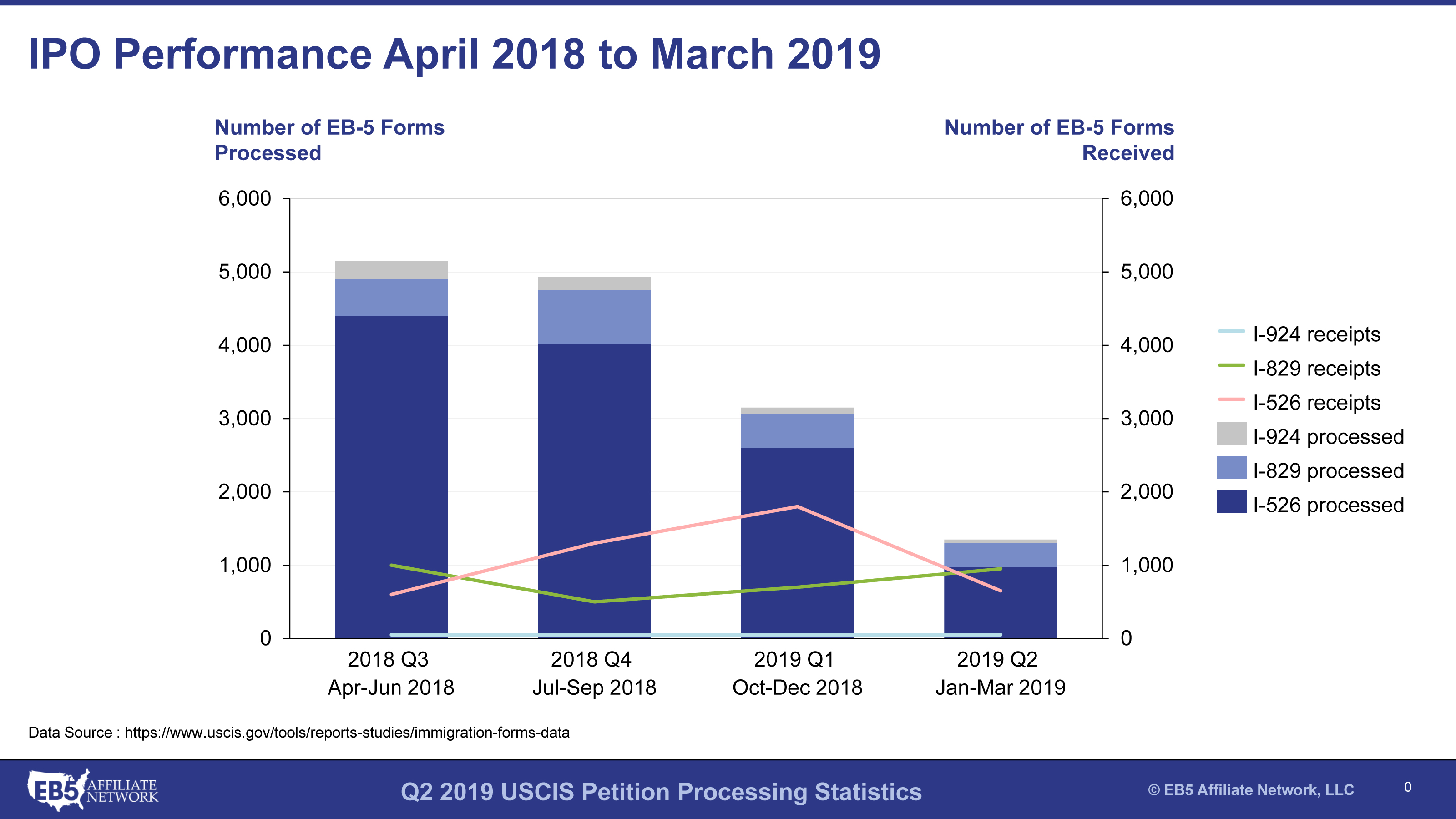
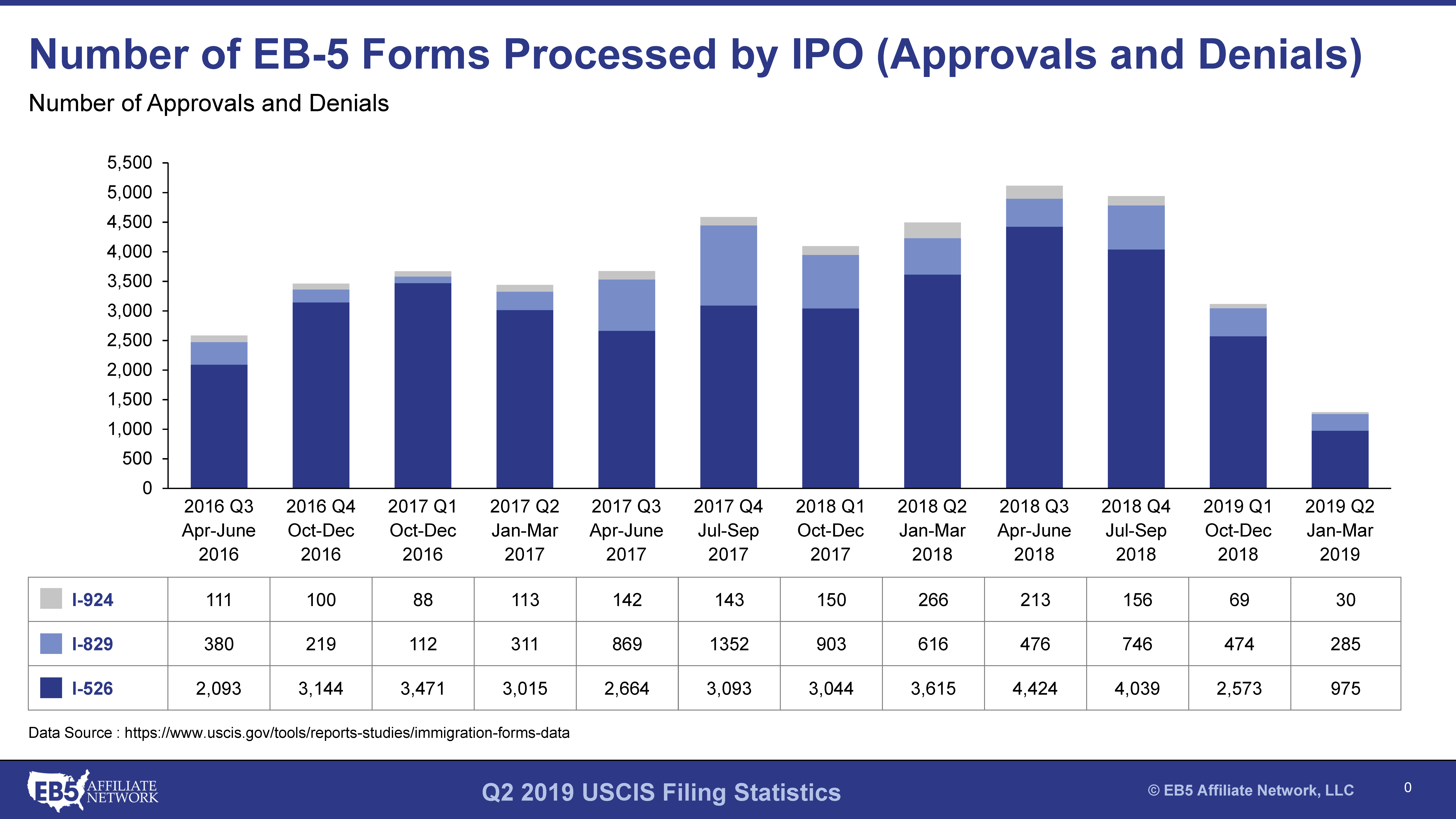
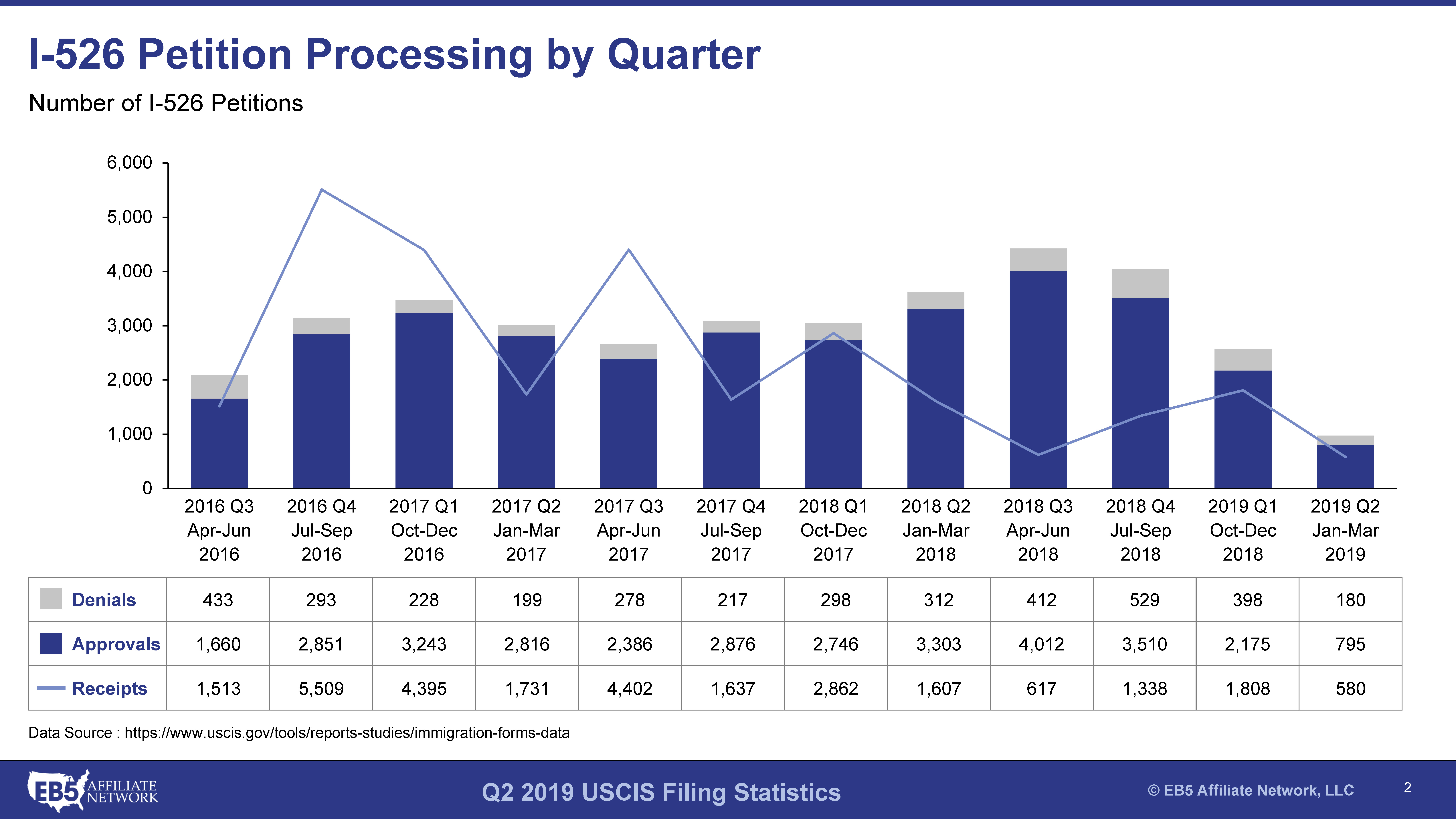
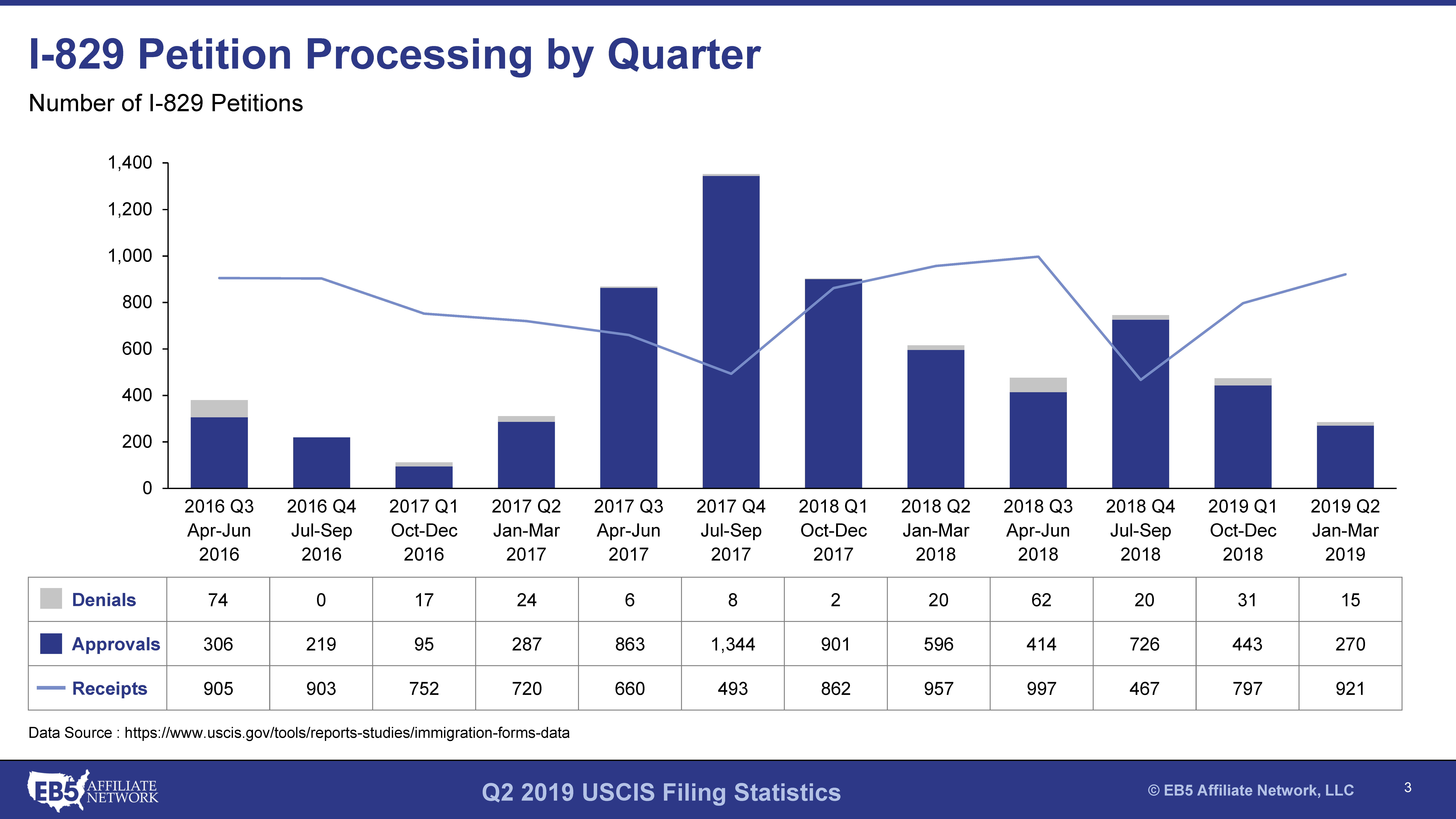
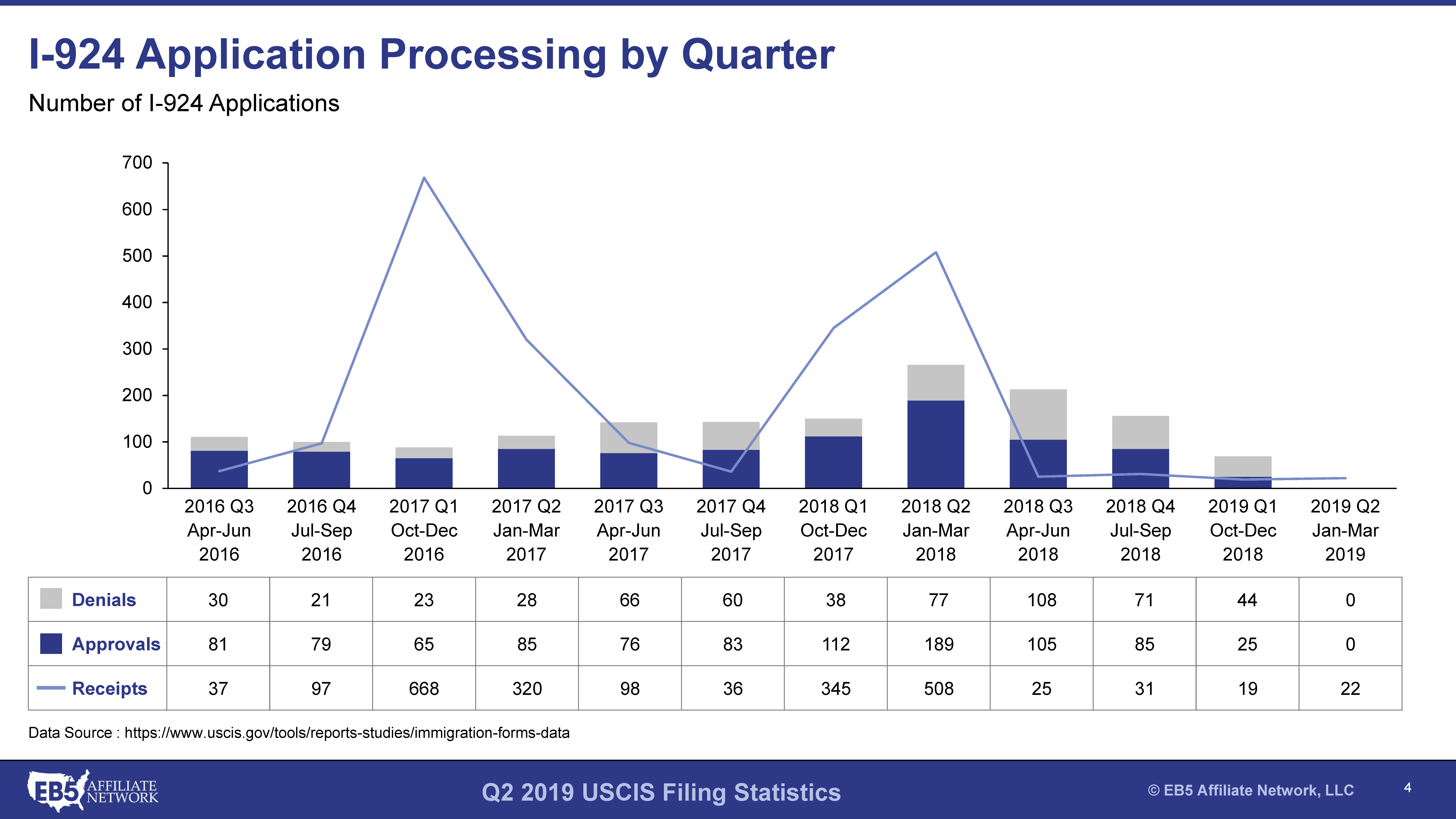
The overall number of EB-5 forms processed by the Immigrant Investor Office (IPO) during this period decreased significantly, from 4,941 in FY2018 Q4 to 3,116 in FY2019 Q1. The number of I-924 applications processed decreased from 156 to only 69, with I-829 applications falling from 746 to 474 and I-526 applications decreasing from 4,039 to 2,573. This has been the IPO’s least productive quarter since FY2016 Q3, when it processed only 2,093 applications.

Of the 2,573 I-526 petitions processed, 398 petitions were denied and 2,175 were approved.Thus, the percentage of I-526 petitions approved decreased slightly, from around 87% in FY2018 Q4 to 85% in FY2019 Q1. Additionally, I-829 application approvals decreased from approximately 97% to 93.5%, and I-924 approvals from around 54% to 36%.

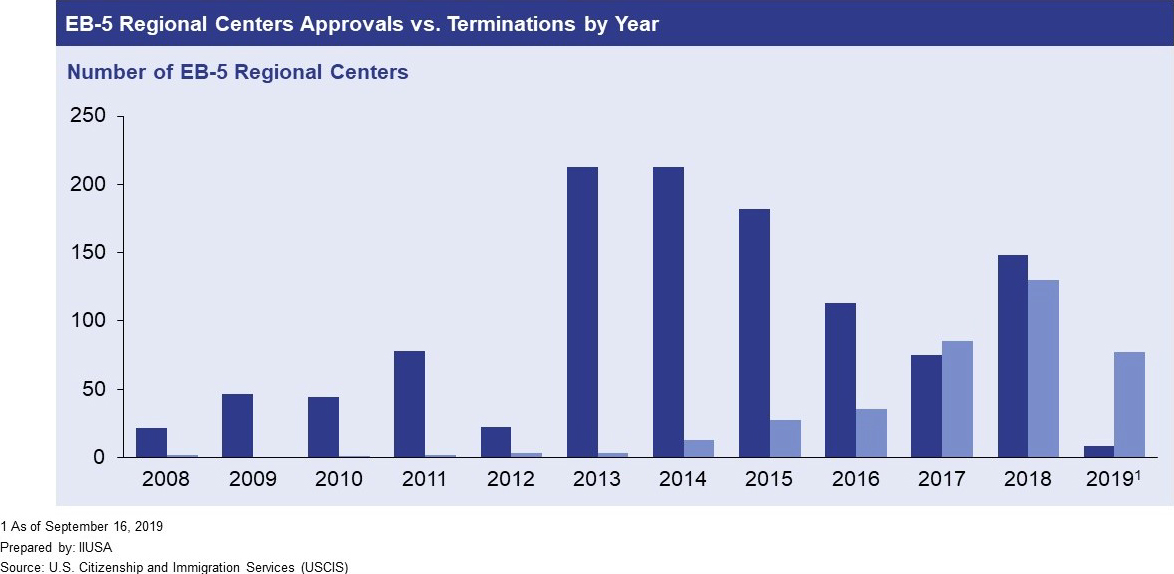
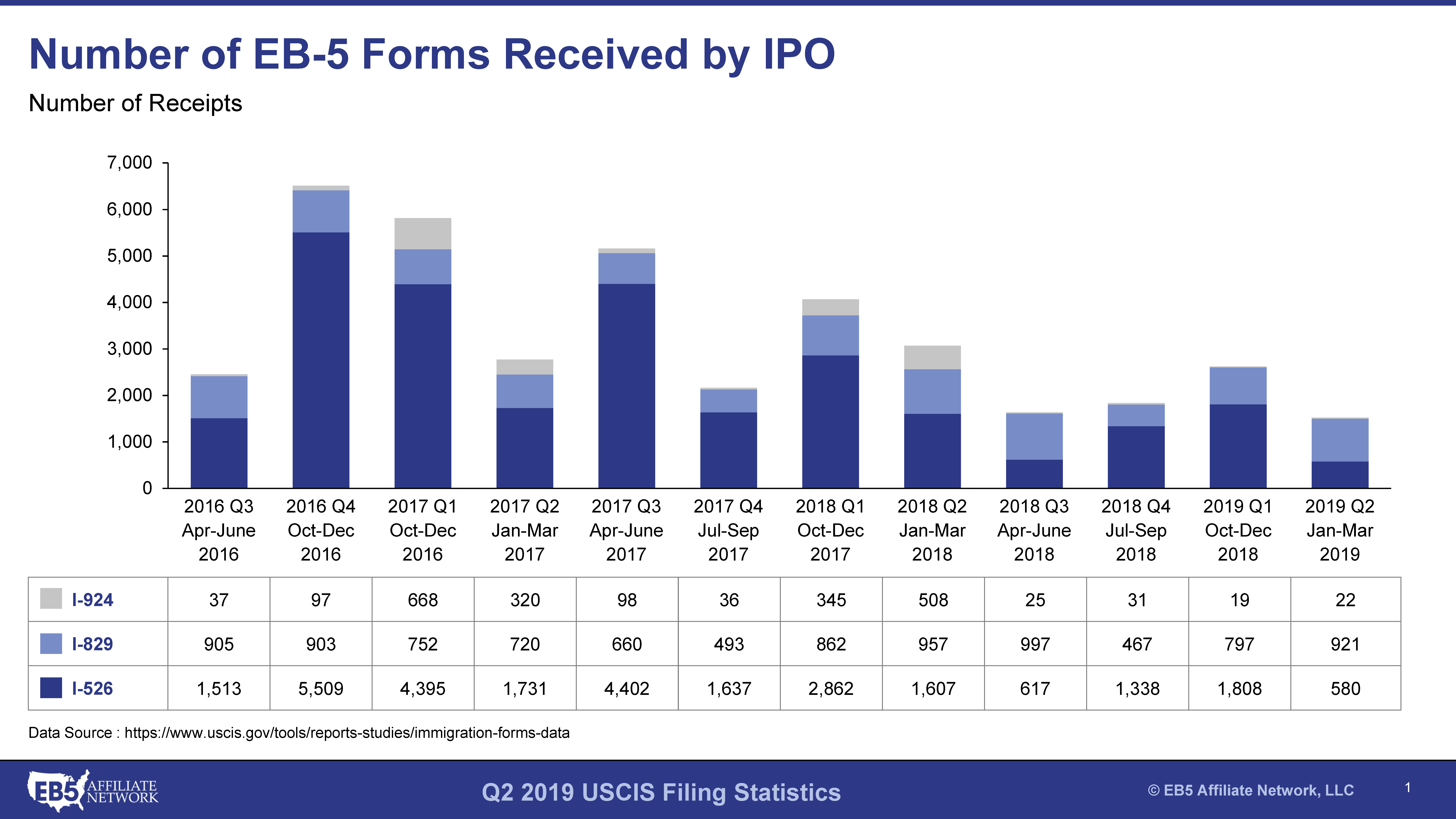
The number of I-829 and I-526 applications received increased compared to the previous quarter, at 797 compared to 467 for I-829 applications, and 1,808 compared to 1,338 for I-526 applications. The number of I-924 applications dropped from 31 to only 19, a surprisingly low number considering the 855 currently approved regional centers should file the I-924A annual report during Q4 to remain in good standing with USCIS. However, it is possible that all filings were not included in the data.

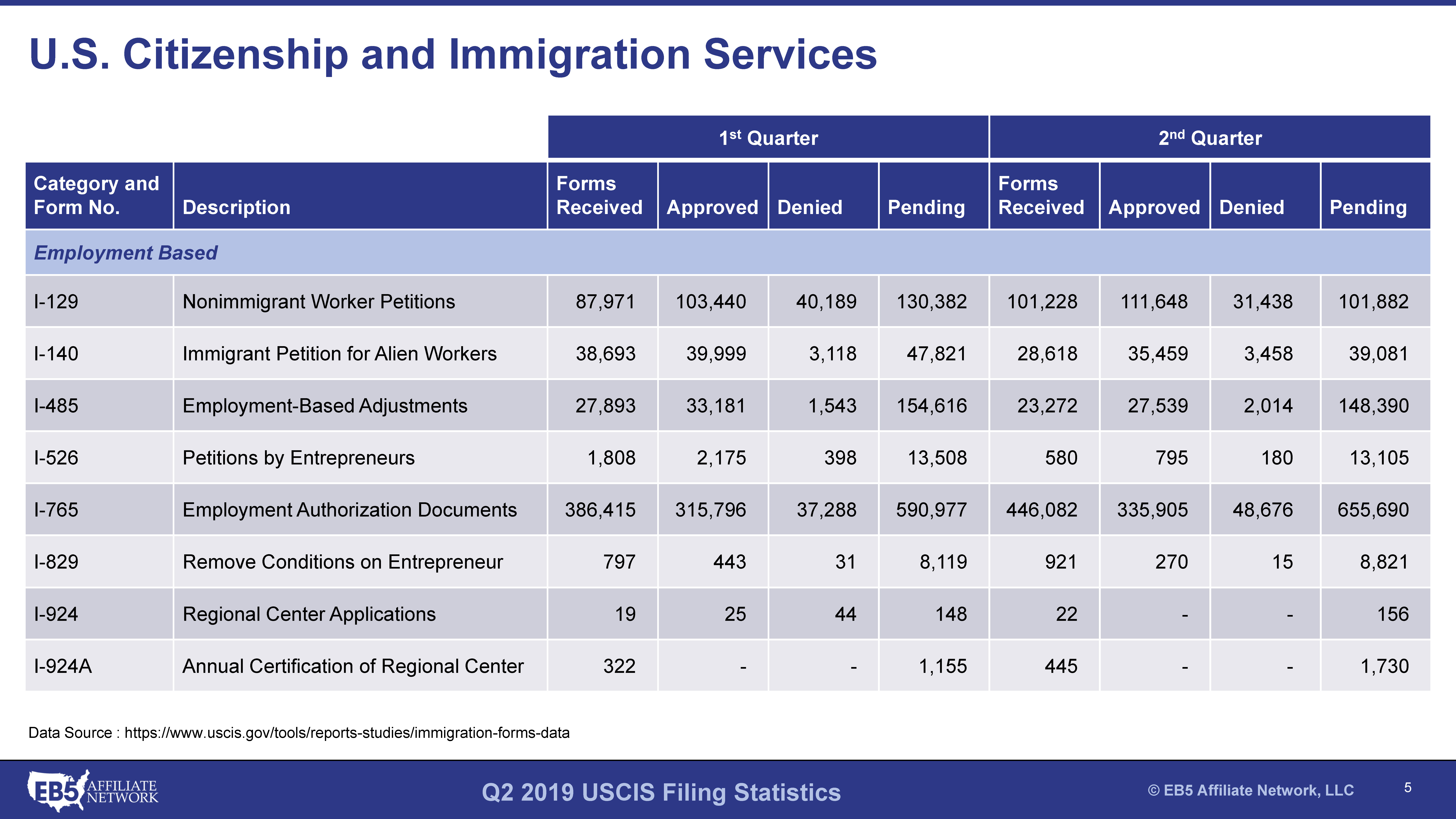
In relation to all types of employment-based petitions, those related to the EB-5 program constitute a small percentage. For example, in FY2019 Q1, USCIS received 388,338 Applications for Employment Authorization, compared to only 3,116 for all three categories related to the EB-5 program (I-526, I-829, and I-924).

A total of 21,775 petitions remain unprocessed, a number that consists of 13,508 I-526 applications, 8,119 I-829 applications, and 148 I-924 applications.Processing times for I-526 applications have increased slightly for FY2019 (up to January 31, 2019) compared to FY2018, at 20.4 months compared to 22.1 months, but processing times for I-829 petitions dropped from 27.1 months to 30.9 months for the same period.

q1uscis1
q1uscis2
q1uscis3
q1uscis4
q1uscis5
q1uscis6
Free EB-5 Project Evaluation

EB-5 Investment from Brazil

With a population of almost 212 million, Brazil now makes up the third-largest EB-5 market behind China and Vietnam, with the bonus of not yet having hit retrogression. Brazil’s interest in EB-5 visas can be attributed to the country’s recent economic downslide, its high crime and corruption rates, and its poor quality of education.

Wealth and Economy

Despite having the seventh-largest economy in the world only a decade ago, a recession in 2015-2016 shrank Brazil’s GDP by 8%, and the country is now facing high inflation and unemployment. Already 2,000 millionaires fled the country in 2017, continuing a trend seen over the last several years. Nevertheless, the number of Brazilian millionaires is expected to rise from the current 164,000 to 296,000 in 2022.

Political Landscape

Brazil has been rocked in recent years by major corruption scandals that even led to the impeachment of a former president. Bribery and fraud are commonplace in Brazil’s politics, tax management, and judicial system. The current president, Jair Bolsonaro, has authoritarian leanings and is an apologist for Brazil’s previous military regime. These factors provide a major incentive for wealthy Brazilians to leave the country.

Crime and Safety

Crime rates in Brazil have reached record highs, with a staggering 30.8 murders per 100,000 people in 2018. Organized crime, drug gang rivalries, and an under-resourced yet violent police force are all contributors. Fear of crime has dampened Brazil’s nightlife, with soldiers and tanks often appearing to keep the peace. Over 15,000 armored cars were sold in 2017 alone. A promise to curtail crime, loosen gun laws, and protect ordinary Brazilians was a large part of President Bolsonaro’s public appeal. A full 62% of young Brazilians surveyed said they would leave the country if they could, and many affluent Brazilians are trying to find a way out.

Environmental Conditions

One of the biggest environmental challenges for Brazil at the moment is deforestation. Brazil is home to the Amazon rainforest, the world’s largest tropical rainforest and a massive source of biodiversity and oxygen production. President Bolsonaro has already made moves to increase deforestation to facilitate higher agricultural production, worrying many environmental groups and activists. High pollution plagues large Brazilian cities such as São Paulo, and the country has a major crisis with waste management. On the other hand, the Brazilian government has been investing heavily in wind power for the last decade, and it is promoting international green building codes around the country.

Educational Quality

Brazilian schools have fallen far behind the recommended average in reading and math scores, exacerbating the current economic crisis. The country’s education system is troubled by inefficient spending, inadequate investment in teachers, and low-quality curricula. There are currently 2,600 public and private universities, and the government is making efforts to improve its vocational training. Nevertheless, many Brazilians are looking elsewhere for better academic opportunities for their offspring. There are already over 13,000 Brazilian students studying in the U.S., making it the tenth largest international student population in America.

EB-5 Project Selection Preferences

Brazilian EB-5 investors are keeping a watchful eye on the unstable political situation unfolding in their country. In order to protect their wealth before it is too late, many EB-5 investors in Brazil prefer to invest in projects that can produce quick results. Like other Latin Americans, Brazilian EB-5 investors lean towards working with regional centers and investing in smaller projects with physical results. However, with the time constraints posed by the current financial crisis in Brazil, the returns from Brazilian EB-5 investments are often secondary considerations.

Capital Flow and Other Challenges with the EB-5 Process

Because of Brazil’s strong trading ties with Florida, cities like Miami have become hotspots for Brazilian EB-5 investors interested in moving to the U.S. However, shifting money out of Brazil is costly and challenging, with bureaucratic banking known for its inefficiency. In addition, monthly transfers out of Brazil are limited to $10,000 BRL, or about $3,000 USD.

Marketing Channels for Investors

Brazil is the world’s fifth-largest country and providesa large source of potential EB-5 investors. However, the EB-5 market in Brazil is highly fragmented, with a nominal number of EB-5-specific immigration brokersfor investors to work with. As a result, most Brazilian EB-5 investors must go through smaller firms such as accountants, real estate brokers, travel agencies, and wealth managers. Many regional centers and project sponsors also hold workshops within Brazil to increase awareness of the EB-5 visa process, as well as targeting Brazilians already in the U.S. who are concerned about their immigration status in the current political climate.

Free EB-5 Project Evaluation

EB-5 Program 2018 Year in Review

For EB5AN, 2018 was an exciting year marked by milestones, accomplishment, and growth. Our partners collectively spent more than 200 days on the ground in foreign markets—including China, India, Brazil, Colombia, and Vietnam (along with many more)—getting a sense for where EB-5 is headed and how we can keep ahead of upcoming trends.

We have now sponsored more than 1,000 investors from more than 30 nations across our regional centers, and we continue to hold a 100% approval rate on all adjudicated USCIS petitions.

Additionally, we are proud of the recognition our company and its principals have received. We were recognized by Entrepreneur Magazine in its 2018 Entrepreneur 360 List, and Managing Members Sam Silverman and Mike Schoenfeld were recognized by Forbes Magazine.

As we enter 2019, we are excited about the opportunities ahead, and we look forward to offering our clients the highest caliber of EB-5 consulting services, Regional Center sponsorship, and document preparation. Our expanded team of specialists is able to quickly respond to client needs without sacrificing quality, and we look forward to all the new client relationships 2019 will bring.

Below, we’ll consider 2018 in light of visa issuance and petition adjudication, program reauthorization, policy updates, and industry trends. We’ve also appended a list of updates to regional centers.

Visa Issuance and Petition Adjudication

This year, the U.S. Department of State provided several key updates regarding visa issuance.

  • Estimated visa wait times for mainland-born Chinese nationals increased
  • A cut-off date was assigned to Vietnam
  • Near term backlogs for India, Brazil, and South Korea were predicted

Beyond these updates, the discussion surrounding EB-5 visa availability has become a mainstream topic, particularly as it relates to marketing projects and making investment decisions.

Currently available data shows a drop in total I-526 Petition filings in 2018, with the total by the end of Q3 standing at just 5,086. The total number by Q3 in 2017 was 10,528, and that fiscal year ended with 12,165 filings. Total adjudications for I-526 Petitions, however, increased: by Q3, 2018, approved and denied petitions totaled 11,083 compared to a total of 9,150 by Q3, 2017. Pending petitions dropped from 24,992 in 2017 to 17,126 by Q3 of 2018. This highlights an increase in processing ability and a decrease in new applications, indicating an anticipated faster timeline for adjudications.

I-829 Petitions rose in 2018, totaling 2,816 by Q3 as compared to 2,132 by Q3, 2017. Current data also reflects a rise in total I-829 adjudications. By Q3, 2018, approved and denied petitions totaled 1,968, while in Q3, 2017, adjudicated petitions totaled only 1,292 (though Q4, 2017, saw a surge in I-829 adjudications, more than doubling this total—we won’t know until new data is available how Q4, 2018, compared to the previous year).

Program Reauthorization

The EB-5 regional center program is subject to periodic reauthorization, which typically is accomplished within appropriations bills. This year, the regional center program required reauthorization five times:

  • January 19 – reauthorized on January 22 after government shutdown
  • February 8 – reauthorized
  • March 23 – reauthorized
  • September 30 – reauthorized
  • December 7 (amended to December 21) – reauthorized on January 25 through February 15 after extended government shutdown

The failure of Congress to facilitate a smooth appropriations process has resulted in a tumultuous year for the EB-5 Program and has created significant uncertainty for all EB-5 industry stakeholders.

We support legislative measures that would stabilize the EB-5 Program, particularly by either eliminating the need for regional center program reauthorization or by providing long-term authorization. Previous proposed legislation has included five-year regional center reauthorization, and the main industry groups are working to advance a bill that also includes a five-year reauthorization period. We support such efforts and hope that the appropriations drama that unfolded in 2018 does not repeat itself in 2019.

Policy Updates

Proposed regulations from 2017—which would have increased the minimum investment threshold for EB-5 investments, changed how targeted employment areas (TEAs) are certified, and more—were expected to receive a Final Rule by February 2018. The anticipated target date for the rule was then changed to November. To date, no Final Rule has been published. The public generally did not favor the draft rule, and the final details of the proposed regulations, if ever published, remain a mystery.

Despite not finalizing the proposed regulation, the Immigrant Investor Program Office (IPO) did issue four updates to the USCIS Policy Manual.

  • May 2 – Reaffirmation that USCIS does provide documentation of investors’ conditional lawful permanent resident (CLPR) status to those who have pending I-829 Petitions
  • May 15 – Rescission of prior guidance regarding tenant-occupancy methodology
  • August 24 – Updated guidance regarding regional center geographic coverage, requests to expand such coverage, and how such requests affect I-526 Petition filings
  • October 30 – Clarification concerning immigrant investors and debt arrangements

Industry Trends

This year, IPO hired a new chief, Sarah M. Kendall, held three stakeholder engagements (all in November), and issued four updates to the policy manual (as mentioned in greater detail above). As already mentioned, I-526 processing volume rose significantly and I-829 processing volume seems to have risen as well (depending on Q4 performance). The rise in petition adjudication times is welcomed, and we hope this trend continues into 2019.

The EB-5 industry in general is trending toward increased fragmentation. Investor origin is diversifying, and new investors are tending to seek out smaller, more niche regional center offerings. Investors are shifting away from larger regional centers and seem to be gravitating toward more personal opportunities in which relationship factors ultimately drive where investors are placing their capital.

Additionally, investors are growing more savvy and are being drawn to projects with reduced administrative fees, fewer intermediaries, and higher returns. Based on our information, preferred equity deals have absorbed a significant share of the market and now represent approximately half of EB-5 regional center project structures—mezzanine debt deals constituting the other half.

As we’ve observed these changes, we continue to offer clients a turnkey solution that remains flexible enough to meet fluctuations in the market. We work with our clients to find solutions that best meet their needs and are experienced at sponsoring and structuring both preferred equity and mezzanine debt deals. We see our time spent on the ground in foreign markets as an invaluable investment that has allowed us to stay on top of these trends.

For more information about how EB5AN can help you structure your project for EB-5, compile the necessary documents, affiliate with one of our regional centers, set up your own regional center, and more, please contact us at info@EB5AN.com.

Changes in Approved Regional Centers

The following regional centers were added to the approved regional center list from September 11 to December 31:

  • California – Los Angeles International Regional Center, LLC
  • California – Southern California EB-5 Fund, LLC
  • Connecticut / New Jersey / New York – York Resources RC Funding, LLC
  • Florida – BC Central Florida Regional Center LLC
  • Illinois / Indiana – Ameri-Link Midwest Regional Center
  • Nevada – Brilliant EB-5 Regional Center, LLC
  • Ohio – Ameri-Link Ohio Regional Center, LLC
  • Puerto Rico – Mayaguez Regional Center, LLC
  • South Carolina – FCA South Carolina Regional Center, LLC
  • Texas – American Equity Fund Texas, LLC
  • Texas – National EB-5 Wealth Center, LLC

The following regional centers were renamed:

  • California / Oregon / Washington – Smith Western Regional Center f/k/a Western Pacific Regional Center
  • Illinois, Indiana – Native American Regional Center, LLC, f/k/a Native American EB-5 Corporation

The following regional centers were terminated throughout the year:

  • Alabama
  • Civitas Alabama Regional Center (9/6/2018)
  • Encore Alabama/Florida Regional Center (4/3/2018)
  • Arizona
  • Central Arizona Regional Center (12/19/2018)
  • Arkansas
  • Ark of the Ozarks LLC (pending; 4/5/2018)
  • Liberty South Regional Center (1/19/2018)
  • California
  • Altura Regional Center, LLC (4/9/2018)
  • Amaxi Regional Center, LLC (5/1/2018)
  • AmerAsia EB5 Regional Center SF, LLC (6/7/2018)
  • American Altin Regional Center (8/8/2018)
  • American Dream Fund San Francisco Regional Center, LLC (10/3/2018)
  • American General Realty Advisors Regional Center (4/20/2018)
  • Build America Capital Partners Regional Center LLC (7/31/2018)
  • Build America Fund 1, LLC (8/9/2018)
  • Cal Pacific RC LLC (7/16/2018)
  • California Bond Finance Regional Center, LLC (4/12/2018)
  • California Global Alliance Regional Center c/o Lewis C. Nelson & Sons, Inc. (8/31/2018)
  • California International Regional Center LLC (7/10/2018)
  • California Investment Immigration Fund, LLC (CIIF) (3/20/2018)
  • California Pacific Regional Center, Inc (6/11/2018)
  • Central California Regional Center, LLC (4/13/2018)
  • Charter Square Regional Center, LLC (7/10/2018)
  • EB5 United West Regional Center, LLC (7/27/2018)
  • Encore S. CA RC, LLC (4/18/2018)
  • Faustus Capital LLC (5/24/2018)
  • Future Resources, Inc. (8/15/2018)
  • Global America Regional Center (4/27/2018)
  • Golden State Economic Development Fund, LLC (12/6/2018)
  • L Global Regional Center, LLC (8/20/2018)
  • Manchester Pacific Regional Center (3/28/2018)
  • New Energy Horizons Regional Center (4/12/2018)
  • QueensFort Capital California Regional Center, LLC (4/12/2018)
  • Regency Regional Center, LLC (3/15/2018)
  • Regional Economic Development & Investment Group (4/5/2018)
  • San Diego Regional Investment Center, LLC (11/16/2018)
  • SPG Regional Center, LLC (4/26/2018)
  • Colorado
  • ADC Colorado Regional Center, LLC (5/1/2018)
  • Colorado Growth Fund, LLC (5/15/2018)
  • Colorado Headwaters RC, LLC (5/24/2018)
  • Encore Colorado RC, LLC (9/24/2018)
  • Live in America – Colorado Regional Center LLC (9/7/2018)
  • Connecticut
  • High Stone Regional Center, LLC (4/9/2018)
  • District of Columbia
  • Civitas Washington D.C. Regional Center (9/5/2018)
  • EB5AN Washington, D.C. Regional Center, LLC (9/13/2018)
  • Encore Wash D.C. RC, LLC (5/25/2018)
  • TBC Washington DC Area Regional Center, LLC (4/6/2018)
  • Florida
  • BLMP Florida Healthcare Regional Center, LLC (3/30/2018)
  • Citizens Regional Center of Florida (8/24/2018)
  • Civitas Miami Regional Center, LLC (9/6/2018)
  • Cornerstone Regional Center, Inc. (4/6/2018)
  • Florida East Coast EB5 Regional Center LLC f/k/a United States Growth Fund, LLC (4/10/2018)
  • Greystone EB5 Southeast Regional Center LLC f/k/a Greystone Florida Regional Center LLC (4/13/2018)
  • Georgia
  • American YiYo Regional Center (4/12/2018)
  • Civitas Atlanta Regional Center (9/6/2018)
  • Diversified Global Investment, LLC (1/30/2018)
  • Hawaii
  • South Pacific Regional Center, LLC (3/29/2018)
  • Idaho
  • Idaho State Regional Center LLC (7/2/2018)
  • Illinois
  • American Pioneer Regional Center, LLC (3/27/2018)
  • Chicagoland Foreign Investment Group (CFIG) Regional Center (7/16/2018)
  • Civitas Illinois Regional Center (9/5/2018)
  • Indiana
  • Energize-ECI EB-5 Visa Regional Center (5/9/2018)
  • Invest Midwest Regional Center f/k/a Civitas Indiana Regional Center (8/21/2018)
  • SAA Cedisus EB-5 Projects – SW Indiana Regional Center, LLC (4/18/2018)
  • The Mid-American Regional Center, LLC (8/30/2018)
  • Iowa
  • Iowa Department of Economic Development (IDED) (4/19/2018)
  • Island of Guam

E Development Corporation dba EDC (10/15/2018)

  • Kansas
  • Southwest Kansas Regional Center (2/1/2018)
  • Kentucky
  • Midwest Regional Center, Inc. (4/5/2018)
  • Louisiana
  • Civitas Louisiana Regional Center (9/11/2018)
  • LIGTT Regional Center (pending; 4/18/2018)
  • New Orleans’ Mayor’s Office RC (2/27/2018)
  • Maine
  • New England Center for Business Development, LLC (5/9/2018)
  • Marianas Islands
  • Marianas EB5 Regional Center (5/29/2018)
  • Rota EB5 Regional Center (6/21/2018)
  • Saipan Regional Investment Center, LLC (8/1/2018)
  • Maryland
  • Maryland Area Regional Center, LLC (1/23/2018)
  • USA ODI Regional Center, LLC (3/20/2018)
  • Massachusetts
  • Americas Green Card Regional Center (7/12/2018)
  • Encore Boston RC, LLC (4/18/2018)
  • Queensfort Capital Massachusetts Regional Center, LLC (3/29/2018)
  • Michigan
  • Civitas Michigan Regional Center (9/6/2018)
  • Lansing Economic Development Corporation (LEDC) Regional Center (1/23/2018)
  • Michigan-Indiana EB-5 Regional Center (3/29/2018)
  • Mississippi
  • Gulf Coast Funds Management, LLC (8/30/2018)
  • Northern Mississippi Regional Center, LLC (9/7/2018)
  • Nebraska
  • White Lotus Group Regional Center (6/26/2018)
  • Nevada
  • Nevada Development Fund LLC (7/12/2018)
  • Silver State Regional Center LLC (4/11/2018)
  • New Jersey
  • East Coast Renewable Regional Center, LLC (4/9/2018)
  • G.R.E.E.N. Regional Center (4/2/2018)
  • North American Regional Center (8/2/2018)
  • New York
  • North Atlantic Regional Center, LLC (5/1/2018)
  • Queens Fort New York Regional Center, LLC (3/28/2018)
  • North Carolina
  • Carolina EB-5 RTP Regional Center, LLC (12/20/2018)
  • Encore Raleigh/Durham Regional Center (4/2/2018)
  • North Dakota
  • Landy Resources Management, LLC (5/1/2018)
  • Ohio
  • Mag Ventures 1, LLC (9/11/2018)
  • Northeast Ohio Regional Center (7/18/2018)
  • Ohio Lakeside Regional Investment Center (5/1/2018)
  • Oklahoma
  • 5 Starr Regional Center LLC (4/5/2018)
  • Chen Roberts Regional Center (3/9/2018)
  • Civitas Great Plains Regional Center (9/12/2018)
  • Oregon
  • American International Venture Fund – Oregon, LLC (4/9/2018)
  • APIC Regional Center, LLC (8/8/2018)
  • Pennsylvania
  • Encore Pennsylvania RC, LLC (EPRC) (8/20/2018)
  • Liberty EB5 Regional Center (5/1/2018)
  • Puerto Rico
  • Commonweaith of Puerto Rico Regional Center Corporation (4/25/2018)
  • Omega Puerto Rico Regional Center, LLC (2/15/2018)
  • Reside in America Puerto Rico, LLC (5/1/2018)
  • South Carolina
  • Southeastern Higher Education Regional Center (1/2/2018)
  • USHoldings Regional Center (9/24/2018)
  • South Dakota
  • South Dakota International Business Institute (SDIBI) (5/11/2018)
  • Tennessee
  • EB5 Memphis Regional Center, LLC (2/26/2018)
  • Texas
  • Central Texas Properties Regional Center (3/27/2018)
  • Central Texas Regional Center (8/21/2018)
  • Civitas Laredo Regional Center, LLC (9/6/2018)
  • Civitas Rio Grande Regional Center (9/10/2018)
  • Collegiate Regional Center LLC d/b/a Texas Collegiate Regional Center (pending; 5/15/2018)
  • Global Century (Houston) (4/12/2018)
  • Greater Houston Investment Center, LLC (1/26/2018)
  • Home Paradise Texas Regional Center, LLC (4/17/2018)
  • One World Development Fund, Inc. (4/12/2018)
  • QueensFort Capital Texas Regional Center, LLC (4/27/2018)
  • RGV EB-5 Regional Center (7/10/2018)
  • South Texas EB-5 Regional Center, LLC (3/27/2018)
  • US Freedom Capital-Texas, LLC (9/18/2018)
  • Utah
  • Utah Invest Regional Center, LLC (7/3/2018)
  • Vermont
  • Vermont Agency of Commerce and Community Development (7/3/2018)
  • Washington
  • American Bridge Seattle Regional Center, LLC (8/1/2018)
  • Encore Washington/Oregon Regional Center, LLC (4/18/2018)
  • Great Ocean Regional Center (7/30/2018)
  • Liongate Regional Center, LLC (4/27/2018)
  • Pacific Northwest Regional Center (4/5/2018)
  • Pacific Viniculture (3/22/2018)
  • Tacoma EB 5 Regional Center (5/2/2018)
  • Washington Foreign Investment Management Group, LLC (4/26/2018)
  • Washington State Regional Center (7/31/2018)