Free EB-5 Project Evaluation

All About EB-5 Regional Centers

The Visa Bulletin for April 2022 At a Glance

The EB-5 Immigrant Investor Program has long been a common pathway for foreign nationals to obtain permanent residency status in the United States, exploding in popularity in the 2010s after severe underutilization in its first two decades of existence. But it isn’t the EB-5 program itself that accounts for most of these EB-5 investments—it’s the EB-5 Regional Center Program. Regional centers are overwhelmingly the preferred vehicle for EB5 investments for a number of reasons. In fact, in FY2019, 96% of investors made their EB-5 investment through a regional center.

The EB-5 Regional Center Program was born in 1992, just two years after the EB-5 program itself. Its purpose was to consolidate EB-5 investment funds from different investors to drive more economic growth and achieve higher job creation figures. Since its initial creation, the program has faced several reauthorizations but has yet to be established as a permanent immigration program, even though EB-5 itself is a permanent visa category. After several months of deauthorization since June 2021, the regional center program was revalidated in March 2022 by the EB-5 Reform and Integrity Act.

What Is a Regional Center?

A regional center is a commercial entity that promotes and manages EB5 investment funds and funnels them into select new commercial enterprises (NCEs) that qualify for the EB-5 program. Most regional centers are limited partnerships or limited liability corporations and may be owned privately or publicly or through a public–private partnership. In most cases, they rely on third-party intermediaries to promote their EB5 investment opportunities to prospective investors, although the rise of the internet opens more avenues for regional centers to conduct recruitment themselves.

A regional center must obtain designation from United States Citizenship and Immigration Services (USCIS) by filing Form I-924. Regional centers apply for designation in a specific geographic area, which can be as large as multiple states and as small as a single county. To maintain their regional center designation, they must demonstrate to USCIS in their annual I-924A report that they are promoting economic growth throughout their entire region of designation. Regional centers may apply to adjust their geographic reach.

Regional Center Terminations

The number of USCIS-approved EB-5 regional centers has followed the same trend as the EB-5 program itself. In 2007, USCIS only listed 11 approved regional centers across the United States, a figure that exploded over the proceeding decade to 674 as of December 2020. However, December 2020’s figure comes off the trail of rampant regional center terminations since 2018. Also in December 2020, USCIS listed a whopping 532 regional centers that it had terminated since 2008, with 73% of those meeting their end since 2018. This highlights the importance for foreign nationals considering making an EB-5 investment through a regional center to conduct careful due diligence before committing their funds.

It is worth noting, however, that a regional center termination only affects investors who have yet to receive their conditional permanent resident status. Foreign nationals (and their immediate family members) who make an EB5 investment through a regional center and obtain conditional permanent resident status after I-526 petition approval are unaffected by their affiliated regional center being terminated, as long as they continue to demonstrate compliance with program regulations. Moreover, the Reform and Integrity Act introduced provisions for innocent investors whose regional centers are terminated—they can now reinvest in another project without losing their processing priority date.

Benefits of Regional Center EB-5 Investment

Why do the majority of EB-5 investors choose regional centers? After all, the EB-5 Regional Center Program is only temporary, whereas the base EB-5 Immigrant Investor Program is permanent.

The overall EB5 investment process is usually much more streamlined and secure for regional center investors. The program requirements remain the same, but the program offers two key differences that facilitate the process for investors: relaxed job creation calculation methodology and differently structured governance that affords investors more freedom.

Anyone who makes an EB-5 investment must demonstrate the creation of at least 10 new jobs for U.S. workers to qualify for the permanent resident immigration benefits the program offers. However, while direct EB-5 investors are restricted to direct jobs listed on the NCE’s payroll—which may be impossible for certain types of businesses—regional center investors may additionally count indirect and induced jobs. Indirect jobs are those created by the NCE’s expenditures on external goods and services, while induced jobs are those created in the community by the local spending of the NCE’s employees. Hiring a third-party economist and using approved calculation methodologies, a regional center investor can meet the 10-job EB-5 requirement much more easily than a direct investor.

Next is the different governance structure of regional center EB5 investments, where investors typically serve as limited partners, voting on important business decisions. This is enough to satisfy the requirement of active involvement in the NCE and can be accomplished remotely, allowing an EB-5 investor to live anywhere in the United States, even if it’s far away from their EB-5 project. It also allows those with limited managerial experience to participate in the EB-5 program. Direct investors, conversely, generally engage in the daily management operations of the NCE, which may necessitate managerial know-how and require them to live near the business.

Free EB-5 Project Evaluation

The Visa Bulletin for April 2022 At a Glance

The Visa Bulletin for April 2022 At a Glance

The Department of State (DOS) has released the Visa Bulletin for April 2022. For the EB-5 industry, this monthly publication shows which investors are eligible to apply for and receive their two-year conditional green cards after their I-526 petitions have been approved. This information only pertains to investors from oversubscribed countries with a particularly high demand for the EB-5 visa. However, investors from countries that could potentially become oversubscribed also do well to keep track of the trends presented in each Visa Bulletin.

Chart A, Final Action Dates For Employment-Based Preference Cases

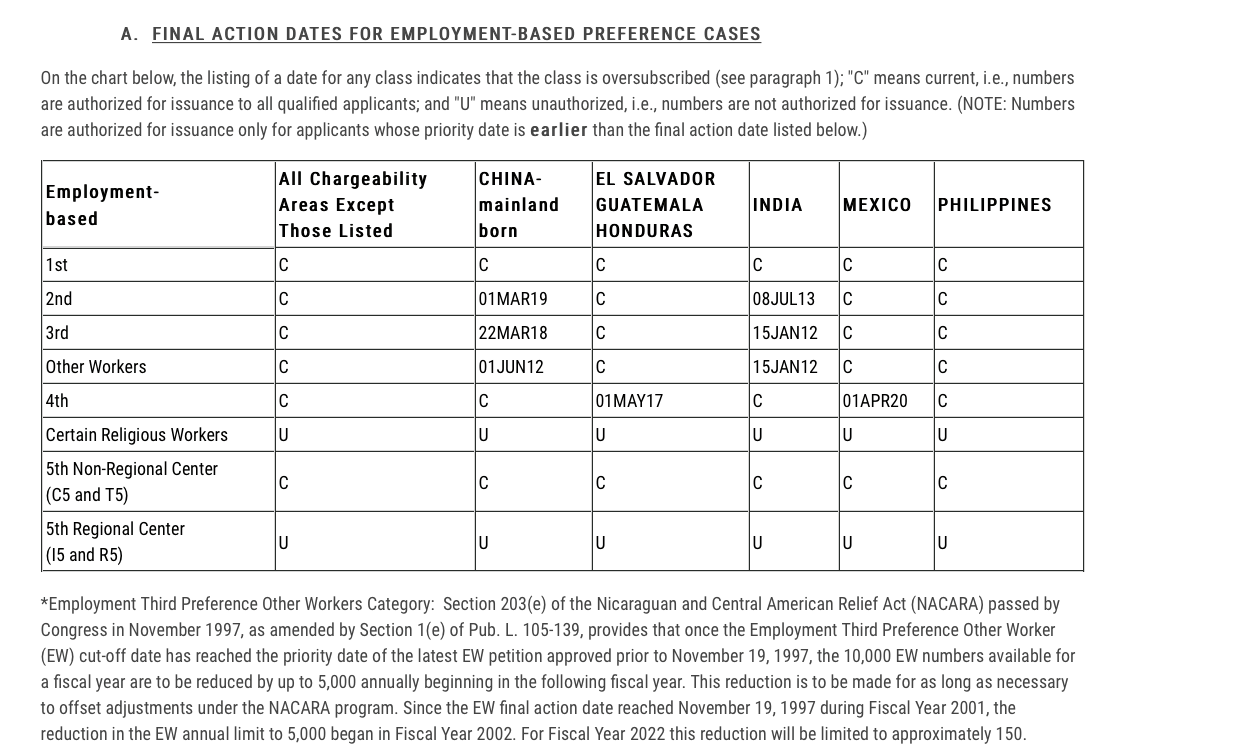
The April 2022 Visa Bulletin does not reflect any changes from the previous month’s cutoff dates. All regional center investors in Chart A are still marked as “Unauthorized”, and direct (that is, “non-regional center”) investors still enjoy “Current” status. For the time being, Chinese investors who receive approval for Form I-526 can apply for and receive their two-year conditional Green Cards as soon as these are available. Chinese investors had experienced a processing backlog from 2015 until the December 2021 Visa Bulletin, but it is unclear if this nationality will enter retrogression once more in the coming months.

Chart B, Dates For Filing Of Employment-Based Visa Applications

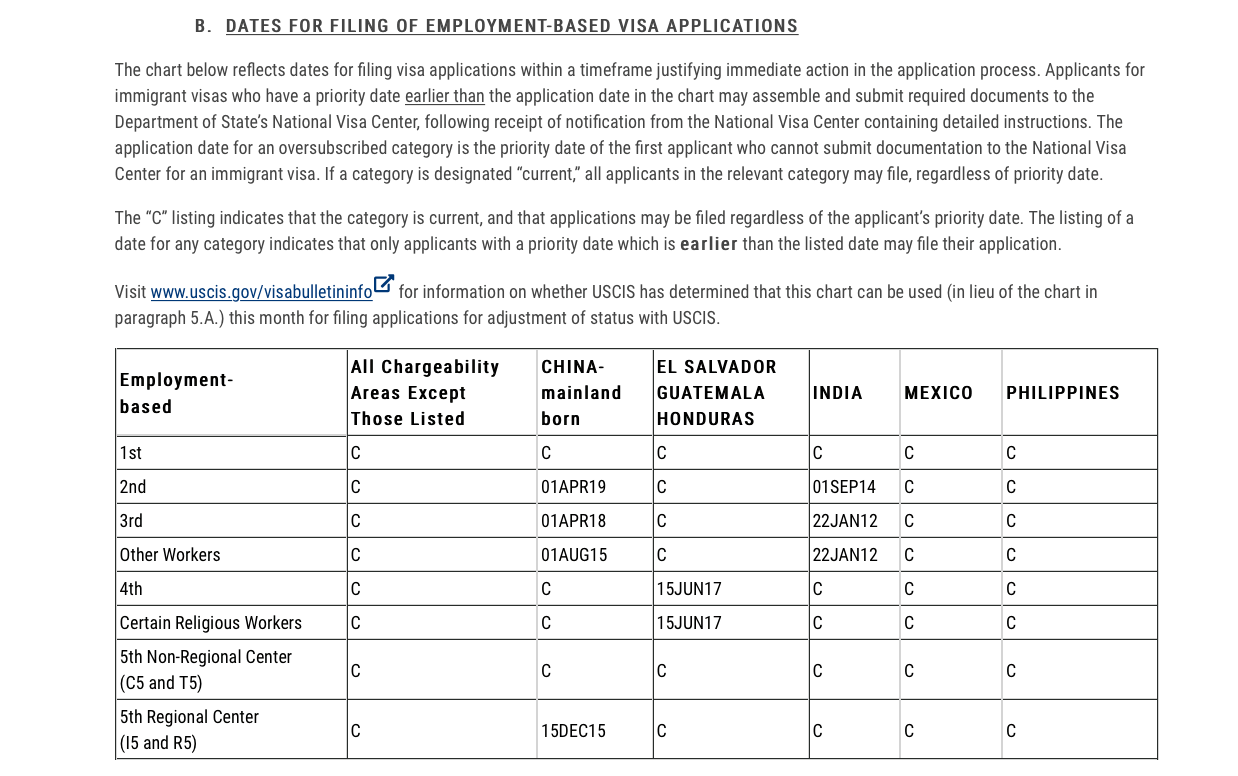
The dates for filing only apply to Chinese investors when the country is undergoing visa retrogression, and they restrict when Chinese nationals with approved I-526 petitions can apply for their initial visas. As in Chart A, all Chinese direct investors have no date for filing, but investors in regional center-sponsored projects have a date for filing of December 15, 2015. This means that regional center investors from China with a I-526 filing date later than December 15, 2015, will not be able to apply for their visas.

A Watershed Period in the EB-5 Investment Industry

The April 2022 Visa Bulletin comes at an important time in the EB-5 program’s history: on March 15, 2022, the EB-5 Reform and Integrity Act was signed into law. This bill reauthorized the regional center program and made many other changes to increase the transparency and safety of EB5 investment offerings. Even though regional center investment was revalidated through 2027, this change will only be made effective starting in May 2022. As a result, the April 2022 Visa Bulletin still marks regional center investors as “Unauthorized” in Chart A. It will be intriguing to find out whether the return of regional center EB-5 visa applications will result in backlogs for countries such as China or India.

Free EB-5 Project Evaluation

Guidelines for Submitting Form I-526

Guidelines for Submitting Form I-526

The first step in the EB-5 visa process is the irrevocable commitment of investment funds in a new commercial enterprise (NCE) in the United States. After that, investors must submit Form I-526, Immigrant Petition by Alien Investor. In this form, investors should include details about the terms of the project they have invested in. In addition, foreign nationals should include documentation supporting the fact that their funds have come from credible sources and that the applicable taxes have been paid. This form is reviewed by United States Citizenship and Immigration Services (USCIS) and, should it determine that their requirements were met, the investor and their immediate family members are granted a two-year residency status.

Although it is a safe pathway to U.S. permanent residency, the EB-5 investment process is not without its challenges. USCIS carefully scrutinizes every detail of Form I-526 and, if they find that there is information missing or something was done incorrectly, they may send a request for evidence (RFE). This doesn’t necessarily mean that the petition will be denied, but it does add another layer of time to a historically slow process.

In order to avoid additional requests for information, potential investors and their immigration attorneys should pay careful attention to an aspect of Form I-526 that demonstrates the financial viability and stability of the EB5 investment project: the business plan.

Potential for Financial Success

A solid EB-5 investment project business plan will show USCIS that the project will successfully meet the job creation criteria, have a positive impact on the economy, and be financially viable. In order to do that, the business plan has to detail how the NCE will operate, including a marketing strategy, a projected budget, and a market analysis from a third party. All aspects of the business plan are important, but the market analysis supports the project developers’ projections for the NCE’s success. The projects most likely to receive approval are the ones that are only using the EB-5 investment funds as a small portion of the business’ overall capital. An overdependence on EB-5 investment funds shows that the business is not financially viable.

Another key factor to keep in mind is consistency throughout the business plan. These may seem like harmless mistakes, but if the information contained in the business plan is not consistent, USCIS is likely to deny the petition. It is in the best interest of the project developers and investors to carefully look over the petition and ensure there are no discrepancies.

Meeting EB-5 Investment Regulations

Prior to irrevocably committing their funds, investors should consider several factors. It is critical that the EB5 investment project not only be a sound, financially viable business, but that it also meets USCIS regulations. One example is ensuring that the NCE can created the required minimum of 10 jobs per investor. In addition, investors should ensure that they’ve met the required minimum investment threshold which, as of March 2022, is $1,050,000 for projects that are not in a targeted employment area (TEA). Projects that are in a TEA have an investment threshold of $800,000.

Meeting the job creation requirement is a key obligation of every EB-5 investment project. After all, the program was created to benefit the U.S. economy while also providing a pathway to U.S. residency for foreign nationals. The minimum of 10 jobs must be available for the entirety of the two-year conditional residency period granted to investors and must be filled by persons who are lawfully authorized for employment in the United States. In addition, the type of employment that can be counted towards the required minimum will depend on the investment model that is being used. The regional center model allows for indirect and induced employment (those that are created by the NCE’s overall economic impact) to be counted. By contrast, direct investments only allow jobs that are directly created by the NCE to count towards the required minimum.

The EB-5 visa process can at times seem overwhelming, which is why it is recommended that foreign nationals choose an immigration attorney with substantial expertise in the industry to guide them through the process.

Free EB-5 Project Evaluation

Changes to the EB-5 Industry Under the EB-5 Reform and Integrity Act

Changes to the EB-5 Industry Under the EB-5 Reform and Integrity Act

After several stopgaps, Congress passed the omnibus spending package on March 11, 2022. This spending package included an EB-5 reform bill, known as the EB-5 Reform and Integrity Act of 2022. The Integrity Act marks the most significant change to the EB-5 investment program since its beginning more than 30 years ago. On March 15, 2022, President Biden signed the spending package, known as the Consolidated Appropriations Act, which put all new measures into immediate effect.

What’s Included in the EB-5 Reform Bill

  • After the longest suspension in its history, the EB-5 Regional Center Program received reauthorization through September 30, 2027. This is the longest reauthorization the program has received since 2015.
  • Pending I-526 petitions from regional center investors will be allowed to continue in the EB-5 visa process, and any petitions made on or before September 30, 2026 will be adjudicated without dependence on the program’s reauthorization. This will avoid having investors in “processing limbo” should the program experience another lengthy suspension.
  • Minimum investment thresholds have increased once again from $500,000 for projects in targeted employment areas (TEAs) to $800,000. Projects not located within TEAs now have an investment threshold of $1,050,000, up from $1,000,000. To account for inflation, these thresholds will be adjusted every five years.
  • United States Citizenship and Immigration Services (USCIS) will now be in charge of designating high-unemployment TEAs.
  • Regional center EB-5 investment projects will still be allowed to count indirect employment to meet the job creation requirement, but only for 90% of the jobs. This means that these projects will now have to create at least one direct employment position.
  • Form I-526 and Form I-485 can now be filed simultaneously.
  • New integrity measures have been put into place to ensure transparency in the EB-5 process. For example, a new integrity fund has been created, requiring regional centers to contribute $10,000–$20,000 each year.
  • 20% of the EB-5 visa pool will be reserved for projects in rural TEAs.

The Impact of These Changes on Current and Potential Investors

The most pressing issue in the EB-5 investment industry has been the reauthorization of the regional center program. The program had been defunct since June 2021, leaving investors with pending I-526 petitions without any guarantees regarding what would happen to their investments and their dreams of U.S. permanent residency. The Integrity Act renews the trust in the program as a safe investment with the “grandfathering” clause, which ensures that each I-526 petition will be adjudicated regardless of the reauthorization of the program. This will also avoid further litigation against the EB-5 program.

With the lapse in the regional center program, direct EB5 investment projects have taken center stage in the industry, and all direct investors have had “current” processing status for months. This may change in the near future, with the reauthorization of the regional center program potentially creating backlogs for countries with high demand, such as China. These countries may experience cutoff dates, which will create challenges in the traditionally slow adjudication process. Faster processing times for I-526 petitions are now more important than ever. Investors from high demand countries may be more interested in rural TEA projects, as those will be the priority and may receive approval prior to cutoff dates being imposed.

Advantages for Holders of Different Visas

Investors who currently reside in the United States under an H-1B or E-2 visa benefit tremendously from the ability to file Form I-526 and I-485 concurrently. Submitting both forms at the same time allows them to receive more immediate work authorization and avoid consular visa processing. In addition, when submitting Form I-485, they will not be held liable for any status violations less than 180 days.

Indian nationals, who made up 75% of the H-1B visas granted in fiscal year 2020, may be particularly interested in filing Form I-485 simultaneously with Form I-526. However, there is an exception to the simultaneous filing, in that investors from high-demand countries that are subject to cutoff dates may not file both forms at the same time. Since India is at risk of cutoff dates being imposed in the near future, Indian nationals with H1-B visas who are planning on investing in an EB-5 project should not delay in contacting an immigration attorney to begin the process.

Expedited EB-5 projects are also a good option for H1-B and E-2 visa holders. These projects allow investors the benefit from decreased processing times for I-526 petitions. These typically offer the most benefit to investors who are currently residing outside of the United States, as they would be able to relocate within a matter of months, rather than waiting years for their conditional permanent resident status. It would be wise for investors to consider projects with the possibility of being granted expedited status.

The new changes to the EB-5 investment industry have the potential to increase the transparency and efficiency of the EB-5 visa process for all stakeholders. While investors stand to gain the most benefits, this extensive reform holds the promise of improving the industry as a whole. EB5AN is always available to provide guidance on the process.

Free EB-5 Project Evaluation

What is Expedited EB-5 Visa Processing?

What is Expedited EB-5 Visa Processing?

For foreign nationals with plans to make the United States their new home, the EB-5 investment program has been a historically safe option. Contrary to other, riskier options, the EB-5 investment program has proven to be a reliable and transparent means of achieving U.S. permanent resident status, not only for investors, but for their immediate family members as well.

One aspect of the EB5 investment program that has caused inconveniences is the lengthy processing times. United States Citizenship and Immigration Services (USCIS) has been known to take more than two years to process Form I-526 petitions. In contrast to other immigration pathways, two years may not seem like a long time. But for an investor who is eager to begin their life in the United States, or whose children are approaching the age limit to qualify under their parents’ EB-5 visa, the more efficiently their petition can be adjudicated, the better. In addition, investors’ projects are also at risk of having to make significant changes to their project should they run into unforeseen challenges. This is far more likely to occur with longer processing times.

Thankfully, project developers have the option to significantly decrease processing times. USCIS offers expedited status for projects that meet certain criteria.

Projects of Interest to the U.S. Government

An EB-5 investment project that is granted expedited status can decrease its processing times from years to mere months. The general time period is anywhere from four to ten months, which is significantly better for the investors, and also for the project itself. Developers have faster access to the investment capital. In addition, the sooner the project can get underway, the sooner the economy can see the benefits of the project, including job creation.

How Does a Project Gain Expedited Status?

Expedited EB-5 investment projects are rare. To qualify for expedited status, the project must meet at least one of several specific criteria. The most prominent criterion is that the project must be one that is of urgent interest to the U.S. government. Examples of such projects include a new housing development for displaced families or an addiction treatment center to combat the opioid crisis.

Why Should Investors Consider Expedited EB-5 Projects?

Very few projects are granted expedited status. Foreign nationals who are presented with the opportunity to invest in one should certainly consider it—expedited processing could allow investors and their families to be granted U.S. permanent resident status far sooner.

Expedited EB-5 investment projects are a great opportunity, but also carry a greater financial and immigration risk for investors. Foreign nationals who plan to invest in an expedited project should begin the process as soon as possible, contact an immigration attorney and do their due diligence to find the best direct investment project for them.

Free EB-5 Project Evaluation

Behring Companies Takes Legal Action in an Attempt to Force the Reauthorization of the Regional Center Program

The EB - 5 Visa is an Excellent Option for Canadian Citizens Looking to Immigrate

The regional center program, formerly the most common EB-5 investment model, has been defunct since June 2021. As a result, many investors have been unable to continue the EB-5 visa process, with no guarantees regarding if or when the program will be reauthorized. In an effort to force the program’s reauthorization, Behring Companies filed a lawsuit against United States Citizenship and Immigration Services (USCIS), the Department of State (DOS), and the Department of Homeland Security (DHS). If successful, these government agencies will be forced to process I-526 petitions from regional center investors, which have been paused since the summer of 2021 and to reauthorize the regional center model.

Behring has a track record of success in taking legal action against government agencies related to the EB-5 industry. In June 2021, the company won a court case that repealed the EB-5 Modernization Rule, which lowered the minimum EB5 investment thresholds back to $500,000. As of February 2022, the court’s decision in that case still stands.

The Urgency Behind Reauthorizing the Regional Center Program

The regional center EB-5 investment model has many stakeholders, from investors and their families to business owners, immigration attorneys and more. As a result of the program’s suspension, which as of February 2022 has gone on for eight months, all of these stakeholders have faced serious inconveniences. The regional center program is subject to frequent reauthorization and has experienced a very brief lapse before, which led all stakeholders to believe that this suspension would be resolved quickly. However, since reauthorization is still pending, investors haven’t been able to continue in their EB-5 investment visa process, regional center projects have been put completely on hold, and billions of dollars may be at risk.

Behring’s lawsuit is representative of the feelings of the thousands of investors and other stakeholders who simply want to have their I-526 petitions adjudicated and be able to move on from this challenging time.

There is hope that the regional center program will be reauthorized as early as March 11, 2022. What the program really needs is permanent reauthorization, but it is certainly in the best interest of everyone in the industry for the program to receive at least temporary reauthorization as quickly as possible.

Free EB-5 Project Evaluation

The EB-5 Visa Is An Excellent Option For Canadian Citizens Looking To Immigrate

The EB-5 Investment Program is a great option for foreign nationals who are planning to relocate to the United States. In the decades since its creation, the program has helped thousands of investors and their families gain U.S. permanent residency.

With its unique advantages and business opportunities, the EB-5 program offers a gateway to permanent residency for qualified investors and their families. It also allows them to invest in the thriving U.S. economy.

If you’re Canadian and wondering whether the EB-5 program is right for you, this article can help you understand what it’s all about. In it, we discuss why the EB-5 visa is such an excellent immigration opportunity, and everything you need to know to apply successfully.

Why Are Canadians Moving to the United States?

Although Canada has historically been a country with a very high quality of life, many of its most attractive characteristics have faced challenges in recent years. This has led to a rise in the number of Canadians looking to move to the U.S. to secure a brighter future for their families.

Many students also move to the U.S. and account for more than one million of the international learners currently enrolled in schools. To add to this, the U.S. is a popular choice among foreign workers who can obtain temporary employment through H-1B visas.

Data from the Migration Policy Institute shows that many Canadians have moved to the U.S. for a better quality of life. Over 95% of Canadian immigrants have access to healthcare in America, and around 65% of those who move to the U.S. are able to find full-time employment.

Canadians may also consider moving to the U.S. because of its lower taxation rate. Data shows that, in 2021, as much as $14,493 per capita was collected for tax in Canada, whereas only $11,365 per capita was collected in the U.S.

There are currently more than 800,000 Canadians living and working in the United States, making up around 60% of immigrants in this country. Of those, around 30% have settled in California and Florida, two states known for their excellent living conditions and work opportunities.

Why Is the EB-5 Program a Great Option for Canadians?

The EB-5 Immigrant Investor Program is an appealing investment opportunity for Canadians looking to immigrate to the United States. With the potential to obtain citizenship, the program offers long-term residency stability and access to various benefits in a strong economic environment.

Unlike many other immigration pathways, the EB-5 program allows participants to bypass many of the complexities foreign nationals face when they want to secure permanent residency. With the EB-5 program, investors won’t have to worry about securing employer sponsorship or adhering to strict travel regulations to maintain their residency status.

The program allows foreign nationals to become business owners by investing in EB-5-approved projects. Not only do these projects promote economic growth, but they also give investors a great opportunity to expand their investment portfolios. Investors can also live and work anywhere in the country, including in any of the nine states that don’t require income taxes.

Brief overview EB-5 program

The EB-5 Immigrant Investor Program is run by the United States Citizenship and Immigration Services (USCIS) and provides an opportunity for foreign investors to obtain permanent residency in the country.

The program requires applicants to make a qualifying investment of at least $800,000 into a new commercial enterprise (NCE) if the NCE is located in a targeted employment area (TEA), or $1,050,000 if it’s not. An NCE is an entity designed to create and maintain at least 10 jobs for full-time U.S. workers.

Investors can also choose to invest money through the EB-5 regional center program—largely because of new project regulations that were approved in 2022—which offers different job creation opportunities within the project.

Certain EB-5 program requirements are a bit more flexible when you make an investment via a regional center. For example, investing in a regional center allows both indirect and direct jobs to be counted towards the required total of 10. If you invest directly in an NCE, you can only count direct jobs.

Wondering which EB-5 investment would work for you? Consider our Twin Lakes Georgia EB-5 Project. You can find more details HERE.

The advantages of the EB-5 Investment Program for Canadians

Applying for U.S. citizenship through the EB-5 program has various advantages for Canadian investors:

  • Faster pathway to obtaining a Green Card: The EB-5 program is generally considered as one of the fastest ways to gain permanent residence in the U.S., because it’s not restricted to visa limitations. Some immigration categories only allow for a certain number of visas to be issued per year, often causing thousands of applicants to be rejected. Of the 700 EB-5 visas available annually for Canadians, only around 35 are claimed, making it a non-competitive environment.
  • No required visa sponsors: An EB-5 investor and their dependent family members are automatically eligible for a Green Card and won’t have to secure employment or educational sponsorship first.
  • Lucrative investment opportunities: NCEs in the U.S. can be highly profitable. U.S. economic development is one of the largest and most diverse in the world, making it a great option for investors.
  • Access to American education: EB-5 investors’ children can attend public school in the U.S. for free. As permanent residents, they will also have a chance to be accepted into various top-rated colleges and universities at a lower tuition rate.
  • Potential for U.S. citizenship: Obtaining citizenship through the EB-5 program is one of the easiest ways to secure your future in the United States. With this program, you can apply for citizenship after five years of receiving your permanent resident status.

Requirements for the EB-5 Investor Visa Program

There are a number of requirements that EB-5 applicants must meet for their applications to be successful. These include:

  • Making the required capital investment into an approved entity in the United States
  • Demonstrating that this investment will create and maintain at least 10 full-time jobs
  • Provide evidence that the invested capital was obtained lawfully. This evidence can include financial or bank statements
  • File the correct forms and supporting documentation

It’s important to note that this isn’t an exhaustive list, and each requirement has many steps that you need to fulfill. These can be tricky to navigate, so it’s recommended to make use of an immigration lawyer to help you.

Key Point: EB-5 Visas vs. E-2 Visas

Canadian foreign nationals may also consider the E-2 visa for treaty investors. This is an employment-based visa that allows the majority of immigrant investors from treaty nations to enter the United States for business purposes.

Similar to the EB-5 visa, E-2 visas also allow an investor’s immediate family members to receive their Green Cards. However, you’ll have to renew your E-2 visa every two years, whereas the EB-5 visa allows you to apply for citizenship after five years if you’ve met the necessary requirements.

What Is the Application Process for the EB-5 Program?

The application process for the EB-5 program involves several key steps that you must follow to have your documents approved. This process is outlined below.:

  1. Determine your eligibility: Potential applicants must ensure that they meet certain eligibility criteria, which include making the necessary investments and fulfilling other program requirements.
  2. Select a sustainable EB-5 project: Investors typically choose a project that aligns with their business investment goals and risk tolerance.

  3. Make the qualifying investment: The minimum investment amount varies depending on whether you put money into a TEA or non-TEA project. For non-TEA projects, the minimum amount is $1,050,000, and for TEA projects, it’s $800,000.
  4. File Form I-526, Immigrant Petition by Regional Center Investor: Applicants must file this form to demonstrate their eligibility and provide details of their investment to USCIS.
  5. Obtain conditional permanent resident status: If your Form I-526 petition is approved, you and your family members can apply for conditional permanent residency in the United States. This status is valid for two years.
  6. File Form I-829, Petition by Entrepreneur to Remove Conditions: Before the end of your two-year residency period, you must file Form I-829 to request that any conditions placed on your status be removed.
  7. Obtain permanent resident status: If your Form I-829 petition is approved, you and your family can obtain permanent residency. After five years, you can apply for citizenship.

How long does it take to get an EB-5 visa?

The processing times for an EB-5 visa can vary depending on the complexity of your application, changes in immigration policies, and the current workload of the USCIS offices.

Recent investors in rural TEA projects have obtained I-526 approval in as little as 11 months through priority processing.

Once you have filed your application, you’ll be issued with a case number that you can use to track its progress. USCIS will also upload any updates or requests for evidence (RFE) under this case number, so it’s important to check their website regularly to ensure you don’t miss anything important.

Looking for the quickest way to become a U.S. citizen? Invest in our Twin Lakes Georgia EB-5 Project TODAY.

Choose the Right Investment Project with EB5AN

It is essential for foreign nationals to seek the help of an immigration attorney to guide them throughout the EB-5 investment process and ensure they follow the strict regulations set out by USCIS. This gives them the best chance to have their application approved.

There may also be significant changes in the future for Canada, which makes this the right time to consider immigrating. The EB-5 investment visa is a good opportunity for Canadian citizens to relocate and start fresh in the United States.

To learn more about finding a qualifying investment project and other information about the EB-5 program, reach out to EB5AN.

Don’t Delay Your Future in the U.S.

The EB-5 visa program and application process can be challenging for individuals to navigate while ensuring they meet all its specific requirements. That’s why EB5AN is here to help. EB5AN has over a decade of EB-5 experience, successfully guiding more than 2000 families from over 40 countries through the project development and investment program.

With a nationwide network of USCIS-approved regional centers that covers more than 30 states and territories and a 100% petition approval rate, EB5AN is well-equipped to streamline your EB-5 visa investment process.

For more information on how our experienced team can help you obtain permanent residency through the EB-5 program, contact EB5AN today.

Free EB-5 Project Evaluation

The Potential Effects of the Omnibus Spending Package on EB-5 Investors

The Potential Effects of the Omnibus Spending Package on EB-5 Investors

In February 2022, the U.S. federal government was in danger of a shutdown, as government spending was set to expire on the 18th. However, President Joe Biden signed a temporary spending bill, and a long-term spending package is now due on March 11, 2022.

The long-term spending bill had a previous deadline of December 2021, but it was pushed back, as the government has not been able to reach a bipartisan agreement on the federal budget. While these delays are likely to negatively affect the U.S. economy overall, the outcome of the omnibus spending package could affect the EB-5 investment industry in a significant way.

Potential EB-5 Investment Industry Reform

Many industry stakeholders predict that an EB-5 reform bill will be included in the omnibus spending package. A draft of the bill was leaked on February 3, 2022, and it included significant changes to the EB5 investment industry, including an increase in the minimum investment threshold. Currently, the minimum investment for an EB-5 project is $500,000. According to the leaked bill, that amount could increase to $700,000. It’s important to note that this threshold affects projects in targeted employment areas (TEAs).

However, not all of the proposed EB-5 reforms will hinder investors. In fact, the majority of the changes would lead to improvements in the EB-5 industry. These include measures to prevent fraud and the long-awaited reauthorization of the regional center program. This program, which was once the most common EB-5 investment, has been defunct since June 2021, causing many investors and their families to be left in processing limbo. United States Citizenship and Immigration Service (USCIS) has paused adjudication on all I-526 petitions from regional center investors, with no signs of if or when their processing will be able to continue. For many investors, this could mean the loss of their family’s life savings and a halt to their plans of obtaining U.S. permanent resident status.

While industry stakeholders hope that the EB-5 investment reform will be included in the upcoming omnibus spending package, there is no guarantee that this will be the case. In addition, the March 11 deadline may be pushed back once again, causing even further delays. Regardless of the decision made on the spending bill, it is important that foreign nationals who have already invested in regional center projects be allowed to continue their process and have their EB-5 visas adjudicated. This will help the EB-5 investment industry maintain its reputation as a safe route to U.S. citizenship and experience increased participation from foreign investors in the future.

Free EB-5 Project Evaluation

The Advantages of Decreased Adjudication Times for I-526 Petitions

The Advantages of Decreased Adjudication Times for I-526 Petitions

The EB-5 investment process is generally a long one. Historically, United States Citizenship and Immigration Services (USCIS) has been known for slow turnaround times on EB-5 visa adjudication. To begin the EB5 investment process, foreign nationals must submit Form I-526, which is usually prepared by an immigration attorney. The form must demonstrate that the investor has made the minimum investment in a qualifying EB-5 project and that said project will create the required amount of jobs. Because Form I-526 petitions require accompanying documentation and each investor’s circumstances are different, there is no set processing time that investors can expect. Understandably, this can cause investors to become frustrated, and it also leads to major inconveniences.

Lengthy Processing Times Can Thwart Investor’s Plans

More often than not, the EB-5 investment threshold can encompass a family’s entire life savings. As of February 2022, the amount is $500,000 for targeted employment area (TEA) projects, but it has been higher in the past and is expected to increase once again in March 2022. In addition to the minimum investment, investors also need to have the funds to pay for USCIS filing fees, their attorneys, and the cost of relocating to the United States. With so much at stake, investors understandably expect USCIS to process their petitions swiftly.

More than a business investment, the EB-5 process is a pathway to permanent residency and even citizenship for foreign investors and their families. Upon completion of the EB-5 process, the investor and their immediate family—including children younger than 21—are granted permanent resident status. It is important to note that once an investor’s children turn 21, they are considered to have “aged out” of the process and are no longer eligible for permanent resident status. Thus, the sooner I-526 petitions are adjudicated, the better for investors who have children. Faster adjudication is also preferable as businesses can face challenges that cause them to make unexpected changes, which lower their chances of approval. USCIS does not allow major changes to be made to a business during processing, so approval chances are much greater if the petition is adjudicated efficiently.

Not every I-526 petition is automatically approved. Denials can happen for a number of reasons, including failure to provide required documentation or investing capital in a non-qualifying project. In the case of a denial, EB-5 investors have the option to try to recover their funds or appeal the USCIS decision. The sooner they receive their denial, the greater the chances that whichever action they take next will be successful.

There is certainly room for improvement in the EB-5 investment industry, including the processing time for I-526 petitions. In February 2022, the draft of an EB-5 reform bill was leaked, which is expected to be brought to Congress on March 11, 2022. The draft proposes significant changes, including an increase in investment thresholds and the reauthorization of the regional center program.

Free EB-5 Project Evaluation

Choosing a Direct EB-5 Investment Project

Choosing a Direct EB-5 Investment Project

The direct EB-5 investment model has grown in popularity in recent months. Prior to its expiration in June 2021, the regional center model was the most common for EB5 investment projects. Historically, the regional center model had always been reauthorized and been able to continue, with the exception of a brief suspension in 2018. As of February 2022, however, the regional center program has been defunct for seven months, leaving thousands of EB-5 investors in processing limbo. Still, in the first two months of 2022, the direct EB5 investment model has raised millions of dollars and given much-needed hope to foreign nationals who dream of U.S. citizenship for themselves and their families.

The current investment threshold for direct EB-5 investments is $500,000. However, a leaked draft of an EB-5 reform bill mentioned the possibility of the investment threshold being raised to $700,000. This means that any foreign nationals who intend to pursue an EB-5 visa through a direct investment project should begin the process as soon as possible. This EB-5 reform is expected to be included in the upcoming March 11 appropriations bill, giving potential EB-5 investors only a few weeks to invest at $500,000.

When selecting an EB-5 investment project, potential investors need to keep in mind the requirements set out by United States Citizenship and Immigration Services (USCIS). In order to receive the EB-5 visa, investors must choose projects that adhere to the agency’s regulations.

Meeting USCIS Requirements

The EB-5 investment program was created in 1990 as a way for foreign nationals to pursue residency, and even U.S. citizenship, by investing in a project that creates jobs for U.S. workers. As such, the main USCIS requirement is for each EB-5 investment project to create a minimum of 10 jobs. In the direct investment model, these jobs must be continuous, full-time positions created directly by the new commercial enterprise (NCE) that last for a minimum of two years. It is important to note that there is no requirement for the jobs to be filled by the same employee during that time period, but they must be active for a full two years. In addition, job sharing agreements can be put into place to allow multiple employees to share a full-time role.

Another aspect for potential EB-5 investors to consider is the viability of the business in which they aim to invest. The business must be financially stable, with a solid business plan and proven financial viability, meaning that the business won’t be entirely dependent upon the foreign investors’ funds. Any business with previously denied I-526 petitions or with unreliable finances would not be a safe option.

Low Financial Risk

For many foreign nationals, the investment they make in an EB-5 project comprises the entirety of their family’s life savings. It is imperative, then, to invest in a project with a low financial risk. The safest investments are those that are made in businesses whose finances are not overly dependent on the EB5 investment funds. In the event of an I-526 denial, investors should also be able to quickly recover their initial investment.

The EB-5 industry has shifted to direct investment projects and has seen great success. As a result, this type of investment is now in high demand. Given the high likelihood of changes to the investment requirement after March 2022, foreign nationals who plan to begin the EB-5 investment process should secure legal representation and get started as soon as possible.