Free EB-5 Project Evaluation

EB5AN Named One of the “Best Entrepreneurial Companies in America” for 2018 by Entrepreneur Magazine

E-2 Visas: Alternative to EB-5 Visas

EB5AN was recently recognized as one of the “Best Entrepreneurial Companies in America” by Entrepreneur Magazine’s Entrepreneur360 List, a premier study delivering the most comprehensive analysis of private companies in the United States.Based on this study, EB5AN ranks among the top 50 companies in the nation and is recognized as a well-rounded firmthat has mastered a balance of impact, innovation, growth leadership, and value.

“We are excited and thankful to receive this honor,” said Sam Silverman, managing partner of EB5AN.“This recognition underscores our belief that EB5AN is one of the most innovative companies in the EB-5 industry, promoting un-paralleled transparency and professionalismin the field.”

“Our annual evaluation of vetted data offers a 360-degree analysis of top privately-held companies across a multitude of industries,” explains Jason Feifer, editor in chief of Entrepreneur Magazine. “They are deemed successful not only by revenue numbers, but by how well-rounded they are. The companies that make the list have pushed boundaries with their innovative ideas, fostered strong company cultures, impacted their communities for the better, and increased their brand awareness.”

EB5AN is a national EB-5 regional center operator and fund manager that owns and operates a network of 14 USCIS-approved regional centers covering more than 20 states. EB5AN was established in 2013, and since then, more than 1,000 investors from more than 30 countries have invested through the company’s regional centers.

Honorees were identified based on the results of a comprehensive study of independently-owned companies, using aproprietary algorithm and other advanced analytics. The algorithm was built on a balanced scorecard designed to measure five metrics reflecting major pillars of entrepreneurship—innovation, growth, leadership, impact,and business valuation.

To learn more about EB5AN, visit www.EB5AffiliateNetwork.com.

For additional details on the Entrepreneur360 List, visit: www.entrepreneur.com/360.

Free EB-5 Project Evaluation

SEC Regulations and Their Relevance to EB-5 Investments

506-SEC Regulations and Their Relevance to EB-5 Investments

There are two questions regarding EB-5 dealings that commonly come up in the legal arena. The first is whether individuals or entities who are recruiting EB-5 investors are permitted compensation if they are not registered broker-dealers. The second is whether a limited liability company (LLC)’s interest in an EB-5-funded new commercial enterprise (NCE) can legally be considered a “security.” These are complicated questions, and looking at recent federal court cases can clarify how these situations are viewed from a legal standpoint. In a recent June 2017 ruling in the case SEC v. Hui Feng and Law Offices of Feng & Associates, the U.S. District Court for the Central District of California found that the LLC interest in that case was indeed a “security” and that the attorney and his firm had acted as broker-dealers without being registered as such.

The Application of Securities Laws to EB-5 Investments

Within federal securities laws, a “security” encompasses a wide range of instruments that could be sold as investments. Many EB-5 investments are in the form of partnerships or LLC interests, and while neither of these terms are specifically listed in the laws as being “securities,” they can be considered as falling under the umbrella term “investment contracts,” which is listed as a qualifying security. If an investment does not qualify as a security, investors lose out on having the protection of securities laws and are more vulnerable to being taken advantage of. Thus, it is important to determine whether or not the EB-5 investment can qualify as a security. In the SEC v. Hui Feng and Law Offices of Feng & Associates, the defendants contended that the LLC interests in their case should not qualify as securities and thus should not be protected by securities laws.

Investment contracts were defined by the U.S. Supreme Court in SEC v. W. J. Howey, 328 U.S. 293, 298-99 (1946). The Supreme Court established three requirements for an instrument to be categorized as an investment contract: 1) Money must be invested 2) in a common enterprise 3) with an expectation of profits. The defendants in the Feng case argued that in their situation, the third requirement was not met, as the investors did not expect any profitable return, and making a profit was not their motive since their expected return was less than the original investment combined with all the fees they had to pay. Since the motive was purely permanent resident status in the United States, they argued that this type of investment was not covered under securities laws.

When the court decided to rule against the defendants’ arguments, it pointed to EB-5 program regulations, specifically statements that investors had to keep their capital at risk for the entire investment term with the goal of receiving a return. It was also noted that the paperwork involved in this particular case referred to possible profit and also described the EB-5 investments using the term “securities.” The court also drew a clear line between fees associated with the program and the actual investment, stating that the fees would not be calculated in when calculating the actual return amount and that there was nothing given in their arguments that would support the defendants’ position.

While the Feng case defendants lost their arguments in court, they did make some reasonable points. It is a no-brainer that EB-5 investors have permanent resident status as their primary goal rather than obtaining a profit from their investment. However, because just the potential for a profitable return is generally adequate to satisfy the requirements, most court rulings would support the position of the Securities and Exchange Commission (SEC).It’s a reasonable assumption, therefore, that EB-5 investments are considered as “securities” in a court of law and subject to securities laws regulations and protections.

Entities Acting as Broker-Dealers Without Registering

Individuals and entities are prohibited from brokering securities transactions unless they have completed the required registration to become broker-dealers. This ensures that brokers are trained and educated on relevant regulations and their responsibilities towards the parties involved in the transaction, particularly the vulnerable investors. According to securities laws, a broker is any individual who is actively engaged in processing securities-related transactions on behalf of someone else. At the federal level, the courts typically refer to SEC v. Hansen in 1984 to decide if an individual or entity has acted as a broker. The ruling in this case set forth several factors that can be evaluated to determine this. All but one of these factors were identified in the Feng case and are listed below.

  1. Did the individual or entity receive transaction-based compensation (like commission) rather than regular pay (like salary or hourly wages)? In the case of Feng, the individuals did receive commissions or referral fees when they sent clients to regional centers.
  2. Did the individual or entity sell securities from other issuers? In the case of Feng, EB-5 transactions had been conducted since 2010, with additional securities transactions being conducted from 2003 to 2014.
  3. Was the individual or entity involved in negotiations between the parties involved in the transaction? In the case of Feng, the individuals negotiated terms on behalf of their clients and worked with various regional centers.
  4. Did the individual or entity advertise on behalf of clients? In the case of Feng, they did.
  5. Did the individual or entity advise the investors or provide appraisals regarding the investment? Yes, this did occur in the Feng casewhen the defendants recommended particular EB-5 regional centers to individual clients and also researched potential EB-5 projects on behalf of their clients.
  6. Did the individual or entity actively seek out investors? Yes, they did.
  7. Does the individual or entity regularly participate in securities-related transactions. Yes, they do.

With only one factor from the Hansen case not being relevant in the Feng case, the court affirmed that the defendants had acted in the role of brokers and would not be exempt from registering as such.

With a total of eight factors that decide whether an individual or entity has acted as a broker, the process of making this determination is complicated and lengthy. There have been cases where individuals receiving compensation for a transaction have not been classified as brokers for various reasons (e.g., SEC v. Kramer). Since the SEC generally argues that compensation equals broker status, parties to securities transactions can safely assume that they will be treated as such.

Disclosure Decisions: What Is Required?

According to U.S. securities laws (both state and federal), all securities offerings must be promptly registered with the appropriate securities commissions if they are not exempt. EB-5 offerings are usually considered exempt and thus not registered. While this removes certain disclosure requirements that normally apply to securities offerings, it does not eliminate the requirement to disclose all material facts to investors as a protection from fraud.Deciding whether or not a fact is material many times falls on courts after the fact, and this can be a difficult decision to make. As a general rule, if a fact is significant to an investor’s investment decision, it should be disclosed.

In the case of Feng, the defendants had neglected to disclose the commissions they received for referrals to the investors and, in fact, had indicated to investors that they were not seeking to find investors at all. They were found guilty of securities fraud because the court determined that if the investors had known about the commissions, they may have selected a different investment that would have been less costly or asked for a portion of the commissions that the defendants received. The court also ruled that commissions for making referrals could create a conflict of interest for the parties and should be disclosed to the investors.

For securities offerings that have to be registered, issuers are mandated to provide detailed information about any form of commission, fees, or compensation that is paid to any agents involved in the process of recruiting or completing the transaction. While that mandate does not specifically include information about commissions earned by EB-5 middlemen, most agree that those amounts should be disclosed to the parties. How much detail must be disclosed is a subject of contention, however. Disclosure may include a brief statement that a middleman has been retained to guide investors or it could name the parties involved and give amounts of commission received. Once concern regarding too much disclosure is that it creates a disadvantage for the issuer during negotiations. If the compensation being received is a reasonable amount, minimal disclosure may be all that is required, whereas more detailed disclosure is needed when there are high amounts of compensation or some other uncommon aspect to the commissions being received.

Despite the current state of ambiguity regarding the need for disclosure, it is expected that legislative changes in the future will clarify regulations and mandate specific disclosures.

Violations of Securities Laws

Individuals or entities that violate securities laws are punishable by sanctions. In the resent Feng case, the defendants had to pay back all of their commissions in addition to interest and additional penalties, which added up to a substantial amount of money.

In addition to monetary sanctions, both registered broker-dealers and unregistered individuals acting as such could also be suspended from the entire industry for fraudulent behavior. Attorneys and accountants committing misconduct could be barred or suspended from cases involving the SEC. Criminal sanctions can be imposed as well, including possible fines and jail time, on individuals or entities deliberately violating securities laws.

As seen in the above case, the determination of whether an EB-5 investment qualifies as a security and whether individuals or entities receiving commission are classified as brokers” is a complicated process that takes many factors into consideration. To avoid errors and potential ramifications, all parties involved with EB-5 investments should seek out experienced counsel to understand the regulations and receive guidance on how to adhere to them.

Free EB-5 Project Evaluation

The EB-5 And Africa’s Economic Boom

The EB-5 and Africa’s Economic Boom

Since the global financial meltdown of 2008, foreign direct investment (FDI) in the southern hemisphere has risen steadily, coinciding with explosive economic growth on the African continent. African countries such as Egypt, South Africa, Morocco, and Ethiopia have become both sources of wealthy investors and destinations for investment from other nations.

African Investment Barriers

Though African leaders have a stated goal of greater ease of travel between African nations (a vital component of economic development), progress toward this goal has been sluggish. In 2016, less than a quarter of African countries allowed visa-free entry or issued visas on arrival to all fellow Africans. North Americans were able to travel to 55% of African countries without a visa, while Africans themselves could travel to just 45% of their continent’s nations without one.

African countries with more welcoming visa policies have seen greater economic growth and more foreign investment than those with more restrictive policies, in part because these policies encourage wealthy Africans to invest within their own continent. Unfortunately, continued resistance to more open borders and ongoing political instability still stand in the way of intra-continental investment for Africans, leading them to look elsewhere for investment opportunities.

While the UK has been a popular FDI destination for African investors, the advantages offered by the EB-5 program in the United States have turned their heads. A glance at the statistics from 2014 to 2016 elucidates this trend.

  • FDI investments by Africans into the US shot up from $1.69 billion to $4.39 billion (Statista 2018)
  • The number of EB-5 visas issued to Africans grew from 89 to 110 (US Dept of State)

The Next Emerging Market

Growing foreign investment by Africans, coupled with gathering economic momentum, is why financial analysts have dubbed Africa “the next emerging market.” At the head of the pack are South Africa, Nigeria, Algeria, and Egypt.These nations are some of the most populous on the continent and account for more than half of its GDP.A combination of factors has facilitated their growth, including political changes, investment from other continents, West African economic recovery, and improved communications infrastructure.For South Africa and Nigeria, inclusion in the BRICS (Brazil, Russia, India, China, and South Africa) and MINT (Mexico, Indonesia, Nigeria, and Turkey) alliances have brought increased trade and security. These leading nations have established themselves as models and harbingers of the future for other African nations.

Advantages of EB-5 Investment

What are the perks of the EB-5 visa program for African investors?

  • Itallows the investor a fast-track to permanent residency, with an unrestricted freedom to live and work anywhere in the continental US.
  • It includes green card provisions for the investor’s spouse and children under 21. For investors seeking to give their families respite from political or economic instability, the American Dream is often appealing.
  • It makes American schools available to African immigrant investors, including a discounted rate for college tuition—a bonus for the many African parents who want their children to be educated in the United States.
  • It provides a route to potential citizenship, requiring only five years of permanent residency.
  • It’s easier to obtain compared with similar programs in other countries. For example, Canada, Australia, Britain, and New Zealand have higher minimum investment requirements than the $500K required by the EB-5 program, and Canada awards only 570 investor visas, in contrast to the US’s 10,000.
  • It gives investors access to economically beneficial infrastructure and technology that may be lacking in their home country, as well as the ability to transfer the technology and resources they’ve cultivated in the US back home.
  • It requires no special knowledge or skills and no sponsor.
  • It’s a relatively quick process. Chinese EB-5 applications are subject to retrogression because of the high demand for visas among Chinese investors, but there are no such restrictions for African investors.
  • It offers a choice between investing in an individual project or combining funds on a larger project through an EB-5 regional center.

Africans who are interested in foreign direct investment have much to gain by applying for an EB-5 visa. With eventual seamless travel between countries, continued local economic growth, technological development, and greater political security, Africa’s expanding economic power will continue to provide profitability and comfort for its people. For investors who are ready to contribute to its flourishing now, the EB-5 paves the way to myriad investment opportunities.

African immigration to the US is on the upswing. According to the US Department of State, between 2014 and 2016, immigrant visas issued to Nigerians, Ethiopians, Egyptians, and Ghanaians increased by approximately 63%, 54%, 6%, and 48% respectively.As an African investor, you can not only be among the Africans seeking a better life in the US, you can enrich both your family and your home country by becoming an EB-5 investor.

Contact EB5AN today to learn more about the EB-5 immigrant investor program and find projects you can invest in.

Free EB-5 Project Evaluation

I-829 Petition Approval Requirements

101_03-01-18_Top 2 Requirements for Successful I-829 Submissions

Getting the I-829 petition approved is the final hurdle that EB-5 investors need to clear to complete the EB-5 process and become legal residents of the United States, on their way to full citizenship. In order to get his or her I-829 petition approved, the applicant must prove that the requirements of the EB-5 Program have all been met within the allotted timeframe.

Typically, regional centers will put together the documents required to prove program compliance. They must first provide documentation that investment funds remained invested in a qualifying new commercial enterprise for the entire duration of the investment period. This is usually done through the use of either proprietary or third-party programs that are able to follow the investment funds throughout the investment period.
Regional centers must also provide evidence that the required 10 jobs were created for each EB-5 investor. This is the most difficult evidence to provide, however, as there is no easy tool that can calculate job creation, taking into consideration all the direct, indirect, and induced jobs that result from the investment.

To calculate job creation, regional centers can use the initial economic report as a framework to record both direct and indirect costs of construction as well as any returns once the project is completed and under operation. If the actual amounts differ substantially from those in the initial economic report, a new one may need to be created.This will not negatively affect petition approval; USCIS does not require the ending economic report to be identical to the original as long as adequate proof of job creation is submitted with each I-829 Petition.

Unfortunately, predicting a construction timeline is not an exact science, and occasionally, the actual timeline ends up being longer or shorter than the predicted one. If the physical construction ends before the two years are up, those construction jobs cannot be used to meet the 10-job requirement and more work will need to be done to identify additional jobs that have been created. If construction takes longer than the planned two years, this can make it easier to meet the job requirement, as there will be a higher number of construction-related jobs. In either case, whenever the actual construction timeline differs from the predicted one, care should be taken to develop a new, accurate economic analysis.

EB-5 investors may enter projects at different times, thus staggering the submission of I-829 Petitions. Because the petitions for all investors are not submitted simultaneously, job creation documentation should be prepared before the first applicant is able to submit his or her final I-829 application. Our organization can assist developers and regional centers in putting together economic analyses and job creation documentation to accompany I-829 Petitions. Contact us to get started now.

Free EB-5 Project Evaluation

The Uncertain Future of the EB-5 Program

04-Image_The Uncertain Future of the EB-5 Program

To avoid a long-term government shutdown, the President and Congress just agreed to a defense spending budget for FY 2018 and FY 2019.The agreement also included a decision to provide continuing funding to several federal programs, including the EB-5 Program,through March 23, 2018. Labeled as the “Continuing Resolution,” this portion of the legislation also laid out an outline of a long-term budget agreement, which is expected to be included in an omnibus spending bill before the funding expiration date.

This latest Continuing Resolution is part of apattern that has been ongoing since September 2015. There has not been a long-term extension of the EB-5 Program since President Obama signed S.3245, granting a three-year extension to the program beginning in September 30, 2012.

Unfortunately, a short-term continuation like this recent one leaves the long-term future of the EB-5 Program up in the air. Truth be told, we don’t know exactly what will happen to the Program. There have been several bills passed around between the House and Senate over the past couple of years, but none have gone anywhere. In the first part of 2018, there have been several proposals related to immigration, but none directly related to the EB-5 Program.

EB-5 Changes Looming Ahead

The direct investment option of the EB-5 Program has been permanent since 1990 and does not require the same renewal process that other aspects of the program do. The Immigrant Investor Pilot Program, however, is another story. This part of the EB-5 Program involves indirect investments through regional centers and was created in 1992. Unlike the direct investment option, the Pilot Program allows project managers to count direct, indirect, and induced jobs in the job creation total instead of just direct jobs. This allows projects that may not result in businesses with multiple direct hires to obtain EB-5 funding.

Over the years since the implementation of the Pilot Program, Congress has become concerned with the rapid growth of the program, and as a result, there have been several proposed bills to modify the program. Up to this point in time, none of these bills have been passed, but there are several recent proposals that are still pending and may affect the future of the program.

One such bill, the American Job Creation and Investment Into Public 4 Works Reform Act of 2017 (H.R.3471), which was introduced on July 27, 2017, proposesincreasing the minimum investment amounts from $500,000 to $800,000 (for investments in projects in targeted employment areas and infrastructure and manufacturing projects) and $1 million to $1.2 million (for all other investments) as well as an extension of the Pilot Program throughSeptember 30, 2022.

A similar bill, the American Job Creation and Investment Promotion Reform Act of 2017,proposes a similar increase for target employment area investments but no increase for other investments (the $1 million would remain the same). It suggests the same extension of the Pilot Program and also proposes including military areas, rural areas, and priority urban areas in the definition of targeted employment areas and setting aside a certain number of EB-5 visas specifically for projects in rural and priority urban areas.

A third bill, the EB-5 Immigrant Investor Visa and Regional Center Program Comprehensive Reform Act of 2017,proposes an additional year’s extension for the Pilot Program and suggests changing the minimum investments from $500,000 to $800,000 and $1 million to $925,000. It also proposes setting aside EB-5 visas for rural projects and including military areas, distressed rural areas, and distressed urban areas as three separate categories of targeted employment areas.

There are additional proposed bills floating around, but these are the most recent and thus the most likely to have an impact on the future of the EB-5 program.

What Comes Next

Frustrated with the delay in reforming the EB-5 Program, United States Citizenship and Immigration Services (USCIS) has stated that it will implement its own reforms to the EB-5Program if Congress does not take action to do so by April 2018. Also campaigning for urgent reforms are Senator Grassley (R-Iowa) and Representative Bob Goodlatte (R-Virginia), who are acting Chairs of the Senate and House Judiciary Committees, respectively. Senator Grassley pushed several months ago to have a proposed reform bill passed by February 2018 and implemented in 30 to 90 days following approval.

Senator Grassley and Representative Goodlatte have specifically pushed for adjustment of the definition of targeted employment areas to include rural and urban distressed areas. Their proposed reform would also increase the minimum investment amount for projects specifically in the new category of TEAs to $925,000 instead of $500,000. It would also increase the minimum amount for other projects by $25,000. Unconfirmed rumors have circulated about additional proposals, such as setting aside EB-5 visas for projects in rural areas, requiring a minimum number of direct jobs, changing some of the interview procedures, and more.

While there is very little information currently available about all the details of the proposed reforms, it is expected to become public information before April 2018. Several EB-5 stakeholders have been actively involved in working with Senators and Representatives to advocate for reforms that include small, gradual increases in the minimum investment amounts rather than large leaps that could hamper the success of the program as well as a greater number of EB-5 visas set aside. We’ll keep you apprised of all changes as the news trickles in.

Free EB-5 Project Evaluation

Fiscal Year 2017 Data for I-526 and I-829 Petitions Updated with Fourth Quarter Stats

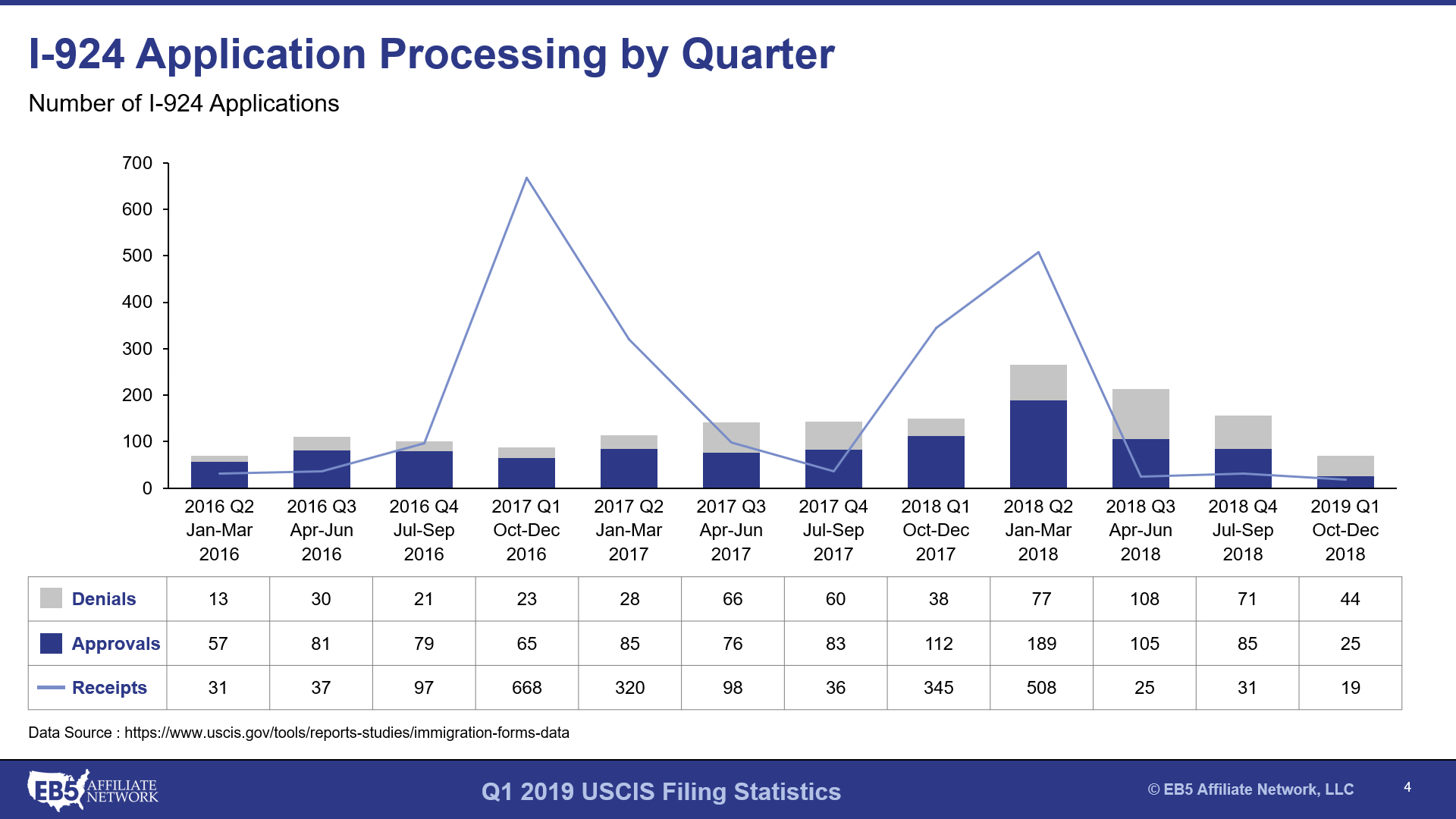
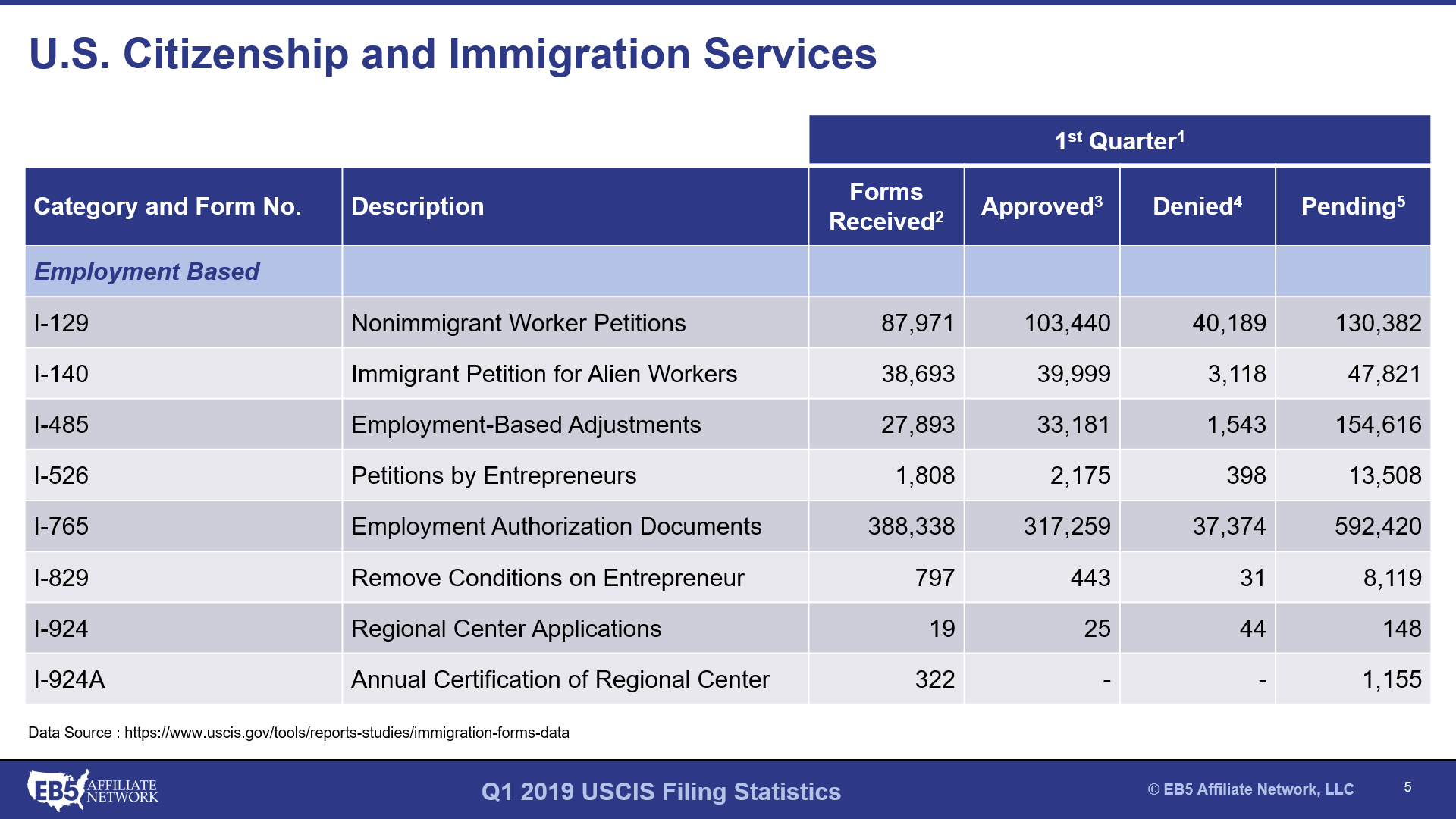
USCIS has completed its online presentation of FY2017 data for I-526 and I-829 petitions with the recent addition of Q4 data.

Fortunately, the USCIS Immigrant Investor Program Office (IPO) managed to reduce its backload of I-526 and I-829 petitions by processing more than it received during the 2017 fiscal year. This is the first time it has been able to do this since 2009, and continuing this pattern will hopefully reduce future petition processing times.

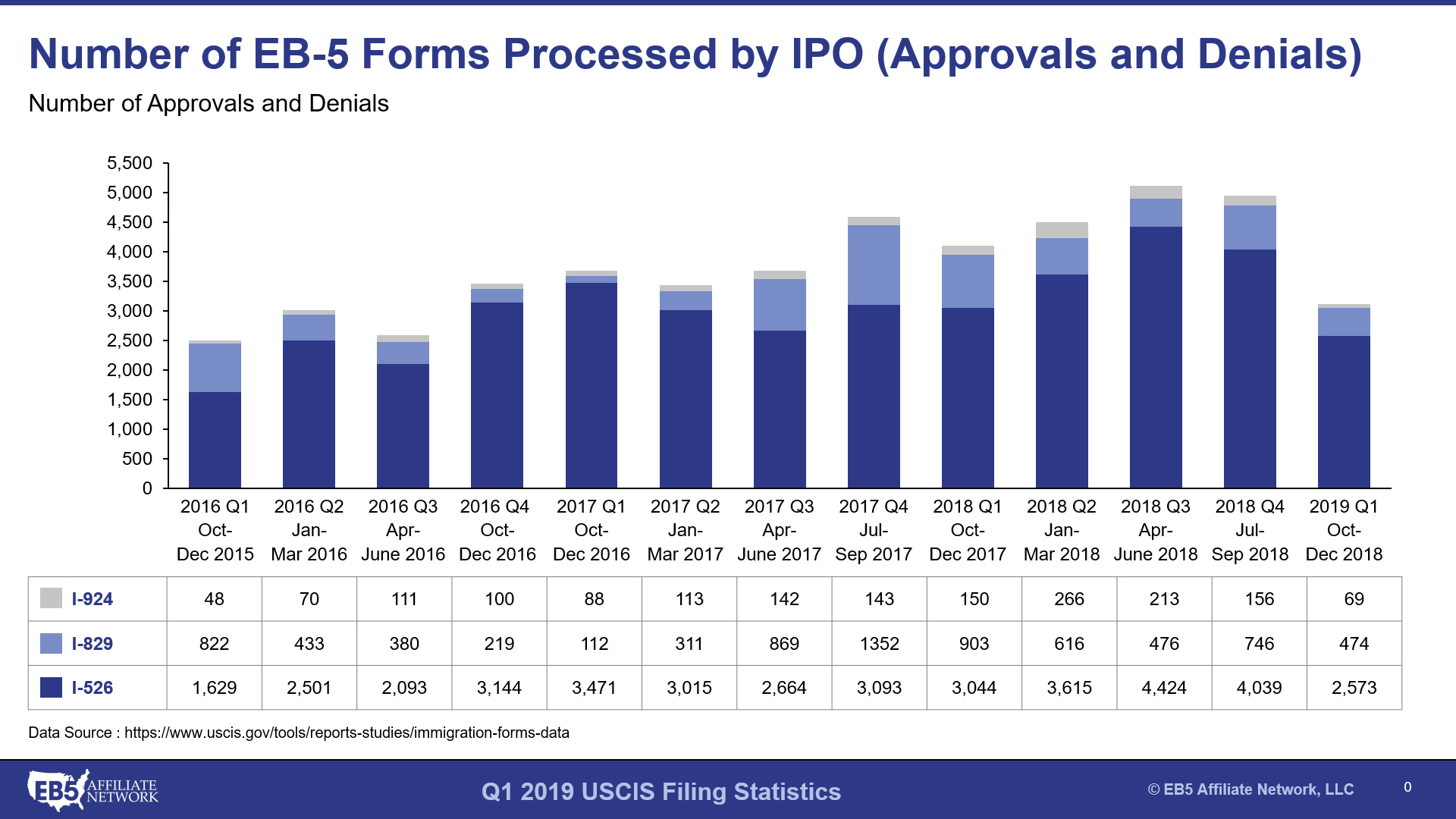
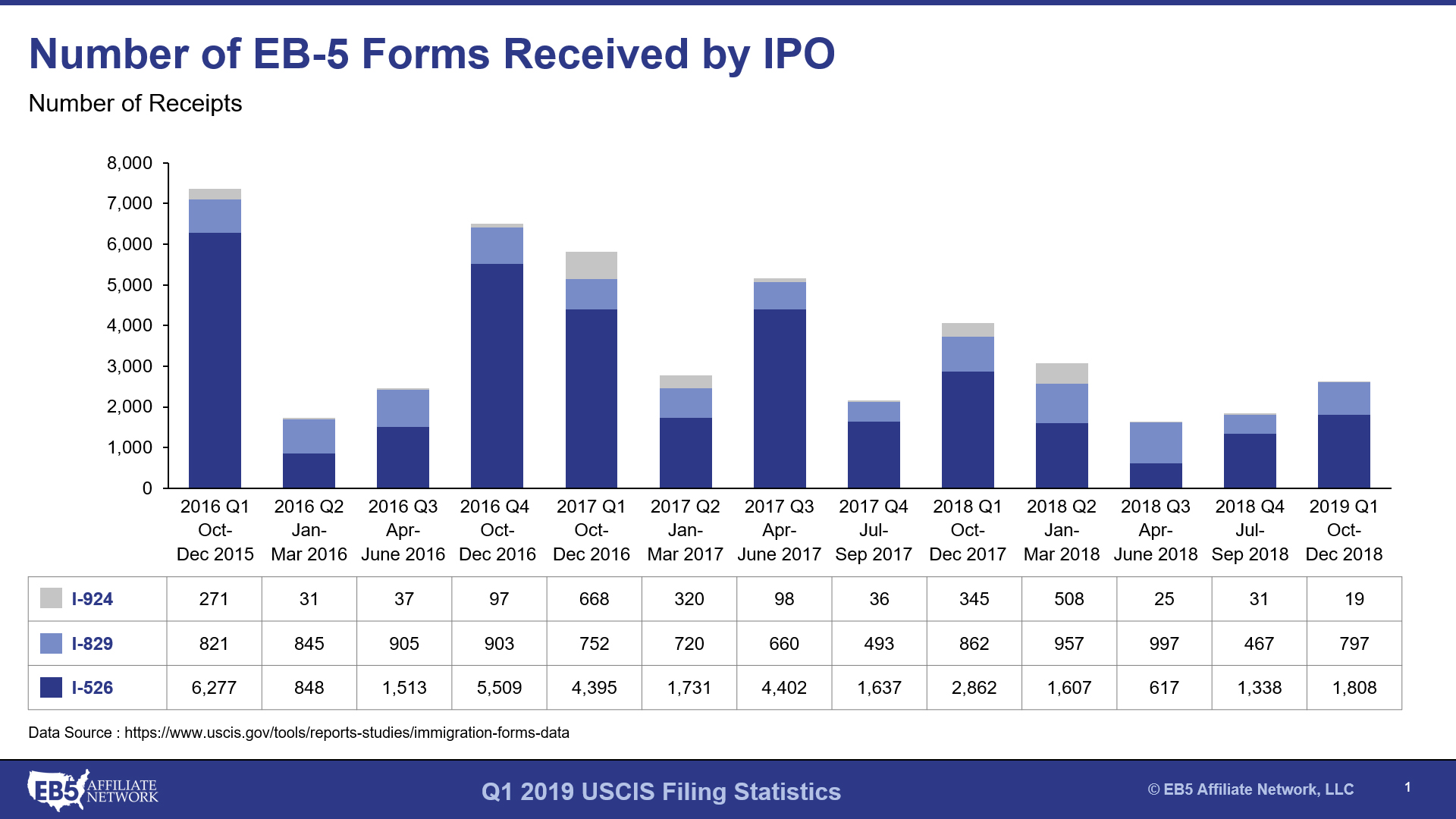
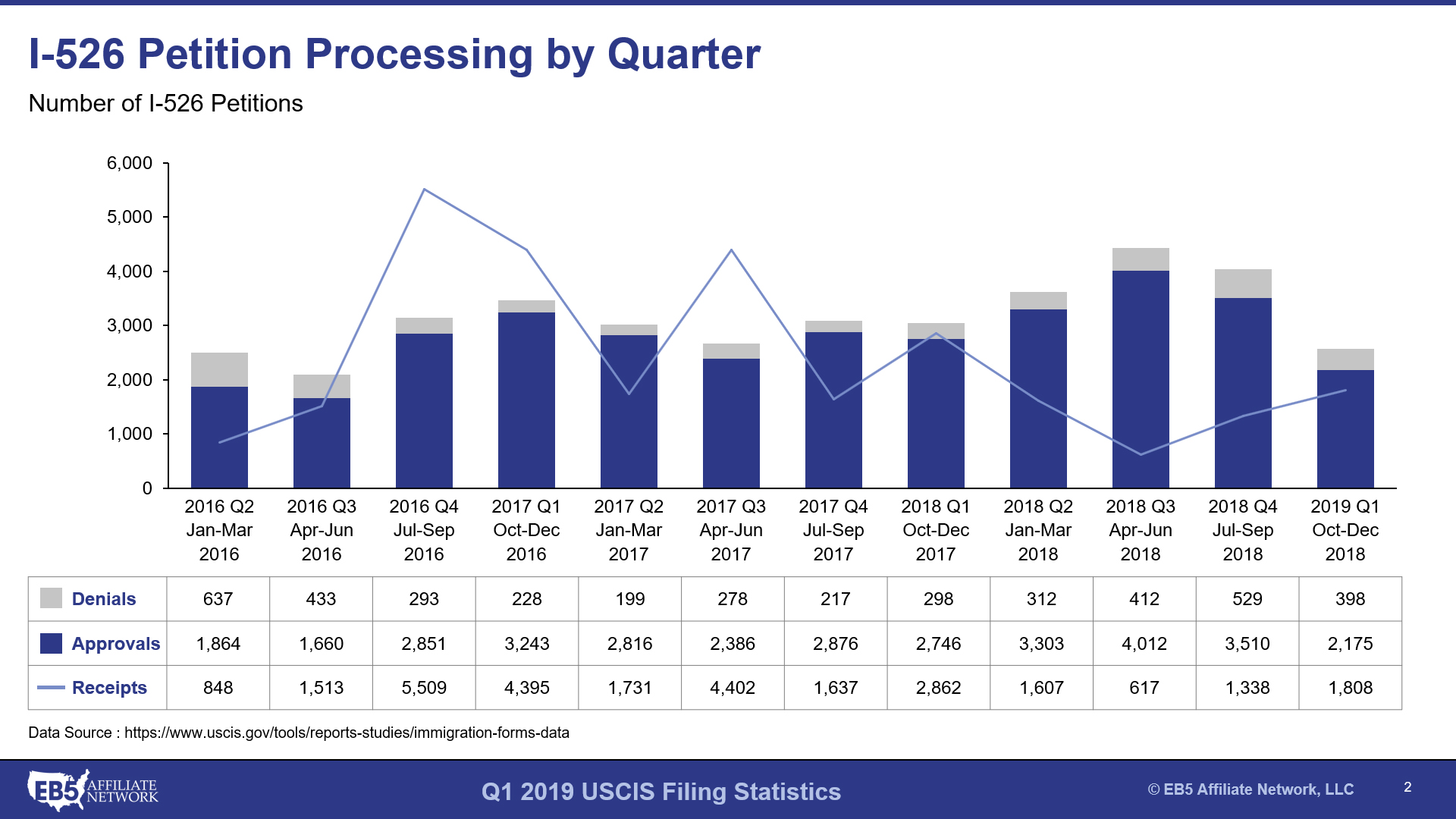
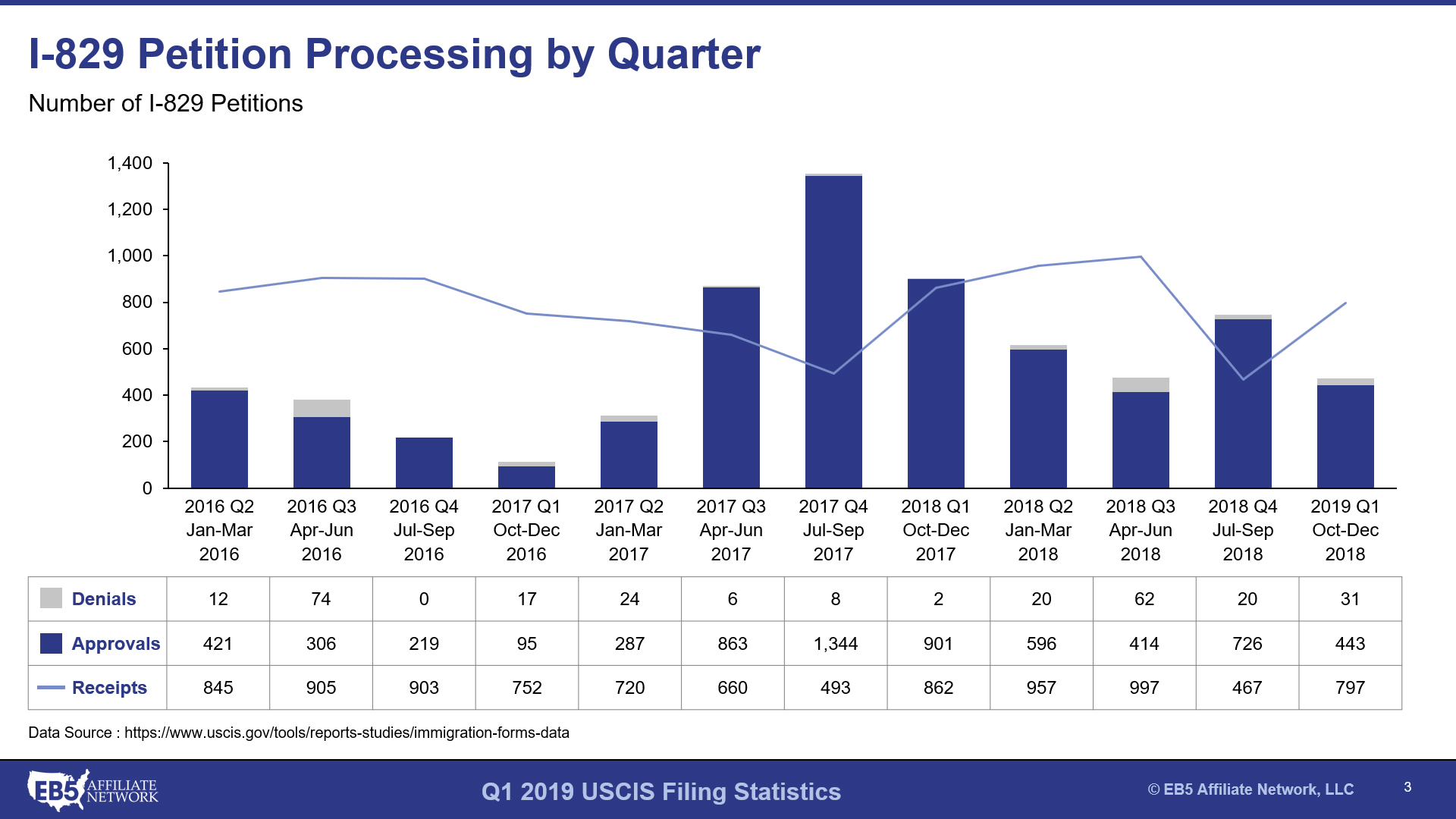
Slide1Slide2Overall, the number of I-526 forms received during the 2017 fiscal year decreased by 14% from the 2016 number, and the number of successfully processed forms increased by 31%. Similarly, 24% fewer I-829 forms were received, and 42% more were adjudicated. Despite the positive changes, the high number of I-526 forms received in 2017 combined with the number of still-pending petitions will take years to process with the current annual immigrant visa issuance limit of 10,000.

The trend over the four quarters of the 2017 fiscal year is similar to trends of previous years: sudden influxes of petitions correspond with sunset dates for regional center programs.
Despite the continued low rate of denial for I-829 petitions, it appears that fewer people with existing conditional permanent residence are filing the necessary paperwork to finalize the EB-5 process; somewhat unexpectedly, the number of I-829 petitions submitted during 2017 consistently fell each quarter.

While I-526 processing has continuously improved for several years, I-829 processing has not, making its improvement in 2017 much more impressive. In addition, I-829 processing in 2017 consistently improved as the year progressed, which differs from the less predictable quarter-to-quarter trend of I-526 processing.

Slide5Slide4Slide3The expectation is that processing times will continue to improve during the next fiscal year, adhering to the trend of the past five years. IPO is in the process of adding to its staff in its efforts to continue reducing those times.

The updated data report also displays corrected numbers for previous years and quarters, indicating recent improvement in USCIS’s ability to maintain accurate records. However, it is interesting to note that there does still appear to be some discrepancy between the sum of the reported still-pending petitions and processed petitions and the reported number of petitions received, i.e., some petitions appear to be unaccounted for.

Free EB-5 Project Evaluation

Navigating EB-5 Project Challenges

As the EB-5 industry expands and matures, it continues to face several serious challenges that threaten the integrity of the program as a whole. These concerns include fraud, misuse of investor funds, and other improper actions undertaken by regional centers and developers—which, in turn, might lead the U.S. Securities and Exchange Commission (SEC) to investigate. But not all of the current challenges are related to legal and ethical violations. EB-5 investments involve general investment risk, so projects have the potential to fail without any fraud or impropriety. And Congress continues to pass stopgap extensions of the EB-5 Program with potential changes looming.

All of these factors create a level of uncertainty and require EB-5 regional centers and other stakeholders to take extra care, especially as it relates to offering documentation and project development.

EB-5 Risk Overview

The two primary risk factors for investors in EB-5 are related to immigration and finances.

Immigration – At its core, the EB-5 Program is a visa program through which foreign nationals gain permanent resident status contingent upon the successful creation of jobs. If a project runs into problems or a regional center is terminated, a foreign national’s EB-5 investment may be unable to create the necessary number of jobs, which could have a direct and substantial impact on the investor’s immigration status.

Finances – Because visa eligibility through the EB-5 Program requires foreign national’s to make qualified, at-risk investments, the return of capital is contingent upon the success of the project. If a project fails to achieve profitability, EB-5 investors may experience significant loss of capital.

The risks involved for investors and the responsibility of regional centers to carefully handle EB-5 investor funds requires careful planning and execution. Regional centers and investors alike should consider these risks before any agreements are signed. If these risk factors aren’t carefully considered and problems arise after agreements have been executed and petitions have been submitted to United States Citizenship and Immigration Services (USCIS), the ability to course correct may be extremely limited and will likely require third-party professional services.

Even with experienced EB-5 professionals, some problems won’t be easily solved—if at all. Which is all the more reason to avoid pitfalls in the first place. The risks of EB-5 are not inconsequential. Foreign investors stand to lose a substantial amount of capital as well as their immigration status if an EB-5 project fails.

And the risks and challenges related to EB-5 are generally knowable and preventable. Below, we’ll consider some of the various challenges an EB-5 project might face and how to handle such situations.

Specific EB-5 Challenges

Project Inflexibility

The EB-5 process is complex and necessitates a strong understanding of the program and its requirements, such as compliance with Matter of Ho. USCIS will not approve an I-829 Petition if the details of the investment have materially changed from what was submitted with the I-526 Petition. This makes EB-5 projects somewhat inflexible, and this factor should be considered carefully before submitting anything to USCIS.

If a project runs into trouble, then, making any changes to salvage the project prior to the final adjudication of all EB-5 investors’ I-829 Petitions may result in their denial. A qualified EB-5 professional should be consulted before any changes are made to the original business plans to ensure any such changes would not be considered material in nature.

Decision-Making Hurdles

The corporate structure of each entity involved in an EB-5 offering—and these entities’ relationships to one another—is a vital consideration as it relates to decision making. For example, if a new commercial enterprise (NCE) is formed as a limited partnership, the limited partnership agreement needs to take into consideration how decisions will be made if the project runs into trouble.

If troubles do arise, the general partner or NCE manager will need to become highly engaged in order to address problems and save the EB-5 investment. If the partnership or operating agreement does not adequately account for potential problems, decision-making authority might be vested in the limited partners rather than the general partner, which could prove problematic and time consuming. This is why care must be taken—and qualified professionals consulted—when drafting agreements. If the agreement has already been executed, it will need to be reviewed in order to determine what constitutes a majority vote for a particular decision.

Beyond this, a qualified professional may be needed to help the general partner make the right decision and implement it effectively.

Loan Enforceability

For EB-5 investments that employ a loan model, the loan documents must be carefully prepared to ensure enforceability. The NCE needs to be able to take whatever legal actions necessary to protect its interests and execute on any pledged collateral.

Fundraising Barriers

Troubled EB-5 projects often need additional capital to complete the project and create the jobs required by the EB-5 Program. Since job creation is typically tied directly to capital expenditures, insufficient capital can adversely impact the immigration success of the project’s EB-5 investors. Finding additional capital within the necessary timeframe may prove challenging—for EB-5 investors awaiting final adjudication, timely job creation is absolutely paramount.

EB-5 investors are an unlikely source of additional capital, and so third-party funding will almost certainly be required. An experienced EB-5 professional should be consulted to determine what options would be best for both saving the project and ensuring the immigration success of the EB-5 investors.

Inappropriate Regional Center Actions

EB-5 regional centers are responsible for overseeing and monitoring ongoing EB-5 projects, carefully handling investor funds, conducting all necessary due diligence, and reporting to USCIS. USCIS holds regional centers accountable for their actions, and if a regional center is deemed to compromise the integrity of the EB-5 Program in any way, USCIS is likely to issue a Notice of Intent to Terminate (NOIT) the regional center.

The purpose of a regional center is to stimulate the regional economy through the infusion of foreign capital in projects that create jobs, particularly in areas of higher-than-average unemployment. If USCIS determines that a regional center is not actively engaged in this mission, USCIS may issue an NOIT. For example, an NOIT might be issued if a regional center fails to conduct sufficient oversight of the EB-5 capital it invests into sponsored projects or if it fails to properly document and report job creation.

The key issue is whether or not the regional center remains compliant with all EB-5 requirements and actively promotes economic growth within the constraints of the EB-5 Program. As a result, inactivity may also lead to a regional center receiving an NOIT.

If a regional center misappropriates EB-5 investor funds—for example, by funneling those funds to expenses not related to the job-creating entity (JCE) as described in offering documents—investor I-526 and I-829 Petitions would be placed at risk and the NCE and JCE would open themselves up to investigation for fraud.

SEC Investigation

The SEC is the U.S. federal agency tasked with protecting investors, keeping markets fair, and otherwise enforcing federal securities laws. If the SEC receives information suggesting inappropriate activity, it will begin an investigation to determine whether any misrepresentation, fraud, misuse of funds, or other violations have been committed. The initial fact-finding investigation is confidential to protect evidence and prevent unnecessary damage to an entity’s reputation. The investigation will become public if the SEC files an action in court.

If any fraudulent or other unlawful activity is discovered, the SEC will step in. For instance, it may appoint a receiver to take control of an asset, freeze assets, or initiate a change in management. Because the SEC is primarily concerned with the financial protection of investors, EB-5 projects facing some level of SEC involvement run a much higher immigration risk. Any action by the SEC is likely to delay the project and may, as a result, adversely affect job creation. In turn, EB-5 investors may not meet the requirements of the EB-5 Program and be denied permanent resident status. Depending on the details of a case and the SEC personnel involved, immigration issues related to EB-5 projects might be considered in SEC actions, but they might not.

When USCIS becomes aware of an SEC investigation, it may withhold the adjudication of I-526 or I-829 Petitions until it more fully understands the facts of the case and what the SEC plans to do. Even before the SEC has made a final decision, however, if USCIS sees evidence that EB-5 capital was used for any purpose not stated in the project’s business plan, it may deny all I-526 and I-829 Petitions associated with the project or regional center under investigation.

Legislative Action & Regulatory Changes

The EB-5 Program was enacted by Congress in 1990 and since then has been renewed several times. Most recently, the program was renewed as is through September 30, 2017. Prior to the latest renewal, an EB-5 reform bill, the American Job Creation and Investment Promotion Reform Act of 2016, was passed. While the bill took a step in the right direction, critics argue it didn’t go far enough to help protect investors who are victims of fraud.

Although little has been done to change the EB-5 Program, a variety of changes to modernize the program, whether through legislation or regulation, remain a priority for USCIS and Congress. While changes to the program are likely unavoidable, what those changes are may be influenced by input from stakeholders. For now, the challenge is operating in an industry facing likely but unknown changes and planning for the future accordingly—while at the same time executing current projects in such a way that immigration and financial risks remain low.

Getting Help

EB-5 stakeholders should be aware of these challenges and how they impact investors’ immigration and financial risk—as well as the broader implications they have on the industry. These challenges should be anticipated in project documentation and handled carefully throughout the life of an EB-5 project. One of the best choices a regional center can make is to engage the necessary EB-5 professionals both preemptively and whenever they run into problems to ensure proper procedures and sound decision making.

Free EB-5 Project Evaluation

USCIS Announces Regional Center Compliance Audits

On March 20, 2017, United States Citizenship and Immigration Services (USCIS) announced new EB-5 regional center compliance audits.

Generally speaking, these audits are intended to enhance integrity within the EB-5 Program, to ensure that regional centers are operating in compliance with the law, and to determine whether they are promoting regional economic growth and job creation in accordance with the stated purpose of the EB-5 Immigrant Investor Program.

The new audit program will involve USCIS audit teams reviewing regional centers’ documents and interviewing their personnel to determine whether they remain eligible for participation in the EB-5 Program.

Overall, the new compliance audits are a positive step toward preventing fraud and abuse within the EB-5 industry. USCIS has not, however, published any standards or rules governing the conduct of its compliance audit teams. Furthermore, the EB-5 regulations and policies are unclear regarding any specific standards for regional centers.

USCIS tends to regulate and clarify policies via requests for evidence (RFEs) and notices of intent to terminate rather than through clear guidelines—and so the new compliance audits may come with a steep learning curve and high level of frustration as regional centers discover exactly how USCIS will handle the process.

As a regional center operator, EB5AN is prepared for whatever these changes bring. We also provide a comprehensive guide for our regional center clients.

What is the purpose of the new compliance audit program?

According to USCIS, these audits represent another method to “enhance EB-5 program integrity” and to “verify information” related to applications filed by regional centers as well as their I-924A submissions. Case-specific data will be collected to verify the information submitted by regional centers to USCIS and ensure compliance with all applicable regulations and laws.

Many EB-5 professionals recognize the need for industry-wide improvements related to integrity and transparency. Bad actors within EB-5 have resulted in several fraud suits and some high-profile cases, all of which damage the credibility of the program and make it more challenging to market EB-5 investment opportunities to potential investors.

While these audits are voluntary, USCIS does have other methods of ensuring compliance with all relevant laws and regulations—but the audit program will give USCIS a new mechanism by which it can increase integrity and transparency in EB-5 and identify problems proactively.

When will these audits begin?

USCIS anticipates starting the new audits soon—but no exact date has been given. Regional centers will, however, be given advance notice of compliance audits. And according to USCIS, if at any time the regional center no longer wishes to participate, “the visit will be terminated.”

According to Law360, USCIS plans to conduct only “a limited number of compliance audits” in 2017, which will be in addition to approximately 250 site visits of new commercial enterprises (NCEs) and job creating entities (JCEs).

What will a regional center compliance audit entail?

In addition to the data requested as part of a compliance audit and information collected during a site visit, the audit process will involve reviewing various sources of information, including information held on government systems, commercial and public records, and evidence submitted by regional centers.

The following excerpt from the USCIS website lists the tasks an audit team will perform:

  • Review applications, certifications, and associated records;
  • Review public records and information on the regional center;
  • Verify the information, including supporting documents, submitted with the application(s) and in the annual certification(s);
  • Conduct site inspection;
  • Review and analyze documents;
  • Interview personnel to confirm the information provided with the application(s) and annual certification(s).

USCIS has indicated that a regional center will be given advance notice of an upcoming compliance audit, and that the notice will include a request for the production of specific records. This will enable the regional center to prepare for the audit. The audit itself is expected to take about one week.

During the compliance audit, the team from USCIS will be on site at the regional center’s office collecting data on the regional center and any related NCEs and JCEs.

While the exact nature and scope of these compliance audits are not yet known, the audits are expected to be relatively high-level, broad examinations of regional centers’ procedures, projects, and handling of investor funds.

How should a regional center prepare for a compliance audit?

USCIS offers some general guidance on how regional centers can prepare for the new compliance audits.

Prior to a site inspection, a regional center should gather all information related to applications or certifications already submitted to USCIS, any updates to those submissions, and any data specifically requested by the compliance audit team.

During a site inspection, a regional center should comply with requests from the audit team for documentation to verify any information provided in submitted applications.

After a site inspection, additional questions may arise, and a regional center should comply with any follow-up requests from USCIS to verify or update information.

What happens after a compliance audit?

Once a compliance audit is complete, the audit team will produce an audit report that will be added to the regional center’s record. The audit report will be used by USCIS to determine whether the regional center is in compliance with all applicable laws and regulations and remains eligible for participation in the EB-5 Program. If the report includes indicators of potential fraudulent activity, USCIS will then determine what additional investigative steps need to be taken.

Free EB-5 Project Evaluation

Upcoming Changes to EB-5 Minimum Investment Amounts

For some time now, EB-5 professionals have been anticipating possible changes to the program—either through legislation or through regulation. Each time the EB-5 Program has been due for renewal over the past several years, some level of concern and speculation has arisen regarding potential changes to the program.

The EB-5 Program is once again due to be extended on April 28, 2017. As opposed to the past several extensions, in which no changes to the program have been made, several factors now indicate a high likelihood that certain aspects of the EB-5 Program will be changed.

One of the chief concerns among EB-5 stakeholders is an increase to minimum investment amounts. Whether through legislation or recently proposed regulations, the minimum investment threshold for the EB-5 Program is likely to increase soon.

Possible Legislation

In June 2015, the “Grassley Bill” was introduced, and since that time, five additional bills have been proposed to increase the minimum investment amount for EB-5 investments in targeted employment areas (TEAs) from $500,000 to as much as $1,000,000. While none of these bills were voted on, they demonstrate the very real possibility of legislative changes to the EB-5 Program.

Now, with another renewal of the EB-5 Program looming in April, a long-term extension of the program may be passed as part of broader legislation to reform EB-5. Under the new administration, Congress is being pressured to pass overall immigration reform legislation, which could also result in changes to EB-5 along with all other immigrant visa categories.

The key issue is whether legislators will begin the process of drafting a bill early enough to move it through the review and amendment process toward a vote before the program expiration date. If this process does not begin early enough, comprehensive reform is much less likely.

Proposed Rulemaking

As part of the executive branch of the U.S. government, U.S. Citizenship and Immigration Services (USCIS) administers and implements all relevant laws enacted by Congress. One way in which government agencies like USCIS implement the law is through regulation.

As early as 2014, USCIS was working to create new EB-5 regulations that included increases to the minimum investment amounts. In 2015, USCIS decided instead to wait for Congress to change the EB-5 Program through legislation.

With the election in 2016, however, it became clear that Congress would not—or could not—pass immigration legislation, whether comprehensive or specifically focused on the EB-5 Program. As a result, USCIS once again indicated its intent to change EB-5 investment minimum thresholds through regulation.

Early in 2017, the Department of Homeland Security (DHS) published a Notice of Proposed Rulemaking on the Federal Register (DHS Docket No. USCIS 2016-0006) revealing potential changes to the EB-5 Program. The January 13 publication, titled, “EB-5 Immigrant Investor Program Modernization,” proposes a number of changes to EB-5—from how priority dates are handled to how TEAs are determined. Among the most controversial proposals is the substantial increase to minimum investment amounts.

The proposed regulation would change both standard EB-5 investments and those within TEAs, increasing the minimum investment threshold from $1,000,000 to $1,800,000 for standard investments and from $500,000 to $1,350,000 for TEA investments.

USCIS based these increases on inflation. The original EB-5 legislation was enacted in 1990, and the proposed regulation uses the Consumer Price Index (CPI) to adjust the original $1,000,000 to current dollars. The minimum investment amount for TEAs is then set to 75% of the standard investment amount. In addition to setting these new values, the proposed regulation establishes an automatic inflation-based increase to these amounts every five years.

As with all Notices of Proposed Rulemaking, the recent USCIS publication has a comment period during which the public can provide USCIS with feedback. In this case, the comment period is 90 days, ending April 11, 2017.

The changes to the minimum investment amounts are substantially greater than those proposed in past draft bills and are viewed by many in the EB-5 industry as destructive—potentially resulting in a temporary halt to EB-5 investment in the short to mid term. The pushback from EB-5 professionals during the proposed regulation’s comment period may result in adjustments to these figures. Even if the final minimum investment amounts are lower than what is currently proposed, however, the EB-5 Program will almost certainly be negatively impacted, at least in the short term.

After the comment period closes, USCIS must review all of the comments it receives and then reply in writing to each with an explanation for why the suggestion was accepted or rejected. Any changes to the proposed regulation must then be approved by DHS.

A large percentage of proposed regulations are never implemented as final rules, and those that are often take 6 months or more to undergo the rulemaking process. In this case, the likelihood that the process is interrupted with legislation or some action by the Trump Administration is fairly high.

So, only time will tell if any of the proposed changes to EB-5 regulations actually take place via the rulemaking process—or if changes to the program occur through legislative action first. In either case, it seems very likely that in the coming months, the minimum investment thresholds for standard and TEA investments will be increased.

And though nothing is certain, the question, “When?” seems to now be overshadowed by a more pressing question: “By how much?”

Free EB-5 Project Evaluation

2017 Changes to the EB-5 Program and Industry Landscape

The EB-5 Program may be facing a number of changes in 2017 from a number of sources—a new administration focused on addressing immigration, a legislature poised to enact comprehensive immigration reform, newly proposed regulations by USCIS, and changes to Chinese capital export restrictions. Taken together, these factors indicate a high probability that changes will occur within the EB-5 Program this year, but with limited specific insight and many possible outcomes, the future of the program is somewhat unclear.

Below, the four main change agents listed above will be examined in greater detail with analysis of how they might affect the EB-5 Program and when—as well as how these four elements interrelate.

The Trump Administration

In many ways, the EB-5 Program is consistent with the stated goals of the new administration. EB-5 is about economic development, investment in the U.S., job creation, and legal means to become permanent residents.

Besides placing pressure on Congress to reform the immigration system, the Trump Administration has the authority to take certain actions that could affect the EB-5 Program. For example, the president has the legal authority to parole any foreign national he considers of particular national interest or benefit. Such authority could be used to help clear the backlog of EB-5 petitioners whose I-526 Petitions have already been approved and whose investments have already been deployed for job creation. Paroling such investors would allow them to enter the U.S. and travel abroad while waiting for their priority date and subsequent I-829 approval.

In addition to actions the president himself has the authority to take, others in the administration (e.g., advisors, cabinet members, and other staff) as well as new ranking members of Senate committees will likely have influence over immigration policy going forward—which will have at least some effect on the EB-5 Program. For example, Senator Feinstein of California, who is the ranking member of the Senate Judiciary Committee, is from the state with the highest participation level in the EB-5 Program, and Attorney General Sessions’ home state, Alabama, had the fifth highest number of EB-5 projects.

Furthermore, a recently released Department of Commerce study of the EB-5 Program demonstrated that from 2012 to 2013, the EB-5 Program contributed $5.8 billion to the U.S. economy and created 174,000 jobs. Cutting or reducing such a program would be counterintuitive for an administration focused on the American economy and job creation.

Congressional Changes

While legislation to reform the legal immigration system—including EB-5 and other employment-based preference categories—is likely to be pursued within the first year or two of the new administration, one of the primary concerns among EB-5 stakeholders is what such legislation might look like in light of the president’s and his advisors’ views on immigration in general. Not surprisingly, President Trump has made strong statements and attempted to take forceful measures with regard to illegal immigration—something he promised to address during his campaign. But current indications suggest the potential for an overall reduction in the number of legal immigrants as well. The effects of such a reduction on the EB-5 Program in particular may or may not be negative.

The targets of any reduction to legal immigration are likely to include the diversity lottery, the family-based preference categories, and the lower-skilled employment-based preference categories. Higher skilled immigrants and immigrant investors may actually benefit from immigration reform legislation.

But EB-5 legislation has been presented in draft form a number of times in the past two years. Senator Grassley and others have sought to enact changes to the program, particularly seeking to increase the minimum investment threshold for investments in targeted employment areas (TEAs) from the current $500,000 to anywhere between $650,000 and $1,000,000. While none of these bills has been sent to the floor for a vote, they indicate some of the intent of Congress with regard to the EB-5 Program.

Apart from the potential for a complete overhaul of U.S. immigration laws, Congress will have to address the EB-5 Program on some level by April 28, 2017, due to the program’s expiration date. Congress is expected to extend the EB-5 Regional Center Program once again, but for how long and with what changes, if any, is unknown.

The length of the extension and the potential for changes to the program largely depend on whether a bill is drafted early enough for discussion, amendment, and a vote before the end of April. With sufficient time, Congress may both pass a long-term extension of the program and a number of changes intended to modernize it. Without sufficient lead time, however, a long-term extension is less likely, and changes to the program become improbable.

The past several program extensions have been short term, and since 2014, USCIS has postponed proposing any regulatory changes pending possible legislation at each renewal of the EB-5 Program. Legislative changes to the EB-5 Program would yield greater stability, making Congress the preferred venue for any changes to the program. But in light of the failure of Congress to produce any such legislation, USCIS has decided to pursue changes through regulation.

USCIS Potential Regulatory Changes

On January 13, 2017, USCIS proposed regulatory changes to the EB-5 Program through a Notice of Proposed Rulemaking, which was published in the Federal Register as DHS Docket No. USCIS 2016-0006 and titled, “EB-5 Immigrant Investor Program Modernization.”

The main changes proposed in this publication are as follows:

Minimum investment threshold – The proposed regulations establish an immediate increase to the minimum investment amounts from $500,000 to $1,350,000 for TEA investments and from $1,000,000 to $1,800,000 for standard investments. The new standard investment amount is calculated based on inflation as demonstrated through the Consumer Price Index (CPI), and the new TEA investment amount is 75% of the standard investment. These minimum investment amounts would be automatically increased every five years based on inflation.

Targeted employment areas (TEAs) – Under the new regulations, TEA designation authority is transferred from state agencies to the Department of Homeland Security (DHS). Metropolitan statistical areas (MSAs), counties, cities, and census tracts can be designated as TEAs, but for census tracts, only the census tract in which the project is located and any or all immediately adjacent tracts may be used to calculate unemployment.

Priority dates – The proposed changes give investors with approved I-526 Petitions the ability to switch projects and maintain their priority dates. If an investor must submit a new I-526 Petition for any reason (e.g., a project fails or a regional center is terminated), the priority date of the originally approved I-526 will, under most circumstances, be transferred, and the investor will not lose his or her place in line for an EB-5 Visa

I-829 Petitions – The proposal defines how derivative beneficiaries may file I-829 Petitions if not included in the principal applicant’s petition. Additionally, the new regulations offer more flexibility with regard to the location of I-829 interviews.

I-829 Petition denial – The new regulations change the policy governing termination of status for investors whose I-829 Petitions are denied. Currently, an investor’s conditional permanent resident status is maintained until his or her case is reviewed by an immigration judge and any appeals are heard. This process can take years, and under the proposed changes, the investor would not be able to remain in the U.S. unless some other legal status was obtained.

The proposed regulations are open to public comment for 90 days—until April 11, 2017. USCIS must respond to each comment, explaining why any suggestion is accepted or rejected. Any changes to the proposed regulations must be approved by DHS before a final rule can be issued.

Apart from legislation, which would likely invalidate the proposed changes, these regulations are, in some form, expected to become final. The process may take time—probably no less than 6 months, which will depend largely on the number of responses received during the comment period—but unless the regulatory process is halted by the administration, the EB-5 Program will undergo at least some level of change in the coming months.

China Currency Regulations

China is another actor that must be considered when examining how the EB-5 Program might change in the months and years ahead. Since the majority of EB-5 investors are from Mainland China, changes to Chinese laws and regulations have the potential to change the landscape of the EB-5 industry.

On January 1, 2017, the Chinese government established further reporting requirements for Chinese nationals investing capital outside of China. These new requirements may discourage, delay, or even prevent Chinese investors from transferring their money out of China and into EB-5 projects.

In addition to these enhanced reporting requirements, China is expected to establish daily currency export restrictions in July 2017—which would create additional roadblocks for Chinese investors seeking to transfer the annual limit of $50,000 out of the country.

Beyond these restrictions, many anticipate a substantial reduction to the annual currency export limit in 2018.

In the short term, these changes—along with the possibility of higher minimum investment thresholds and the fear of even tighter restrictions—may fuel interest in the EB-5 Program among Mainland Chinese nationals. The long-term effects these export restrictions might have on the EB-5 market in China, however, are as yet unknown.