Author Archives: admineb5

Free EB-5 Project Evaluation

USCIS Fourth Quarter I-526 and I-829 Data Released for FY 2017

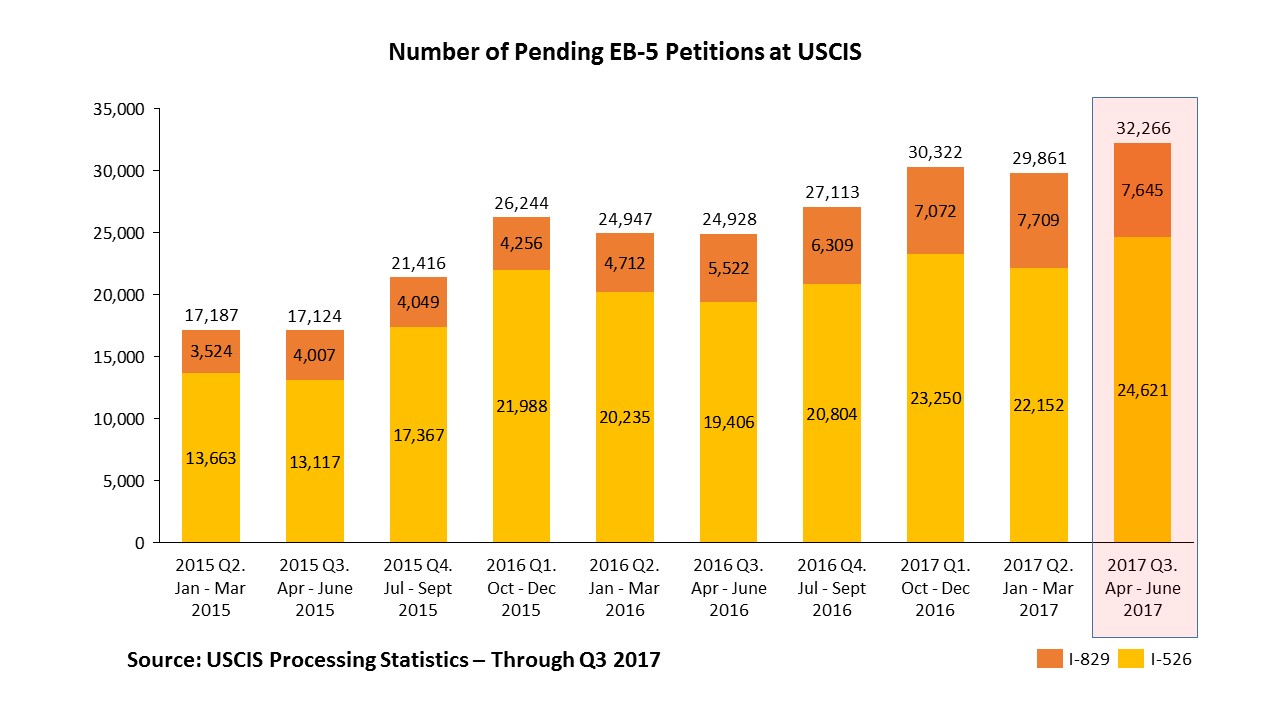
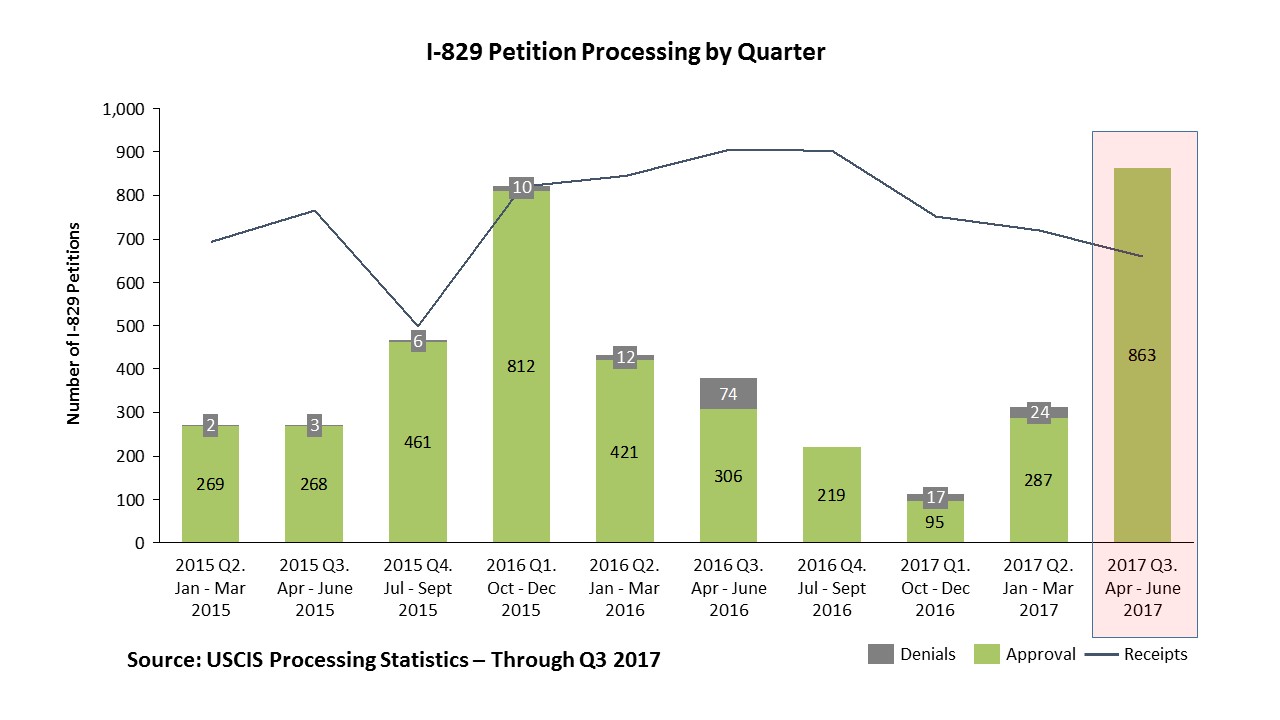
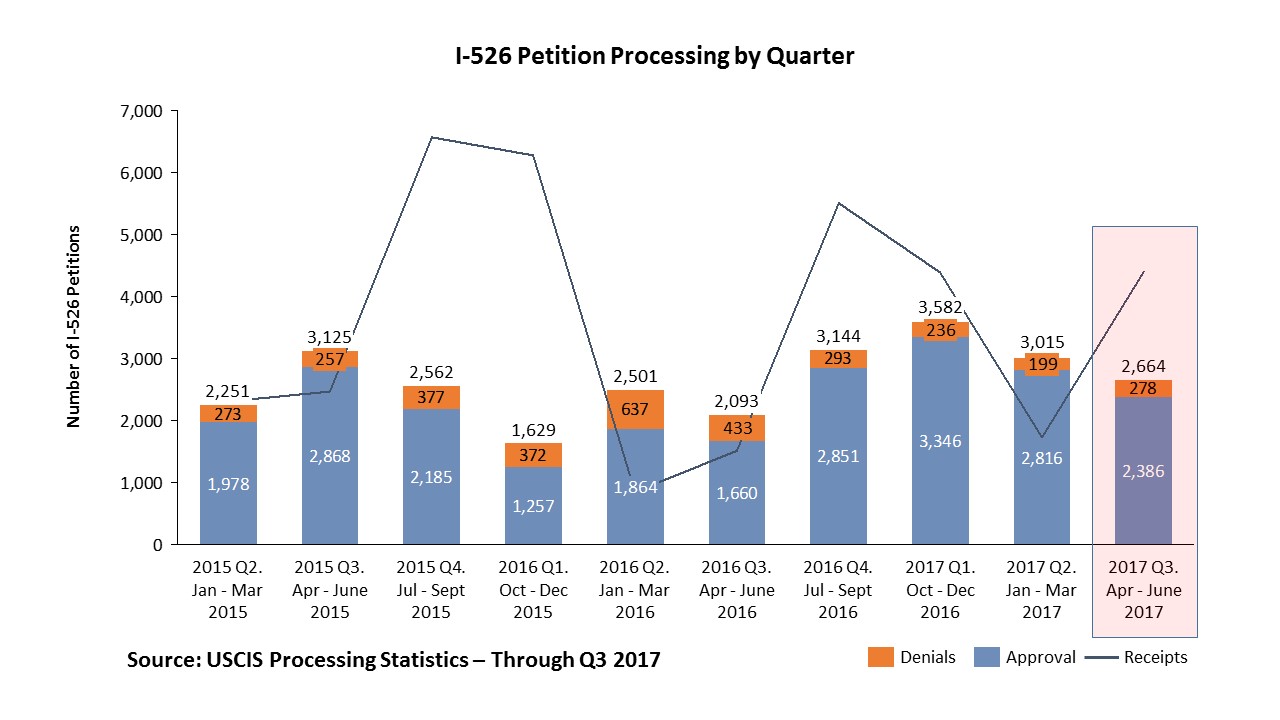
USCIS recently updated its online data for I-526 and I-829 Petitions to include Q3 of fiscal year 2017.

During Q3 (April through June), the Investor Program Office (IPO) significantly increased its processing of I-829 Petitions, outpacing the receipt of new petitions for the first time in years—and by a significant margin. This increase in processing volume is likely due to the recently announced formation of a specific division of adjudicators focused on I-829 Petitions.

I-526 Petitions, on the other hand, experienced reduced processing, resulting in the lowest number of adjudicated petitions this fiscal year. Fewer I-526 adjudications combined with a rise in I-526 filings means the total number of pending I-526 petitions yet again went up.

The increased number of I-526 Petitions filed during Q3 correlates with the historical pattern of increased filings just before the sunset date of the Regional Center Pilot Program. The legislative sunset date of the program has an obvious destabilizing impact on the market, creating uncertainty about whether the program will continue, and if so, what changes may be implemented by Congress. Drastic spikes in I-526 filings have occurred prior to each of the most recent five program extensions (Q4 FY2015, Q1 FY2016, Q4 FY2016, Q1 FY2017, and Q3 FY2017). These extreme increases to filings, often more than doubling the previous quarter’s filings, inundates IPO and serves only to expand an already massive backlog of pending EB-5 petitions.

The massive number of petitions filed in Q4 FY2015 and Q1 FY2016 in particular have caused adjudication times to grow—and as of the previous two IPO processing time reports, the office was still working through petitions with priority dates of November 22, 2015. Once IPO works through these two quarters, the office is expected to process the following two quarters much more quickly due to the drastically lower number of filings. They will, however, likely face another slowdown with two more back-to-back surges in I-526 filings during Q4 FY2016 and Q1 FY2017.

Slide3 Slide2 Slide1

Free EB-5 Project Evaluation

Navigating EB-5 Project Challenges

As the EB-5 industry expands and matures, it continues to face several serious challenges that threaten the integrity of the program as a whole. These concerns include fraud, misuse of investor funds, and other improper actions undertaken by regional centers and developers—which, in turn, might lead the U.S. Securities and Exchange Commission (SEC) to investigate. But not all of the current challenges are related to legal and ethical violations. EB-5 investments involve general investment risk, so projects have the potential to fail without any fraud or impropriety. And Congress continues to pass stopgap extensions of the EB-5 Program with potential changes looming.

All of these factors create a level of uncertainty and require EB-5 regional centers and other stakeholders to take extra care, especially as it relates to offering documentation and project development.

EB-5 Risk Overview

The two primary risk factors for investors in EB-5 are related to immigration and finances.

Immigration – At its core, the EB-5 Program is a visa program through which foreign nationals gain permanent resident status contingent upon the successful creation of jobs. If a project runs into problems or a regional center is terminated, a foreign national’s EB-5 investment may be unable to create the necessary number of jobs, which could have a direct and substantial impact on the investor’s immigration status.

Finances – Because visa eligibility through the EB-5 Program requires foreign national’s to make qualified, at-risk investments, the return of capital is contingent upon the success of the project. If a project fails to achieve profitability, EB-5 investors may experience significant loss of capital.

The risks involved for investors and the responsibility of regional centers to carefully handle EB-5 investor funds requires careful planning and execution. Regional centers and investors alike should consider these risks before any agreements are signed. If these risk factors aren’t carefully considered and problems arise after agreements have been executed and petitions have been submitted to United States Citizenship and Immigration Services (USCIS), the ability to course correct may be extremely limited and will likely require third-party professional services.

Even with experienced EB-5 professionals, some problems won’t be easily solved—if at all. Which is all the more reason to avoid pitfalls in the first place. The risks of EB-5 are not inconsequential. Foreign investors stand to lose a substantial amount of capital as well as their immigration status if an EB-5 project fails.

And the risks and challenges related to EB-5 are generally knowable and preventable. Below, we’ll consider some of the various challenges an EB-5 project might face and how to handle such situations.

Specific EB-5 Challenges

Project Inflexibility

The EB-5 process is complex and necessitates a strong understanding of the program and its requirements, such as compliance with Matter of Ho. USCIS will not approve an I-829 Petition if the details of the investment have materially changed from what was submitted with the I-526 Petition. This makes EB-5 projects somewhat inflexible, and this factor should be considered carefully before submitting anything to USCIS.

If a project runs into trouble, then, making any changes to salvage the project prior to the final adjudication of all EB-5 investors’ I-829 Petitions may result in their denial. A qualified EB-5 professional should be consulted before any changes are made to the original business plans to ensure any such changes would not be considered material in nature.

Decision-Making Hurdles

The corporate structure of each entity involved in an EB-5 offering—and these entities’ relationships to one another—is a vital consideration as it relates to decision making. For example, if a new commercial enterprise (NCE) is formed as a limited partnership, the limited partnership agreement needs to take into consideration how decisions will be made if the project runs into trouble.

If troubles do arise, the general partner or NCE manager will need to become highly engaged in order to address problems and save the EB-5 investment. If the partnership or operating agreement does not adequately account for potential problems, decision-making authority might be vested in the limited partners rather than the general partner, which could prove problematic and time consuming. This is why care must be taken—and qualified professionals consulted—when drafting agreements. If the agreement has already been executed, it will need to be reviewed in order to determine what constitutes a majority vote for a particular decision.

Beyond this, a qualified professional may be needed to help the general partner make the right decision and implement it effectively.

Loan Enforceability

For EB-5 investments that employ a loan model, the loan documents must be carefully prepared to ensure enforceability. The NCE needs to be able to take whatever legal actions necessary to protect its interests and execute on any pledged collateral.

Fundraising Barriers

Troubled EB-5 projects often need additional capital to complete the project and create the jobs required by the EB-5 Program. Since job creation is typically tied directly to capital expenditures, insufficient capital can adversely impact the immigration success of the project’s EB-5 investors. Finding additional capital within the necessary timeframe may prove challenging—for EB-5 investors awaiting final adjudication, timely job creation is absolutely paramount.

EB-5 investors are an unlikely source of additional capital, and so third-party funding will almost certainly be required. An experienced EB-5 professional should be consulted to determine what options would be best for both saving the project and ensuring the immigration success of the EB-5 investors.

Inappropriate Regional Center Actions

EB-5 regional centers are responsible for overseeing and monitoring ongoing EB-5 projects, carefully handling investor funds, conducting all necessary due diligence, and reporting to USCIS. USCIS holds regional centers accountable for their actions, and if a regional center is deemed to compromise the integrity of the EB-5 Program in any way, USCIS is likely to issue a Notice of Intent to Terminate (NOIT) the regional center.

The purpose of a regional center is to stimulate the regional economy through the infusion of foreign capital in projects that create jobs, particularly in areas of higher-than-average unemployment. If USCIS determines that a regional center is not actively engaged in this mission, USCIS may issue an NOIT. For example, an NOIT might be issued if a regional center fails to conduct sufficient oversight of the EB-5 capital it invests into sponsored projects or if it fails to properly document and report job creation.

The key issue is whether or not the regional center remains compliant with all EB-5 requirements and actively promotes economic growth within the constraints of the EB-5 Program. As a result, inactivity may also lead to a regional center receiving an NOIT.

If a regional center misappropriates EB-5 investor funds—for example, by funneling those funds to expenses not related to the job-creating entity (JCE) as described in offering documents—investor I-526 and I-829 Petitions would be placed at risk and the NCE and JCE would open themselves up to investigation for fraud.

SEC Investigation

The SEC is the U.S. federal agency tasked with protecting investors, keeping markets fair, and otherwise enforcing federal securities laws. If the SEC receives information suggesting inappropriate activity, it will begin an investigation to determine whether any misrepresentation, fraud, misuse of funds, or other violations have been committed. The initial fact-finding investigation is confidential to protect evidence and prevent unnecessary damage to an entity’s reputation. The investigation will become public if the SEC files an action in court.

If any fraudulent or other unlawful activity is discovered, the SEC will step in. For instance, it may appoint a receiver to take control of an asset, freeze assets, or initiate a change in management. Because the SEC is primarily concerned with the financial protection of investors, EB-5 projects facing some level of SEC involvement run a much higher immigration risk. Any action by the SEC is likely to delay the project and may, as a result, adversely affect job creation. In turn, EB-5 investors may not meet the requirements of the EB-5 Program and be denied permanent resident status. Depending on the details of a case and the SEC personnel involved, immigration issues related to EB-5 projects might be considered in SEC actions, but they might not.

When USCIS becomes aware of an SEC investigation, it may withhold the adjudication of I-526 or I-829 Petitions until it more fully understands the facts of the case and what the SEC plans to do. Even before the SEC has made a final decision, however, if USCIS sees evidence that EB-5 capital was used for any purpose not stated in the project’s business plan, it may deny all I-526 and I-829 Petitions associated with the project or regional center under investigation.

Legislative Action & Regulatory Changes

The EB-5 Program was enacted by Congress in 1990 and since then has been renewed several times. Most recently, the program was renewed as is through September 30, 2017. Prior to the latest renewal, an EB-5 reform bill, the American Job Creation and Investment Promotion Reform Act of 2016, was passed. While the bill took a step in the right direction, critics argue it didn’t go far enough to help protect investors who are victims of fraud.

Although little has been done to change the EB-5 Program, a variety of changes to modernize the program, whether through legislation or regulation, remain a priority for USCIS and Congress. While changes to the program are likely unavoidable, what those changes are may be influenced by input from stakeholders. For now, the challenge is operating in an industry facing likely but unknown changes and planning for the future accordingly—while at the same time executing current projects in such a way that immigration and financial risks remain low.

Getting Help

EB-5 stakeholders should be aware of these challenges and how they impact investors’ immigration and financial risk—as well as the broader implications they have on the industry. These challenges should be anticipated in project documentation and handled carefully throughout the life of an EB-5 project. One of the best choices a regional center can make is to engage the necessary EB-5 professionals both preemptively and whenever they run into problems to ensure proper procedures and sound decision making.

Free EB-5 Project Evaluation

USCIS Announces Regional Center Compliance Audits

On March 20, 2017, United States Citizenship and Immigration Services (USCIS) announced new EB-5 regional center compliance audits.

Generally speaking, these audits are intended to enhance integrity within the EB-5 Program, to ensure that regional centers are operating in compliance with the law, and to determine whether they are promoting regional economic growth and job creation in accordance with the stated purpose of the EB-5 Immigrant Investor Program.

The new audit program will involve USCIS audit teams reviewing regional centers’ documents and interviewing their personnel to determine whether they remain eligible for participation in the EB-5 Program.

Overall, the new compliance audits are a positive step toward preventing fraud and abuse within the EB-5 industry. USCIS has not, however, published any standards or rules governing the conduct of its compliance audit teams. Furthermore, the EB-5 regulations and policies are unclear regarding any specific standards for regional centers.

USCIS tends to regulate and clarify policies via requests for evidence (RFEs) and notices of intent to terminate rather than through clear guidelines—and so the new compliance audits may come with a steep learning curve and high level of frustration as regional centers discover exactly how USCIS will handle the process.

As a regional center operator, EB5AN is prepared for whatever these changes bring. We also provide a comprehensive guide for our regional center clients.

What is the purpose of the new compliance audit program?

According to USCIS, these audits represent another method to “enhance EB-5 program integrity” and to “verify information” related to applications filed by regional centers as well as their I-924A submissions. Case-specific data will be collected to verify the information submitted by regional centers to USCIS and ensure compliance with all applicable regulations and laws.

Many EB-5 professionals recognize the need for industry-wide improvements related to integrity and transparency. Bad actors within EB-5 have resulted in several fraud suits and some high-profile cases, all of which damage the credibility of the program and make it more challenging to market EB-5 investment opportunities to potential investors.

While these audits are voluntary, USCIS does have other methods of ensuring compliance with all relevant laws and regulations—but the audit program will give USCIS a new mechanism by which it can increase integrity and transparency in EB-5 and identify problems proactively.

When will these audits begin?

USCIS anticipates starting the new audits soon—but no exact date has been given. Regional centers will, however, be given advance notice of compliance audits. And according to USCIS, if at any time the regional center no longer wishes to participate, “the visit will be terminated.”

According to Law360, USCIS plans to conduct only “a limited number of compliance audits” in 2017, which will be in addition to approximately 250 site visits of new commercial enterprises (NCEs) and job creating entities (JCEs).

What will a regional center compliance audit entail?

In addition to the data requested as part of a compliance audit and information collected during a site visit, the audit process will involve reviewing various sources of information, including information held on government systems, commercial and public records, and evidence submitted by regional centers.

The following excerpt from the USCIS website lists the tasks an audit team will perform:

  • Review applications, certifications, and associated records;
  • Review public records and information on the regional center;
  • Verify the information, including supporting documents, submitted with the application(s) and in the annual certification(s);
  • Conduct site inspection;
  • Review and analyze documents;
  • Interview personnel to confirm the information provided with the application(s) and annual certification(s).

USCIS has indicated that a regional center will be given advance notice of an upcoming compliance audit, and that the notice will include a request for the production of specific records. This will enable the regional center to prepare for the audit. The audit itself is expected to take about one week.

During the compliance audit, the team from USCIS will be on site at the regional center’s office collecting data on the regional center and any related NCEs and JCEs.

While the exact nature and scope of these compliance audits are not yet known, the audits are expected to be relatively high-level, broad examinations of regional centers’ procedures, projects, and handling of investor funds.

How should a regional center prepare for a compliance audit?

USCIS offers some general guidance on how regional centers can prepare for the new compliance audits.

Prior to a site inspection, a regional center should gather all information related to applications or certifications already submitted to USCIS, any updates to those submissions, and any data specifically requested by the compliance audit team.

During a site inspection, a regional center should comply with requests from the audit team for documentation to verify any information provided in submitted applications.

After a site inspection, additional questions may arise, and a regional center should comply with any follow-up requests from USCIS to verify or update information.

What happens after a compliance audit?

Once a compliance audit is complete, the audit team will produce an audit report that will be added to the regional center’s record. The audit report will be used by USCIS to determine whether the regional center is in compliance with all applicable laws and regulations and remains eligible for participation in the EB-5 Program. If the report includes indicators of potential fraudulent activity, USCIS will then determine what additional investigative steps need to be taken.

Free EB-5 Project Evaluation

Upcoming Changes to EB-5 Minimum Investment Amounts

For some time now, EB-5 professionals have been anticipating possible changes to the program—either through legislation or through regulation. Each time the EB-5 Program has been due for renewal over the past several years, some level of concern and speculation has arisen regarding potential changes to the program.

The EB-5 Program is once again due to be extended on April 28, 2017. As opposed to the past several extensions, in which no changes to the program have been made, several factors now indicate a high likelihood that certain aspects of the EB-5 Program will be changed.

One of the chief concerns among EB-5 stakeholders is an increase to minimum investment amounts. Whether through legislation or recently proposed regulations, the minimum investment threshold for the EB-5 Program is likely to increase soon.

Possible Legislation

In June 2015, the “Grassley Bill” was introduced, and since that time, five additional bills have been proposed to increase the minimum investment amount for EB-5 investments in targeted employment areas (TEAs) from $500,000 to as much as $1,000,000. While none of these bills were voted on, they demonstrate the very real possibility of legislative changes to the EB-5 Program.

Now, with another renewal of the EB-5 Program looming in April, a long-term extension of the program may be passed as part of broader legislation to reform EB-5. Under the new administration, Congress is being pressured to pass overall immigration reform legislation, which could also result in changes to EB-5 along with all other immigrant visa categories.

The key issue is whether legislators will begin the process of drafting a bill early enough to move it through the review and amendment process toward a vote before the program expiration date. If this process does not begin early enough, comprehensive reform is much less likely.

Proposed Rulemaking

As part of the executive branch of the U.S. government, U.S. Citizenship and Immigration Services (USCIS) administers and implements all relevant laws enacted by Congress. One way in which government agencies like USCIS implement the law is through regulation.

As early as 2014, USCIS was working to create new EB-5 regulations that included increases to the minimum investment amounts. In 2015, USCIS decided instead to wait for Congress to change the EB-5 Program through legislation.

With the election in 2016, however, it became clear that Congress would not—or could not—pass immigration legislation, whether comprehensive or specifically focused on the EB-5 Program. As a result, USCIS once again indicated its intent to change EB-5 investment minimum thresholds through regulation.

Early in 2017, the Department of Homeland Security (DHS) published a Notice of Proposed Rulemaking on the Federal Register (DHS Docket No. USCIS 2016-0006) revealing potential changes to the EB-5 Program. The January 13 publication, titled, “EB-5 Immigrant Investor Program Modernization,” proposes a number of changes to EB-5—from how priority dates are handled to how TEAs are determined. Among the most controversial proposals is the substantial increase to minimum investment amounts.

The proposed regulation would change both standard EB-5 investments and those within TEAs, increasing the minimum investment threshold from $1,000,000 to $1,800,000 for standard investments and from $500,000 to $1,350,000 for TEA investments.

USCIS based these increases on inflation. The original EB-5 legislation was enacted in 1990, and the proposed regulation uses the Consumer Price Index (CPI) to adjust the original $1,000,000 to current dollars. The minimum investment amount for TEAs is then set to 75% of the standard investment amount. In addition to setting these new values, the proposed regulation establishes an automatic inflation-based increase to these amounts every five years.

As with all Notices of Proposed Rulemaking, the recent USCIS publication has a comment period during which the public can provide USCIS with feedback. In this case, the comment period is 90 days, ending April 11, 2017.

The changes to the minimum investment amounts are substantially greater than those proposed in past draft bills and are viewed by many in the EB-5 industry as destructive—potentially resulting in a temporary halt to EB-5 investment in the short to mid term. The pushback from EB-5 professionals during the proposed regulation’s comment period may result in adjustments to these figures. Even if the final minimum investment amounts are lower than what is currently proposed, however, the EB-5 Program will almost certainly be negatively impacted, at least in the short term.

After the comment period closes, USCIS must review all of the comments it receives and then reply in writing to each with an explanation for why the suggestion was accepted or rejected. Any changes to the proposed regulation must then be approved by DHS.

A large percentage of proposed regulations are never implemented as final rules, and those that are often take 6 months or more to undergo the rulemaking process. In this case, the likelihood that the process is interrupted with legislation or some action by the Trump Administration is fairly high.

So, only time will tell if any of the proposed changes to EB-5 regulations actually take place via the rulemaking process—or if changes to the program occur through legislative action first. In either case, it seems very likely that in the coming months, the minimum investment thresholds for standard and TEA investments will be increased.

And though nothing is certain, the question, “When?” seems to now be overshadowed by a more pressing question: “By how much?”

Free EB-5 Project Evaluation

2017 Changes to the EB-5 Program and Industry Landscape

The EB-5 Program may be facing a number of changes in 2017 from a number of sources—a new administration focused on addressing immigration, a legislature poised to enact comprehensive immigration reform, newly proposed regulations by USCIS, and changes to Chinese capital export restrictions. Taken together, these factors indicate a high probability that changes will occur within the EB-5 Program this year, but with limited specific insight and many possible outcomes, the future of the program is somewhat unclear.

Below, the four main change agents listed above will be examined in greater detail with analysis of how they might affect the EB-5 Program and when—as well as how these four elements interrelate.

The Trump Administration

In many ways, the EB-5 Program is consistent with the stated goals of the new administration. EB-5 is about economic development, investment in the U.S., job creation, and legal means to become permanent residents.

Besides placing pressure on Congress to reform the immigration system, the Trump Administration has the authority to take certain actions that could affect the EB-5 Program. For example, the president has the legal authority to parole any foreign national he considers of particular national interest or benefit. Such authority could be used to help clear the backlog of EB-5 petitioners whose I-526 Petitions have already been approved and whose investments have already been deployed for job creation. Paroling such investors would allow them to enter the U.S. and travel abroad while waiting for their priority date and subsequent I-829 approval.

In addition to actions the president himself has the authority to take, others in the administration (e.g., advisors, cabinet members, and other staff) as well as new ranking members of Senate committees will likely have influence over immigration policy going forward—which will have at least some effect on the EB-5 Program. For example, Senator Feinstein of California, who is the ranking member of the Senate Judiciary Committee, is from the state with the highest participation level in the EB-5 Program, and Attorney General Sessions’ home state, Alabama, had the fifth highest number of EB-5 projects.

Furthermore, a recently released Department of Commerce study of the EB-5 Program demonstrated that from 2012 to 2013, the EB-5 Program contributed $5.8 billion to the U.S. economy and created 174,000 jobs. Cutting or reducing such a program would be counterintuitive for an administration focused on the American economy and job creation.

Congressional Changes

While legislation to reform the legal immigration system—including EB-5 and other employment-based preference categories—is likely to be pursued within the first year or two of the new administration, one of the primary concerns among EB-5 stakeholders is what such legislation might look like in light of the president’s and his advisors’ views on immigration in general. Not surprisingly, President Trump has made strong statements and attempted to take forceful measures with regard to illegal immigration—something he promised to address during his campaign. But current indications suggest the potential for an overall reduction in the number of legal immigrants as well. The effects of such a reduction on the EB-5 Program in particular may or may not be negative.

The targets of any reduction to legal immigration are likely to include the diversity lottery, the family-based preference categories, and the lower-skilled employment-based preference categories. Higher skilled immigrants and immigrant investors may actually benefit from immigration reform legislation.

But EB-5 legislation has been presented in draft form a number of times in the past two years. Senator Grassley and others have sought to enact changes to the program, particularly seeking to increase the minimum investment threshold for investments in targeted employment areas (TEAs) from the current $500,000 to anywhere between $650,000 and $1,000,000. While none of these bills has been sent to the floor for a vote, they indicate some of the intent of Congress with regard to the EB-5 Program.

Apart from the potential for a complete overhaul of U.S. immigration laws, Congress will have to address the EB-5 Program on some level by April 28, 2017, due to the program’s expiration date. Congress is expected to extend the EB-5 Regional Center Program once again, but for how long and with what changes, if any, is unknown.

The length of the extension and the potential for changes to the program largely depend on whether a bill is drafted early enough for discussion, amendment, and a vote before the end of April. With sufficient time, Congress may both pass a long-term extension of the program and a number of changes intended to modernize it. Without sufficient lead time, however, a long-term extension is less likely, and changes to the program become improbable.

The past several program extensions have been short term, and since 2014, USCIS has postponed proposing any regulatory changes pending possible legislation at each renewal of the EB-5 Program. Legislative changes to the EB-5 Program would yield greater stability, making Congress the preferred venue for any changes to the program. But in light of the failure of Congress to produce any such legislation, USCIS has decided to pursue changes through regulation.

USCIS Potential Regulatory Changes

On January 13, 2017, USCIS proposed regulatory changes to the EB-5 Program through a Notice of Proposed Rulemaking, which was published in the Federal Register as DHS Docket No. USCIS 2016-0006 and titled, “EB-5 Immigrant Investor Program Modernization.”

The main changes proposed in this publication are as follows:

Minimum investment threshold – The proposed regulations establish an immediate increase to the minimum investment amounts from $500,000 to $1,350,000 for TEA investments and from $1,000,000 to $1,800,000 for standard investments. The new standard investment amount is calculated based on inflation as demonstrated through the Consumer Price Index (CPI), and the new TEA investment amount is 75% of the standard investment. These minimum investment amounts would be automatically increased every five years based on inflation.

Targeted employment areas (TEAs) – Under the new regulations, TEA designation authority is transferred from state agencies to the Department of Homeland Security (DHS). Metropolitan statistical areas (MSAs), counties, cities, and census tracts can be designated as TEAs, but for census tracts, only the census tract in which the project is located and any or all immediately adjacent tracts may be used to calculate unemployment.

Priority dates – The proposed changes give investors with approved I-526 Petitions the ability to switch projects and maintain their priority dates. If an investor must submit a new I-526 Petition for any reason (e.g., a project fails or a regional center is terminated), the priority date of the originally approved I-526 will, under most circumstances, be transferred, and the investor will not lose his or her place in line for an EB-5 Visa

I-829 Petitions – The proposal defines how derivative beneficiaries may file I-829 Petitions if not included in the principal applicant’s petition. Additionally, the new regulations offer more flexibility with regard to the location of I-829 interviews.

I-829 Petition denial – The new regulations change the policy governing termination of status for investors whose I-829 Petitions are denied. Currently, an investor’s conditional permanent resident status is maintained until his or her case is reviewed by an immigration judge and any appeals are heard. This process can take years, and under the proposed changes, the investor would not be able to remain in the U.S. unless some other legal status was obtained.

The proposed regulations are open to public comment for 90 days—until April 11, 2017. USCIS must respond to each comment, explaining why any suggestion is accepted or rejected. Any changes to the proposed regulations must be approved by DHS before a final rule can be issued.

Apart from legislation, which would likely invalidate the proposed changes, these regulations are, in some form, expected to become final. The process may take time—probably no less than 6 months, which will depend largely on the number of responses received during the comment period—but unless the regulatory process is halted by the administration, the EB-5 Program will undergo at least some level of change in the coming months.

China Currency Regulations

China is another actor that must be considered when examining how the EB-5 Program might change in the months and years ahead. Since the majority of EB-5 investors are from Mainland China, changes to Chinese laws and regulations have the potential to change the landscape of the EB-5 industry.

On January 1, 2017, the Chinese government established further reporting requirements for Chinese nationals investing capital outside of China. These new requirements may discourage, delay, or even prevent Chinese investors from transferring their money out of China and into EB-5 projects.

In addition to these enhanced reporting requirements, China is expected to establish daily currency export restrictions in July 2017—which would create additional roadblocks for Chinese investors seeking to transfer the annual limit of $50,000 out of the country.

Beyond these restrictions, many anticipate a substantial reduction to the annual currency export limit in 2018.

In the short term, these changes—along with the possibility of higher minimum investment thresholds and the fear of even tighter restrictions—may fuel interest in the EB-5 Program among Mainland Chinese nationals. The long-term effects these export restrictions might have on the EB-5 market in China, however, are as yet unknown.


Free EB-5 Project Evaluation

Proposed EB-5 Program Revisions – January, 2017

United States Citizenship and Immigration Services (USCIS), an agency of the Department of Homeland Security (DHS), has proposed a number of revisions to the EB-5 Program. These revisions were published in the Federal Register on January 13, 2017, and written comments will be accepted through April 11, 2017. The four primary revisions under consideration are as follows:

Priority Date Retention for EB-5 Petitioners. This revision would generally allow EB-5 petitioners with previously approved petitions to retain their earlier priority dates for use with subsequent petitions. Such petitions may, for instance, arise in the event that a regional center’s designation is terminated by USCIS or the petitioner makes material changes to his or her investment. The purpose for this change is to help petitioners avoid further delays in the EB-5 process.

Increases to Investment Amounts for TEAs and non-TEAs. This revision would increase the minimum required investment for all new EB-5 investors. For standard investments, the minimum investment threshold would increase from $1 million to $1.8 million. For investments in targeted employment areas (TEAs), the minimum investment threshold would increase from $500,000 to $1.35 million (75% of the standard investment amount). The change is intended to reflect inflation, and regular changes based on the Consumer Price Index for All Urban Consumers (CPI-U) will be made every 5 years.

Changes to the TEA Designation Process. This proposed revision would affect TEA designation in three ways. First, towns and cities with populations greater than 20,000 would now be eligible for TEA designation. Second, states would no longer be responsible for designating special TEAs; instead, special TEA designation would be handled directly by the DHS with the intent that such designations would be handled more consistently. Third, the DHS would make special TEA determinations at the census tract level—a census tract or group of contiguous census tracts may qualify as a TEA if the NCE is principally doing business in the census tract(s) and the weighted average unemployment rate of the tract(s) is at least 150% of the national average; if the tract(s) in which the NCE operates do not independently qualify as a TEA, any or all adjacent tracts can be included when calculating the weighted average unemployment rate.

Changes to the Filing and Interview Process for Removal of Conditions. This proposed revision would clarify and update certain elements of the removal of conditions process. For example, it would clarify language related to the filing process for derivative family members who file separate I-829 Petitions to remove conditions. It would also allow petitioners some flexibility in determining the location for the Form I-829 interview. Furthermore, the revision would update the regulations governing biometric data collection to reflect current practices.

Free EB-5 Project Evaluation

EB-5 Program Poised for Success under Trump Administration

After a contentious and in many ways unprecedented election season, one question looms in the minds of many: What next? What will President Trump do and how will his actions shape the future of the EB-5 Program? Much of Donald Trump’s platform relied on tough talk, particularly toward immigration, and as a result, many immigration attorneys have been left wondering what this election means for their clients. What does a Trump presidency mean for those interested in EB-5 investment? What does it mean for those who’ve already made EB-5 investments?

Without any specific comment regarding the EB-5 Program from the president-elect or his transition team, it is impossible to know exactly what a Trump presidency means for EB-5 stakeholders. Many in the EB-5 industry, however, are optimistic that despite any changes to the United States’ immigration policies—changes that would probably result in stricter security screening and greater scrutiny of investor finances—the Trump administration is likely to view the EB-5 Program favorably since much of the Trump campaign focused on creating American jobs and investing in the U.S., two foundational elements of the EB-5 Program.

If his actions as president are in keeping with what he has said on the campaign trail, Donald Trump is likely to support the EB-5 Program since it has a proven track record of job creation and economic stimulation. According to IIUSA, the national trade association for the EB-5 Regional Center Program, from 2010 to 2013, EB-5 investments resulted in the creation of 19,395 jobs in California and 17,161 jobs in New York State. Across the U.S., during that period, foreign investment through the EB-5 Program generated an average of more than 29,000 jobs per year.

Furthermore, the role that the EB-5 Program played in real estate development during the recent recession is not likely lost on President-elect Trump. While traditional financing was harder to come by, the EB-5 Program helped keep projects alive through its alternative source of affordable capital.

In addition to the fact that the EB-5 Program aligns with the president-elect’s stated agenda for his administration, as a businessman, Trump has connections to EB-5. His name and brand have been licensed for use by several EB-5 projects—a Trump-brand golf course in Jupiter, Florida; a luxury hotel and condominium development in Austin, Texas; and the Trump Bay Street in New York City, which is being developed by Trump’s son-in-law’s real estate organization, Kushner Companies. Although the president-elect is not directly partnering with or financing any of these projects, he seems to have no qualms licensing his name to them, which may suggest some level of acceptance toward the use of EB-5 capital.

In general, President-elect Trump has indicated he intends to create a business environment marked by lower taxes that will be favorable for foreign investors. If such an environment is created and the demand for foreign investment rises—and assuming the immigration reform on the Trump agenda is manageable—the EB-5 Program could be poised to flourish in the coming years.

Free EB-5 Project Evaluation

Five Recent Causes of RFEs and NOIDs for I-526 Petitions

In response to changing economic needs and securities regulations over the years, various trends have emerged in the adjudication of EB-5 visa petitions as United States Citizenship and Immigration Services (USCIS) focuses on new areas of concern within the program. As the I-526 petition is a crucial determiner of whether investors successfully navigate program requirements and are granted conditional permanent residence, industry professionals must make note of recent adjudication decisions and adapt their strategies accordingly.

This article discusses trends in the issuance of requests for evidence (RFEs) and notices of intent to deny (NOIDs) and examines the criteria USCIS has recently used to evaluate and adjudicate I-526 petitions.

What are RFEs and NOIDs?

As part of the I-526 petition, the investor must provide USCIS with sufficient documentation to illustrate that the new commercial enterprise will create the ten fulltime jobs required under the EB-5 Program and how the invested amount will be allocated for job creation. The supporting evidence generally includes a comprehensive business plan, proof of fund sources via relevant bank and financial documents, and a timeline for job creation.

If USCIS uncovers issues with any of this material, the adjudicator will issue an RFE or a NOID:

  • An RFE signifies that the submitted documents lack sufficient detail to prove that a project will fulfill the requirements of the EB-5 Program. This is meant to provide the investor the opportunity to clarify outstanding issues and provide further evidence if necessary, and RFEs can therefore provide valuable insight into potential issues with EB-5 projects.
  • Whereas an RFE is issued when the adjudicator believes he or she requires more evidence before making a decision, a NOID signifies that the adjudicator strongly believes the petition will be denied. Investors also have the opportunity to respond to a NOID, and any further material is likewise taken into consideration before a final decision is issued.

Neither an RFE nor a NOID spells certain denial of a petition, but an investor must ensure he or she clarifies any issues in as much detail as necessary to satisfy USCIS that the project will be economically feasible and will satisfy the requirements of the EB-5 Program.

Investors can lessen the likelihood of receiving either of these notices by working with an experienced team of advisors. Generally, regional centers facilitate a high volume of I-526 petitions and are therefore able to approach each petition with a wealth of background knowledge about program requirements as well as recent adjudication trends as they relate to the project at hand.

Recent Focuses of RFEs and NOIDs

The most common factor underlying the issuance of RFEs and NOIDs is inconsistency or lack of detail regarding the major aspects of a project. This may result from changes to the scope of the project, the job creation timeline, or the source of funds while the project documents are being prepared. As such, project teams must be apprised of any changes and ensure those changes translate accurately to the project materials.

Aside from this, adjudicators may focus on more substantive details of the I-526 petition. Below is an outline of recent trends in the reasons for RFEs and NOIDs:

  • Lack of credible data. USCIS expects that the feasibility of a project will be supported with relevant industry and economic data provided by third parties, not simply by the managers of the project. To avoid this issue, some projects have commissioned feasibility studies and provided historical and geographic industry data to support their business plans.
  • Uncompetitive marketing plans. When adjudicating an I-526 petition, USCIS will judge, based on the information provided, whether the business can realistically compete in its target market and sustain itself long enough to provide meaningful job creation in the United States. In certain cases, if a business fails before its investor has the opportunity to file his or her I-829 petition, the jobs created by that business can no longer be counted, and the investor risks losing his or her visa. The I-526 petition should therefore include a comprehensive marketing strategy and a SWOT analysis of competing businesses.
  • Unclear source of investment funds. US law requires that investors be able to trace the path of funds from a legal source. This may require investors to produce supporting documents such as employment records and transaction statements, all of which USCIS reviews as part of the adjudication process. If the source or path of the investment funds is unclear, USCIS will request further detail.
  • Invalid or unrealistic job creation strategies. Recent RFEs have focused on whether tenant jobs should be counted toward the job creation total. In a commercial real estate development, for example, can jobs created by tenant businesses be counted for EB-5 purposes? An additional concern has been discrepancies between job creation totals and the cost of a project, such as in cases where the investment amount for a project would not realistically support its job creation plans.
  • Incorrect financial projections. Investors should ensure that an economist experienced with the EB-5 Program and its requirements reviews the I-526 petition package to verify all calculations. The feasibility of the business and its job creation potential must be supported with accepted economic models, and cost projections should be based on relevant current data. Again, this data should be provided by third parties, not by stakeholders within the project itself.

While USCIS has not provided explicit guidelines on the types of data projects should use, an experienced regional center can assist investors in preparing comprehensive I-526 petitions based on established industry standards and sound economic models. The petition should clearly illustrate how the new commercial enterprise will fulfill the goals of the EB-5 Program, and the document should be reviewed thoroughly for internal consistency. An understanding of the potential concerns of USCIS adjudicators outlined above allows investors to avoid the most common recent reasons for RFEs and NOIDs and successfully navigate the I-526 petition process.

Free EB-5 Project Evaluation

USCIS Fee Increases Announced 10/28/2016

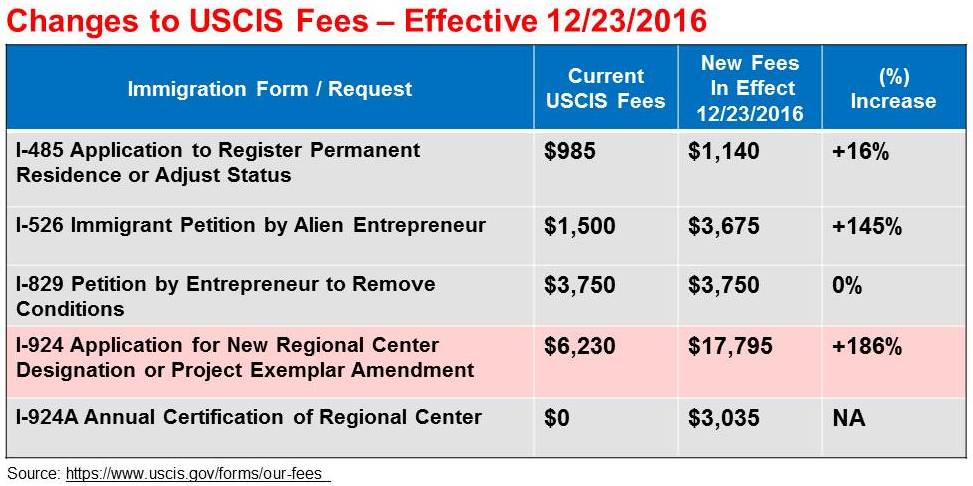
Today the Federal Register published U.S. Citizenship and Immigration Services Fee Schedule, a final rule adjusting the fees required for most immigration applications and petitions.immigration fees chart V4

Out of the above changes, the fee increase for Form I-924 is the most significant – a 186% increase from $6,230 to $17,795. This fee increase applies to new regional center applications and to projects seeking to file I-924 project exemplar applications.

The good news is that these USCIS fee increases go into effect on December 23, 2016. Therefore, anyone thinking about filing a new regional center application or renting a regional center to file a project exemplar application should take immediate steps to insure that their application(s) can be completed and submitted to USCIS before December 23, 2016.


Free EB-5 Project Evaluation

USCIS Third Quarter I-526 and I-829 Data Released for FY 2017

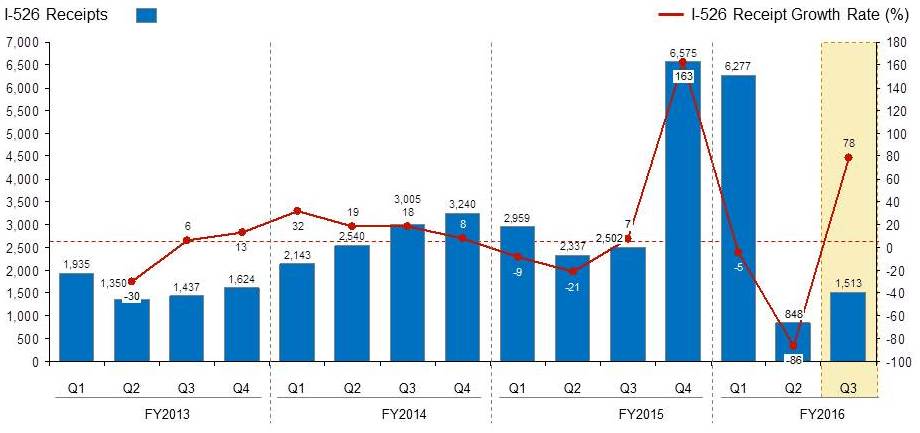
USCIS recently published the EB-5 program statistics for the third quarter of fiscal year 2016 (April-June 2016). I-526 receipts moved towards the norm but were still lower at 1,513 receipts than the same time last year. Annualized Q3 leads to a 6,000 petition number which is in line with 2012 / 2013 figures.

As a reminder 1Q FY 2016 was at the end of calendar year 2015 when there was a rush to file before December, and in that month alone there were over 6,000 petitions filed. Since then there was a large drop-off in Q2 (Jan-March) and only 848 petitions were filed. Q3 rebounded with 1,513 petitions filed which is nearly double Q2, but still below historical norms.

We expect for there to be a significant pickup in Q4 as there is another rush to file petitions before 9/30 although we believe it will be a significantly smaller rush than at the same point in the prior year.

Trends of I-526 Receipts by Quarter
FY2013 – FY2016, Q3

I-526 Receipts Q3 2016

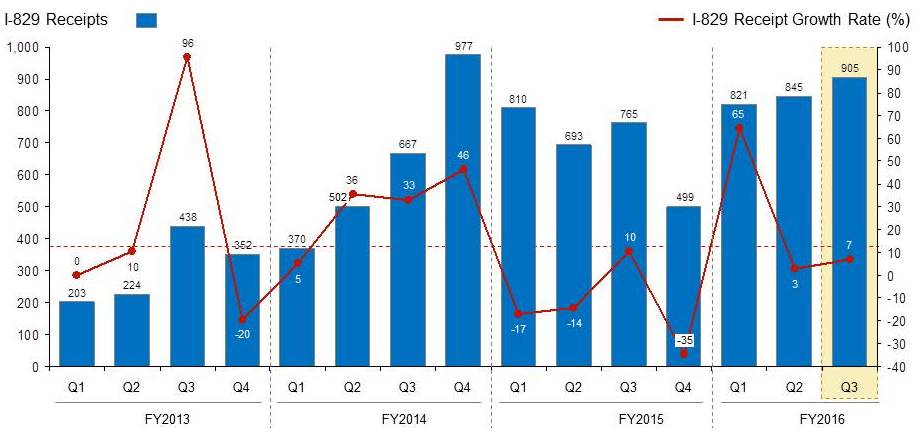
Trends of I-829 Receipts by Quarter
FY2013 – FY2016, Q3

I-829 Receipts Q3 2016 CROPPED

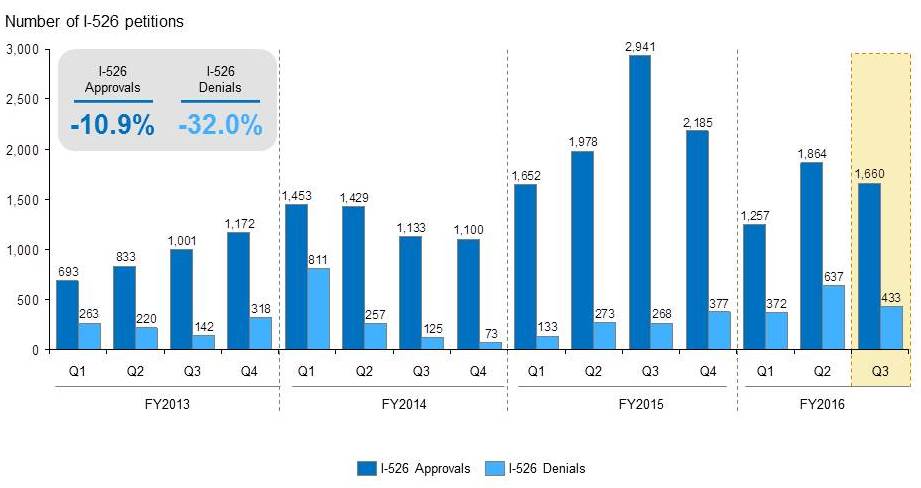
I-526 Petition Quarterly Statistics
FY2013 – FY2016, Q3

I-526 Petitions Third Quarter 2016


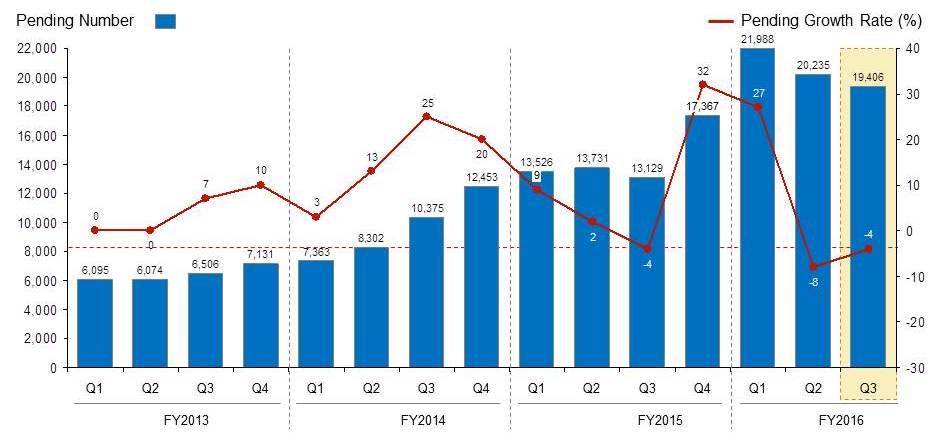
Trends of I-526 Pending by Quarter
FY2013 – FY2016, Q3

I-526 Trends by Quarter FY 2016

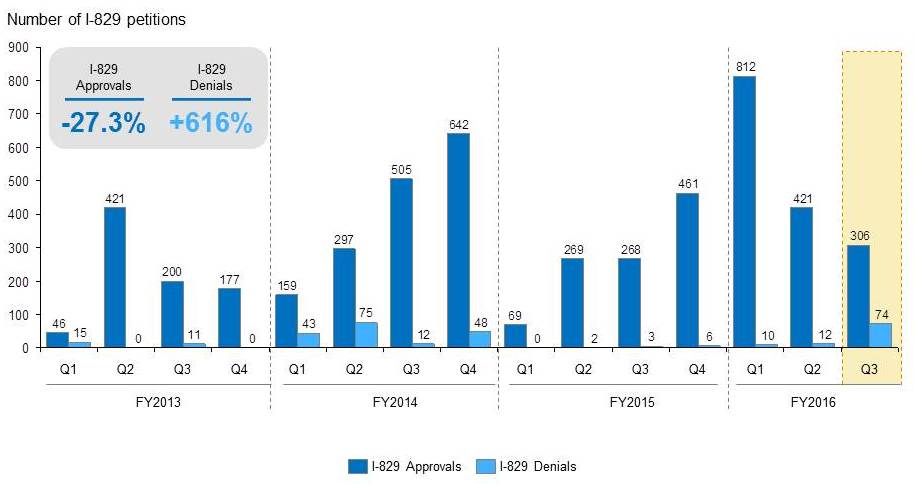
I-829 Petition Quarterly Statistics
FY2013 – FY2016, Q3

USCIS I-829 Trends FY 2016

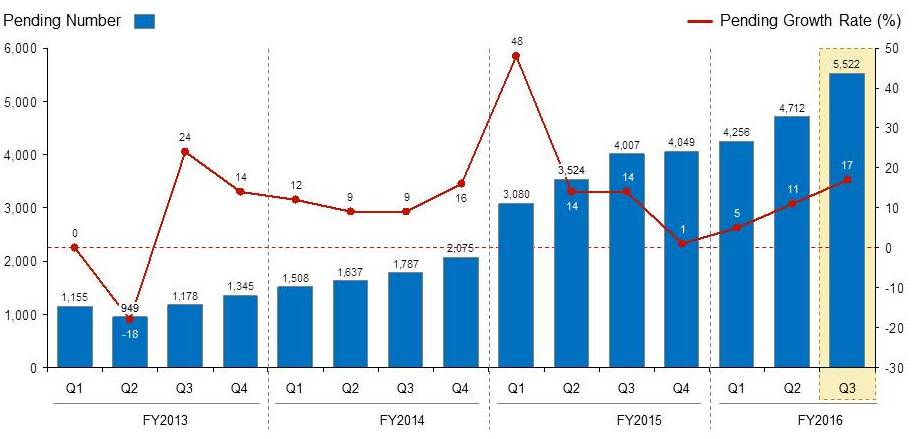
Trends of I-829 Pending by Quarter
FY2013 – FY2016, Q2

USCIS EB-5 I-829 Trends by Quarter