



Free EB-5 Project Evaluation

USCIS Guidelines About EB-5 Regional Center Audits

A person taking notes on a tablet in front of piles of documents.

The United States Citizenship and Immigration Services (USCIS) oversees the EB-5 Immigrant Investor Program. This program allows foreign individuals to invest in U.S. businesses and apply for Green Cards.

Investors can invest in a new commercial enterprise directly or via a regional center; this choice is entirely up to them. Within the EB-5 program, a regional center is an organization that USCIS designates to facilitate investments and help the local economy grow.


Audit of Regional Centers

A calculator and magnifying glass on business documents, books and ledgers.

Compliance reviews of regional centers have already been standard practice, but the EB-5 Reform and Integrity Act of 2022 (RIA) introduced a new audit requirement. USCIS made an announcement about this on April 9, 2024, and started the audit process on April 23.

The agency stated that “regional center audits enhance the integrity of the EB-5 program by helping us verify information in regional center applications and annual certifications as well as associated investor petitions.” This is to keep the EB-5 program trustworthy and ensure compliance with its rules. Under this provision, regional centers must be audited every five years.

USCIS’s Audit Process

Four light bulbs with Step 1, Step 2, Step 3, and Step 4 written on them.

The USCIS manages the audit process for each regional center on a case-by-case basis. Numerous factors can cause audit timelines to be different, such as the regional center’s average response time and any issues present in the audit processes.

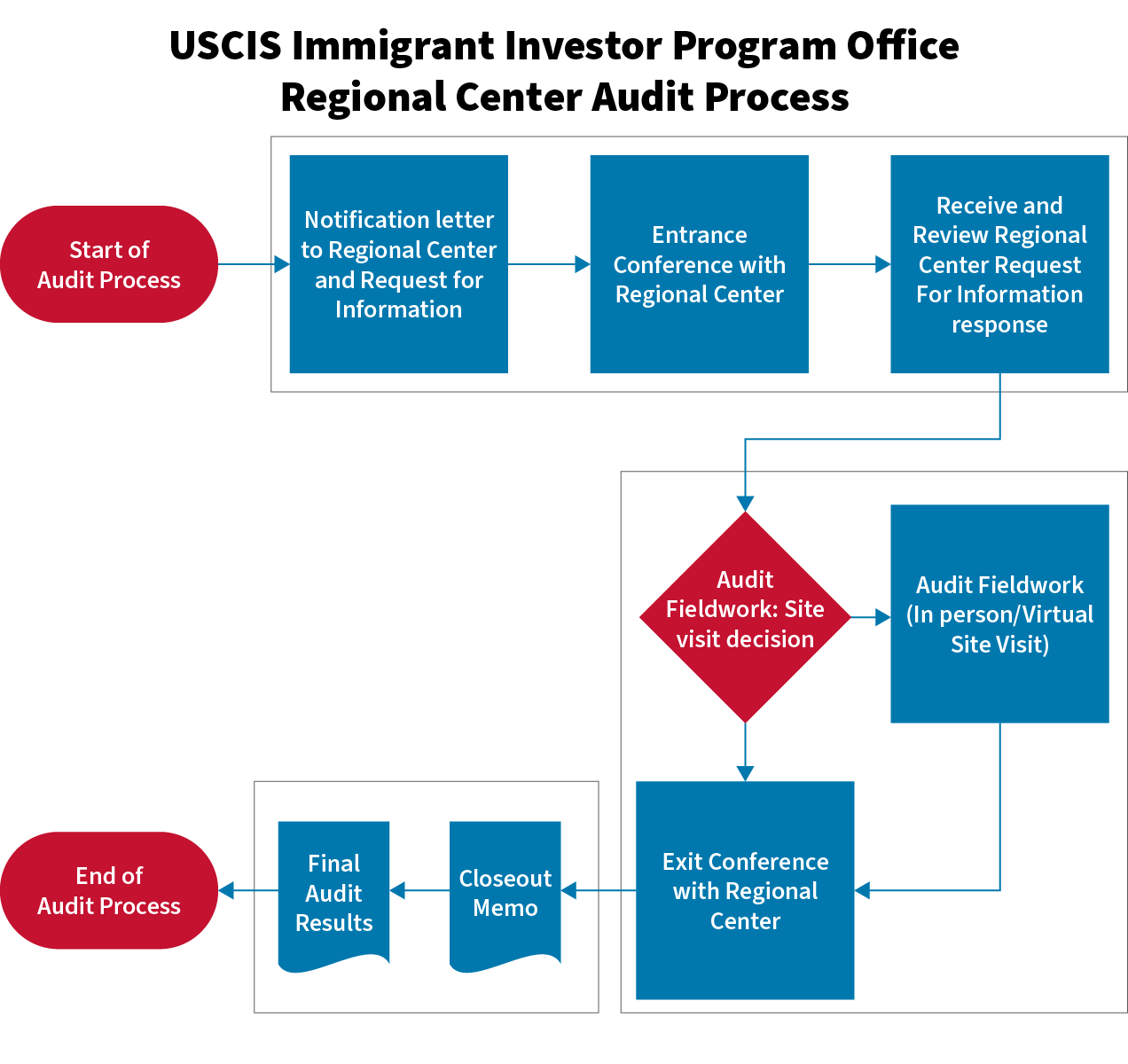
USCIS's flowchart depicting the Immigrant Investor Program Office Regional Center Audit Process.

Source: USCIS

Pre-Audit Intimation

USCIS sends an official notification letter to the selected regional center, initiating the audit process. The letter likely includes the audit’s scope and schedule. It also includes instructions on cooperating with the USCIS audit officials. This intimation ensures that the audit process goes smoothly.

In response to the USCIS’s request for an audit, the chosen EB-5 regional center needs to gather all the records needed by the INA. This includes everything from new and up-to-date financial records to ledgers.

During Audit

During these audits, USCIS checks the paperwork. They verify that investor funds go into the projects and evaluate how well the regional centers follow applicable laws. In addition, they conduct in-person interviews with the regional center’s management teams, staff, and other involved stakeholders. Besides assessing the regional center’s compliance with program requirements—such as creating jobs for U.S. workers—USCIS also looks at its capacity to attract and manage EB-5 investments.

Starting April 23, USCIS has standardized these evaluations. They use the Generally Accepted Government Auditing Standards (GAGAS), also known as the Yellow Book. These standards provide a method for conducting fair and thorough audits.

Auditors physically visit the regional centers to inspect them as part of the auditing process. If the regional center’s representative shows no interest in being present during an audit, USCIS can cancel the visit at any time. If this happens, USCIS will finish the audit report with the information they have access to, noting that the regional center asked for the site visit to be canceled. Moreover, a regional center can have its accreditation revoked if it does not cooperate with the audit or attempts to obstruct it.

Post-Audit

A person stamping a document.

After an audit, USCIS sends a Notice of Audited Findings (NOAF) or a Notice of Intent to Terminate (NOIT) to the regional center. In these notices, USCIS explains what the audit revealed and gives the regional center a chance to respond to and settle any issues the agency raises.

The recently established EB-5 Regional Center Audits webpage provides detailed information regarding how regional centers can prepare for and participate in audits.

Findings of the Audit Process

As previously mentioned, the agency implemented the audit requirement in order to eliminate regional centers that do not adhere to the rules established by USCIS. By doing this, the U.S. government aims to protect foreign investors and the EB-5 program.

If the audit results are unfavorable for the regional center, this does not necessarily impact its designation status or the immigration procedures of foreign investors who have invested in projects the regional center has sponsored.

However, if a representative from a regional center refuses to follow the rules or tries to prevent USCIS from auditing its documents and operations, the agency will end the audit and write in its report that the regional center was not cooperative. The regional center may then lose its designation.

Stay Informed With EB5AN

A person in a suit celebrating with his arm up, and the EB5AN logo on the side.

It is essential that regional centers cooperate fully with USCIS throughout the audit process and take it seriously. Failure to comply with program requirements or to address issues raised during an audit could result in the termination of the regional center’s designation, which would have severe consequences for both the regional center and its investors.

By following audit requirements and staying transparent, regional centers can continue to attract foreign investors and support the integrity of the EB-5 program.

EB5AN owns over 10 EB-5 regional centers that cover the entire continental United States, and has helped more than 2,300 families from 60 countries relocate to the United States as lawful permanent residents. We offer our clients first-rate, low-risk EB-5 regional center projects with a 100% USCIS project approval rate to date.

Book a free consultation with our team today to learn how we can help you through every step of the EB-5 process.

A hand filling out a U.S. visa application document. Free EB-5 Project Evaluation

Understanding EB-5 Visa Carryovers

A hand filling out a U.S. visa application document.

Every year, the U.S. government sets aside a specific number of visas for each immigrant visa category under the Immigration and Nationality Act (INA). However, not all visas in one category may be used within a year, while other categories may have surplus applications. When this happens, the U.S. Department of State (DOS) redistributes the unused visas by carrying them over to the following year, and across different categories in some cases.

EB-5 visa carryovers can significantly impact investors by increasing the total number of visas available. Consequently, EB-5 applicants may receive their visas earlier, and the U.S. Citizenship and Immigration Services (USCIS) can speed up the EB-5 process.

Ideally, once an EB-5 applicant has filed the right petitions and met all the EB-5 investment requirements, they should be granted a U.S. Green Card, but this is not always the case. Other factors such as EB-5 visa availability may influence applicants’ chances of obtaining permanent residence in the U.S. Therefore, EB-5 investors should learn how unused EB-5 visas are reallocated and use this information to their advantage.

In this post, we will explain how EB-5 visas are allocated each year, what happens to unused EB-5 visas, and how this impacts the EB-5 program and the investors involved.

EB-5 Carryovers and Other Key Terms

A magnifying glass on top of a dictionary or immigration law book, with the word EB-5 in the center.

To fully understand how EB-5 visa carryovers work, investors must be familiar with certain terms relating to EB-5 visa availability and the important dates leading up to the receipt of their Green Cards.

EB-5 Visa Carryovers

EB-5 visa carryovers are unused visas in a given year that get rolled over to the next year. DOS processes EB-5 visa carryovers to increase EB-5 visa availability, reduce backlog, and speed up EB-5 processing times.

Reserved Visas

To redirect investments to areas that need them the most, the U.S. government sets aside a percentage of EB-5 visas for specific targeted employment areas (TEAs), namely rural regions, high-employment areas, and infrastructure projects. The government encourages investments in these targeted areas by setting a lower investment threshold for them, as well as offering “reserved” visa availability, which especially benefits new investors from otherwise backlogged countries. This way, investors who apply for reserved visas have shorter waiting times than regular EB-5 processing times.

Unreserved Visas

EB-5 projects outside of targeted employment areas that do not qualify for reserved set-asides fall under the “unreserved” category. They take longer to process, and once the given annual limit is exceeded, affected investors would have to wait until their priority date becomes current again. This is where Chinese and Indian investors are currently facing backlogs.

Visa Bulletin

A magnifying glass on a page with text, with the word News in the center, which stands for the DOS monthly visa bulletin news.

An investor’s priority date is when USCIS receives their Form I-526 or I-526E immigrant petition. This date is essential for the EB-5 investor as it marks their position in line for an EB-5 visa. When an EB-5 investor’s priority date falls before the final action date on the visa bulletin, it means that an immigrant visa is available for their use. However, priority dates that fall after the final action date exceed the EB-5 annual visa limit and a visa will not be issued until it becomes available.

Final Action Date

Final action dates are also indicated in the visa bulletin. It is the date when EB-5 investors who have an approved immigrant petition can expect to adjust status.

How Are EB-5 Visas Allocated?

A hand holding half a globe, with a figurine below it.

There is an annual limit for employment-based visas, which also includes eligible dependents. Under the INA provisions, EB-5 visas account for around 7% of the total employment-based visas.

Of these visas, 32% are set aside for three categories of EB-5 applicants. Specifically, 20% are for applicants who invest in rural areas, 10% are for applicants who invest in areas with high unemployment, and 2% are for those who invest in infrastructure projects.

The remaining 68% constitute unreserved EB-5 visas.

How Are Unused EB-5 Visas Carried Over?

A person holding a checklist, next to a stack of digital folder icons symbolizing visa application documents.

Within certain limitations, DOS may transfer unused visas from the family-based to the employment-based categories, including EB-5.

Unused visas within the same category may also be redistributed. For instance, where there are unused EB-1 visas, DOS may transfer them to another employment-based visa category, such as the EB-2 visa.

Impact of RIA

With the enactment of the Reform and Integrity Act of 2022 (RIA), new visa carryover provisions under the reserved categories were introduced. According to this, unused reserved visas from the fiscal year immediately prior will be rolled over to the current fiscal year within the same category. If these reserved carryover visas are not used within that fiscal year, either, then they will be carried over to increase the unreserved visa numbers.

This means that the reserved visas from FY 2022 were carried over to FY 2023. As FY 2023’s reserved visas also weren’t used in the same year, they rolled over to FY 2024. This translates into an unusually high number of EB-5 visas being available in FY 2024, including those made available in the unreserved category. If USCIS and relevant U.S. consulates and embassies in retrogressed countries can process these available visas efficiently, this relatively new EB-5 visa carryover policy may help ease current backlogs.

Start Your EB-5 Journey With EB5AN

A person holding a green card with the EB5AN logo on it.

The EB-5 Immigrant Investor Program is one of the most straightforward pathways to obtaining permanent residency in the U.S. However, the program often involves complicated details, leaving many investors frustrated and discouraged. This is why seeking guidance from experienced EB-5 professionals can help you through every step of the process.

To learn more about the EB-5 program, please feel free to book a free consultation with us.

Free EB-5 Project Evaluation

Exploring the Differences Between EB-5 Rural, High-Unemployment, and Infrastructure Project Investments

A person sitting at a desk thinking with project documents in front of her, and real estate development models behind her.

The EB-5 Immigrant Investor Program has long been a popular pathway for foreign nationals seeking permanent residency in the United States through investment in a U.S. business venture.

The program, administered by United States Citizenship and Immigration Services (USCIS), was introduced by Congress in 1990 to stimulate the U.S. economy through job creation and capital investment by foreign entrepreneurs. It enables non-U.S. citizens and their eligible dependent family members, i.e., the spouse and unmarried children under 21, to obtain lawful permanent residency in the United States, also known as the Green Card.

To be eligible for the EB-5 visa, applicants must invest a minimum amount in a new commercial enterprise and create at least 10 permanent full-time jobs for qualified U.S. workers. The standard EB-5 minimum capital investment is $1,050,000. However, for specific infrastructure projects and projects located in a targeted employment area (TEA), the minimum investment threshold is much lower at $800,000.

TEAs are areas designated by the U.S. government as regions requiring economic stimulation due to rural location or high unemployment rates. The EB-5 program aims to promote economic growth in these areas with investment capital and jobs, which is one of its main objectives.

In this article, we will explore the differences between the three investment options—rural TEA, high-unemployment TEA, and infrastructure projects. We will also understand how potential investors can accelerate their EB-5 process and the factors they must consider while selecting a TEA investment that best suits their immigration and financial goals.

Faster Immigration with Set-Aside Visas

A model plane on a stack of passports.

Besides requiring lower capital, investments in rural areas, high-unemployment areas, and infrastructure projects also provide a faster immigration route to EB-5 applicants, as these investments are eligible for set-aside visas introduced under the EB-5 Reform and Integrity Act of 2022 (RIA).

Under the RIA, 32% of the total yearly quota of EB-5 visas are reserved as set-aside visas—20% for investments in rural areas, 10% for investments in high-unemployment regions, and 2% for investments in designated infrastructure projects.

This provision of the RIA offers an invaluable opportunity to applicants from high-demand countries, such as China and India, to avoid backlogs in the unreserved category. Investors from these countries often face years-long extended waiting times for their Green Cards as the demand far outnumbers the limited annual availability of EB-5 visas. With the new set-aside visa categories, they can potentially obtain a Green Card as soon as their EB-5 petition (Form I-526E) is approved.

As of now, there is no extra waiting time or backlog in the reserved categories. However, the supply of EB5 set-aside visas is limited, and these categories may also become oversubscribed. Investors considering an EB-5 investment must file their petitions without delay while the reserved visas are still available.

Each of these investments has unique risks and benefits for investors, as discussed below.

Rural Area Investments

A close up of a map with pins, showing rural areas designated by a governmental entity.

To qualify as a rural area, an area must not have more than 20,000 residents, not border a city or town with a population of 20,000 or more, and not be located within a metropolitan statistical area according to the most recent 10-year census of the United States.

Investing in a rural TEA project has multiple advantages and is one of the best options for foreign investors to expedite their immigration journey.

Low Investment Amount

A person putting coins into a jar while making calculations on a notebook, symbolizing economic development through the regional center program.

As mentioned earlier, rural TEA projects qualify for the reduced minimum investment amount of $800,000, which means considerable savings for investors at the outset.

Priority Processing

In addition, rural EB-5 investments are eligible for priority processing of Form I-526E by USCIS. Of all other EB-5 investment categories, rural TEA petitions are adjudicated first, ensuring the shortest processing time for rural EB-5 investors. Due to priority processing for rural projects, many EB-5 investors and their family members have been approved for U.S. Green Cards in a matter of months.

Maximum Reserved Visa Quota

Another key benefit of a rural TEA investment is that it qualifies for 20% of the annual EB-5 visa quota, the largest share among the three set-aside visa categories. As the demand for rural EB-5 projects has historically been lower than for high-unemployment TEA projects, the reserved quota under this category is expected to last the longest, reducing the chances of a backlog in this category.

Faster processing for rural EB-5 petitions is particularly advantageous for investors applying from outside the United States, as they often face longer waiting times than investors already in the United States. This is because investors in the United States on non-immigrant visas can benefit from the concurrent filing provision of the RIA.

While rural EB-5 investments are an excellent option for investors looking for fast visa processing, they also have some inherent risks, such as financial viability due to low population, unpredictability of construction costs, and difficulty in securing financing.

To increase their chances of immigrating successfully and getting their money back, EB-5 investors must research carefully and invest in profitable and fully financed projects executed by reputed developers.

High-Unemployment Area Investments

A group of people sitting in chairs and checking their phones, with employee/workforce network icons in the foreground.

A high-unemployment TEA is an area that has an average unemployment rate of 150% above the national average at the time an investor files their EB-5 petition.

Historical Preference for High-Unemployment TEA Investments

Before the RIA introduced significant incentives for rural TEA investments, high-unemployment urban TEA projects dominated the EB-5 market. Typically, large real estate urban TEA projects developed by major companies were considered a safe option for EB-5 investors as they were often fully capitalized and had significant job creation.

Post-RIA, although there is an increase in the demand for rural TEA investments, urban TEA projects continue to remain popular among investors. Recent data from USCIS reveals that urban TEA projects are more than twice as popular as rural TEA projects.

Pros and Cons of Urban TEA Investments

A silver scale with money on one side and a house icon on the other, alluding to significant development through capital invested.

Just like rural EB-5 investments, urban TEA investments are also eligible for reduced minimum capital criteria and set-aside visa quota.

However, as the set-aside visa allocation for high-unemployment TEA investments is only 10% of the total EB-5 visas, this category may soon become significantly oversubscribed and face long processing delays, especially for investors from China and India.

In comparison, rural TEA investments have a larger (20%) visa allocation, and with lower demand, the rural EB-5 visa category is not expected to face backlogs for a longer time. Because of this, for investors from high-demand countries, rural TEA investments could be a better option for faster immigration to the United States.

However, investors already in the United States on non-immigrant visas can opt for urban TEA projects as they will not practically be affected by the long waiting time in case of backlogging. Such investors can exercise the concurrent filing option to adjust their status.

Under the concurrent filing provision, investors are allowed to file their adjustment of status petition (Form I-485) along with their EB-5 petition, after which they can apply for work and travel permits. Within a few months, they can receive their work and travel authorization and enjoy Green Card benefits while their EB-5 petition is being processed.

Infrastructure Project Investments

The EB-5 infrastructure project investment is a new category created by the RIA in March 2022.

An infrastructure project is defined as one that is administered by a federal, state, or local government entity and involves the development of a public works project. This new category aims to support infrastructure development projects across the United States.

Investments in qualifying public infrastructure projects are eligible for the reduced investment amount criteria of $800,000 and have access to 2% of the annual EB-5 visa quota as reserved visa set-asides.

However, this category only applies to immigrant investors who file EB-5 petitions through regional centers.

Infrastructure project investments being a relatively new category, there is still some ambiguity about the eligibility criteria for projects. The demand for this category is low, with only a few projects qualifying under the infrastructure classification.

Contact EB5AN for More Information

A hand holding a piggy bank next to an alarm clock, with the EB5AN logo on top.

Both rural and urban TEA projects offer an excellent opportunity for investors to fast-track their immigration journey at a lower investment cost. Even so, each investor has unique needs, and EB5AN can help you find the right project for your individual immigration and financial goals.

EB5AN has helped more than 2,300 families from 60 countries relocate to the United States as lawful permanent residents. Our expert team has more than a decade of experience and offers clients first-rate, low-risk EB-5 regional center projects with a 100% USCIS project approval rate.

For more information on TEA investments, please book a free call with our expert team today.

Free EB-5 Project Evaluation

How Can EB-5 Funds Help Developers

A hand reaching out to another person's hands holding money.

Many businesses face difficulties in securing loans or investments from traditional sources like banks or venture capitalists. The EB-5 program provides a solution to this capital challenge by facilitating foreign investment in U.S. businesses.

The EB-5 program is a U.S. immigration program that grants permanent residency (Green Card) to foreign investors who meet specific criteria. Investors must invest either $1,050,000 or $800,000 (in a targeted employment area) in a new commercial enterprise that creates at least 10 full-time jobs for U.S. workers.

Investors and their immediate family members receive a conditional green card valid for two years initially, then become permanent residents of the U.S. if they fulfill various U.S. Citizenship and Immigration Services (USCIS) requirements.

While this program offers many financial and immigration benefits to investors, it can also help project developers. In this article, we will explore the benefits of EB-5 funds for developers.

Benefits of EB-5 Funds for Developers

A person holding a small model house in one hand, and some dollars in the other.

The EB-5 program provides developers with a significant capital injection, enabling them to secure the necessary funds for large-scale projects that might otherwise be challenging to finance through traditional means. Here’s how this influx of capital benefits developers seeking to launch projects.

Flexibility

Even though EB-5 capital isn’t always much cheaper than regular debt, it comes with fewer rules and restrictions. Through EB-5, developers can also get better financial terms since foreign investors tend to prioritize immigration benefits over return on investment.

Additionally, repayment periods tend to be longer, giving developers more breathing room for project completion and cash flow generation. The non-recourse structure of EB-5 investments protects the developer’s assets in case of default, offering greater financial security compared to traditional loans.

Global Funds Reach

A small wooden house on top of a pile of dollars.

Investors can use a wide range of lawful funds, including salaries, business profits, real estate sales, inheritances, and even gifts. This global reach attracts investors from various backgrounds, expanding the potential pool of capital. EB-5 projects can potentially secure capital from hundreds or even thousands of individual investors. This diversification reduces the risk associated with relying on a single or limited number of funding sources, enhancing financial stability and mitigating the impact of any potential investor defaults or withdrawals.

Expedited Funds

EB-5 capital expedites the visa process for foreign investors, injecting funds quickly. This streamlines project execution, shortening timelines compared to traditional financing methods. Faster project completion also leads to quicker market entry, potentially securing a first-mover advantage. This can lead to market share capture, higher profits, and a strong competitive edge in the industry.

Increased Credibility

An EB-5 investor and real estate developers shaking hands.

EB-5 projects undergo a meticulous vetting process by USCIS to ensure compliance with program regulations. This scrutiny involves examining the project’s financial viability, job creation potential, and adherence to TEA requirements, if applicable. Successfully navigating this process demonstrates the project’s overall soundness and strengthens the developer’s reputation.

Attracting foreign investors through EB-5 means that many people from different backgrounds find the project promising and worth investing significant capital in, hoping to get U.S. residency in return. This validation adds a layer of credibility to the developer’s capabilities and the project’s potential.

EB-5 Funding for Real Estate Development

A wide shot of cranes at an EB-5 real estate development project site.

There are many types of projects that can qualify for EB-5 funding, with a wide range of industries represented. However, real estate developers typically use EB5 capital the most.

Real estate development boasts a natural synergy with EB-5 funding due to its inherent job creation potential. Projects like mixed-use developments, hotels, and office buildings tend to require significant construction and ongoing operational staff, directly translating investment into job opportunities.

Infrastructure improvements also often accompany development projects. New roads, utilities, and public spaces can revitalize areas, attracting residents and businesses and further stimulating job creation within the surrounding community.

For instance, hotel development in a growing tourist destination not only creates construction and hospitality jobs but also drives demand for ancillary services like transportation, restaurants, and retail. These indirect and induced jobs may count toward the EB-5 job creation requirement in the case of regional center investments.

Due Diligence and Marketing

The core EB-5 requirement is job creation: the project must generate at least 10 full-time jobs for U.S. workers within a designated timeframe (currently two years). Additionally, the project must be a new commercial enterprise (NCE) established after November 29, 1990, or an existing business undergoing significant restructuring that increases its net worth or employee count by 40%.

Thorough due diligence is key for developers using EB-5. This involves preparing a comprehensive offering document outlining the project details, financial projections, job creation plan, and potential risks. Transparency and clear communication are very important when it comes to building trust with potential investors.

Marketing strategies should target the specific investor profile aligned with the project. Attending industry events, collaborating with investment firms specializing in EB-5, and using digital marketing tools are all effective ways to reach the desired audience.

For instance, a developer planning a resort project in a rural area can leverage the TEA designation to attract investors with a lower investment threshold of $800,000. Partnering with a reputable regional center experienced in the industry can provide access to a network of pre-qualified investors and streamline the fundraising process.

Seeking the help of experienced EB-5 professionals is crucial to ensure project compliance with all regulations and maximize the chances of successful capital raising through the program.

Get Started with EB5AN

A group of EB-5 people sitting at a desk, with the EB5AN logo on their computer.

EB-5 funding offers a powerful tool for developers seeking capital to fuel their projects. By providing access to significant investment opportunities, the program facilitates the realization of diverse projects across various industries.

While the EB-5 landscape is subject to ongoing modifications and potential legislative changes, its core principles of promoting economic growth and job creation through foreign investment remain a valuable asset for developers seeking innovative funding solutions.

If you would like to learn more about how to use EB-5 funds to your advantage as a developer, book a call with us today.

Free EB-5 Project Evaluation

An EB-5 Investor’s Guide to Private Placement Memorandums

A person holding a document and a pen.

Private Placement Memorandums (PPMs) are legal documents issued by entities seeking funding. They provide these documents to potential investors so that they can make informed investment decisions. Unlike a business plan, the PPM is a descriptive document that details a company’s overall business structure, the nature of the investment offering, relevant financial data, and the investment’s associated risks.

PPMs are commonly used to facilitate funding for startup businesses and real estate projects, including any EB-5 new commercial enterprise (NCE). For such investment ventures, the U.S. security laws do not enforce the full securities registration process, to enable project developers to raise investment capital at a lower rate. While the relaxed securities regulations may speed up the fundraising process for developers, they expose investors to higher risk, which requires the issuance of PPMs.

In this article, we will outline the purpose and components of typical PPM documents in the EB-5 context.

What Is the Purpose of a PPM in EB-5 Investments?

A group of people holding a clipboard with business data and graphs on it, studying EB-5 immigrant investor program economic growth.

A private placement memorandum is of some value to all the stakeholders in an EB-5 investment. As we highlighted earlier, it provides the investor with all the information they need to decide whether a proposed investment meets their financial objectives.

The PPM discloses any potential risks associated with the investments. It also outlines how investments comply with U.S. immigration and securities laws, ensuring investors of their legality.

As for the project developer or regional center, who may also be the issuers in this context, a detailed PPM will boost investors’ confidence and speed up the fundraising process. Furthermore, the PPM shields EB-5 project developers from liability for non-disclosure since the document contains proof that the issuers disclosed all relevant information to investors.

EB-5 professionals like lawyers and financial advisors also use the PPM because it clearly explains the unique chances and risks of each project. The detailed information helps them do their jobs better, from conducting market research to ensuring due diligence at every stage of the project.

What Are the Components of a Comprehensive PPM for EB-5 Investments?

An office with people in front of their computers in the background, with investment capital icons on the foreground.

A comprehensive EB-5 PPM must have certain components and disclose specific information about the EB-5 investment. These include the following:

Executive Summary

The executive summary features a short overview of the PPM, providing investors with a quick and clear understanding of the document’s content. It should include a summary of the investment project, the type of investment, and its structure. The executive summary could also include any important legal disclaimers, such as the non-guarantee of immigration benefits and investment returns.

Business Plan

The business plan section of the PPM provides more in-depth information on the nature, purpose, location, and direction of the investment project. It outlines the investment history, objectives, and project development timeline. EB-5 PPMs should specifically include information on how the investment can fulfill the U.S. Citizenship and Immigration Services (USCIS) job creation criteria and minimum investment amounts.

The business plan should also indicate how the business will function daily and the management team responsible for ensuring its smooth running.

Financial Information

A regional center's management team working on a computer and a calculator to provide financial info about the investor's capital.

A comprehensive PPM should feature detailed accounts of the use of investment funds.

This includes summarized financial statements that disclose accurate information on revenue, expenditures, profits, and business cash flow projections.

This section should also include information on the business’s capital structure, such as the total investment required for the EB-5 project and the amount already acquired.

Risk Factors of the Investment

A person pointing at blocks of wood with the word risk spelled out.

Investors and other stakeholders in the EB-5 investment rely on the PPM for risk assessment purposes. This is why a PPM must detail all the potential risks of the investment, from business risks, such as potential competition, to financial risks and immigration risks.

Terms of the Investment

This section informs investors of the basic conditions for participating in an EB-5 project. It should also cover the terms of the investment, such as the minimum investment amount required from each investor. The terms section of the PPM should also inform investors of the mode of investment, whether equity-based or loan-based, as well as the issuer’s preferred subscription procedures.

In addition, this part of the PPM usually features the rights and obligations of the issuers and investors to one another and a viable exit strategy. Conditions regarding repayment, redeployment, and I-526E approval refund guaranty may also be included in the PPM.

Legal Compliance

An immigration attorney revising a subscription agreement, escrow agreement or supporting documentation.

The project developers must outline how they intend to ensure the legality of the EB-5 investment. The PPM must disclose that the EB-5 project is in compliance with the regulations of USCIS and the U.S. Securities and Exchange Commission (SEC).

Do EB-5 Investors Need a PPM?

A foreign investor looking at a private placement memorandum offering documents.

While USCIS does not mandate PPMs from EB-5 investors, most of the components of the legal document are required. For instance, USCIS requires a business plan, along with evidence that the investment meets the minimum amount and will create the required number of jobs. This is why having a PPM is highly recommended; it allows investors to organize all the required paperwork into one comprehensive document.

In summary, showing a PPM to USCIS facilitates the review process, increasing investors’ chances of having a successful EB-5 process. It also ensures that investors comply with U.S. securities laws as enforced by the SEC, which are just as important as the U.S. immigration laws.

Seek Guidance from Industry Experts

A group of EB-5 experts sitting at a desk on tablets and computers, with the EB5AN logo on one of them.

PPMs are primarily issued to investors. However, investors alone usually cannot analyze and apply the information without consulting EB-5 professionals. After receiving your PPM, it is advisable to review it yourself first, then consult experts to determine whether the investment is viable.

This is where EB5AN comes in. Our team of professionals comprises industry leaders in the EB-5 space who have helped over 2,300 families obtain permanent residency status in the U.S.

If you would like to learn more about how to review PPMs or other EB-5 services we offer, please book a free consultation with our expert team today.

Free EB-5 Project Evaluation

The Form I-485 Checklist That EB-5 Investors Need to Adjust Status

A checklist on a desk with a pen on it, with the title I-485.

Foreign nationals located in the United States can use Form I-485, Application to Register Permanent Residence or Adjust Status, to change their immigration status to permanent resident. This allows them to receive Green Cards under one of several USCIS eligibility categories.

However, this is easier said than done. The process can be complicated. Applicants must keep track of many documents, fill out required forms correctly, and file them on time.

United States Citizenship and Immigration Services (USCIS) accepts most of the I-485 petitions it receives, but it still denies thousands of them every year. During the last quarter of 2023, USCIS rejected nearly 12% of the I-485s it received from applicants under the employment-based immigrant category.

You don’t want your application to be one of those.

In this article, we will provide checklists and explanations to help ensure your Form I-485 includes everything it needs for the best chance of approval.

Check Your Eligibility

A hand stamping a document with a stamp that says approved on it.

The main EB-5 investor is called the principal applicant. This person typically invests in a new commercial enterprise that will eventually create at least 10 full-time jobs for American workers. This person also files Form I-485 and other required documentation.

A principal applicant who fulfills all of the EB-5 program’s requirements receives lawful permanent resident status for themselves and eligible family members.

But before you can apply to adjust your immigration status, you must meet a series of USCIS requirements, which include:

  • Having an approved immigrant petition (Form I-526 or I-526E).
  • Having an available visa number, per the USCIS Visa Bulletin.
  • Being physically present in the United States.
  • Never having entered the United States illegally.
  • Not falling under certain grounds of inadmissibility without a waiver.

Let’s explore some additional requirements to change your lawful status.

An I-485 Checklist

Hands ticking a digital checklist image with filing form graphics on the screen.

Key Immigration Information You’ll Need

  • Alien registration number (if applicable).
  • Passport (even if expired).
  • I-94 Arrival/Departure Record.
  • Receipt number (if you have a pending or approved I-130 petition).
  • Address history from the past five years.
  • Employment history from the past five years.
  • Marriage and divorce dates for any previous marriages.
  • Information about organizations you have been involved with.

Other Forms to File with Form I-485

Many EB-5 investors find it necessary or desirable to file additional forms with their I-485s. These may include.

  • I-130, Petition for Alien Relative.
  • I-130A, Biographic Supplement (for a spouse).
  • I-864, Affidavit of Support.
  • I-693, Report of Medical Examination and Vaccination Record.
  • I-765, Application for Employment Authorization (optional).
  • I-131, Application for Travel Document (optional).

Gather Required Documentation

The hands of a principal applicant piling up supporting documents.

A successful I-485 applicant must provide the right evidence and supporting documents to USCIS. These include:

  1. Government-issued photo ID: Typically copies of your passport pages or a copy of a driver’s license. Military identification also may be accepted.
  2. Photos: Two identical passport-style photos (glossy, unedited, and printed on a white or off-white background) that were taken no more than 30 days before you submitted your I-485. Be sure you specifically requested that passport photos meet these criteria before submitting.
  3. Birth and marriage records: Copies of your long-form birth certificate, marriage certificate(s), and divorce certificate(s), if applicable. If your birth certificate is not available, submit proof of its unavailability.
  4. Form I-94 or alternative immigration documents: Include documentation proving you were inspected by an immigration officer and admitted or paroled into the United States. Provide copies of passport pages with visa stamps or a copy of your Form I-94 Arrival-Departure Record.
  5. Form I-526/I-526E or Form I-797: You need to present one of these forms to show that you are eligible to adjust status under a particular immigrant category. If you file Form I-485 concurrently with your I-526/I-526E immigrant petition, include a copy of the I-526/I-526E. Otherwise, include a copy of Form I-797, Approval or Receipt Notice. This is the official notification that shows USCIS received your immigrant petition.
  6. Criminal history documentation: Certified records of your court, police, charge, and conviction history, if applicable.
  7. Medical documentation: Vaccinations and other medical records, including Form I-693, Report of Immigration Medical Examination and Vaccination Record, signed by a USCIS-designated civil surgeon. This is valid for two years from the signature’s date.
  8. Biographic information: Each eligible immediate relative should complete and file Form I-130, Petition for Alien Relative.
  9. Biometrics: USCIS may request your fingerprints, photos, and/or your signature at a biometrics appointment, which it will schedule with you later.

When it comes to I-485 approvals, it’s not just what you do that matters.

What you don’t do is equally important. Ensure you haven’t engaged in conduct that could get your application denied.

Beware of These Disqualifying Conditions

The main “inadmissibility grounds,” as described in the Immigration and Nationality Act, that can disqualify an I-485 petitioner fall under these buckets

  • Criminal Activities: Such as serious crime convictions.
  • Security Concerns: Indications of posing a threat to U.S. national security.
  • Legal Issues: Violations of U.S. immigration law.
  • Health Problems: Such as carrying a dangerous infectious disease.
  • Miscellaneous: Other issues at the discretion of USCIS.

If you think one or more of these categories applies to you, be sure to speak with an experienced immigration attorney before filing. Waivers may be possible in some cases.

💡Key Point: Don’t Forget Translations

An EB-5 investor must include English translations of any documents they submit written in a foreign language. The translator must also include a signed statement indicating the translation was done accurately.

Use the Right Mailing Address and Enclose the Right Filing Fee

You must mail a copy of your I-485 petition with the correct filing fee ($1,440, effective since April 1, 2024) in a sealed envelope to the correct USCIS lockbox.

A lockbox facility collects documents and filing fees. This facility also determines whether your application will move forward based on the amount paid. If your application is rejected at this stage, you probably enclosed the wrong fee.

EB-5 investors should send their I-485s to the address below that corresponds to the delivery service used. Check the list of USCIS direct addresses for the latest guidance before filing your form.

USCIS Dallas Lockbox

U.S. Postal Service (USPS)

USCIS
Attn: I-526/E
P.O. Box 660168
Dallas, TX 75266-0168

FedEx, UPS, and DHL Deliveries

USCIS
Attn: I-526/E (Box 660168)
2501 S. State Highway 121 Business
Suite 400
Lewisville, TX 75067-8003

Why Concurrent Filing Is a Good Idea

A person giving the thumbs up about their adjustment of status application.

Foreign nationals physically present in the United States on non-immigrant visas should strongly consider concurrent filing of Form I-485 and Form I-526E.

Made possible because of the EB-5 Reform and Integrity Act of 2022, concurrent filing is a good idea because it saves investors time. It allows them to get their conditional Green Card faster, including the associated benefits of lawful permanent resident status.

Foreign investors and their families are also eligible for improved work and travel flexibility while their I-485s are being adjudicated.

If you need a work permit, file Form I-765, Application for Employment Authorization. Filing this means you can get an Employment Authorization Document.

You may also wish to obtain a travel permit, also called an advance parole document. This lets a noncitizen travel outside of the country temporarily and come back to the United States with minimal hassle.

Other Form I-485 Best Practices

You can improve your chances of avoiding delays or denial by following these tips in completing your I-485 petition:

  • Understand and ensure you meet all eligibility criteria for adjustment of status.
  • Confirm you are using the most recent edition of Form I-485 (released on February 21, 2023).
  • Read the filing instructions carefully.
  • Ensure your answers are full and accurate.
  • Type your responses or write them out neatly in black ink.
  • Review this checklist of required initial evidence.
  • Work with an experienced immigration lawyer to draft and submit the I-485.
  • Respond to any USCIS requests for evidence promptly.
  • Work with an experienced immigration attorney to draft the I-485 and address any legal issues that may arise related to your case.

While you await approval of your application, you should maintain your lawful status in the United States and monitor USCIS announcements for any updates to the process.

It’s also a good idea to make copies of your entire application, supporting documents, and receipts.

Check with EB-5 Experts Before Filing

An EB-5 expert pointing at an investor's adjustment of status application on a desk.

Checking all the boxes on your I-485 application is only one part of a longer EB-5 process that may last a while, depending on your nationality and visa category. You must do more than understand the adjustment of status document checklist to receive Green Cards for yourself and qualified immediate relatives.

Don’t take the risk of getting your application denied by trying to do this on your own. Instead, be sure to work with seasoned professionals. They can give your full application the best chance of approval.

EB5AN has helped more than 2,300 families from 60 countries relocate to the United States as lawful permanent residents. Our expert team has more than a decade of experience, and offers clients first-rate, low-risk EB-5 regional center projects with 100% USCIS project approval rate to date.

If you have questions about anything connected to the EB-5 Immigrant Investor Program, do not hesitate to book a free call with us.

Free EB-5 Project Evaluation

A Closer Look at the EB-5 Program History

An American flag hung in front of a governmental building.

In the late 80s, when the U.S. economy struggled, lawmakers explored new ways to revive it. Around this same time, it had become popular for governments to boost commercial activity in their countries by attracting global talent and foreign investments. After observing the potential benefits of this strategy, Congress adopted the investment immigration option, which we now know as the EB-5 Immigrant Investor Program.

The EB-5 program provides a pathway for foreign investors to obtain permanent residency in the U.S., if they satisfy the EB-5 eligibility requirements regarding investments and job creation quotas. The EB-5 initiative works because both parties benefit from it: the U.S. boosts its economic growth while foreign nationals obtain permanent residency.

However, the EB-5 program has its pain points, and over the years, Congress and other stakeholders have sought several ways to improve its effectiveness. In this article, we will break down the EB-5 program history and explore the development of the program from its inception until now.

How Did the EB-5 Program Start?

A downward arrow showing economic decline in early 90s, marking the beginning of the immigrant investor pilot program.

Between the late 1980s and early 1990s, the U.S. experienced an economic decline due to high inflation and other tight monetary policies. As a result, the country faced rising unemployment rates, urging the U.S. Congress to enact new policies to improve the situation.

One such policy is the EB-5 visa program, which Congress enacted through the Immigration Act of 1990. The immigration initiative was the perfect match for the economic situation in the U.S., aiming to create more job opportunities and promote infrastructure by encouraging foreign investments.

The EB-5 Program Timeline

The success of the EB-5 program is largely due to several regulatory adjustments made by the U.S. Congress and other immigration regulators. This section will feature a comprehensive analysis of the program’s issues and the reforms put in place to maintain its economic relevance.

Inception to Late 1990s

An investor against the backdrop of the American flag, turning his pockets out.

When the U.S. Congress launched the EB-5 visa program in the 1990s, foreign investors’ participation was relatively low. This was primarily due to the significant capital investment amounts needed and other complex regulatory requirements of the program.

To encourage EB-5 investors, the U.S. immigration regulators introduced the EB-5 Regional Center Program in 1992. Regional centers are entities designated by the U.S. Citizenship and Immigration Services (USCIS) to facilitate investments on behalf of foreign investors.

The new entities made the EB-5 pathway to permanent residency more accessible, being able to rely on regional center teams to navigate the EB-5 program’s regulations.

The regional center concept successfully increased investors’ participation in the initiative and drove employment opportunities in targeted employment areas (TEA) through direct and indirect job opportunities.

However, the initial EB-5 program model was also vulnerable to fraud and misuse. In the high-profile fraud case of the U.S. District Court v. O’Connor, the defendants falsified bank transactions, claiming that investors had met the EB-5 program’s investment requirements. To combat this issue, USCIS and the Administrative Appeals Office (AAO) enforced more stringent regulations to ensure EB-5 investments were legally funded.

Following the new reforms, the AAO used specific examples to ensure decisions were consistent and the new rules were applied correctly. The following four cases, in particular, were critical in defining the structure of the EB-5 visa program in operation today:

  • Matter of Ho: The case informed the USCIS regulations on the EB-5 job creation criteria. The ruling emphasized the need for comprehensive and feasible business plans to meet the EB-5 job creation requirements.
  • Matter of Izummi: In this case, the court highlighted the need for investors to be involved in managing their EB-5 projects. The case reinforced the “at-risk” requirement of EB-5 programs, clarifying that only projects subject to profit or loss will be valid EB-5 investments.
  • Matter of Hsiung: The decision in this case stressed the EB-5 program requirement that all investment funds must belong to the investor(s) and be obtained legally.
  • Matter of Soffici: This case supports the Matter of Ho, specifying that EB-5 investments must create employment for at least 10 full-time U.S. workers, among other key decisions.

The EB-5 Program in the 2000s

A close-up of hands shaking.

In 2005, USCIS established the Investor and Regional Center Unit (IRCU) to enhance the management of the EB-5 regional centers. The new regulatory body worked to improve the integrity of the EB-5 program by streamlining the process and ensuring better compliance with its regulations. By this time, the EB-5 program had become more popular, with more foreigners gaining confidence in the effectiveness of the EB-5 pathway to U.S. residency.

The 2012 EB-5 Reform

By 2012, demand for EB-5 applications had increased vastly. However, immigration regulatory bodies struggled to keep up with the scale and complexity of investors’ applications. In addition, fraud and mismanagement were still rampant within the EB-5 industry, requiring stricter policies and more reforms by USCIS.

In response to these issues, USCIS introduced the annual reporting requirement for regional centers and released memoranda clarifying previous EB-5 regulations for better implementation of the program. The immigration agency also worked to increase engagement with investors to address their concerns and improve EB-5 investment transparency.

2015 – 2019: Major Policy Changes in the EB-5 Program

A judge's gavel on top of an American flag.

From around 2015, the U.S. Congress began to introduce new bills to modernize the EB-5 Immigrant Investor Program. By the end of 2019, these legislative changes took effect, representing one of the most significant reforms to the EB-5 program since its inception.

The updated EB-5 legislation included an increase in the minimum investment amount from $1 million to $1.8 million, and $500,000 to $900,000 for targeted employment areas.

Furthermore, the new rules modified the criteria for designating targeted employment areas and authorized the Department of Homeland Security (DHS) to designate them. The objective here was to ensure a fairer distribution of benefits across rural and urban areas and channel investments to areas that needed it the most.

Relapse of the Regional Center Program in 2021

The Regional Center Program is subject to periodic renewals by Congress. The existing Regional Center Program was set to expire on June 30, 2021. However, stakeholders felt the need to modify the program before reauthorizing it.

Unfortunately, Congress could not agree on what legislative adjustments to include in the new reform, further delaying the passage of a reauthorization bill. The bill was not passed by the given deadline, resulting in the lapse of the Regional Center Program.

Consequently, new and ongoing EB-5 applications were suspended indefinitely, causing significant disruption of the EB-5 processes for many investors.

Reinstatement of the Regional Center Program in 2022

Digital icons about immigration law in front of the U.S. flag.

In 2022, Congress worked out a more stable framework for the EB-5 program by enacting the EB-5 Reform and Integrity Act of 2022. The new act aimed to combat fraud by enforcing stricter auditing and reporting requirements for direct investors and regional centers.

Also, the act authorized a new Regional Center Program that will last until September 30, 2027, with the new minimum investment threshold of $1,050,000 (and 800,000 in targeted employment areas). The idea was to reinstate an extended Regional Center Program to provide more stability to EB-5 investors and ensure the initiative’s sustainability. In addition, the act included provisions that shorten EB-5 processing times and offer various benefits to new investors.

The Current State of the EB-5 Program

There have been more adjustments in the EB-5 framework since 2022. In 2023, USCIS changed the status of approximately 100 rural TEA and metropolitan statistical area designations across the nation. Most recently, the agency’s fee hike of April 1, 2024, increased the filing fee of Form I-526E to $11,160.

There are also ongoing discussions about the agency’s policies, including the EB-5 investment sustainment period update.

Prospective investors are encouraged to follow industry updates closely to stay informed about EB-5 visa developments and recent trends.

Achieve EB-5 Success with EB5AN

A group of EB-5 experts in an office, smiling at the camera.

The numerous adjustments to the EB-5 program have resulted in a reliable pathway to obtaining permanent residency in the U.S.

However, like all other immigration processes, this one can also be complex, so investors should plan for challenges in their EB-5 journey. After you’ve chosen the EB-5 route to U.S. residency, the next step should be to contact professionals in the industry.

EB5AN has successfully facilitated the EB-5 process for over 2,300 families. Our team of experts includes highly experienced EB-5 specialists who can guide you in achieving financial and immigration success.

If you would like to learn more about the EB-5 program, please schedule a free consultation today.

Free EB-5 Project Evaluation

The Importance of an Advance Parole and How EB-5 Investors Can Get One

A group of miniature figurines of travelers at an airport carrying their luggage.

The EB-5 Immigrant Investor Program is one of the employment-based visa options in the U.S. The program aims to boost economic growth by enabling long-term investments by foreign nationals. By doing so, the U.S. attracts global investors and increases job opportunities and economic activity while the investors are granted permanent residency.

Like other employment-based visas, the EB-5 application process can take several years to complete depending on the specific visa category and the investor’s nationality. Within that time, foreign nationals may need to leave the country temporarily. However, there are serious consequences for investors who travel abroad without following the procedures laid out by the U.S. Citizenship and Immigration Services (USCIS).

An Advance Parole (AP) is the most important document an EB-5 applicant needs to travel internationally while their EB-5 process is ongoing. In this article, we will explain the importance of an AP and how EB-5 investors can obtain one through concurrent filing.

Why Is an Advance Parole Important to EB-5 Investors?

Certain travel restrictions generally apply to individuals seeking employment-based visas in the U.S. The immigration process can be lengthy across many visa categories, and within that time, applicants usually need to travel abroad for one reason or another.

EB-5 investors without conditional Green Cards need to file Form I-131 before traveling abroad in order to prevent abandonment of their EB-5 visa process. When USCIS approves this form, EB-5 applicants obtain a special travel document called an Advance Parole (AP). With this document, they can leave the U.S. and re-enter without terminating their EB-5 visa process.

EB-5 investors who fail to obtain an AP before leaving the country risk starting their immigration processes from the beginning. Consequently, the investor’s EB-5 process and adjustment of status (AOS) application may become longer than necessary, making it harder to obtain permanent resident status in the U.S.

While an AP is required for travel abroad, it doesn’t guarantee re-entry. The U.S. Customs and Border Protection (CBP) requests other documents and interrogates foreign nationals on them at the border. Therefore, investors must travel with caution, carry their complete documents, and answer any questions with conviction to ensure the continuity of their immigration processes.

Who Is Eligible to Obtain an Advance Parole?

An EB-5 travel permit applicant looking at some documents.

The first step in obtaining an AP is to ensure you have filled out the right petitions and that your documents are complete. Below, we’ve listed four factors applicants should consider before applying to USCIS for an AP.

Pending Adjustment of Status (AOS) Application

Foreign nationals who have filed Form I-485 (Application to Register Permanent Residence or Adjust Status) and expect to obtain permanent residency or adjust their status are eligible to apply for an AP. This category includes EB-5 investors waiting to receive conditional permanent residency.

Reason for Travel

Investors must convince USCIS that their reasons for requesting a travel permit are valid. This may include anything from business meetings to leisure purposes.

USCIS also does its part to speed up the AP application where an urgent humanitarian need arises, such as medical treatment or serious family-related issues.

Compliance with EB-5 Requirements

Foreign nationals who apply for an AP must comply with all EB-5 requirements, from the minimum investment threshold to the job creation criteria. Defaulting on any requirements may prevent applicants from obtaining their advance parole documents.

Even after USCIS grants an AP, the agency will revoke the travel permit and terminate the entire EB-5 process if an investor fails to fulfill any EB-5 requirements.

Documentation

EB-5 investors need to present their I-526 or I-526E immigrant petition as proof of their ongoing EB-5 investments in the U.S. They also need a copy of their I-485 petition to show that they are processing permanent residency in the U.S.

Other helpful documents may include medical reports, scheduled business meetings, proof of school engagements, etc., to further validate your AP application.

How to Apply for an Advance Parole as an EB-5 Investor

A close-up of several U.S. visa documents, including a passport and a Green Card.

Previously, U.S. immigration laws prevented EB-5 investors from initiating their AOS application during their EB-5 visa processing. However, changes with the EB-5 Reform and Integrity Act of 2022 now allow eligible EB-5 investors who are present in the U.S. to file for both processes simultaneously through EB-5 concurrent filing.

A key benefit of concurrent filing is that these EB-5 investors can also apply for an advance parole and employment authorization document (EAD) at the same time, meaning that they can benefit from work and travel flexibilities before obtaining their Green Cards.

Furthermore, with the new provision, investors can begin their applications well on time and obtain travel permit documents in a matter of weeks, before any urgent situations arise.

Below is a step-by-step guide for applying for advance parole as an EB-5 investor.

Ensure Your Eligibility

To file Form I-131, investors must be engaged in a pending AOS process, either expecting permanent residency registration or an adjustment of status. Most times, investors show their notice of action document as proof of their pending application status. If you are a foreign national in a valid non-immigrant visa status for whom a visa is immediately available, you may be able to file your I-526E, I-485, and I-131 at the same time.

Fill Form I-131

An immigration lawyer holding a stack of documents on a desk.

Once you are certain you are eligible to apply for an AP, the next step is to fill out Form I-131, USCIS’s official application for a travel permit. This step involves providing all the required documents and paying the necessary fees as stated on the USCIS official website. The U.S. immigration agency changes its filing fees periodically, so it is advisable to confirm and pay the correct fee amount to prevent any rejections.

Submit Your Application

Applicants need to mail their forms and fees to their designated USCIS Lockbox Facility. It is preferable to use a trackable mail service so applicants can monitor and ensure the safe delivery of their immigration documents.

The processing times for AP applications can vary. Each applicant’s unique circumstances influence the decision to grant a travel permit. While you can expect the process to take only a few months if not less, you should still do your best to prevent delays.

Once Form I-131 has been approved, USCIS will send the AP, and the investor will be free to travel internationally while their immigration processes are pending.

Challenges Faced by EB-5 Investors Seeking an Advance Parole

A group of people sitting in chairs, waiting for processing.

Here are some of the challenges investors may face while applying for an AP document.

Extended Processing Time

EB-5 investors often seek travel permit documents for urgent reasons such as medical treatment, illness of a loved one, or even business ventures that directly influence their EB-5 investments. Unfortunately, applicants may experience an undue delay in their AP processing, which could be consequential for them, their families, and their investments.
To mitigate this risk, make sure you file all forms and supporting documents correctly and in full. It is also highly recommended that you seek help from an experienced EB-5 immigration attorney while preparing and filing your applications.

Investing in rural EB-5 projects, which is a set-aside EB-5 targeted employment area category that comes with the benefit of priority processing, can also significantly reduce the wait times for new EB-5 investors.

Impact on AOS Application

Foreign nationals with pending AOS applications must only travel abroad after receiving their travel permit documents from USCIS. Traveling without the approval of Form I-131 can terminate an investor’s EB-5 visa process and their AOS application.

Additionally, EB-5 investors should be mindful of the length and frequency of their travel and try to maintain a stable presence in the U.S. Taking frequent, extended trips abroad may raise concerns as to whether an investor is really interested in obtaining permanent residence in the U.S. Such speculations can affect the success of the EB-5 application and future attempts at naturalization.

Expiry Date and Renewal of Advance Parole Documents

In September 2023, USCIS increased the maximum validity period for advance parole documents to five years. However, applicants should refer to their travel permit documents to know the specific expiration date of their APs.

Since approval for I-131 can take more than a month, it is important to stay ahead by applying for a renewal well before the previous AP expires. Foreign nationals must ensure their advance parole documents do not expire while abroad, as the consequence may be the termination of their ongoing immigration processes.

Regulatory Changes

Periodic adjustments in U.S. immigration policies can affect investors’ immigration statuses and eligibility for advance parole, making the application process more complex than necessary. As a result, investors should try their best to stay informed of changes in the U.S. immigration policies and the EB-5 industry at large.

Obtain an Advance Parole Seamlessly with EB5AN

A happy family holding up the American flag outdoors, with the EB5AN logo on the side.

As is the case with many forms, working with industry experts to obtain travel permits for you and your family can make your application process smoother and ensure the continuity of your EB-5 visa and AOS applications.

EB5AN has assisted over 2,300 families worldwide, ensuring the success of their EB-5 visa processes. If you are an EB-5 investor desiring to travel abroad, or a prospective investor who would like to know more about the steps involved, please schedule a free consultation today and our expert team will be happy to help you.

A stack of coins with the letters TAX on them. There is a Canadian flag and American flag on the corner, with a judge's gavel in the back. Free EB-5 Project Evaluation

Canada’s Tax Fairness for Every Generation vs. U.S. Taxation Laws

A stack of coins with the letters TAX on them. There is a Canadian flag and American flag on the corner, with a judge's gavel in the back.

For decades, Canada has upheld a brand that promotes inclusive economic growth. The country’s policies show a clear aim for sustainable development, aiming to support the vulnerable groups in society. Efforts like the Canada Child Benefit (CCB) program, minimum wage laws, and progressive taxation policies are designed to provide equal economic opportunity for Canadian residents.

The Canadian Department of Finance recently made significant changes to its taxation laws, which include measures to discourage tax avoidance while bridging the income distribution gap among residents.

In this article, we will cover the highlights of Canada’s new tax fairness laws, as outlined in its 2024 budget. Furthermore, we will compare Canadian and U.S. tax laws, and discuss how the EB-5 visa program can benefit Canadian investors.


What Is Canada’s Tax Fairness for Every Generation?

A person in a suit with their arms crossed in front of a Canadian flag.

The year 2024 will be pivotal for the Canadian taxation system and economy at large, due to the new anti-avoidance tax laws outlined in the country’s 2024 budget documents. The Canadian Department of Finance aims to influence income distribution to favor less-earning Canadians by placing higher taxes on income from capital gains.

Essentially, the Canadian government found that many young people struggle to get by, unlike older generations. The global pandemic triggered a rise in the cost of living, making it difficult for younger middle-class Canadians to achieve financial security. On the other hand, the top one percent in the Canadian economy, comprising an older generation, earns more and pays less taxes.

Acknowledging this problem, the Canadian government, through its finance department, has enacted new tax laws.

Canada’s new tax fairness policy aims to reduce the taxation burden on middle and lower-class individuals while compelling the upper class to contribute more to the economy.

Tax Laws on Capital Gains in Canada

A wooden balance with piggybanks on one side and the letters TAX on the other.

Before the new taxation policies, the Canadian upper class enjoyed a capital gains tax advantage, paying tax on just half of the income derived from capital gains. However, the country’s 2024 budget documents now mandate that individuals who earn over $250,000 in annual capital gains pay tax on two-thirds of their income. Specifically, the new update calls for an increase in capital gains tax from 50% to 67%.

The updated tax policies in Canada imply that individuals who earn a high income from capital investments will pay higher taxes. For example, an individual who makes a $400,000 annual profit from capital investments will pay $125,000 (50% of $250,000) plus $100,000 (⅔ of $150,000) as of June 25, 2024. That is a total of $225,000, a whopping $25,000 more than what they would have paid before June 25, 2024.

An article on tax fairness from the Canadian Department of Finance indicates that only about 0.01 percent of Canadians under 30 are expected to have capital gains above the $250,000 annual threshold in 2025. In other words, the new tax fairness laws mostly affect the older, upper-class demographic.

The updated tax laws maintained the exemption of certain domestic assets from taxation to ease the financial burden on the middle and lower-class demographic. Consequently, assets such as tax-free savings accounts, pension plans, and principal residences will not be taxable, if they are registered accordingly.

Alternative Minimum Tax

A person writing on a notebook and using a calculator, with paid invoices on the side.

Canada’s new taxation laws also updated the previous Alternative Minimum Tax (AMT) system. The system was adopted to curb tax avoidance by limiting the use of tax credits and other tax deduction methods.

Canadian residents with taxable income compare their minimum tax to their usual tax liability to determine whether they will pay AMT. If the AMT is higher, they pay the difference; if it’s lower, they pay their usual tax amount.

The 2024 budget documents modified Canada’s AMT policy to include a broadened AMT base. The government increased the percentage of taxable capital gains, once again targeting individuals who earn a high income from investments.

Canadian vs. U.S. Taxation Laws

A lock on a door with American and Canadian flags on either side, symbolizing the differences between Canadian vs. U.S. tax laws.

Changes in Canada’s tax rules prompt investors to compare taxation laws in Canada and the USA.

While both countries tax high-income earners, the U.S. tax system stands out for its favorable treatment of investors. Unlike Canada, the U.S. offers more opportunities for deductions and credits, providing investors with several pathways to mitigate their tax liabilities and optimize their financial returns.

One key advantage of the U.S. tax system is how it encourages investment and entrepreneurship through various tax breaks and incentives. For example, the U.S. provides generous deductions for business expenses, including research and development costs, equipment purchases, and employee wages. It also offers favorable tax treatment for long-term capital gains, with lower tax rates applied to investments held for more than one year.

The U.S. tax code also allows for a wide range of deductions and credits for specific industries and activities, such as real estate development, renewable energy investments, and charitable contributions. Additionally, investors in the U.S. have more tax-saving options. They can reduce taxes and increase profits through strategic planning.

Ultimately, the choice between Canada and the U.S. as an investment destination depends on personal goals, risk tolerance, and preferences. Canada has its own advantages, but the U.S. stands out with its low taxes and investor-friendly policies.

Investors should seek guidance from qualified tax professionals to make informed investment decisions and avoid losing money.

Obtain Permanent Residency in the U.S. Through EB5AN

A family of Canadian EB5 Investors standing together and holding up the U.S. flag, with the EB5AN logo on the side.

The EB-5 Immigrant Investor Program presents the perfect opportunity for Canadian investors looking to immigrate to the U.S. This initiative offers foreign nationals the opportunity to obtain permanent residence in the U.S. in exchange for boosting the country’s economy through investments.

If the taxation laws in the U.S. align with your long-term financial goals, then EB5AN can help you get your Green Card fast. With over a decade of experience, we have successfully facilitated the EB-5 process for over 2,300 families, including Canadian nationals.

For more information on how we can help you kickstart your EB-5 journey, schedule a free consultation with EB5AN today.

A close-up of Form I-485, Application to Register Permanent Residence or Adjust Status. Free EB-5 Project Evaluation

Form I-485 Instructions: A Step-by-Step Guide on Filing

A close-up of Form I-485, Application to Register Permanent Residence or Adjust Status.

Foreign nationals who seek to become lawful permanent residents of the United States must typically file Form I-485, Application to Register Permanent Residence or Adjust Status. This is one of the most important steps in the EB-5 Immigrant Investor Program.

An approved form means the applicant can get a U.S. Permanent Resident Card, more commonly known as a Green Card. This provides many benefits, including the right to live and work in the United States.

However, the application process can be tricky. Making a big mistake on Form I-485 could result in a processing delay at best or a rejection at worst. A denied I-485 means losing out on the benefits that come with U.S. permanent residence, as well as a great deal of time and effort. You don’t want to get this wrong.

In this article, we’ll explain the process of submitting Form I-485 step by step, and tell you who to contact to give your application the best chance of success.

Part 1: Information About You – Names, Addresses, and Arrivals

A principal applicant going over a Form I-485 Application to Register Permanent Residence or Adjust Status with the help of an immigration expert.

The first section requires your current legal name. If the name on your current passport has not changed, fill out this section with it spelled exactly as it appears on the passport.

If you have changed your name, provide written evidence that this was done legally. For example, if you got married, include a copy of the marriage certificate.

The second section requires that you provide any other names you have used since birth. If you once had a maiden name, write that out here.

In the section that requests your mailing address, provide one that you can regularly access to get correspondence from the United States Citizenship and Immigration Services (USCIS). This does not have to be your residential address. You can use a P.O. Box if you prefer.

You must also identify the port of entry in the United States where the U.S. Customs and Border Protection (CBP) inspected you.

To complete the Form I-94 Arrival-Departure Record Number section, pull up the I-94 website to locate your record number and other required information.

Part 2: Application Type or Filing Category

The first section requires you to identify your application type or filing category. Select only one. For example, if you are an EB-5 investor, check the box for alien entrepreneur, Form I-526 under the employment-based category.

In the section requesting information about your immigrant category, be aware that if you are an EB-5 investor, you are the principal applicant. Each of your qualified immediate family members applying with you would be considered a derivative applicant.

Part 3: Additional Information About You – Application, Address, and Employment History

First, you should indicate whether you previously applied for an immigrant visa to become a permanent resident of the United States via a U.S. embassy or consulate. In most cases, this means you submitted Form DS-260. If you did apply, provide the city and country of the U.S. facility where you filed and details regarding the decision.

In the next section, fill out your address history and employment history from the last five years. If you don’t have enough room to fill it out completely, use the last page’s Part 14 to finish your entries. Revealing that you were unemployed at any time during that period will not adversely affect your petition. However, being an unauthorized employee in the United States might get your application denied.

Part 4: Information About Your Parents

In this section, you’ll answer questions about your parents. Include the dates and locations of their birth and where they currently reside, if applicable. Indicate if one or both of them has died. If you do not have information about your parents, indicate that you do not know.

Part 5: Information About Your Marriage(s) – Past and Present

If applicable, provide details about your marriage(s), including current and past spouses. This section is most important for those seeking marriage-based permanent residence.

Part 6: Information About Your Children – Names, Birthdays, Birthplaces

Here, you will share information about each of your living biological, adopted, and step children. Fill this out completely, regardless of whether they are eligible to immigrate to the United States with you.

Part 7: Biographic Information – Ethnicity, Race, Appearance

In this section, you will indicate your race(s) by selecting one or more of the options listed. Note that USCIS does not consider Hispanic to be a race; if you are a Hispanic applicant, you must choose one or more of the other options, such as “white,” “black,” or “American Indian.”

Part 8: General Eligibility and Inadmissibility Grounds – Criminal, Security, Financial, and Other Issues

In this section about grounds of inadmissibility for permanent residence, you will need to provide details regarding your past and present organizational affiliation(s) worldwide. These may include political, military, and religious associations.

Study each of these questions closely and double-check each response to ensure you do not misrepresent anything. Some applicants have engaged in activities that resulted in their I-485s being denied. The greatest risk to your application comes from participation in organizations that violate American laws and values.

You may wish to consult an experienced immigration attorney in drafting your responses to these questions.

Part 9: Accommodations for Those with Disabilities and/or Impairments

Here you may indicate whether you need reasonable accommodations for any mental or physical disability you may have. Specify the nature of your disability or impairment. Also add details on what kind of assistance you require. USCIS provides accommodations to allow those with disabilities full access to their services.

Part 10: Applicant Signature and Contact Information

In this section, convey whether you completed Form I-485 by yourself or had help from a professional preparer, relative, friend, and/or interpreter.

Here you should also input your contact information so that USCIS can get in touch with you if necessary.

Finally, sign in the correct field.

Part 11: Interpreter’s Signature and Contact Information

Here you will provide details about any interpreter you used to understand the application, if applicable. The interpreter will also sign this section.

Part 12: Preparer’s Signature and Contact Information

If you filled out the application by yourself, you do not have to write anything in this section.

If someone else prepared the application on your behalf, you should include details about the preparer here. That person would also provide a signature in this section.

Part 13: Signature at Interview

You should not write anything in this section until a USCIS official tells you to sign it during an interview.

Frequently Asked Questions

What Evidence Should I Submit with Form I-485?

An applicant needs to submit more than just Form I-485. The application package should include supporting evidence that confirms the petitioner is eligible to adjust their immigration status.

The required documentation can vary depending on an individual’s circumstances. However, it typically includes the following:

  1. Form I-485: Confirm that you signed, dated, and filled it out correctly.
  2. Filing Fee: Enclose the filing fee ($1,440 at the time of writing) or ask to receive a fee waiver if you are eligible.
  3. Identification Documents: Include copies of your passport, birth certificate, or another form of government-issued identification.
  4. Photos: Provide two passport-style photos (identical copies, glossy, on a white background) of the applicant that were taken within the previous 30 days.
  5. Form I-94: Include a copy of Form I-94, Arrival/Departure Record, that you received from CBP.
  6. Form I-693: Include medical exam and vaccination records from a civil surgeon on Form I-693. This shows that you have not been disqualified from entering the country due to health concerns.
  7. Form I-864: Provide Form I-864, Affidavit of Support from the petitioner or sponsor, if applicable. This document shows the applicant will have financial support.
  8. Form I-765: If you require an employment authorization document (EAD), provide a filled-out Form I-765.
  9. Form I-131: If you wish authorization to travel abroad as a permanent resident (also called advance parole or AP) provide a filled-out Form I-131.
  10. Personal Records: Include copies of your birth certificate, marriage certificate(s), and divorce certificate(s), if applicable.
  11. Proof of Lawful Entry: Include copies of any documents (for example, a visa or passport stamp) that show you entered the country lawfully.
  12. Police Clearance Certificate: Include a police clearance certificate from every country you resided in for over six months since the age of 16, if applicable.
  13. Proof of Eligibility: Depending on your filing category, you may need to include other documentation. For example, if you are an EB-5 investor filing concurrently with your I-526E immigrant petition, include a copy of the I-526E or the Form I-797 that acknowledges USCIS received your petition.

When Should I File Form I-485?

The best time to file Form I-485 may vary, depending on your filing category and other factors. In all cases, you must read the filing instructions carefully.

We will focus on guidance for employment-based visas. Keep the following considerations in mind. After you have met these requirements, you will be ready to file.

  1. You Have an Available Visa: Check the Department of State’s latest Visa Bulletin to see whether there is an available visa for your priority date and preference category. If your priority date is current (marked by a “C”) on the Visa Bulletin, you may be eligible to file Form I-485.
  2. Your Immigration Status Is Valid: If you are physically present in the United States, you may typically remain there when you submit Form I-485. If you are outside of the United States, you should apply for a DS-260 via consular processing instead of filing an I-485.
  3. You Have Made a Decision on Concurrent Filing: Many applicants choose to file Form I-485 concurrently with their immigrant petition. We encourage EB-5 investors to do this, which can save time.
  4. You Are Eligible for Adjustment of Status: Confirm that you have fulfilled the criteria to be approved for adjustment of status and that grounds of inadmissibility do not apply to you. Some criminal activities or immigration violations may disqualify your application, unless you receive a waiver or address these issues first.
  5. You Have Supporting Paperwork: Compile supporting documents, such as your proof of eligibility, medical records, and identification documentation before you file.
  6. You Have Consulted an Immigration Attorney: It’s a good idea to reach out to an experienced immigration lawyer, especially if you have questions about whether you qualify or if you have complicated issues to resolve. An attorney can tailor guidance to the specifics of your case.

What Is the Purpose of Form I-485?

Submitting Form I-485 is an important part of the immigration process. One of multiple forms, it permits qualifying foreign nationals to change their nonimmigrant or temporary immigration status and become (conditional) permanent residents of the United States. This status is also more commonly known as being a Green Card holder.

Becoming a lawful permanent resident means an individual may work and live in the United States permanently. In addition, Green Card holders may travel freely, work without major restrictions, and eventually apply to become citizens of the United States.

Filing this form allows USCIS to review biographic information about an applicant so it can make an informed decision about whether to grant them lawful permanent resident status.

Approval of Form I-485 lets qualified applicants become a part of American society, pursue work opportunities, and contribute to the United States as lawful permanent residents.

Who May File Form I-485?

If you are a foreign national currently located in the United States and meet other criteria, you can file Form I-485.
Most of those who submit Form I-485 do so under one of these immigration categories:

  1. Family-Based Immigration: Applies to an alien relative, such as spouses, children, parents, and siblings.
  2. Employment-Based Immigration: Such as priority workers, professionals with advanced degrees or exceptional ability, skilled workers, special immigrants, and immigrant investors.
  3. Diversity Visa Lottery Winners: Those chosen under the Diversity Visa Lottery program.
  4. Refugees and Asylees: Individuals who receive refugee or asylee status.
  5. Special Immigrant Categories: Individuals including Afghan or Iraqi citizens who worked for the U.S. government.
  6. Victims of Abuse or Crime: Victims of domestic violence or certain crimes.
  7. Other: Those who have received parole on humanitarian grounds, have been judged as providing significant public benefit, or meet other criteria under the Immigration and Nationality Act.

However, being qualified to apply under one of these immigration categories is not a guarantee of approval. Some individuals will be disqualified if certain circumstances apply to them.

Who May Not Be Eligible to Adjust Status?

Some foreign nationals cannot be approved for adjustment of status to become lawful permanent residents of the United States. The Immigration and Nationality Act describes these restrictions—or grounds of inaccessibility—in detail. Here is a broad overview of the situations that may disqualify an applicant from adjusting their status:

Medical Grounds: Those who have certain health conditions—such as carrying dangerous infectious diseases or posing a significant public health risk—may be disapproved of adjusting their status.

Criminal Grounds: Those convicted of particular crimes—such as felonies, drug trafficking, and other serious offenses—may not be eligible to adjust status.

Unlawful Entry or Status: Those who crossed into the United States without inspection or did not receive lawful immigration status before entering the United States typically cannot adjust status. Certain exceptions may apply, such as under the Violence Against Women Act.

Immigration Violations: Those who have committed immigration fraud, not abided by the terms of their nonimmigrant status, or performed unauthorized work may be denied adjustment of status. Other examples of such violations include exceeding an authorized period of stay and violating the terms of a valid visa.

Security Concerns: Those who are considered a threat to U.S. national security may be unable to adjust status. Examples of such concerns include affiliating with terrorists or conducting espionage.

Public Charge Concerns: Those who cannot financially support themselves without major public assistance may be unable to adjust status.

What Is the I-485 Filing Fee?

The filing fee has increased from $1,140 ($1,225 with biometric services) to $1,440 (with biometric services), effective April 1, 2024.

USCIS will reject any application filed on or after this date if the updated fee is not enclosed.

Fees are subject to change. It is recommended that applicants confirm current filing fees by checking the USCIS website before mailing in their applications. In some situations, fee waivers are possible for petitioners who cannot afford to pay them.

What Is the I-485 Filing Address?

The appropriate filing address varies between applicants. Factors including immigration category and current residence location will affect this.

EB5AN works most frequently with EB-5 investors, and we advise our clients to mail hard copies of their I-485 petitions to the correct USCIS lockbox.

Lockbox facilities collect documentation and filing fees. They also determine whether to accept or reject an application based on the enclosed fee. A denial at this stage generally means the applicant sent the wrong fee amount.

EB-5 investors should send their I-485s by mail or courier service to one of the lockboxes below, depending on which delivery service they choose. Addresses are subject to change, so review the list of USCIS direct addresses for the latest information before submitting your I-485.

USCIS Dallas Lockbox
U.S. Postal Service (USPS)

USCIS
Attn: I-526/E
P.O. Box 660168
Dallas, TX 75266-0168

FedEx, UPS, and DHL Deliveries

USCIS
Attn: I-526/E (Box 660168)
2501 S. State Highway 121 Business
Suite 400
Lewisville, TX 75067-8003

You can sign up to receive an email and/or text message alert acknowledging the USCIS lockbox received your form. To do this, fill out Form G-1145, E-Notification of Application/Petition Acceptance. Attach it to the first page of your application.

What Happens After I File Form I-485?

After you mail Form I-485 to USCIS, be ready for several next steps in the application process.

  1. Save Your Receipt Notice: USCIS will send you a receipt notice (Form I-797, Notice of Action) to acknowledge they have your application. Take note of the receipt number so you can track your case’s progress online.
  2. Schedule and Participate in a Biometrics Appointment: USCIS often schedules applicants for biometrics appointments. You can expect to have your fingerprints, photographs, and signature taken then and there to verify your identity and for use in a background check.
  3. Answer Questions from USCIS: Sometimes USCIS needs more documentation or has clarification questions for applicants before it can adjudicate Form I-485. If this is the case, you may receive a formal Request for Evidence. Be sure to respond within the time frame provided.
  4. Schedule and Participate in an Interview: In addition to the biometrics appointment, USCIS may require you to participate in an interview at a local USCIS field office. There, USCIS will confirm details from your application, determine whether you are eligible to adjust status, and request more information if necessary.
  5. Receive Adjudication Decision: USCIS will decide on your case after it has reviewed your application, paperwork, and interview(s). Approval means you will get a Green Card (Form I-551) in the mail.
  6. Gain Conditional Permanent Resident Status: Depending on your immigration category, you may receive conditional permanent resident status. This is the case for EB-5 investors. Such investors receive two-year conditional permanent resident status. During the 90-day period toward the end of that time frame, they should file Form I-829 to remove conditions and become unconditional lawful permanent residents of the United States.
  7. Respond to Denial (if Applicable): If your I-485 is denied, you may be able to appeal it or request that your case be reopened.

EB5AN Can Help You Become a Permanent Resident of the United States

An Eb5 investor and an EB5AN immigration expert going over I-485 application at a desk with documents and a laptop.

It’s important for those who wish to become lawful permanent residents of the United States to understand how to fill out and file Form I-485. It’s even more important to work with experts who can guide you through each step of the process and answer your questions.

Consider participating in the EB-5 Immigrant Investor Program, which is one of the most straightforward ways to achieve permanent residency status in the United States.

EB5AN has helped more than 2,300 families from 60 countries relocate to the United States as lawful permanent residents. Our expert team has more than a decade of experience, and offers clients first-rate, low-risk EB-5 regional center projects with a 100% USCIS project approval rate to date.

Please book a free consultation today to find out how we can do the same for you.